
Year 8 Drama Big Picture Using Drama to
Year 8 Drama Big Picture: Using Drama to explore and learn more about the characters and plot of a piece of fiction Lesson Objectives: To use still images to explore the plot of the story, selecting relevant information and interpreting that into a performance.
Lesson Objectives: To use still images to explore the plot of the story, selecting relevant information and interpreting that into a performance. Key Terminology • Still Images, What is a Still Image?
Lesson Objectives: To use still images to explore the plot of the story, selecting relevant information and interpreting that into a performance. Key Terminology • Still Images, What makes a Still Image good?
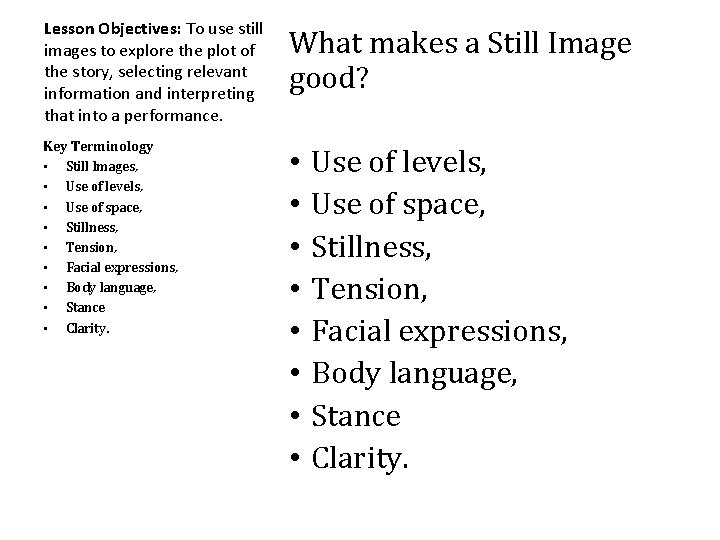
Lesson Objectives: To use still images to explore the plot of the story, selecting relevant information and interpreting that into a performance. What makes a Still Image good? Key Terminology • Still Images, • Use of levels, • Use of space, • Stillness, • Tension, • Facial expressions, • Body language, • Stance • Clarity. • • Use of levels, Use of space, Stillness, Tension, Facial expressions, Body language, Stance Clarity.
Lesson Objectives: To use still images to explore the plot of the story, selecting relevant information and interpreting that into a performance. Key Terminology • Still Images, • Use of levels, • Use of space, • Stillness, • Tension, • Facial expressions, • Body language, • Stance • Clarity. Think before you speak! • Who are the key characters? • What are the key relationships? • What are the key events?
Lesson Objectives: To use still images to explore the plot of the story, selecting relevant information and interpreting that into a performance. Key Terminology • Still Images, • Use of levels, • Use of space, • Stillness, • Tension, • Facial expressions, • Body language, • Stance • Clarity. In drama we use ICER to help us structure our time to make performances Ideas Create Evaluate Rehearse
Lesson Objectives: To use still images to explore the plot of the story, selecting relevant information and interpreting that into a performance. Key Terminology • Still Images, • Use of levels, • Use of space, • Stillness, • Tension, • Facial expressions, • Body language, • Stance • Clarity. Ideas (5 minutes) – You have 5 minutes to sit in your group and plan out how you are going to use Still Images to perform this story. Decide on the who is going to be which character and try to make sure that the same person plays the same character throughout the performance. Create Evaluate Rehearse

Lesson Objectives: To use still images to explore the plot of the story, selecting relevant information and interpreting that into a performance. Key Terminology • Still Images, • Use of levels, • Use of space, • Stillness, • Tension, • Facial expressions, • Body language, • Stance • Clarity. Ideas (5 minutes) Create (10 minutes) – You now have 10 minutes to make a whole performance from beginning to end. Remember it must be clear to the audience what the story is and how that story is being developed from a beginning, a middle and an end. Create a movement sequence between the still images. Evaluate Rehearse
Lesson Objectives: To use still images to explore the plot of the story, selecting relevant information and interpreting that into a performance. Key Terminology • Still Images, • Use of levels, • Use of space, • Stillness, • Tension, • Facial expressions, • Body language, • Stance • Clarity. Ideas (5 minutes) Create (10 minutes) Evaluate (2/3 minutes) Just stop for a minute or two and ask yourself and your group does your performance match what we said a good still image is and incorporates all those key words. Rehearse
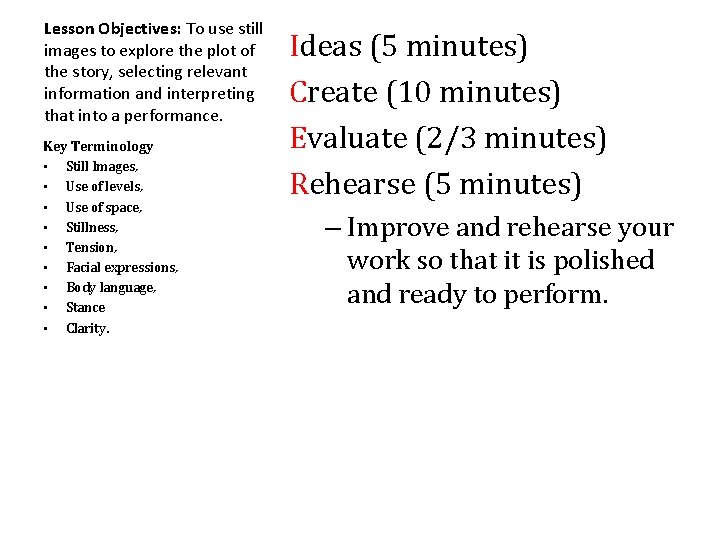
Lesson Objectives: To use still images to explore the plot of the story, selecting relevant information and interpreting that into a performance. Key Terminology • Still Images, • Use of levels, • Use of space, • Stillness, • Tension, • Facial expressions, • Body language, • Stance • Clarity. Ideas (5 minutes) Create (10 minutes) Evaluate (2/3 minutes) Rehearse (5 minutes) – Improve and rehearse your work so that it is polished and ready to perform.
Time to perform

Time to perform
Lesson Objectives: To use still images to explore the plot of the story, selecting relevant information and interpreting that into a performance. Key Terminology • Still Images, • Use of levels, • Use of space, • Stillness, • Tension, • Facial expressions, • Body language, • Stance • Clarity. Drama DIRT Books • Write your name on the front of the book and answer the first set of questions for the first lesson.
Lesson Objectives: To use still images to explore the plot of the story, selecting relevant information and interpreting that into a performance. Key Terminology • Still Images, • Use of levels, • Use of space, • Stillness, • Tension, • Facial expressions, • Body language, • Stance • Clarity. Homework • Watch and answer questions.
- Slides: 14