
Year 8 Biology Knowledge Organiser Organisation Transport Diffusion
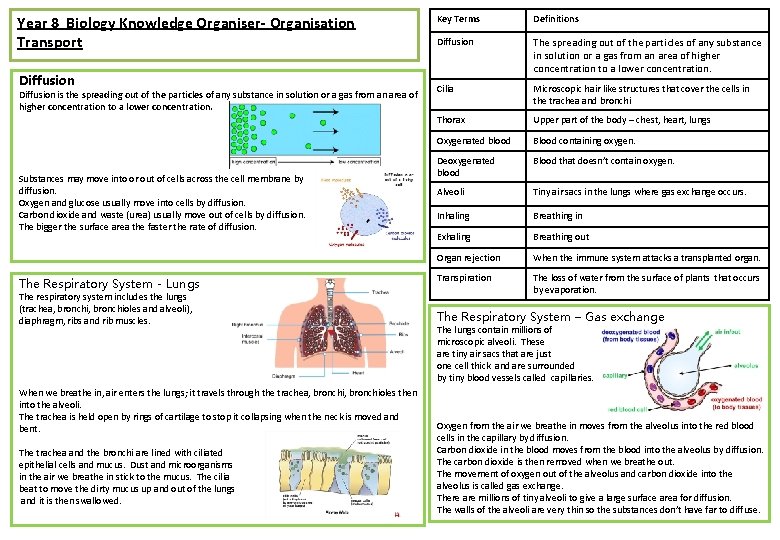
Year 8 Biology Knowledge Organiser- Organisation Transport Diffusion is the spreading out of the particles of any substance in solution or a gas from an area of higher concentration to a lower concentration. Substances may move into or out of cells across the cell membrane by diffusion. Oxygen and glucose usually move into cells by diffusion. Carbon dioxide and waste (urea) usually move out of cells by diffusion. The bigger the surface area the faster the rate of diffusion. The Respiratory System - Lungs The respiratory system includes the lungs (trachea, bronchioles and alveoli), diaphragm, ribs and rib muscles. When we breathe in, air enters the lungs; it travels through the trachea, bronchioles then into the alveoli. The trachea is held open by rings of cartilage to stop it collapsing when the neck is moved and bent. The trachea and the bronchi are lined with ciliated epithelial cells and mucus. Dust and microorganisms in the air we breathe in stick to the mucus. The cilia beat to move the dirty mucus up and out of the lungs and it is then swallowed. Key Terms Definitions Diffusion The spreading out of the particles of any substance in solution or a gas from an area of higher concentration to a lower concentration. Cilia Microscopic hair like structures that cover the cells in the trachea and bronchi Thorax Upper part of the body – chest, heart, lungs Oxygenated blood Blood containing oxygen. Deoxygenated blood Blood that doesn’t contain oxygen. Alveoli Tiny air sacs in the lungs where gas exchange occurs. Inhaling Breathing in Exhaling Breathing out Organ rejection When the immune system attacks a transplanted organ. Transpiration The loss of water from the surface of plants that occurs by evaporation. The Respiratory System – Gas exchange The lungs contain millions of microscopic alveoli. These are tiny air sacs that are just one cell thick and are surrounded by tiny blood vessels called capillaries. Oxygen from the air we breathe in moves from the alveolus into the red blood cells in the capillary by diffusion. Carbon dioxide in the blood moves from the blood into the alveolus by diffusion. The carbon dioxide is then removed when we breathe out. The movement of oxygen out of the alveolus and carbon dioxide into the alveolus is called gas exchange. There are millions of tiny alveoli to give a large surface area for diffusion. The walls of the alveoli are very thin so the substances don’t have far to diffuse.
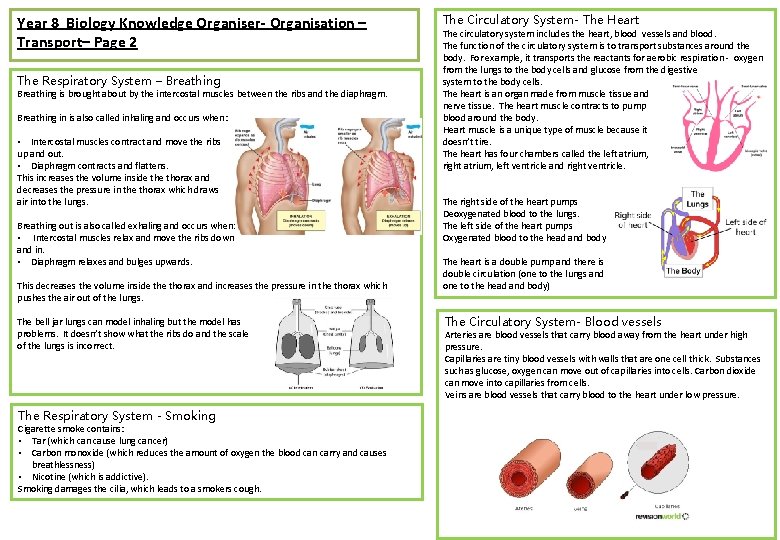
Year 8 Biology Knowledge Organiser- Organisation – Transport– Page 2 The Respiratory System – Breathing is brought about by the intercostal muscles between the ribs and the diaphragm. Breathing in is also called inhaling and occurs when: • Intercostal muscles contract and move the ribs up and out. • Diaphragm contracts and flattens. This increases the volume inside thorax and decreases the pressure in the thorax which draws air into the lungs. Breathing out is also called exhaling and occurs when: • Intercostal muscles relax and move the ribs down and in. • Diaphragm relaxes and bulges upwards. This decreases the volume inside thorax and increases the pressure in the thorax which pushes the air out of the lungs. The bell jar lungs can model inhaling but the model has problems. It doesn’t show what the ribs do and the scale of the lungs is incorrect. The Respiratory System - Smoking Cigarette smoke contains: • Tar (which can cause lung cancer) • Carbon monoxide (which reduces the amount of oxygen the blood can carry and causes breathlessness) • Nicotine (which is addictive). Smoking damages the cilia, which leads to a smokers cough. The Circulatory System- The Heart The circulatory system includes the heart, blood vessels and blood. The function of the circulatory system is to transport substances around the body. For example, it transports the reactants for aerobic respiration - oxygen from the lungs to the body cells and glucose from the digestive system to the body cells. The heart is an organ made from muscle tissue and nerve tissue. The heart muscle contracts to pump blood around the body. Heart muscle is a unique type of muscle because it doesn’t tire. The heart has four chambers called the left atrium, right atrium, left ventricle and right ventricle. The right side of the heart pumps Deoxygenated blood to the lungs. The left side of the heart pumps Oxygenated blood to the head and body The heart is a double pump and there is double circulation (one to the lungs and one to the head and body) The Circulatory System- Blood vessels Arteries are blood vessels that carry blood away from the heart under high pressure. Capillaries are tiny blood vessels with walls that are one cell thick. Substances such as glucose, oxygen can move out of capillaries into cells. Carbon dioxide can move into capillaries from cells. Veins are blood vessels that carry blood to the heart under low pressure.

Year 8 Biology Knowledge Organiser- Organisation – Transport– Page 3 The Circulatory System- Blood Transport in plants – Xylem, Phloem and Transpiration Xylem cells transport water and minerals from the roots to the leaves in an upward direction. Phloem cells transport sugars around the plant from the leaves to the roots and flowers. Blood is made up from red blood cells, white blood cells, platelets floating in a pale yellow liquid called plasma. • • • Red blood cells carry oxygen around the body. White blood cells are part of the immune system and are involved in fighting disease. Platelets are needed for blood clotting. Plasma transports dissolved glucose and carbon dioxide. Transpiration is the loss of water from a plant by evaporation. Although transpiration causes water to be lost, it is essential for moving water up through the plant. The rate of transpiration is affected by the temperature. The Circulatory System- Blood groups and transplants There are 4 different blood groups called O, A, B and AB. If a person loses lots of blood due to an accident or an operation, they might need to have a blood transfusion. The blood that is transfused needs to be compatible. If it is not compatible, the immune system will attack it. Donor A B AB O Recipient A √ x x √ B x √ AB √ √ O x x x √ People with blood group ‘O’ are called universal donors as their blood can be given to all of the other types. People with blood group AB are called the universal recipient because they can receive blood of all types. The heart is an example of an organ that can be transplanted. This might be needed if a heart is damaged (e. g. by disease). The organ that is transplanted needs to be compatible between the donor and the recipient to reduce the chance of the recipient’s body rejecting the organ. Rejection occurs when the recipients’ immune system attacks the organ. Transplanted organs are donated by people who have died (usually after an unexpected accident). Organ transplant lists are often very long and it can be difficult to find a compatible organ donor. Transport in plants – Minerals Plants need minerals from the soil for healthy growth. Nitrates and magnesium are examples of minerals. Nitrates are needed to make proteins. A plant that is deficient in nitrates has stunted growth and yellow leaves. Magnesium is needed for making chlorophyll. Fertilisers can be added to the soil to improve the growth of crops and plants.
- Slides: 3