
Year 8 Art Independent learning project I have
- Slides: 2
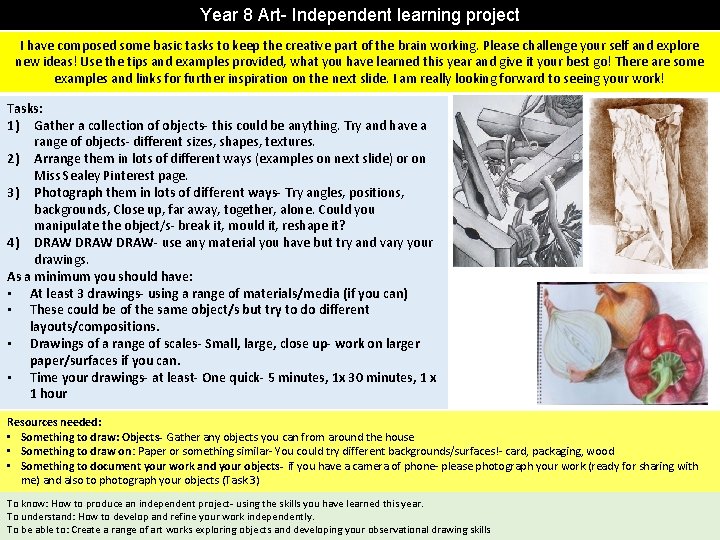
Year 8 Art- Independent learning project I have composed some basic tasks to keep the creative part of the brain working. Please challenge your self and explore new ideas! Use the tips and examples provided, what you have learned this year and give it your best go! There are some examples and links for further inspiration on the next slide. I am really looking forward to seeing your work! Tasks: 1) Gather a collection of objects- this could be anything. Try and have a range of objects- different sizes, shapes, textures. 2) Arrange them in lots of different ways (examples on next slide) or on Miss Sealey Pinterest page. 3) Photograph them in lots of different ways- Try angles, positions, backgrounds, Close up, far away, together, alone. Could you manipulate the object/s- break it, mould it, reshape it? 4) DRAW- use any material you have but try and vary your drawings. As a minimum you should have: • At least 3 drawings- using a range of materials/media (if you can) • These could be of the same object/s but try to do different layouts/compositions. • Drawings of a range of scales- Small, large, close up- work on larger paper/surfaces if you can. • Time your drawings- at least- One quick- 5 minutes, 1 x 30 minutes, 1 x 1 hour Resources needed: • Something to draw: Objects- Gather any objects you can from around the house • Something to draw on: Paper or something similar- You could try different backgrounds/surfaces!- card, packaging, wood • Something to document your work and your objects- if you have a camera of phone- please photograph your work (ready for sharing with me) and also to photograph your objects (Task 3) To know: How to produce an independent project- using the skills you have learned this year. To understand: How to develop and refine your work independently. To be able to: Create a range of art works exploring objects and developing your observational drawing skills
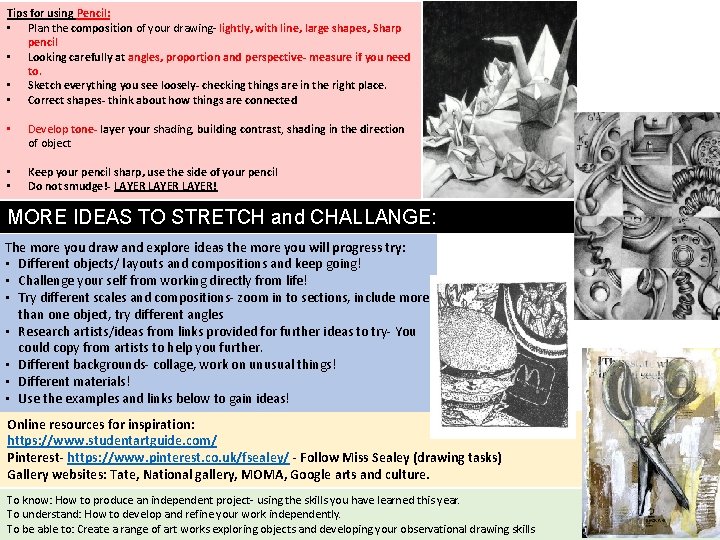
Tips for using Pencil: • Plan the composition of your drawing- lightly, with line, large shapes, Sharp pencil • Looking carefully at angles, proportion and perspective- measure if you need to. • Sketch everything you see loosely- checking things are in the right place. • Correct shapes- think about how things are connected • Develop tone- layer your shading, building contrast, shading in the direction of object • • Keep your pencil sharp, use the side of your pencil Do not smudge!- LAYER! MORE IDEAS TO STRETCH and CHALLANGE: The more you draw and explore ideas the more you will progress try: • Different objects/ layouts and compositions and keep going! • Challenge your self from working directly from life! • Try different scales and compositions- zoom in to sections, include more than one object, try different angles • Research artists/ideas from links provided for further ideas to try- You could copy from artists to help you further. • Different backgrounds- collage, work on unusual things! • Different materials! • Use the examples and links below to gain ideas! Online resources for inspiration: https: //www. studentartguide. com/ Pinterest- https: //www. pinterest. co. uk/fsealey/ - Follow Miss Sealey (drawing tasks) Gallery websites: Tate, National gallery, MOMA, Google arts and culture. To know: How to produce an independent project- using the skills you have learned this year. To understand: How to develop and refine your work independently. To be able to: Create a range of art works exploring objects and developing your observational drawing skills