
Year 8 Art Homework Booklet Term 1 Name
Year 8 Art Homework Booklet Term 1 Name: Teacher: How is your homework marked? Group: 1 Exceeding target level 2 Achieving target level 3 Working towards target level 4 Working below target level

Homework 1 Line Drawing Techniques Task 1 Use a different line technique to fill each of the 10 boxes. Invent your own to fill the last 6 boxes Short dashes hatching Wavy lines dots Task 2 Use these techniques to apply tone to the geometric objectives drawn on the right. Look carefully at where the light source is (darker areas) Teacher Assessment WWW: EBI:
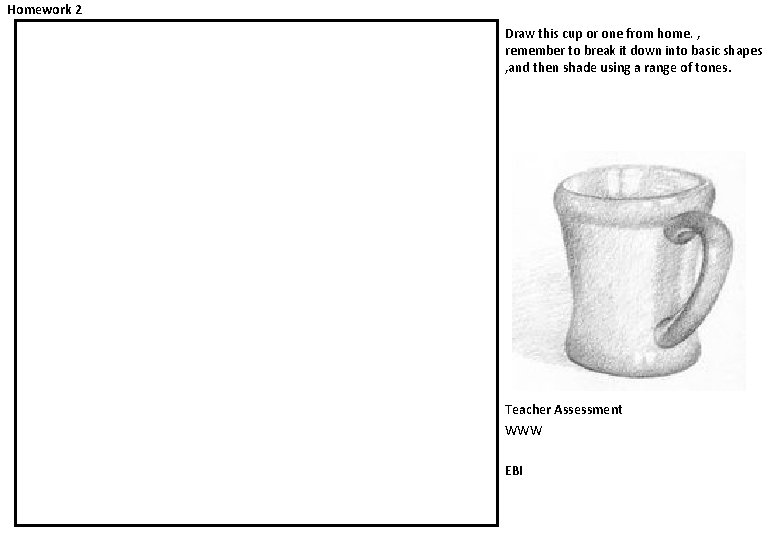
Homework 2 Draw this cup or one from home. , remember to break it down into basic shapes , and then shade using a range of tones. Teacher Assessment WWW EBI
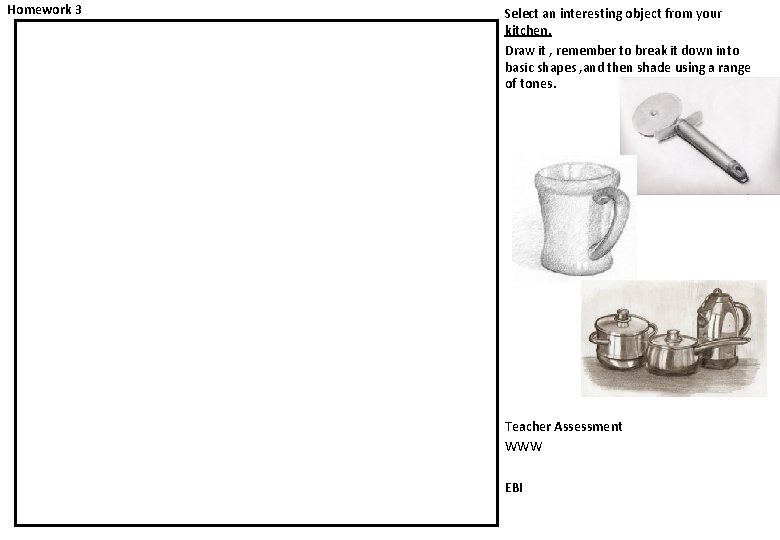
Homework 3 Select an interesting object from your kitchen. Draw it , remember to break it down into basic shapes , and then shade using a range of tones. Teacher Assessment WWW EBI
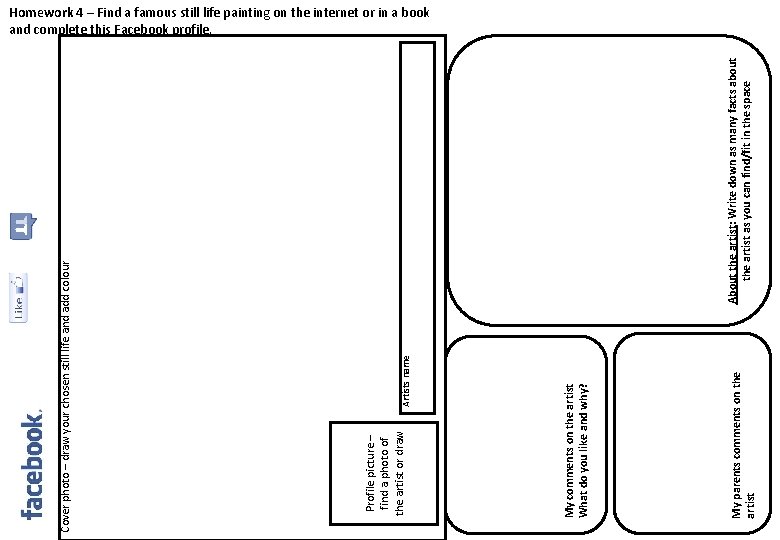
Artists name My parents comments on the artist My comments on the artist What do you like and why? Profile picture – find a photo of the artist or draw About the artist: Write down as many facts about the artist as you can find/fit in the space Cover photo – draw your chosen still life and add colour Homework 4 – Find a famous still life painting on the internet or in a book and complete this Facebook profile.
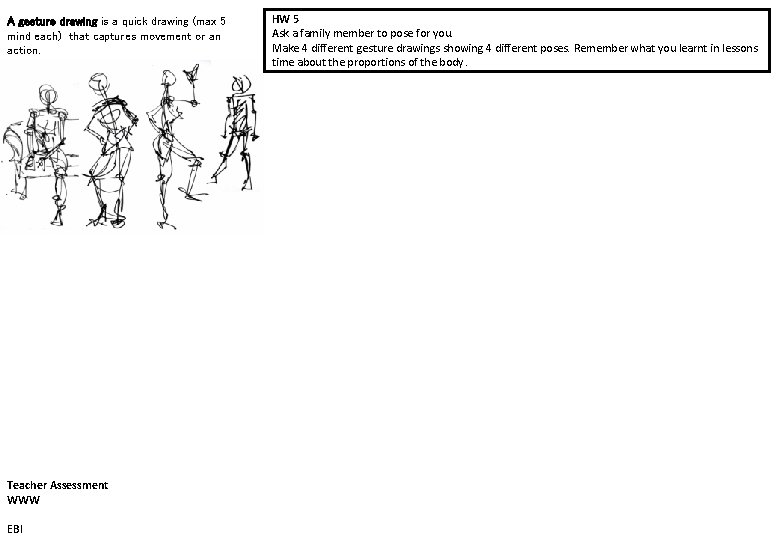
A gesture drawing is a quick drawing (max 5 mind each) that captures movement or an action. Teacher Assessment WWW EBI HW 5 Ask a family member to pose for you. Make 4 different gesture drawings showing 4 different poses. Remember what you learnt in lessons time about the proportions of the body.
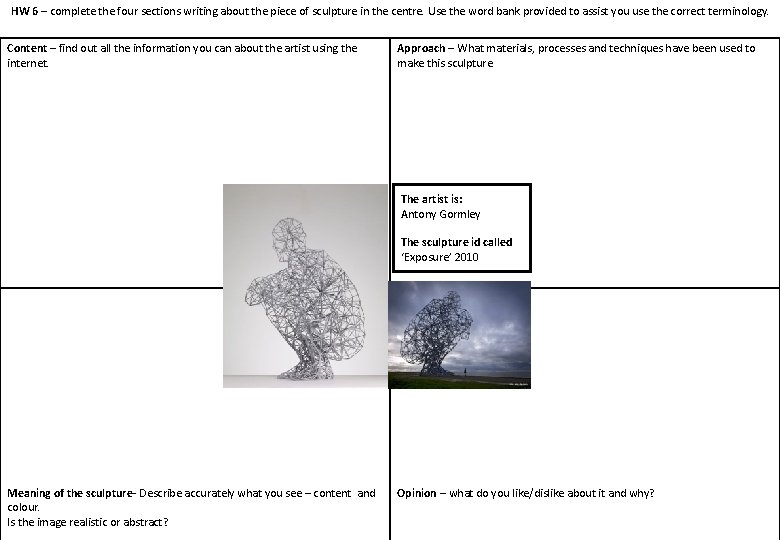
HW 6 – complete the four sections writing about the piece of sculpture in the centre. Use the word bank provided to assist you use the correct terminology. Content – find out all the information you can about the artist using the internet. Approach – What materials, processes and techniques have been used to make this sculpture The artist is: Antony Gormley The sculpture id called ‘Exposure’ 2010 Meaning of the sculpture- Describe accurately what you see – content and colour. Is the image realistic or abstract? Opinion – what do you like/dislike about it and why?
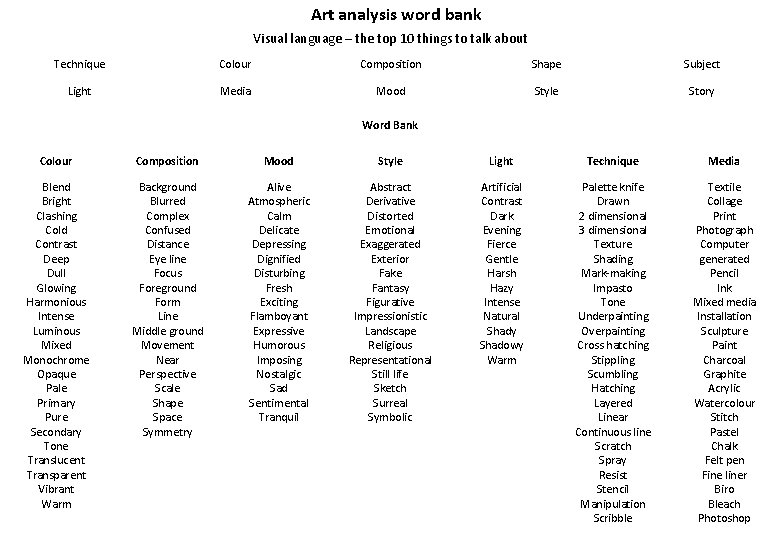
Art analysis word bank Visual language – the top 10 things to talk about Technique Colour Composition Shape Subject Light Media Mood Style Story Word Bank Colour Composition Mood Style Light Technique Media Blend Bright Clashing Cold Contrast Deep Dull Glowing Harmonious Intense Luminous Mixed Monochrome Opaque Pale Primary Pure Secondary Tone Translucent Transparent Vibrant Warm Background Blurred Complex Confused Distance Eye line Focus Foreground Form Line Middle ground Movement Near Perspective Scale Shape Space Symmetry Alive Atmospheric Calm Delicate Depressing Dignified Disturbing Fresh Exciting Flamboyant Expressive Humorous Imposing Nostalgic Sad Sentimental Tranquil Abstract Derivative Distorted Emotional Exaggerated Exterior Fake Fantasy Figurative Impressionistic Landscape Religious Representational Still life Sketch Surreal Symbolic Artificial Contrast Dark Evening Fierce Gentle Harsh Hazy Intense Natural Shady Shadowy Warm Palette knife Drawn 2 dimensional 3 dimensional Texture Shading Mark-making Impasto Tone Underpainting Overpainting Cross hatching Stippling Scumbling Hatching Layered Linear Continuous line Scratch Spray Resist Stencil Manipulation Scribble Textile Collage Print Photograph Computer generated Pencil Ink Mixed media Installation Sculpture Paint Charcoal Graphite Acrylic Watercolour Stitch Pastel Chalk Felt pen Fine liner Biro Bleach Photoshop
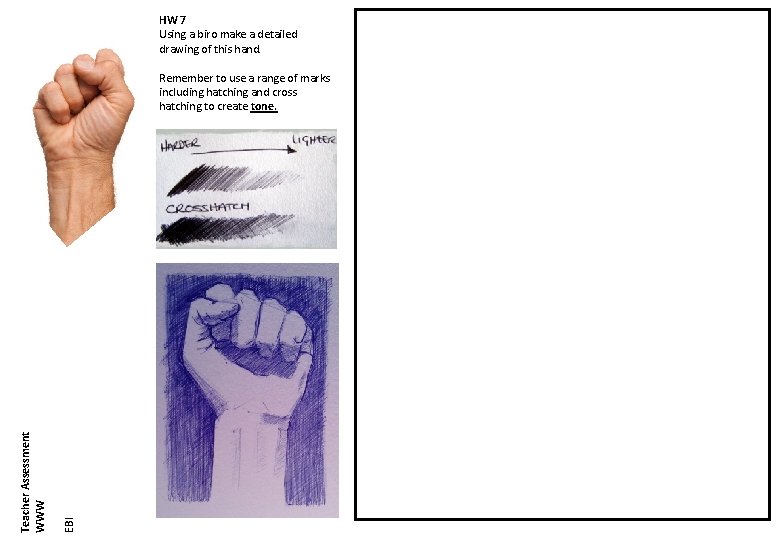
HW 7 Using a biro make a detailed drawing of this hand. EBI Teacher Assessment WWW Remember to use a range of marks including hatching and cross hatching to create tone.
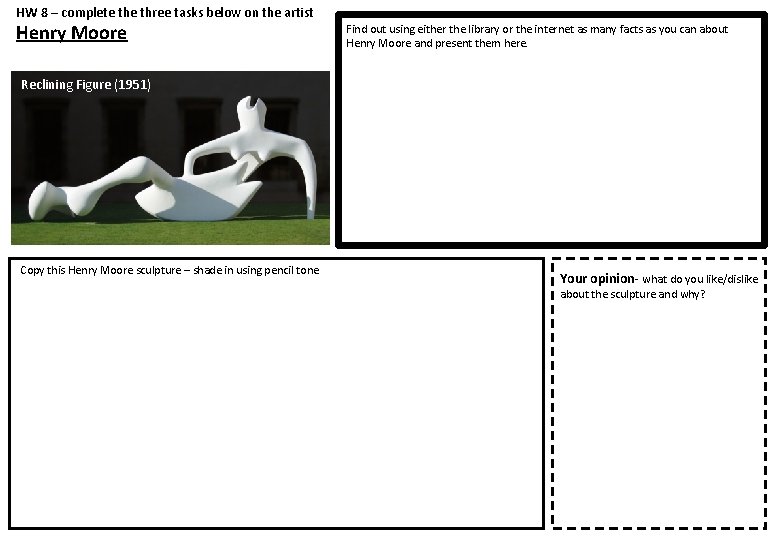
HW 8 – complete three tasks below on the artist Henry Moore Find out using either the library or the internet as many facts as you can about Henry Moore and present them here. Reclining Figure (1951) Copy this Henry Moore sculpture – shade in using pencil tone Your opinion- what do you like/dislike about the sculpture and why?
- Slides: 10