
Year 7 Knowledge Organiser Cells Key words Cell
- Slides: 1
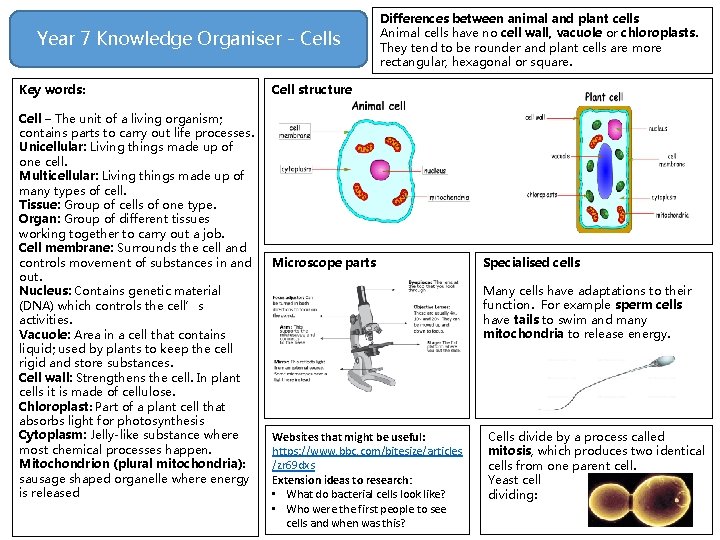
Year 7 Knowledge Organiser - Cells Key words: Cell – The unit of a living organism; contains parts to carry out life processes. Unicellular: Living things made up of one cell. Multicellular: Living things made up of many types of cell. Tissue: Group of cells of one type. Organ: Group of different tissues working together to carry out a job. Cell membrane: Surrounds the cell and controls movement of substances in and out. Nucleus: Contains genetic material (DNA) which controls the cell’s activities. Vacuole: Area in a cell that contains liquid; used by plants to keep the cell rigid and store substances. Cell wall: Strengthens the cell. In plant cells it is made of cellulose. Chloroplast: Part of a plant cell that absorbs light for photosynthesis Cytoplasm: Jelly-like substance where most chemical processes happen. Mitochondrion (plural mitochondria): sausage shaped organelle where energy is released Differences between animal and plant cells Animal cells have no cell wall, vacuole or chloroplasts. They tend to be rounder and plant cells are more rectangular, hexagonal or square. Cell structure Microscope parts Specialised cells Many cells have adaptations to their function. For example sperm cells have tails to swim and many mitochondria to release energy. Websites that might be useful: https: //www. bbc. com/bitesize/articles /zr 69 dxs Extension ideas to research: • What do bacterial cells look like? • Who were the first people to see cells and when was this? Cells divide by a process called mitosis, which produces two identical cells from one parent cell. Yeast cell dividing: