
Year 7 Geography Knowledge Organizer A Geographical Skills






- Slides: 10
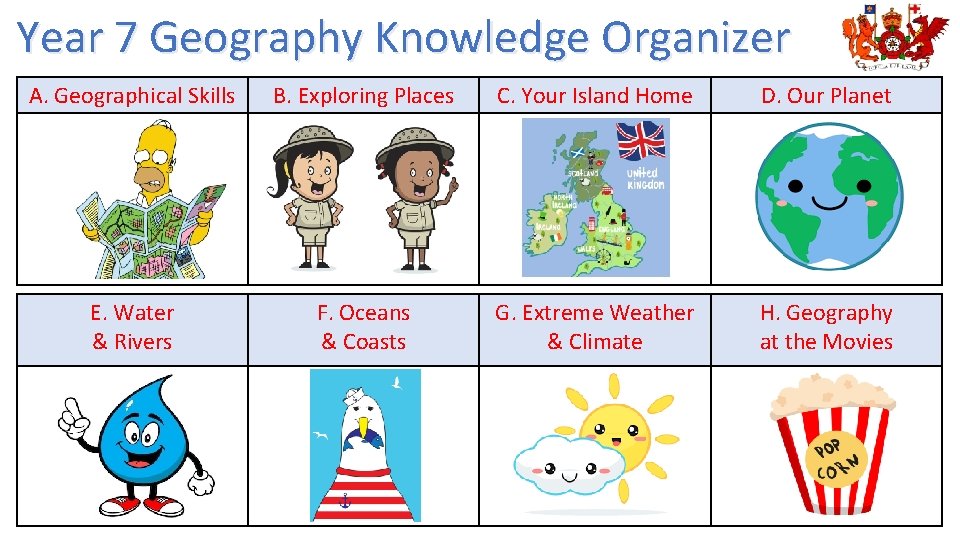
Year 7 Geography Knowledge Organizer A. Geographical Skills B. Exploring Places C. Your Island Home D. Our Planet E. Water & Rivers F. Oceans & Coasts G. Extreme Weather & Climate H. Geography at the Movies
10 different ways you can use your Knowledge organizer: 1. Prepare for a spelling test of key words e. g. environment. Your teacher might misspell them on purpose, so be ready to correct their mistakes! 6. Make your own quiz or challenge for a classmate or your teacher. You could design a crossword using the key terms and use definitions for the clues. 2. Prepare for a quiz at the start of the lessons – the answers are all the key words… Or you have to think of the questions instead! 7. Organise the key words in different ways – try making a spider diagram or a mind map. 3. Sort the key words somehow (into categories such as physical geography or human geography) 8. Your teacher could ask you which words in the knowledge organiser are most relevant to the topic you are studying. 4. Use the key words by including them in an answer to a question you’ve been set by your teacher. 9. Make connections between the key words – you could draw a flow diagram to show different words and ideas are linked. 5. Check you know what the key words mean – talk about what they mean at home, take notes, or make a glossary containing definitions for them. 10. Put a next to key words if you are confident that you know what they mean. Work on the others, and ask your teacher for some help if you need it.
7 A. Geographical Skills What is this topic all about? Key Words You will learn about different places and new map skills, and then carry out an investigation of your own so you can present the information you have collected. Continents Countries Population Cities Mountain range OS Maps Area Atlas Compass Scale Map Symbols Distance Direction Contour lines Grid references Graphs Fact Box Six Figure Grid References • Most geographers say there are 7 different continents - but not everybody agrees! The six figure grid reference for the red square is 943668. Can you work out the blue square? • The largest continent by size is Asia. • ‘Never Eat Shredded Wheat’ is a helpful pneumonic to learn compass points – north, east, south and west. • ‘OS’ maps stands for Ordnance Survey maps. • ‘Along the corridor and up the stairs’ is useful to remember when trying to work out grid references on an OS map.
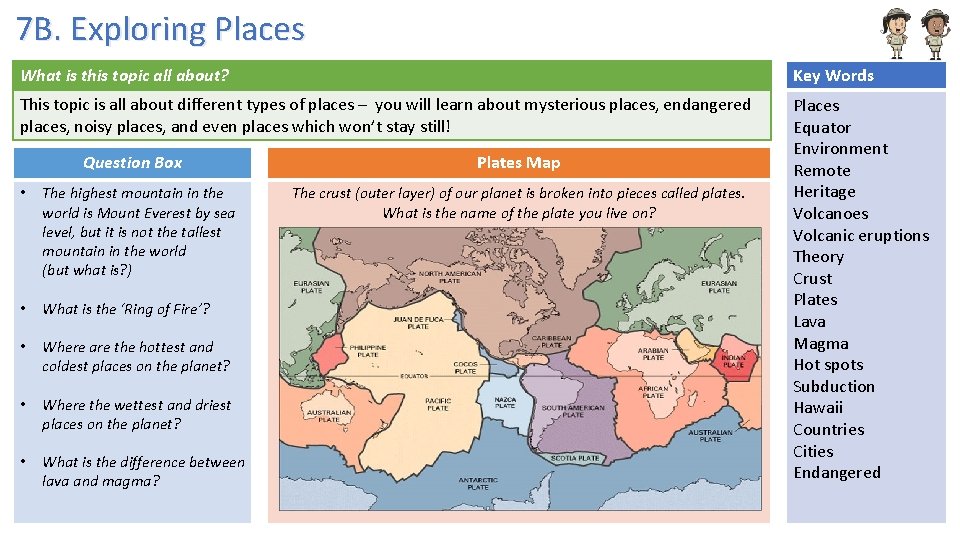
7 B. Exploring Places What is this topic all about? Key Words This topic is all about different types of places – you will learn about mysterious places, endangered places, noisy places, and even places which won’t stay still! Places Equator Environment Remote Heritage Volcanoes Volcanic eruptions Theory Crust Plates Lava Magma Hot spots Subduction Hawaii Countries Cities Endangered Question Box • The highest mountain in the world is Mount Everest by sea level, but it is not the tallest mountain in the world (but what is? ) • What is the ‘Ring of Fire’? • Where are the hottest and coldest places on the planet? • Where the wettest and driest places on the planet? • What is the difference between lava and magma? Plates Map The crust (outer layer) of our planet is broken into pieces called plates. What is the name of the plate you live on?
7 C. Your Island Home What is this topic all about? Key Words This topic is all about the physical and human geography of your island home. You will learn about the different landscapes, geology, understanding the weather, people, and even how our island became an island! Great Britain United Kingdom British Isles Country County City Geological Rock cycle Igneous Sedimentary Metamorphic Convectional, frontal & relief rainfall Isolines Desire line Granite Fault line OS Map symbols Uneven development Flag Challenge: Rock Cycle Which of these two flags is correct? What are three different types of rock shown in the rock cycle below? Can you explain the difference between Great Britain, the United Kingdom, and the British Isles? How are the rock types formed? Find some examples of each.
7 D. Our Planet What is this topic all about? Key Words This topic is all about our planet. You will learn about geological time, the rocks our planet is made from, and the importance of the atmosphere for sustaining life on Earth structure Inner core Outer core Mantle Crust Bacteria Landforms Peninsula Plateau Glacier Canyon Atmosphere Carbon dioxide Geological time Ecosystem Organism Producers Consumers Natural Hazards Layers of the Earth Food Chain Research the different layers of the Earth you can see in the diagram below: What are the differences between ‘producers’ and ‘consumers’ in this food chain? Research: What are the layers like? How are they different to each other? Can you explain what a food chain is? What about a food web?
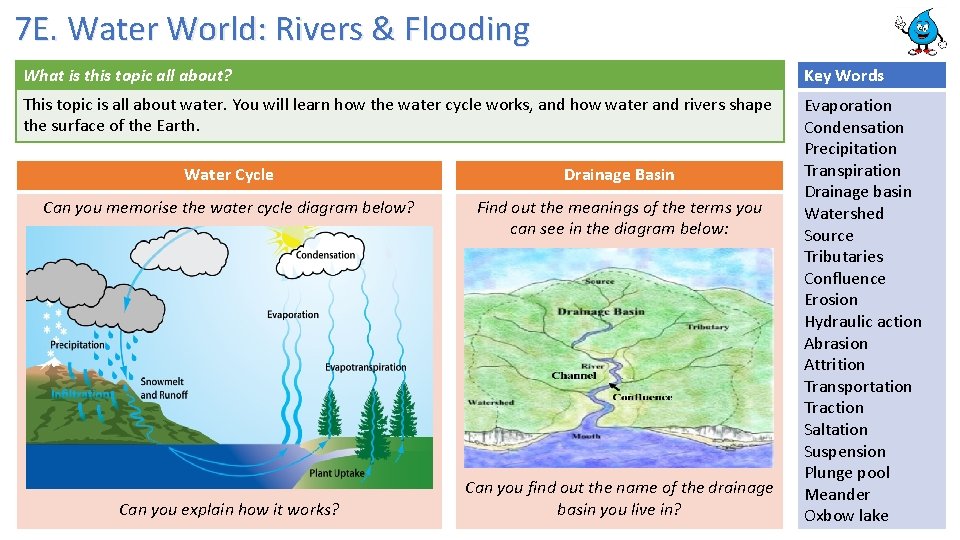
7 E. Water World: Rivers & Flooding What is this topic all about? Key Words This topic is all about water. You will learn how the water cycle works, and how water and rivers shape the surface of the Earth. Evaporation Condensation Precipitation Transpiration Drainage basin Watershed Source Tributaries Confluence Erosion Hydraulic action Abrasion Attrition Transportation Traction Saltation Suspension Plunge pool Meander Oxbow lake Water Cycle Drainage Basin Can you memorise the water cycle diagram below? Find out the meanings of the terms you can see in the diagram below: Can you explain how it works? Can you find out the name of the drainage basin you live in?
7 F. Water World: Oceans & Coasts What is this topic all about? Key Words In this topic you will investigate how the oceans formed, and how ocean currents affect the climate. You will learn about how waves and tides shape our coastline. Pacific Atlantic Mediterranean Gulf Stream Spring tide Neap tide Constructive waves Destructive waves Swash Backwash Fetch Longshore drift Deposition Stacks and stumps Arches Spits Headlands and bays Hard engineering Ocean Currents Can you see the name of the warm ocean current which helps keep temperatures on our island home milder (especially in winter months)?
7 G. Extreme Weather & Climate What is this topic all about? Key Words This topic is about extreme types of weather, including wildfires and tornadoes. You will also learn about the importance of the atmosphere and the impact human activity is having on it. Weather Meteorology Precipitation Temperature Celsius Cloud cover (oktas) Air pressure Low pressure High pressure Millibars Convection cell Climate Greenhouse effect Greenhouse gases Carbon emissions Sea level change Tidal gauge Air Pressure Greenhouse effect Why does low pressure usually mean cloud and rain, whereas high pressure brings clear skies and sunshine? How is the atmosphere a bit like a greenhouse?
7 H. Geography at the Movies What is this topic all about? For this topic you will improve your place knowledge - and you will get to do an investigation of your own. Continent Challenge See if you can memorise every country in a continent of your choice. . . You could start with South America which has few countries. Africa is a real challenge! Practise at home. When you are ready, ask your teacher to test you to earn a commendation or two!