
Year 7 Geography Knowledge Organisers Year 7 Summer

- Slides: 4
Year 7 Geography Knowledge Organisers Year 7 Summer Exam 2019 • United Kingdom • Ecosystems & Tropical Rainforests • China
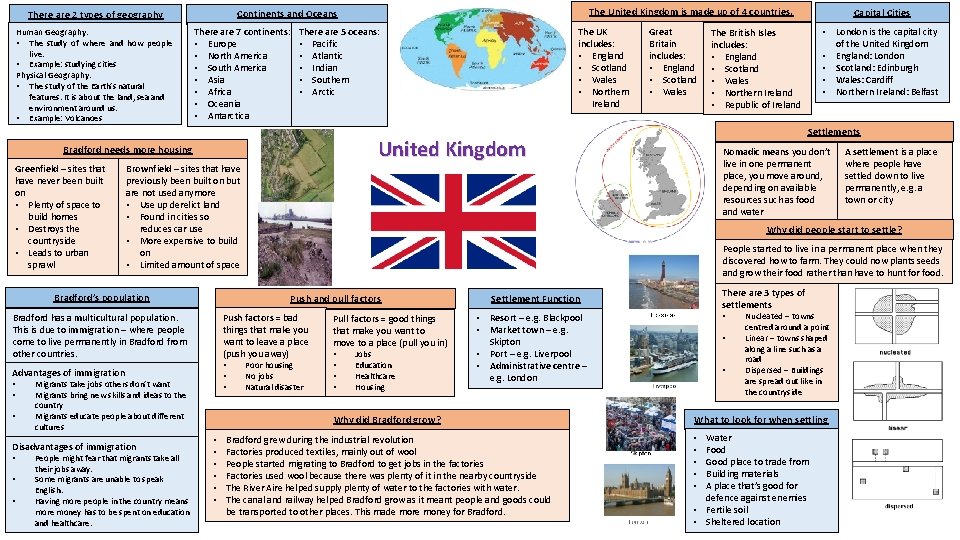
Human Geography: • The study of where and how people live. • Example: studying cities Physical Geography: • The study of the Earth’s natural features. It is about the land, sea and environment around us. • Example: Volcanoes There are 7 continents: • Europe • North America • South America • Asia • Africa • Oceania • Antarctica Advantages of immigration • • • Migrants take jobs others don’t want Migrants bring new skills and ideas to the country Migrants educate people about different cultures Disadvantages of immigration • • • People might fear that migrants take all their jobs away. Some migrants are unable to speak English. Having more people in the country means more money has to be spent on education and healthcare. Settlements Nomadic means you don’t live in one permanent place, you move around, depending on available resources such as food and water Poor housing No jobs Natural disaster Pull factors = good things that make you want to move to a place (pull you in) • • Jobs Education Healthcare Housing There are 3 types of settlements Settlement Function • • Resort – e. g. Blackpool • Market town – e. g. Skipton • Port – e. g. Liverpool • Administrative centre – e. g. London Why did Bradford grow? • • London is the capital city of the United Kingdom • England: London • Scotland: Edinburgh • Wales: Cardiff • Northern Ireland: Belfast The British Isles includes: • England • Scotland • Wales • Northern Ireland • Republic of Ireland A settlement is a place where people have settled down to live permanently, e. g. a town or city People started to live in a permanent place when they discovered how to farm. They could now plants seeds and grow their food rather than have to hunt for food. Push factors = bad things that make you want to leave a place (push you away) • • • Capital Cities Why did people start to settle? Push and pull factors Bradford has a multicultural population. This is due to immigration – where people come to live permanently in Bradford from other countries. Great Britain includes: • England • Scotland • Wales United Kingdom Brownfield – sites that have previously been built on but are not used anymore • Use up derelict land • Found in cities so reduces car use • More expensive to build on • Limited amount of space Bradford’s population The UK includes: • England • Scotland • Wales • Northern Ireland There are 5 oceans: • Pacific • Atlantic • Indian • Southern • Arctic Bradford needs more housing Greenfield – sites that have never been built on • Plenty of space to build homes • Destroys the countryside • Leads to urban sprawl The United Kingdom is made up of 4 countries. Continents and Oceans There are 2 types of geography Bradford grew during the industrial revolution Factories produced textiles, mainly out of wool People started migrating to Bradford to get jobs in the factories Factories used wool because there was plenty of it in the nearby countryside The River Aire helped supply plenty of water to the factories with water. The canal and railway helped Bradford grow as it meant people and goods could be transported to other places. This made more money for Bradford. • • Nucleated – towns centred around a point Linear – towns shaped along a line such as a road Dispersed – Buildings are spread out like in the countryside What to look for when settling Water Food Good place to trade from Building materials A place that’s good for defence against enemies • Fertile soil • Sheltered location • • •
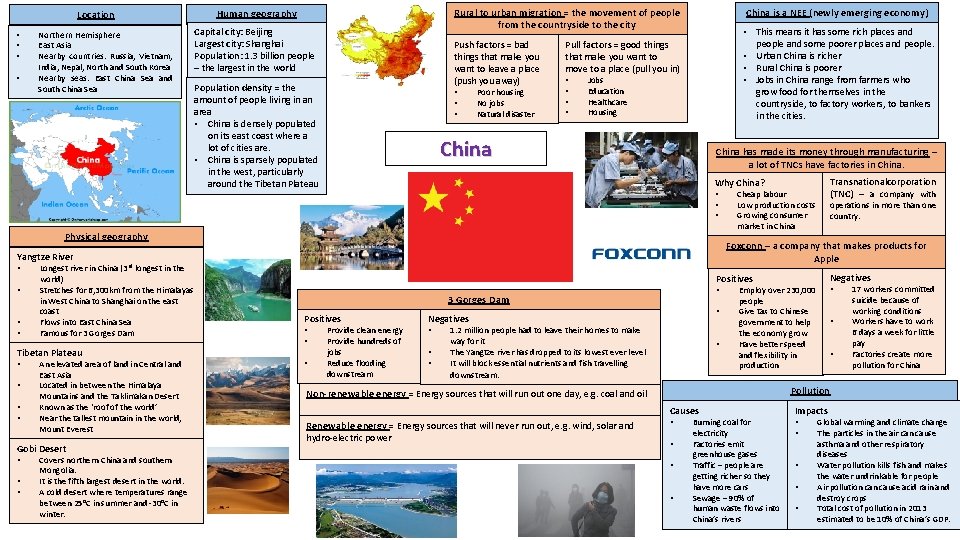
Location • • Northern Hemisphere East Asia Nearby countries: Russia, Vietnam, India, Nepal, North and South Korea Nearby seas: East China Sea and South China Sea China is a NEE (newly emerging economy) Rural to urban migration = the movement of people from the countryside to the city Human geography Capital city: Beijing Largest city: Shanghai Population: 1. 3 billion people – the largest in the world Push factors = bad things that make you want to leave a place (push you away) Population density = the amount of people living in an area • China is densely populated on its east coast where a lot of cities are. • China is sparsely populated in the west, particularly around the Tibetan Plateau • • • Poor housing No jobs Natural disaster • This means it has some rich places and people and some poorer places and people. • Urban China is richer • Rural China is poorer • Jobs in China range from farmers who grow food for themselves in the countryside, to factory workers, to bankers in the cities. Pull factors = good things that make you want to move to a place (pull you in) • • Jobs Education Healthcare Housing China has made its money through manufacturing – a lot of TNCs have factories in China. • • • Physical geography • • • Longest river in China (3 rd longest in the world) Stretches for 6, 300 km from the Himalayas in West China to Shanghai on the east coast Flows into East China Sea Famous for 3 Gorges Dam Tibetan Plateau • • An elevated area of land in Central and East Asia Located in between the Himalaya Mountains and the Taklimakan Desert Known as the ‘roof of the world’ Near the tallest mountain in the world, Mount Everest Gobi Desert • • • Covers northern China and southern Mongolia. It is the fifth largest desert in the world. A cold desert where temperatures range between 25 o. C in summer and -30 o. C in winter. Cheap labour Low production costs Growing consumer market in China operations in more than one country. Foxconn – a company that makes products for Apple Yangtze River • Transnationalcorporation (TNC) – a company with Why China? Negatives Positives • 3 Gorges Dam Positives Negatives • • • Provide clean energy Provide hundreds of jobs Reduce flooding downstream • • 1. 2 million people had to leave their homes to make way for it The Yangtze river has dropped to its lowest ever level It will block essential nutrients and fish travelling downstream. • • • 17 workers committed suicide because of working conditions Workers have to work 6 days a week for little pay Factories create more pollution for China Pollution Non-renewable energy = Energy sources that will run out one day, e. g. coal and oil Causes Renewable energy = Energy sources that will never run out, e. g. wind, solar and hydro-electric power • Employ over 230, 000 people Give tax to Chinese government to help the economy grow Have better speed and flexibility in production • • Burning coal for electricity Factories emit greenhouse gases Traffic – people are getting richer so they have more cars Sewage – 90% of human waste flows into China’s rivers Impacts • • • Global warming and climate change The particles in the air can cause asthma and other respiratory diseases Water pollution kills fish and makes the water undrinkable for people Air pollution cause acid rain and destroy crops Total cost of pollution in 2013 estimated to be 10% of China’s GDP.
Keywords. Abiotic - Relating to non-living things. Biotic - Relating to living things. Consumer - Creature that eats herbivores and/or plant matter. Decomposer - An organism such as a bacterium or fungus, that breaks down dead tissue, which is then recycled to the environment. Nutrient cycling - A set of processes whereby organisms extract minerals necessary for growth from soil or water, before passing them on through the food chain - and ultimately back to the soil and water. Global ecosystem - Very large ecological areas on the earth’s surface (or biomes), with fauna and flora (animals and plants) adapting to their environment. Producer - An organism or plant that is able to absorb energy from the sun through photosynthesis. Biodiversity - The variety of life in the world or a particular habitat. Commercial farming - Farming to sell produce for a profit to retailers or food processing companies. Debt reduction - Countries are relieved of some of their debt in return for protecting their rainforests. Deforestation - The chopping down and removal of trees to clear an area of forest. Ecotourism - Responsible travel to natural areas that conserves the environment, sustains the wellbeing of the local people, and may involve education. It is usually carried out in small groups and has minimal impact on the local ecosystem. Sustainability - Actions and forms of progress that meet the needs of the present without reducing the ability of future generations to meet their needs. Location of Tropical Rainforests. These lie along the Equator in Asia, Africa and South America. Characteristics of the Tropical Rainforest. Climate: High rainfall and high temperatures throughout the year. No definite seasons. Vegetation: Dense vegetation cover. Evergreen due to the continual growing season. Many trees are very tall. Soil: Isn’t very fertile as heavy washes nutrients away. Animals: Rainforests have more species than any other ecosystem. People: Home to many people, who have adapted to life over many generations. Food Chains and Webs. A food chain shows the connections between different organisms (plants and animals) they rely on one another as their source of food. A food web is a complex hierarchy of plants and animals relying on each other food. Adaptation. Plants have adapted to cope with high rainfall, high temperatures, and competition for light. Animals have adapted in different ways so that they can find food and escape predators. Ecosystems & TRF Deforestation Case Study – Malaysia. The rate of deforestation in Malaysia is increasing faster than any tropical country in the world. Causes: - Logging – Malaysia became the world’s largest exporter of tropical wood in the 1980 s. - Energy development – Bakun Dam generates electricity, the reservoir flooded 700 km 2 of forests and farmland. Impacts of Deforestation in Malaysia. Soil Erosion – without tree roots binding the soil together wind and rain easily erodes the soil. Loss of Biodiversity – Destroying the ecosystem and the many habitats that exist on the ground and in the trees. Climate Change – During photosynthesis, trees absorb CO 2 and emit oxygen. By absorbing CO 2 trees store the carbon and reduce the rate of global warming. Deforestation reduces moisture in the air resulting in a drier climate. Economic Development – Deforestation is mainly driven by profit. However deforestation may result in short-term gains it may also lead to long term losses: Economic Gains Development will lead to an increase in jobs. Companies will pay taxes to the government. Improved transport. Minerals such as gold are very valuable. Economic Losses Pollution of water results in water shortage. Fires can break out and destroy vast areas of forest. Rising temperatures could devastate farming.