
Year 7 French Summer Term revision booklet Name
Year 7 French Summer Term revision booklet Name: _______ Class: _______
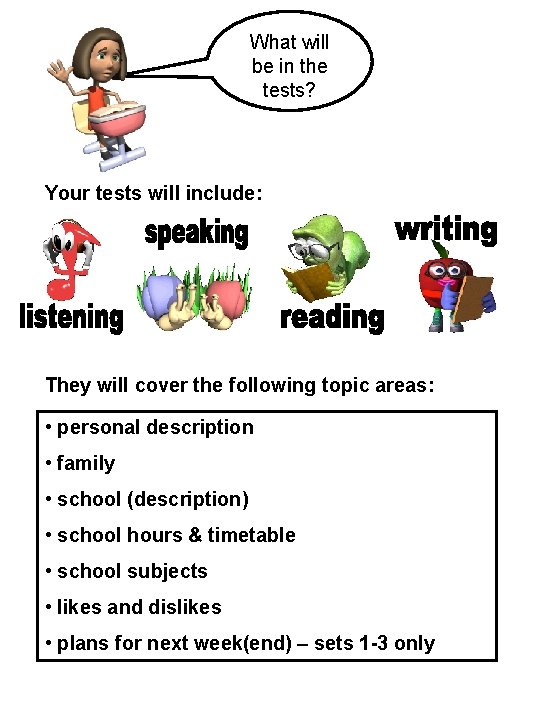
What will be in the tests? Your tests will include: They will cover the following topic areas: • personal description • family • school (description) • school hours & timetable • school subjects • likes and dislikes • plans for next week(end) – sets 1 -3 only
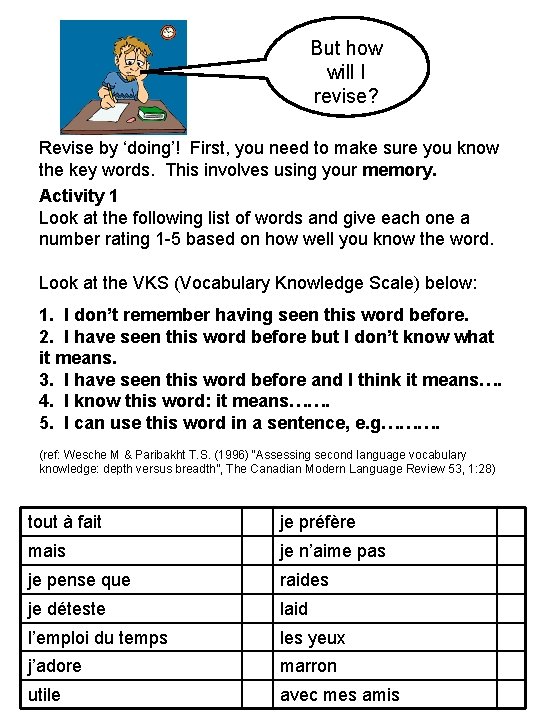
But how will I revise? Revise by ‘doing’! First, you need to make sure you know the key words. This involves using your memory. Activity 1 Look at the following list of words and give each one a number rating 1 -5 based on how well you know the word. Look at the VKS (Vocabulary Knowledge Scale) below: 1. I don’t remember having seen this word before. 2. I have seen this word before but I don’t know what it means. 3. I have seen this word before and I think it means…. 4. I know this word: it means……. 5. I can use this word in a sentence, e. g………. (ref: Wesche M & Paribakht T. S. (1996) “Assessing second language vocabulary knowledge: depth versus breadth”, The Canadian Modern Language Review 53, 1: 28) tout à fait je préfère mais je n’aime pas je pense que raides je déteste laid l’emploi du temps les yeux j’adore marron utile avec mes amis
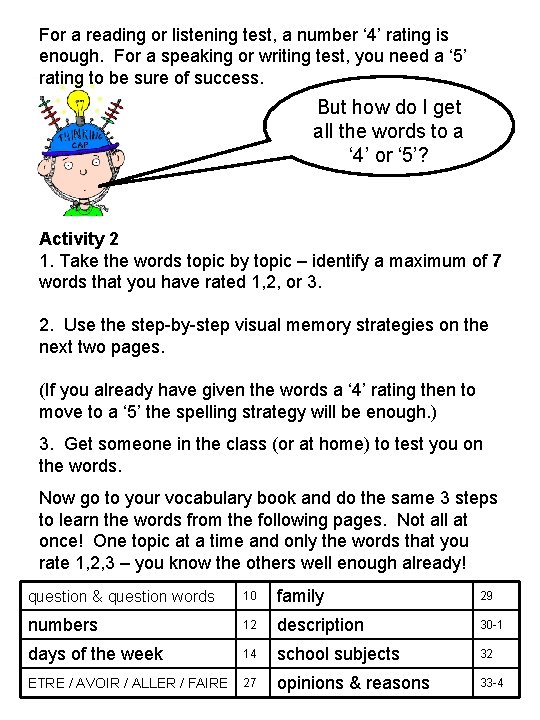
For a reading or listening test, a number ‘ 4’ rating is enough. For a speaking or writing test, you need a ‘ 5’ rating to be sure of success. But how do I get all the words to a ‘ 4’ or ‘ 5’? Activity 2 1. Take the words topic by topic – identify a maximum of 7 words that you have rated 1, 2, or 3. 2. Use the step-by-step visual memory strategies on the next two pages. (If you already have given the words a ‘ 4’ rating then to move to a ‘ 5’ the spelling strategy will be enough. ) 3. Get someone in the class (or at home) to test you on the words. Now go to your vocabulary book and do the same 3 steps to learn the words from the following pages. Not all at once! One topic at a time and only the words that you rate 1, 2, 3 – you know the others well enough already! question & question words 10 family 29 numbers 12 description 30 -1 days of the week 14 school subjects 32 ETRE / AVOIR / ALLER / FAIRE 27 opinions & reasons 33 -4
Brain researchers have shown many times that the power of memory is multiplied many times if we connect an association to the picture asking What does this sound like/remind me of? An association is simply something that is connected to and reminds us of something else. Author David Sousa says, “Whenever two events, actions or feelings are learned together they are said to be associated or bonded, so that the recall of one prompts the spontaneous recall of the other. The word Romeo elicits Juliet, Batman gets Robin. ” Word-Picture association 1. Choose a word, look at it and say it out loud. 2. What does the sound of the word remind you of? (at this stage don’t think of the real meaning of the word, only what the sound of the word makes you think of) 3 Now think of the actual meaning of your new word. Create a picture (looking up and to the side) in your mind of your association and the real meaning of the word – make the mental image as humorous and detailed as you can and hold the picture in your mind. 4 Now draw the picture – use as much colour as you can as this also enhances memory! 5 Now write the word under the picture you have drawn. 6 In another colour write the English meaning of the word in the top corner (right or left depending on where your visual memory is) of the card. 7 Hold your card up above eye level in your own visual memory position and say the word and the English meaning several times. 8 Now you are going to be tested on this vocabulary – sit as if you are successful! 9 As you are recalling each word, use your visual memory – look upward and to the right/left.
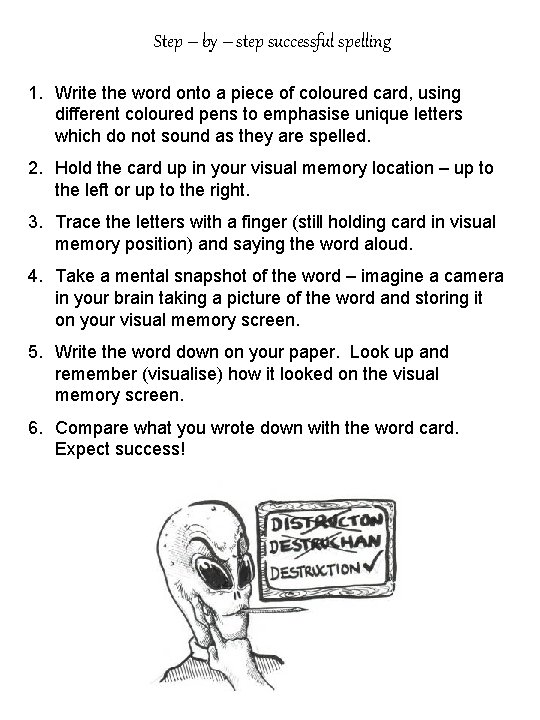
Step – by – step successful spelling 1. Write the word onto a piece of coloured card, using different coloured pens to emphasise unique letters which do not sound as they are spelled. 2. Hold the card up in your visual memory location – up to the left or up to the right. 3. Trace the letters with a finger (still holding card in visual memory position) and saying the word aloud. 4. Take a mental snapshot of the word – imagine a camera in your brain taking a picture of the word and storing it on your visual memory screen. 5. Write the word down on your paper. Look up and remember (visualise) how it looked on the visual memory screen. 6. Compare what you wrote down with the word card. Expect success!
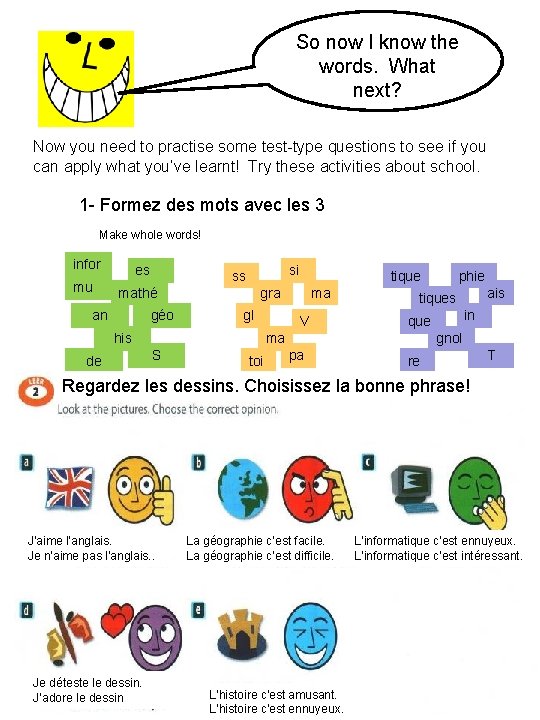
So now I know the words. What next? Now you need to practise some test-type questions to see if you can apply what you’ve learnt! Try these activities about school. 1 - Formez des mots avec les 3 parties! Make whole words! infor mu es si ss mathé an géo gra gl his de tique ma V toi ais tiques in que ma S phie gnol pa re T Regardez les dessins. Choisissez la bonne phrase! J’aime l’anglais. Je n’aime pas l’anglais. . Je déteste le dessin. J’adore le dessin La géographie c’est facile. La géographie c’est difficile. L’histoire c’est amusant. L’histoire c’est ennuyeux. L’informatique c’est ennuyeux. L’informatique c’est intéressant.
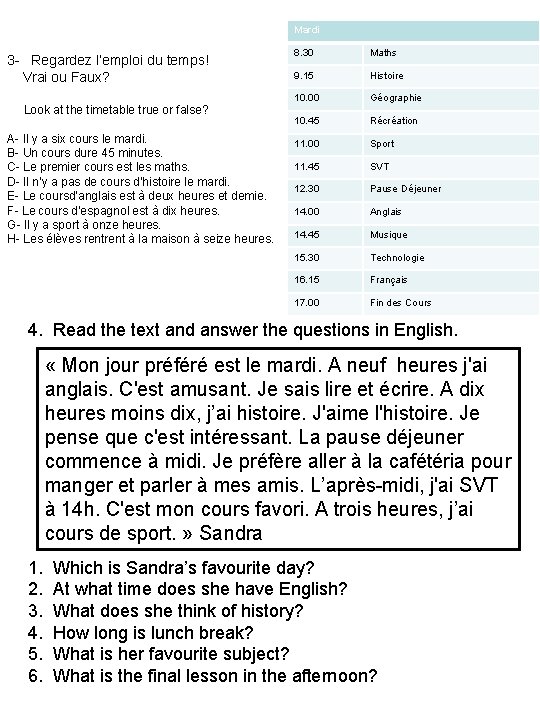
Mardi 3 - Regardez l’emploi du temps! Vrai ou Faux? Look at the timetable true or false? A- Il y a six cours le mardi. B- Un cours dure 45 minutes. C- Le premier cours est les maths. D- Il n’y a pas de cours d’histoire le mardi. E- Le coursd’anglais est à deux heures et demie. F- Le cours d’espagnol est à dix heures. G- Il y a sport à onze heures. H- Les élèves rent à la maison à seize heures. 8. 30 Maths 9. 15 Histoire 10. 00 Géographie 10. 45 Récréation 11. 00 Sport 11. 45 SVT 12. 30 Pause Déjeuner 14. 00 Anglais 14. 45 Musique 15. 30 Technologie 16. 15 Français 17. 00 Fin des Cours 4. Read the text and answer the questions in English. « Mon jour préféré est le mardi. A neuf heures j'ai anglais. C'est amusant. Je sais lire et écrire. A dix heures moins dix, j’ai histoire. J'aime l'histoire. Je pense que c'est intéressant. La pause déjeuner commence à midi. Je préfère aller à la cafétéria pour manger et parler à mes amis. L’après-midi, j'ai SVT à 14 h. C'est mon cours favori. A trois heures, j’ai cours de sport. » Sandra 1. Which is Sandra’s favourite day? 2. At what time does she have English? 3. What does she think of history? 4. How long is lunch break? 5. What is her favourite subject? 6. What is the final lesson in the afternoon?
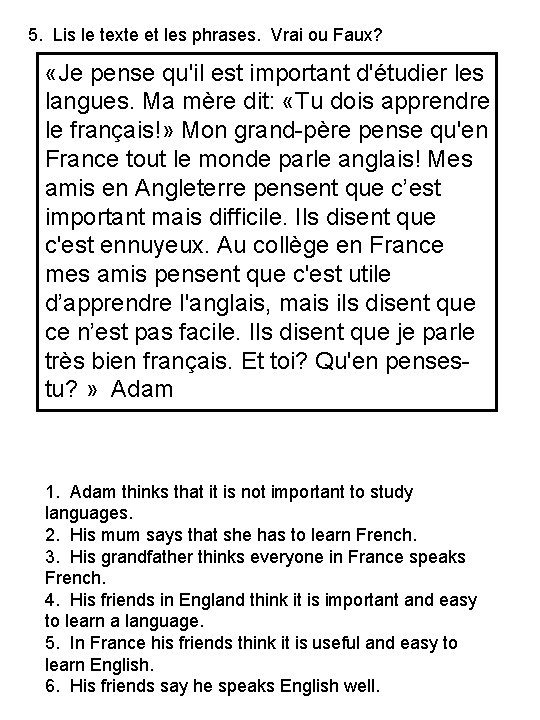
5. Lis le texte et les phrases. Vrai ou Faux? «Je pense qu'il est important d'étudier les langues. Ma mère dit: «Tu dois apprendre le français!» Mon grand-père pense qu'en France tout le monde parle anglais! Mes amis en Angleterre pensent que c’est important mais difficile. Ils disent que c'est ennuyeux. Au collège en France mes amis pensent que c'est utile d’apprendre l'anglais, mais ils disent que ce n’est pas facile. Ils disent que je parle très bien français. Et toi? Qu'en pensestu? » Adam 1. Adam thinks that it is not important to study languages. 2. His mum says that she has to learn French. 3. His grandfather thinks everyone in France speaks French. 4. His friends in England think it is important and easy to learn a language. 5. In France his friends think it is useful and easy to learn English. 6. His friends say he speaks English well.
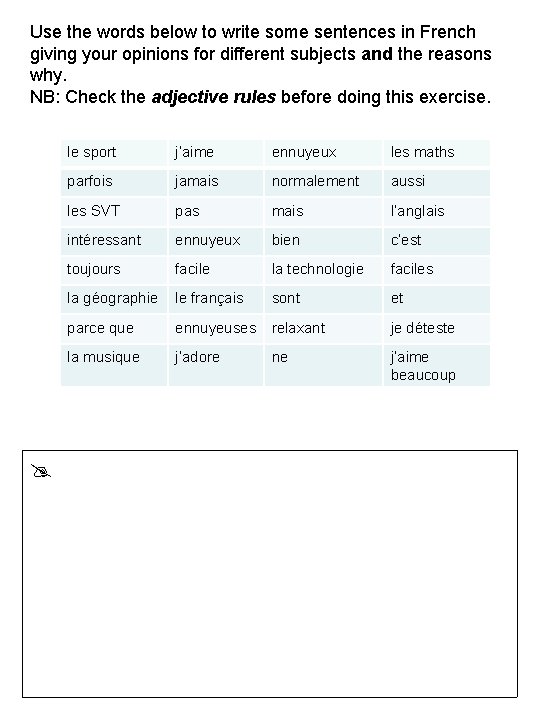
Use the words below to write some sentences in French giving your opinions for different subjects and the reasons why. NB: Check the adjective rules before doing this exercise. le sport j’aime ennuyeux les maths parfois jamais normalement aussi les SVT pas mais l’anglais intéressant ennuyeux bien c’est toujours facile la technologie faciles la géographie le français sont et parce que ennuyeuses relaxant je déteste la musique j’adore ne j’aime beaucoup
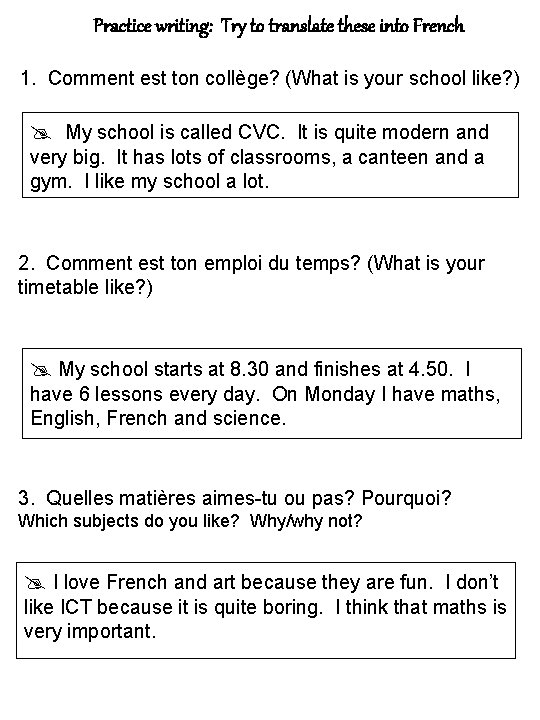
Practice writing: Try to translate these into French 1. Comment est ton collège? (What is your school like? ) My school is called CVC. It is quite modern and very big. It has lots of classrooms, a canteen and a gym. I like my school a lot. 2. Comment est ton emploi du temps? (What is your timetable like? ) My school starts at 8. 30 and finishes at 4. 50. I have 6 lessons every day. On Monday I have maths, English, French and science. 3. Quelles matières aimes-tu ou pas? Pourquoi? Which subjects do you like? Why/why not? I love French and art because they are fun. I don’t like ICT because it is quite boring. I think that maths is very important.
1. Comment est ton collège? (What is your school like? ) 2. Comment est ton emploi du temps? (What is your timetable like? ) 3. Quelles matières aimes-tu ou pas? Pourquoi? Which subjects do you like? Why/why not?
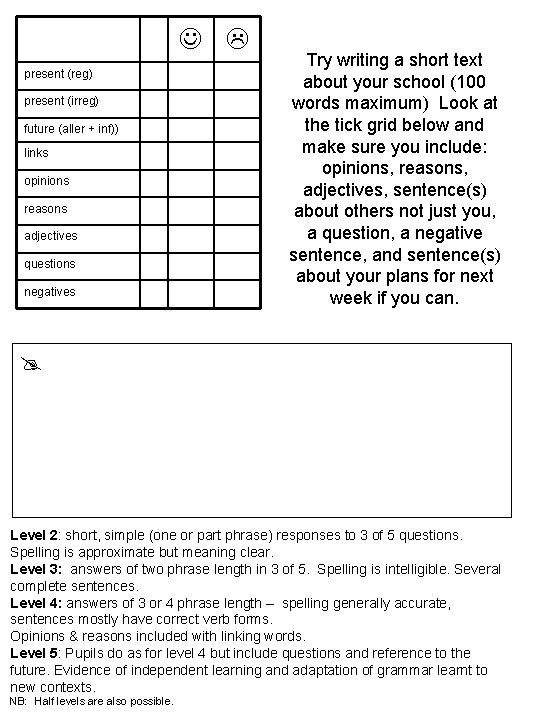
present (reg) present (irreg) future (aller + inf)) links opinions reasons adjectives questions negatives Try writing a short text about your school (100 words maximum) Look at the tick grid below and make sure you include: opinions, reasons, adjectives, sentence(s) about others not just you, a question, a negative sentence, and sentence(s) about your plans for next week if you can. Level 2: short, simple (one or part phrase) responses to 3 of 5 questions. Spelling is approximate but meaning clear. Level 3: answers of two phrase length in 3 of 5. Spelling is intelligible. Several complete sentences. Level 4: answers of 3 or 4 phrase length – spelling generally accurate, sentences mostly have correct verb forms. Opinions & reasons included with linking words. Level 5: Pupils do as for level 4 but include questions and reference to the future. Evidence of independent learning and adaptation of grammar learnt to new contexts. NB: Half levels are also possible.
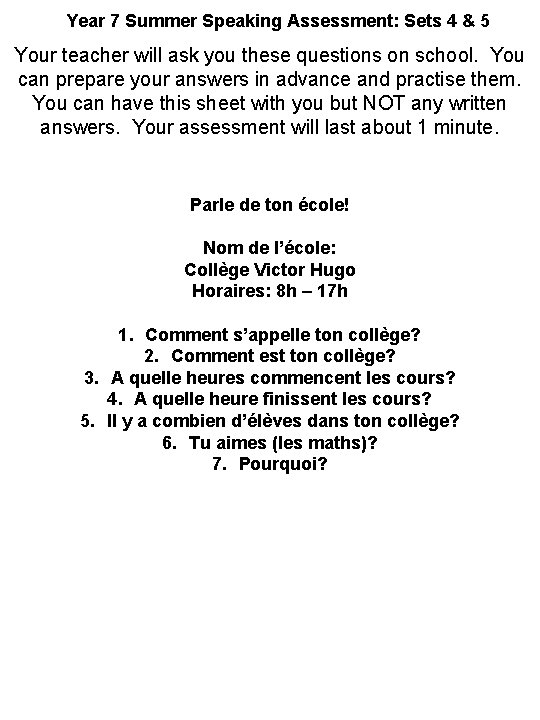
Year 7 Summer Speaking Assessment: Sets 4 & 5 Your teacher will ask you these questions on school. You can prepare your answers in advance and practise them. You can have this sheet with you but NOT any written answers. Your assessment will last about 1 minute. Parle de ton école! Nom de l’école: Collège Victor Hugo Horaires: 8 h – 17 h 1. Comment s’appelle ton collège? 2. Comment est ton collège? 3. A quelle heures commencent les cours? 4. A quelle heure finissent les cours? 5. Il y a combien d’élèves dans ton collège? 6. Tu aimes (les maths)? 7. Pourquoi?
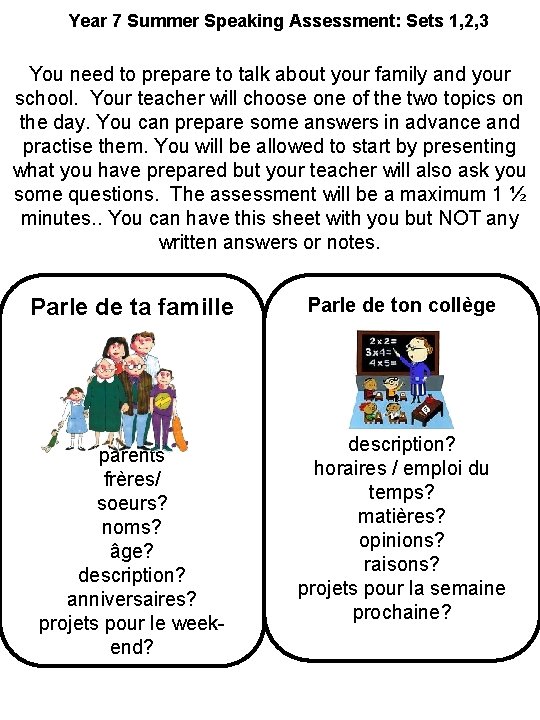
Year 7 Summer Speaking Assessment: Sets 1, 2, 3 You need to prepare to talk about your family and your school. Your teacher will choose one of the two topics on the day. You can prepare some answers in advance and practise them. You will be allowed to start by presenting what you have prepared but your teacher will also ask you some questions. The assessment will be a maximum 1 ½ minutes. . You can have this sheet with you but NOT any written answers or notes. Parle de ta famille parents frères/ soeurs? noms? âge? description? anniversaires? projets pour le weekend? Parle de ton collège description? horaires / emploi du temps? matières? opinions? raisons? projets pour la semaine prochaine?
Remember to keep active when you revise! ‘REVISE BY DOING’
- Slides: 16