
Year 7 Chemistry Knowledge Organiser Topic 3 Particles
- Slides: 2
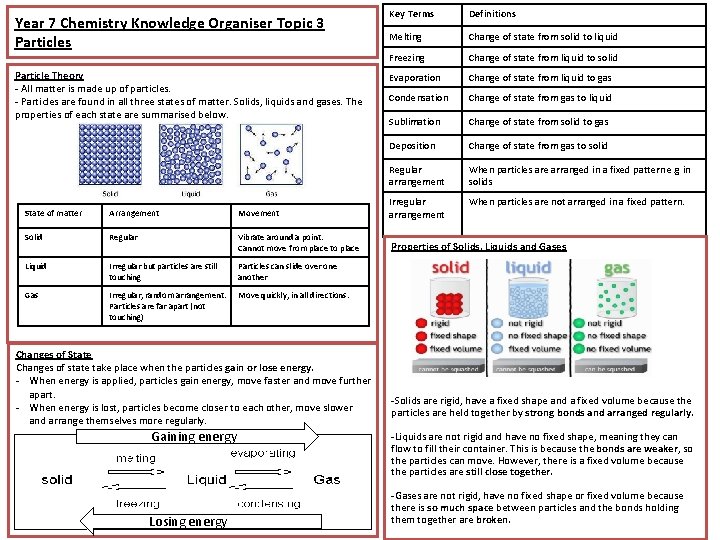
Year 7 Chemistry Knowledge Organiser Topic 3 Particles Particle Theory - All matter is made up of particles. - Particles are found in all three states of matter. Solids, liquids and gases. The properties of each state are summarised below. Key Terms Definitions Melting Change of state from solid to liquid Freezing Change of state from liquid to solid Evaporation Change of state from liquid to gas Condensation Change of state from gas to liquid Sublimation Change of state from solid to gas Deposition Change of state from gas to solid Regular arrangement When particles are arranged in a fixed pattern e. g in solids When particles are not arranged in a fixed pattern. State of matter Arrangement Movement Irregular arrangement Solid Regular Vibrate around a point. Cannot move from place to place Properties of Solids, Liquids and Gases Liquid Irregular but particles are still touching Particles can slide over one another Gas Irregular, random arrangement. Particles are far apart (not touching) Move quickly, in all directions. Changes of State Changes of state take place when the particles gain or lose energy. - When energy is applied, particles gain energy, move faster and move further apart. - When energy is lost, particles become closer to each other, move slower and arrange themselves more regularly. Gaining energy Losing energy -Solids are rigid, have a fixed shape and a fixed volume because the particles are held together by strong bonds and arranged regularly. -Liquids are not rigid and have no fixed shape, meaning they can flow to fill their container. This is because the bonds are weaker, so the particles can move. However, there is a fixed volume because the particles are still close together. -Gases are not rigid, have no fixed shape or fixed volume because there is so much space between particles and the bonds holding them together are broken.
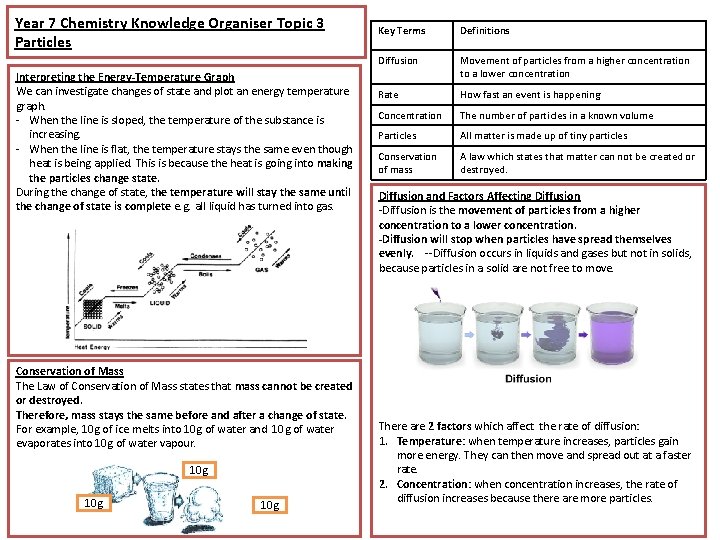
Year 7 Chemistry Knowledge Organiser Topic 3 Particles Interpreting the Energy-Temperature Graph We can investigate changes of state and plot an energy temperature graph. - When the line is sloped, the temperature of the substance is increasing. - When the line is flat, the temperature stays the same even though heat is being applied. This is because the heat is going into making the particles change state. During the change of state, the temperature will stay the same until the change of state is complete e. g. all liquid has turned into gas. Conservation of Mass The Law of Conservation of Mass states that mass cannot be created or destroyed. Therefore, mass stays the same before and after a change of state. For example, 10 g of ice melts into 10 g of water and 10 g of water evaporates into 10 g of water vapour. 10 g 10 g Key Terms Definitions Diffusion Movement of particles from a higher concentration to a lower concentration Rate How fast an event is happening Concentration The number of particles in a known volume Particles All matter is made up of tiny particles Conservation of mass A law which states that matter can not be created or destroyed. Diffusion and Factors Affecting Diffusion -Diffusion is the movement of particles from a higher concentration to a lower concentration. -Diffusion will stop when particles have spread themselves evenly. --Diffusion occurs in liquids and gases but not in solids, because particles in a solid are not free to move. There are 2 factors which affect the rate of diffusion: 1. Temperature: when temperature increases, particles gain more energy. They can then move and spread out at a faster rate. 2. Concentration: when concentration increases, the rate of diffusion increases because there are more particles.