
Year 6 Writing Assessment Activities Pack Warmup Activities
- Slides: 11
Year 6 – Writing Assessment Activities Pack Warm-up Activities You might want to use one of the warm-up activities before your child starts writing. These are designed to be fun and to develop and hopefully increase your child’s vocabulary and perhaps even help with their spelling. Activity 1: Information page (writing to inform/interest) Activity 2: Instructions (writing to inform/interest) Activity 3: Continuing a story (writing to interest/entertain ) There is no time limit for each of these activities. One activity might, for example, be done over a series of days. Children should attempt at least two out of the three activities. Completed activities should be submitted before …
Year 6 – Word Warm-Ups Smashing Synonyms • Use alliteration to write a snappy caption. Make it Snappy • Explore the power of words and make conscious choices in writing. Grab the reader • Sometimes writers put in too much detail in their writing and the reader loses interest. The challenge is to grab the reader: are you up to the challenge? Spelling pattern word searches
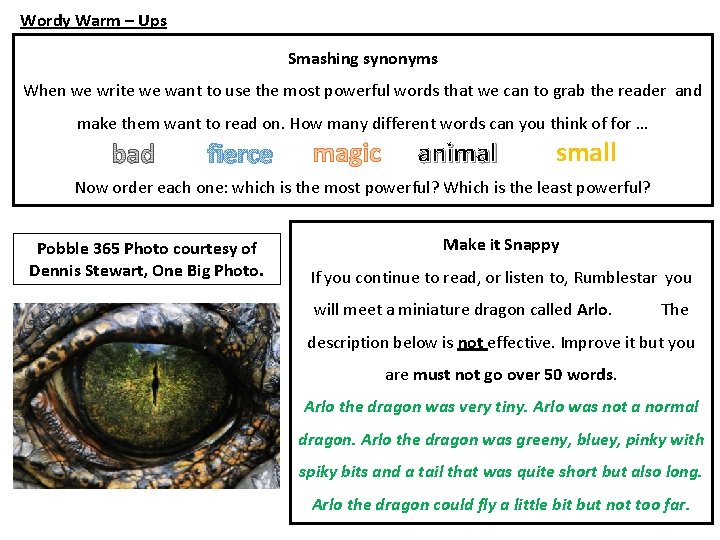
Wordy Warm – Ups Smashing synonyms When we write we want to use the most powerful words that we can to grab the reader and make them want to read on. How many different words can you think of for … fierce magic animal small Now order each one: which is the most powerful? Which is the least powerful? Pobble 365 Photo courtesy of Dennis Stewart, One Big Photo. Make it Snappy If you continue to read, or listen to, Rumblestar you will meet a miniature dragon called Arlo. The description below is not effective. Improve it but you are must not go over 50 words. Arlo the dragon was very tiny. Arlo was not a normal dragon. Arlo the dragon was greeny, bluey, pinky with spiky bits and a tail that was quite short but also long. Arlo the dragon could fly a little bit but not too far.
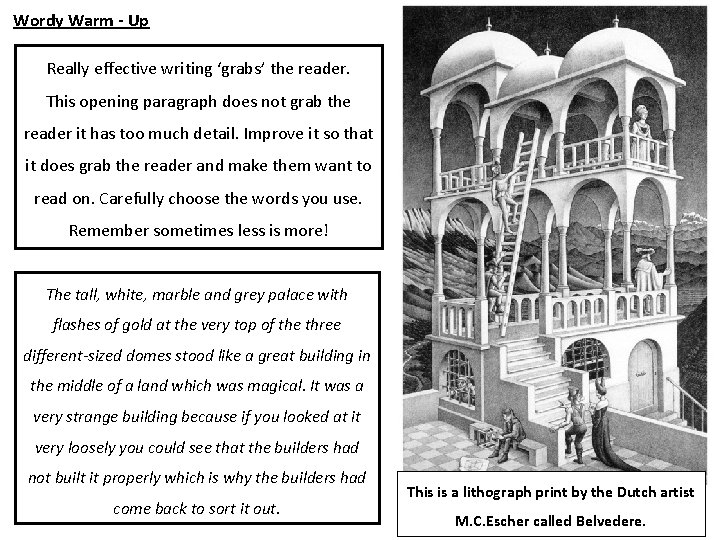
Wordy Warm - Up Really effective writing ‘grabs’ the reader. This opening paragraph does not grab the reader it has too much detail. Improve it so that it does grab the reader and make them want to read on. Carefully choose the words you use. Remember sometimes less is more! The tall, white, marble and grey palace with flashes of gold at the very top of the three different-sized domes stood like a great building in the middle of a land which was magical. It was a very strange building because if you looked at it very loosely you could see that the builders had not built it properly which is why the builders had come back to sort it out. This is a lithograph print by the Dutch artist M. C. Escher called Belvedere.
Notes for parents These activities are designed to assess what children can do independently. Children will need help in reading and understanding each task. They will benefit from your encouragement whilst they are doing each one, but please ensure that the ideas and the work are the children’s own. We are not expecting or looking for perfection, any mistakes your child may make will help us plan their next steps in learning. If you do help, or support your child in any way please can you make a note so that we know if certain parts have been aided by an adult. E. g. Edna asked how to spell the words underlined and I helped her sound them out/use her word mat OR Edgar needed lots of encouragement to start his invitation so we wrote the first sentence together. More than anything try to allow your child’s imagination to shine through. Ask them, and encourage them, to do the very best they can by motivating them with praise for their efforts. Do feel free to make suggestions to your children but try to phrase them as questions rather than giving them the answer. E. g. Have you used your word mat to help you with your spelling?
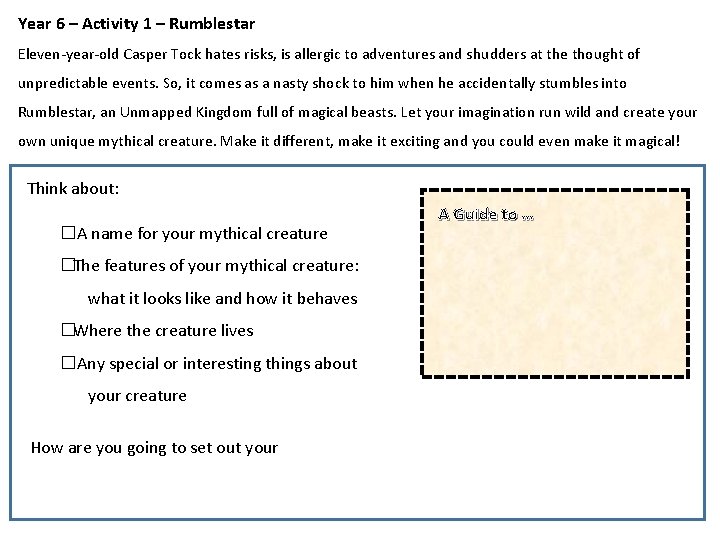
Year 6 – Activity 1 – Rumblestar Eleven-year-old Casper Tock hates risks, is allergic to adventures and shudders at the thought of unpredictable events. So, it comes as a nasty shock to him when he accidentally stumbles into Rumblestar, an Unmapped Kingdom full of magical beasts. Let your imagination run wild and create your own unique mythical creature. Make it different, make it exciting and you could even make it magical! Think about: �A name for your mythical creature �The features of your mythical creature: what it looks like and how it behaves �Where the creature lives �Any special or interesting things about your creature How are you going to set out your A Guide to …
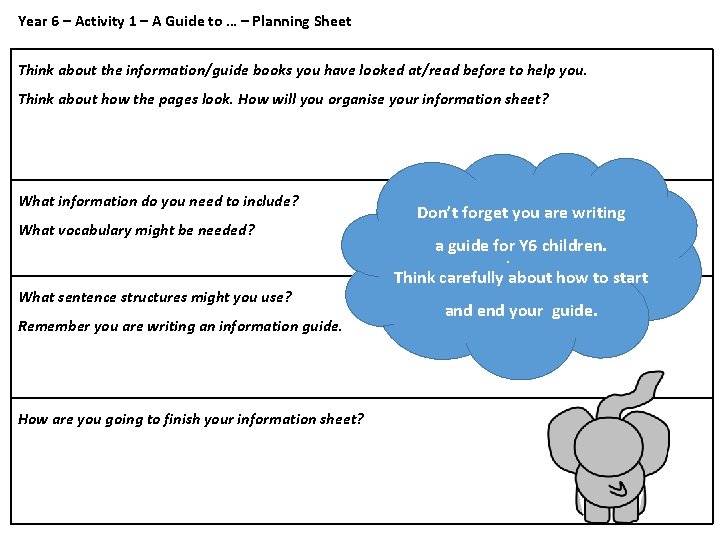
Year 6 – Activity 1 – A Guide to … – Planning Sheet Think about the information/guide books you have looked at/read before to help you. Think about how the pages look. How will you organise your information sheet? What information do you need to include? What vocabulary might be needed? What sentence structures might you use? Remember you are writing an information guide. How are you going to finish your information sheet? Don’t forget you are writing a guide for Y 6 children. . Think carefully about how to start and end your guide.
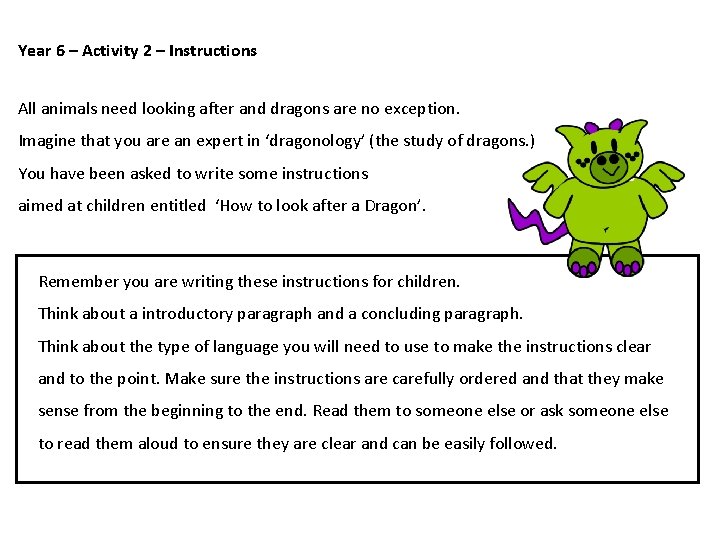
Year 6 – Activity 2 – Instructions All animals need looking after and dragons are no exception. Imagine that you are an expert in ‘dragonology’ (the study of dragons. ) You have been asked to write some instructions aimed at children entitled ‘How to look after a Dragon’. Remember you are writing these instructions for children. Think about a introductory paragraph and a concluding paragraph. Think about the type of language you will need to use to make the instructions clear and to the point. Make sure the instructions are carefully ordered and that they make sense from the beginning to the end. Read them to someone else or ask someone else to read them aloud to ensure they are clear and can be easily followed.
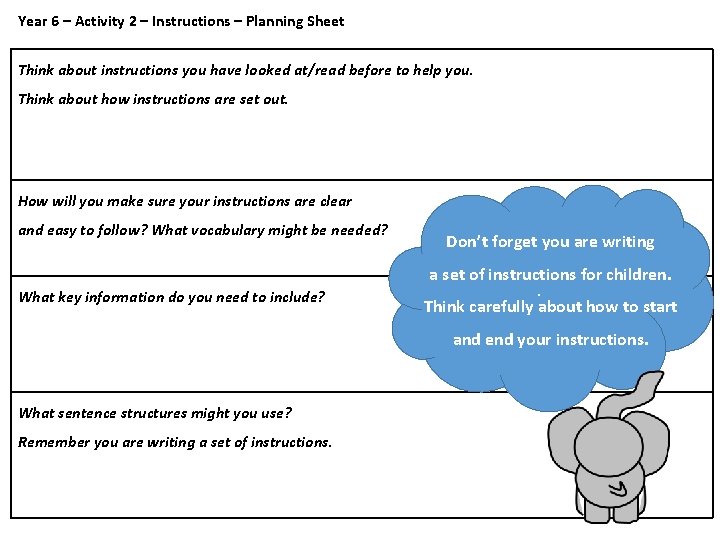
Year 6 – Activity 2 – Instructions – Planning Sheet Think about instructions you have looked at/read before to help you. Think about how instructions are set out. How will you make sure your instructions are clear and easy to follow? What vocabulary might be needed? What key information do you need to include? Don’t forget you are writing a set of instructions for children. . Think carefully about how to start and end your instructions. What sentence structures might you use? Remember you are writing a set of instructions.
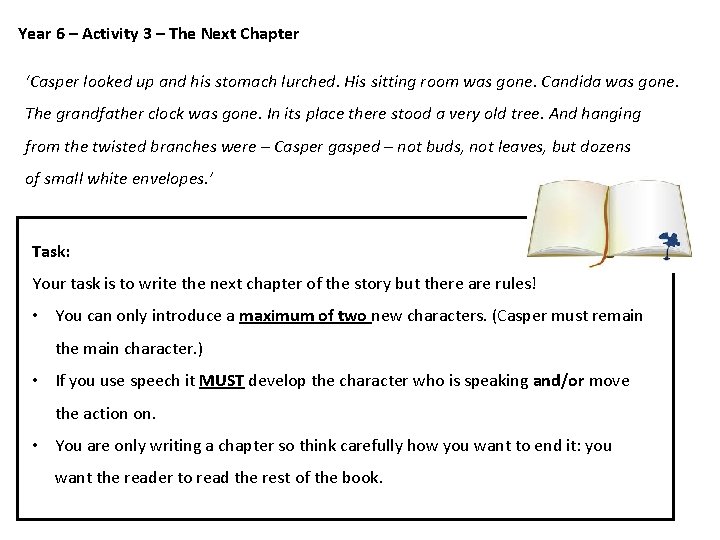
Year 6 – Activity 3 – The Next Chapter ‘Casper looked up and his stomach lurched. His sitting room was gone. Candida was gone. The grandfather clock was gone. In its place there stood a very old tree. And hanging from the twisted branches were – Casper gasped – not buds, not leaves, but dozens of small white envelopes. ’ Task: Your task is to write the next chapter of the story but there are rules! • You can only introduce a maximum of two new characters. (Casper must remain the main character. ) • If you use speech it MUST develop the character who is speaking and/or move the action on. • You are only writing a chapter so think carefully how you want to end it: you want the reader to read the rest of the book.
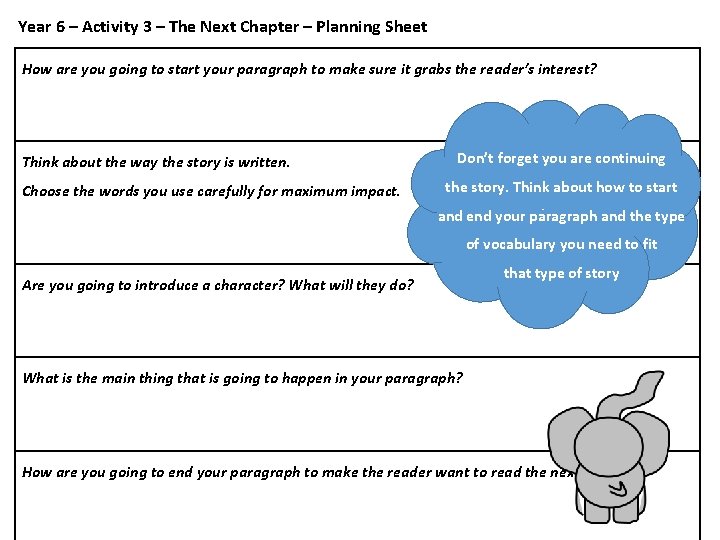
Year 6 – Activity 3 – The Next Chapter – Planning Sheet How are you going to start your paragraph to make sure it grabs the reader’s interest? Think about the way the story is written. Choose the words you use carefully for maximum impact. Don’t forget you are continuing the story. Think about how to start . and end your paragraph and the type of vocabulary you need to fit Are you going to introduce a character? What will they do? that type of story What is the main thing that is going to happen in your paragraph? How are you going to end your paragraph to make the reader want to read the next one?