
Year 6 Living things and their habitats Topic
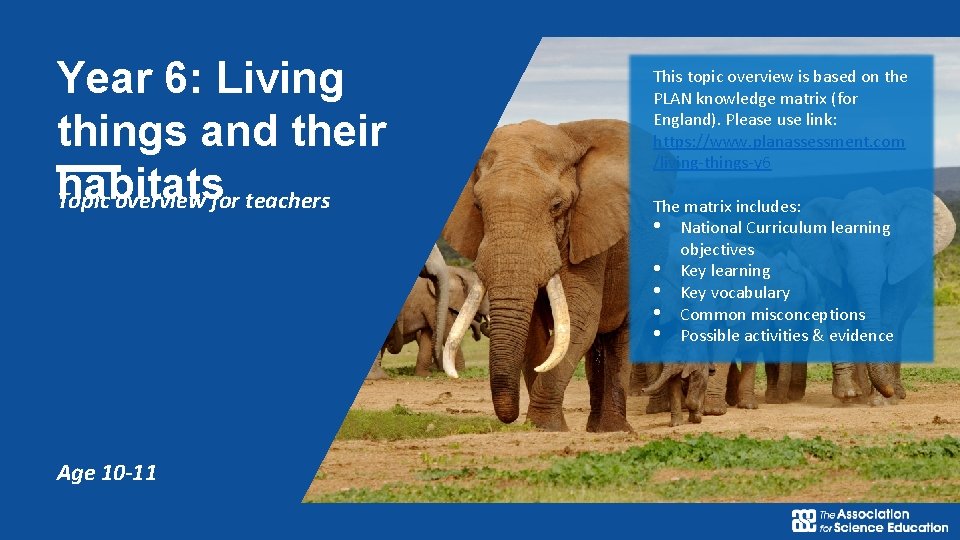
Year 6: Living things and their habitats Topic overview for teachers Age 10 -11 This topic overview is based on the PLAN knowledge matrix (for England). Please use link: https: //www. planassessment. com /living-things-y 6 The matrix includes: • National Curriculum learning objectives • Key learning • Key vocabulary • Common misconceptions • Possible activities & evidence
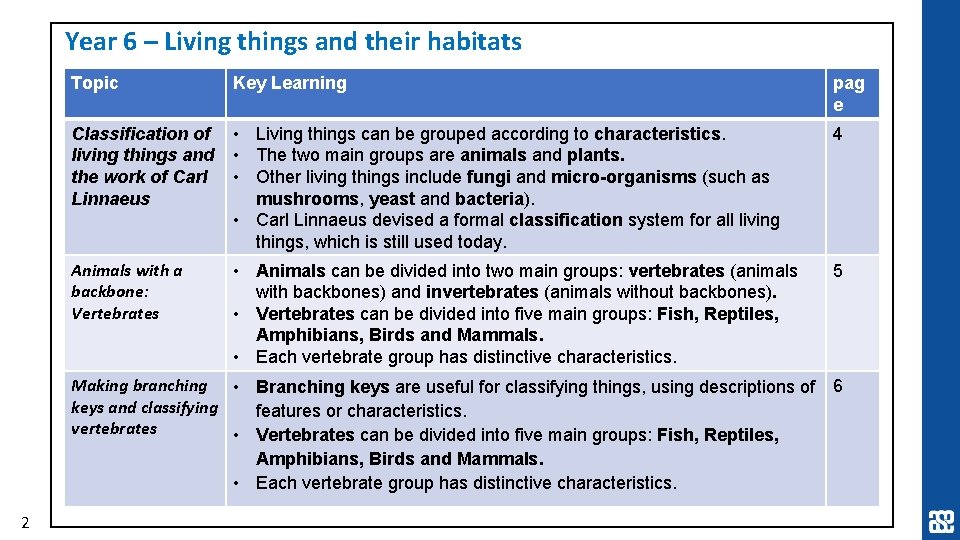
Year 6 – Living things and their habitats Topic Key Learning pag e Classification of living things and the work of Carl Linnaeus • Living things can be grouped according to characteristics. • The two main groups are animals and plants. • Other living things include fungi and micro-organisms (such as mushrooms, yeast and bacteria). • Carl Linnaeus devised a formal classification system for all living things, which is still used today. 4 Animals with a backbone: Vertebrates • Animals can be divided into two main groups: vertebrates (animals with backbones) and invertebrates (animals without backbones). • Vertebrates can be divided into five main groups: Fish, Reptiles, Amphibians, Birds and Mammals. • Each vertebrate group has distinctive characteristics. 5 Making branching • Branching keys are useful for classifying things, using descriptions of keys and classifying features or characteristics. vertebrates • Vertebrates can be divided into five main groups: Fish, Reptiles, Amphibians, Birds and Mammals. • Each vertebrate group has distinctive characteristics. 2 6
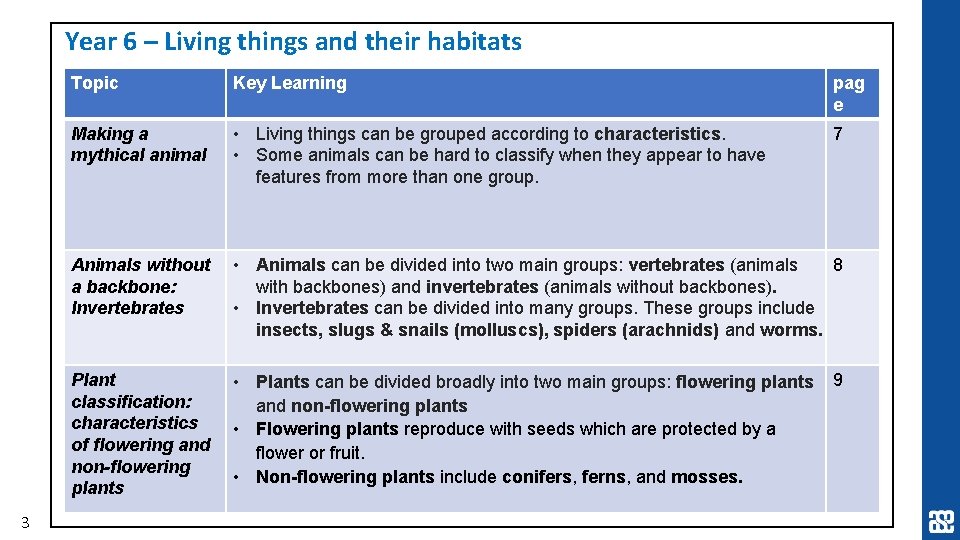
Year 6 – Living things and their habitats 3 Topic Key Learning pag e Making a mythical animal • Living things can be grouped according to characteristics. • Some animals can be hard to classify when they appear to have features from more than one group. 7 Animals without a backbone: Invertebrates • Animals can be divided into two main groups: vertebrates (animals 8 with backbones) and invertebrates (animals without backbones). • Invertebrates can be divided into many groups. These groups include insects, slugs & snails (molluscs), spiders (arachnids) and worms. Plant classification: characteristics of flowering and non-flowering plants • Plants can be divided broadly into two main groups: flowering plants and non-flowering plants • Flowering plants reproduce with seeds which are protected by a flower or fruit. • Non-flowering plants include conifers, ferns, and mosses. 9
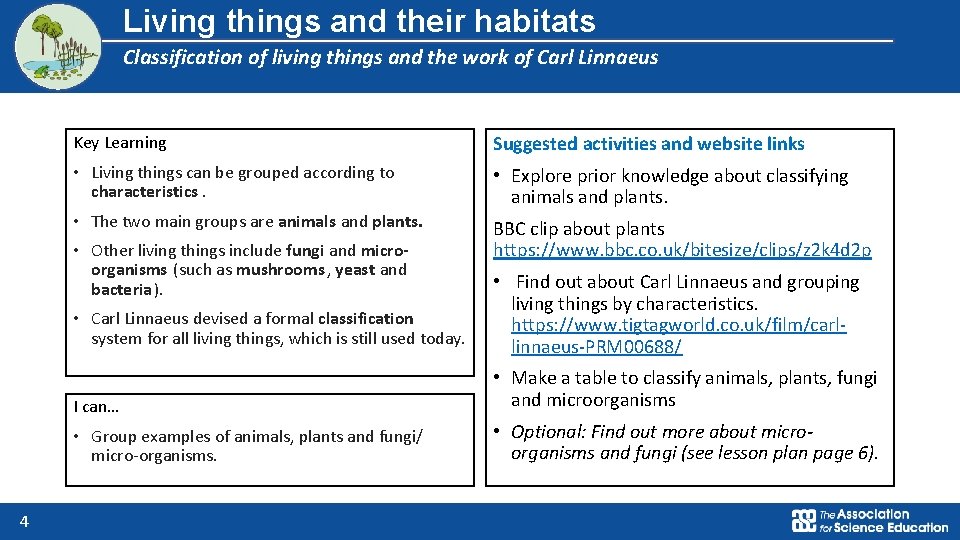
Logo for section to sit inside roundel Living things and their habitats Classification of living things and the work of Carl Linnaeus Key Learning Suggested activities and website links • Living things can be grouped according to characteristics. • Explore prior knowledge about classifying animals and plants. • The two main groups are animals and plants. BBC clip about plants https: //www. bbc. co. uk/bitesize/clips/z 2 k 4 d 2 p • Other living things include fungi and microorganisms (such as mushrooms, yeast and bacteria). • Carl Linnaeus devised a formal classification system for all living things, which is still used today. 4 • Find out about Carl Linnaeus and grouping living things by characteristics. https: //www. tigtagworld. co. uk/film/carllinnaeus-PRM 00688/ I can… • Make a table to classify animals, plants, fungi and microorganisms • Group examples of animals, plants and fungi/ micro-organisms. • Optional: Find out more about microorganisms and fungi (see lesson plan page 6).
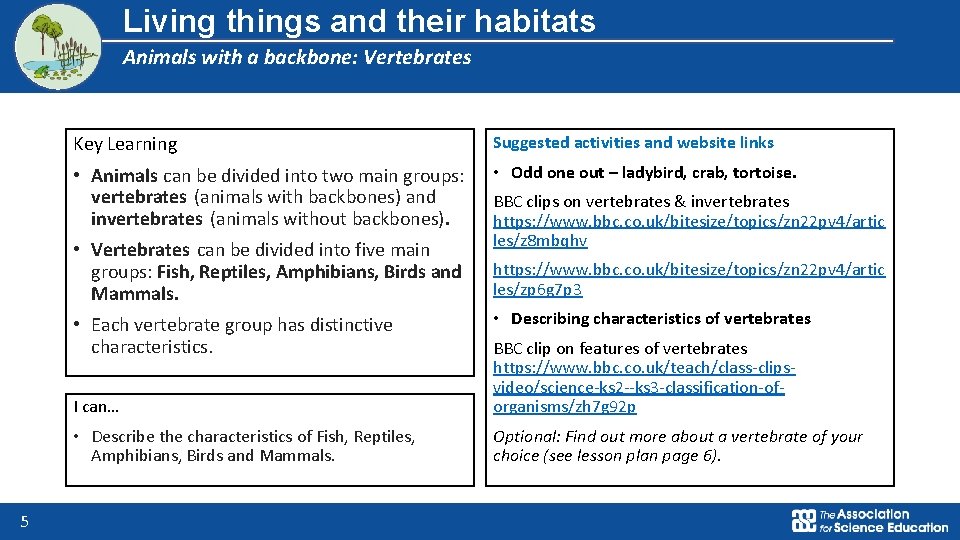
Logo for section to sit inside roundel Living things and their habitats Animals with a backbone: Vertebrates Key Learning Suggested activities and website links • Animals can be divided into two main groups: vertebrates (animals with backbones) and invertebrates (animals without backbones). • Odd one out – ladybird, crab, tortoise. • Vertebrates can be divided into five main groups: Fish, Reptiles, Amphibians, Birds and Mammals. • Each vertebrate group has distinctive characteristics. 5 BBC clips on vertebrates & invertebrates https: //www. bbc. co. uk/bitesize/topics/zn 22 pv 4/artic les/z 8 mbqhv https: //www. bbc. co. uk/bitesize/topics/zn 22 pv 4/artic les/zp 6 g 7 p 3 • Describing characteristics of vertebrates I can… BBC clip on features of vertebrates https: //www. bbc. co. uk/teach/class-clipsvideo/science-ks 2 --ks 3 -classification-oforganisms/zh 7 g 92 p • Describe the characteristics of Fish, Reptiles, Amphibians, Birds and Mammals. Optional: Find out more about a vertebrate of your choice (see lesson plan page 6).

Logo for section to sit inside roundel Year 6 Living things and their habitats Making branching keys and classifying vertebrates Key Learning Suggested activities and links to websites • Branching keys are useful for classifying things, using descriptions of features or characteristics. • Learning to make a branching key with liquorice allsorts (packet of sweets or cut out sweets). • Vertebrates can be divided into five main groups: Fish, Reptiles, Amphibians, Birds and Mammals. • Each vertebrate group has distinctive characteristics. I can… • Make a branching key to classify a group of objects. • Make a branching key to classify vertebrates (animals with a backbone). 6 Thank you to SAPS for this activity – more details on p. 19 of their guide: www. saps. org. uk/attachments/article/1377/SA PS%20 book%205%20%20 Grouping%20 and%20 Classification%20%202016. pdf • Making a branching key to classify four vertebrates. • Optional: Making a key for all five vertebrate groups.
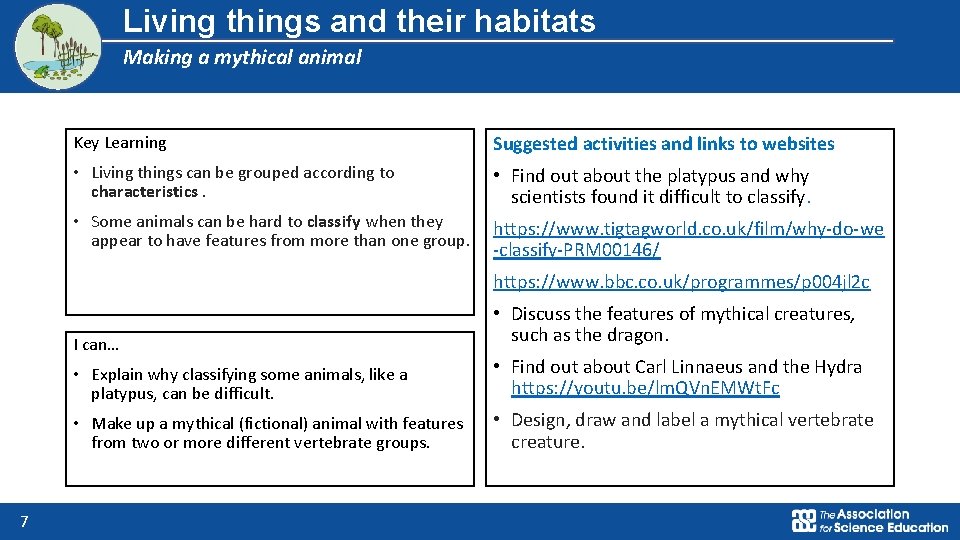
Logo for section to sit inside roundel Living things and their habitats Making a mythical animal Key Learning Suggested activities and links to websites • Living things can be grouped according to characteristics. • Find out about the platypus and why scientists found it difficult to classify. • Some animals can be hard to classify when they appear to have features from more than one group. https: //www. tigtagworld. co. uk/film/why-do-we -classify-PRM 00146/ https: //www. bbc. co. uk/programmes/p 004 jl 2 c I can… 7 • Discuss the features of mythical creatures, such as the dragon. • Explain why classifying some animals, like a platypus, can be difficult. • Find out about Carl Linnaeus and the Hydra https: //youtu. be/lm. QVn. EMWt. Fc • Make up a mythical (fictional) animal with features from two or more different vertebrate groups. • Design, draw and label a mythical vertebrate creature.
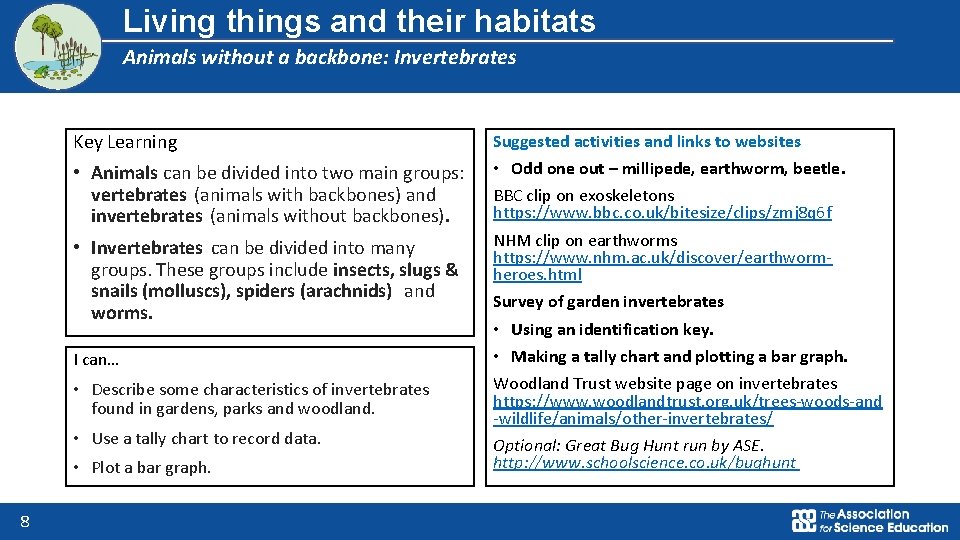
Logo for section to sit inside roundel Living things and their habitats Animals without a backbone: Invertebrates Key Learning Suggested activities and links to websites • Animals can be divided into two main groups: vertebrates (animals with backbones) and invertebrates (animals without backbones). • Odd one out – millipede, earthworm, beetle. • Invertebrates can be divided into many groups. These groups include insects, slugs & snails (molluscs), spiders (arachnids) and worms. NHM clip on earthworms https: //www. nhm. ac. uk/discover/earthwormheroes. html I can… • Making a tally chart and plotting a bar graph. • Describe some characteristics of invertebrates found in gardens, parks and woodland. Woodland Trust website page on invertebrates https: //www. woodlandtrust. org. uk/trees-woods-and -wildlife/animals/other-invertebrates/ • Use a tally chart to record data. • Plot a bar graph. 8 BBC clip on exoskeletons https: //www. bbc. co. uk/bitesize/clips/zmj 8 q 6 f Survey of garden invertebrates • Using an identification key. Optional: Great Bug Hunt run by ASE. http: //www. schoolscience. co. uk/bughunt
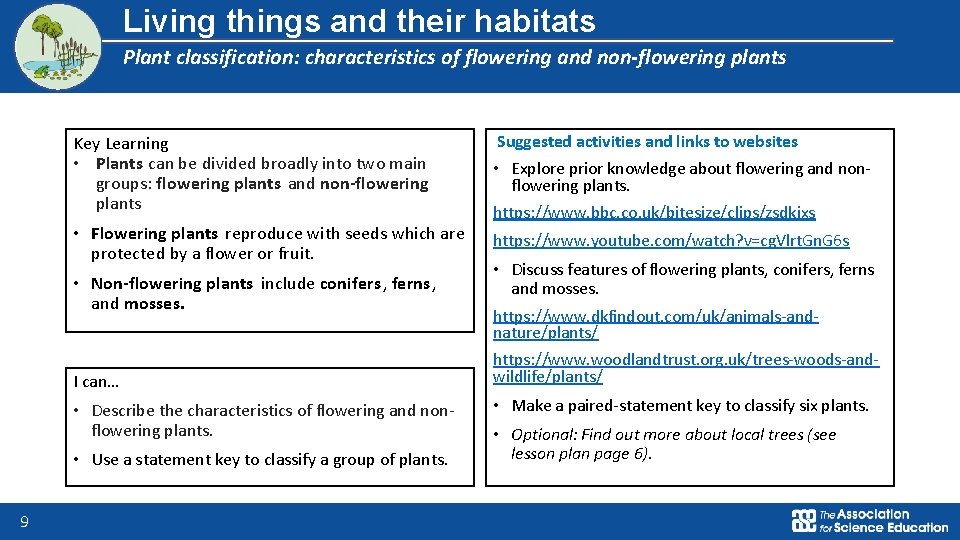
Logo for section to sit inside roundel Living things and their habitats Plant classification: characteristics of flowering and non-flowering plants • Explore prior knowledge about flowering and nonflowering plants. • Flowering plants reproduce with seeds which are protected by a flower or fruit. https: //www. youtube. com/watch? v=cg. Vlrt. Gn. G 6 s • Non-flowering plants include conifers, ferns, and mosses. I can… • Describe the characteristics of flowering and nonflowering plants. • Use a statement key to classify a group of plants. 9 Suggested activities and links to websites Key Learning • Plants can be divided broadly into two main groups: flowering plants and non-flowering plants https: //www. bbc. co. uk/bitesize/clips/zsdkjxs • Discuss features of flowering plants, conifers, ferns and mosses. https: //www. dkfindout. com/uk/animals-andnature/plants/ https: //www. woodlandtrust. org. uk/trees-woods-andwildlife/plants/ • Make a paired-statement key to classify six plants. • Optional: Find out more about local trees (see lesson plan page 6).
- Slides: 9