
Year 6 Light Making and measuring shadows Year


- Slides: 10
Year 6: Light Making and measuring shadows Year 6 Age 10 -11 For parents Thank you for supporting your child’s learning in science. Before the session: • Please read slide 2 so you know what your child is learning and what you need to get ready. • As an alternative to squared paper, slide 6 may be printed for your child to record on. During the session: • Share the learning intentions on slide 2. • Support your child with the main activities on slides 3 - 7, as needed. • Slide 8 has some further, optional activities. • Slide 9 has a glossary of key terms. Reviewing with your child: • Slide 10 gives an idea of what your child may produce.
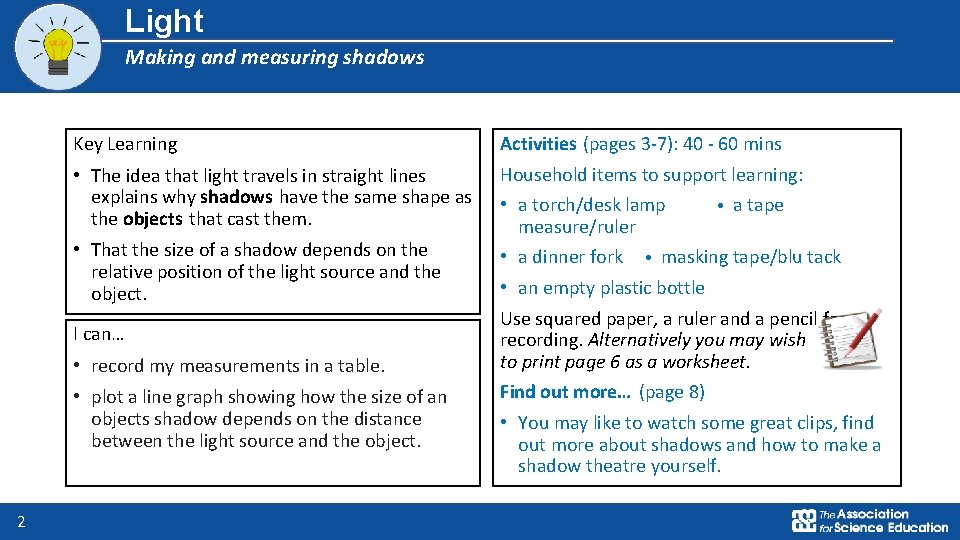
Light Making and measuring shadows Key Learning Activities (pages 3 -7): 40 - 60 mins • The idea that light travels in straight lines explains why shadows have the same shape as the objects that cast them. Household items to support learning: • That the size of a shadow depends on the relative position of the light source and the object. • a dinner fork I can… • record my measurements in a table. • plot a line graph showing how the size of an objects shadow depends on the distance between the light source and the object. 2 • a torch/desk lamp measure/ruler • • a tape masking tape/blu tack • an empty plastic bottle Use squared paper, a ruler and a pencil for recording. Alternatively you may wish to print page 6 as a worksheet. Find out more… (page 8) • You may like to watch some great clips, find out more about shadows and how to make a shadow theatre yourself.
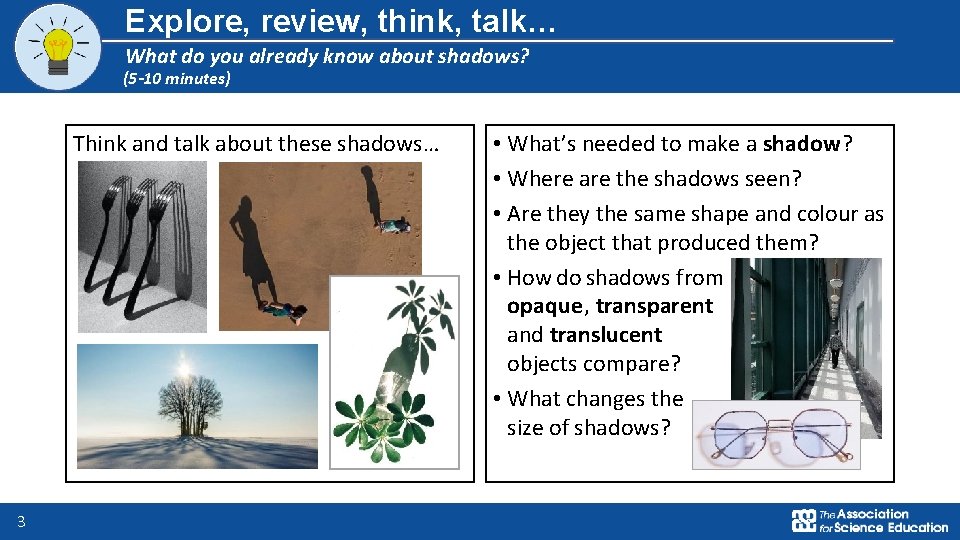
Explore, review, think, talk… What do you already know about shadows? (5 -10 minutes) Think and talk about these shadows… 3 • What’s needed to make a shadow? • Where are the shadows seen? • Are they the same shape and colour as the object that produced them? • How do shadows from opaque, transparent and translucent objects compare? • What changes the size of shadows?
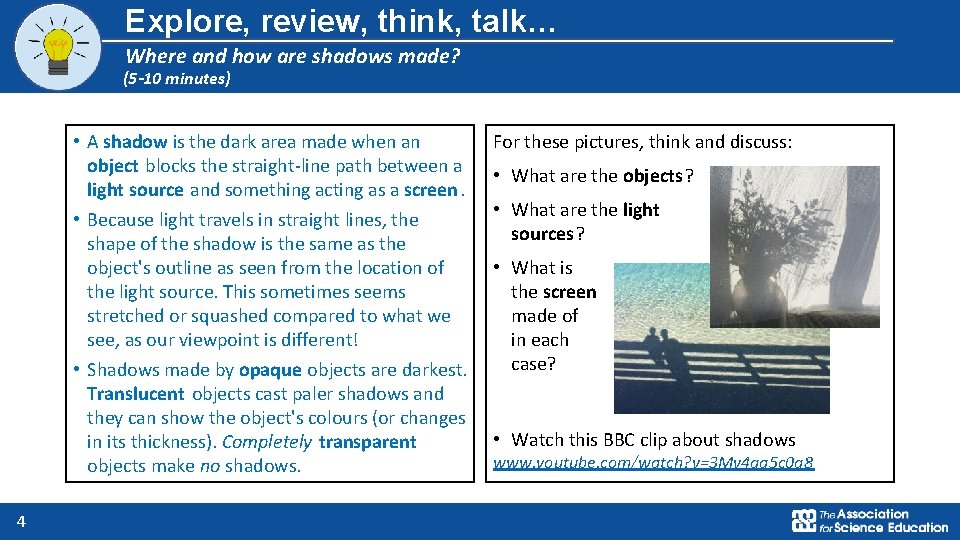
Explore, review, think, talk… Where and how are shadows made? (5 -10 minutes) • A shadow is the dark area made when an object blocks the straight-line path between a light source and something acting as a screen. • Because light travels in straight lines, the shape of the shadow is the same as the object's outline as seen from the location of the light source. This sometimes seems stretched or squashed compared to what we see, as our viewpoint is different! • Shadows made by opaque objects are darkest. Translucent objects cast paler shadows and they can show the object's colours (or changes in its thickness). Completely transparent objects make no shadows. 4 For these pictures, think and discuss: • What are the objects? • What are the light sources? • What is the screen made of in each case? • Watch this BBC clip about shadows www. youtube. com/watch? v=3 Mv 4 qa 5 c 0 q 8
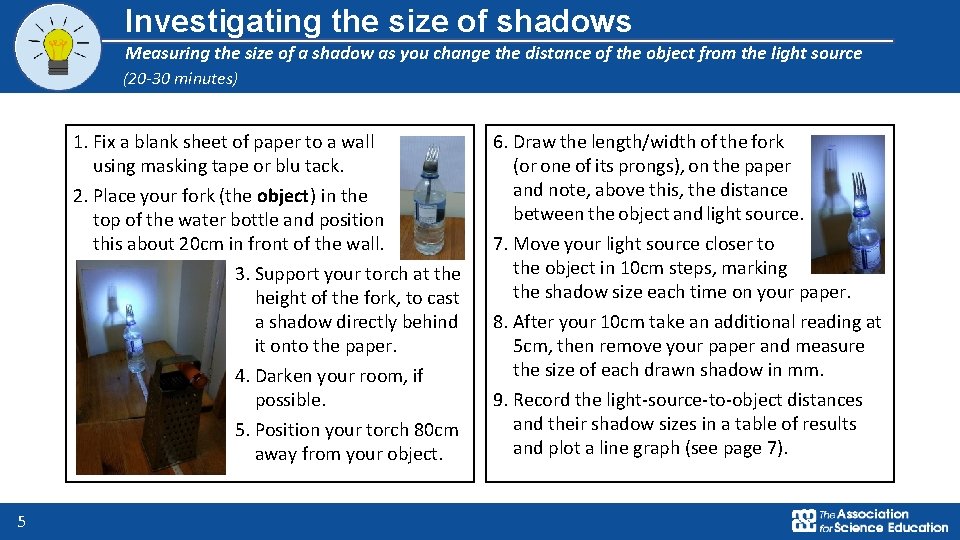
Investigating the size of shadows Measuring the size of a shadow as you change the distance of the object from the light source (20 -30 minutes) 1. Fix a blank sheet of paper to a wall using masking tape or blu tack. 2. Place your fork (the object) in the top of the water bottle and position this about 20 cm in front of the wall. 3. Support your torch at the height of the fork, to cast a shadow directly behind it onto the paper. 4. Darken your room, if possible. 5. Position your torch 80 cm away from your object. 5 6. Draw the length/width of the fork (or one of its prongs), on the paper and note, above this, the distance between the object and light source. 7. Move your light source closer to the object in 10 cm steps, marking the shadow size each time on your paper. 8. After your 10 cm take an additional reading at 5 cm, then remove your paper and measure the size of each drawn shadow in mm. 9. Record the light-source-to-object distances and their shadow sizes in a table of results and plot a line graph (see page 7).
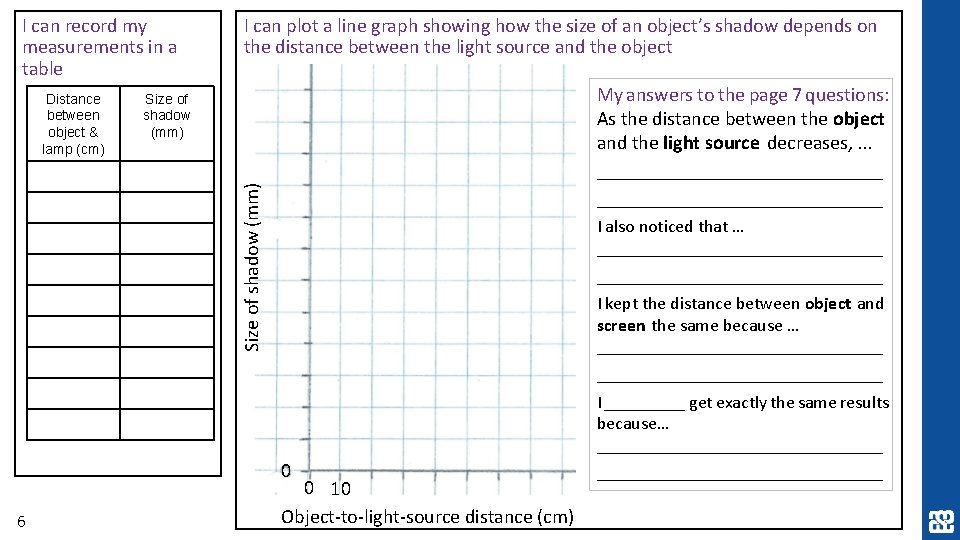
I can record my measurements in a table Distance between object & lamp (cm) I can plot a line graph showing how the size of an object’s shadow depends on the distance between the light source and the object My answers to the page 7 questions: As the distance between the object and the light source decreases, . . . Size of shadow (mm) ________________________________ I also noticed that … ________________________________ I kept the distance between object and screen the same because … ________________________________ I _____ get exactly the same results because… ________________ 0 6 0 10 Object-to-light-source distance (cm) ________________
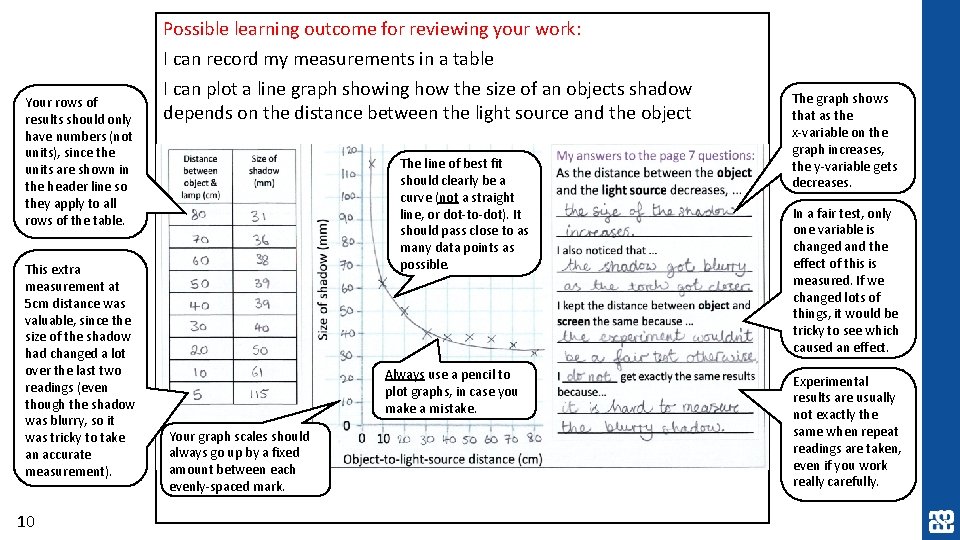
Think and talk about your findings… What exactly did you observe and why? (10 minutes) • Draw a line of best fit for your data and describe the pattern you see in your results. • Did you observe any other differences in the shadow? • Why do you need to keep the distance between the object and the screen the same? • Repeat some of your measurements (20, 40, 60, 80 cm) and see if you get the same results. If not, why not? • If you want to, you could carry out a second related experiment, where you keep the distance between the light source and the object the same and move them closer to the screen. (You might find a tray helps with this. ) 7 • The size of the object’s shadow increases as the distance between the light source and the object decreases. This is because light travels in straight lines , so objects closer to the light source block light travelling in a greater range of different directions. • As a wide light source moves towards an object, the shadow’s edges become less sharp (as it actually consists of overlapping shadows due to different parts of the light source). • We only change one variable in a fair test. • It is tricky to measure with 100% accuracy.
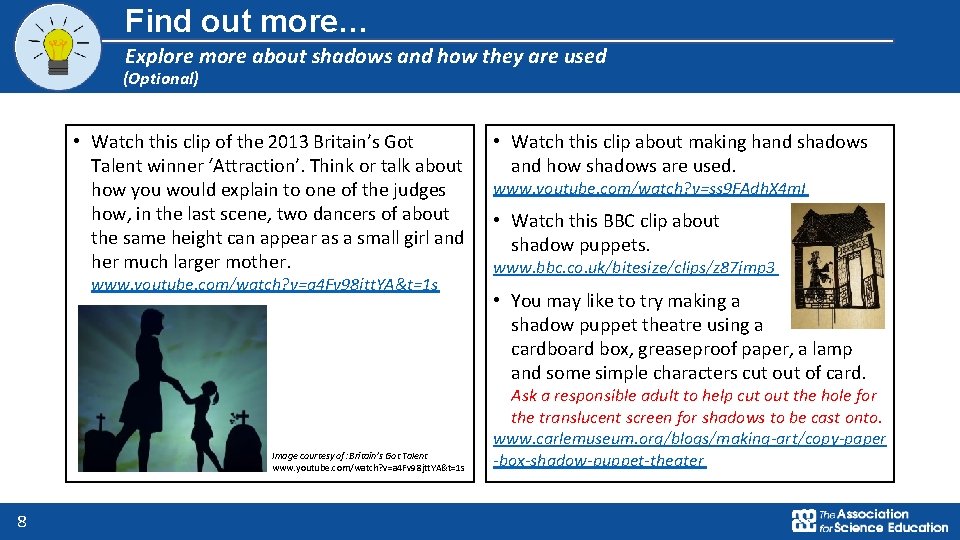
Find out more… Explore more about shadows and how they are used (Optional) • Watch this clip of the 2013 Britain’s Got Talent winner ‘Attraction’. Think or talk about how you would explain to one of the judges how, in the last scene, two dancers of about the same height can appear as a small girl and her much larger mother. www. youtube. com/watch? v=a 4 Fv 98 jtt. YA&t=1 s Image courtesy of: Britain’s Got Talent www. youtube. com/watch? v=a 4 Fv 98 jtt. YA&t=1 s 8 • Watch this clip about making hand shadows and how shadows are used. www. youtube. com/watch? v=ss 9 FAdh. X 4 m. I • Watch this BBC clip about shadow puppets. www. bbc. co. uk/bitesize/clips/z 87 jmp 3 • You may like to try making a shadow puppet theatre using a cardboard box, greaseproof paper, a lamp and some simple characters cut of card. Ask a responsible adult to help cut out the hole for the translucent screen for shadows to be cast onto. www. carlemuseum. org/blogs/making-art/copy-paper -box-shadow-puppet-theater
Glossary of terms fair test: A fair test is an enquiry (to answer a scientific question) in which all except one variable is kept the same (controlled). line of best fit: A line of best fit is a curved or straight line that best describes the pattern that the graph data show. It is not a dot-to-dot, and in fact it does not need to go through any of the data points, provided it goes as close to as many as possible. light source: A light source emits (gives out) light. object: A shadow is seen when an object blocks light from a surface. opaque: Opaque materials/objects block all light. screen: A screen is a surface on which a shadow is seen. shadow: A shadow is a dark area caused by blocking light from reaching a surface or screen. transparent: Transparent materials look clear, as all light passes through them. translucent: Translucent materials look cloudy, as they only let some light through. variable: A variable is something (a factor) that we either change or decide not to change in an experiment. In a fair test we only change one variable. 9
Possible learning outcome for reviewing your work: Your rows of results should only have numbers (not units), since the units are shown in the header line so they apply to all rows of the table. This extra measurement at 5 cm distance was valuable, since the size of the shadow had changed a lot over the last two readings (even though the shadow was blurry, so it was tricky to take an accurate measurement). 10 I can record my measurements in a table I can plot a line graph showing how the size of an objects shadow depends on the distance between the light source and the object The line of best fit should clearly be a curve (not a straight line, or dot-to-dot). It should pass close to as many data points as possible. Always use a pencil to plot graphs, in case you make a mistake. Your graph scales should always go up by a fixed amount between each evenly-spaced mark. The graph shows that as the x-variable on the graph increases, the y-variable gets decreases. In a fair test, only one variable is changed and the effect of this is measured. If we changed lots of things, it would be tricky to see which caused an effect. Experimental results are usually not exactly the same when repeat readings are taken, even if you work really carefully.