
Year 5 Properties and changes of materials Topic


- Slides: 9
Year 5: Properties and changes of materials Topic overview for teachers Age 9 -10 This topic overview is based on the PLAN knowledge matrix (for England). Please use link: https: //www. planassessment. c om/properties-changes-ofmaterials-y 5 The matrix includes: • National Curriculum learning objectives • Key learning • Key vocabulary • Common misconceptions • Possible activities & evidence
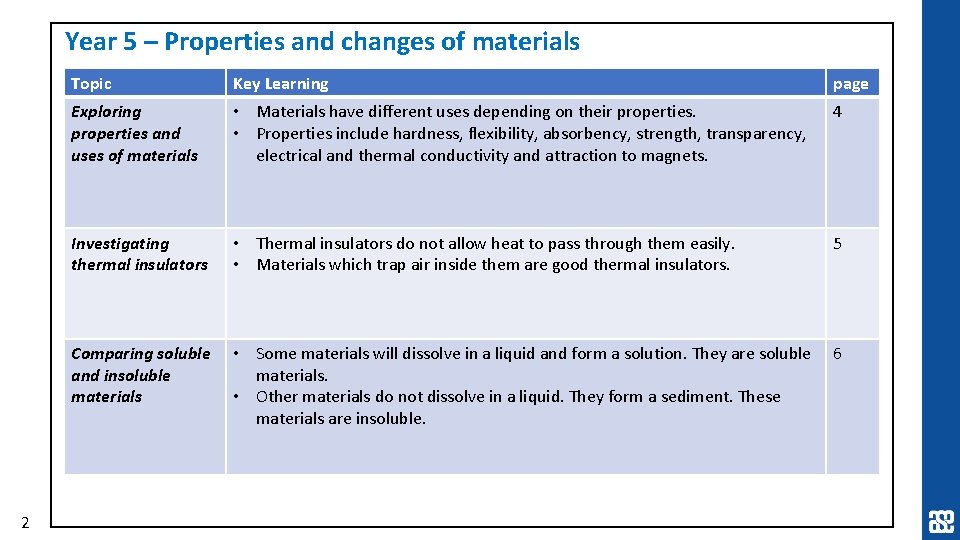
Year 5 – Properties and changes of materials 2 Topic Key Learning page Exploring properties and uses of materials • Materials have different uses depending on their properties. • Properties include hardness, flexibility, absorbency, strength, transparency, electrical and thermal conductivity and attraction to magnets. 4 Investigating thermal insulators • Thermal insulators do not allow heat to pass through them easily. • Materials which trap air inside them are good thermal insulators. 5 Comparing soluble and insoluble materials • Some materials will dissolve in a liquid and form a solution. They are soluble materials. • Other materials do not dissolve in a liquid. They form a sediment. These materials are insoluble. 6
Year 5 – Properties and changes of materials 3 Topic Key Learning page Investigating reversible changes by separating materials • Some changes to materials such as dissolving and mixing are reversible. The materials can be separated, as no new materials have been formed. • Insoluble materials can be separated from a liquid by sieving or filtering. • Soluble materials can be separated from a liquid by the process of evaporation. 7 Understanding that • Melting is a change of state from solid to liquid. Freezing is a change of state changes of state from liquid to solid. are reversible • Boiling and evaporating are both a change of state from liquid to gas. (see Year 4 topic for a Condensing is a change of state from gas to liquid. more detailed set of • All changes of state are reversible. lessons) 8 Exploring irreversible changes 9 • Some changes to materials are not reversible. New materials are formed. These are called irreversible changes. • Burning wood, rusting, cooking food and mixing vinegar with bicarbonate of soda are examples of irreversible changes.
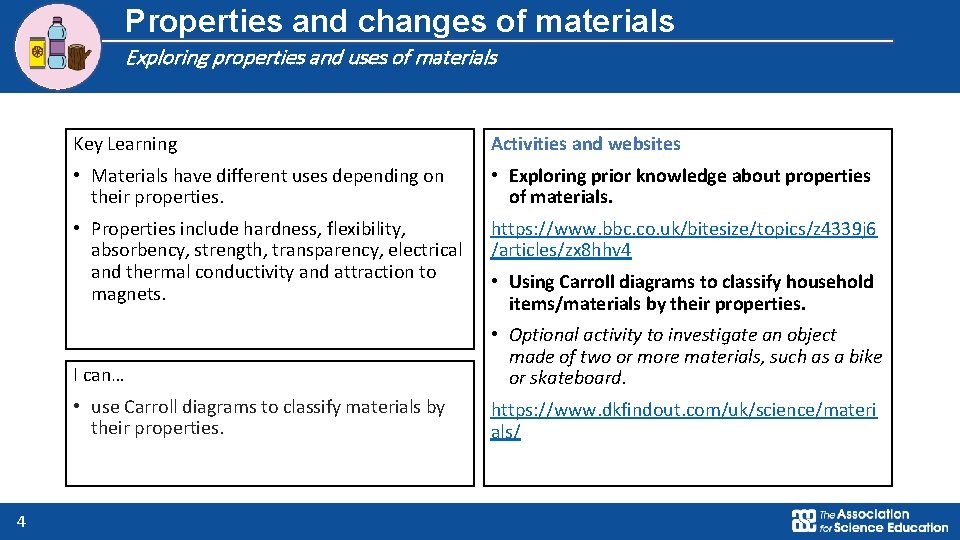
Properties and changes of materials Exploring properties and uses of materials 4 Key Learning Activities and websites • Materials have different uses depending on their properties. • Exploring prior knowledge about properties of materials. • Properties include hardness, flexibility, absorbency, strength, transparency, electrical and thermal conductivity and attraction to magnets. https: //www. bbc. co. uk/bitesize/topics/z 4339 j 6 /articles/zx 8 hhv 4 • Using Carroll diagrams to classify household items/materials by their properties. I can… • Optional activity to investigate an object made of two or more materials, such as a bike or skateboard. • use Carroll diagrams to classify materials by their properties. https: //www. dkfindout. com/uk/science/materi als/
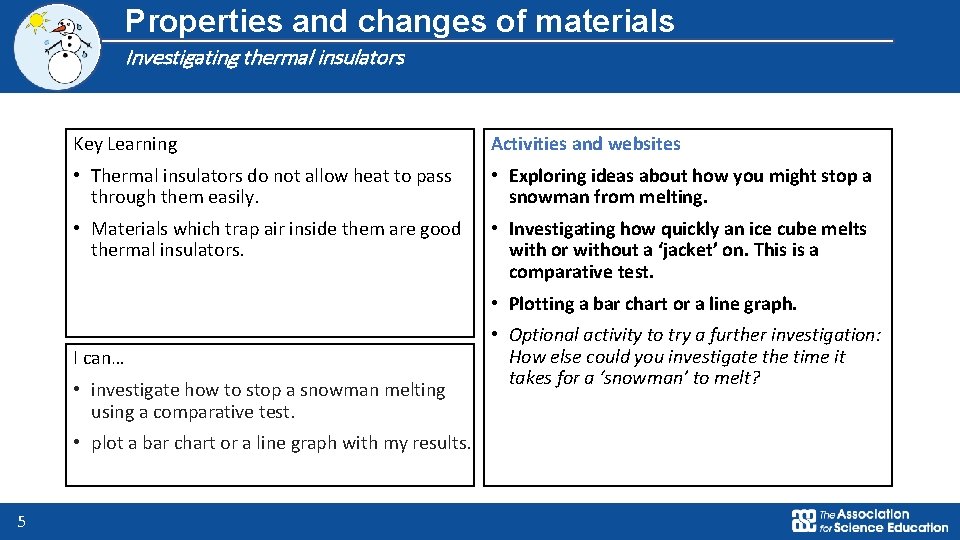
Properties and changes of materials Investigating thermal insulators Key Learning Activities and websites • Thermal insulators do not allow heat to pass through them easily. • Exploring ideas about how you might stop a snowman from melting. • Materials which trap air inside them are good thermal insulators. • Investigating how quickly an ice cube melts with or without a ‘jacket’ on. This is a comparative test. • Plotting a bar chart or a line graph. I can… • investigate how to stop a snowman melting using a comparative test. • plot a bar chart or a line graph with my results. 5 • Optional activity to try a further investigation: How else could you investigate the time it takes for a ‘snowman’ to melt?
Properties and changes of materials Comparing soluble and insoluble materials Key Learning Activities and websites • Some materials will dissolve in a liquid and form a solution. They are soluble materials. • Exploring what happens when you add sugar to a warm drink. • Other materials do not dissolve in a liquid. They form a sediment. These materials are insoluble. https: //www. bbc. co. uk/bitesize/topics/zcvv 4 wx/artic les/zpbdpbk • Comparing soluble and insoluble materials we use in the kitchen. • Optional activities to find out more about the properties of salty water. I can… • identify and compare soluble and insoluble materials. 6 https: //pstt. org. uk/application/files/6115/8633/7142/3. _EGGCITING_SCIENCE. pdf https: //www. dkfindout. com/uk/earth/oceans-and-seas/ https: //www. wildlifetrusts. org/why-sea-salty-and-why-sea-blue https: //www. nhm. ac. uk/discover/quick-questions/why-is-the-seasalty. html
Properties and changes of materials Investigating reversible changes by separating materials Key Learning • Some changes to materials such as dissolving and mixing are reversible. The materials can be separated, as no new materials have been formed. • Insoluble materials can be separated from a liquid by sieving or filtering. • Soluble materials can be separated from a liquid by the process of evaporation. I can… • select equipment to separate two or more materials using sieving, filtering and/or evaporating. 7 Activities and websites • Exploring how sieves and colanders are used in the kitchen. • Considering how you can separate materials that are mixed together. https: //www. bbc. co. uk/bitesize/clips/z 9 jd 7 ty https: //www. bbc. co. uk/bitesize/topics/zcvv 4 wx/articles/zw 7 tv 9 q • Separating materials using sieving, filtering and evaporating. • Optional further activities to explore separating mixtures. https: //www. youtube. com/watch? v=sg. Rn. DK 4 CFX 4 https: //pstt. org. uk/resources/curriculum-materials/Science-Fun-at. Home
Properties and changes of materials Understanding that changes of state are reversible Key Learning • Melting is a change of state from solid to liquid. Freezing is a change of state from liquid to solid. • Boiling and evaporating are both a change of state from liquid to gas. Condensing is a change of state from gas to liquid. • All changes of state are reversible. I can… • observe and describe changes of state, including melting, freezing, evaporating and condensing. 8 Activities and websites • Exploring prior knowledge about melting, freezing, boiling, evaporating and condensing. https: //www. bbc. co. uk/bitesize/topics/zkgg 87 h/articles/z 9 ck 9 qt https: //www. bbc. co. uk/bitesize/topics/zkgg 87 h/articles/zydxmnb • Observing and describing changes of state including melting, freezing, evaporating and condensing. • Optional activities to find out more about how chocolate is made or to try making chocolate ice cream. https: //www. youtube. com/watch? v=On. E_84 Gt. Pd. U&list=PLg 7 f. Tk. W 11 i. V 563 gfc. Xj. Rlafm 2 jlkl. QOc&index=12&t=0 s https: //www. youtube. com/watch? v=-Jc. NMN 0 uvv. E
Properties and changes of materials Exploring irreversible changes Key Learning • Some changes to materials are not reversible. New materials are formed. These are called irreversible changes. • Burning wood, rusting, cooking food and mixing vinegar with bicarbonate of soda are examples of irreversible changes. I can… • compare reversible and irreversible changes. • recognise that new materials are formed during an irreversible change. 9 Activities and websites • Exploring different types of change which can be made to materials. https: //www. bbc. co. uk/bitesize/clips/zc 84 d 2 p • Identifying and comparing reversible and irreversible changes. https: //www. bbc. co. uk/bitesize/topics/zcvv 4 wx/artic les/z 9 brcwx https: //www. bbc. co. uk/bitesize/clips/zc 89 wmn https: //www. bbc. co. uk/bitesize/clips/z 9 wkjxs • Optional further activities to explore irreversible changes. (See website links on page 7 of this lesson. )