
Year 5 Maths Week 5 Exploring Fractions and


- Slides: 8
Year 5 Maths – Week 5 Exploring Fractions and other values
This Week’s Learning At a Glance… Y 5 Week 5 – Our Sequence of Lessons 1. 2. 3. 4. 5. “I am 800” investigation with fractions, decimals and percentages to find Comparative study with grid to complete and our arithmetic weekly test Finding equivalent fractions and comparing fractions Ordering fractions (with decimals and percentages for some of us!) Arithmetic session to consolidate our equivalent values grid and discussion of how to use Smart Strategy 65 and Smart Strategy 66. Week 6: Calculating fractions and percentages of amounts to solve problems.
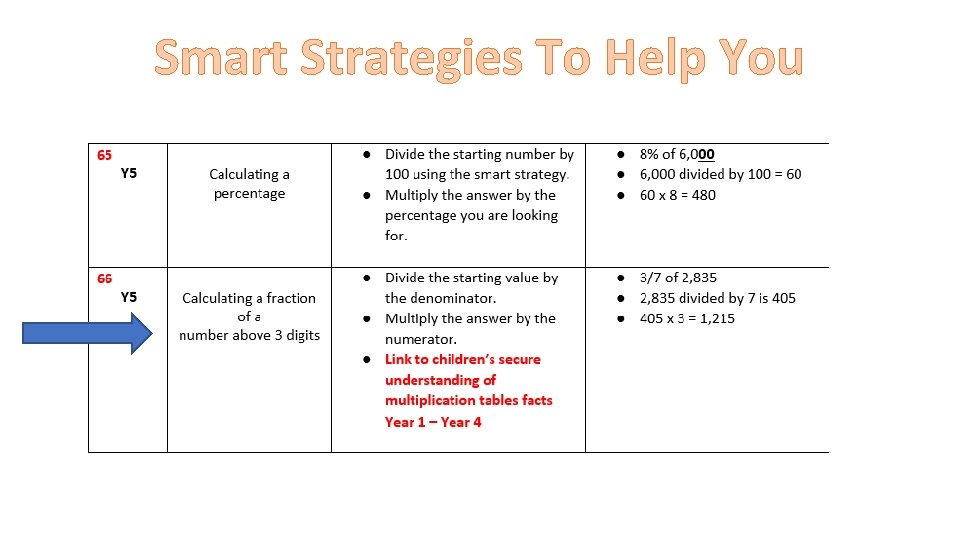
Smart Strategies To Help You
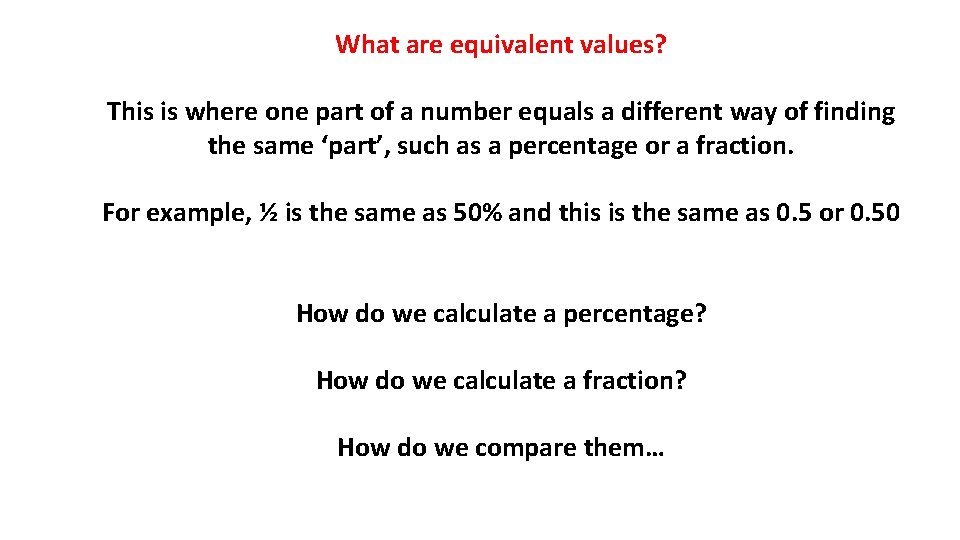
What are equivalent values? This is where one part of a number equals a different way of finding the same ‘part’, such as a percentage or a fraction. For example, ½ is the same as 50% and this is the same as 0. 5 or 0. 50 How do we calculate a percentage? How do we calculate a fraction? How do we compare them…
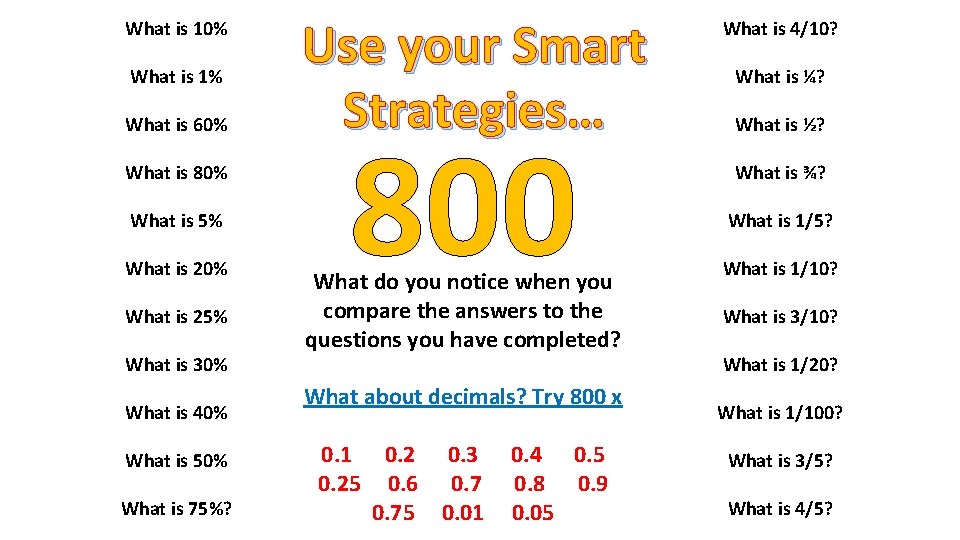
What is 10% What is 1% What is 60% What is 80% What is 5% What is 20% What is 25% What is 30% What is 40% What is 50% What is 75%? Use your Smart Strategies… 800 What do you notice when you compare the answers to the questions you have completed? What about decimals? Try 800 x 0. 1 0. 2 0. 3 0. 25 0. 6 0. 75 0. 01 0. 4 0. 5 0. 8 0. 9 0. 05 What is 4/10? What is ¼? What is ½? What is ¾? What is 1/5? What is 1/10? What is 3/10? What is 1/20? What is 1/100? What is 3/5? What is 4/5?
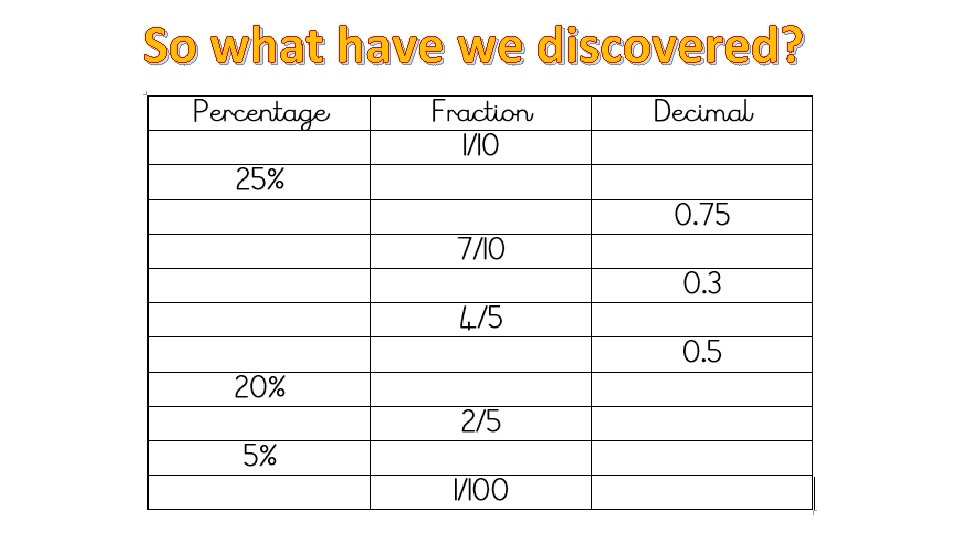
So what comes next in this sequence? Your next task is to compare all of your answers and see if anything strange happens. Do any of your fractions have the same answers as any of your percentages or decimals? Explore and investigate the connections between these values and create a fact file to inform your reader about your discoveries. Here’s a clue: What is 25% of 800? What is ¼ of 800? What is 800 x 0. 25? What does this tell you about equivalent values?
So what have we discovered?
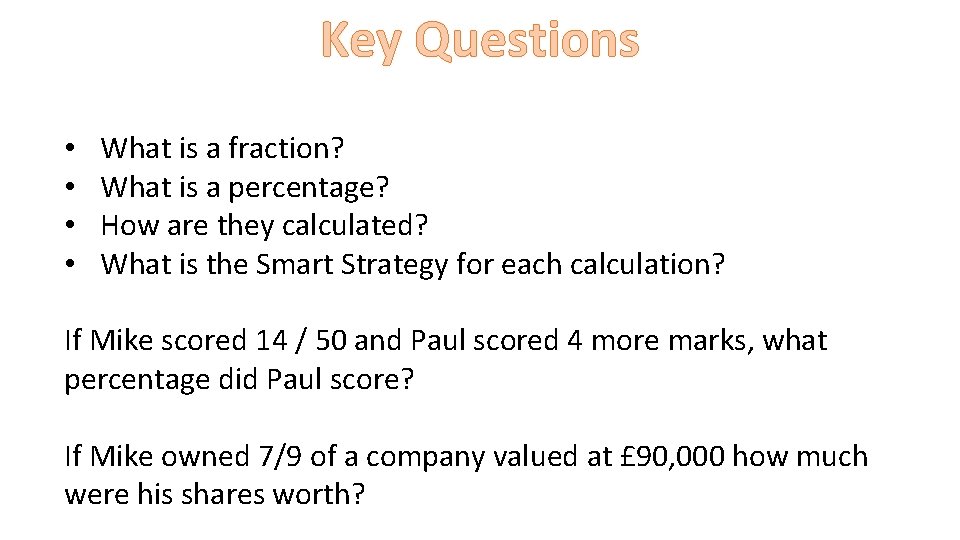
Key Questions • • What is a fraction? What is a percentage? How are they calculated? What is the Smart Strategy for each calculation? If Mike scored 14 / 50 and Paul scored 4 more marks, what percentage did Paul score? If Mike owned 7/9 of a company valued at £ 90, 000 how much were his shares worth?