
Year 4 Maths Lesson Week 3 Lesson 1


- Slides: 9
Year 4 Maths Lesson Week 3 Lesson 1 Monday 18 th January 2021
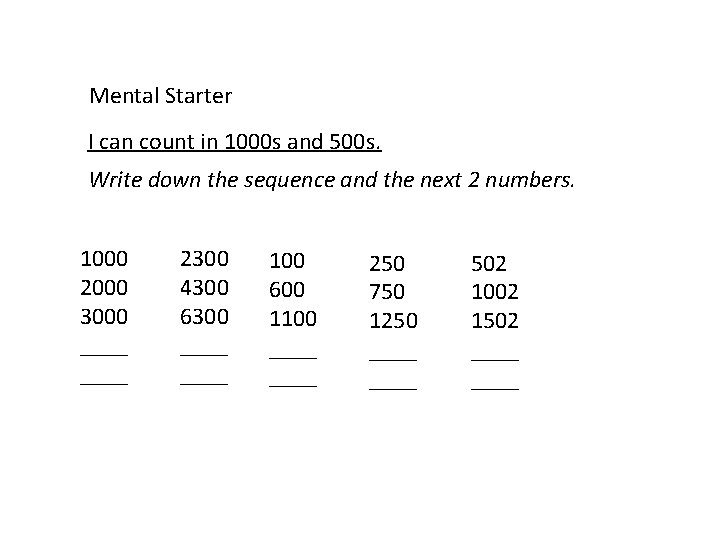
Mental Starter I can count in 1000 s and 500 s. Write down the sequence and the next 2 numbers. 1000 2000 3000 ____ 2300 4300 6300 ____ 100 600 1100 ____ 250 750 1250 ____ 502 1002 1502 ____
LO: I can convert between metric units of measure. Today we are going to convert between: Metres and kilometres Grams and kilograms Millilitres and litres The video will show you how to use a place value chart to help with your conversions – if you make a place value chart don’t throw it away – you can use it all week.
LO: I can convert between metric units of measure. Metres and kilometres are used to measure length and distance. For example the height of a giraffe is measured in metres. The distance from London Bridge to East Dulwich can be measured in kilometres. 1000 metres (M) = 1 kilometre (KM) 7 kilometres 6 metres
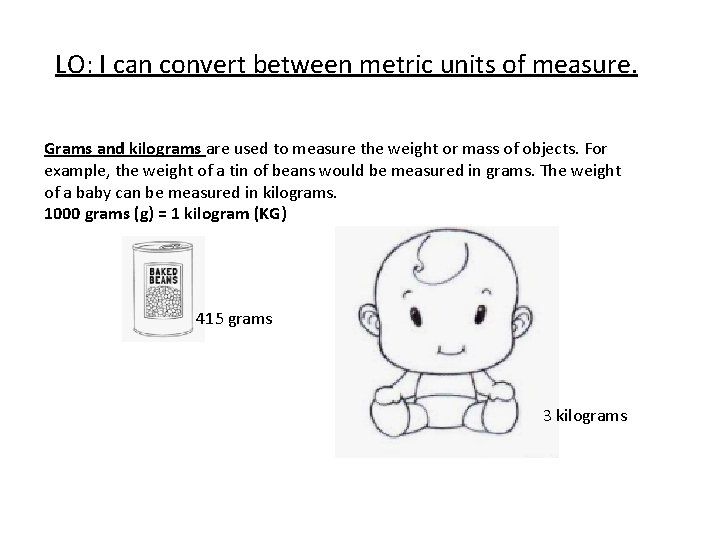
LO: I can convert between metric units of measure. Grams and kilograms are used to measure the weight or mass of objects. For example, the weight of a tin of beans would be measured in grams. The weight of a baby can be measured in kilograms. 1000 grams (g) = 1 kilogram (KG) 415 grams 3 kilograms
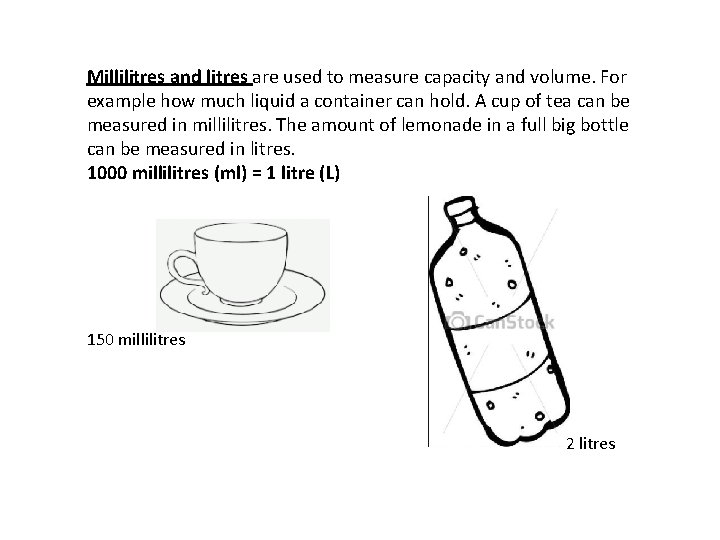
Millilitres and litres are used to measure capacity and volume. For example how much liquid a container can hold. A cup of tea can be measured in millilitres. The amount of lemonade in a full big bottle can be measured in litres. 1000 millilitres (ml) = 1 litre (L) 150 millilitres 2 litres
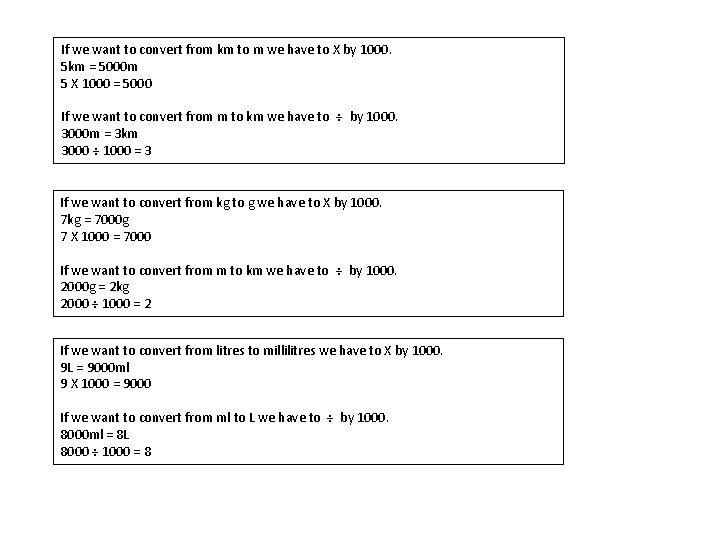
If we want to convert from km to m we have to X by 1000. 5 km = 5000 m 5 X 1000 = 5000 If we want to convert from m to km we have to ÷ by 1000. 3000 m = 3 km 3000 ÷ 1000 = 3 If we want to convert from kg to g we have to X by 1000. 7 kg = 7000 g 7 X 1000 = 7000 If we want to convert from m to km we have to ÷ by 1000. 2000 g = 2 kg 2000 ÷ 1000 = 2 If we want to convert from litres to millilitres we have to X by 1000. 9 L = 9000 ml 9 X 1000 = 9000 If we want to convert from ml to L we have to ÷ by 1000. 8000 ml = 8 L 8000 ÷ 1000 = 8
Work these out on paper. Remember to show your working out. Tricky 3000 m = ___km 5000 g = ____kg 2000 ml = ___l 7000 m = ___km 4000 g = ____kg 9000 ml = ___l 8000 m = ___km 10000 g = ___ kg 14000 ml = ____l 15000 m = ___km Trickier 3200 m = ___km 5100 g = ____kg 2600 ml = ___l 7800 m = ___km 4500 g = ____kg 9300 ml = ___l 8400 m = ___km 19200 g = ___ kg 14700 ml = ____l 15300 m = ___km Trickiest 3120 m = ___km 5460 g = ____kg 2680 ml = ___l 7390 m = ___km 4510 g = ____kg 9360 ml = ___l 8740 m = ___km 16190 g = ___ kg 14820 ml = ____l 15070 m = ___km Extra investigation – ask an adult for help finding things first and to find out what you are allowed to use. If you have a measuring tape find the measurements of different household objects. If you have weighing scales find some different objects and find out how heavy they are. Also look on the labels of food packets. Measure volume and capacity with a measuring jug. Also look at the labels on different bottles and containers.
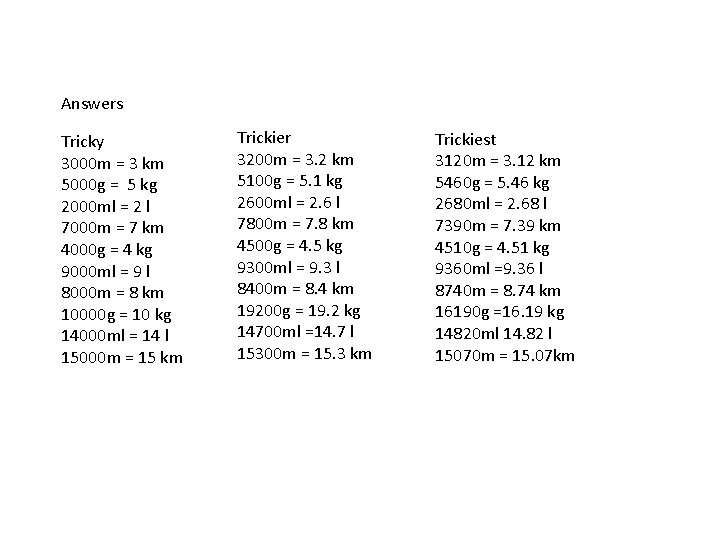
Answers Tricky 3000 m = 3 km 5000 g = 5 kg 2000 ml = 2 l 7000 m = 7 km 4000 g = 4 kg 9000 ml = 9 l 8000 m = 8 km 10000 g = 10 kg 14000 ml = 14 l 15000 m = 15 km Trickier 3200 m = 3. 2 km 5100 g = 5. 1 kg 2600 ml = 2. 6 l 7800 m = 7. 8 km 4500 g = 4. 5 kg 9300 ml = 9. 3 l 8400 m = 8. 4 km 19200 g = 19. 2 kg 14700 ml =14. 7 l 15300 m = 15. 3 km Trickiest 3120 m = 3. 12 km 5460 g = 5. 46 kg 2680 ml = 2. 68 l 7390 m = 7. 39 km 4510 g = 4. 51 kg 9360 ml =9. 36 l 8740 m = 8. 74 km 16190 g =16. 19 kg 14820 ml 14. 82 l 15070 m = 15. 07 km