
Year 4 Grammar and Punctuation Test 5 Guided

- Slides: 12
Year 4 Grammar and Punctuation Test 5 Guided Power. Point
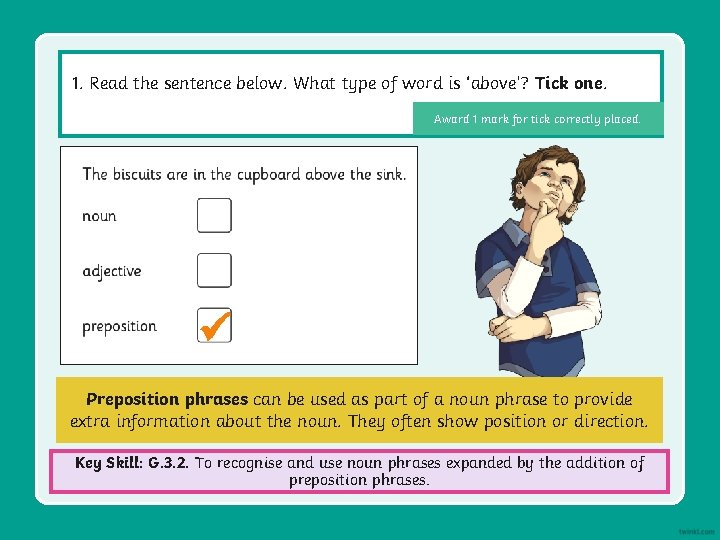
1. Read the sentence below. What type of word is ‘above’? Tick one. Award 1 mark for tick correctly placed. Preposition phrases can be used as part of a noun phrase to provide extra information about the noun. They often show position or direction. Key Skill: G. 3. 2. To recognise and use noun phrases expanded by the addition of preposition phrases.
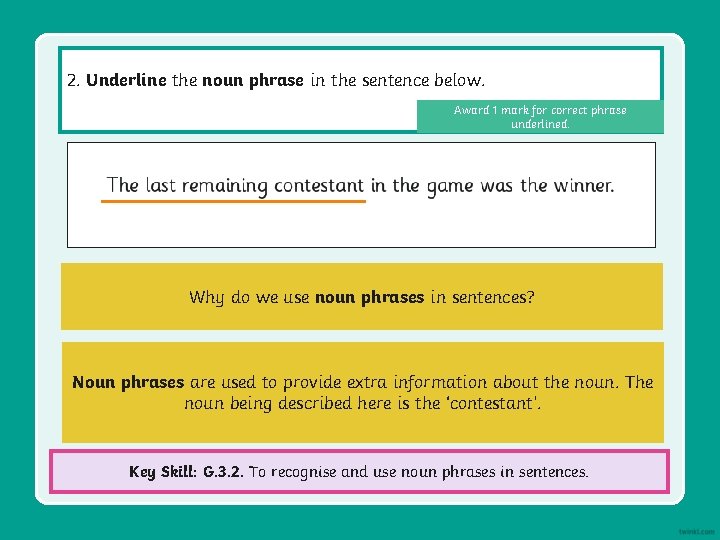
2. Underline the noun phrase in the sentence below. Award 1 mark for correct phrase underlined. Why do we use noun phrases in sentences? Noun phrases are used to provide extra information about the noun. The noun being described here is the ‘contestant’. Key Skill: G. 3. 2. To recognise and use noun phrases in sentences.
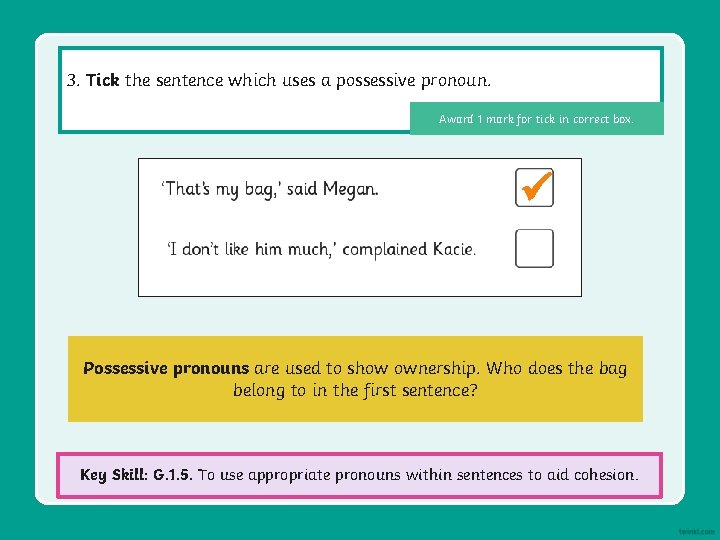
3. Tick the sentence which uses a possessive pronoun. Award 1 mark for tick in correct box. Possessive pronouns are used to show ownership. Who does the bag belong to in the first sentence? Key Skill: G. 1. 5. To use appropriate pronouns within sentences to aid cohesion.
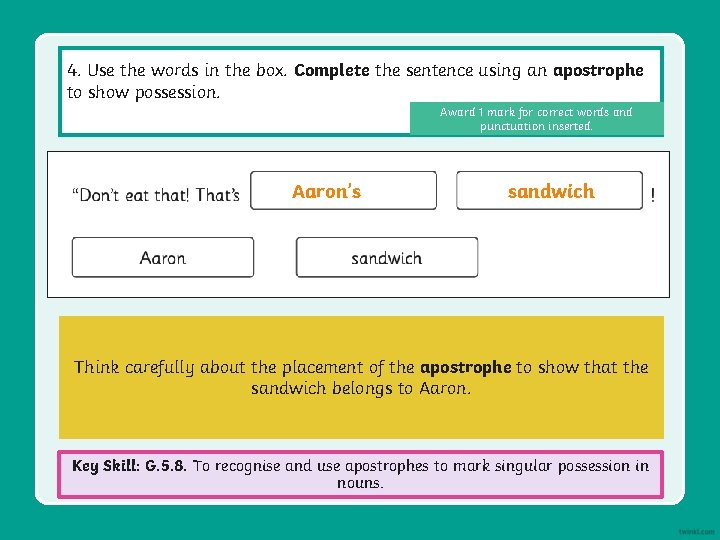
4. Use the words in the box. Complete the sentence using an apostrophe to show possession. Award 1 mark for correct words and punctuation inserted. Aaron’s sandwich Think carefully about the placement of the apostrophe to show that the sandwich belongs to Aaron. Key Skill: G. 5. 8. To recognise and use apostrophes to mark singular possession in nouns.
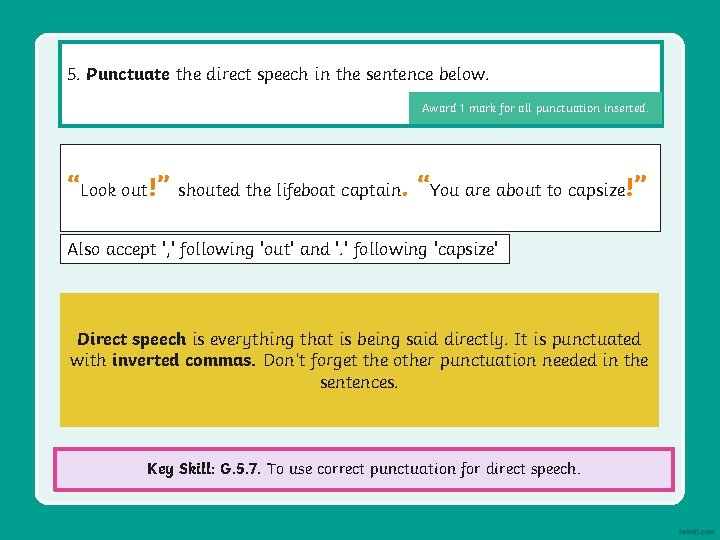
5. Punctuate the direct speech in the sentence below. Award 1 mark for all punctuation inserted. “Look out!” shouted the lifeboat captain. “You are about to capsize!” Also accept ', ' following 'out' and '. ' following 'capsize' Direct speech is everything that is being said directly. It is punctuated with inverted commas. Don’t forget the other punctuation needed in the sentences. Key Skill: G. 5. 7. To use correct punctuation for direct speech.
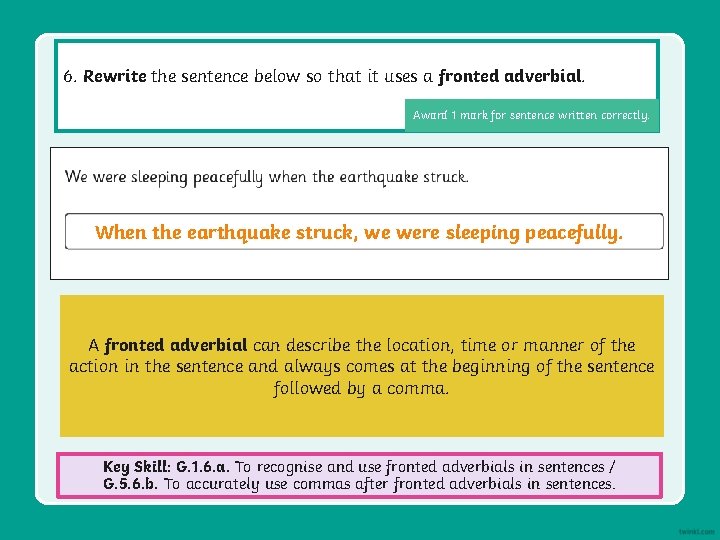
6. Rewrite the sentence below so that it uses a fronted adverbial. Award 1 mark for sentence written correctly. When the earthquake struck, we were sleeping peacefully. A fronted adverbial can describe the location, time or manner of the action in the sentence and always comes at the beginning of the sentence followed by a comma. Key Skill: G. 1. 6. a. To recognise and use fronted adverbials in sentences / G. 5. 6. b. To accurately use commas after fronted adverbials in sentences.
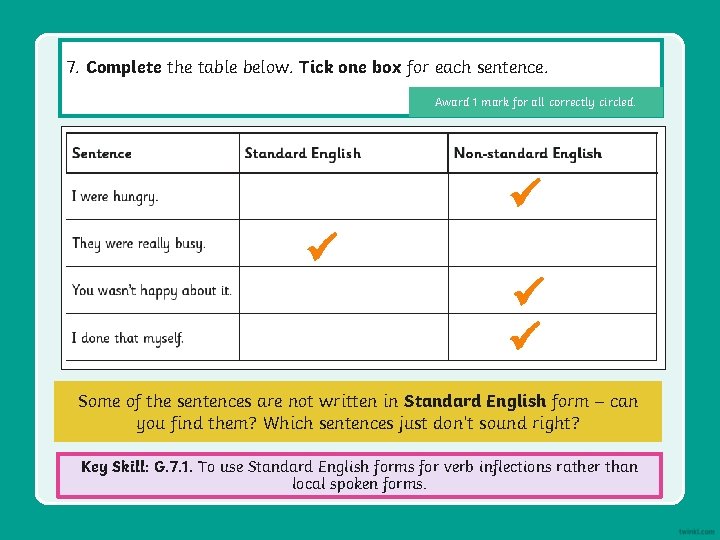
7. Complete the table below. Tick one box for each sentence. Award 1 mark for all correctly circled. Some of the sentences are not written in Standard English form – can you find them? Which sentences just don’t sound right? Key Skill: G. 7. 1. To use Standard English forms for verb inflections rather than local spoken forms.
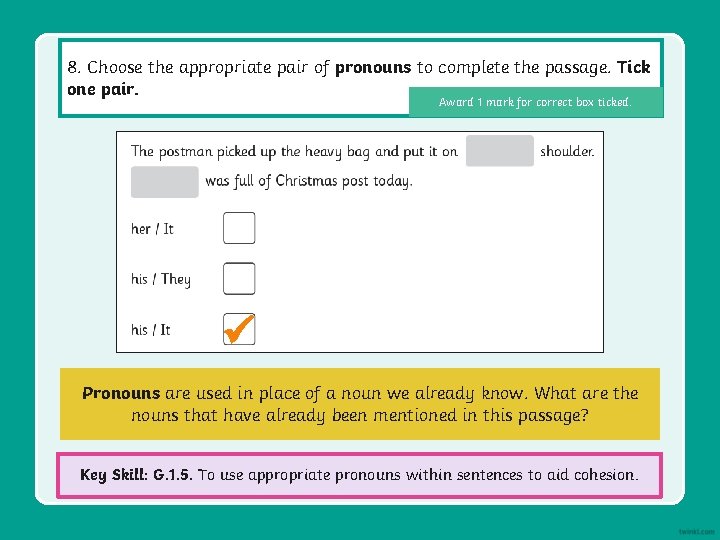
8. Choose the appropriate pair of pronouns to complete the passage. Tick one pair. Award 1 mark for correct box ticked. Pronouns are used in place of a noun we already know. What are the nouns that have already been mentioned in this passage? Key Skill: G. 1. 5. To use appropriate pronouns within sentences to aid cohesion.
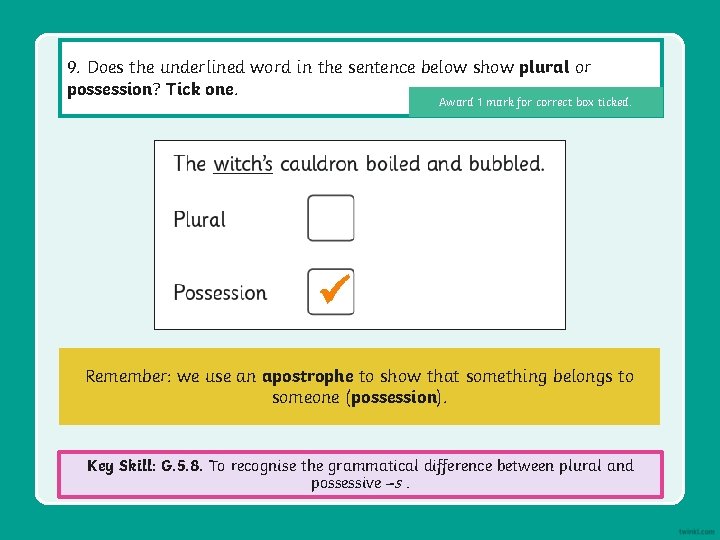
9. Does the underlined word in the sentence below show plural or possession? Tick one. Award 1 mark for correct box ticked. Remember: we use an apostrophe to show that something belongs to someone (possession). Key Skill: G. 5. 8. To recognise the grammatical difference between plural and possessive –s.
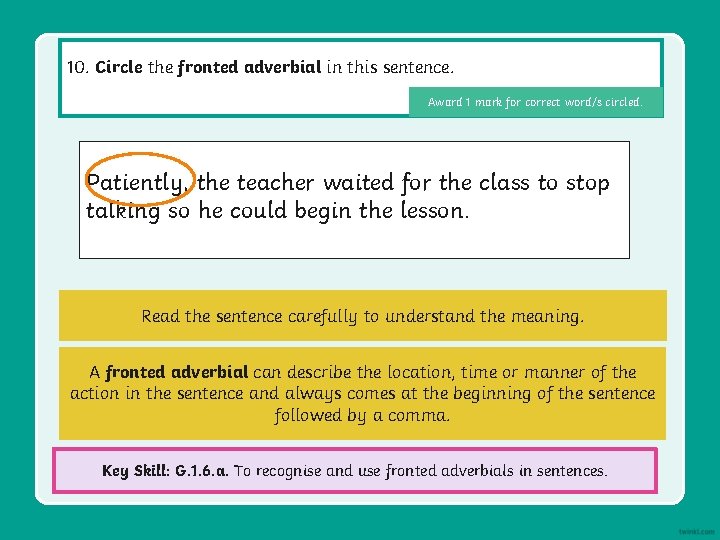
10. Circle the fronted adverbial in this sentence. Award 1 mark for correct word/s circled. Patiently, the teacher waited for the class to stop talking so he could begin the lesson. Read the sentence carefully to understand the meaning. A fronted adverbial can describe the location, time or manner of the action in the sentence and always comes at the beginning of the sentence followed by a comma. Key Skill: G. 1. 6. a. To recognise and use fronted adverbials in sentences.