
Year 4 Digestive System Knowledge Mat What happens
- Slides: 4
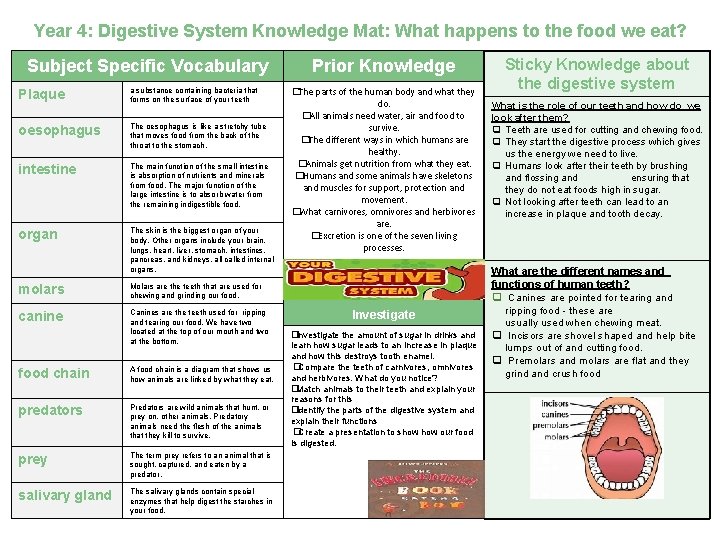
Year 4: Digestive System Knowledge Mat: What happens to the food we eat? Subject Specific Vocabulary Plaque a substance containing bacteria that forms on the surface of your teeth oesophagus The oesophagus is like a stretchy tube that moves food from the back of the throat to the stomach. intestine The main function of the small intestine is absorption of nutrients and minerals from food. The major function of the large intestine is to absorb water from the remaining indigestible food. organ The skin is the biggest organ of your body. Other organs include your brain, lungs, heart, liver, stomach, intestines, pancreas, and kidneys, all called internal organs. molars Molars are the teeth that are used for chewing and grinding our food. canine Canines are the teeth used for ripping and tearing our food. We have two located at the top of our mouth and two at the bottom. food chain A food chain is a diagram that shows us how animals are linked by what they eat. predators Predators are wild animals that hunt, or prey on, other animals. Predatory animals need the flesh of the animals that they kill to survive. prey The term prey refers to an animal that is sought, captured, and eaten by a predator. salivary gland The salivary glands contain special enzymes that help digest the starches in your food. Prior Knowledge �The parts of the human body and what they do. �All animals need water, air and food to survive. �The different ways in which humans are healthy. �Animals get nutrition from what they eat. �Humans and some animals have skeletons and muscles for support, protection and movement. �What carnivores, omnivores and herbivores are. �Excretion is one of the seven living processes. Investigate �Investigate the amount of sugar in drinks and learn how sugar leads to an increase in plaque and how this destroys tooth enamel. �Compare the teeth of carnivores, omnivores and herbivores. What do you notice? �Match animals to their teeth and explain your reasons for this �Identify the parts of the digestive system and explain their functions �Create a presentation to show our food is digested. Sticky Knowledge about the digestive system What is the role of our teeth and how do we look after them? q Teeth are used for cutting and chewing food. q They start the digestive process which gives us the energy we need to live. q Humans look after their teeth by brushing and flossing and ensuring that they do not eat foods high in sugar. q Not looking after teeth can lead to an increase in plaque and tooth decay. What are the different names and functions of human teeth? q Canines are pointed for tearing and ripping food - these are usually used when chewing meat. q Incisors are shovel shaped and help bite lumps out of and cutting food. q Premolars and molars are flat and they grind and crush food
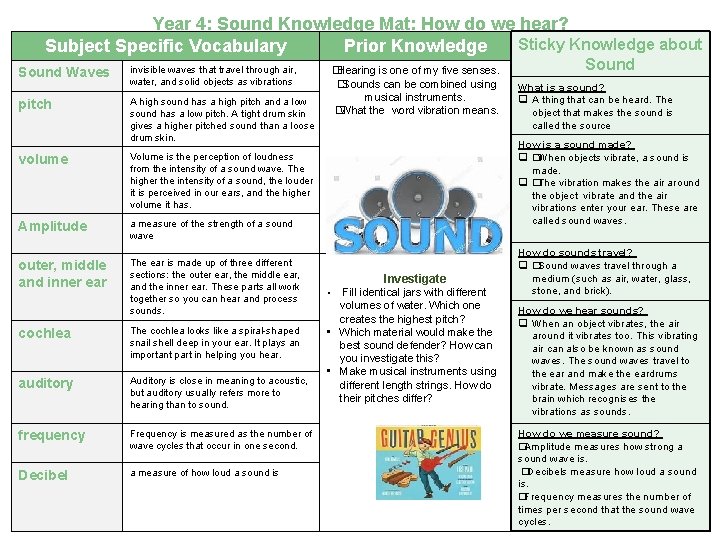
Year 4: Sound Knowledge Mat: How do we hear? Sticky Knowledge about Subject Specific Vocabulary Prior Knowledge Sound Waves invisible waves that travel through air, water, and solid objects as vibrations pitch A high sound has a high pitch and a low sound has a low pitch. A tight drum skin gives a higher pitched sound than a loose drum skin. volume Volume is the perception of loudness from the intensity of a sound wave. The higher the intensity of a sound, the louder it is perceived in our ears, and the higher volume it has. Amplitude a measure of the strength of a sound wave outer, middle and inner ear The ear is made up of three different sections: the outer ear, the middle ear, and the inner ear. These parts all work together so you can hear and process sounds. cochlea The cochlea looks like a spiral-shaped snail shell deep in your ear. It plays an important part in helping you hear. auditory Auditory is close in meaning to acoustic, but auditory usually refers more to hearing than to sound. frequency Frequency is measured as the number of wave cycles that occur in one second. Decibel a measure of how loud a sound is �Hearing is one of my five senses. �Sounds can be combined using musical instruments. �What the word vibration means. Sound What is a sound? q A thing that can be heard. The object that makes the sound is called the source How is a sound made? q �When objects vibrate, a sound is made. q �The vibration makes the air around the object vibrate and the air vibrations enter your ear. These are called sound waves. Investigate Fill identical jars with different volumes of water. Which one creates the highest pitch? • Which material would make the best sound defender? How can you investigate this? • Make musical instruments using different length strings. How do their pitches differ? • How do sounds travel? q �Sound waves travel through a medium (such as air, water, glass, stone, and brick). How do we hear sounds? q When an object vibrates, the air around it vibrates too. This vibrating air can also be known as sound waves. The sound waves travel to the ear and make the eardrums vibrate. Messages are sent to the brain which recognises the vibrations as sounds. How do we measure sound? �Amplitude measures how strong a sound wave is. �Decibels measure how loud a sound is. �Frequency measures the number of times per second that the sound wave cycles.
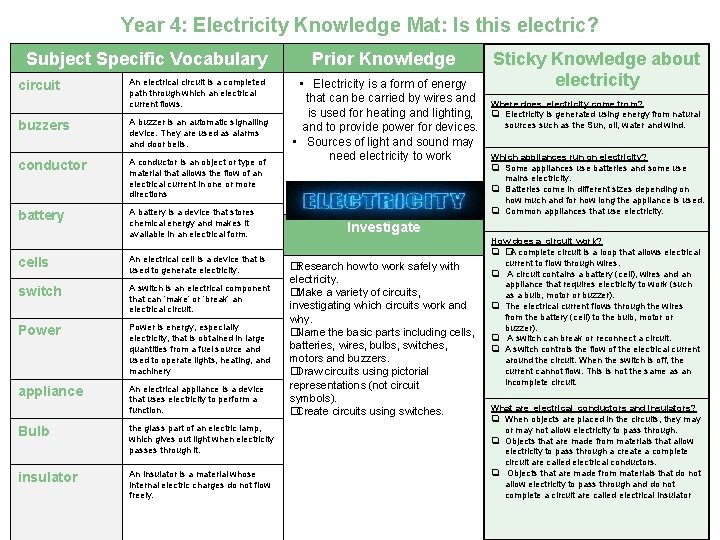
Year 4: Electricity Knowledge Mat: Is this electric? Subject Specific Vocabulary circuit An electrical circuit is a completed path through which an electrical current flows. buzzers A buzzer is an automatic signalling device. They are used as alarms and door bells. conductor A conductor is an object or type of material that allows the flow of an electrical current in one or more directions battery A battery is a device that stores chemical energy and makes it available in an electrical form. cells An electrical cell is a device that is used to generate electricity. switch A switch is an electrical component that can ‘make’ or ‘break’ an electrical circuit. Power is energy, especially electricity, that is obtained in large quantities from a fuel source and used to operate lights, heating, and machinery appliance An electrical appliance is a device that uses electricity to perform a function. Bulb the glass part of an electric lamp, which gives out light when electricity passes through it. insulator An insulator is a material whose internal electric charges do not flow freely. Prior Knowledge • Electricity is a form of energy that can be carried by wires and is used for heating and lighting, and to provide power for devices. • Sources of light and sound may need electricity to work Sticky Knowledge about electricity Where does electricity come from? q Electricity is generated using energy from natural sources such as the Sun, oil, water and wind. Which appliances run on electricity? q Some appliances use batteries and some use mains electricity. q Batteries come in different sizes depending on how much and for how long the appliance is used. q Common appliances that use electricity. Investigate �Research how to work safely with electricity. �Make a variety of circuits, investigating which circuits work and why. �Name the basic parts including cells, batteries, wires, bulbs, switches, motors and buzzers. �Draw circuits using pictorial representations (not circuit symbols). �Create circuits using switches. How does a circuit work? q �A complete circuit is a loop that allows electrical current to flow through wires. q A circuit contains a battery (cell), wires and an appliance that requires electricity to work (such as a bulb, motor or buzzer). q The electrical current flows through the wires from the battery (cell) to the bulb, motor or buzzer). q A switch can break or reconnect a circuit. q A switch controls the flow of the electrical current around the circuit. When the switch is off, the current cannot flow. This is not the same as an incomplete circuit. What are electrical conductors and insulators? q When objects are placed in the circuits, they may or may not allow electricity to pass through. q Objects that are made from materials that allow electricity to pass through a create a complete circuit are called electrical conductors. q Objects that are made from materials that do not allow electricity to pass through and do not complete a circuit are called electrical insulator
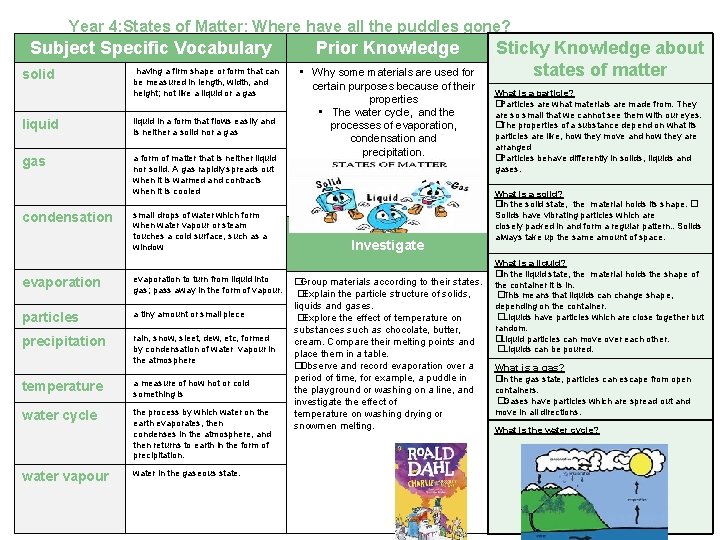
Year 4: States of Matter: Where have all the puddles gone? Subject Specific Vocabulary solid having a firm shape or form that can be measured in length, width, and height; not like a liquid or a gas liquid in a form that flows easily and is neither a solid nor a gas a form of matter that is neither liquid nor solid. A gas rapidly spreads out when it is warmed and contracts when it is cooled condensation small drops of water which form when water vapour or steam touches a cold surface, such as a window evaporation to turn from liquid into gas; pass away in the form of vapour. particles a tiny amount or small piece precipitation rain, snow, sleet, dew, etc, formed by condensation of water vapour in the atmosphere temperature a measure of how hot or cold something is water cycle the process by which water on the earth evaporates, then condenses in the atmosphere, and then returns to earth in the form of precipitation. water vapour water in the gaseous state. Prior Knowledge • Why some materials are used for certain purposes because of their properties • The water cycle, and the processes of evaporation, condensation and precipitation. Investigate �Group materials according to their states. �Explain the particle structure of solids, liquids and gases. �Explore the effect of temperature on substances such as chocolate, butter, cream. Compare their melting points and place them in a table. �Observe and record evaporation over a period of time, for example, a puddle in the playground or washing on a line, and investigate the effect of temperature on washing drying or snowmen melting. Sticky Knowledge about states of matter What is a particle? �Particles are what materials are made from. They are so small that we cannot see them with our eyes. �The properties of a substance depend on what its particles are like, how they move and how they are arranged �Particles behave differently in solids, liquids and gases. What is a solid? �In the solid state, the material holds its shape. � Solids have vibrating particles which are closely packed in and form a regular pattern. . Solids always take up the same amount of space. What is a liquid? �In the liquid state, the material holds the shape of the container it is in. �This means that liquids can change shape, depending on the container. �Liquids have particles which are close together but random. �Liquid particles can move over each other. �Liquids can be poured. What is a gas? �In the gas state, particles can escape from open containers. �Gases have particles which are spread out and move in all directions. What is the water cycle?