
Year 3 Writing Assessment Activities Pack Warmup Activities

- Slides: 10
Year 3 – Writing Assessment Activities Pack Warm-up Activities You might want to use one of the warm-up activities before your child starts writing. These are designed to be fun and to develop and hopefully increase your child’s vocabulary and perhaps even help with their spelling. Activity 1: Wanted Poster (writing to inform/entertain) Activity 2: Diary Entry (writing to inform/entertain) Activity 3: The Next Chapter (writing to entertain) There is no time limit for each of these activities. One activity might, for example, be done over a series of days. Children should attempt at least two out of the three activities. Completed activities should be submitted before …
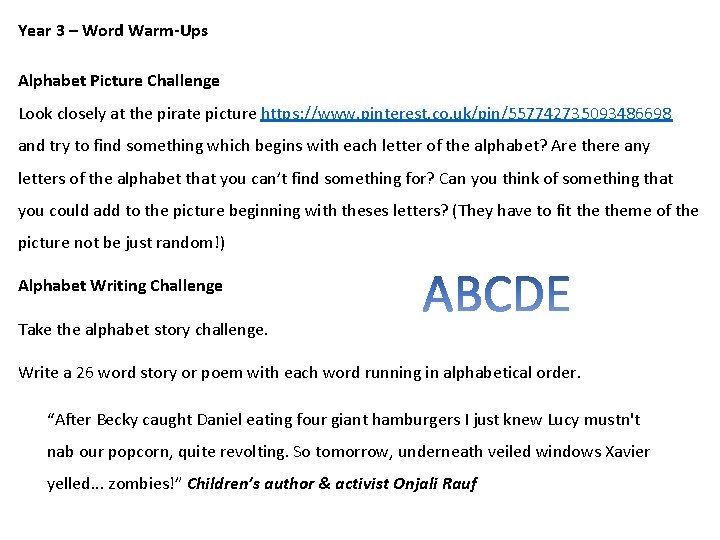
Year 3 – Word Warm-Ups Alphabet Picture Challenge Look closely at the pirate picture https: //www. pinterest. co. uk/pin/557742735093486698 and try to find something which begins with each letter of the alphabet? Are there any letters of the alphabet that you can’t find something for? Can you think of something that you could add to the picture beginning with theses letters? (They have to fit theme of the picture not be just random!) Alphabet Writing Challenge Take the alphabet story challenge. Write a 26 word story or poem with each word running in alphabetical order. “After Becky caught Daniel eating four giant hamburgers I just knew Lucy mustn't nab our popcorn, quite revolting. So tomorrow, underneath veiled windows Xavier yelled. . . zombies!” Children’s author & activist Onjali Rauf
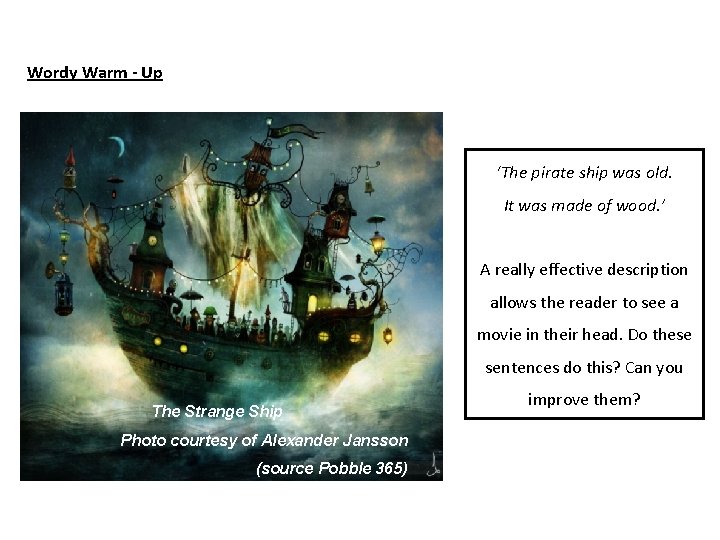
Wordy Warm - Up ‘The pirate ship was old. It was made of wood. ’ A really effective description allows the reader to see a movie in their head. Do these sentences do this? Can you The Strange Ship Photo courtesy of Alexander Jansson (source Pobble 365) improve them?
Notes for parents These activities are designed to assess what children can do independently. Children will need help in reading and understanding each task. They will benefit from your encouragement whilst they are doing each one, but please ensure that the ideas and the work are the children’s own. We are not expecting or looking for perfection, any mistakes your child may make will help us plan their next steps in learning. If you do help, or support your child in any way please can you make a note so that we know if certain parts have been aided by an adult. E. g. Edna asked how to spell the words underlined and I helped her sound them out/use her word mat OR Edgar needed lots of encouragement to start his invitation so we wrote the first sentence together. More than anything try to allow your child’s imagination to shine through. Ask them, and encourage them, to do the very best they can by motivating them with praise for their efforts. Do feel free to make suggestions to your children but try to phrase them as questions rather than giving them the answer. E. g. Have you used your word mat to help you with your spelling?
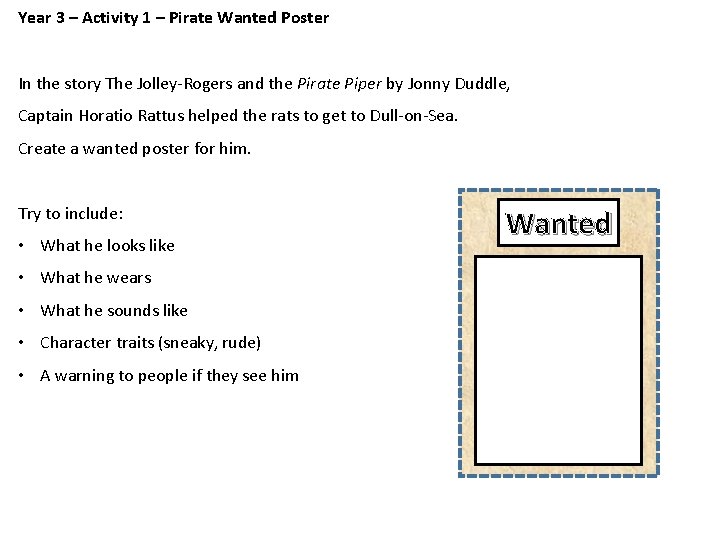
Year 3 – Activity 1 – Pirate Wanted Poster In the story The Jolley-Rogers and the Pirate Piper by Jonny Duddle, Captain Horatio Rattus helped the rats to get to Dull-on-Sea. Create a wanted poster for him. Try to include: • What he looks like • What he wears • What he sounds like • Character traits (sneaky, rude) • A warning to people if they see him Wanted
Year 3 – Activity 2 – Diary entry Write a diary entry – either as Captain Horatio Rattus or Arthur after this scene. Remember to write like they would think. Captain Horatio Rattus Arthur How is he feeling after dropping the rats off? When he wakes up and finds out what happened, how does he feel? What does he think of Dull-on-Sea? What would the consequences of Where does he go next? letting the rats into Dull-on Sea be? _______ _______ _______ _______
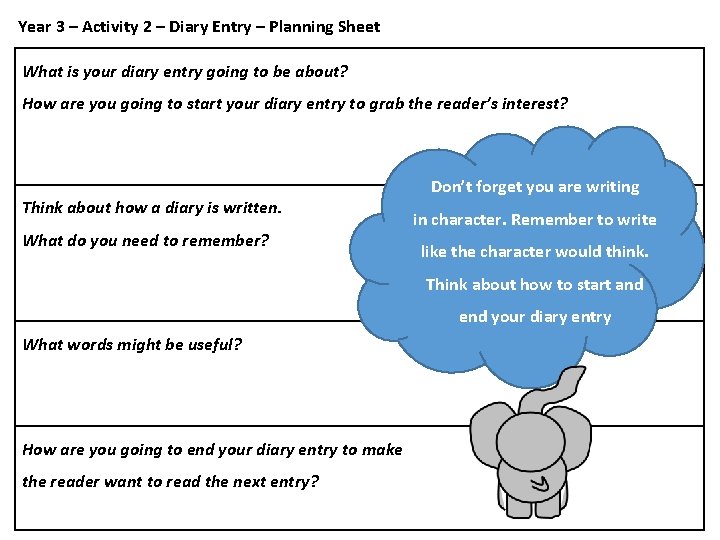
Year 3 – Activity 2 – Diary Entry – Planning Sheet What is your diary entry going to be about? How are you going to start your diary entry to grab the reader’s interest? Think about how a diary is written. What do you need to remember? Don’t forget you are writing in character. Remember to write. like the character would think. Think about how to start and end your diary entry What words might be useful? How are you going to end your diary entry to make the reader want to read the next entry?
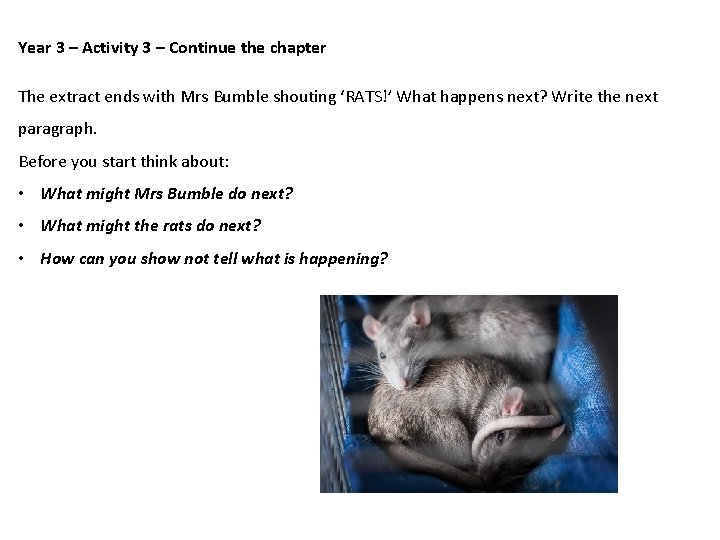
Year 3 – Activity 3 – Continue the chapter The extract ends with Mrs Bumble shouting ‘RATS!’ What happens next? Write the next paragraph. Before you start think about: • What might Mrs Bumble do next? • What might the rats do next? • How can you show not tell what is happening?
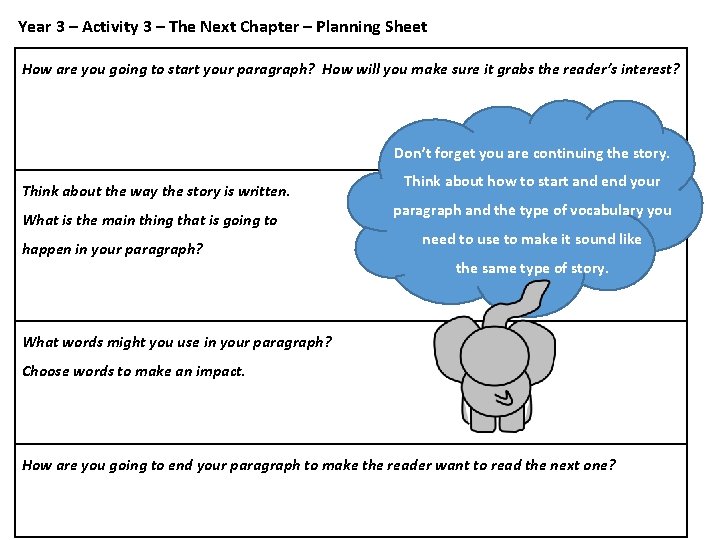
Year 3 – Activity 3 – The Next Chapter – Planning Sheet How are you going to start your paragraph? How will you make sure it grabs the reader’s interest? Don’t forget you are continuing the story. Think about the way the story is written. What is the main thing that is going to happen in your paragraph? Think about how to start and end your paragraph and the. type of vocabulary you need to use to make it sound like the same type of story. What words might you use in your paragraph? Choose words to make an impact. How are you going to end your paragraph to make the reader want to read the next one?
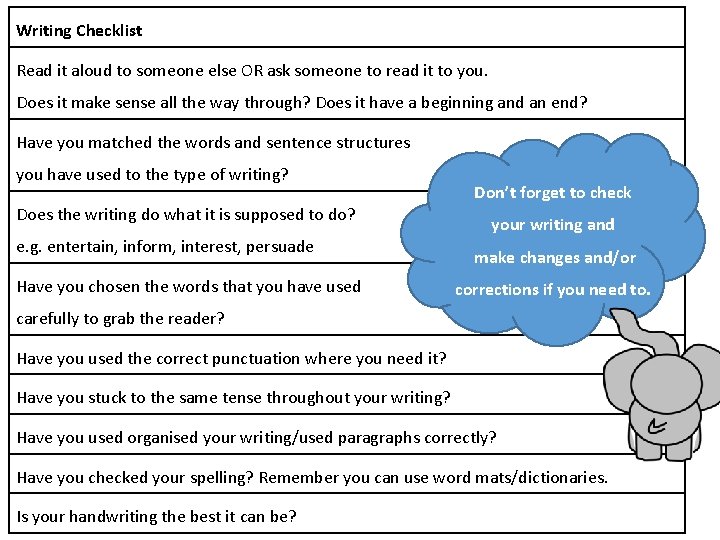
Writing Checklist Read it aloud to someone else OR ask someone to read it to you. Does it make sense all the way through? Does it have a beginning and an end? Have you matched the words and sentence structures you have used to the type of writing? Does the writing do what it is supposed to do? e. g. entertain, inform, interest, persuade Have you chosen the words that you have used Don’t forget to check your writing and make changes and/or corrections if you need to. carefully to grab the reader? Have you used the correct punctuation where you need it? Have you stuck to the same tense throughout your writing? Have you used organised your writing/used paragraphs correctly? Have you checked your spelling? Remember you can use word mats/dictionaries. Is your handwriting the best it can be?