
Year 3 National Curriculum Non Core Subjects Explanation
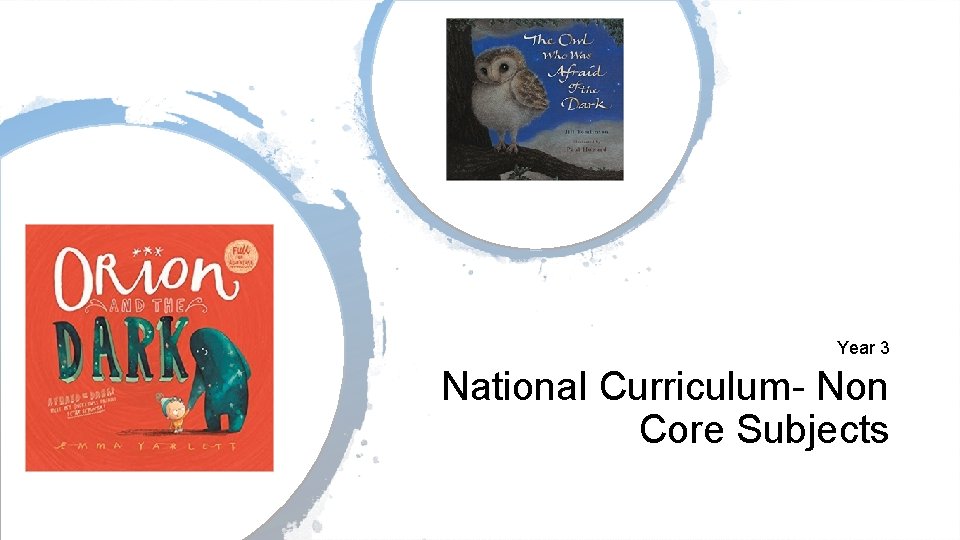
Year 3 National Curriculum- Non Core Subjects
Explanation During this unit, History and Geography will not be taught. The final showcase will be……… A Science Fair where parents/carers will be invited to try the investigations.
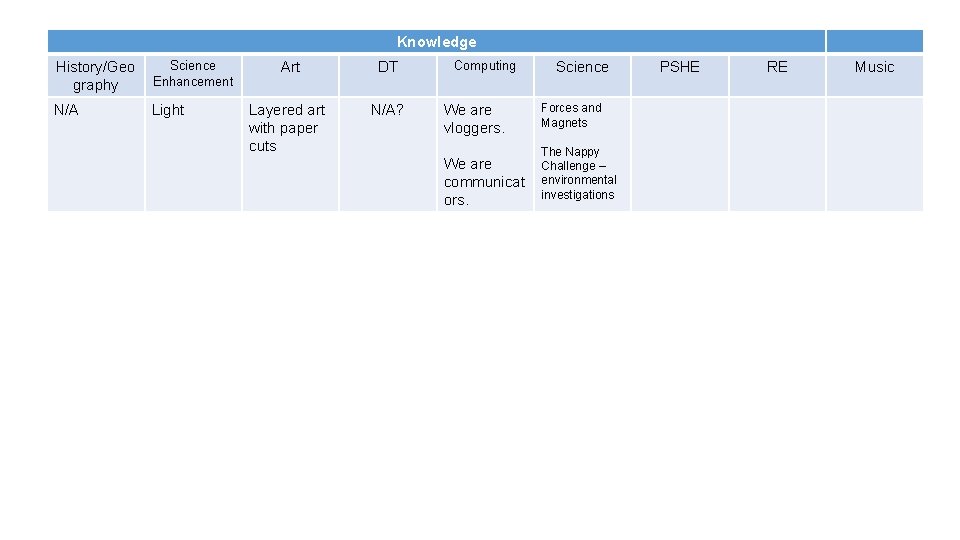
Knowledge History/Geo graphy Science Enhancement N/A Light Art DT Layered art with paper cuts N/A? Computing We are vloggers. We are communicat ors. Science Forces and Magnets The Nappy Challenge – environmental investigations PSHE RE Music
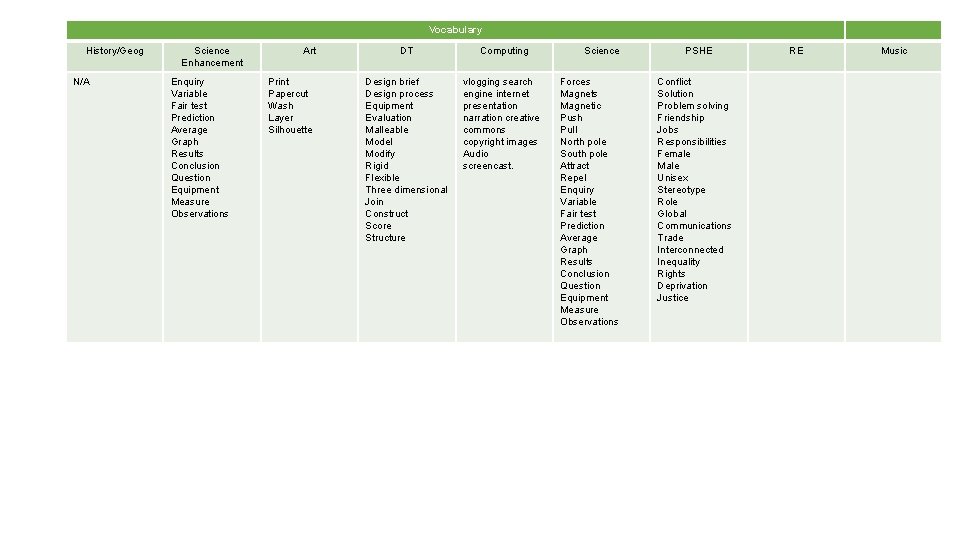
Vocabulary History/Geog N/A Science Enhancement Enquiry Variable Fair test Prediction Average Graph Results Conclusion Question Equipment Measure Observations Art Print Papercut Wash Layer Silhouette DT Computing Design brief Design process Equipment Evaluation Malleable Model Modify Rigid Flexible Three dimensional Join Construct Score Structure vlogging search engine internet presentation narration creative commons copyright images Audio screencast. Science Forces Magnetic Push Pull North pole South pole Attract Repel Enquiry Variable Fair test Prediction Average Graph Results Conclusion Question Equipment Measure Observations PSHE Conflict Solution Problem solving Friendship Jobs Responsibilities Female Male Unisex Stereotype Role Global Communications Trade Interconnected Inequality Rights Deprivation Justice RE Music
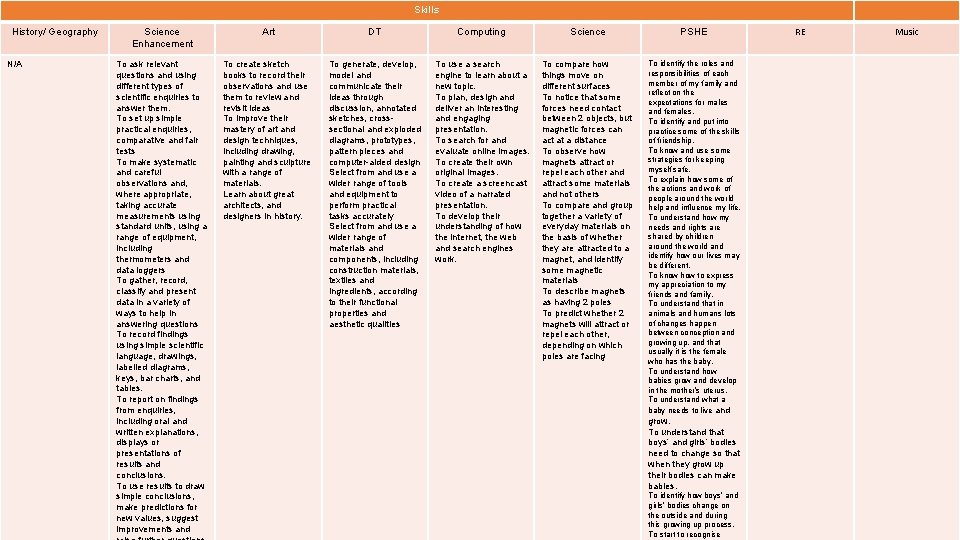
Skills History/ Geography N/A Science Enhancement Art DT Computing Science PSHE To ask relevant questions and using different types of scientific enquiries to answer them. To set up simple practical enquiries, comparative and fair tests To make systematic and careful observations and, where appropriate, taking accurate measurements using standard units, using a range of equipment, including thermometers and data loggers To gather, record, classify and present data in a variety of ways to help in answering questions To record findings using simple scientific language, drawings, labelled diagrams, keys, bar charts, and tables. To report on findings from enquiries, including oral and written explanations, displays or presentations of results and conclusions. To use results to draw simple conclusions, make predictions for new values, suggest improvements and To create sketch books to record their observations and use them to review and revisit ideas To improve their mastery of art and design techniques, including drawing, painting and sculpture with a range of materials. Learn about great architects, and designers in history. To generate, develop, model and communicate their ideas through discussion, annotated sketches, crosssectional and exploded diagrams, prototypes, pattern pieces and computer-aided design Select from and use a wider range of tools and equipment to perform practical tasks accurately Select from and use a wider range of materials and components, including construction materials, textiles and ingredients, according to their functional properties and aesthetic qualities To use a search engine to learn about a new topic. To plan, design and deliver an interesting and engaging presentation. To search for and evaluate online images. To create their own original images. To create a screencast video of a narrated presentation. To develop their understanding of how the internet, the web and search engines work. To compare how things move on different surfaces To notice that some forces need contact between 2 objects, but magnetic forces can act at a distance To observe how magnets attract or repel each other and attract some materials and not others To compare and group together a variety of everyday materials on the basis of whether they are attracted to a magnet, and identify some magnetic materials To describe magnets as having 2 poles To predict whether 2 magnets will attract or repel each other, depending on which poles are facing To identify the roles and responsibilities of each member of my family and reflect on the expectations for males and females. To identify and put into practice some of the skills of friendship. To know and use some strategies for keeping myself safe. To explain how some of the actions and work of people around the world help and influence my life. To understand how my needs and rights are shared by children around the world and identify how our lives may be different. To know how to express my appreciation to my friends and family. To understand that in animals and humans lots of changes happen between conception and growing up, and that usually it is the female who has the baby. To understand how babies grow and develop in the mother’s uterus. To understand what a baby needs to live and grow. To understand that boys’ and girls’ bodies need to change so that when they grow up their bodies can make babies. To identify how boys’ and girls’ bodies change on the outside and during this growing up process. To start to recognise RE Music
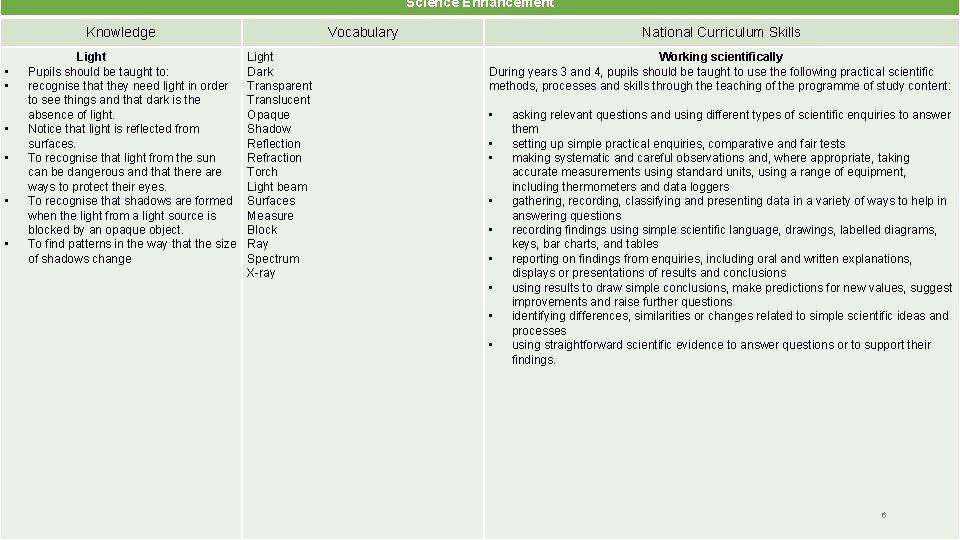
Science Enhancement Knowledge • • • Light Pupils should be taught to: recognise that they need light in order to see things and that dark is the absence of light. Notice that light is reflected from surfaces. To recognise that light from the sun can be dangerous and that there are ways to protect their eyes. To recognise that shadows are formed when the light from a light source is blocked by an opaque object. To find patterns in the way that the size of shadows change Vocabulary Light Dark Transparent Translucent Opaque Shadow Reflection Refraction Torch Light beam Surfaces Measure Block Ray Spectrum X-ray National Curriculum Skills Working scientifically During years 3 and 4, pupils should be taught to use the following practical scientific methods, processes and skills through the teaching of the programme of study content: • • • asking relevant questions and using different types of scientific enquiries to answer them setting up simple practical enquiries, comparative and fair tests making systematic and careful observations and, where appropriate, taking accurate measurements using standard units, using a range of equipment, including thermometers and data loggers gathering, recording, classifying and presenting data in a variety of ways to help in answering questions recording findings using simple scientific language, drawings, labelled diagrams, keys, bar charts, and tables reporting on findings from enquiries, including oral and written explanations, displays or presentations of results and conclusions using results to draw simple conclusions, make predictions for new values, suggest improvements and raise further questions identifying differences, similarities or changes related to simple scientific ideas and processes using straightforward scientific evidence to answer questions or to support their findings. 6
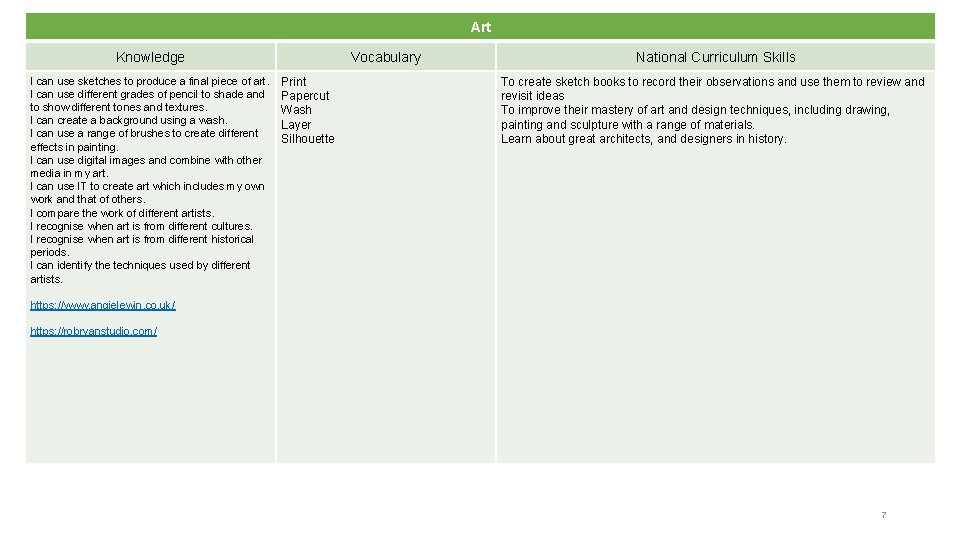
Art Knowledge I can use sketches to produce a final piece of art. I can use different grades of pencil to shade and to show different tones and textures. I can create a background using a wash. I can use a range of brushes to create different effects in painting. I can use digital images and combine with other media in my art. I can use IT to create art which includes my own work and that of others. I compare the work of different artists. I recognise when art is from different cultures. I recognise when art is from different historical periods. I can identify the techniques used by different artists. Vocabulary Print Papercut Wash Layer Silhouette National Curriculum Skills To create sketch books to record their observations and use them to review and revisit ideas To improve their mastery of art and design techniques, including drawing, painting and sculpture with a range of materials. Learn about great architects, and designers in history. https: //www. angielewin. co. uk/ https: //robryanstudio. com/ 7
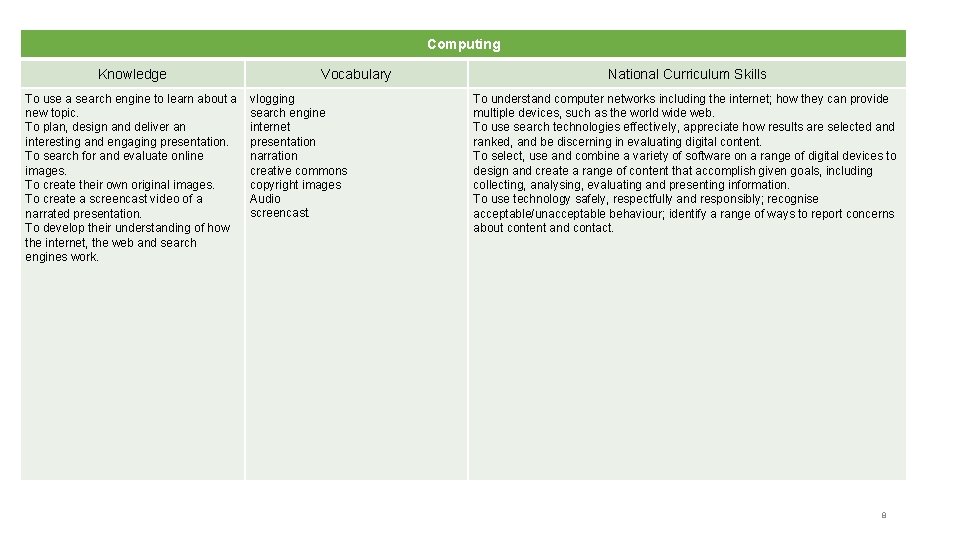
Computing Knowledge To use a search engine to learn about a new topic. To plan, design and deliver an interesting and engaging presentation. To search for and evaluate online images. To create their own original images. To create a screencast video of a narrated presentation. To develop their understanding of how the internet, the web and search engines work. Vocabulary vlogging search engine internet presentation narration creative commons copyright images Audio screencast. National Curriculum Skills To understand computer networks including the internet; how they can provide multiple devices, such as the world wide web. To use search technologies effectively, appreciate how results are selected and ranked, and be discerning in evaluating digital content. To select, use and combine a variety of software on a range of digital devices to design and create a range of content that accomplish given goals, including collecting, analysing, evaluating and presenting information. To use technology safely, respectfully and responsibly; recognise acceptable/unacceptable behaviour; identify a range of ways to report concerns about content and contact. 8
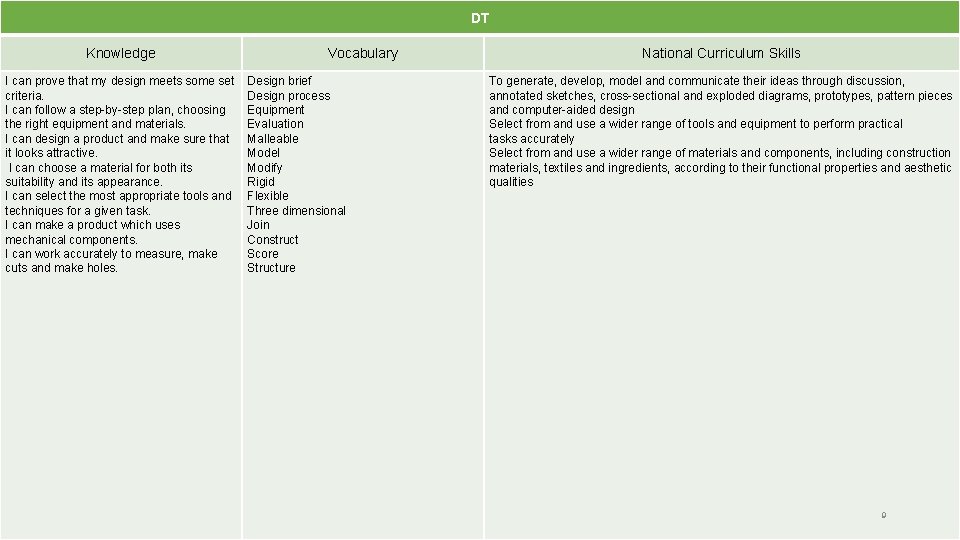
DT Knowledge I can prove that my design meets some set criteria. I can follow a step-by-step plan, choosing the right equipment and materials. I can design a product and make sure that it looks attractive. I can choose a material for both its suitability and its appearance. I can select the most appropriate tools and techniques for a given task. I can make a product which uses mechanical components. I can work accurately to measure, make cuts and make holes. Vocabulary Design brief Design process Equipment Evaluation Malleable Model Modify Rigid Flexible Three dimensional Join Construct Score Structure National Curriculum Skills To generate, develop, model and communicate their ideas through discussion, annotated sketches, cross-sectional and exploded diagrams, prototypes, pattern pieces and computer-aided design Select from and use a wider range of tools and equipment to perform practical tasks accurately Select from and use a wider range of materials and components, including construction materials, textiles and ingredients, according to their functional properties and aesthetic qualities 9
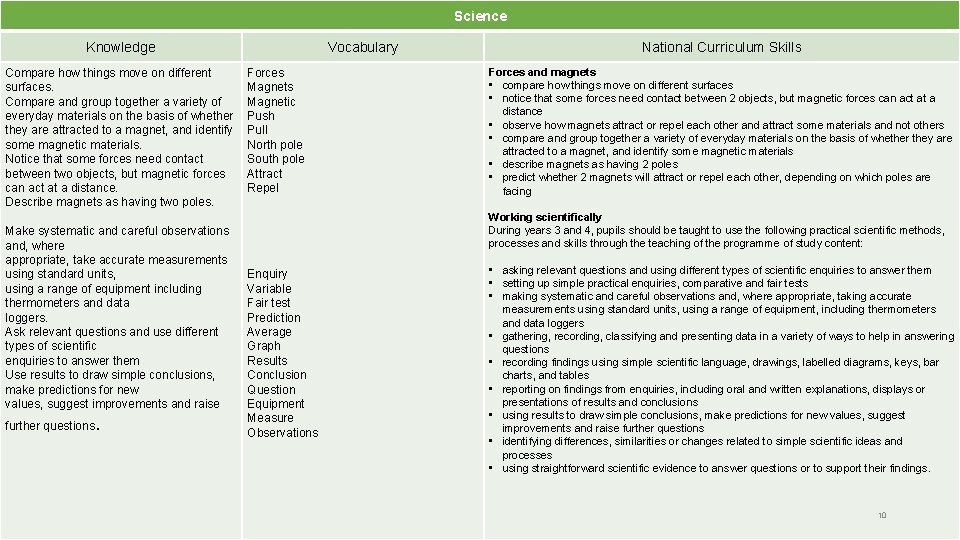
Science Knowledge Compare how things move on different surfaces. Compare and group together a variety of everyday materials on the basis of whether they are attracted to a magnet, and identify some magnetic materials. Notice that some forces need contact between two objects, but magnetic forces can act at a distance. Describe magnets as having two poles. Make systematic and careful observations and, where appropriate, take accurate measurements using standard units, using a range of equipment including thermometers and data loggers. Ask relevant questions and use different types of scientific enquiries to answer them Use results to draw simple conclusions, make predictions for new values, suggest improvements and raise . further questions Vocabulary Forces Magnetic Push Pull North pole South pole Attract Repel National Curriculum Skills Forces and magnets • compare how things move on different surfaces • notice that some forces need contact between 2 objects, but magnetic forces can act at a distance • observe how magnets attract or repel each other and attract some materials and not others • compare and group together a variety of everyday materials on the basis of whether they are attracted to a magnet, and identify some magnetic materials • describe magnets as having 2 poles • predict whether 2 magnets will attract or repel each other, depending on which poles are facing Working scientifically During years 3 and 4, pupils should be taught to use the following practical scientific methods, processes and skills through the teaching of the programme of study content: Enquiry Variable Fair test Prediction Average Graph Results Conclusion Question Equipment Measure Observations • asking relevant questions and using different types of scientific enquiries to answer them • setting up simple practical enquiries, comparative and fair tests • making systematic and careful observations and, where appropriate, taking accurate measurements using standard units, using a range of equipment, including thermometers and data loggers • gathering, recording, classifying and presenting data in a variety of ways to help in answering questions • recording findings using simple scientific language, drawings, labelled diagrams, keys, bar charts, and tables • reporting on findings from enquiries, including oral and written explanations, displays or presentations of results and conclusions • using results to draw simple conclusions, make predictions for new values, suggest improvements and raise further questions • identifying differences, similarities or changes related to simple scientific ideas and processes • using straightforward scientific evidence to answer questions or to support their findings. 10
RE Knowledge Vocabulary National Curriculum 11
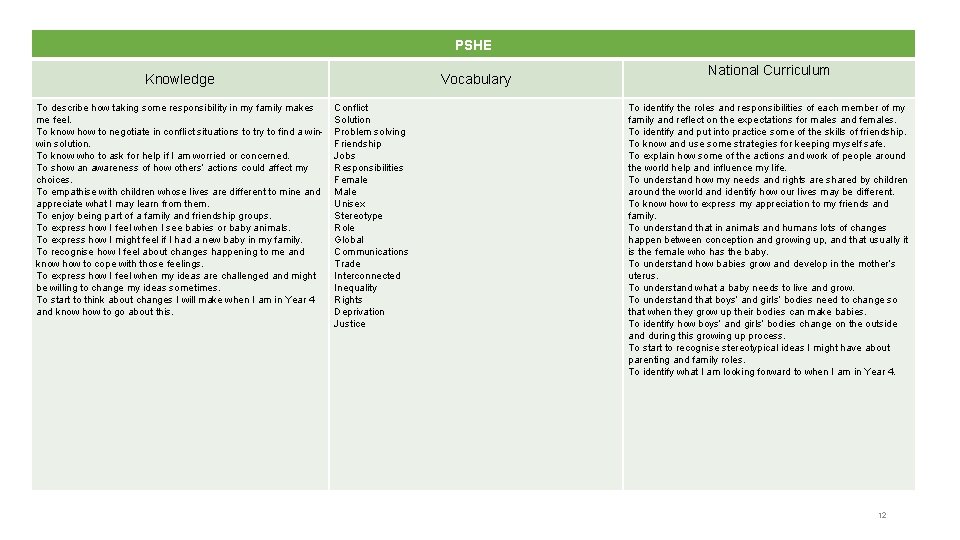
PSHE Knowledge To describe how taking some responsibility in my family makes me feel. To know how to negotiate in conflict situations to try to find a winwin solution. To know who to ask for help if I am worried or concerned. To show an awareness of how others’ actions could affect my choices. To empathise with children whose lives are different to mine and appreciate what I may learn from them. To enjoy being part of a family and friendship groups. To express how I feel when I see babies or baby animals. To express how I might feel if I had a new baby in my family. To recognise how I feel about changes happening to me and know how to cope with those feelings. To express how I feel when my ideas are challenged and might be willing to change my ideas sometimes. To start to think about changes I will make when I am in Year 4 and know how to go about this. Vocabulary Conflict Solution Problem solving Friendship Jobs Responsibilities Female Male Unisex Stereotype Role Global Communications Trade Interconnected Inequality Rights Deprivation Justice National Curriculum To identify the roles and responsibilities of each member of my family and reflect on the expectations for males and females. To identify and put into practice some of the skills of friendship. To know and use some strategies for keeping myself safe. To explain how some of the actions and work of people around the world help and influence my life. To understand how my needs and rights are shared by children around the world and identify how our lives may be different. To know how to express my appreciation to my friends and family. To understand that in animals and humans lots of changes happen between conception and growing up, and that usually it is the female who has the baby. To understand how babies grow and develop in the mother’s uterus. To understand what a baby needs to live and grow. To understand that boys’ and girls’ bodies need to change so that when they grow up their bodies can make babies. To identify how boys’ and girls’ bodies change on the outside and during this growing up process. To start to recognise stereotypical ideas I might have about parenting and family roles. To identify what I am looking forward to when I am in Year 4. 12
Music Knowledge Vocabulary National Curriculum 13
Assessment for learning • The assessments should take place at the end of each taught unit or and the end of the topic • Assessments need to be linked to the knowledge objectives that have been taught. 14
- Slides: 14