
YEAR 3 4 Curriculum guide to parents OVERVIEW


- Slides: 19
YEAR 3 &4 Curriculum guide to parents
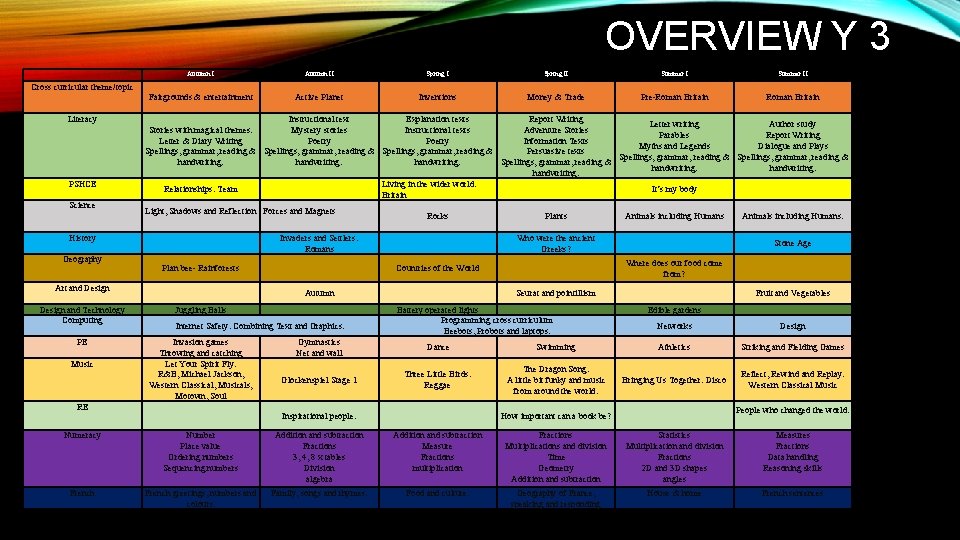
OVERVIEW Y 3 Autumn II Spring II Summer II Fairgrounds & entertainment Active Planet Inventions Money & Trade Pre-Roman Britain Cross curricular theme/topic Literacy PSHCE Science Instructional text Explanation texts Report Writing Letter writing Author study Mystery stories Instructional texts Adventure Stories with magical themes. Parables Report Writing Letter & Diary Writing Poetry Information Texts Myths and Legends Dialogue and Plays Spellings, grammar, reading & Persuasive texts Spellings, grammar, reading & handwriting. Living in the wider world: Relationships: Team It’s my body Britain Light, Shadows and Reflection Forces and Magnets History Geography Invaders and Settlers: Romans Plan bee- Rainforests Art and Design Juggling Balls PE Invasion games Throwing and catching Let Your Spirit Fly: R&B, Michael Jackson, Western Classical, Musicals, Motown, Soul Animals including Humans. Stone Age Where does our food come from? Countries of the World Internet Safety. Combining Text and Graphics. RE Plants Who were the ancient Greeks? Autumn Design and Technology Computing Music Rocks Seurat and pointillism Battery operated lights Programming cross curriculum Beebots, Probots and laptops. Fruit and Vegetables Edible gardens Networks Design Gymnastics Net and wall Dance Swimming Athletics Striking and Fielding Games Glockenspiel Stage 1 Three Little Birds: Reggae The Dragon Song: A little bit funky and music from around the world. Bringing Us Together: Disco Reflect, Rewind and Replay: Western Classical Music Inspirational people. People who changed the world. How important can a book be? Numeracy Number Place value Ordering numbers Sequencing numbers Addition and subtraction Fractions 3, 4, 8 x tables Division algebra Addition and subtraction Measure Fractions multiplication Fractions Multiplications and division Time Geometry Addition and subtraction Statistics Multiplication and division Fractions 2 D and 3 D shapes angles Measures Fractions Data handling Reasoning skills French greetings, numbers and colours. Family, songs and rhymes. Food and culture. Geography of France, speaking and responding House & home French sentences
OVERVIEWS – YR 4
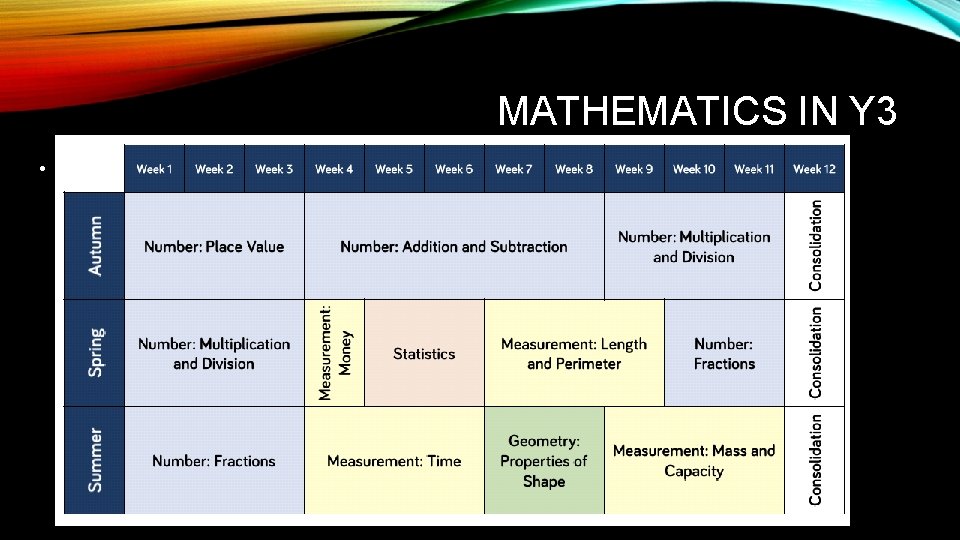
MATHEMATICS IN Y 3 • Non negotiable- standards
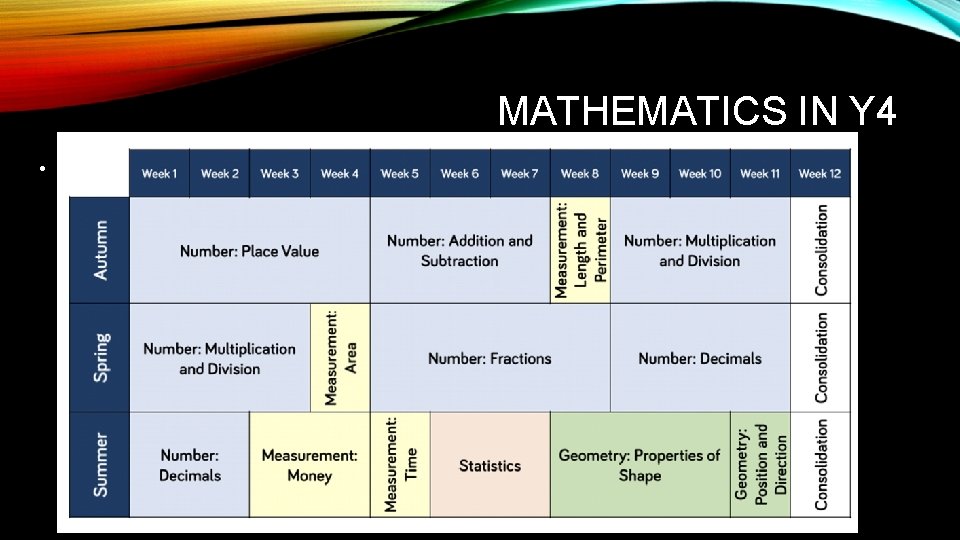
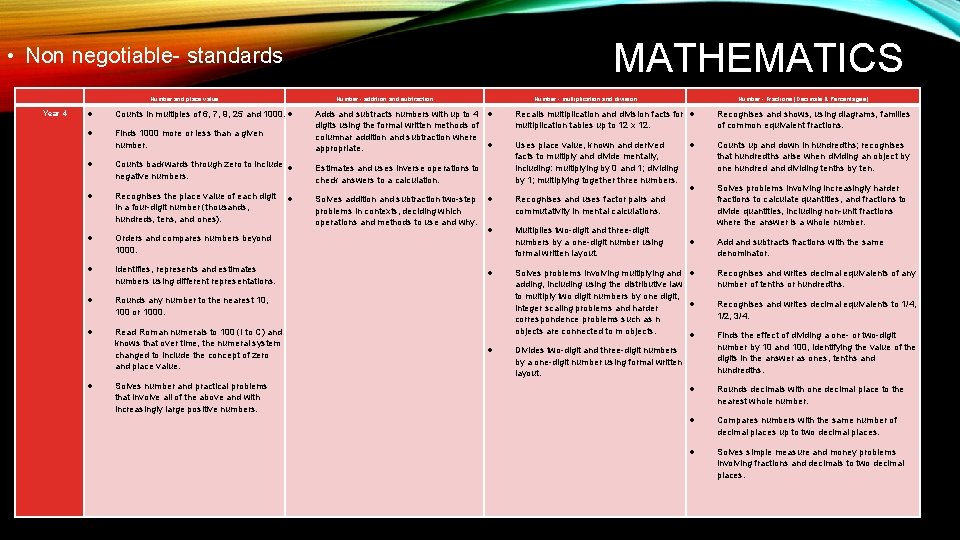
MATHEMATICS IN Y 4 • Non negotiable- standards
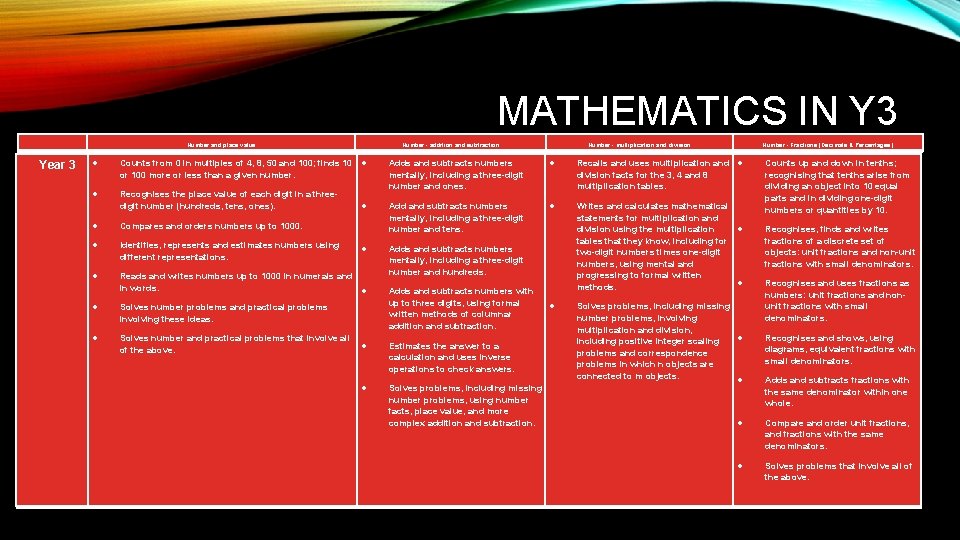
MATHEMATICS IN Y 3 Number and place value Year 3 Counts from 0 in multiples of 4, 8, 50 and 100; finds 10 or 100 more or less than a given number. Recognises the place value of each digit in a threedigit number (hundreds, tens, ones). Compares and orders numbers up to 1000. Identifies, represents and estimates numbers using different representations. Reads and writes numbers up to 1000 in numerals and in words. Solves number problems and practical problems involving these ideas. Solves number and practical problems that involve all of the above. Number - addition and subtraction Number - multiplication and division Number - Fractions (Decimals & Percentages) Adds and subtracts numbers mentally, including a three-digit number and ones. Recalls and uses multiplication and division facts for the 3, 4 and 8 multiplication tables. Add and subtracts numbers mentally, including a three-digit number and tens. Writes and calculates mathematical statements for multiplication and division using the multiplication tables that they know, including for two-digit numbers times one-digit numbers, using mental and progressing to formal written methods. Adds and subtracts numbers mentally, including a three-digit number and hundreds. Adds and subtracts numbers with up to three digits, using formal written methods of columnar addition and subtraction. Estimates the answer to a calculation and uses inverse operations to check answers. Solves problems, including missing number problems, using number facts, place value, and more complex addition and subtraction. Counts up and down in tenths; recognising that tenths arise from dividing an object into 10 equal parts and in dividing one-digit numbers or quantities by 10. Recognises, finds and writes fractions of a discrete set of objects: unit fractions and non-unit fractions with small denominators. Recognises and uses fractions as numbers: unit fractions and nonunit fractions with small denominators. Solves problems, including missing number problems, involving multiplication and division, including positive integer scaling problems and correspondence problems in which n objects are connected to m objects. Recognises and shows, using diagrams, equivalent fractions with small denominators. Adds and subtracts fractions with the same denominator within one whole. Compare and order unit fractions, and fractions with the same denominators. Solves problems that involve all of the above.
MATHEMATICS • Non negotiable- standards Number and place value Year 4 Number - addition and subtraction Counts in multiples of 6, 7, 9, 25 and 1000. Finds 1000 more or less than a given number. Adds and subtracts numbers with up to 4 digits using the formal written methods of columnar addition and subtraction where appropriate. Counts backwards through zero to include negative numbers. Estimates and uses inverse operations to check answers to a calculation. Recognises the place value of each digit in a four-digit number (thousands, hundreds, tens, and ones). Solves addition and subtraction two-step problems in contexts, deciding which operations and methods to use and why. Orders and compares numbers beyond 1000. Identifies, represents and estimates numbers using different representations. Rounds any number to the nearest 10, 100 or 1000. Read Roman numerals to 100 (I to C) and knows that over time, the numeral system changed to include the concept of zero and place value. Solves number and practical problems that involve all of the above and with increasingly large positive numbers. Number - multiplication and division Number - Fractions (Decimals & Percentages) Recalls multiplication and division facts for multiplication tables up to 12 x 12. Recognises and shows, using diagrams, families of common equivalent fractions. Uses place value, known and derived facts to multiply and divide mentally, including: multiplying by 0 and 1; dividing by 1; multiplying together three numbers. Counts up and down in hundredths; recognises that hundredths arise when dividing an object by one hundred and dividing tenths by ten. Recognises and uses factor pairs and commutativity in mental calculations. Multiplies two-digit and three-digit numbers by a one-digit number using formal written layout. Solves problems involving increasingly harder fractions to calculate quantities, and fractions to divide quantities, including non-unit fractions where the answer is a whole number. Add and subtracts fractions with the same denominator. Solves problems involving multiplying and adding, including using the distributive law to multiply two digit numbers by one digit, integer scaling problems and harder correspondence problems such as n objects are connected to m objects. Divides two-digit and three-digit numbers by a one-digit number using formal written layout. Recognises and writes decimal equivalents of any number of tenths or hundredths. Recognises and writes decimal equivalents to 1/4, 1/2, 3/4. Finds the effect of dividing a one- or two-digit number by 10 and 100, identifying the value of the digits in the answer as ones, tenths and hundredths. Rounds decimals with one decimal place to the nearest whole number. Compares numbers with the same number of decimal places up to two decimal places. Solves simple measure and money problems involving fractions and decimals to two decimal places.
EXAMPLES OF QUESTIONS
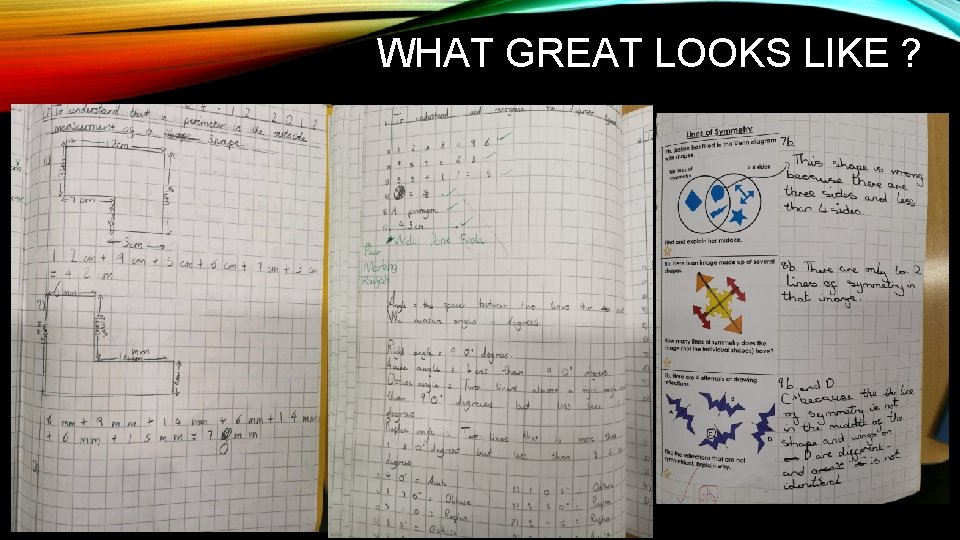
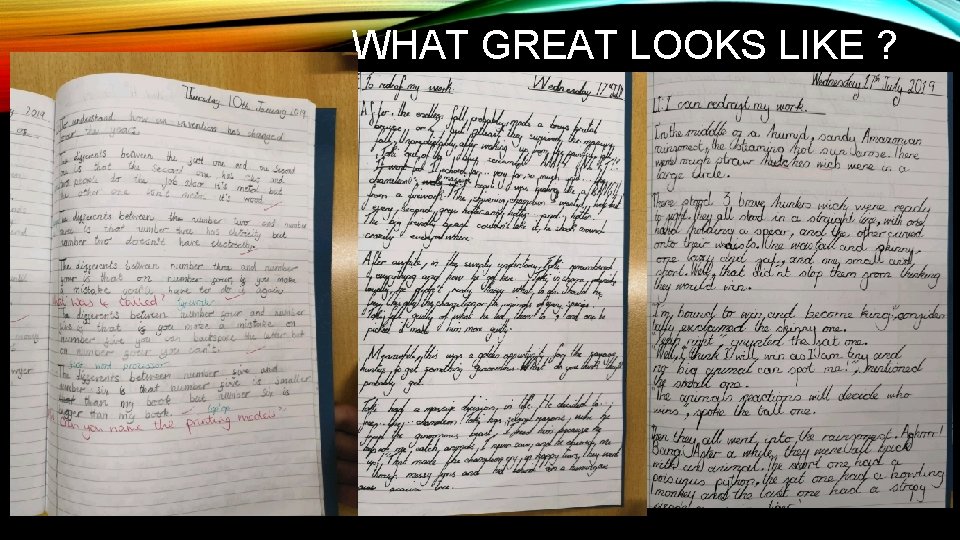
WHAT GREAT LOOKS LIKE ?
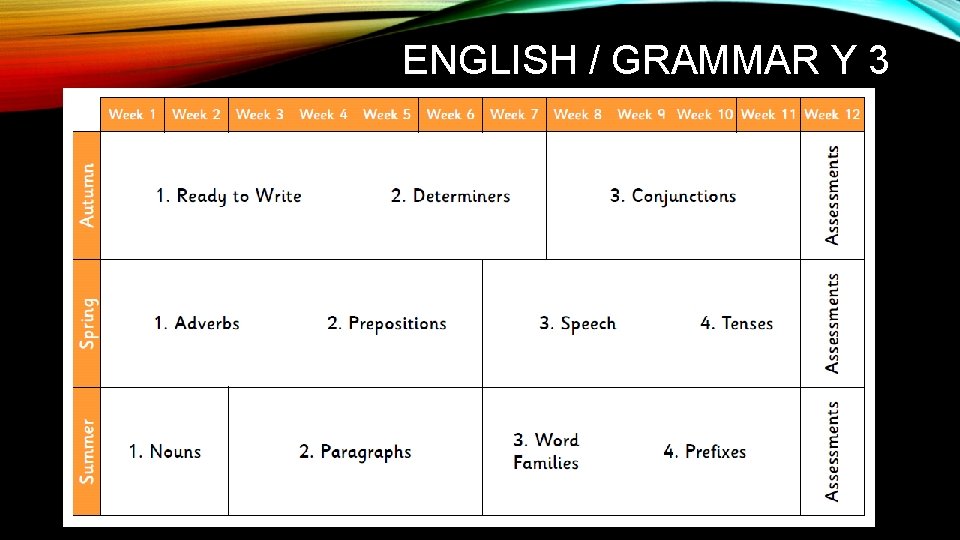
ENGLISH / GRAMMAR Y 3
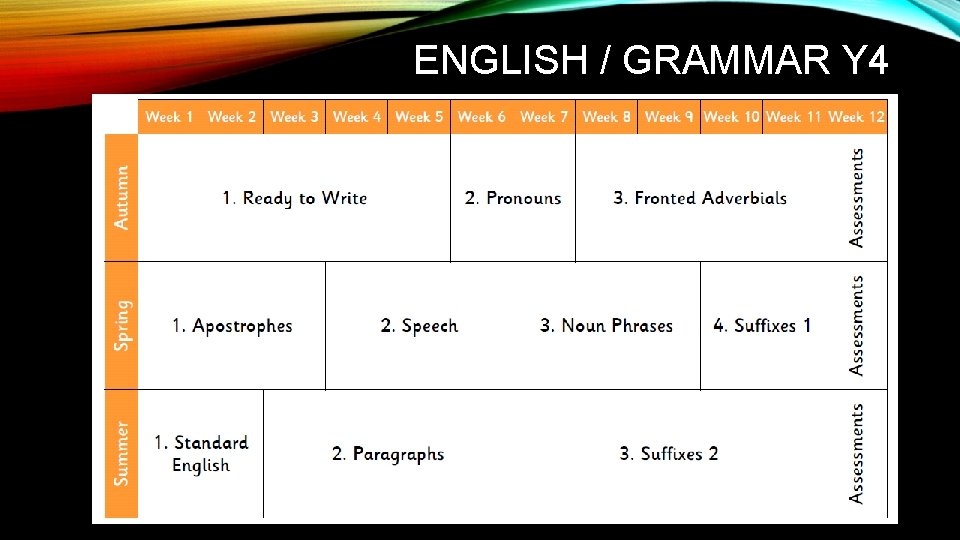
ENGLISH / GRAMMAR Y 4
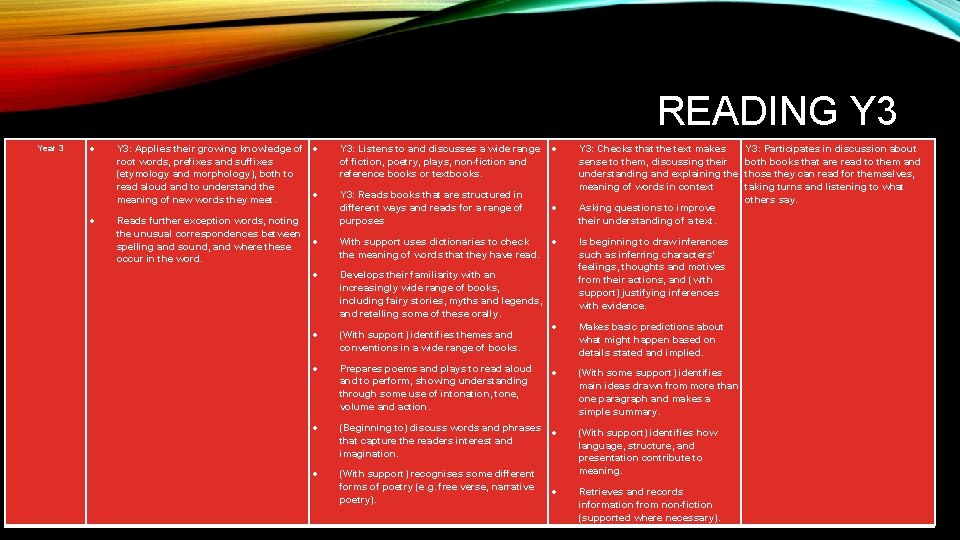
READING Y 3 Year 3 Y 3: Applies their growing knowledge of root words, prefixes and suffixes (etymology and morphology), both to read aloud and to understand the meaning of new words they meet. Reads further exception words, noting the unusual correspondences between spelling and sound, and where these occur in the word. Y 3: Listens to and discusses a wide range of fiction, poetry, plays, non-fiction and reference books or textbooks. Y 3: Reads books that are structured in different ways and reads for a range of purposes Y 3: Checks that the text makes sense to them, discussing their understanding and explaining the meaning of words in context Asking questions to improve their understanding of a text. Is beginning to draw inferences such as inferring characters' feelings, thoughts and motives from their actions, and (with support) justifying inferences with evidence. Makes basic predictions about what might happen based on details stated and implied. With support uses dictionaries to check the meaning of words that they have read. Develops their familiarity with an increasingly wide range of books, including fairy stories, myths and legends, and retelling some of these orally. (With support) identifies themes and conventions in a wide range of books. Prepares poems and plays to read aloud and to perform, showing understanding through some use of intonation, tone, volume and action. (With some support) identifies main ideas drawn from more than one paragraph and makes a simple summary. (Beginning to) discuss words and phrases that capture the readers interest and imagination. (With support) recognises some different forms of poetry (e. g. free verse, narrative poetry). (With support) identifies how language, structure, and presentation contribute to meaning. Retrieves and records information from non-fiction (supported where necessary). Y 3: Participates in discussion about both books that are read to them and those they can read for themselves, taking turns and listening to what others say.
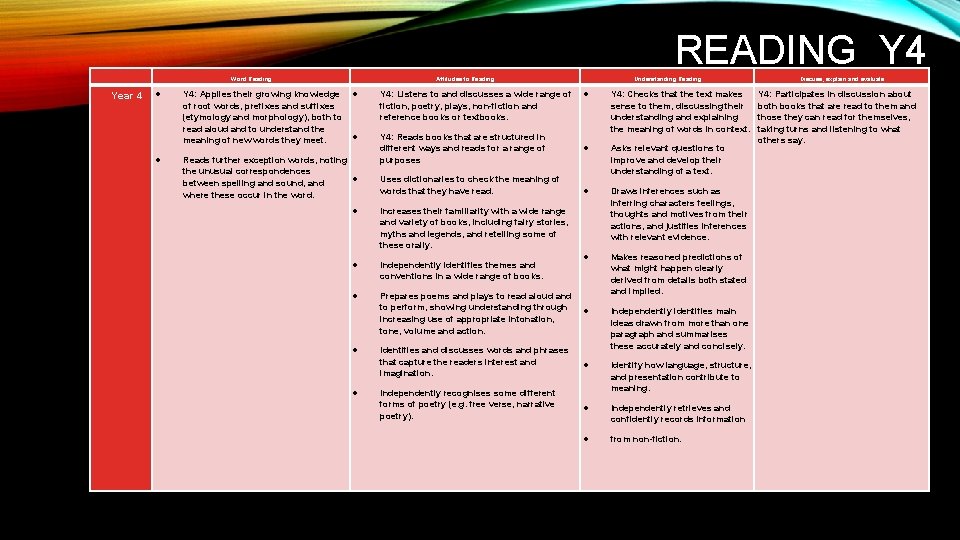
READING Y 4 Word Reading Year 4 Y 4: Applies their growing knowledge of root words, prefixes and suffixes (etymology and morphology), both to read aloud and to understand the meaning of new words they meet. Attitudes to Reading Y 4: Listens to and discusses a wide range of fiction, poetry, plays, non-fiction and reference books or textbooks. Y 4: Reads books that are structured in different ways and reads for a range of purposes Reads further exception words, noting the unusual correspondences between spelling and sound, and where these occur in the word. Uses dictionaries to check the meaning of words that they have read. Understanding Reading Y 4: Checks that the text makes sense to them, discussing their understanding and explaining the meaning of words in context. Asks relevant questions to improve and develop their understanding of a text. Draws inferences such as inferring characters feelings, thoughts and motives from their actions, and justifies inferences with relevant evidence. Makes reasoned predictions of what might happen clearly derived from details both stated and implied. Increases their familiarity with a wide range and variety of books, including fairy stories, myths and legends, and retelling some of these orally. Independently identifies themes and conventions in a wide range of books. Prepares poems and plays to read aloud and to perform, showing understanding through increasing use of appropriate intonation, tone, volume and action. Identifies and discusses words and phrases that capture the readers interest and imagination. Independently identifies main ideas drawn from more than one paragraph and summarises these accurately and concisely. Independently recognises some different forms of poetry (e. g. free verse, narrative poetry). Identify how language, structure, and presentation contribute to meaning. Independently retrieves and confidently records information from non-fiction. Discuss, explain and evaluate Y 4: Participates in discussion about both books that are read to them and those they can read for themselves, taking turns and listening to what others say.
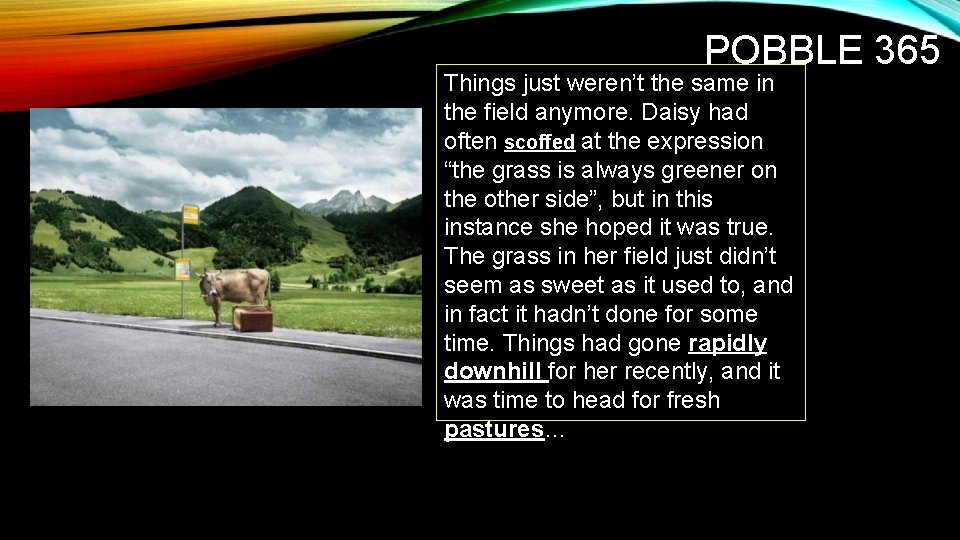
POBBLE 365 Things just weren’t the same in the field anymore. Daisy had often scoffed at the expression “the grass is always greener on the other side”, but in this instance she hoped it was true. The grass in her field just didn’t seem as sweet as it used to, and in fact it hadn’t done for some time. Things had gone rapidly downhill for her recently, and it was time to head for fresh pastures…
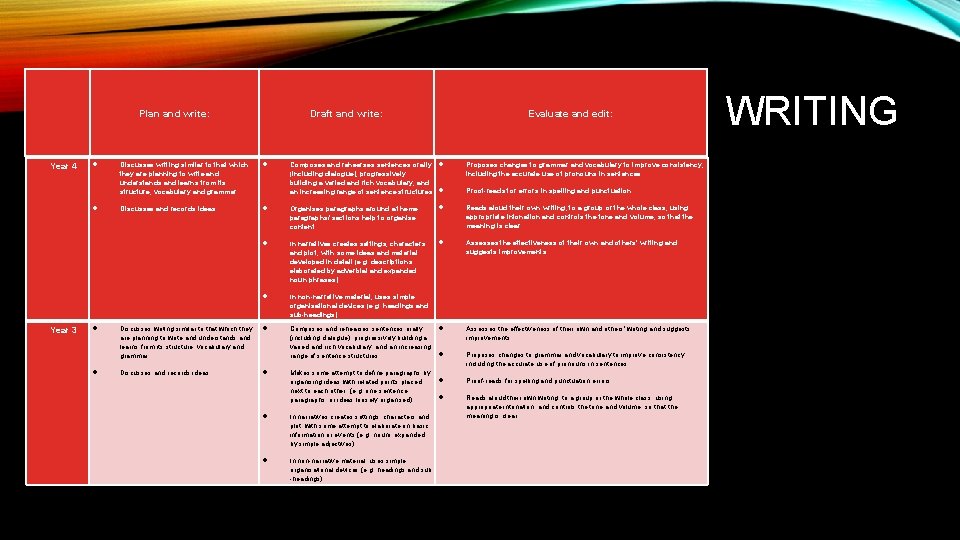
Plan and write: Year 4 Discusses writing similar to that which they are planning to write and understands and learns from its structure, vocabulary and grammar. Discusses and records ideas. Draft and write: Year 3 Discusses writing similar to that which they are planning to write and understands and learns from its structure, vocabulary and grammar. Discusses and records ideas. Composes and rehearses sentences orally (including dialogue), progressively building a varied and rich vocabulary, and an increasing range of sentence structures. Organises paragraphs around a theme: paragraphs/ sections help to organise content. In narratives creates settings, characters and plot, with some ideas and material developed in detail (e. g. descriptions elaborated by adverbial and expanded noun phrases). Evaluate and edit: Proposes changes to grammar and vocabulary to improve consistency, including the accurate use of pronouns in sentences. Proof-reads for errors in spelling and punctuation. Reads aloud their own writing, to a group or the whole class, using appropriate intonation and controls the tone and volume, so that the meaning is clear. Assesses the effectiveness of their own and others' writing and suggests improvements. In non-narrative material, uses simple organisational devices (e. g. headings and sub-headings). Composes and rehearses sentences orally (including dialogue), progressively building a varied and rich vocabulary, and an increasing range of sentence structures. Makes some attempt to define paragraphs by organising ideas with related points placed next to each other. (e. g. one sentence paragraphs, or ideas loosely organised). In narratives creates settings, characters and plot, with some attempt to elaborate on basic information or events (e. g. nouns expanded by simple adjectives). In non-narrative material, uses simple organisational devices (e. g. headings and sub -headings). Assesses the effectiveness of their own and others' writing and suggests improvements. Proposes changes to grammar and vocabulary to improve consistency, including the accurate use of pronouns in sentences. Proof-reads for spelling and punctuation errors. Reads aloud their own writing, to a group or the whole class, using appropriate intonation, and controls the tone and volume, so that the meaning is clear. WRITING
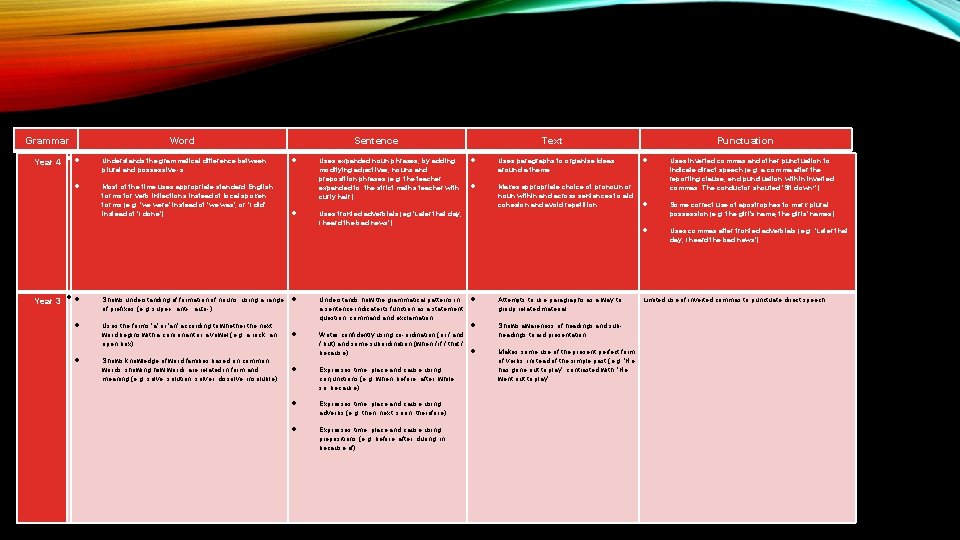
Grammar Word Year 4 Year 3 Understands the grammatical difference between plural and possessive -s Most of the time uses appropriate standard English forms for verb inflections instead of local spoken forms (e. g. 'we were' instead of 'we was', or 'I did' instead of 'I done'). Shows understanding of formation of nouns, using a range of prefixes (e. g. super-, anti-, auto-). Uses the forms 'a' or 'an' according to whether the next word begins with a consonant or a vowel (e. g. a rock, an open box). Shows knowledge of word families based on common words, showing how words are related in form and meaning (e. g. solve, solution, solver, dissolve, insoluble). Sentence Uses expanded noun phrases, by adding modifying adjectives, nouns and preposition phrases (e. g. the teacher expanded to: the strict maths teacher with curly hair). Text Uses paragraphs to organise ideas around a theme. Makes appropriate choice of pronoun or noun within and across sentences to aid cohesion and avoid repetition. Uses fronted adverbials (eg 'Later that day, I heard the bad news'). Understands how the grammatical patterns in a sentence indicate its function as a statement, question, command exclamation. Writes confidently using co-ordination (or / and / but) and some subordination (when / if / that / because) Expresses time, place and cause using conjunctions (e. g. when, before, after, while, so, because). Expresses time, place and cause using adverbs (e. g. then, next, soon, therefore). Expresses time, place and cause using prepositions (e. g. before, after, during, in, because of). Punctuation Attempts to use paragraphs as a way to group related material. Shows awareness of headings and subheadings to aid presentation. Makes some use of the present perfect form of verbs, instead of the simple past (e. g. 'He has gone out to play', contrasted with, 'He went out to play'. Uses inverted commas and other punctuation to indicate direct speech (e. g. a comma after the reporting clause; end punctuation within inverted commas: The conductor shouted 'Sit down!') Some correct use of apostrophes to mark plural possession (e. g. the girl's name, the girls' names). Uses commas after fronted adverbials (e. g. 'Later that day, I heard the bad news'). Limited use of inverted commas to punctuate direct speech.
WHAT GREAT LOOKS LIKE ?
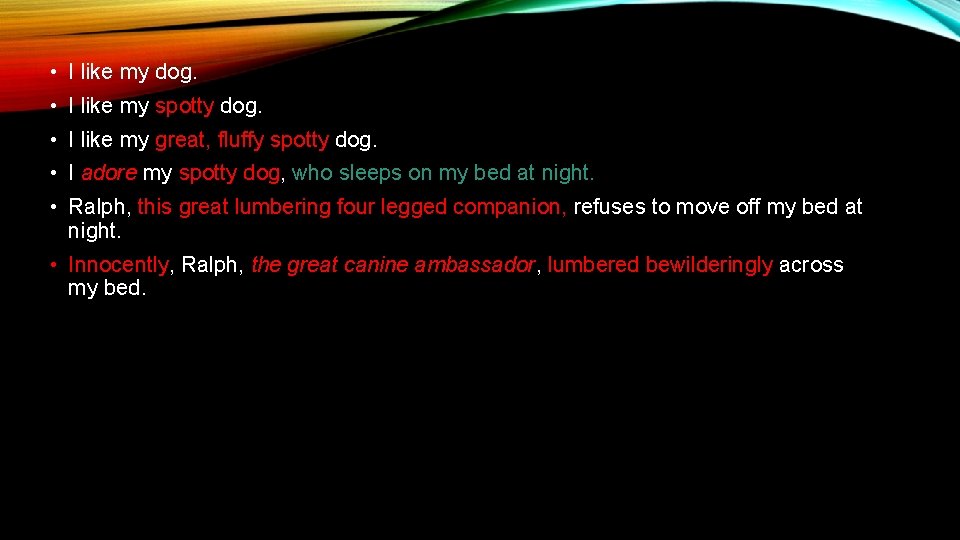
• I like my dog. • I like my spotty dog. • I like my great, fluffy spotty dog. • I adore my spotty dog, who sleeps on my bed at night. • Ralph, this great lumbering four legged companion, refuses to move off my bed at night. • Innocently, Ralph, the great canine ambassador, lumbered bewilderingly across my bed.
USEFUL SITES • https: //www. ncetm. org. uk/ • https: //www. timestables. co. uk/ • https: //mathsframe. co. uk/ - paid • http: //www. pobble 365. com/