
Year 13 Hamlet Unit 4 Course background Think
Year 13 Hamlet – Unit 4.
Course background Think of Year 13 English Literature as a journey at the end of which, as far as we know now, there will be 2 exams. One of those will be on Hamlet (Unit 4). It seems sensible, therefore, to understand what it takes to complete this journey successfully. Part of that success relies on knowing what WJEC is looking for when it comes to assessing your exam responses. Therefore I'm starting by referencing the Course Background and Assessment Objectives.
The basic details • Unit 4 is known as a closed book exam which means that you will not be allowed to take the text into the exam with you. • The exam will last 2 hours. • The exam is divided into section A and section B both of equal value. • Your exam will be set by WJEC https: //www. wjec. co. uk/qualificatio ns/english-literature-as-alevel/#tab_overview
Section A • This will consist of one question based on an extract from the play. This extract can be taken from anywhere in the play. • There is no choice. • This extract is meant to assess knowledge and understanding and close analysis of the extract.
Section B • This will consist of choosing one essay question from a choice of two. • Think of it as a thematic essay. We'll be examining themes associated with the play as we go along. • This question will assess wider knowledge and understanding of the play as a whole.
Overall Unit 4 uses the following AOs; Assessment Objectives • AO 1 – Articulate informed, personal and creative responses to literary texts, using associated concepts and terminology, and coherent, accurate written expression – 5% • AO 2 - Analyses your ability to show you understand the meaning(s) of the play – 7. 5% • AO 3 - Demonstrate understanding of the significance and influence of the contexts in which literary texts are written and received – 5%. • AO 5 - Explore literary texts informed by different interpretations – 2. 5%
So. . . • As you'll see Unit 4 closely mirrors the AS work you did last year with its extract focus and then a second question focusing on the text as a whole. • Also note that, when it comes to Hamlet, there is no need to consider AO 4. That AO, which is to do with comparison, will be found on Unit 3, the poetry paper.
Let's get started. . . • Before you do anything else, you will need a clear understanding of the plot. What is Hamlet about? • You could start by going straight to the performance. However, I suggest reading a synopsis. Here a couple of suggestions : • https: //www. shakespeare. org. uk/exploreshakespeare/shakespedia/shakespearesplays/hamlet/# • https: //www. rsc. org. uk/hamlet/the-plot • Your Heinemann copy of the play also provides an act by act breakdown.
The play in performanc e • There are many versions of the play available. Here is an example; • https: //www. bbc. co. uk/iplayer/episode/p 089 zf 8 r/ culture-in-quarantine-shakespeare-hamlet • And, the cartoon version (why not!) https: //www. youtube. com/watch? v=Ot. NM j. Zo. ZNb. M • As you watch try to get a handle on the main events, characters and relationships. Don't worry if you find it confusing. You're just at the start. All WILL fall into place!
Past section B questions - • From understanding the play as a whole, we will move on to consider its themes. A good place to start is by looking back on the past questions that have been set. So, here goes;
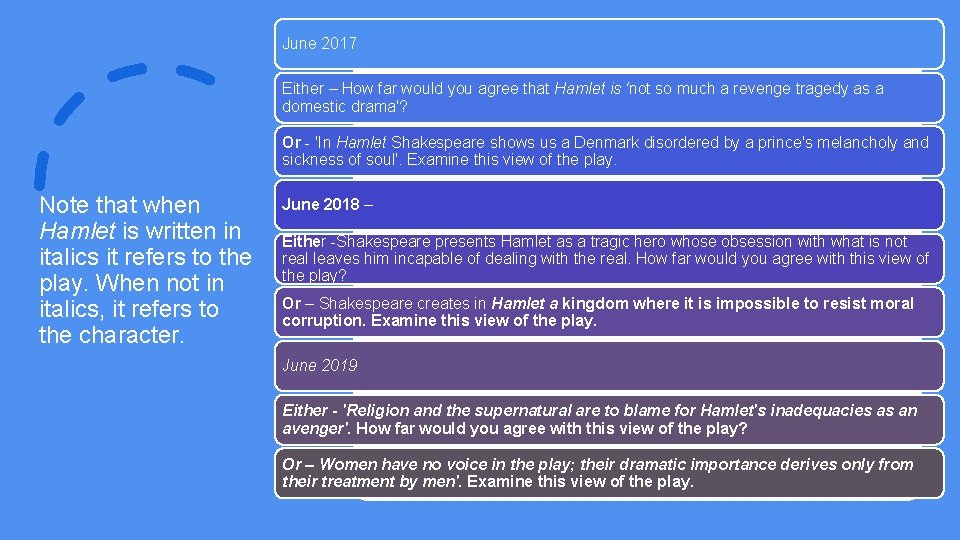
June 2017 Either – How far would you agree that Hamlet is 'not so much a revenge tragedy as a domestic drama'? Or - 'In Hamlet Shakespeare shows us a Denmark disordered by a prince's melancholy and sickness of soul'. Examine this view of the play. Note that when Hamlet is written in italics it refers to the play. When not in italics, it refers to the character. June 2018 – Either -Shakespeare presents Hamlet as a tragic hero whose obsession with what is not real leaves him incapable of dealing with the real. How far would you agree with this view of the play? Or – Shakespeare creates in Hamlet a kingdom where it is impossible to resist moral corruption. Examine this view of the play. June 2019 Either - 'Religion and the supernatural are to blame for Hamlet's inadequacies as an avenger'. How far would you agree with this view of the play? Or – Women have no voice in the play; their dramatic importance derives only from their treatment by men'. Examine this view of the play.
What kind of play? • You will often come across reference to Hamlet as a 'revenge tragedy'. • Therefore, make sure you understand what revenge means. • You're probably thinking about such ideas as taking the law into your own hands, paying someone back for a wrong they have done to you or one of yours. All of these are sensible working definitions. • Specifically note that revenge is, by definition, outside of the Law. The State, whether a Tudor one or a Boris one, does not condone it. You, effectively, break the law, when you take the law into your own hands! • That didn't use to be the case. Time was once when disputes were often sorted outside of the Law. Duelling was a particularly popular way of doing this and a way that persisted into Victorian times. • However, during Shakespearian times, this sort of private revenge was, increasingly, seen as taboo.
Revenge • So, by the time Shakespeare was writing Hamlet, the general feeling amongst those in charge was that private revenge was to be avoided at all costs. Effectively, no nation state could allow its people to run amok just when it liked. • To begin with it was seen as an attempt to usurp the prerogative of God. 'Vengeance is mine; I will repay, saith the lord'. • Also, and by extension, it was seen as a way of powerful individuals assuming the rights of the sovereign. That couldn't be tolerated either. • By and large, people accepted this.
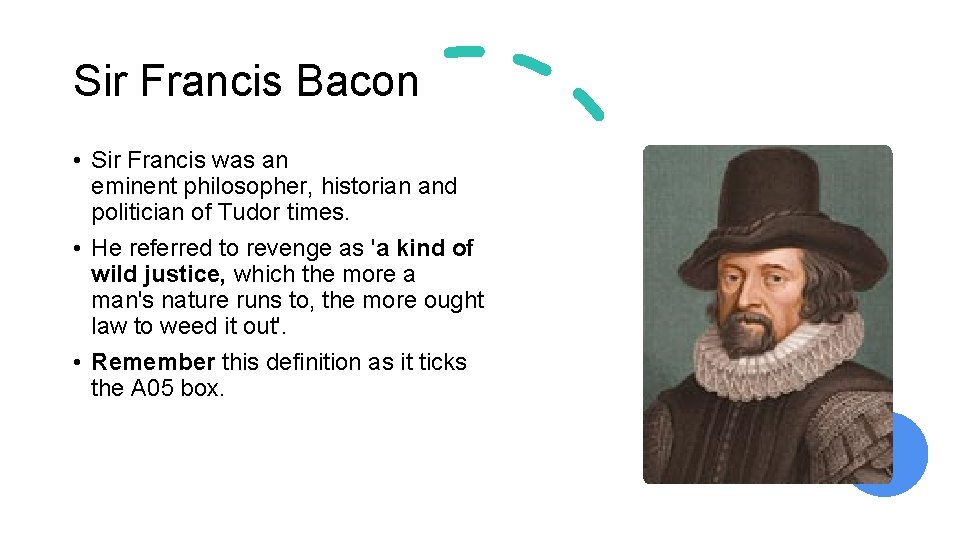
Sir Francis Bacon • Sir Francis was an eminent philosopher, historian and politician of Tudor times. • He referred to revenge as 'a kind of wild justice, which the more a man's nature runs to, the more ought law to weed it out'. • Remember this definition as it ticks the A 05 box.
However. . . • Revenge might have been frowned upon by the State, but it was not entirely forgotten by the populous who were fascinated by the intrigue, scandal, blood and gore it provided! • The Elizabethan theatre took advantage of this appetite with the result that plays which had the 'forbidden' topic of revenge at their heart became all the rage.
Context - A 03 • Thomas Kyd's The Spanish Tragedy (1587) was an early revenge play which was a massive hit with theatre goers. • Others included, Women Beware Women by Thomas Middleton and John Webster's The White Devil. • Such writers took inspiration from the Roman writer Seneca whose bloody versions of Greek tragedies were also popular at the time. • This is the kind of background which, in part, accounts for the popularity of Hamlet.
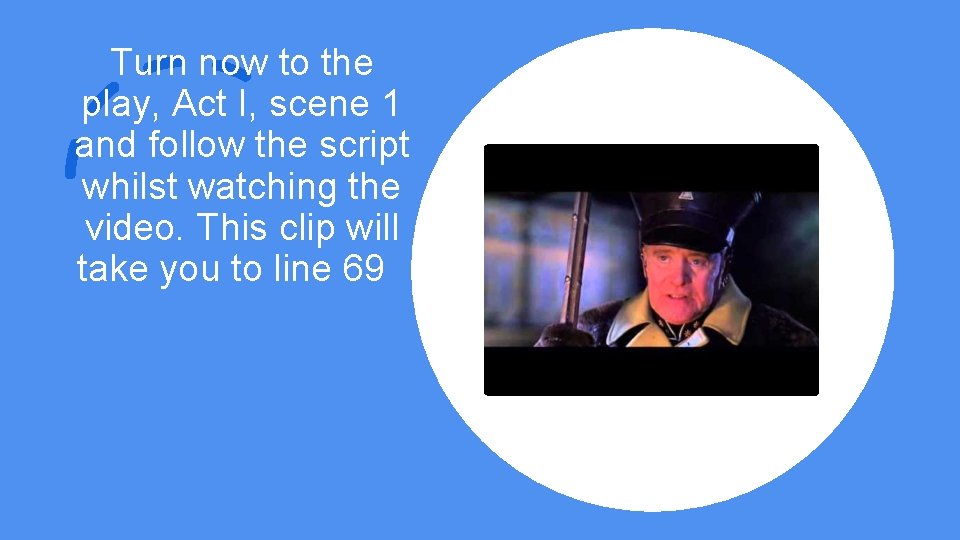
Turn now to the play, Act I, scene 1 and follow the script whilst watching the video. This clip will take you to line 69
• As a rule, always pay notice to how a text starts. What the writer wants us to know first is significant. • So, what do we learn from this opening? • What do you notice about the very first line? What kind of sentence is it? Act 1, scene 1 – the opening. • Indeed, is the interrogative answered? Does Barnardo actually get an answer to his question? • If you read closely you will also notice that it is Barnardo who offers the first challenge. Yet he is the one taking over from Francisco. By rights it is more reasonable to expect Francisco, the guard who is already on watch, to be asking the question. • What do you notice about the weather conditions ? The time of day? Revise your understanding of the term pathetic fallacy (AO 1) and consider what is the effect of Shakespeare's use of pathetic fallacy here.
Act 1, scene 1(cont. ) • Francisco admits, in line 8, to being 'sick at heart'. As you read further you will see that such references to sickness, disease, decay re-occur. This is an example of an extended metaphor, or a conceit (AO 1). So, you could say that Shakespeare uses the extended metaphor of illness to suggest the decay and corruption at the heart of the Danish state (AO 2) • In this example, what details are suggested to explain Francisco's malaise? ( if you have not come across this word before, look it up. The quality of your expression will be rewarded in AO 1)
A feeling of unease. . . So, if we accept that there is a general sense of unease in this opening, where does it come from? Consider the following • The weather • The time of day • The confusion of the sentinels. Listen to the teacher's commentary
Consider where this opening scene takes place. Act 1, scene 1 - setting. Barnardo and Francisco are on the castle battlements, looking out to sea. They are on watch as Denmark is on high alert, expecting an imminent Norwegian invasion. Read closely from line 80 to 125. Horatio explains here the reason for the high alert. Be clear as to the reasons for this. We can consider this as the political dimension of the play: State against State; Norway against Denmark.
• Ghosts appeared frequently on the Tudor stage especially within the framework of the revenge genre. They appealed to the audience in much the same way as the supernatural does today. Bottom line, audiences were intrigued, fascinated and hooked which was, commercially, great news for the playwright! The Ghost • Some of you may have studied Macbeth at GCSE and remember Banquo’s ghost. However, unlike Banquo’s ghost who is only seen by Macbeth, the ghost of Hamlet Senior will be seen by four characters. • The Ghost first appears on the castle battlements to Marcellus and Bernardo. So uncertain are they of what they have experienced that they send for the 'scholar', Horatio. Can you think of a reason why Shakespeare has deliberately referred to Horatio as a 'scholar'? • At first, Horatio is sceptical, 'Tush, tush, 'twill not appear'. He is only going to believe what he sees.
• The character of Horatio is significant because he, like Hamlet, represents the new, the forward thinking, the 'modern' Renaissance scholar. • Thus, as such a man, he is not going to be persuaded that some supernatural phantom is prowling the castle battlements easily. Horatio • As we have seen, his initial response to Marcellus and Barnardo is doubtful to say the least. • And this is precisely why they call on him to reinforce their experiences. • So when he does see, and then admits that the Ghost is 'something more than fantasy', the existence of the Ghost is not in question. • What is in doubt is its status. Why has it appeared? Is it for good or evil ?
• Horatio speaks to the Ghost, but it turns away and leaves without saying a word. What can be inferred from this? • Re read this section. Who does the Ghost remind the men of? What is the Ghost dressed in? What associations are drawn from this appearance? The Ghost (cont. ) • Re-read scene 1, lines 61 -119, which outline the Fortinbras back story. What do you learn about Hamlet senior from this extract? . Pay attention to the actual role he played in the battle against Fortinbras' father. What action did he perform in the battle? What did Denmark (Hamlet senior) gain from the battle? What did Norway(Fortinbras senior) lose? Listen to the teacher's commentary
Act 1, scene 1 - a recap. • So, in this opening scene, we see Marcellus and Barnardo on the battlements of Elsinore castle. They are on watch for an imminent Norwegian invasion. Over the last two nights they have seen a ghost. Not believing their eyes, they send for Horatio, whom they respect as an intelligent and rational human being not given to flights of fancy. Suddenly the ghost appears again looking exactly like the old King Hamlet. He is dressed in a full suit of armour. Horatio explains to the other guards how the ambitious Fortinbras senior tried to conquer Denmark but was killed by Hamlet senior. What do we learn? 1. The ghost of the dead king of Denmark has been stalking the castle at night. 2. Horatio does not believe the ghost exists till he sees it. 3. The ghost is dressed in the battle armour he wore when he conquered Fortinbras and seized Norwegian land.
- Slides: 25