
Year 12 Current Electricity Lesson 3 Potential difference
- Slides: 10
Year 12 Current Electricity Lesson 3 Potential difference and power Miss O’Donnell
What questions are we looking at today? • What do we mean by potential difference? • How can we calculate electrical power? • How do energy transfers take place in electrical devices?
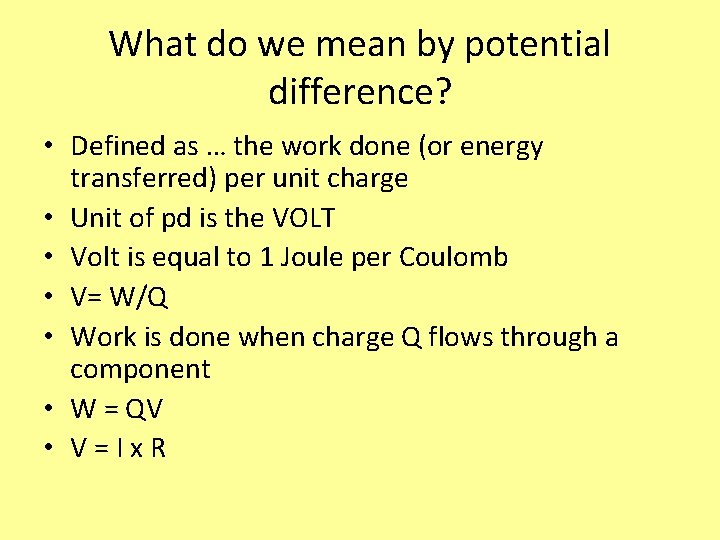
What do we mean by potential difference? • Defined as … the work done (or energy transferred) per unit charge • Unit of pd is the VOLT • Volt is equal to 1 Joule per Coulomb • V= W/Q • Work is done when charge Q flows through a component • W = QV • V=Ix. R
Quick Questions • 30 J of work is done when 5 C of charge pass through a component – what is the pd? • If the pd is 12 V across a component and 3 C of charge is passed through it – what is the energy transfer from the battery to the component?
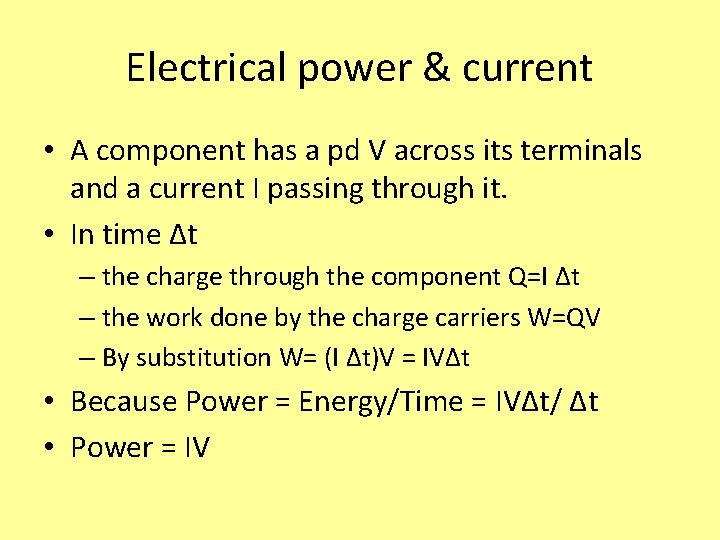
Electrical power & current • A component has a pd V across its terminals and a current I passing through it. • In time ∆t – the charge through the component Q=I ∆t – the work done by the charge carriers W=QV – By substitution W= (I ∆t)V = IV∆t • Because Power = Energy/Time = IV∆t/ ∆t • Power = IV
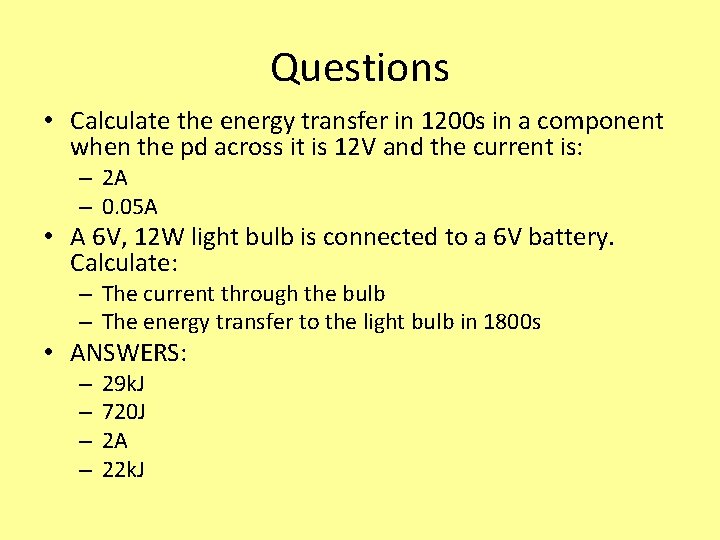
Questions • Calculate the energy transfer in 1200 s in a component when the pd across it is 12 V and the current is: – 2 A – 0. 05 A • A 6 V, 12 W light bulb is connected to a 6 V battery. Calculate: – The current through the bulb – The energy transfer to the light bulb in 1800 s • ANSWERS: – – 29 k. J 720 J 2 A 22 k. J
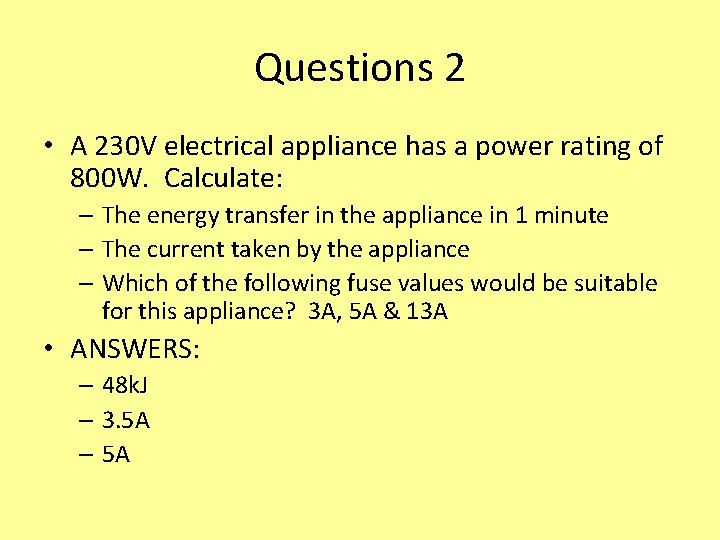
Questions 2 • A 230 V electrical appliance has a power rating of 800 W. Calculate: – The energy transfer in the appliance in 1 minute – The current taken by the appliance – Which of the following fuse values would be suitable for this appliance? 3 A, 5 A & 13 A • ANSWERS: – 48 k. J – 3. 5 A – 5 A
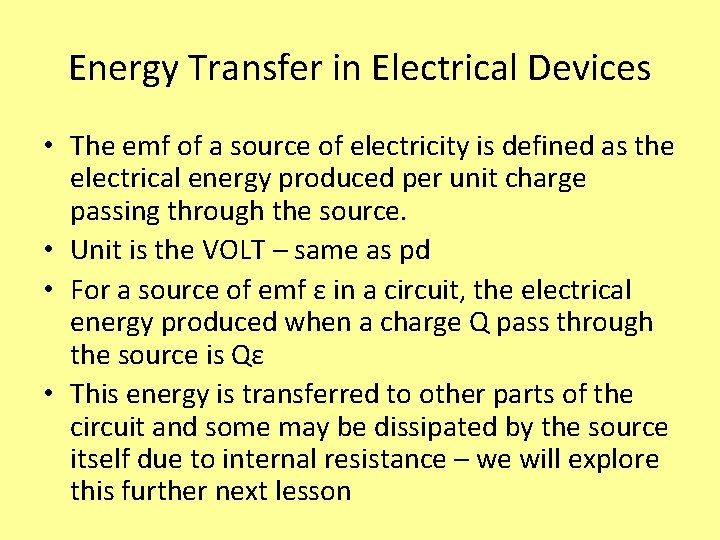
Energy Transfer in Electrical Devices • The emf of a source of electricity is defined as the electrical energy produced per unit charge passing through the source. • Unit is the VOLT – same as pd • For a source of emf ε in a circuit, the electrical energy produced when a charge Q pass through the source is Qε • This energy is transferred to other parts of the circuit and some may be dissipated by the source itself due to internal resistance – we will explore this further next lesson
Electric current effects • What effects do electric currents have when they pass through components and appliances? – Heating – when they pass through a component with resistance. WHY? – Magnetic – in electric motors and loudspeakers – Kinetic – force the charge carriers though wires
Questions 3 • A battery has an emf of 9 V and negligible internal resistance. It is capable of delivering a total charge of 1350 C. Calculate: – The maximum energy the battery could deliver – The power it would deliver to the components of the circuit if the current through it was 0. 5 A – How long the battery would last for, if it were to supply power at the rate calculated in the last part of the question • ANSWERS: – 12 k. J – 4. 5 W – 2700 s