
Year 11 Transition Activities and Work to help
- Slides: 24
Year 11 Transition Activities and Work to help you step up to Level 3 studying during the Covid 19 outbreak, whether you enrol in our Sixth Form or study/ work elsewhere, your teachers will support you with relevant work, research and enrichment. To aspire, endeavour and thrive together Year 11 Transition work
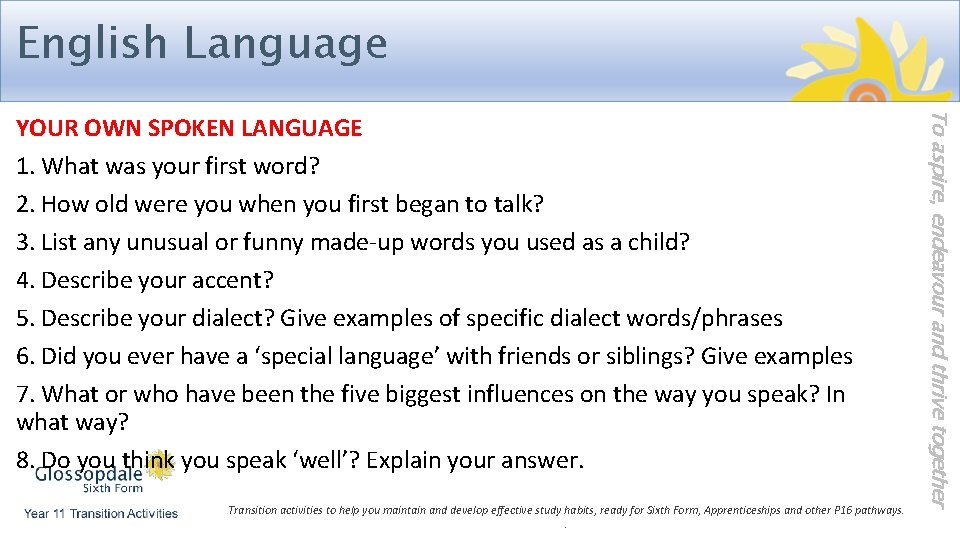
English Language Transition activities to help you maintain and develop effective study habits, ready for Sixth Form, Apprenticeships and other P 16 pathways. . To aspire, endeavour and thrive together YOUR OWN SPOKEN LANGUAGE 1. What was your first word? 2. How old were you when you first began to talk? 3. List any unusual or funny made-up words you used as a child? 4. Describe your accent? 5. Describe your dialect? Give examples of specific dialect words/phrases 6. Did you ever have a ‘special language’ with friends or siblings? Give examples 7. What or who have been the five biggest influences on the way you speak? In what way? 8. Do you think you speak ‘well’? Explain your answer.
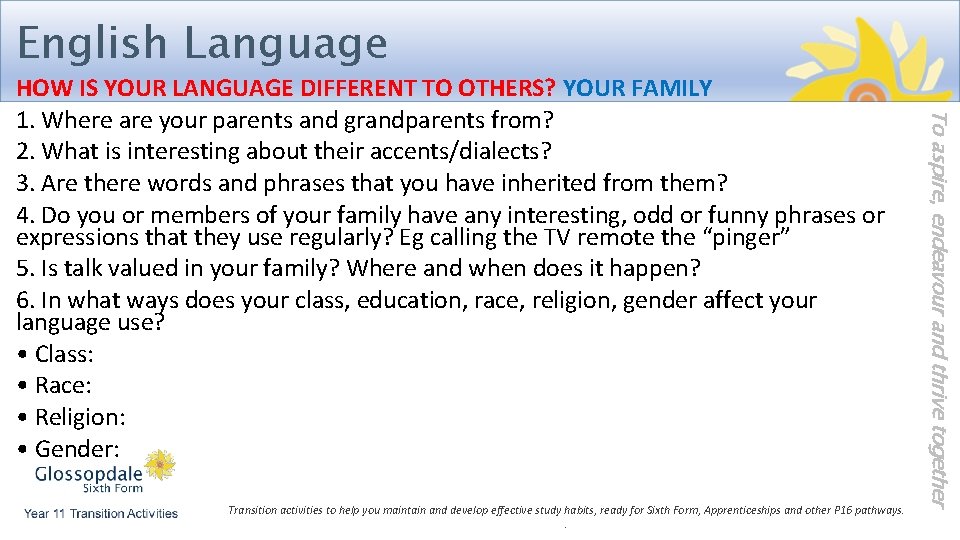
English Language Transition activities to help you maintain and develop effective study habits, ready for Sixth Form, Apprenticeships and other P 16 pathways. . To aspire, endeavour and thrive together HOW IS YOUR LANGUAGE DIFFERENT TO OTHERS? YOUR FAMILY 1. Where are your parents and grandparents from? 2. What is interesting about their accents/dialects? 3. Are there words and phrases that you have inherited from them? 4. Do you or members of your family have any interesting, odd or funny phrases or expressions that they use regularly? Eg calling the TV remote the “pinger” 5. Is talk valued in your family? Where and when does it happen? 6. In what ways does your class, education, race, religion, gender affect your language use? • Class: • Race: • Religion: • Gender:
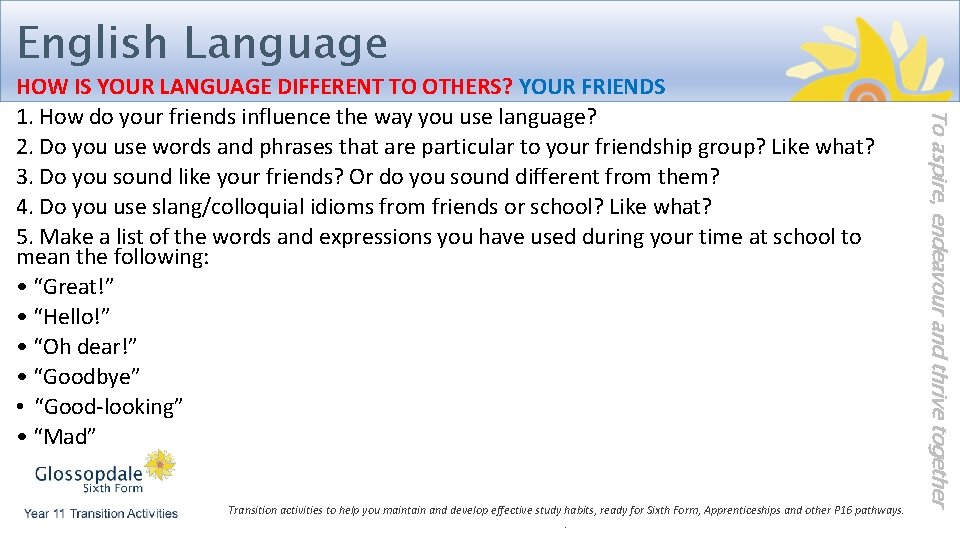
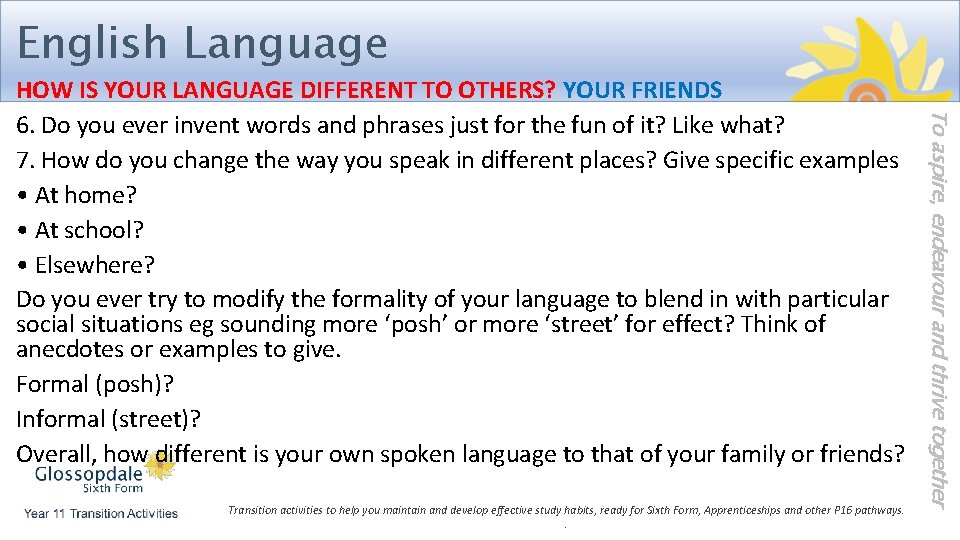
English Language Transition activities to help you maintain and develop effective study habits, ready for Sixth Form, Apprenticeships and other P 16 pathways. . To aspire, endeavour and thrive together HOW IS YOUR LANGUAGE DIFFERENT TO OTHERS? YOUR FRIENDS 1. How do your friends influence the way you use language? 2. Do you use words and phrases that are particular to your friendship group? Like what? 3. Do you sound like your friends? Or do you sound different from them? 4. Do you use slang/colloquial idioms from friends or school? Like what? 5. Make a list of the words and expressions you have used during your time at school to mean the following: • “Great!” • “Hello!” • “Oh dear!” • “Goodbye” • “Good-looking” • “Mad”
English Language Transition activities to help you maintain and develop effective study habits, ready for Sixth Form, Apprenticeships and other P 16 pathways. . To aspire, endeavour and thrive together HOW IS YOUR LANGUAGE DIFFERENT TO OTHERS? YOUR FRIENDS 6. Do you ever invent words and phrases just for the fun of it? Like what? 7. How do you change the way you speak in different places? Give specific examples • At home? • At school? • Elsewhere? Do you ever try to modify the formality of your language to blend in with particular social situations eg sounding more ‘posh’ or more ‘street’ for effect? Think of anecdotes or examples to give. Formal (posh)? Informal (street)? Overall, how different is your own spoken language to that of your family or friends?
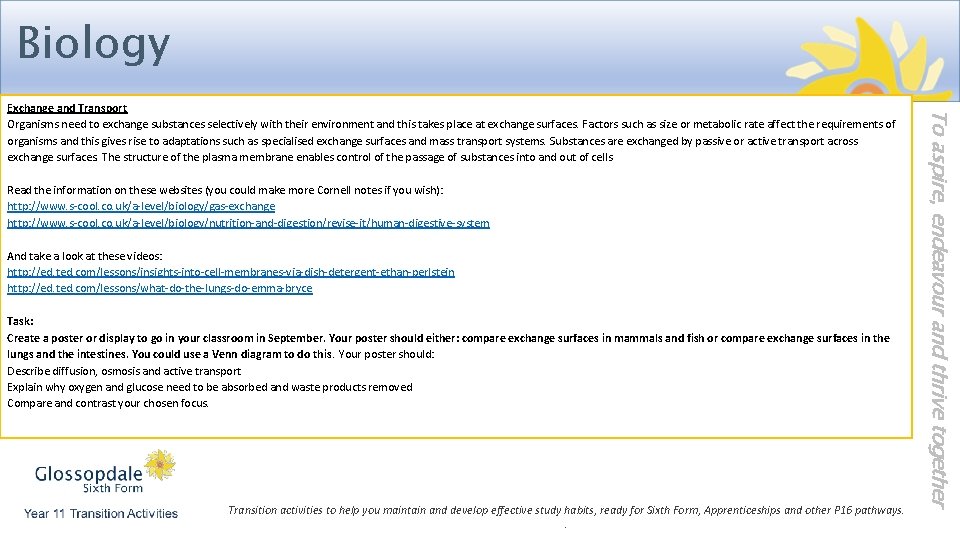
Biology Read the information on these websites (you could make more Cornell notes if you wish): http: //www. s-cool. co. uk/a-level/biology/gas-exchange http: //www. s-cool. co. uk/a-level/biology/nutrition-and-digestion/revise-it/human-digestive-system And take a look at these videos: http: //ed. ted. com/lessons/insights-into-cell-membranes-via-dish-detergent-ethan-perlstein http: //ed. ted. com/lessons/what-do-the-lungs-do-emma-bryce Task: Create a poster or display to go in your classroom in September. Your poster should either: compare exchange surfaces in mammals and fish or compare exchange surfaces in the lungs and the intestines. You could use a Venn diagram to do this. Your poster should: Describe diffusion, osmosis and active transport Explain why oxygen and glucose need to be absorbed and waste products removed Compare and contrast your chosen focus. Transition activities to help you maintain and develop effective study habits, ready for Sixth Form, Apprenticeships and other P 16 pathways. . To aspire, endeavour and thrive together Exchange and Transport Organisms need to exchange substances selectively with their environment and this takes place at exchange surfaces. Factors such as size or metabolic rate affect the requirements of organisms and this gives rise to adaptations such as specialised exchange surfaces and mass transport systems. Substances are exchanged by passive or active transport across exchange surfaces. The structure of the plasma membrane enables control of the passage of substances into and out of cells
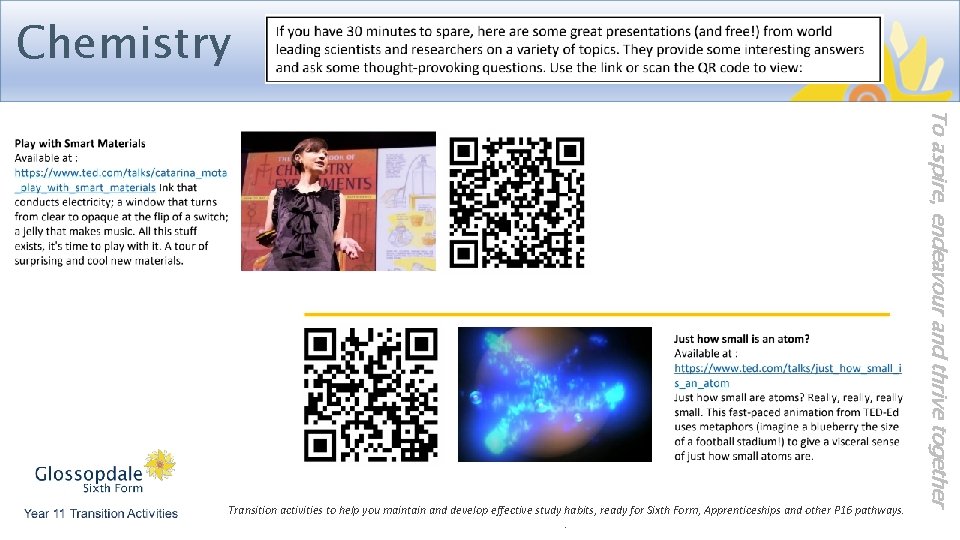
Chemistry To aspire, endeavour and thrive together Transition activities to help you maintain and develop effective study habits, ready for Sixth Form, Apprenticeships and other P 16 pathways. .
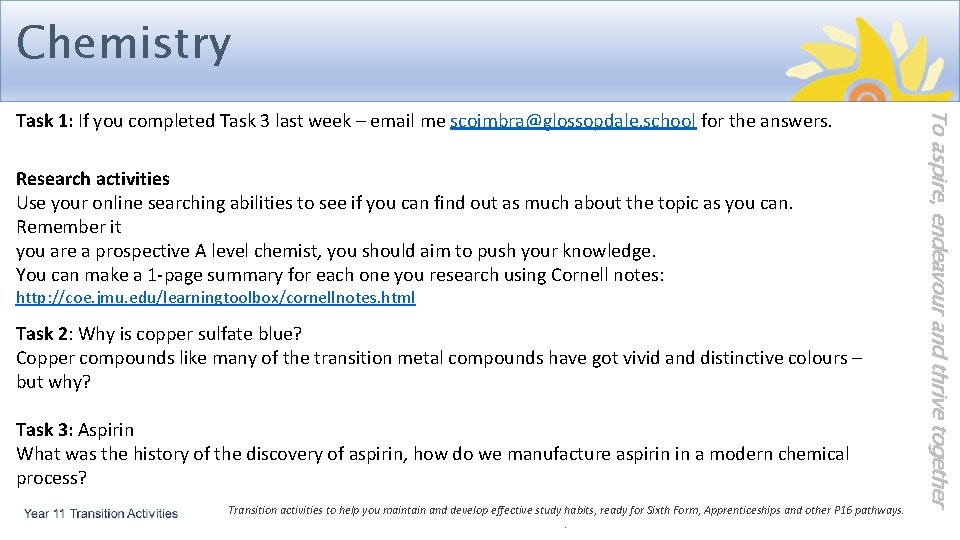
Chemistry Research activities Use your online searching abilities to see if you can find out as much about the topic as you can. Remember it you are a prospective A level chemist, you should aim to push your knowledge. You can make a 1 -page summary for each one you research using Cornell notes: http: //coe. jmu. edu/learningtoolbox/cornellnotes. html Task 2: Why is copper sulfate blue? Copper compounds like many of the transition metal compounds have got vivid and distinctive colours – but why? Task 3: Aspirin What was the history of the discovery of aspirin, how do we manufacture aspirin in a modern chemical process? Transition activities to help you maintain and develop effective study habits, ready for Sixth Form, Apprenticeships and other P 16 pathways. . To aspire, endeavour and thrive together Task 1: If you completed Task 3 last week – email me scoimbra@glossopdale. school for the answers.
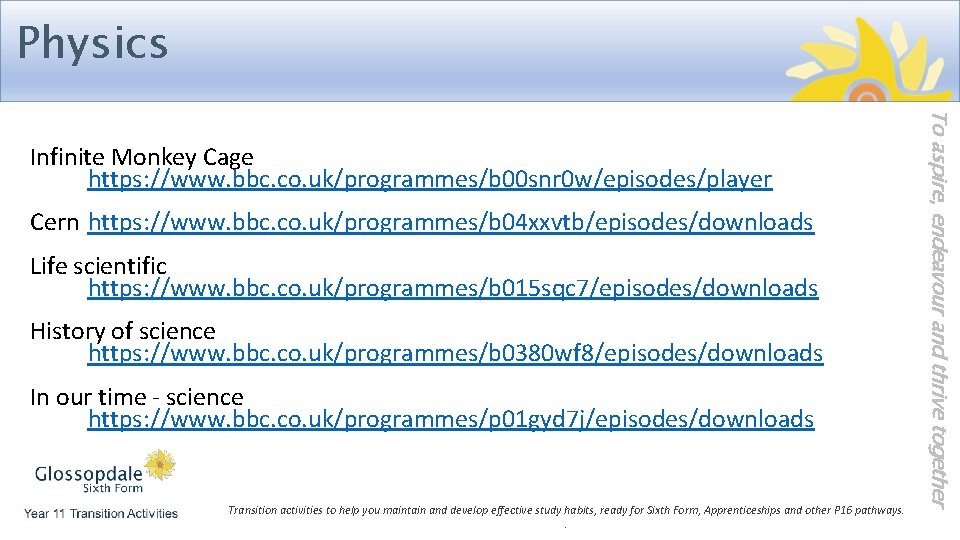
Physics Cern https: //www. bbc. co. uk/programmes/b 04 xxvtb/episodes/downloads Life scientific https: //www. bbc. co. uk/programmes/b 015 sqc 7/episodes/downloads History of science https: //www. bbc. co. uk/programmes/b 0380 wf 8/episodes/downloads In our time - science https: //www. bbc. co. uk/programmes/p 01 gyd 7 j/episodes/downloads Transition activities to help you maintain and develop effective study habits, ready for Sixth Form, Apprenticeships and other P 16 pathways. . To aspire, endeavour and thrive together Infinite Monkey Cage https: //www. bbc. co. uk/programmes/b 00 snr 0 w/episodes/player
Psychology Transition activities to help you maintain and develop effective study habits, ready for Sixth Form, Apprenticeships and other P 16 pathways. . To aspire, endeavour and thrive together Research Task: Mental health Research the clinical characteristic (diagnostic criteria) of at least three different psychological disorders including the following – Obsessive Compulsive Disorder (OCD), Depression and Phobias. Produce a poster or Power. Point for each disorder to explain the symptoms/ characteristics under the following headings 1) Emotional, 2) Behavioural 3) Cognitive characteristics.
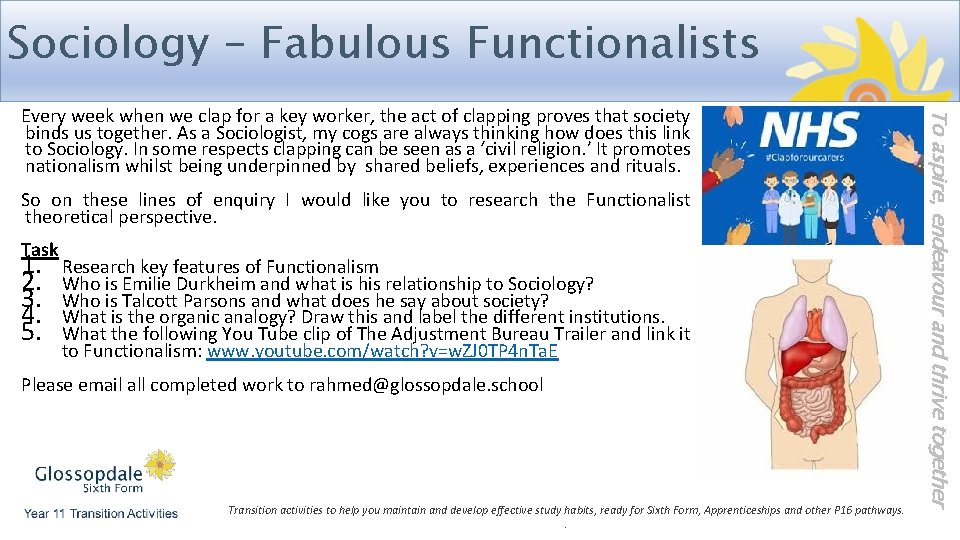
Sociology – Fabulous Functionalists So on these lines of enquiry I would like you to research the Functionalist theoretical perspective. Task 1. 2. 3. 4. 5. Research key features of Functionalism Who is Emilie Durkheim and what is his relationship to Sociology? Who is Talcott Parsons and what does he say about society? What is the organic analogy? Draw this and label the different institutions. What the following You Tube clip of The Adjustment Bureau Trailer and link it to Functionalism: www. youtube. com/watch? v=w. ZJ 0 TP 4 n. Ta. E Please email all completed work to rahmed@glossopdale. school Transition activities to help you maintain and develop effective study habits, ready for Sixth Form, Apprenticeships and other P 16 pathways. . To aspire, endeavour and thrive together Every week when we clap for a key worker, the act of clapping proves that society binds us together. As a Sociologist, my cogs are always thinking how does this link to Sociology. In some respects clapping can be seen as a ‘civil religion. ’ It promotes nationalism whilst being underpinned by shared beliefs, experiences and rituals.
Sociology – Alternative Task Sociologists believe that people behave as they do because they are taught how to behave. For example the sociologist Michael Haralambos states: ‘human beings learn their behaviour and use their intelligence whereas animals simply act on instinct’. This is known as a Nurture theory of human behaviour. Nurture means the way you were brought up. It is also a reference to socialisation, the lifelong process by which we learn our culture, values, norms and how to behave. Task - Watch this video on feral children https: //www. youtube. com/watch? v=93 Hym. GXC_w. M to understand how Oxana Malya was brought up with dogs and behaves in a similar manner to dogs. Another case study is Genie a heart breaking case study that highlighted the importance of a normal development in shaping our lives. Sociologists reject nature theories for two particular reasons. If people behaved as they do because of nature, we would all act the same. We know that people do not all act the same: 1. History: people acted differently in the past from the way that they do today. They had different ideas and different beliefs. 2. Anthropology: this is the study of different human societies. Wherever you go in the world, people act differently from the way they do in Britain. Task - Think of two ways in which we are different from people in the past then think of four ways in which people in other countries are different from people in Britain Transition activities to help you maintain and develop effective study habits, ready for Sixth Form, Apprenticeships and other P 16 pathways. . To aspire, endeavour and thrive together Nature vs Nurture – The Big Debate There are many ways of explaining why certain people behave in certain ways. For example, biologists think that people behave as they do because they are controlled by nature which is based on instincts of survival of the fittest. This is known as Nature theory.
Sociology – Alternative Task Continued Task - Imagine a newborn human infant cast adrift on a desert island. For the sake of this illustration we will assume that it doesn’t become an instant snack for some passing predator! Now, bearing in mind that this baby has had no human contact; can you think of anything that would enable it to survive? Explain why you think the baby would either survive or not survive Humans are dependent upon other humans for the most basic needs such as food and shelter. We do not arrive in this world equipped with instincts inherited from our parents that will enable us to survive. An instinct can be defined as a complex unlearned pattern of behaviour that is universal in a species. On the maternal ‘instinct’ we do not ‘instinctively’ know how to act as a mother. Little girls learn about mothering via a range of ‘learning’ experiences (called socialisation) such as how their mother behaves towards them or younger brothers and sisters, toys such as dolls and other related influences. Please email all completed work to rahmed@glossopdale. school Transition activities to help you maintain and develop effective study habits, ready for Sixth Form, Apprenticeships and other P 16 pathways. . To aspire, endeavour and thrive together Social behaviour and culture Sociology is the study of human groups and social life in modern societies. Sociology recognises that as members of society we have to learn social behaviour and this is done through a variety of social institutions and social groups.
History https: //www. bbc. co. uk/podcasts/category/history GREAT LIVES https: //www. bbc. co. uk/programmes/b 006 qxsb/episodes/downloads In our time - history History podcasts http: //www. bbc. co. uk/podcasts/radio 4/category/history https: //inews. co. uk/culture/radio/best-podcasts-history-buffs/ Daily Telegraph podcasts https: //www. telegraph. co. uk/radio/podcasts/the-besthistory-podcasts/ History extra podcasts https: //www. historyextra. com/article-type/podcast/ Transition activities to help you maintain and develop effective study habits, ready for Sixth Form, Apprenticeships and other P 16 pathways. . To aspire, endeavour and thrive together BBC History podcasts
Geography Costing the earth https: //www. bbc. co. uk/programmes/b 006 r 4 wn/episodes/player Crossing continents https: //www. bbc. co. uk/programmes/b 006 qt 55/episodes/downloads More or less https: //www. bbc. co. uk/programmes/b 006 qshd The Inquiry https: //www. bbc. co. uk/programmes/p 029399 x/episodes/downloads Transition activities to help you maintain and develop effective study habits, ready for Sixth Form, Apprenticeships and other P 16 pathways. . To aspire, endeavour and thrive together Some interesting programmes and podcasts, when you have listened to one, write some notes, what were the key points made and possible implications.
Religious Studies • • http: //ethics. sandiego. edu/ Ethics Updates • http: //www. lancs. ac. uk/users/philosophy/courses/100 menu. htm There are some excellent materials on free will and determinism, Aristotle, Kant and issues surrounding relativism. from the University of Lancaster Philosophy and Ethics course. • • http: //ocw. mit. edu/courses/linguistics-and-philosophy/24 -231 -ethics-fall-2009/lecture-notes/ http: //www. jcu. edu/philosophy/gensler Ethics exercises http: //www. cep. unt. edu/ Environmental Ethics http: //users. ox. ac. uk/~worc 0337/phil_topics. html Philosophy sites by topic http: //highered. mcgraw-hill. com/sites/0072878274/student_view 0/chapter 5/theories. html For a library of links on all parts of our theory syllabus http: //www. justiceharvard. org/index. php? option=com_content&view=category&layout=blog&id=9&Itemid=5#ep 2 Michael Sandel's excellent lectures are available online, covering most of our course. Click this link to access a summary of the lectures The Massachusetts Institute of Technology have an excellent online course on ethics - more than you need for A level, but brilliant nonetheless Transition activities to help you maintain and develop effective study habits, ready for Sixth Form, Apprenticeships and other P 16 pathways. . To aspire, endeavour and thrive together What are Ethics? Do some research on these and other relevant websites and then present your thoughts on 1 A 4 page of notes
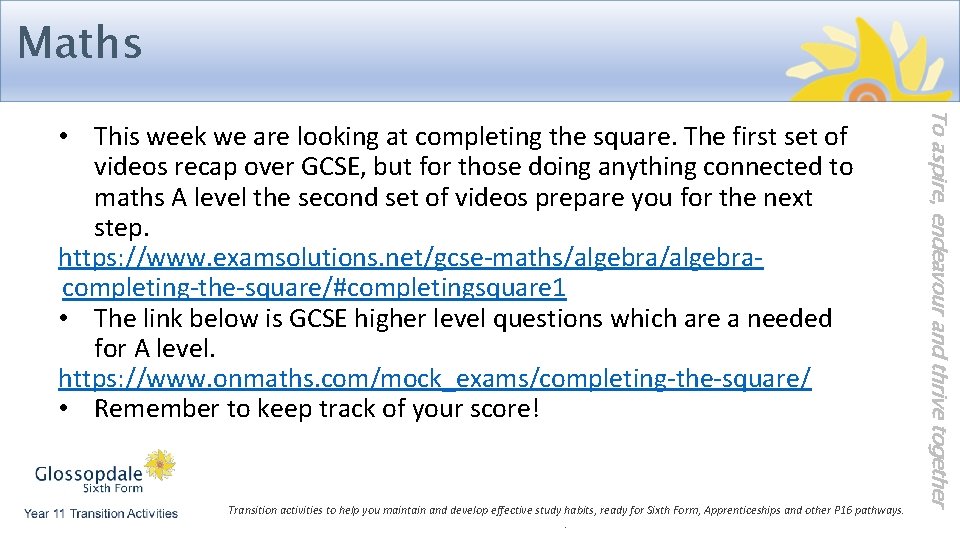
Maths Transition activities to help you maintain and develop effective study habits, ready for Sixth Form, Apprenticeships and other P 16 pathways. . To aspire, endeavour and thrive together • This week we are looking at completing the square. The first set of videos recap over GCSE, but for those doing anything connected to maths A level the second set of videos prepare you for the next step. https: //www. examsolutions. net/gcse-maths/algebracompleting-the-square/#completingsquare 1 • The link below is GCSE higher level questions which are a needed for A level. https: //www. onmaths. com/mock_exams/completing-the-square/ • Remember to keep track of your score!
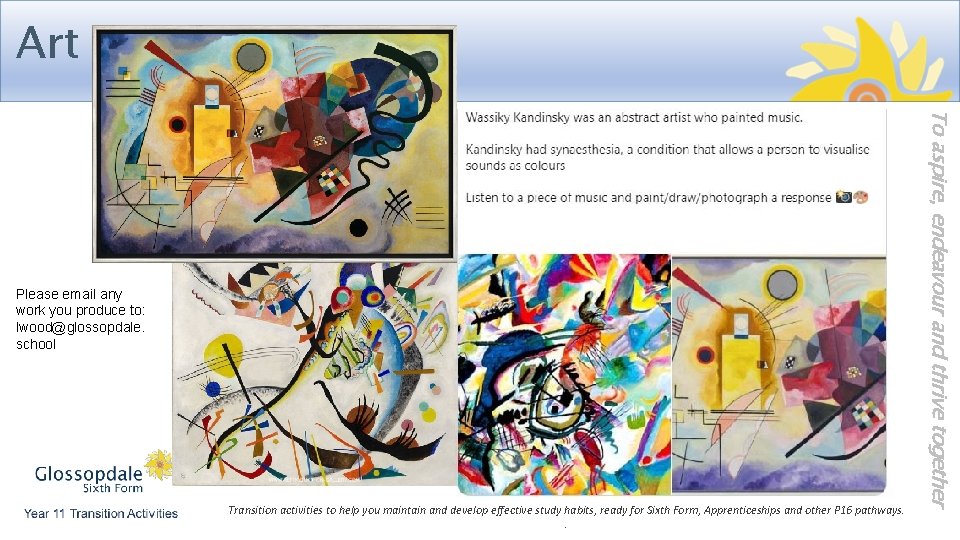
Art Transition activities to help you maintain and develop effective study habits, ready for Sixth Form, Apprenticeships and other P 16 pathways. . To aspire, endeavour and thrive together Please email any work you produce to: lwood@glossopdale. school
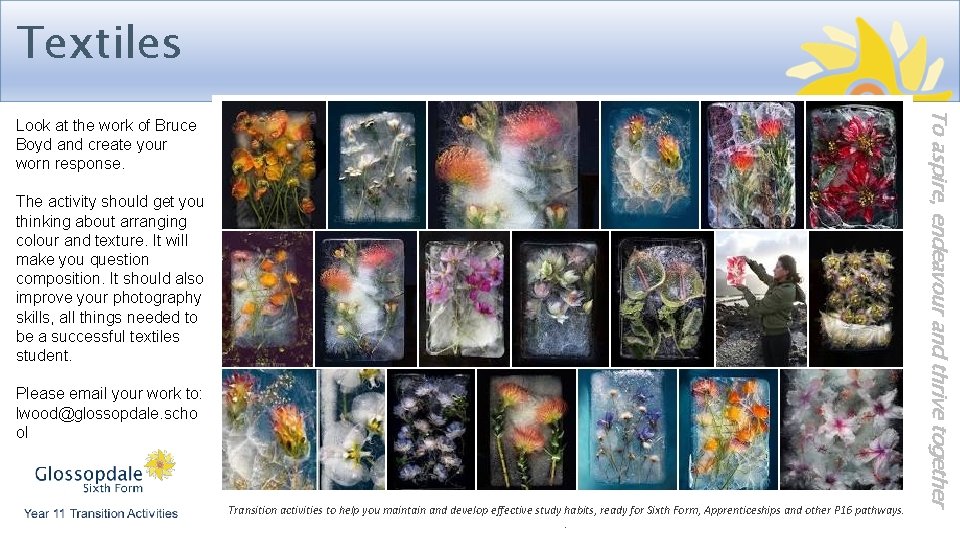
Textiles The activity should get you thinking about arranging colour and texture. It will make you question composition. It should also improve your photography skills, all things needed to be a successful textiles student. Please email your work to: lwood@glossopdale. scho ol Transition activities to help you maintain and develop effective study habits, ready for Sixth Form, Apprenticeships and other P 16 pathways. . To aspire, endeavour and thrive together Look at the work of Bruce Boyd and create your worn response.
Performing Arts Transition activities to help you maintain and develop effective study habits, ready for Sixth Form, Apprenticeships and other P 16 pathways. . To aspire, endeavour and thrive together Performing Arts Summer Take opportunity to appreciate some of the brilliant live streaming. Task 1: After enjoying all or one of these suggestions, must of which have a 16+ rating, so beware if you have younger siblings – write your own devised piece inspired by one or all: • https: //www. dv 8. co. uk/media-portal • https: //www. nationaltheatre. org. uk/nt-at-home • https: //www. hofesh. co. uk/ • https: //www. bbc. co. uk/programmes/b 0 blmn 01 • https: //www. youtube. com/watch? time_continue=12&v=CL 2 DIlzz 73 w&feature =emb_logo
Business Overview Leadership can be the difference between a company’s success or failure. Make sure you're prepared, with an online leadership and management course. As part of Management and Leadership component, University of Leeds will ask you on this course to explore the challenges and benefits of remote working. You’ll consider different technologies for collaboration and get introduced to project management tools that can help to ease the difficulties of working remotely. Transition activities to help you maintain and develop effective study habits, ready for Sixth Form, Apprenticeships and other P 16 pathways. . To aspire, endeavour and thrive together Business Studies - Week 4 Collaborative Working in a Remote Team
Business Course Map & Learning Outcomes Week 4 - How to work remotely and collaboratively Transition activities to help you maintain and develop effective study habits, ready for Sixth Form, Apprenticeships and other P 16 pathways. . To aspire, endeavour and thrive together Sign up for “Collaborative Working in a Remote Team” Week 4 Itinerary
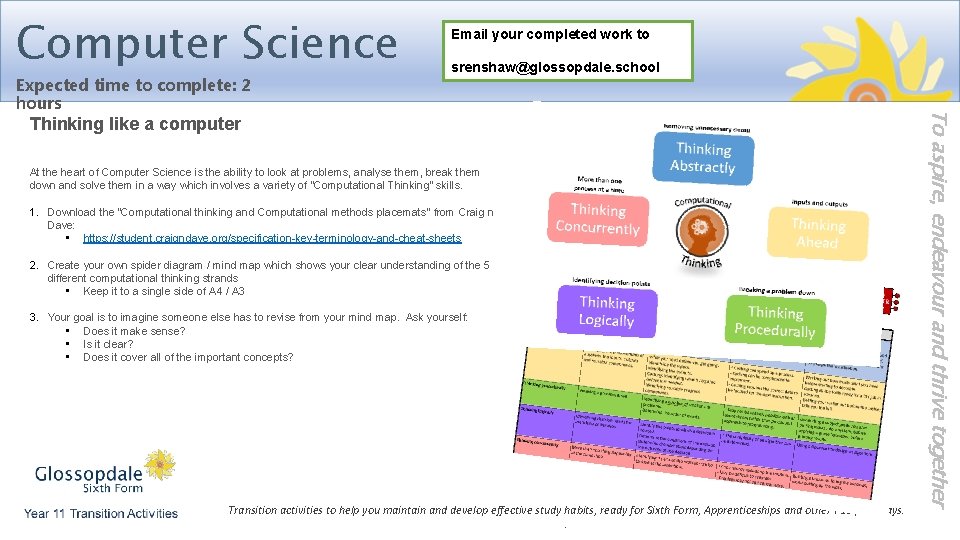
Computer Science srenshaw@glossopdale. school Thinking like a computer At the heart of Computer Science is the ability to look at problems, analyse them, break them down and solve them in a way which involves a variety of “Computational Thinking” skills. 1. Download the “Computational thinking and Computational methods placemats” from Craig n Dave: • https: //student. craigndave. org/specification-key-terminology-and-cheat-sheets 2. Create your own spider diagram / mind map which shows your clear understanding of the 5 different computational thinking strands • Keep it to a single side of A 4 / A 3 3. Your goal is to imagine someone else has to revise from your mind map. Ask yourself: • Does it make sense? • Is it clear? • Does it cover all of the important concepts? Transition activities to help you maintain and develop effective study habits, ready for Sixth Form, Apprenticeships and other P 16 pathways. . To aspire, endeavour and thrive together Expected time to complete: 2 hours Email your completed work to
French Quizlet - Year 12 French - https: //quizlet. com/join/ct. Mc. ZKq. Zy Memrise - Yr 12 French https: //www. memrise. com/group/402291/ Duolingo Yr 12 French https: //www. duolingo. com/o/ywjusj Transition activities to help you maintain and develop effective study habits, ready for Sixth Form, Apprenticeships and other P 16 pathways. . To aspire, endeavour and thrive together Here are some great online resources for languages Online learning – topic vocabulary, phrases, expressions