
Year 11 Spring 1 Maths Functions and Vectors



- Slides: 12
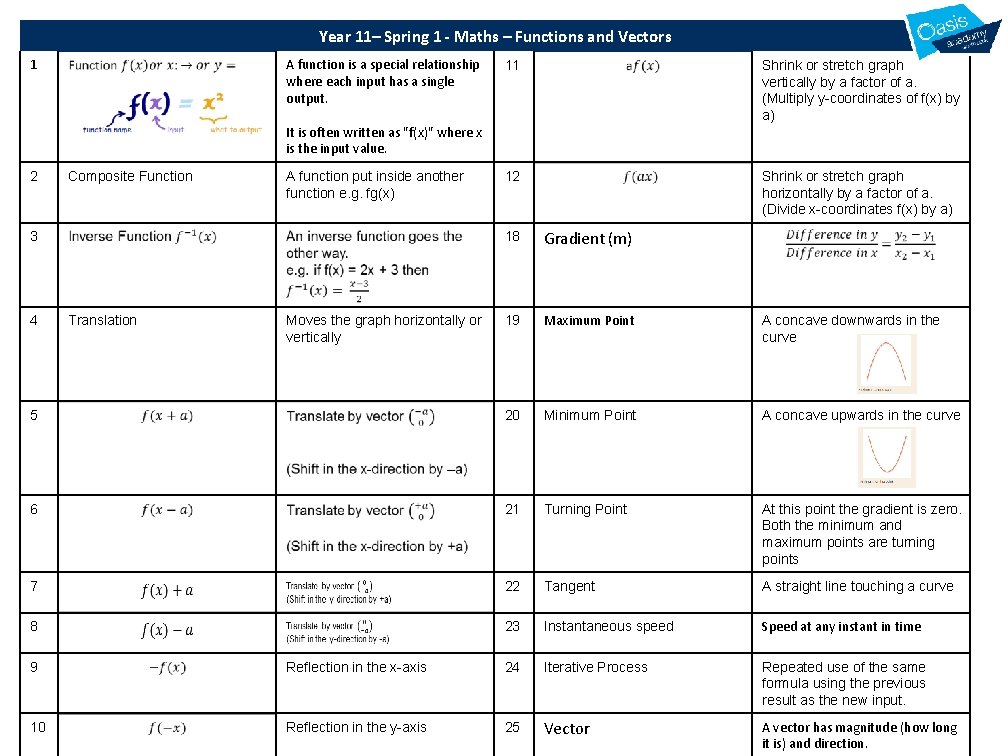
Year 11– Spring 1 - Maths – Functions and Vectors 1 A function is a special relationship where each input has a single output. 11 Shrink or stretch graph vertically by a factor of a. (Multiply y coordinates of f(x) by a) 12 Shrink or stretch graph horizontally by a factor of a. (Divide x coordinates f(x) by a) It is often written as "f(x)" where x is the input value. 2 Composite Function A function put inside another function e. g. fg(x) 18 Gradient (m) 19 Maximum Point A concave downwards in the curve 5 20 Minimum Point A concave upwards in the curve 6 21 Turning Point At this point the gradient is zero. Both the minimum and maximum points are turning points 7 22 Tangent A straight line touching a curve 8 23 Instantaneous speed Speed at any instant in time 3 4 Translation Moves the graph horizontally or vertically 9 Reflection in the x axis 24 Iterative Process Repeated use of the same formula using the previous result as the new input. 10 Reflection in the y axis 25 Vector A vector has magnitude (how long it is) and direction.
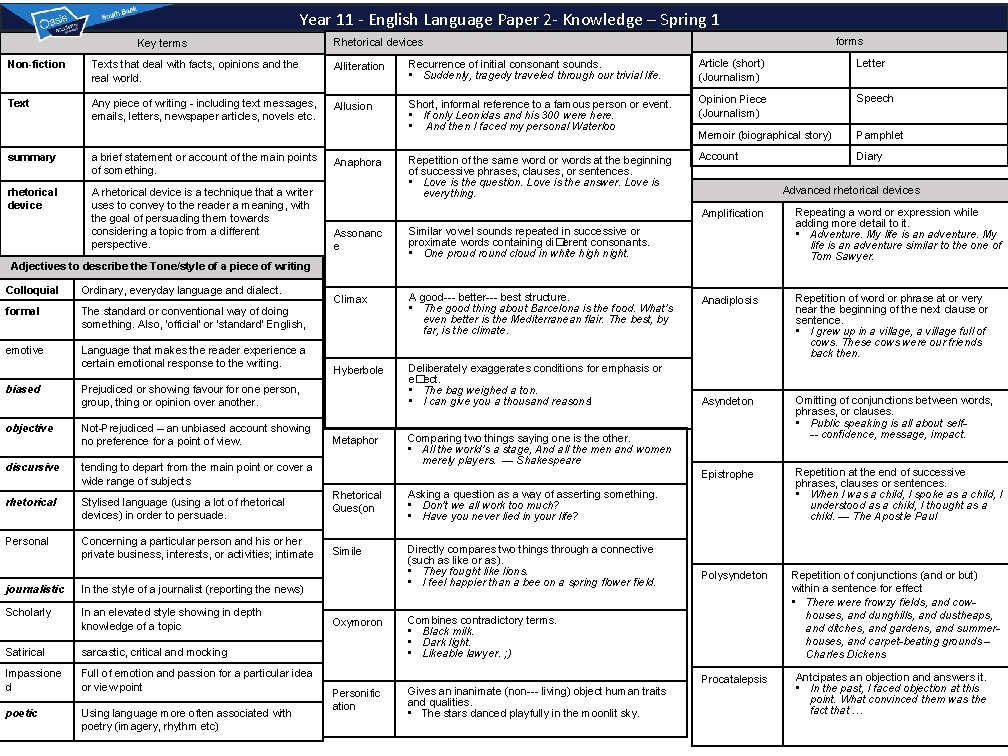
Year 11 - English Language Paper 2 - Knowledge – Spring 1 Key terms forms Rhetorical devices Non-fiction Texts that deal with facts, opinions and the real world. Alliteration Recurrence of initial consonant sounds. • Year Suddenly, 11 English tragedy Language traveled knowledgethrough our trivial life. Article (short) (Journalism) Letter Text Any piece of writing including text messages, emails, letters, newspaper articles, novels etc. Allusion Short, informal reference to a famous person or event. • If only Leonidas and his 300 were here. • And then I faced my personal Waterloo Opinion Piece (Journalism) Speech Memoir (biographical story) Pamphlet Repetition of the same word or words at the beginning of successive phrases, clauses, or sentences. • Love is the question. Love is the answer. Love is everything. Account Diary summary a brief statement or account of the main points of something. rhetorical device A rhetorical device is a technique that a writer uses to convey to the reader a meaning, with the goal of persuading them towards considering a topic from a different perspective. Anaphora Assonanc e Similar vowel sounds repeated in successive or proximate words containing di�erent consonants. • One proud round cloud in white high night. Climax A good ‐better ‐best structure. • The good thing about Barcelona is the food. What’s even better is the Mediterranean flair. The best, by far, is the climate. Hyberbole Deliberately exaggerates conditions for emphasis or e�ect. • The bag weighed a ton. • I can give you a thousand reasons! Advanced rhetorical devices Amplification Repeating a word or expression while adding more detail to it. • Adventure. My life is an adventure similar to the one of Tom Sawyer. Anadiplosis Repetition of word or phrase at or very near the beginning of the next clause or sentence. • I grew up in a village, a village full of cows. These cows were our friends back then. Asyndeton Omitting of conjunctions between words, phrases, or clauses. • Public speaking is all about self confidence, message, impact. ‐ Epistrophe Repetition at the end of successive phrases, clauses or sentences. • When I was a child, I spoke as a child, I understood as a child, I thought as a child. — The Apostle Paul Adjectives to describe the Tone/style of a piece of writing Colloquial Ordinary, everyday language and dialect. formal The standard or conventional way of doing something. Also, 'official' or 'standard' English, emotive Language that makes the reader experience a certain emotional response to the writing. biased Prejudiced or showing favour for one person, group, thing or opinion over another. objective Not Prejudiced – an unbiased account showing no preference for a point of view. discursive tending to depart from the main point or cover a wide range of subjects rhetorical Stylised language (using a lot of rhetorical devices) in order to persuade. Personal Concerning a particular person and his or her private business, interests, or activities; intimate journalistic In the style of a journalist (reporting the news) Scholarly In an elevated style showing in depth knowledge of a topic Satirical sarcastic, critical and mocking Impassione d Full of emotion and passion for a particular idea or view point poetic Using language more often associated with poetry (imagery, rhythm etc) Metaphor Comparing two things saying one is the other. • All the world’s a stage, And all the men and women merely players. — Shakespeare Rhetorical Ques(on Asking a question as a way of asserting something. • Don’t we all work too much? • Have you never lied in your life? Simile Directly compares two things through a connective (such as like or as). • They fought like lions. • I feel happier than a bee on a spring flower field. Oxymoron Combines contradictory terms. • Black milk. • Dark light. • Likeable lawyer. ; ) Personific ation Gives an inanimate (non ‐living) object human traits and qualities. • The stars danced playfully in the moonlit sky. Polysyndeton Procatalepsis Repetition of conjunctions (and or but) within a sentence for effect • There were frowzy fields, and cow houses, and dunghills, and dustheaps, and ditches, and gardens, and summer houses, and carpet beating grounds – Charles Dickens Antcipates an objection and answers it. • In the past, I faced objection at this point. What convinced them was the fact that …
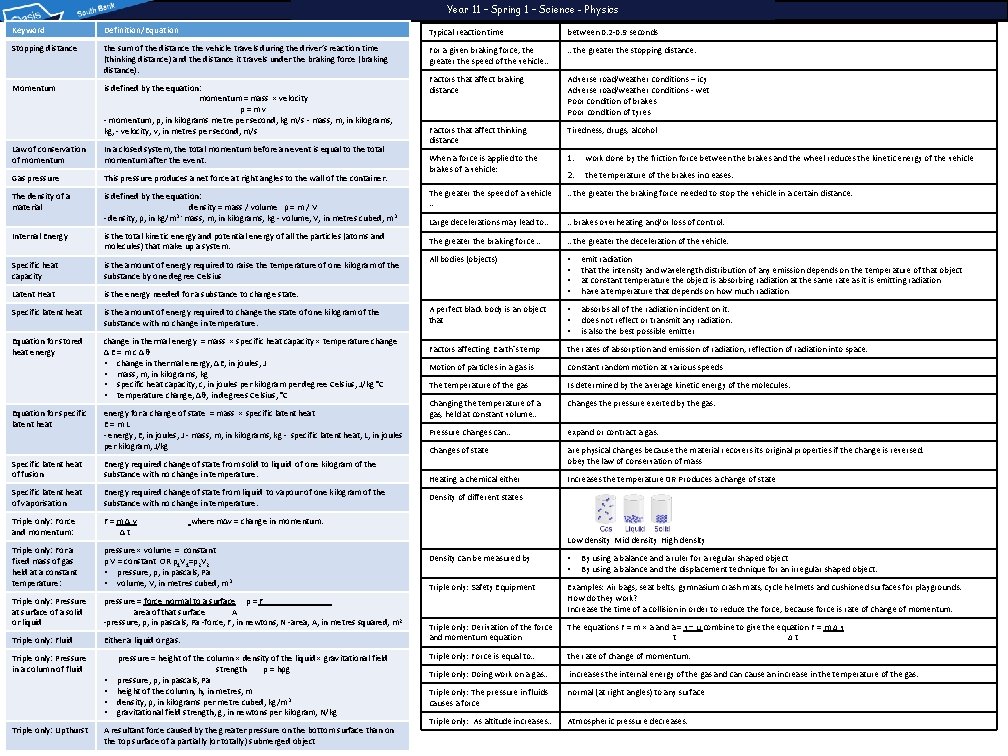
Angle Properties Year 11 – Spring 1 – Science - Physics Keyword Definition/Equation Typical reaction time between 0. 2 -0. 9 seconds Stopping distance the sum of the distance the vehicle travels during the driver’s reaction time (thinking distance) and the distance it travels under the braking force (braking distance). For a given braking force, the greater the speed of the vehicle… …the greater the stopping distance. Momentum is defined by the equation: momentum = mass × velocity p=mv - momentum, p, in kilograms metre per second, kg m/s - mass, m, in kilograms, kg, - velocity, v, in metres per second, m/s Factors that affect braking distance Adverse road/weather conditions – icy Adverse road/weather conditions - wet Poor condition of brakes Poor condition of tyres Factors that affect thinking distance Tiredness, drugs, alcohol When a force is applied to the brakes of a vehicle: 1. work done by the friction force between the brakes and the wheel reduces the kinetic energy of the vehicle 2. the temperature of the brakes increases. The greater the speed of a vehicle … …the greater the braking force needed to stop the vehicle in a certain distance. Large decelerations may lead to… …brakes overheating and/or loss of control. The greater the braking force … …the greater the deceleration of the vehicle. All bodies (objects) • • emit radiation that the intensity and wavelength distribution of any emission depends on the temperature of that object at constant temperature the object is absorbing radiation at the same rate as it is emitting radiation have a temperature that depends on how much radiation A perfect black body is an object that • • • absorbs all of the radiation incident on it. does not reflect or transmit any radiation. is also the best possible emitter Factors affecting Earth’s temp the rates of absorption and emission of radiation, reflection of radiation into space. Motion of particles in a gas is constant random motion at various speeds The temperature of the gas Is determined by the average kinetic energy of the molecules. Changing the temperature of a gas, held at constant volume… changes the pressure exerted by the gas. Pressure changes can… expand or contract a gas. Changes of state are physical changes because the material recovers its original properties if the change is reversed. obey the law of conservation of mass Heating a chemical either Increases the temperature OR Produces a change of state Law of conservation of momentum In a closed system, the total momentum before an event is equal to the total momentum after the event. Gas pressure This pressure produces a net force at right angles to the wall of the container. The density of a material is defined by the equation: density = mass / volume ρ = m / V - density, ρ, in kg/m 3 - mass, m, in kilograms, kg - volume, V, in metres cubed, m 3 Internal Energy is the total kinetic energy and potential energy of all the particles (atoms and molecules) that make up a system. Specific heat capacity is the amount of energy required to raise the temperature of one kilogram of the substance by one degree Celsius Latent Heat is the energy needed for a substance to change state. Specific latent heat is the amount of energy required to change the state of one kilogram of the substance with no change in temperature. Equation for stored heat energy change in thermal energy = mass × specific heat capacity × temperature change ∆E=mc∆θ • change in thermal energy, ∆E, in joules, J • mass, m, in kilograms, kg • specific heat capacity, c, in joules per kilogram per degree Celsius, J/kg °C • temperature change, ∆θ, in degrees Celsius, °C Equation for specific latent heat energy for a change of state = mass × specific latent heat E=m. L - energy, E, in joules, J - mass, m, in kilograms, kg - specific latent heat, L, in joules per kilogram, J/kg Specific latent heat of fusion Energy required change of state from solid to liquid of one kilogram of the substance with no change in temperature. Specific latent heat of vaporisation Energy required change of state from liquid to vapour of one kilogram of the substance with no change in temperature. Triple only: Force and momentum: F=m∆v ∆t Triple only: For a fixed mass of gas held at a constant temperature: pressure × volume = constant p V = constant OR p 1 V 1=p 2 V 2 • pressure, p, in pascals, Pa • volume, V, in metres cubed, m 3 Triple only: Pressure at surface of a solid or liquid pressure = force normal to a surface p = F area of that surface A -pressure, p, in pascals, Pa -force, F, in newtons, N -area, A, in metres squared, m 2 Triple only: Fluid Either a liquid or gas. Triple only: Pressure in a column of fluid Triple only: Upthurst • • Density of different states where m∆v = change in momentum. pressure = height of the column × density of the liquid × gravitational field strength p = hρg pressure, p, in pascals, Pa height of the column, h, in metres, m density, ρ, in kilograms per metre cubed, kg/m 3 gravitational field strength, g, in newtons per kilogram, N/kg A resultant force caused by the greater pressure on the bottom surface than on the top surface of a partially (or totally) submerged object Low density Mid density High density Density can be measured by • • Triple only: Safety Equipment Examples: Air bags, seat belts, gymnasium crash mats, cycle helmets and cushioned surfaces for playgrounds. How do they work? Increase the time of a collision in order to reduce the force, because force is rate of change of momentum. Triple only: Derivation of the force and momentum equation The equations F = m × a and a = v − u combine to give the equation F = m ∆ v t ∆t Triple only: Force is equal to… the rate of change of momentum. Triple only: Doing work on a gas… increases the internal energy of the gas and can cause an increase in the temperature of the gas. Triple only: The pressure in fluids causes a force normal (at right angles) to any surface Triple only: As altitude increases… Atmospheric pressure decreases. By using a balance and a ruler for a regular shaped object By using a balance and the displacement technique for an irregular shaped object.
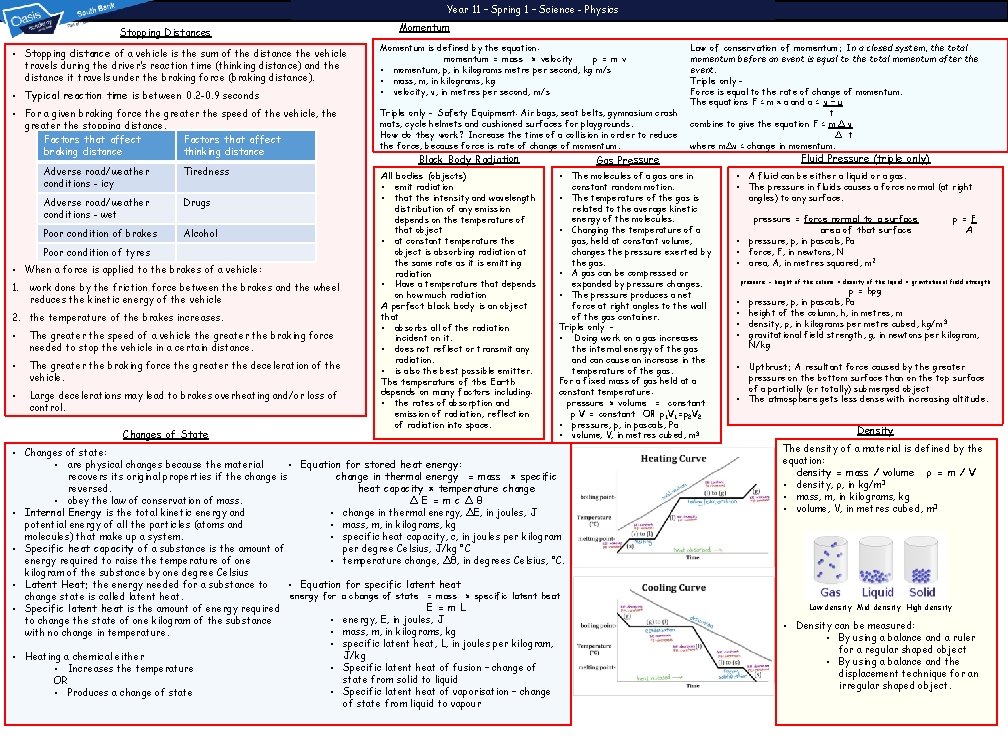
Angle Properties Year 11 – Spring 1 – Science - Physics Stopping Distances • Stopping distance of a vehicle is the sum of the distance the vehicle travels during the driver’s reaction time (thinking distance) and the distance it travels under the braking force (braking distance). • Typical reaction time is between 0. 2 -0. 9 seconds • For a given braking force the greater the speed of the vehicle, the greater the stopping distance. Factors that affect braking distance thinking distance Adverse road/weather conditions - icy Tiredness Adverse road/weather conditions - wet Drugs Poor condition of brakes Alcohol Poor condition of tyres • When a force is applied to the brakes of a vehicle: 1. work done by the friction force between the brakes and the wheel reduces the kinetic energy of the vehicle 2. the temperature of the brakes increases. • The greater the speed of a vehicle the greater the braking force needed to stop the vehicle in a certain distance. • The greater the braking force the greater the deceleration of the vehicle. • Large decelerations may lead to brakes overheating and/or loss of control. Changes of State Momentum is defined by the equation: momentum = mass × velocity p = m v • momentum, p, in kilograms metre per second, kg m/s • mass, m, in kilograms, kg • velocity, v, in metres per second, m/s Triple only - Safety Equipment: Air bags, seat belts, gymnasium crash mats, cycle helmets and cushioned surfaces for playgrounds. How do they work? Increase the time of a collision in order to reduce the force, because force is rate of change of momentum. Black Body Radiation All bodies (objects) • emit radiation • that the intensity and wavelength distribution of any emission depends on the temperature of that object • at constant temperature the object is absorbing radiation at the same rate as it is emitting radiation • Have a temperature that depends on how much radiation A perfect black body is an object that • absorbs all of the radiation incident on it. • does not reflect or transmit any radiation. • is also the best possible emitter. The temperature of the Earth depends on many factors including: • the rates of absorption and emission of radiation, reflection of radiation into space. Law of conservation of momentum: In a closed system, the total momentum before an event is equal to the total momentum after the event. Triple only Force is equal to the rate of change of momentum. The equations F = m × a and a = v − u t combine to give the equation F = m ∆ v ∆ t where m∆v = change in momentum. Fluid Pressure (triple only) Gas Pressure The molecules of a gas are in constant random motion. • The temperature of the gas is related to the average kinetic energy of the molecules. • Changing the temperature of a gas, held at constant volume, changes the pressure exerted by the gas. • A gas can be compressed or expanded by pressure changes. • The pressure produces a net force at right angles to the wall of the gas container. Triple only • Doing work on a gas increases the internal energy of the gas and can cause an increase in the temperature of the gas. For a fixed mass of gas held at a constant temperature: pressure × volume = constant p V = constant OR p 1 V 1=p 2 V 2 • pressure, p, in pascals, Pa • volume, V, in metres cubed, m 3 • • Changes of state: • are physical changes because the material • Equation for stored heat energy: recovers its original properties if the change is change in thermal energy = mass × specific reversed. heat capacity × temperature change • obey the law of conservation of mass. ∆ E = m c ∆ θ • Internal Energy is the total kinetic energy and • change in thermal energy, ∆E, in joules, J potential energy of all the particles (atoms and • mass, m, in kilograms, kg molecules) that make up a system. • specific heat capacity, c, in joules per kilogram • Specific heat capacity of a substance is the amount of per degree Celsius, J/kg °C energy required to raise the temperature of one • temperature change, ∆θ, in degrees Celsius, °C. kilogram of the substance by one degree Celsius • Latent Heat: the energy needed for a substance to • Equation for specific latent heat energy for a change of state = mass × specific latent heat change state is called latent heat. E = m L • Specific latent heat is the amount of energy required • energy, E, in joules, J to change the state of one kilogram of the substance • mass, m, in kilograms, kg with no change in temperature. • specific latent heat, L, in joules per kilogram, J/kg • Heating a chemical either • Specific latent heat of fusion – change of • Increases the temperature state from solid to liquid OR • Specific latent heat of vaporisation – change • Produces a change of state from liquid to vapour • • • A fluid can be either a liquid or a gas. The pressure in fluids causes a force normal (at right angles) to any surface. pressure = force normal to a surface area of that surface pressure, p, in pascals, Pa force, F, in newtons, N area, A, in metres squared, m 2 p = F A pressure = height of the column × density of the liquid × gravitational field strength • • • p = hρg pressure, p, in pascals, Pa height of the column, h, in metres, m density, ρ, in kilograms per metre cubed, kg/m 3 gravitational field strength, g, in newtons per kilogram, N/kg Upthrust: A resultant force caused by the greater pressure on the bottom surface than on the top surface of a partially (or totally) submerged object The atmosphere gets less dense with increasing altitude. Density The density of a material is defined by the equation: density = mass / volume ρ = m / V • density, ρ, in kg/m 3 • mass, m, in kilograms, kg • volume, V, in metres cubed, m 3 Low density Mid density High density • Density can be measured: • By using a balance and a ruler for a regular shaped object • By using a balance and the displacement technique for an irregular shaped object.
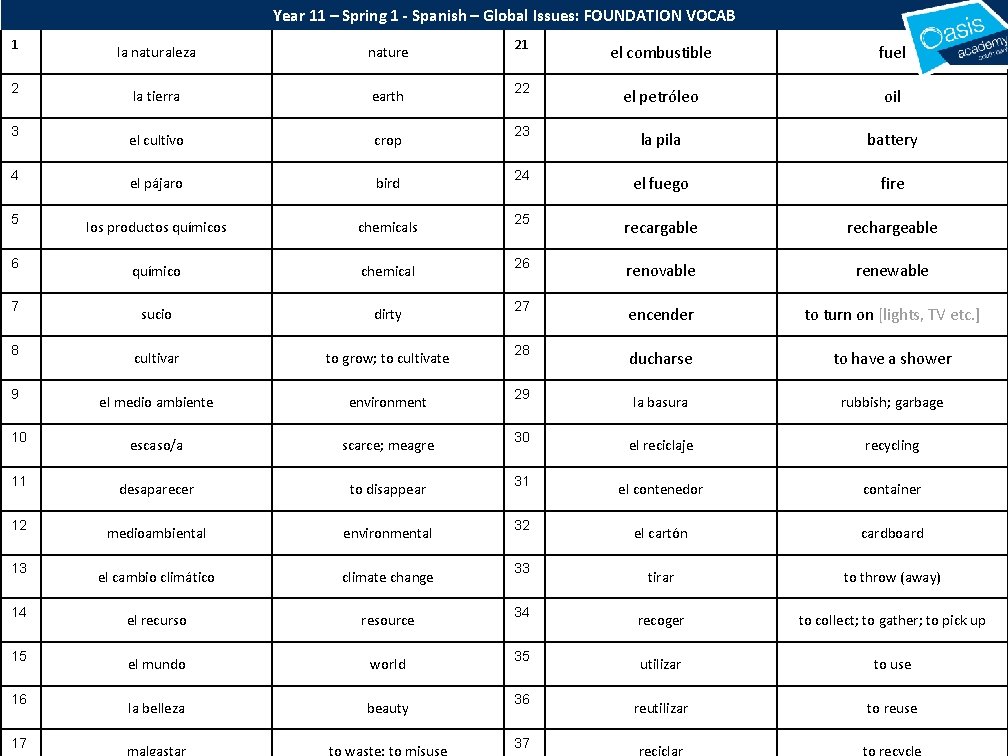
Year 11 – Spring 1 - Spanish – Global Issues: FOUNDATION VOCAB 1 21 el combustible fuel earth 22 el petróleo oil el cultivo crop 23 la pila battery 4 el pájaro bird 24 el fuego fire 5 los productos químicos chemicals 25 recargable rechargeable 6 químico chemical 26 renovable renewable 7 sucio dirty 27 encender to turn on [lights, TV etc. ] 8 cultivar to grow; to cultivate 28 ducharse to have a shower 9 el medio ambiente environment 29 la basura rubbish; garbage 10 escaso/a scarce; meagre 30 el reciclaje recycling 11 desaparecer to disappear 31 el contenedor container 12 medioambiental environmental 32 el cartón cardboard 13 el cambio climático climate change 33 tirar to throw (away) 14 el recurso resource 34 recoger to collect; to gather; to pick up 15 el mundo world 35 utilizar to use 16 la belleza beauty 36 reutilizar to reuse la naturaleza nature 2 la tierra 3 17 37
Year 11 – Spring 1 – Spanish F – Global Issues: FOUNDATION VOCAB 35 malgastar to waste; to misuse los necesitados needy people 37 la pobreza poverty 38 pobre 39 52 la ley law el robo theft; burglary 54 el ladrón thief poor 55 la violencia violence los derechos rights 56 la culpa fault; blame 40 la preocupación worry; anxiety 57 robar to steal 41 preocupado worried; anxious 58 matar to kill 42 luchar to fight; to struggle 59 el daño harm; damage 43 inquietar(se) to worry; to upset oneself 60 el peligro danger 44 el desarrollo development 61 peligroso dangerous 45 la campaña campaign 62 mundial global; world-wide 46 la libertad liberty; freedom 63 inquietante worrying; disturbing 47 injusto unjust; unfair 64 grave serious 48 el gobierno government 65 dañar to harm; to damage 49 el extranjero foreigner 66 aumentar to increase 50 beneficiar to benefit 67 proteger to protect 36 51 53 68
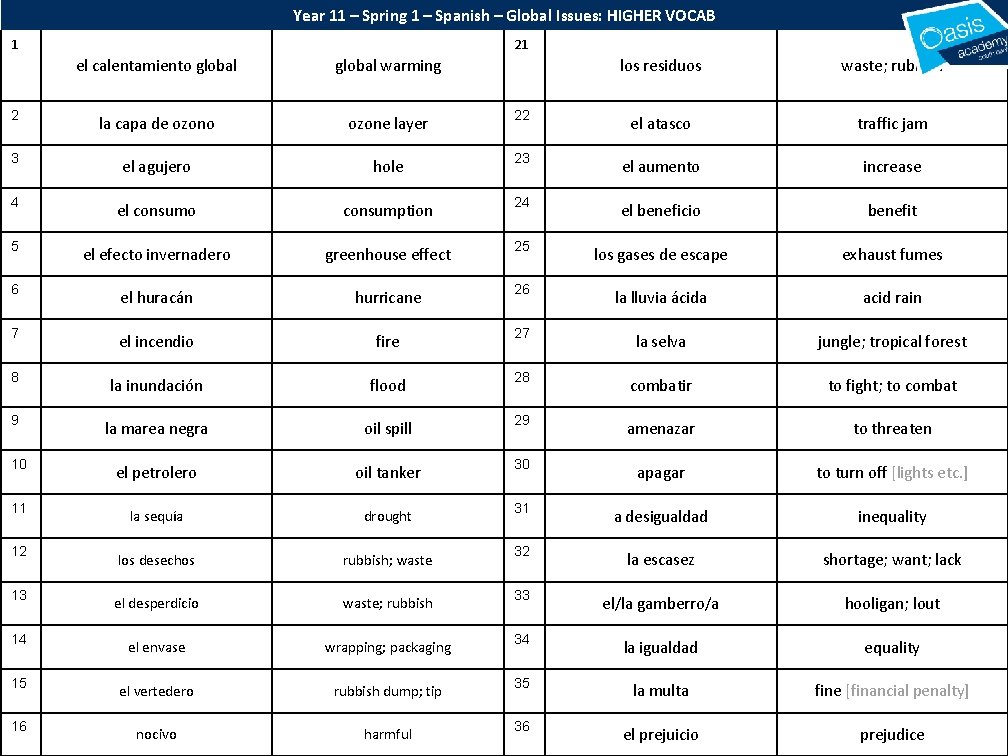
Year 11 – Spring 1 – Spanish – Global Issues: HIGHER VOCAB 1 21 el calentamiento global warming los residuos waste; rubbish 2 la capa de ozono ozone layer 22 el atasco traffic jam 3 el agujero hole 23 el aumento increase 4 el consumo consumption 24 el beneficio benefit 5 el efecto invernadero greenhouse effect 25 los gases de escape exhaust fumes 6 el huracán hurricane 26 la lluvia ácida acid rain 7 el incendio fire 27 la selva jungle; tropical forest 8 la inundación flood 28 combatir to fight; to combat 9 la marea negra oil spill 29 amenazar to threaten 10 el petrolero oil tanker 30 apagar to turn off [lights etc. ] 11 la sequía drought 31 a desigualdad inequality 12 los desechos rubbish; waste 32 la escasez shortage; want; lack 13 el desperdicio waste; rubbish 33 el/la gamberro/a hooligan; lout 14 el envase wrapping; packaging 34 la igualdad equality 15 el vertedero rubbish dump; tip 35 la multa fine [financial penalty] 16 nocivo harmful 36 el prejuicio prejudice
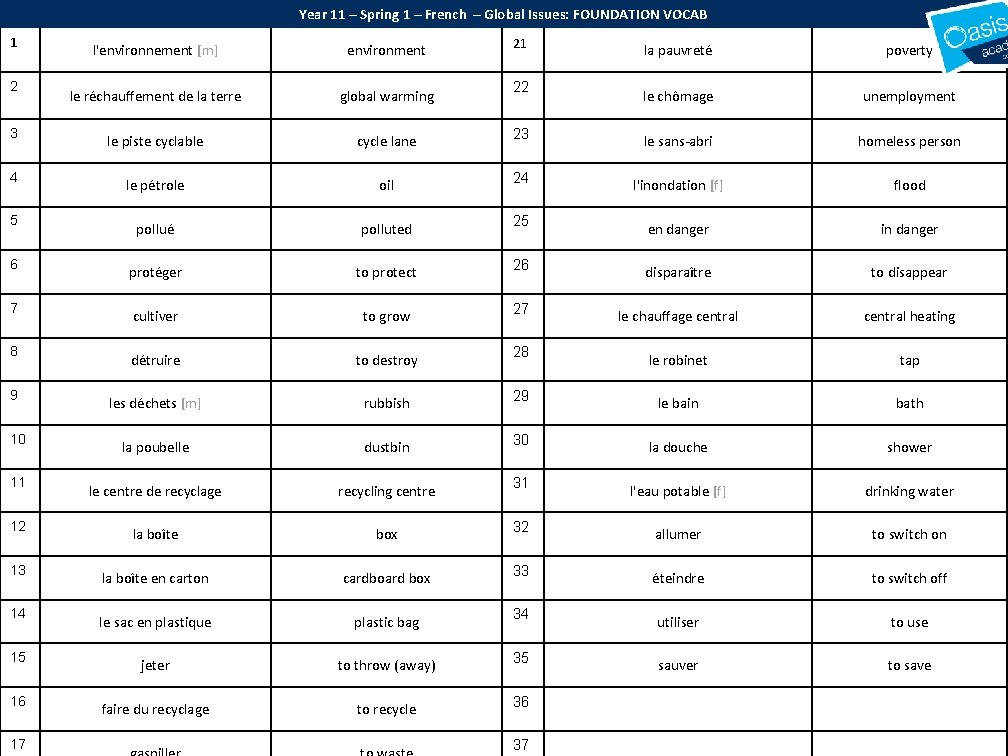
Year 11 – Spring 1 – French – Global Issues: FOUNDATION VOCAB 1 l'environnement [m] environment le réchauffement de la terre global warming 3 le piste cyclable cycle lane 4 le pétrole 5 21 la pauvreté poverty le chômage unemployment 23 le sans-abri homeless person oil 24 l'inondation [f] flood pollué polluted 25 en danger in danger 6 protéger to protect 26 disparaître to disappear 7 cultiver to grow 27 le chauffage central heating 8 détruire to destroy 28 le robinet tap 9 les déchets [m] rubbish 29 le bain bath 10 la poubelle dustbin 30 la douche shower 11 le centre de recyclage recycling centre 31 l'eau potable [f] drinking water 12 la boîte box 32 allumer to switch on 13 la boîte en carton cardboard box 33 éteindre to switch off 14 le sac en plastique plastic bag 34 utiliser to use 15 jeter to throw (away) 35 sauver to save 16 faire du recyclage to recycle 36 2 17 22 37
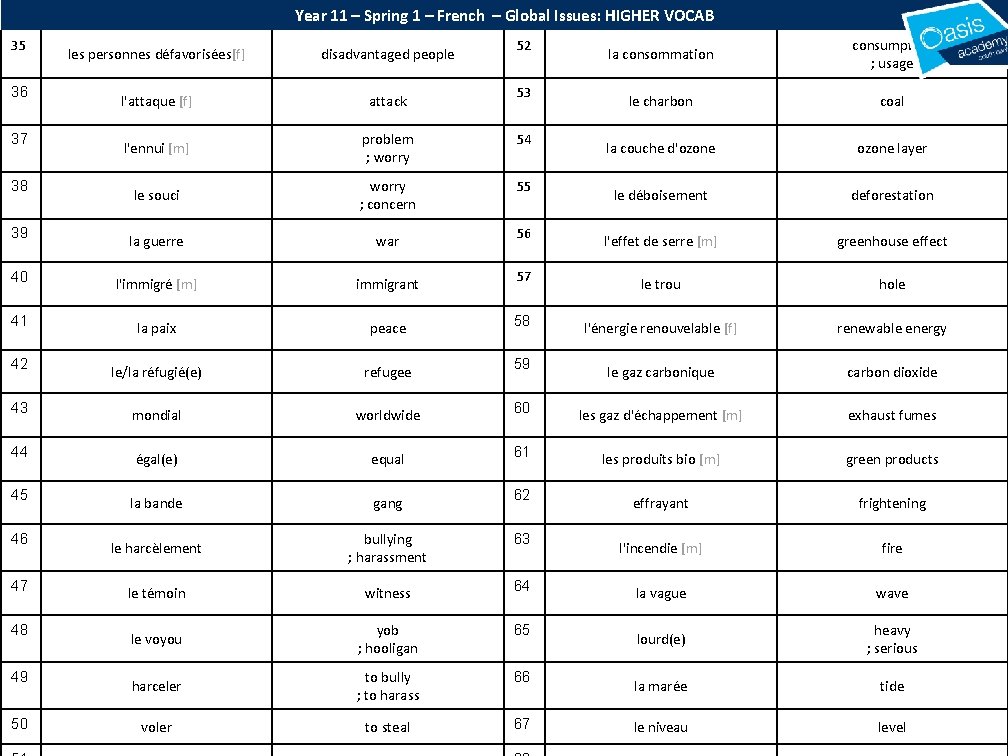
Year 11 – Spring 1 – French – Global Issues: HIGHER VOCAB 35 52 la consommation consumption ; usage le charbon coal la couche d'ozone layer le déboisement deforestation l'effet de serre [m] greenhouse effect le trou hole 58 l'énergie renouvelable [f] renewable energy refugee 59 le gaz carbonique carbon dioxide mondial worldwide 60 les gaz d'échappement [m] exhaust fumes 44 égal(e) equal 61 les produits bio [m] green products 45 la bande gang 62 effrayant frightening le harcèlement bullying ; harassment 63 l'incendie [m] fire le témoin witness 64 la vague wave le voyou yob ; hooligan 65 lourd(e) heavy ; serious harceler to bully ; to harass 66 la marée tide voler to steal 67 le niveau level les personnes défavorisées[f] disadvantaged people l'attaque [f] attack l'ennui [m] problem ; worry 54 le souci worry ; concern 55 39 la guerre war 40 l'immigré [m] immigrant 41 la paix peace 42 le/la réfugié(e) 43 36 37 38 46 47 48 49 50 53 56 57
Year 11 – Spring Term 1 - PE – Principles and Methods of training / Injury Prevention 1 Warm up 8 Progression This principle involves gradually increasing the amount of exercise you do. 2 Cool down Returns the body to a resting state gradually. 9 Overload fitness can only be improved by training more than you normally do. You must work hard. 3 Warm up stages 1. Pulse raiser e. g. jogging. 2. Static stretches e. g. stretch quadriceps. 3. Dynamic stretches e. g. lunges. 4. Skill rehearsal e. g. follow pass in football. 10 Reversibility is the process of an athletes body losing fitness levels. This can occur if training has stopped due to illness or injury. 4 Cool down stages 1. Low intensity exercise e. g. jogging. 2. Static stretching of all major muscle groups. 11 Principles of training The best training programmes are built on SPOR principles. (no. 7 -10). 5 Purpose of a warm up 1. 2. 3. 4. 5. 6. Injury prevention Increase muscle temperature Mental preparation Gradually increases Heart Rate. Increases flexibility of muscles. Increased speed of muscular contractions. 12 FITT Principle For training to improve an individuals fitness they must following the FITT principle (in order to see Progression from the SPOR principle). 6 Purpose of a cool down 1. Gradually lowers Heart Rate back to a resting level. 2. Gradually lowers muscle temperature. 3. Removes waste products e. g. lactic acid. 4. Prevents DOMS (Delayed Onset Muscle Soreness). 13 Frequency How often we train (number of training sessions per week) Intensity How hard we train. Time How long we train per session. Type What type of training is used. 7 Specificity Prepares the body for physical work. Your training should be geared specifically towards your chosen sport or activity.
Year 11 – Spring Term 1 - PE – Principles and Methods of training / Injury Prevention 14 Methods of training 21 High Intensity Interval Training (HIIT) This type of training involves repeated bouts of high intensity effort followed by varied recovery times. These short, intense workouts will improve cardiovascular endurance. Different types of training are used when working on different components of fitness. 15 Continuous training This type of training involves a steady pace at a moderate intensity which should last for at least 30 minutes e. g. running. 22 Risk This is the possibility or chance of injury occurring. 16 Fartlek training It is a combination of different intensities. Involves both aerobic and anaerobic fitness due to the varying intensity e. g. 1 lap at 50% of max, 1 lap at 80% of max. 23 Hazard Something that is dangerous or could cause harm. 17 Interval training This training involves periods of work followed by periods of rest e. g. 20 M sprint then walk back to start. 24 Considerations to prevent injury 1. A thorough warm up. 2. A full cool down. 3. Use of correct footwear and clothing e. g. football boots in football. 18 Circuit training is a series of exercises completed one after another. It is a very good way of developing strength, muscular endurance and power. 25 Considerations to prevent injury (part 2) 1. Personal protective equipment e. g. shin pads in football. 2. Appropriate level of competition 3. Correct carrying techniques e. g. moving a bench with a straight back. 19 Weight training is a form of training that uses progressive resistance against a muscle group. E. g. free weights – dumbbell curl. 20 Plyometrics A type of strength training that can be used to improve power or muscular strength. E. g. jumping and bounding activities.
Ao. S 4: Film Music and Ao. S 5: Pop Music Year 11 – Spring 1 – Music Film Music Definitions Pop Music Key Features and Artists Rock and Roll (1950 s-1960 s ) Bill Haley and His Comets 1 Fast Tempo To give a lively, upbeat feel 2 Major Harmony Happy-sounding chords 3 4/4 Time Signature Steady and danceable 4 Verse/Chorus Structure Verses with a high male voice and chorus with backing singers [loud] 5 Walking Bass The bass line moves constantly 6 12 -Bar Blues Harmony A chord sequence that includes 3 chords played in a pattern for 3 bars Instrumental / Improvisation A section in which one of the instruments improvises a melody (no singers) 19 Film Music Composers John Williams Hanz Zimmer 20 Video Game Composers Martin O’Donnell 21 Chromatic Using notes not in the scale – all the black and white notes on the keyboard 22 Glissando Sliding between notes – to add emotion 23 Free Tempo No set tempo (not steady) there might be lots of silence or the music changes speed Rock Anthems (1970 s-1980 s) Survivor, Europe 24 Electronic Instruments Amplifiers, Electric Guitars, Bass Guitars Crescendo and Diminuendo Volume gets gradually louder and softer throughout 25 Homophonic Electric Guitar Effects Distortion Thick texture but all generally playing at the same time (with each other) 10 Repeated vocal lines Short vocal lines are often repeated 26 Staccato Articulation Very short, detached notes 11 4/4 Time Signature Steady and danceable 27 Legato Articulation Smooth, sustained notes 12 Verse/Chorus Structure Clear verses followed by choruses 28 Strong, steady beat Gives it a ‘heavy’ rock feel - Drum Kit Often a ‘backbeat’ – beats 2 and 4 stronger Dissonant Harmony Chords or notes that seem to ‘clash’ or not fit with each other 29 Descending Melody A tune that gets lower in pitch (could signify something bad) 30 Ascending Melody A tune that gets higher in pitch (could signify something positive) 31 Tremolo A wavering/wobble on a note, produced by rapid repitition of a note 32 Pizzicato Articulation When a string instrument ‘pluck’s a note – could sound a bit like a guitar 7 8 9 13 14 Repeated chords Only 3 or 4 chords 15 Instrumental / Improvisation A section in which one of the instruments improvises a melody (no singers) Pop Ballads (1970 -1990 s) Elton John, Bonnie Tyler 16 Simple Accompaniment Piano, Acoustic Guitar, Strings 17 Slow Tempo To give a sense of emotion 18 Variety of chords Broken chords, sustained chords, block chords 33 Stepwise melody A tune whose notes are next to each other (without big leaps) Depicting a Mood (or a scene) in a film 34 Battle or War Loud dynamics, Fast Tempo, Brass and percussion instruments, Accents, Ostinato rhythms, steady tempo, homophonic texture, repeated notes or melody, minor harmony, snare drum 35 Peaceful/Calm Countryside or Mainly string instruments, high woodwind instruments, soft dynamics with crescendo and diminuendo, slow or moderate tempo, legato articulation, major harmony, stepwise melody 36 Mystery or Magic Delicate timbre, tremolo strings, free tempo, slow tempo, legato articulation, crescendo and diminuendo, pizzicato articulation, glissando, high pitch , use of technology effects 37 Sad or Cold Minor harmony, low pitch, use of silence, string instruments, sustained notes, dissonant (clashing) notes, legato articulation, descending melody, crescendo dynamics 38 Emotion or Tragedy Chromatic melody, dissonant (clash) harmony, crescendo, low pitch that rises, repeating melody, low pitch, vibrato notes, low sustained notes 39 Happy or Joyful Major harmony, fast tempo, mainly strings, woodwind instruments, syncopated rhythm, staccato articulation, leaps in melody, repeating melody, loud dynamics, crescendo, timpani roll, percussion crash Pop Solos (1990 s – Present) Rihanna, Adele, Michael Jackson 40 Electronic Effects Amplification, Reverb, Panning, Echo, Delay, Sampling, Looping 41 Fast Tempo Often lively and upbeat 42 Multi-tracking Soloist records in harmony parts and layers 43 Rap style Sometimes singers chant or say things in rap-style 44 Hook Short repeated vocal phrase 45 Vocal Slide When a singer ‘slides’ between two notes to add emphasis