
Year 10 Life Sciences Pearson Science 10 Chapter






- Slides: 15
Year 10 Life Sciences Pearson Science 10 Chapter 2. 1
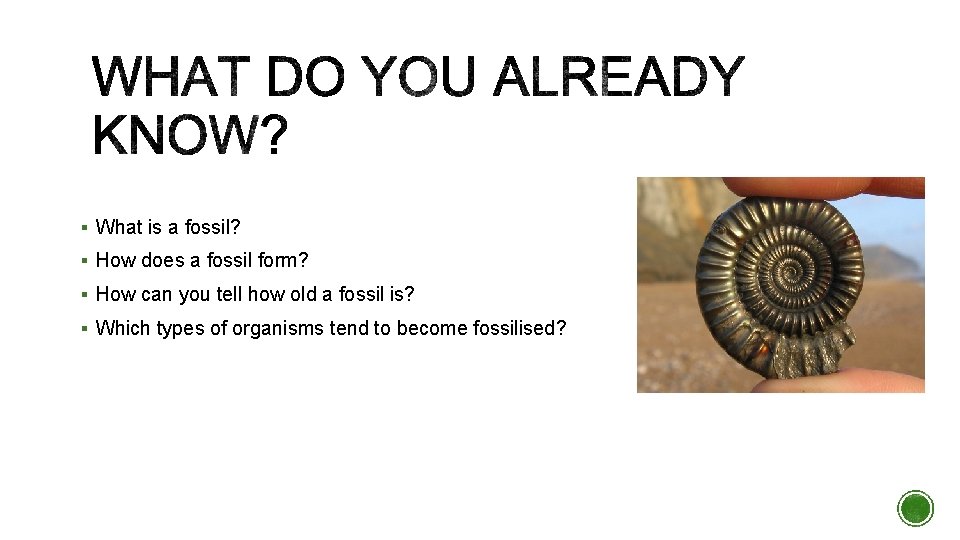
§ What is a fossil? § How does a fossil form? § How can you tell how old a fossil is? § Which types of organisms tend to become fossilised?
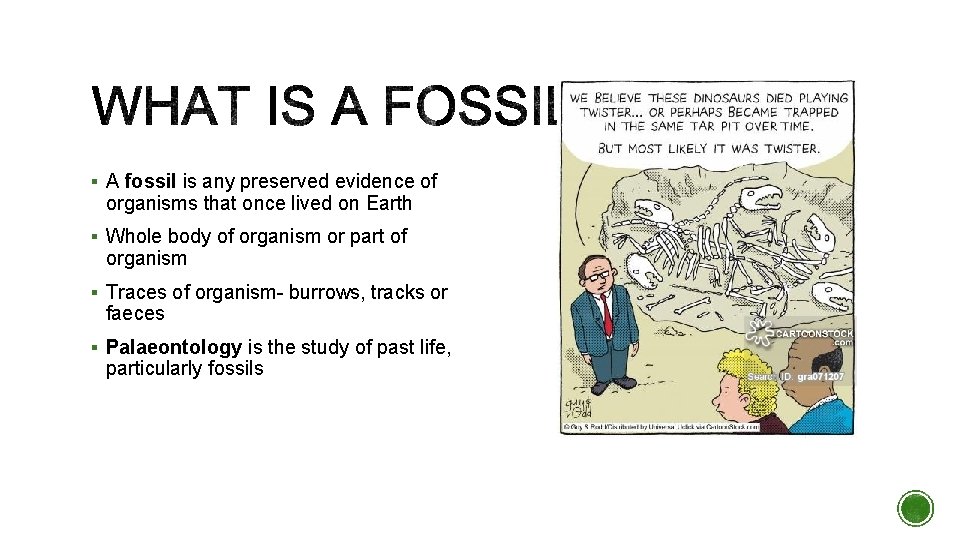
§ A fossil is any preserved evidence of organisms that once lived on Earth § Whole body of organism or part of organism § Traces of organism- burrows, tracks or faeces § Palaeontology is the study of past life, particularly fossils
§ The fossil record is a list showing all the species that have been discovered fossilised, their age and location. § A very useful tool for scientists- holds information on evolution, human history, and geology. § Not all organisms are represented in the fossil record
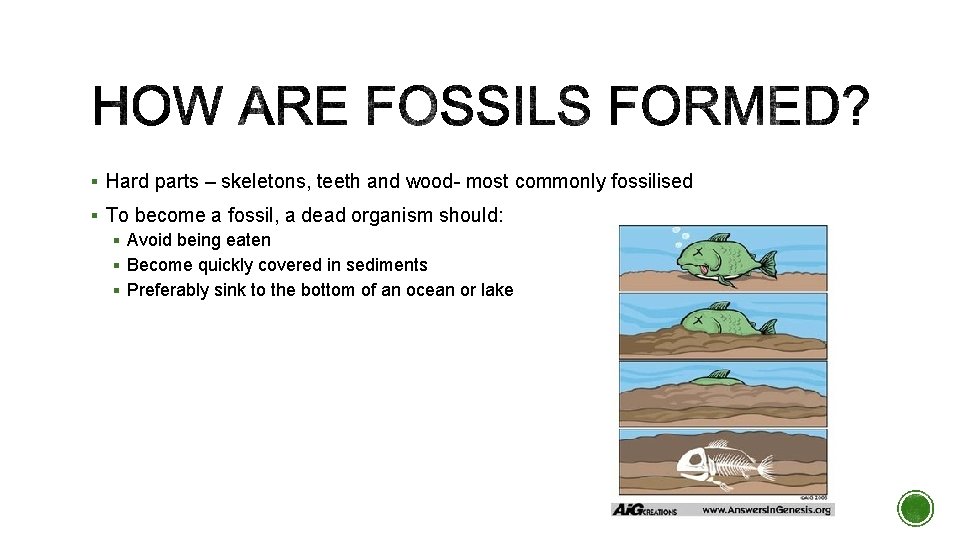
§ Hard parts – skeletons, teeth and wood- most commonly fossilised § To become a fossil, a dead organism should: § Avoid being eaten § Become quickly covered in sediments § Preferably sink to the bottom of an ocean or lake
§Original §Replacement §Carbon film §Indirect
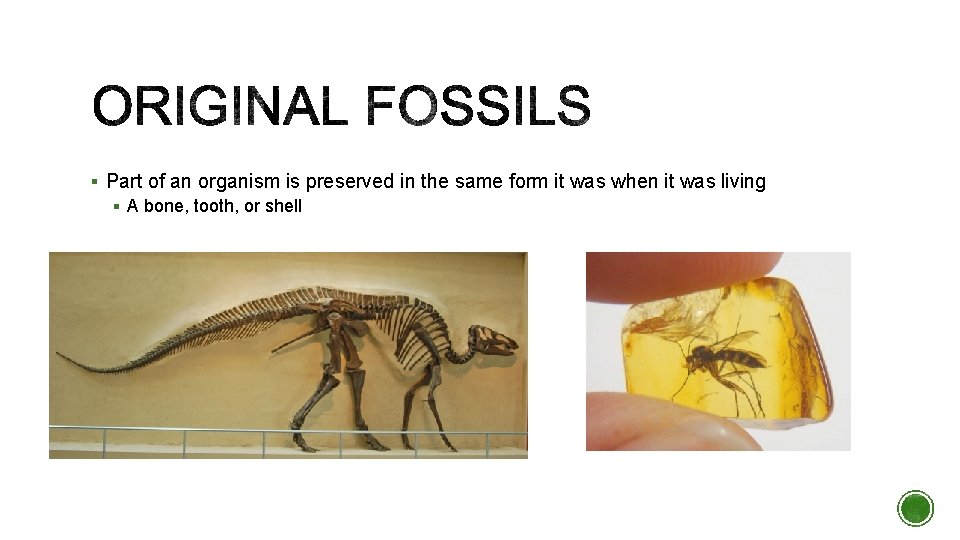
§ Part of an organism is preserved in the same form it was when it was living § A bone, tooth, or shell
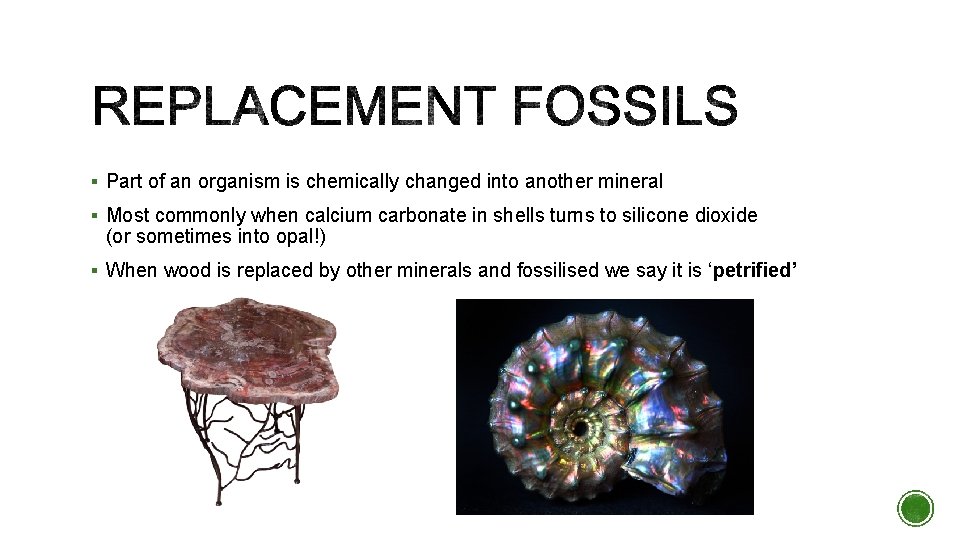
§ Part of an organism is chemically changed into another mineral § Most commonly when calcium carbonate in shells turns to silicone dioxide (or sometimes into opal!) § When wood is replaced by other minerals and fossilised we say it is ‘petrified’
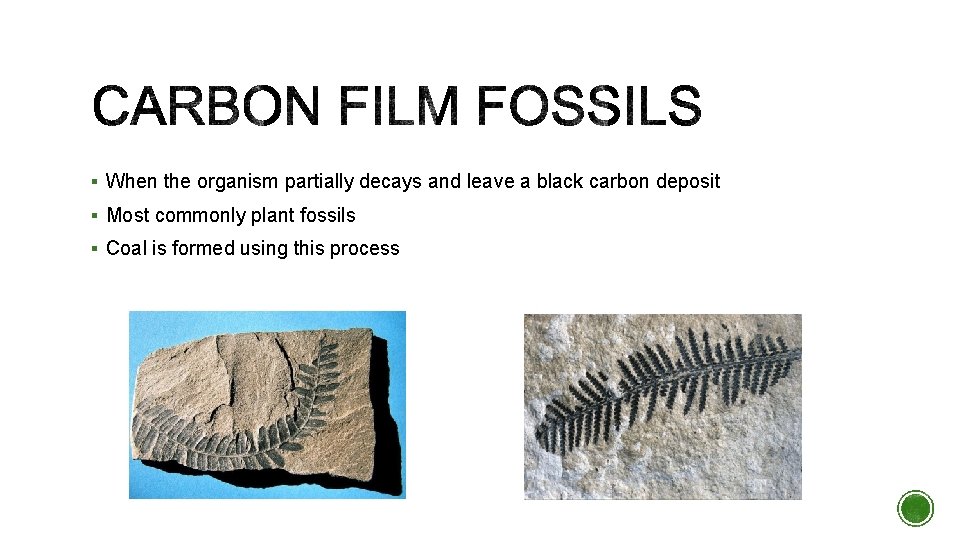
§ When the organism partially decays and leave a black carbon deposit § Most commonly plant fossils § Coal is formed using this process
§ Preserved remains of the organism, but not the organism itself § Imprints of body, footprints, faeces or burrows § A mould is the imprint of the outside of the body in rock § A cast when an organism in rock decomposes and the space in the rock fills with soil that turns to rock
§ http: //ed. ted. com/lessons/how-to-fossilize-yourself-phoebe-a-cohen#watch
§ https: //play. kahoot. it/#/intro? quiz. Id=f 6 f 857 b 5 -2183 -4079 -be 7 f-83058 cce 572 a
§ In these environments, soft parts have a better chance of being preserved § Permafrost- in permanently frozen land decay causing bacteria and fungi cannot survive. Wooly mammoth fossils have been found in permafrost- possibility to clone it using Asian elephant surrogate (Look on You. Tube- very cool docos!) § Amber- solid plant sap that entombs insects can preserve the entire organism § Tar- where oil seeps naturally out of the ground and traps animals in pits § Peat- partly decomposed plant remains in swamps, where oxygen and bacteria are absent § Dry air- without moisture bacteria and fungi cannot survive
§ Be done with a sharp pencil § Use solid lines, not sketching § Use ‘stippling’ to show darker areas, not shading or cross hatching § Be labelled using a ruled line, to one side of the drawing only § Fill the space you have to draw in
§ https: //play. kahoot. it/#/k/879520 c 6 -819 c-4392 -8403 -e 9 b 471 f 9 f 960