
Year 10 Geography Knowledge Organisers Paper 1 1
- Slides: 12
Year 10 Geography Knowledge Organisers Paper 1 1. Tectonic Hazards 2. Atmospheric Hazards 3. Extreme Weather in the UK 4. Climate Change 5. Coasts 6. Rivers Paper 2 7. Ecosystems 8. Tropical Rainforests 9. Cold Environments 10. Urban Issues and Challenges: Rio 11. Urban Issues and Challenges: Bristol
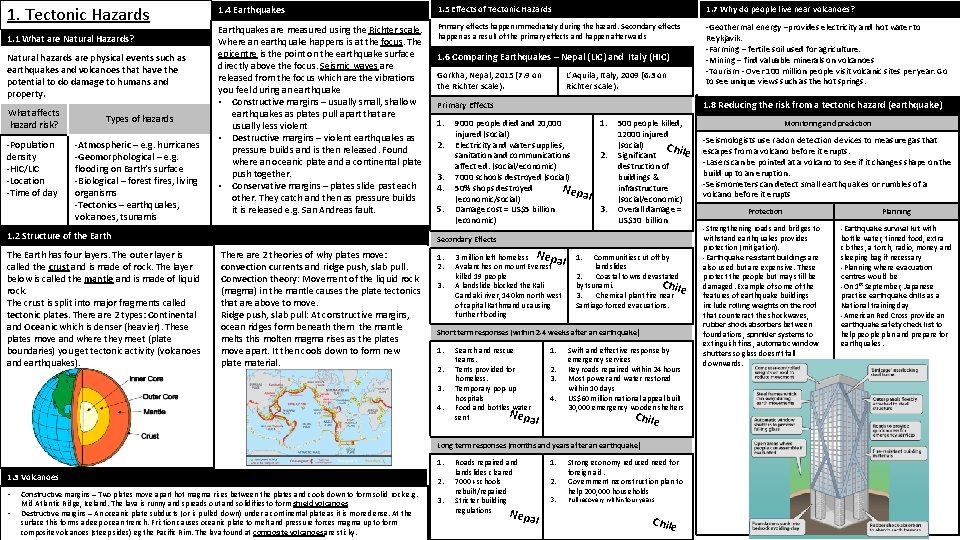
1. Tectonic Hazards 1. 1 What are Natural Hazards? Natural hazards are physical events such as earthquakes and volcanoes that have the potential to do damage to humans and property. What affects hazard risk? -Population density -HIC/LIC -Location -Time of day Types of hazards -Atmospheric – e. g. hurricanes -Geomorphological – e. g. flooding on Earth’s surface -Biological – forest fires, living organisms -Tectonics – earthquakes, volcanoes, tsunamis 1. 4 Earthquakes 1. 5 Effects of Tectonic Hazards 1. 7 Why do people live near volcanoes? Earthquakes are measured using the Richter scale. Where an earthquake happens is at the focus. The epicentre is the point on the earthquake surface directly above the focus. Seismic waves are released from the focus which are the vibrations you feel during an earthquake • Constructive margins – usually small, shallow earthquakes as plates pull apart that are usually less violent • Destructive margins – violent earthquakes as pressure builds and is then released. Found where an oceanic plate and a continental plate push together. • Conservative margins – plates slide past each other. They catch and then as pressure builds it is released e. g. San Andreas fault. Primary effects happen immediately during the hazard. Secondary effects happen as a result of the primary effects and happen afterwards -Geothermal energy –provides electricity and hot water to Reykjavik. -Farming – fertile soil used for agriculture. -Mining – find valuable minerals on volcanoes -Tourism - Over 100 million people visit volcanic sites per year. Go to see unique views such as the hot springs. 1. 2 Structure of the Earth The Earth has four layers. The outer layer is called the crust and is made of rock. The layer below is called the mantle and is made of liquid rock. The crust is split into major fragments called tectonic plates. There are 2 types: Continental and Oceanic which is denser (heavier). These plates move and where they meet (plate boundaries) you get tectonic activity (volcanoes and earthquakes). 1. 6 Comparing Earthquakes – Nepal (LIC) and Italy (HIC) Gorkha, Nepal, 2015 (7. 9 on the Richter scale). L’Aquila, Italy, 2009 (6. 3 on Richter scale). 1. 8 Reducing the risk from a tectonic hazard (earthquake) Primary Effects 1. 2. 3. 4. 5. 9000 people died and 20, 000 injured (social) Electricity and water supplies, sanitation and communications affect ed. (social/economic) 7000 schools destroyed (social) 50% shops destroyed Nepa l (economic/social) Damage cost = US$5 billion (economic) 1. 2. 3. 500 people killed, 12000 injured (social) Chile Significant destruction of buildings & infrastructure (social/economic) Overall damage = US$30 billion Secondary Effects There are 2 theories of why plates move: convection currents and ridge push, slab pull. Convection theory: Movement of the liquid rock (magma) in the mantle causes the plate tectonics that are above to move. Ridge push, slab pull: At constructive margins, ocean ridges form beneath them the mantle melts this molten magma rises as the plates move apart. It then cools down to form new plate material. 1. 2. 3. 3 million left homeless Nep a Avalanches on mount Everest l killed 19 people A landslide blocked the Kali Gandaki river, 140 km north west of capital Kathmandu causing further flooding 1. Communities cut off by landslides 2. Coastal towns devastated Chile by tsunami. 3. Chemical plant fire near Santiago forced evacuations. Short term responses (within 2 -4 weeks after an earthquake) 1. 2. 3. 4. 1. Search and rescue teams. Tents provided for homeless. Temporary pop-up hospitals Food and bottles water Nepa sent 2. 3. 4. Swift and effective response by emergency services Key roads repaired within 24 hours Most power and water restored within 10 days US$60 million national appeal built 30, 000 emergency wooden shelters Chile l Long term responses (months and years after an earthquake) 1. 3 Volcanoes • • Constructive margins – Two plates move apart hot magma rises between the plates and cools down to form solid rock e. g. Mid Atlantic Ridge, Iceland. The lava is runny and spreads out and solidifies to form shield volcanoes Destructive margins – An oceanic plate subducts (or is pulled down) under a continental plate as it is more dense. At the surface this forms a deep ocean trench. Friction causes oceanic plate to melt and pressure forces magma up to form composite volcanoes (steep sides) eg the Pacific Rim. The lava found at composite volcanoes are sticky. 2. 3. Roads repaired and landslides cleared 7000+ schools rebuilt/repaired Stricter building regulations N epal 1. 2. 3. Strong economy reduced need foreign aid. Government reconstruction plan to help 200, 000 households Full recovery within four years Chile Monitoring and prediction -Seismologists use radon detection devices to measure gas that escapes from a volcano before it erupts. -Lasers can be pointed at a volcano to see if it changes shape on the build up to an eruption. -Seismometers can detect small earthquakes or rumbles of a volcano before it erupts Protection -Strengthening roads and bridges to withstand earthquakes provides protection (mitigation). -Earthquake resistant buildings are also used but are expensive. These protect the people but may still be damaged. Example of some of the features of earthquake buildings include rolling weights on the roof that counteract the shockwaves, rubber shock absorbers between foundations, sprinkler systems to extinguish fires, automatic window shutters so glass doesn’t fall downwards. Planning -Earthquake survival kit with bottle water, tinned food, extra clothes, a torch, radio, money and sleeping bag if necessary -Planning where evacuation centres would be -On 1 st September, Japanese practise earthquake drills as a National training day -American Red Cross provide an earthquake safety check list to help people plan and prepare for earthquakes.
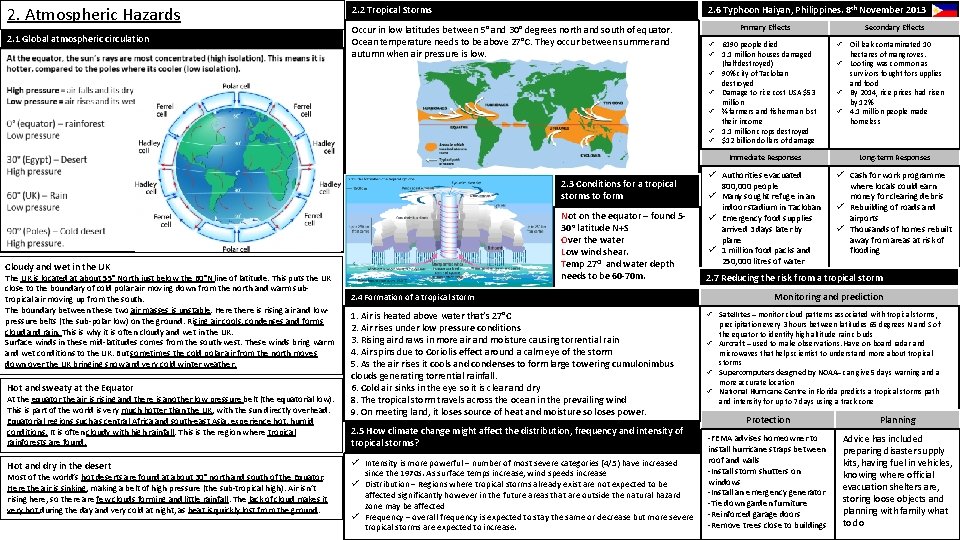
2. Atmospheric Hazards 2. 1 Global atmospheric circulation 2. 2 Tropical Storms 2. 6 Typhoon Haiyan, Philippines. 8 th November 2013 Occur in low latitudes between 5° and 30° degrees north and south of equator. Ocean temperature needs to be above 27°C. They occur between summer and autumn when air pressure is low. Primary Effects ü 6190 people died ü 1. 1 million houses damaged ü Oil leak contaminated 10 ü survivors fought for supplies and food ü By 2014, rice prices had risen by 12% ü 4. 1 million people made homeless ü ü (half destroyed) 90% city of Tacloban destroyed Damage to rice cost USA $53 million ¾ farmers and fisherman lost their income 1. 1 million crops destroyed $12 billion dollars of damage Immediate Responses 2. 3 Conditions for a tropical storms to form Not on the equator – found 530 o latitude N+S Over the water Low wind shear. Temp 27 O and water depth needs to be 60 -70 m. Cloudy and wet in the UK The UK is located at about 55° North just below the 60°N line of latitude. This puts the UK close to the boundary of cold polar air moving down from the north and warm subtropical air moving up from the south. The boundary between these two air masses is unstable. Here there is rising air and lowpressure belts (the sub-polar low) on the ground. Rising air cools, condenses and forms cloud and rain. This is why it is often cloudy and wet in the UK. Surface winds in these mid-latitudes comes from the south-west. These winds bring warm and wet conditions to the UK. But sometimes the cold polar air from the north moves down over the UK bringing snow and very cold winter weather. Hot and sweaty at the Equator At the equator the air is rising and there is another low pressure belt (the equatorial low). This is part of the world is very much hotter than the UK, with the sun directly overhead. Equatorial regions such as central Africa and south-east Asia, experience hot, humid conditions. It is often cloudy with high rainfall. This is the region where tropical rainforests are found. Hot and dry in the desert Most of the world’s hot deserts are found at about 30° north and south of the Equator. Here the air is sinking, making a belt of high pressure (the sub-tropical high). Air isn’t rising here, so there are few clouds forming and little rainfall. The lack of cloud makes it very hot during the day and very cold at night, as heat is quickly lost from the ground. 2. 4 Formation of a tropical storm 1. Air is heated above water that’s 27°C 2. Air rises under low pressure conditions 3. Rising air draws in more air and moisture causing torrential rain 4. Air spins due to Coriolis effect around a calm eye of the storm 5. As the air rises it cools and condenses to form large towering cumulonimbus clouds generating torrential rainfall. 6. Cold air sinks in the eye so it is clear and dry 8. The tropical storm travels across the ocean in the prevailing wind 9. On meeting land, it loses source of heat and moisture so loses power. 2. 5 How climate change might affect the distribution, frequency and intensity of tropical storms? ü Intensity is more powerful – number of most severe categories (4/5) have increased since the 1970 s. As surface temps increase, wind speeds increase ü Distribution – Regions where tropical storms already exist are not expected to be affected significantly however in the future areas that are outside the natural hazard zone may be affected ü Frequency – overall frequency is expected to stay the same or decrease but more severe tropical storms are expected to increase. Secondary Effects ü Authorities evacuated 800, 000 people ü Many sought refuge in an indoor stadium in Tacloban ü Emergency food supplies arrived 3 days later by plane ü 1 million food packs and 250, 000 litres of water hectares of mangroves. ü Looting was common as Long-term Responses ü Cash for work programme where locals could earn money for clearing debris ü Rebuilding of roads and airports ü Thousands of homes rebuilt away from areas at risk of flooding 2. 7 Reducing the risk from a tropical storm Monitoring and prediction ü Satellites – monitor cloud patterns associated with tropical storms, precipitation every 3 hours between latitudes 65 degrees N and S of the equator to identify high altitude rain clouds ü Aircraft – used to make observations. Have on-board radar and microwaves that help scientist to understand more about tropical storms ü Supercomputers designed by NOAA– can give 5 days warning and a more accurate location ü National Hurricane Centre in Florida predicts a tropical storms path and intensity for up to 7 days using a track cone Protection Planning -FEMA advises homeowner to install hurricane straps between roof and walls -Install storm shutters on windows -Install an emergency generator -Tie down garden furniture -Reinforced garage doors -Remove trees close to buildings Advice has included preparing disaster supply kits, having fuel in vehicles, knowing where official evacuation shelters are, storing loose objects and planning with family what to do
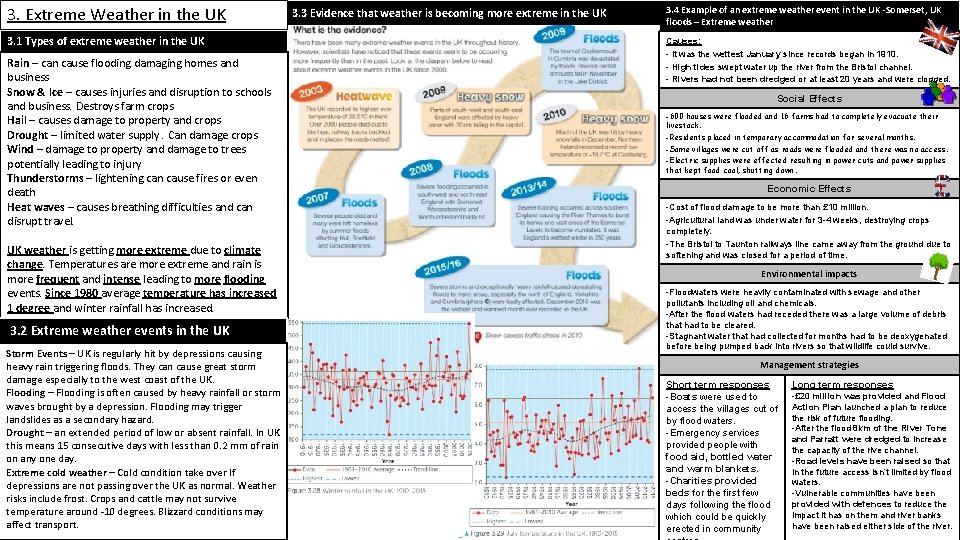
3. Extreme Weather in the UK 3. 1 Types of extreme weather in the UK Rain – can cause flooding damaging homes and business Snow & Ice – causes injuries and disruption to schools and business. Destroys farm crops Hail – causes damage to property and crops Drought – limited water supply. Can damage crops Wind – damage to property and damage to trees potentially leading to injury Thunderstorms – lightening can cause fires or even death Heat waves – causes breathing difficulties and can disrupt travel. UK weather is getting more extreme due to climate change. Temperatures are more extreme and rain is more frequent and intense leading to more flooding events. Since 1980 average temperature has increased 1 degree and winter rainfall has increased. 3. 2 Extreme weather events in the UK Storm Events – UK is regularly hit by depressions causing heavy rain triggering floods. They can cause great storm damage especially to the west coast of the UK. Flooding – Flooding is often caused by heavy rainfall or storm waves brought by a depression. Flooding may trigger landslides as a secondary hazard. Drought – an extended period of low or absent rainfall. In UK this means 15 consecutive days with less than 0. 2 mm of rain on any one day. Extreme cold weather – Cold condition take over If depressions are not passing over the UK as normal. Weather risks include frost. Crops and cattle may not survive temperature around -10 degrees. Blizzard conditions may affect transport. 3. 3 Evidence that weather is becoming more extreme in the UK 3. 4 Example of an extreme weather event in the UK -Somerset, UK floods – Extreme weather Causes: - It was the wettest January since records began in 1910. - High tides swept water up the river from the Bristol channel. - Rivers had not been dredged or at least 20 years and were clogged. Social Effects -600 houses were flooded and 16 farms had to completely evacuate their livestock. -Residents placed in temporary accommodation for several months. -Some villages were cut off as roads were flooded and there was no access. -Electric supplies were effected resulting in power cuts and power supplies that kept food cool, shutting down. Economic Effects -Cost of flood damage to be more than £ 10 million. -Agricultural land was under water for 3 -4 weeks, destroying crops completely. -The Bristol to Taunton railways line came away from the ground due to softening and was closed for a period of time. Environmental impacts -Floodwaters were heavily contaminated with sewage and other pollutants including oil and chemicals. -After the flood waters had receded there was a large volume of debris that had to be cleared. -Stagnant water that had collected for months had to be deoxygenated before being pumped back into rivers so that wildlife could survive. Management strategies Short term responses -Boats were used to access the villages cut of by flood waters. -Emergency services provided people with food aid, bottled water and warm blankets. -Charities provided beds for the first few days following the flood which could be quickly erected in community Long term responses -£ 20 million was provided and Flood Action Plan launched a plan to reduce the risk of future flooding. -After the flood 8 km of the River Tone and Parratt were dredged to increase the capacity of the rive channel. -Road levels have been raised so that in the future access isn’t limited by flood waters. -Vulnerable communities have been provided with defences to reduce the impact it has on them and river banks have been raised either side of the river.
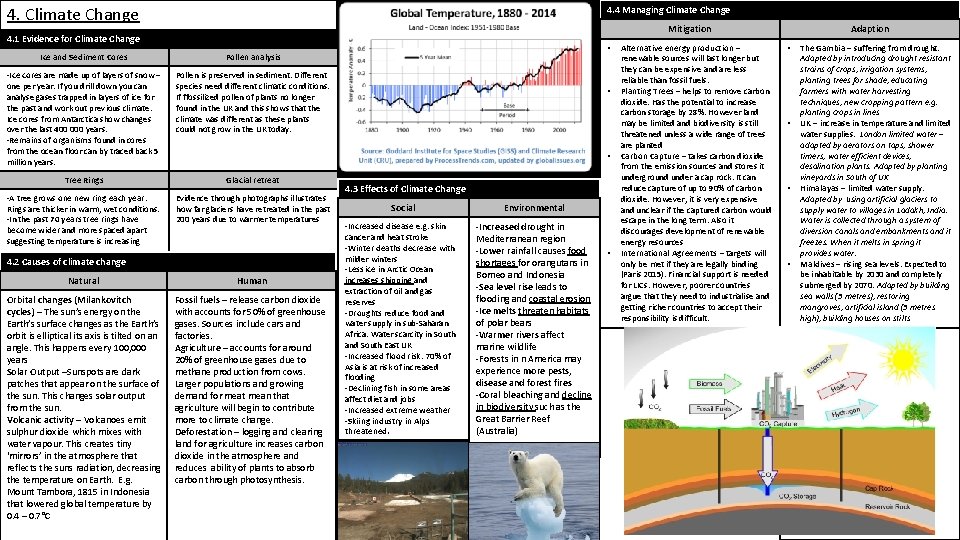
4. Climate Change 4. 4 Managing Climate Change Mitigation 4. 1 Evidence for Climate Change Ice and Sediment Cores Pollen analysis -Ice cores are made up of layers of snow – one per year. If you drill down you can analyse gases trapped in layers of ice for the past and work out previous climate. Ice cores from Antarctica show changes over the last 400 000 years. -Remains of organisms found in cores from the ocean floor can by traced back 5 million years. Pollen is preserved in sediment. Different species need different climatic conditions. If ffossilized pollen of plants no longer found in the UK and this shows that the climate was different as these plants could not grow in the UK today. Tree Rings Glacial retreat -A tree grows one new ring each year. Rings are thicker in warm, wet conditions. -In the past 70 years tree rings have become wider and more spaced apart suggesting temperature is increasing Evidence through photographs illustrates how far glaciers have retreated in the past 200 years due to warmer temperatures • • • 4. 2 Causes of climate change Natural Human Orbital changes (Milankovitch cycles) – The sun’s energy on the Earth’s surface changes as the Earth’s orbit is elliptical its axis is tilted on an angle. This happens every 100, 000 years Solar Output –Sunspots are dark patches that appear on the surface of the sun. This changes solar output from the sun. Volcanic activity – Volcanoes emit sulphur dioxide which mixes with water vapour. This creates tiny ‘mirrors’ in the atmosphere that reflects the suns radiation, decreasing the temperature on Earth. E. g. Mount Tambora, 1815 in Indonesia that lowered global temperature by 0. 4 – 0. 7°C Fossil fuels – release carbon dioxide with accounts for 50% of greenhouse gases. Sources include cars and factories. Agriculture – accounts for around 20% of greenhouse gases due to methane production from cows. Larger populations and growing demand for meat mean that agriculture will begin to contribute more to climate change. Deforestation – logging and clearing land for agriculture increases carbon dioxide in the atmosphere and reduces ability of plants to absorb carbon through photosynthesis. 4. 3 Effects of Climate Change Social -Increased disease e. g. skin cancer and heat stroke -Winter deaths decrease with milder winters -Less ice in Arctic Ocean increases shipping and extraction of oil and gas reserves -Droughts reduce food and water supply in sub-Saharan Africa. Water scarcity in South and South East UK -Increased flood risk. 70% of Asia is at risk of increased flooding -Declining fish in some areas affect diet and jobs -Increased extreme weather -Skiing industry in Alps threatened. Environmental -Increased drought in Mediterranean region -Lower rainfall causes food shortages for orangutans in Borneo and Indonesia -Sea level rise leads to flooding and coastal erosion -Ice melts threaten habitats of polar bears -Warmer rivers affect marine wildlife -Forests in n America may experience more pests, disease and forest fires -Coral bleaching and decline in biodiversity such as the Great Barrier Reef (Australia) • Alternative energy production – renewable sources will last longer but they can be expensive and are less reliable than fossil fuels. Planting Trees – helps to remove carbon dioxide. Has the potential to increase carbon storage by 28%. However land may be limited and biodiversity is still threatened unless a wide range of trees are planted Carbon Capture – takes carbon dioxide from the emission sources and stores it underground under a cap rock. It can reduce capture of up to 90% of carbon dioxide. However, it is very expensive and unclear if the captured carbon would escape in the long term. Also it discourages development of renewable energy resources International Agreements – targets will only be met if they are legally binding (Paris 2015). Financial support is needed for LICs. However, poorer countries argue that they need to industrialise and getting richer countries to accept their responsibility is difficult. Adaption • • The Gambia – suffering from drought. Adapted by introducing drought resistant strains of crops, irrigation systems, planting trees for shade, educating farmers with water harvesting techniques, new cropping pattern e. g. planting crops in lines UK – increase in temperature and limited water supplies. London limited water – adapted by aerators on taps, shower timers, water efficient devices, desalination plants. Adapted by planting vineyards in South of UK Himalayas – limited water supply. Adapted by using artificial glaciers to supply water to villages in Ladakh, India. Water is collected through a system of diversion canals and embankments and it freezes. When it melts in spring it provides water. Maldives – rising sea levels. Expected to be inhabitable by 2030 and completely submerged by 2070. Adapted by building sea walls (3 metres), restoring mangroves, artificial island (3 metres high), building houses on stilts
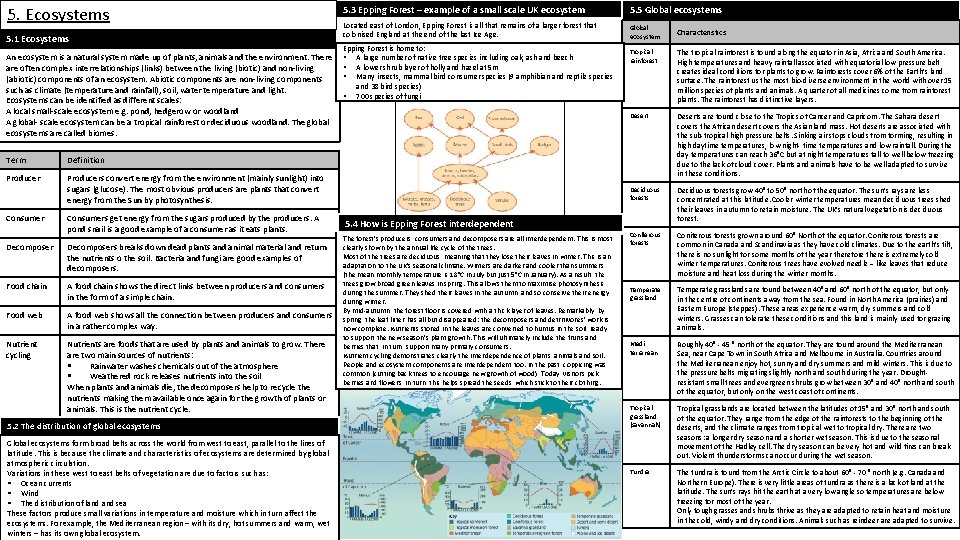
5. Ecosystems 5. 1 Ecosystems An ecosystem is a natural system made up of plants, animals and the environment. There are often complex interrelationships (links) between the living (biotic) and non-living (abiotic) components of an ecosystem. Abiotic components are non-living components such as climate (temperature and rainfall), soil, water temperature and light. Ecosystems can be identified as different scales: A local small-scale ecosystem e. g. pond, hedgerow or woodland A global- scale ecosystem can be a tropical rainforest or deciduous woodland. The global ecosystems are called biomes. Term Definition Producers convert energy from the environment (mainly sunlight) into sugars (glucose). The most obvious producers are plants that convert energy from the Sun by photosynthesis. Consumers get energy from the sugars produced by the producers. A pond snail is a good example of a consumer as it eats plants. Decomposers breaks down dead plants and animal material and return the nutrients o the soil. Bacteria and fungi are good examples of decomposers. Food chain A food chain shows the direct links between producers and consumers in the form of a simple chain. Food web A food web shows all the connection between producers and consumers in a rather complex way. Nutrient cycling Nutrients are foods that are used by plants and animals to grow. There are two main sources of nutrients: § Rainwater washes chemicals out of the atmosphere § Weathered rock releases nutrients into the soil When plants and animals die, the decomposers help to recycle the nutrients making them available once again for the growth of plants or animals. This is the nutrient cycle. 5. 2 The distribution of global ecosystems Global ecosystems form broad belts across the world from west to east, parallel to the lines of latitude. This is because the climate and characteristics of ecosystems are determined by global atmospheric circulation. Variations in these west to east belts of vegetation are due to factors such as: § Ocean currents § Wind § The distribution of land sea These factors produce small variations in temperature and moisture which in turn affect the ecosystems. For example, the Mediterranean region – with its dry, hot summers and warm, wet winters – has its own global ecosystem. 5. 3 Epping Forest – example of a small scale UK ecosystem 5. 5 Global ecosystems Located east of London, Epping Forest is all that remains of a larger forest that colonised England at the end of the last Ice Age. Global ecosystem Epping Forest is home to: § A large number of native tree species including oak, ash and beech § A lower shrub layer of holly and hazel at 5 m § Many insects, mammal bird consumer species (9 amphibian and reptile species and 38 bird species) § 700 species of fungi Tropical rainforest The tropical rainforest is found along the equator in Asia, Africa and South America. High temperatures and heavy rainfall associated with equatorial low pressure belt creates ideal conditions for plants to grow. Rainforests cover 6% of the Earth’s land surface. The rainforest us the most bio-diverse environment in the world with over 15 million species of plants and animals. A quarter of all medicines come from rainforest plants. The rainforest has distinctive layers. Deserts are found close to the Tropics of Cancer and Capricorn. The Sahara desert covers the African desert covers the Asian land mass. Hot deserts are associated with the sub-tropical high pressure belts. Sinking air stops clouds from forming, resulting in high daytime temperatures, low night- time temperatures and low rainfall. During the day temperatures can reach 36⁰C but at night temperatures fall to well below freezing due to the lack of cloud cover. Plants and animals have to be well adapted to survive in these conditions. Deciduous forests grow 40⁰ to 50⁰ north of the equator. The sun’s rays are less concentrated at this latitude. Cooler winter temperatures mean deciduous trees shed their leaves in autumn to retain moisture. The UK’s natural vegetation is deciduous forest. Coniferous forests grown around 60⁰ North of the equator. Coniferous forests are common in Canada and Scandinavia as they have cold climates. Due to the earth’s tilt, there is no sunlight for some months of the year therefore there is extremely cold winter temperatures. Coniferous trees have evolved needle – like leaves that reduce moisture and heat loss during the winter months. Temperate grasslands are found between 40⁰ and 60⁰ north of the equator, but only in the centre of continents away from the sea. Found in North America (prairies) and Eastern Europe (steppes). These areas experience warm, dry summers and cold winters. Grasses can tolerate these conditions and this land is mainly used for grazing animals. Mediterranean Roughly 40⁰ - 45 ⁰ north of the equator. They are found around the Mediterranean Sea, near Cape Town in South Africa and Melbourne in Australia. Countries around the Mediterranean enjoy hot, sunny and dry summers and mild winters. This is due to the pressure belts migrating slightly north and south during the year. Droughtresistant small trees and evergreen shrubs grow between 30⁰ and 40⁰ north and south of the equator, but only on the west coast of continents. Tropical grassland (savannah) Tropical grasslands are located between the latitudes of 15⁰ and 30⁰ north and south of the equator. They range from the edge of the rainforests to the beginning of the deserts, and the climate ranges from tropical wet to tropical dry. There are two seasons: a longer dry season and a shorter wet season. This is due to the seasonal movement of the Hadley cell. The dry season can be very hot and wild fires can break out. Violent thunderstorms can occur during the wet season. Tundra The tundra is found from the Arctic Circle to about 60⁰ - 70 ⁰ north (e. g. Canada and Northern Europe). There is very little areas of tundra as there is a lack of land at the latitude. The sun’s rays hit the earth at a very low angle so temperatures are below freezing for most of the year. Only tough grasses and shrubs thrive as they are adapted to retain heat and moisture in the cold, windy and dry conditions. Animals such as reindeer are adapted to survive. 5. 4 How is Epping Forest interdependent The forest's producers, consumers and decomposers are all interdependent. This is most clearly shown by the annual life cycle of the trees. Most of the trees are deciduous, meaning that they lose their leaves in winter. This is an adaptation to the UK's seasonal climate. Winters are darker and cooler than summers (the mean monthly temperature is 18°C in July but just 5°C in January). As a result, the trees grow broad green leaves in spring. This allows them to maximise photosynthesis during the summer. They shed their leaves in the autumn, and so conserve their energy during winter. By mid-autumn, the forest floor is covered with a thick layer of leaves. Remarkably, by spring, the leaf litter has all but disappeared: the decomposers and detritivores' work is now complete. Nutrients stored in the leaves are converted to humus in the soil, ready to support the new season's plant growth. This will ultimately include the fruits and berries that, in turn, support many primary consumers. Nutrient cycling demonstrates clearly the interdependence of plants, animals and soil. People and ecosystem components are interdependent too. In the past, coppicing was common (cutting back trees to encourage new growth of wood), Today, visitors pick berries and flowers, In turn, this helps spread the seeds, which stick to their clothing. Characteristics
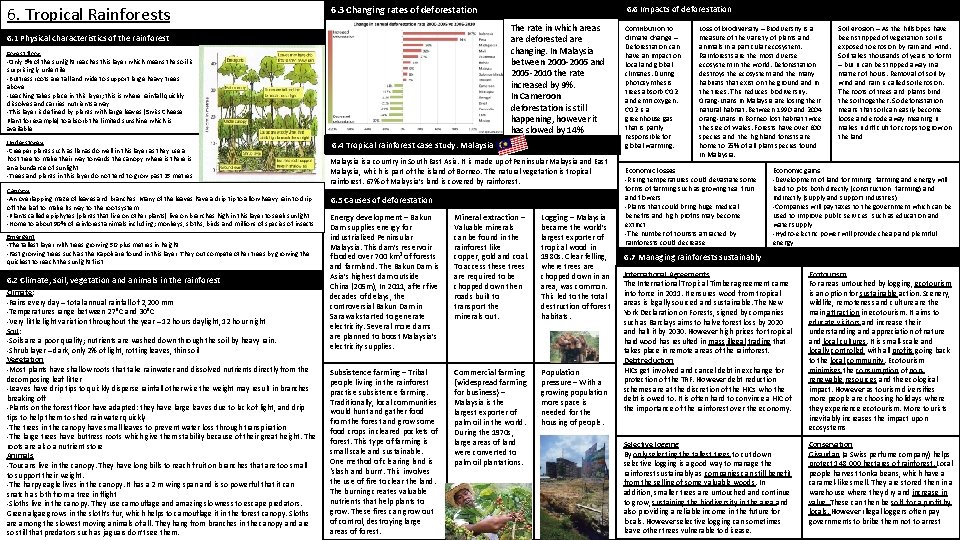
6. Tropical Rainforests The rate in which areas are deforested are changing. In Malaysia between 2000 -2005 and 2005 -2010 the rate increased by 9%. In Cameroon deforestation is still happening, however it has slowed by 14% 6. 1 Physical characteristics of the rainforest Forest floor -Only 3% of the sunlight reaches this layer which means the soil is surprisingly unfertile -Buttress roots are tall and wide to support large heavy trees above -Leaching takes place in this layer; this is where rainfall quickly dissolves and carries nutrients away. -This layer is defined by plants with large leaves (Swiss Cheese Plant for example) to absorb the limited sunshine which is available Understorey -Creeper plants such as lianas do well in this layer as they use a host tree to make their way towards the canopy where is there is an abundance of sunlight -Trees and plants in this layer do not tend to grow past 25 metres Canopy -An overlapping maze of leaves and branches. Many of the leaves have a drip to allow heavy rain to drip off the leaf to make its way to the root system -Plants called epiphytes (plants that live on other plants) live on branches high in this layer to seek sunlight. -Home to about 90% of rainforest animals including; monkeys, sloths, birds and millions of species of insects Emergent -The tallest layer with trees growing 50 plus metres in height -Fast growing trees such as the Kapok are found in this layer. They out compete other trees by growing the quickest to reach the sunlight first 6. 2 Climate, soil, vegetation and animals in the rainforest Climate: -Rains every day – total annual rainfall of 2, 200 mm -Temperatures range between 27⁰C and 30⁰C -Very little light variation throughout the year – 12 hours daylight, 12 hour night Soil: -Soils are a poor quality; nutrients are washed down through the soil by heavy rain. -Shrub layer – dark, only 2% of light, rotting leaves, thin soil Vegetation -Most plants have shallow roots that take rainwater and dissolved nutrients directly from the decomposing leaf litter -Leaves have drip tips to quickly disperse rainfall otherwise the weight may result in branches breaking off -Plants on the forest floor have adapted: they have large leaves due to lack of light, and drip tips to help them to shed rainwater quickly -The trees in the canopy have small leaves to prevent water loss through transpiration -The large trees have buttress roots which give them stability because of their great height. The roots are also a nutrient store Animals -Toucans live in the canopy. They have long bills to reach fruit on branches that are too small to support their weight. -The harpy eagle lives in the canopy. It has a 2 m wing span and is so powerful that it can snatch a sloth from a tree in flight -Sloths live in the canopy. They use camouflage and amazing slowness to escape predators. Green algae grows in the sloth’s fur, which helps to camouflage it in the forest canopy. Sloths are among the slowest moving animals of all. They hang from branches in the canopy and are so still that predators such as jaguars don’t see them. 6. 6 Impacts of deforestation 6. 3 Changing rates of deforestation 6. 4 Tropical rainforest case study: Malaysia is a country in South East Asia. It is made up of Peninsular Malaysia and East Malaysia, which is part of the island of Borneo. The natural vegetation is tropical rainforest. 67% of Malaysia’s land is covered by rainforest. 6. 5 Causes of deforestation Energy development – Bakun Dam supplies energy for industrialized Peninsular Malaysia. This dam’s reservoir flooded over 700 km² of forests and farmland. The Bakun Dam is Asia’s highest dam outside China (205 m), In 2011, after five decades of delays, the controversial Bakun Dam in Sarawak started to generate electricity. Several more dams are planned to boost Malaysia’s electricity supplies. Mineral extraction – Valuable minerals can be found in the rainforest like copper, gold and coal. To access these trees are required to be chopped down then roads built to transport the minerals out. Logging – Malaysia became the world’s largest exporter of tropical wood in 1980 s. Clear felling, where trees are chopped down in an area, was common. This led to the total destruction of forest habitats. Subsistence farming – Tribal people living in the rainforest practise subsistence farming. Traditionally, local communities would hunt and gather food from the forest and grow some food crops in cleared pockets of forest. This type of farming is small scale and sustainable. One method of clearing land is ‘slash and burn’. This involves the use of fire to clear the land. The burning creates valuable nutrients that help plants to grow. These fires can grow out of control, destroying large areas of forest. Commercial farming (widespread farming for business) – Malaysia is the largest exporter of palm oil in the world. During the 1970 s, large areas of land were converted to palm oil plantations. Population pressure – With a growing population more space is needed for the housing of people. Contribution to climate change – Deforestation can have an impact on local and global climates. During photosynthesis, trees absorb CO 2 and emit oxygen. CO 2 is a greenhouse gas that is partly responsible for global warming. Loss of biodiversity – Biodiversity is a measure of the variety of plants and animals in a particular ecosystem. Rainforests are the most diverse ecosystem in the world. Deforestation destroys the ecosystem and the many habitats that exist on the ground and in the trees. This reduces biodiversity. Orang-utans in Malaysia are losing their natural habitat. Between 1990 and 2004 orang-utans in Borneo lost habitat twice the size of Wales. Forests have over 600 species and the highland forests are home to 25% of all plant species found in Malaysia. Economic losses -Rising temperatures could devastate some forms of farming such as growing tea, fruit and flowers -Plants that could bring huge medical benefits and high profits may become extinct -The number of tourists attracted by rainforests could decrease Soil erosion – As the hillslopes have been stripped of vegetation, soil is exposed to erosion by rain and wind. Soil takes thousands of years to form – but it can be stripped away in a matter of hours. Removal of soil by wind and rain is called soil erosion. The roots of trees and plants bind the soil together. So deforestation means that soil can easily become loose and erode away meaning it makes it difficult for crops to grow on the land Economic gains -Development of land for mining, farming and energy will lead to jobs both directly (construction, farming) and indirectly (supply and support industries) -Companies will pay taxes to the government which can be used to improve public services, such as education and water supply -Hydro-electric power will provide cheap and plentiful energy 6. 7 Managing rainforests sustainably International Agreements The International Tropical Timber agreement came into force in 2011. It ensures wood from tropical areas is legally sourced and sustainable. The New York Declaration on Forests, signed by companies such as Barclays aims to halve forest loss by 2020 and halt it by 2030. However high prices for tropical hardwood has resulted in mass illegal trading that takes place in remote areas of the rainforest. Debt reduction HICs get involved and cancel debt in exchange for protection of the TRF. However debt reduction schemes are at the discretion of the HICs who the debt is owed to. It is often hard to convince a HIC of the importance of the rainforest over the economy. Ecotourism For areas untouched by logging, ecotourism is an option for sustainable action. Scenery, wildlife, remoteness and culture are the main attraction in ecotourism. It aims to educate visitors and increase their understanding and appreciation of nature and local cultures. It is small-scale and locally controlled with all profits going back to the local community. Ecotourism minimises the consumption of nonrenewable resources and the ecological impact. However as tourism diversifies more people are choosing holidays where they experience ecotourism. More tourists inevitably increases the impact upon ecosystems Selective logging By only selecting the tallest trees to cut down selective logging is a good way to manage the rainforest sustainably as companies can still benefit from the selling of some valuable woods. In addition, smaller trees are untouched and continue to grow, sustaining the biodiversity in the area and also providing a reliable income in the future for locals. However selective logging can sometimes leave other trees vulnerable to disease. Conservation Givaudan (a Swiss perfume company) helps protect 148, 000 hectares of rainforest. Local people harvest tonka beans, which have a caramel-like smell. They are stored then in a warehouse where they dry and increase in value. These can then be sold for a profit by locals. However illegal loggers often pay governments to bribe them not to arrest
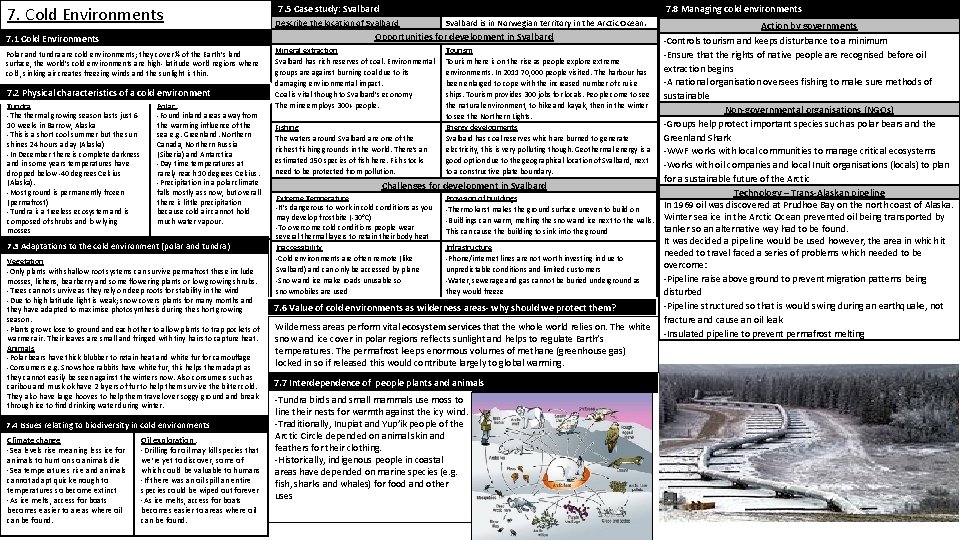
7. Cold Environments Polar and tundra are cold environments; they cover ¼ of the Earth’s land surface, the world’s cold environments are high- latitude world regions where cold, sinking air creates freezing winds and the sunlight is thin. 7. 2 Physical characteristics of a cold environment Polar. -Found inland areas away from the warming influence of the sea e. g. Greenland. Northern Canada, Northern Russia (Siberia) and Antarctica -Day time temperatures at rarely reach 10 degrees Celsius. -Precipitation in a polar climate falls mostly as snow, but overall there is little precipitation because cold air cannot hold much water vapour. 7. 3 Adaptations to the cold environment (polar and tundra) Vegetation -Only plants with shallow root systems can survive permafrost these include mosses, lichens, bearberry and some flowering plants or low growing shrubs. -Trees cannot survive as they rely on deep roots for stability in the wind -Due to high latitude light is weak; snow covers plants for many months and they have adapted to maximise photosynthesis during the short growing season. -Plants grow close to ground and each other to allow plants to trap pockets of warmer air. Their leaves are small and fringed with tiny hairs to capture heat. Animals -Polar bears have thick blubber to retain heat and white fur for camouflage -Consumers e. g. Snowshoe rabbits have white fur, this helps them adapt as they cannot easily be seen against the winter snow. Also consumers such as caribou and musk ok have 2 layers of fur to help them survive the bitter cold. They also have large hooves to help them travel over soggy ground and break through ice to find drinking water during winter. 7. 4 Issues relating to biodiversity in cold environments Climate change -Sea levels rise meaning less ice for animals to hunt on so animals die -Sea temperatures rise and animals cannot adapt quick enough to temperatures so become extinct -As ice melts, access for boats becomes easier to areas where oil can be found. 7. 8 Managing cold environments Describe the location of Svalbard is in Norwegian territory in the Arctic Ocean. Opportunities for development in Svalbard 7. 1 Cold Environments Tundra -The thermal growing season lasts just 610 weeks in Barrow, Alaska -This is a short cool summer but the sun shines 24 hours a day (Alaska) -In December there is complete darkness and in some years temperatures have dropped below -40 degrees Celsius (Alaska). -Most ground is permanently frozen (permafrost) -Tundra is a treeless ecosystem and is composed of shrubs and low lying mosses 7. 5 Case study: Svalbard Oil exploration. -Drilling for oil may kill species that we’re yet to discover, some of which could be valuable to humans -If there was an oil spill an entire species could be wiped out forever -As ice melts, access for boats becomes easier to areas where oil can be found. Mineral extraction Svalbard has rich reserves of coal. Environmental groups are against burning coal due to its damaging environmental impact. Coal is vital though to Svalbard’s economy The mine employs 300+ people. Fishing The waters around Svalbard are one of the richest fishing grounds in the world. There’s an estimated 150 species of fish here. Fish stocks need to be protected from pollution. Tourism here is on the rise as people explore extreme environments. In 2011 70, 000 people visited. The harbour has been enlarged to cope with the increased number of cruise ships. Tourism provides 300 jobs for locals. People come to see the natural environment, to hike and kayak, then in the winter to see the Northern Lights. Energy developments Svalbard has coal reserves which are burned to generate electricity, this is very polluting though. Geothermal energy is a good option due to the geographical location of Svalbard, next to a constructive plate boundary. Challenges for development in Svalbard Extreme Temperature -It’s dangerous to work in cold conditions as you may develop frostbite (-30°C) -To overcome cold conditions people wear several thermal layers to retain their body heat Inaccessibility -Cold environments are often remote (like Svalbard) and can only be accessed by plane -Snow and ice make roads unusable so snowmobiles are used Provision of buildings -Thermokarst makes the ground surface uneven to build on -Buildings can warm, melting the snow and ice next to the walls. This can cause the building to sink into the ground Infrastructure -Phone/internet lines are not worth investing in due to unpredictable conditions and limited customers -Water, sewerage and gas cannot be buried underground as they would freeze 7. 6 Value of cold environments as wilderness areas- why should we protect them? Wilderness areas perform vital ecosystem services that the whole world relies on. The white snow and ice cover in polar regions reflects sunlight and helps to regulate Earth’s temperatures. The permafrost keeps enormous volumes of methane (greenhouse gas) locked in so if released this would contribute largely to global warming. 7. 7 Interdependence of people plants and animals -Tundra birds and small mammals use moss to line their nests for warmth against the icy wind. -Traditionally, Inupiat and Yup’ik people of the Arctic Circle depended on animal skin and feathers for their clothing. -Historically, indigenous people in coastal areas have depended on marine species (e. g. fish, sharks and whales) for food and other uses Action by governments -Controls tourism and keeps disturbance to a minimum -Ensure that the rights of native people are recognised before oil extraction begins -A national organisation oversees fishing to make sure methods of sustainable Non-governmental organisations (NGOs) -Groups help protect important species such as polar bears and the Greenland Shark -WWF works with local communities to manage critical ecosystems -Works with oil companies and local Inuit organisations (locals) to plan for a sustainable future of the Arctic Technology – Trans-Alaskan pipeline In 1969 oil was discovered at Prudhoe Bay on the north coast of Alaska. Winter sea ice in the Arctic Ocean prevented oil being transported by tanker so an alternative way had to be found. It was decided a pipeline would be used however, the area in which it needed to travel faced a series of problems which needed to be overcome: -Pipeline raise above ground to prevent migration patterns being disturbed -Pipeline structured so that is would swing during an earthquake, not fracture and cause an oil leak -Insulated pipeline to prevent permafrost melting
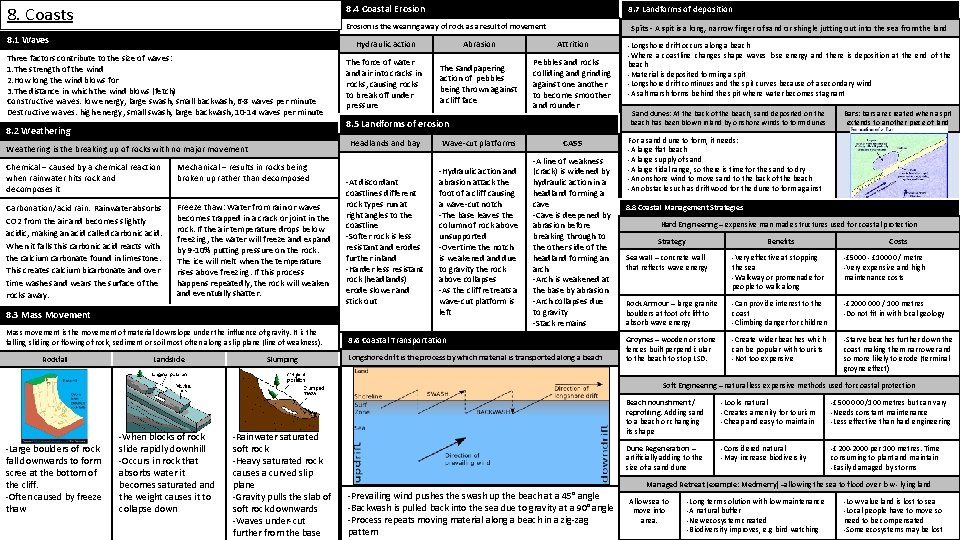
8. 4 Coastal Erosion 8. Coasts Erosion is the wearing away of rock as a result of movement 8. 1 Waves Three factors contribute to the size of waves: 1. The strength of the wind 2. How long the wind blows for 3. The distance in which the wind blows (fetch) Constructive waves: low energy, large swash, small backwash, 6 -8 waves per minute Destructive waves: high energy, small swash, large backwash, 10 -14 waves per minute Spits - A spit is a long, narrow finger of sand or shingle jutting out into the sea from the land Hydraulic action Abrasion Attrition The force of water and air into cracks in rocks, causing rocks to break off under pressure The sandpapering action of pebbles being thrown against a cliff face Pebbles and rocks colliding and grinding against one another to become smoother and rounder 8. 5 Landforms of erosion 8. 2 Weathering is the breaking up of rocks with no major movement Chemical – caused by a chemical reaction when rainwater hits rock and decomposes it Mechanical – results in rocks being broken up rather than decomposed Carbonation/acid rain: Rainwater absorbs CO 2 from the air and becomes slightly acidic, making an acid called carbonic acid. When it falls this carbonic acid reacts with the calcium carbonate found in limestone. This creates calcium bicarbonate and over time washes and wears the surface of the rocks away. Freeze thaw: Water from rain or waves becomes trapped in a crack or joint in the rock. If the air temperature drops below freezing, the water will freeze and expand by 9 -10% putting pressure on the rock. The ice will melt when the temperature rises above freezing. If this process happens repeatedly, the rock will weaken and eventually shatter. 8. 3 Mass Movement Mass movement is the movement of material downslope under the influence of gravity. It is the falling, sliding or flowing of rock, sediment or soil most often along a slip plane (line of weakness). Rockfall 8. 7 Landforms of deposition Landslide Slumping Headlands and bay Wave-cut platforms CASS -At discordant coastlines different rock types run at right angles to the coastline -Softer rock is less resistant and erodes further inland -Harder less resistant rock (headlands) erode slower and stick out -Hydraulic action and abrasion attack the foot of a cliff causing a wave-cut notch -The base leaves the column of rock above unsupported -Overtime the notch is weakened and due to gravity the rock above collapses -As the cliff retreats a wave-cut platform is left -A line of weakness (crack) is widened by hydraulic action in a headland forming a cave -Cave is deepened by abrasion before breaking through to the other side of the headland forming an arch -Arch is weakened at the base by abrasion -Arch collapses due to gravity -Stack remains 8. 6 Coastal Transportation Longshore drift is the process by which material is transported along a beach -Longshore drift occurs along a beach -Where a coastline changes shape waves lose energy and there is deposition at the end of the beach -Material is deposited forming a spit -Longshore drift continues and the spit curves because of a secondary wind -A saltmarsh forms behind the spit where water becomes stagnant Sand dunes: At the back of the beach, sand deposited on the beach has been blown inland by onshore winds to form dunes Bars: bars are created when a spit extends to another piece of land For a sand dune to form, it needs: -A large flat beach -A large supply of sand -A large tidal range, so there is time for the sand to dry -An onshore wind to move sand to the back of the beach -An obstacle such as driftwood for the dune to form against 8. 8 Coastal Management Strategies Hard Engineering – expensive man made structures used for coastal protection Strategy Benefits Costs Sea wall – concrete wall that reflects wave energy -Very effective at stopping the sea -Walkway or promenade for people to walk along -£ 5000 - £ 10000 / metre -Very expensive and high maintenance costs Rock Armour – large granite boulders at foot of cliff to absorb wave energy -Can provide interest to the coast -Climbing danger for children -£ 2000 / 100 metres -Do not fit in with local geology Groynes – wooden or stone fences built perpendicular to the beach to stop LSD. -Create wider beaches which can be popular with tourists -Not too expensive -Starve beaches further down the coast making them narrower and so more likely to erode (terminal groyne effect) Soft Engineering – natural less expensive methods used for coastal protection -Large boulders of rock fall downwards to form scree at the bottom of the cliff. -Often caused by freeze thaw -When blocks of rock slide rapidly downhill -Occurs in rock that absorbs water it becomes saturated and the weight causes it to collapse down -Rainwater saturated soft rock -Heavy saturated rock causes a curved slip plane -Gravity pulls the slab of soft rock downwards -Waves under-cut further from the base Beach nourishment / reprofiling. Adding sand to a beach or changing its shape -Looks natural -Creates amenity for tourism -Cheap and easy to maintain -£ 500 000 /100 metres but can vary -Needs constant maintenance -Less effective than hard engineering Dune Regeneration – artificially adding to the size of a sand dune -Considered natural -May increase biodiversity -£ 200 -2000 per 100 metres. Time consuming to plant and maintain -Easily damaged by storms Managed Retreat (example: Medmerry) –allowing the sea to flood over low - lying land -Prevailing wind pushes the swash up the beach at a 45° angle -Backwash is pulled back into the sea due to gravity at a 90° angle -Process repeats moving material along a beach in a zig-zag pattern Allow sea to move into area. -Long term solution with low maintenance -A natural buffer -New ecosystem created -Biodiversity improves, e. g bird watching -Low value land is lost to sea -Local people have to move so need to be compensated -Some ecosystems may be lost
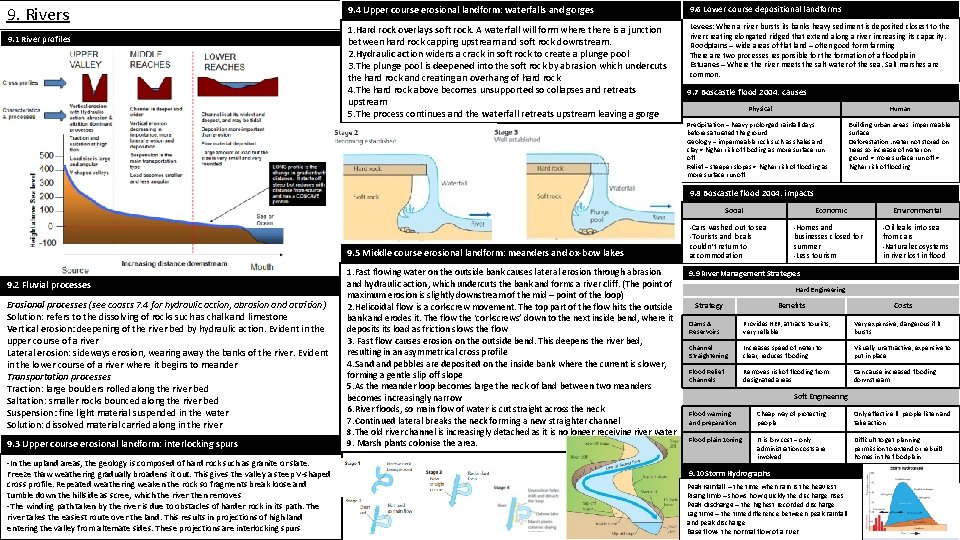
9. Rivers 9. 1 River profiles 9. 4 Upper course erosional landform: waterfalls and gorges 9. 6 Lower course depositional landforms 1. Hard rock overlays soft rock. A waterfall will form where there is a junction between hard rock capping upstream and soft rock downstream. 2. Hydraulic action widens a crack in soft rock to create a plunge pool 3. The plunge pool is deepened into the soft rock by abrasion which undercuts the hard rock and creating an overhang of hard rock 4. The hard rock above becomes unsupported so collapses and retreats upstream 5. The process continues and the waterfall retreats upstream leaving a gorge Levees: When a river bursts its banks heavy sediment is deposited closest to the river creating elongated ridged that extend along a river increasing its capacity. Floodplains – wide areas of flat land – often good form farming There are two processes responsible for the formation of a floodplain Estuaries – Where the river meets the salt water of the sea. Salt marshes are common. 9. 7 Boscastle flood 2004: causes Physical Human Precipitation – heavy prolonged rainfall days before saturated the ground Geology – impermeable rock such as shales and clay = higher risk of flooding as more surface run off Relief – steeper slopes = higher risk of flooding as more surface run off Building urban areas: impermeable surface Deforestation : water not stored on trees so increase of water on ground = more surface run off = higher risk of flooding 9. 8 Boscastle flood 2004: impacts Social 9. 5 Middle course erosional landform: meanders and ox-bow lakes 9. 2 Fluvial processes Erosional processes (see coasts 7. 4 for hydraulic action, abrasion and attrition) Solution: refers to the dissolving of rocks such as chalk and limestone Vertical erosion: deepening of the river bed by hydraulic action. Evident in the upper course of a river Lateral erosion: sideways erosion, wearing away the banks of the river. Evident in the lower course of a river where it begins to meander Transportation processes Traction: large boulders rolled along the river bed Saltation: smaller rocks bounced along the river bed Suspension: fine light material suspended in the water Solution: dissolved material carried along in the river 9. 3 Upper course erosional landform: interlocking spurs -In the upland areas, the geology is composed of hard rock such as granite or slate. Freeze thaw weathering gradually broadens it out. This gives the valley a steep V-shaped cross profile. Repeated weathering weaken the rock so fragments break loose and tumble down the hillside as scree, which the river then removes -The winding path taken by the river is due to obstacles of harder rock in its path. The river takes the easiest route over the land. This results in projections of high land entering the valley from alternate sides. These projections are interlocking spurs 1. Fast flowing water on the outside bank causes lateral erosion through abrasion and hydraulic action, which undercuts the bank and forms a river cliff. (The point of maximum erosion is slightly downstream of the mid – point of the loop) 2. Helicoidal flow is a corkscrew movement. The top part of the flow hits the outside bank and erodes it. The flow the ‘corkscrews’ down to the next inside bend, where it deposits load as friction slows the flow 3. Fast flow causes erosion on the outside bend. This deepens the river bed, resulting in an asymmetrical cross profile 4. Sand pebbles are deposited on the inside bank where the current is slower, forming a gentle slip off slope 5. As the meander loop becomes large the neck of land between two meanders becomes increasingly narrow 6. River floods, so main flow of water is cut straight across the neck 7. Continued lateral breaks the neck forming a new straighter channel 8. The old river channel is increasingly detached as it is no longer receiving river water 9. Marsh plants colonise the area. Economic -Cars washed out to sea -Tourists and locals couldn’t return to accommodation Environmental -Homes and businesses closed for summer -Less tourism -Oil leaks into sea from cars -Natural ecosystems in river lost in flood 9. 9 River Management Strategies Hard Engineering Strategy Benefits Costs Dams & Reservoirs Provides HEP, attracts tourists, very reliable Very expensive, dangerous if it bursts Channel Straightening Increases speed of water to clear, reduces flooding Visually unattractive, expensive to put in place Flood Relief Channels Removes risk of flooding from designated areas Can cause increased flooding downstream Soft Engineering Flood warning and preparation Cheap way of protecting people Only effective if people listen and take action. Flood plain zoning It is low cost – only administration costs are involved Difficult to get planning permission to extend or rebuild homes in the floodplain 9. 10 Storm Hydrographs Peak rainfall – the time when rain is the heaviest Rising limb – shows how quickly the discharge rises Peak discharge – the highest recorded discharge Lag time – the time difference between peak rainfall and peak discharge Base flow- the normal flow of a river
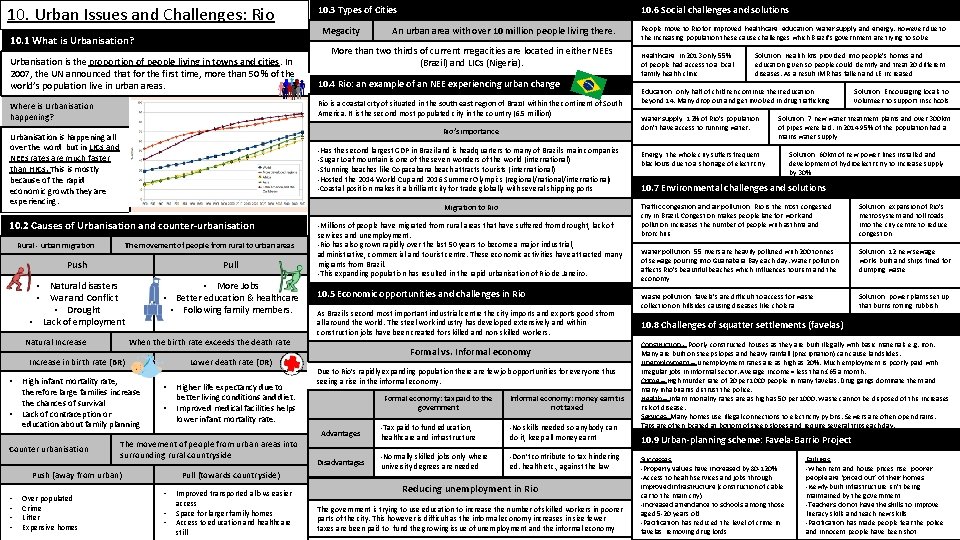
10. Urban Issues and Challenges: Rio 10. 1 What is Urbanisation? Urbanisation is the proportion of people living in towns and cities. In 2007, the UN announced that for the first time, more than 50 % of the world’s population live in urban areas. The movement of people from rural to urban areas Push Pull • Natural disasters • War and Conflict • Drought • Lack of employment • More Jobs • Better education & healthcare • Following family members. Natural Increase When the birth rate exceeds the death rate Increase in birth rate (BR) High infant mortality rate, therefore large families increase the chances of survival Lack of contraception or education about family planning Lower death rate (DR) • • Higher life expectancy due to better living conditions and diet. Improved medical facilities helps lower infant mortality rate. -Millions of people have migrated from rural areas that have suffered from drought, lack of services and unemployment. -Rio has also grown rapidly over the last 50 years to become a major industrial, administrative, commercial and tourist centre. These economic activities have attracted many migrants from Brazil. -This expanding population has resulted in the rapid urbanisation of Rio de Janeiro. 10. 5 Economic opportunities and challenges in Rio As Brazil’s second most important industrial centre the city imports and exports good sfrom all around the world. The steel work industry has developed extensively and within construction jobs have been created for skilled and non-skilled workers. Formal vs. Informal economy Due to Rio’s rapidly expanding population there are few job opportunities for everyone thus seeing a rise in the informal economy. Formal economy: tax paid to the government Advantages The movement of people from urban areas into surrounding rural countryside Push (away from urban) Over populated Crime Litter Expensive homes 10. 4 Rio: an example of an NEE experiencing urban change Migration to Rio Rural - urban migration • • More than two thirds of current megacities are located in either NEEs (Brazil) and LICs (Nigeria). -Has the second largest GDP in Brazil and is headquarters to many of Brazil’s main companies -Sugar Loaf mountain is one of the seven wonders of the world (international) -Stunning beaches like Copacabana beach attracts tourists (international) -Hosted the 2014 World Cup and 2016 Summer Olympics (regional/national/international) -Coastal position makes it a brilliant city for trade globally with several shipping ports 10. 2 Causes of Urbanisation and counter-urbanisation Counter urbanisation An urban area with over 10 million people living there. Rio’s importance Urbanisation is happening all over the word but in LICs and NEEs rates are much faster than HICs. This is mostly because of the rapid economic growth they are experiencing. • Megacity Rio is a coastal city of situated in the south east region of Brazil within the continent of South America. It is the second most populated city in the country (6. 5 million) Where is Urbanisation happening? • 10. 6 Social challenges and solutions 10. 3 Types of Cities Pull (towards countryside) • • • Improved transported allows easier access Space for larger family homes Access to education and healthcare still Disadvantages Informal economy: money earnt is not taxed -Tax paid to fund education, healthcare and infrastructure -No skills needed so anybody can do it, keep all money earnt -Normally skilled jobs only where university degrees are needed -Don’t contribute to tax hindering ed. health etc. , against the law Reducing unemployment in Rio The government is trying to use education to increase the number of skilled workers in poorer parts of the city. This however is difficult as the informal economy increases in size fewer taxes are been paid to fund the growing issue of unemployment and the informal economy People move to Rio for improved healthcare, education, water supply and energy. However due to the increasing population these cause challenges which Brazil’s government are trying to solve Healthcare: in 2013 only 55% of people had access to a local family health clinic Solution: Health kits provided into people’s homes and education given so people could identify and treat 20 different diseases. As a result IMR has fallen and LE increased Education: only half of children continue their education beyond 14. Many drop out and get involved in drug trafficking Water supply: 12% of Rio’s population don’t have access to running water. Solution: Encouraging locals to volunteer to support in schools Solution: 7 new water treatment plants and over 300 km of pipes were laid. In 2014 95% of the population had a mains water supply Energy: the whole city suffers frequent blackouts due to a shortage of electricity Solution: 60 km of new power lines installed and development of hydroelectricity to increase supply by 30% 10. 7 Environmental challenges and solutions Traffic congestion and air pollution: Rio is the most congested city in Brazil. Congestion makes people late for work and pollution increases the number of people with asthma and bronchitis Solution: expansion of Rio’s metro system and toll roads into the city centre to reduce congestion Water pollution: 55 rivers are heavily polluted with 200 tonnes of sewage pouring into Guanabara Bay each day. Water pollution affects Rio’s beautiful beaches which influences tourism and the economy Solution: 12 new sewage works built and ships fined for dumping waste Waste pollution: favela’s are difficult to access for waste collection on hillsides causing diseases like cholera Solution: power plants set up that burns rotting rubbish 10. 8 Challenges of squatter settlements (favelas) Construction - Poorly constructed houses as they are built illegally with basic materials e. g. iron. Many are built on steep slopes and heavy rainfall (precipitation) can cause landslides. Unemployment – Unemployment rates are as high as 20%. Much employment is poorly paid with irregular jobs in informal sector. Average income = less than £ 65 a month. Crime – High murder rate of 20 per 1000 people in many favelas. Drug gangs dominate them and many inhabitants distrust the police. Health – Infant mortality rates are as high as 50 per 1000. Waste cannot be disposed of this increases risk of disease. Services- Many homes use illegal connections to electricity pylons. Sewers are often open drains. Taps are often located at bottom of steep slopes and require several trips each day. 10. 9 Urban-planning scheme: Favela-Barrio Project Successes -Property values have increased by 80 -120% -Access to health services and jobs through improved infrastructure (construction of cable car to the main city) -Increased attendance to schools among those aged 5 -20 years old -Pacification has reduced the level of crime in favelas, removing drug lords Failures -When rent and house prices rise, poorer people are ‘priced out’ of their homes -Newly-built infrastructure isn’t being maintained by the government -Teachers do not have the skills to improve literacy skills and teach new skills -Pacification has made people fear the police and innocent people have been shot
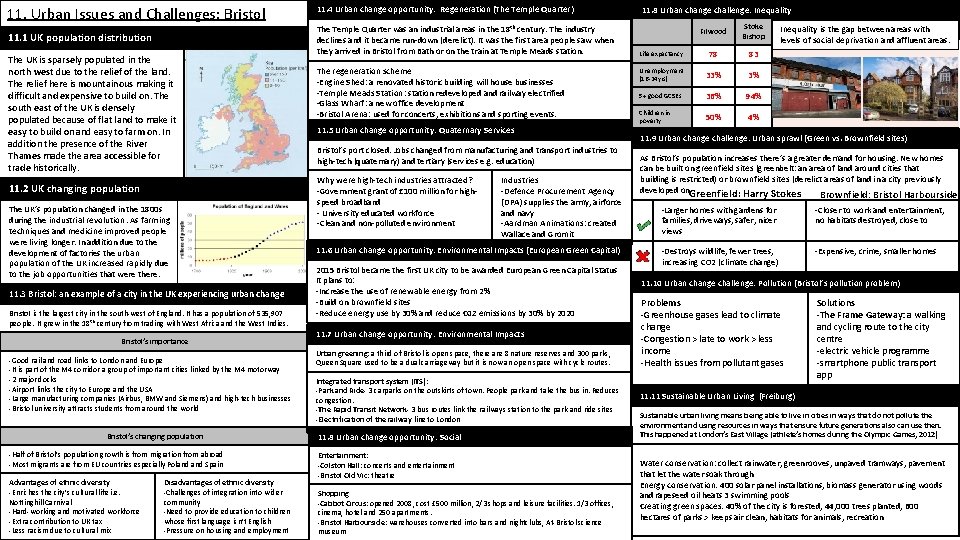
11. Urban Issues and Challenges: Bristol 11. 4 Urban change opportunity: Regeneration (The Temple Quarter) 11. 1 UK population distribution The Temple Quarter was an industrial areas in the 18 th century. The industry declines and it became run-down (derelict). It was the first area people saw when they arrived in Bristol from Bath or on the train at Temple Meads station. The UK is sparsely populated in the north west due to the relief of the land. The relief here is mountainous making it difficult and expensive to build on. The south east of the UK is densely populated because of flat land to make it easy to build on and easy to farm on. In addition the presence of the River Thames made the area accessible for trade historically. 11. 2 UK changing population The UK’s population changed in the 1800 s during the industrial revolution. As farming techniques and medicine improved people were living longer. In addition due to the development of factories the urban population of the UK increased rapidly due to the job opportunities that were there. 11. 3 Bristol: an example of a city in the UK experiencing urban change Bristol is the largest city in the south-west of England. It has a population of 535, 907 people. It grew in the 18 th century from trading with West Africa and the West Indies. Bristol’s importance -Good rail and road links to London and Europe -It is part of the M 4 corridor a group of important cities linked by the M 4 motorway -2 major docks -Airport links the city to Europe and the USA -Large manufacturing companies (Airbus, BMW and Siemens) and high-tech businesses -Bristol university attracts students from around the world Bristol’s changing population -Half of Bristol’s population growth is from migration from abroad -Most migrants are from EU countries especially Poland Spain Advantages of ethnic diversity -Enriches the city’s cultural life i. e. Nottinghill Carnival -Hard-working and motivated workforce -Extra contribution to UK tax -Less racism due to cultural mix Disadvantages of ethnic diversity -Challenges of integration into wider community -Need to provide education to children whose first language isn’t English -Pressure on housing and employment The regeneration scheme -Engine Shed: a renovated historic building will house businesses -Temple Meads Station: station redeveloped and railway electrified -Glass Wharf: a new office development -Bristol Arena: used for concerts, exhibitions and sporting events. 11. 5 Urban change opportunity: Quaternary Services Bristol’s port closed. Jobs changed from manufacturing and transport industries to high-tech (quaternary) and tertiary (services e. g. education) Why were high-tech industries attracted? -Government grant of £ 100 million for highspeed broadband - University educated workforce -Clean and non-polluted environment Industries -Defence Procurement Agency (DPA) supplies the army, airforce and navy -Aardman Animations: created Wallace and Gromit 11. 6 Urban change opportunity: Environmental Impacts (European Green Capital) 2015 Bristol became the first UK city to be awarded European Green Capital Status It plans to: -Increase the use of renewable energy from 2% -Build on brownfield sites -Reduce energy use by 30% and reduce C 02 emissions by 30% by 2020 11. 7 Urban change opportunity: Environmental Impacts Urban greening: a third of Bristol is open space, there are 8 nature reserves and 300 parks, Queen Square used to be a dual carriageway but it is now an open space with cycle routes. Integrated transport system (ITS): -Park and Ride- 3 carparks on the outskirts of town. People park and take the bus in. Reduces congestion. -The Rapid Transit Network- 3 bus routes link the railways station to the park and ride sites -Electrification of the railway line to London 11. 8 Urban change opportunity: Social Entertainment: -Colston Hall: concerts and entertainment -Bristol Old Vic: theatre Shopping -Cabbot Circus: opened 2008, cost £ 500 million, 2/3 shops and leisure facilities. 1/3 offices, cinema, hotel and 250 apartments. -Bristol Harbourside: warehouses converted into bars and nightclubs, At-Bristol science museum 11. 8 Urban change challenge: Inequality Filwood Stoke Bishop Life expectancy 78 83 Unemployment (16 -24 yrs) 33% 3% 5+ good GCSEs 36% 94% Children in poverty 50% 4% Inequality is the gap between areas with levels of social deprivation and affluent areas. 11. 9 Urban change challenge: Urban sprawl (Green vs. Brownfield sites) As Bristol’s population increases there’s a greater demand for housing. New homes can be built on greenfield sites (greenbelt: an area of land around cities that building is restricted) or brownfield sites (derelict areas of land in a city previously developed on. Greenfield: Harry Stokes Brownfield: Bristol Harbourside -Larger homes with gardens for families, driveways, safer, nicer views -Closer to work and entertainment, no habitats destroyed, close to -Destroys wildlife, fewer trees, increasing CO 2 (climate change) -Expensive, crime, smaller homes 11. 10 Urban change challenge: Pollution (Bristol’s pollution problem) Problems -Greenhouse gases lead to climate change -Congestion > late to work > less income -Health issues from pollutant gases Solutions -The Frame Gateway: a walking and cycling route to the city centre -electric vehicle programme -smartphone public transport app 11. 11 Sustainable Urban Living (Freiburg) Sustainable urban living means being able to live in cities in ways that do not pollute the environment and using resources in ways that ensure future generations also can use then. This happened at London’s East Village (athlete’s homes during the Olympic Games, 2012) Water conservation: collect rainwater, greenrooves, unpaved tramways, pavement that let the water soak through Energy conservation: 400 solar panel installations, biomass generator using woods and rapeseed oil heats 3 swimming pools Creating green spaces: 40% of the city is forested, 44, 000 trees planted, 600 hectares of parks > keeps air clean, habitats for animals, recreation