
Year 10 Genetics and Biotechnology Biology Variation Survey
Year 10 – Genetics and Biotechnology (Biology) Variation Survey
Year 10 – Genetics and Biotechnology (Biology) • By the end of the lesson I will be able to: – State the difference between inherited and acquired variation – Describe how variation can be classified and give examples – Complete diagrams to show genetic crosses.

Year 10 – Genetics and Biotechnology (Biology) Classifying variation l A feature that can be measured and given a value from a range of values shows continuous variation. l A feature that cannot be measured but is one of a few distinct options shows discontinuous variation. Which type of variation are eye colour and height?
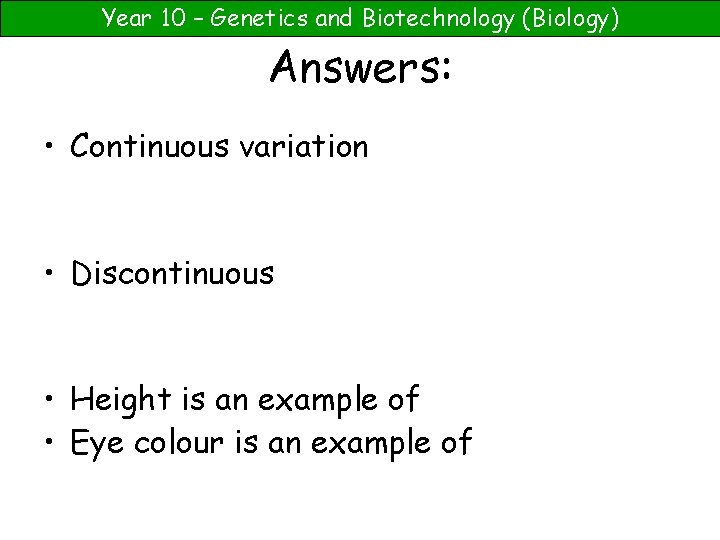
Year 10 – Genetics and Biotechnology (Biology) Answers: • Continuous variation • Discontinuous • Height is an example of • Eye colour is an example of
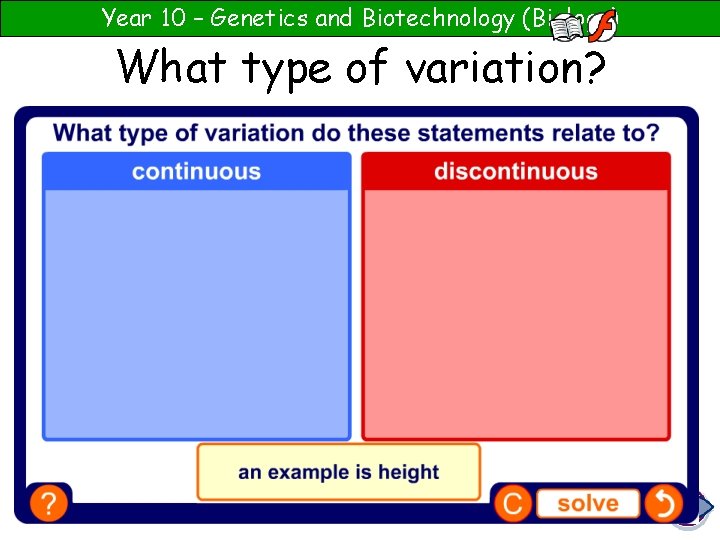
Year 10 – Genetics and Biotechnology (Biology) What type of variation?
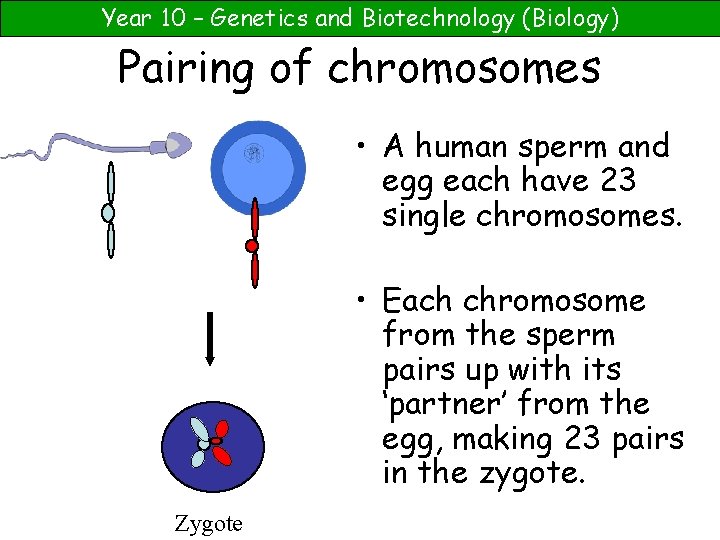
Year 10 – Genetics and Biotechnology (Biology) Pairing of chromosomes • A human sperm and egg each have 23 single chromosomes. • Each chromosome from the sperm pairs up with its ‘partner’ from the egg, making 23 pairs in the zygote. Zygote

Year 10 – Genetics and Biotechnology (Biology) Pairing of genes • This brings the 2 sets of genes together. 1 Blonde hair colour gene 1 brown 2 blue eyed gene • They are now called Homologous pairs. • The genes for hair colour pair up, genes for skin colour pair up etc. • These different forms of the same gene are called alleles. father Mother
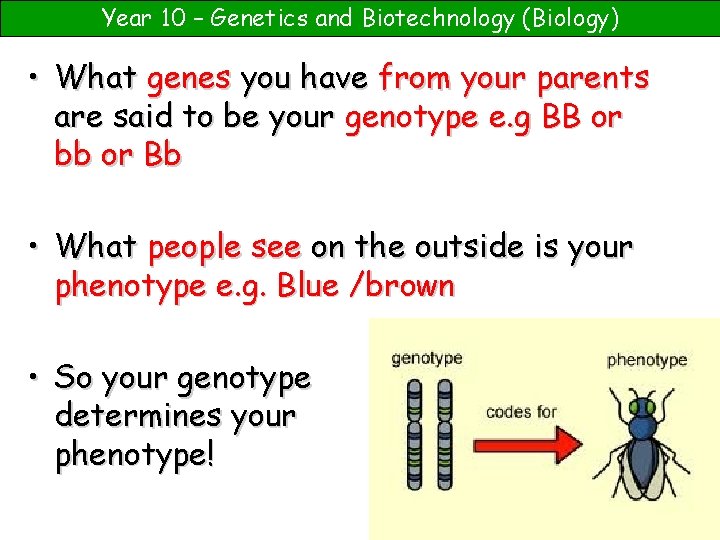
Year 10 – Genetics and Biotechnology (Biology) • What genes you have from your parents are said to be your genotype e. g BB or bb or Bb • What people see on the outside is your phenotype e. g. Blue /brown • So your genotype determines your phenotype!
Year 10 – Genetics and Biotechnology (Biology) Task 2: Questions 1. How many single chromosomes does a sperm and egg cell have? 2. What happens to this number when the sperm and egg fertilise? 3. What is an Allele? 4. Name 2 alleles for eye colour? 5. What is genotype? 6. What is phenotype?
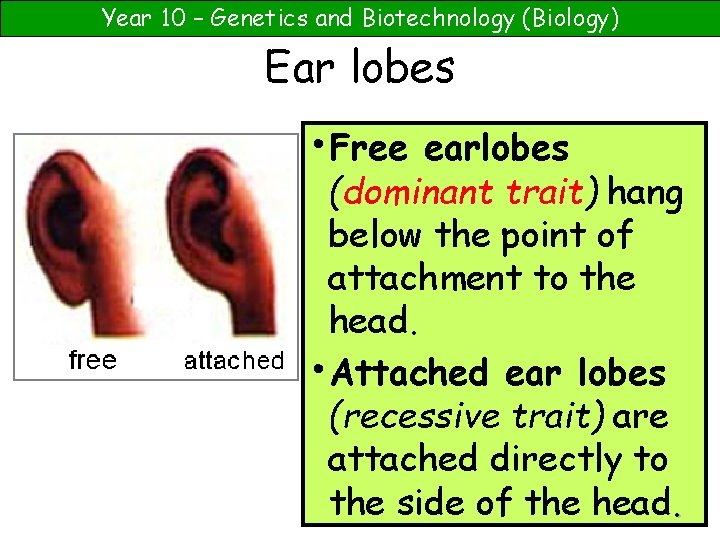
Year 10 – Genetics and Biotechnology (Biology) Ear lobes • Free earlobes (dominant trait) hang below the point of attachment to the head. • Attached ear lobes (recessive trait) are attached directly to the side of the head.
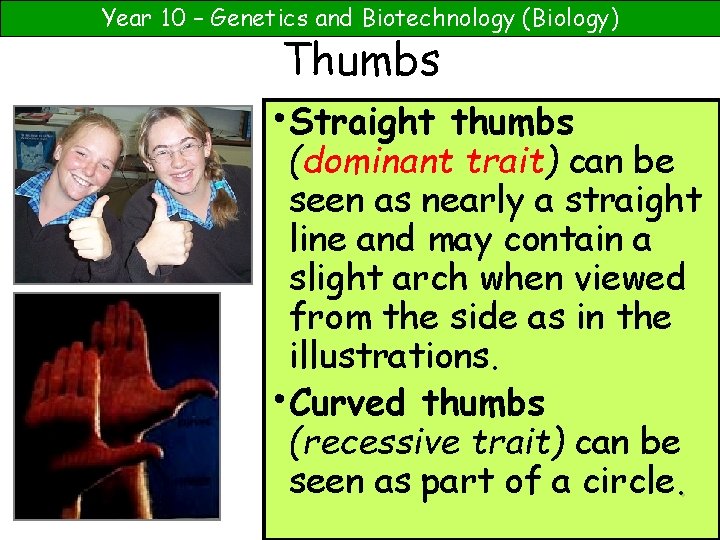
Year 10 – Genetics and Biotechnology (Biology) Thumbs • Straight thumbs (dominant trait) can be seen as nearly a straight line and may contain a slight arch when viewed from the side as in the illustrations. • Curved thumbs (recessive trait) can be seen as part of a circle.
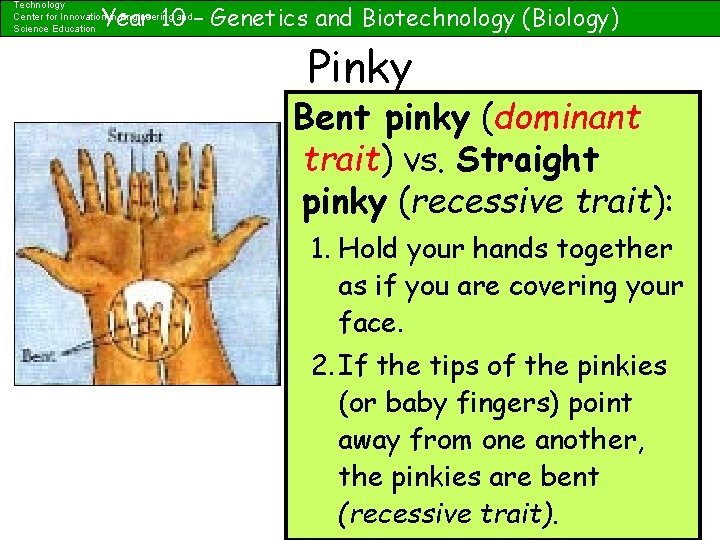
Technology Center for Innovation in Engineering and Science Education Year 10 – Genetics and Biotechnology (Biology) Pinky Bent pinky (dominant trait) vs. Straight pinky (recessive trait): 1. Hold your hands together as if you are covering your face. 2. If the tips of the pinkies (or baby fingers) point away from one another, the pinkies are bent (recessive trait).
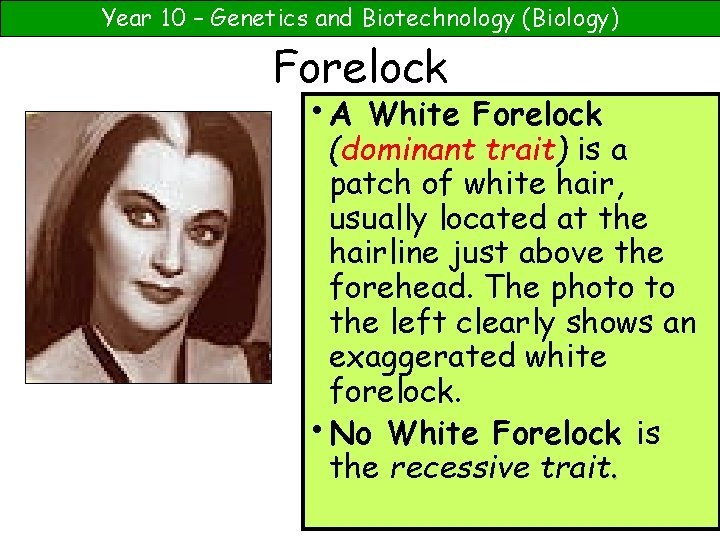
Year 10 – Genetics and Biotechnology (Biology) Forelock • A White Forelock (dominant trait) is a patch of white hair, usually located at the hairline just above the forehead. The photo to the left clearly shows an exaggerated white forelock. • No White Forelock is the recessive trait.
Year 10 – Genetics and Biotechnology (Biology) Task 3: Design a survey • Design a survey table that could be used to ask the class about their traits. • • Ear lobes Thumbs Pinky Forelock Height Shoe size Eye colour If we are sensible we could carry this out for small groups
Year 10 – Genetics and Biotechnology (Biology) My survey
Year 10 – Genetics and Biotechnology (Biology) • Make a note of this info • Draw a diagram or picture • Discuss • Think • Investigate Watch Answer question
- Slides: 16