
Year 1 signs and missing numbers Children need
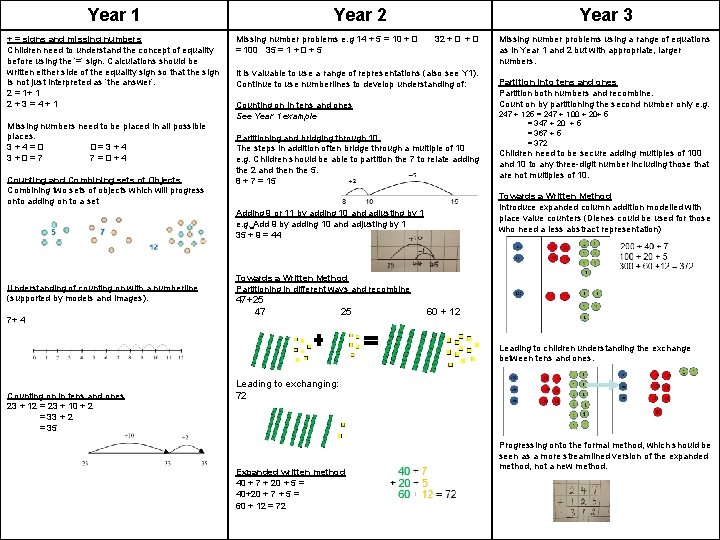
Year 1 + = signs and missing numbers Children need to understand the concept of equality before using the ‘=’ sign. Calculations should be written either side of the equality sign so that the sign is not just interpreted as ‘the answer’. 2 = 1+ 1 2+3=4+1 Missing numbers need to be placed in all possible places. 3+4=� �=3+4 3+�=7 7=�+4 Counting and Combining sets of Objects Combining two sets of objects which will progress onto adding on to a set Year 2 Missing number problems e. g 14 + 5 = 10 + � = 100 35 = 1 + � + 5 Year 3 32 + � It is valuable to use a range of representations (also see Y 1). Continue to use numberlines to develop understanding of: Counting on in tens and ones See Year 1 example Partitioning and bridging through 10. The steps in addition often bridge through a multiple of 10 e. g. Children should be able to partition the 7 to relate adding the 2 and then the 5. 8 + 7 = 15 7+ 4 Partition into tens and ones Partition both numbers and recombine. Count on by partitioning the second number only e. g. 247 + 125 = 247 + 100 + 20+ 5 = 347 + 20 + 5 = 367 + 5 = 372 Children need to be secure adding multiples of 100 and 10 to any three-digit number including those that are not multiples of 10. Towards a Written Method Introduce expanded column addition modelled with place value counters (Dienes could be used for those who need a less abstract representation) Adding 9 or 11 by adding 10 and adjusting by 1 e. g. Add 9 by adding 10 and adjusting by 1 35 + 9 = 44 Understanding of counting on with a numberline (supported by models and images). Missing number problems using a range of equations as in Year 1 and 2 but with appropriate, larger numbers. Towards a Written Method Partitioning in different ways and recombine 47+25 47 25 60 + 12 Leading to children understanding the exchange between tens and ones. Counting on in tens and ones 23 + 12 = 23 + 10 + 2 = 33 + 2 = 35 Leading to exchanging: 72 Expanded written method 40 + 7 + 20 + 5 = 40+20 + 7 + 5 = 60 + 12 = 72 Progressing onto the formal method, which should be seen as a more streamlined version of the expanded method, not a new method.
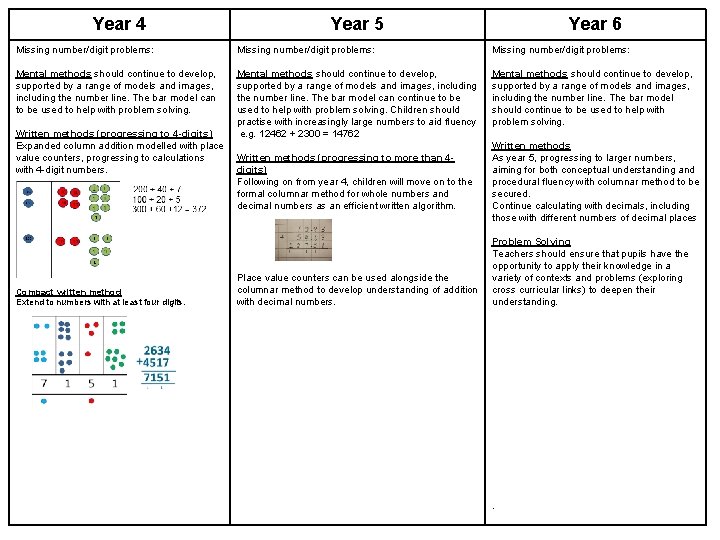
Year 4 Year 5 Year 6 Missing number/digit problems: Mental methods should continue to develop, supported by a range of models and images, including the number line. The bar model can to be used to help with problem solving. Mental methods should continue to develop, supported by a range of models and images, including the number line. The bar model can continue to be used to help with problem solving. Children should practise with increasingly large numbers to aid fluency e. g. 12462 + 2300 = 14762 Mental methods should continue to develop, supported by a range of models and images, including the number line. The bar model should continue to be used to help with problem solving. Written methods (progressing to 4 -digits) Expanded column addition modelled with place value counters, progressing to calculations with 4 -digit numbers. Compact written method Extend to numbers with at least four digits. Written methods (progressing to more than 4 digits) Following on from year 4, children will move on to the formal columnar method for whole numbers and decimal numbers as an efficient written algorithm. Place value counters can be used alongside the columnar method to develop understanding of addition with decimal numbers. Written methods As year 5, progressing to larger numbers, aiming for both conceptual understanding and procedural fluency with columnar method to be secured. Continue calculating with decimals, including those with different numbers of decimal places Problem Solving Teachers should ensure that pupils have the opportunity to apply their knowledge in a variety of contexts and problems (exploring cross curricular links) to deepen their understanding. .
- Slides: 2