
YARN NUMBERING SYSTEM The term hank or count
YARN NUMBERING SYSTEM • The term hank or count is used in yarn numbering system. • The hank or count is a numerical expression which indicate the degree of fineness of cotton yarn / fibre as it is passes through various processes of spinning. • The term hank is used in the preparatory processes like blow room lap, card sliver, draw -frame sliver and speed frame roving etc. • The term count is used for the yarn in the finished form of ring frame stage.
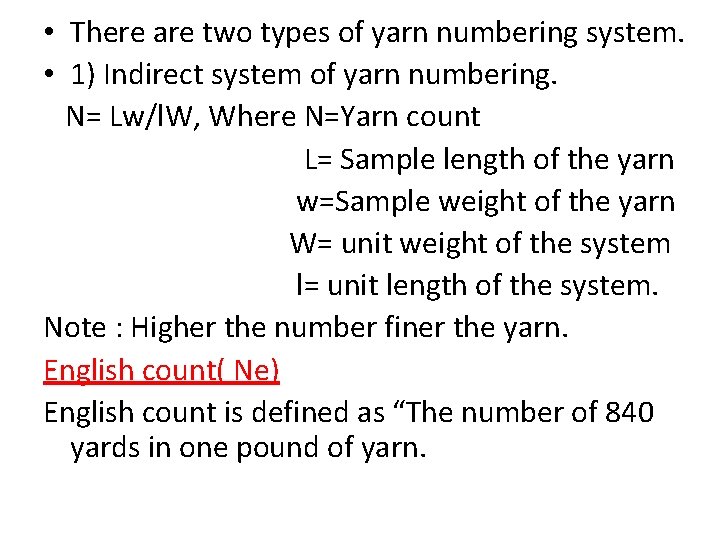
• There are two types of yarn numbering system. • 1) Indirect system of yarn numbering. N= Lw/l. W, Where N=Yarn count L= Sample length of the yarn w=Sample weight of the yarn W= unit weight of the system l= unit length of the system. Note : Higher the number finer the yarn. English count( Ne) English count is defined as “The number of 840 yards in one pound of yarn.
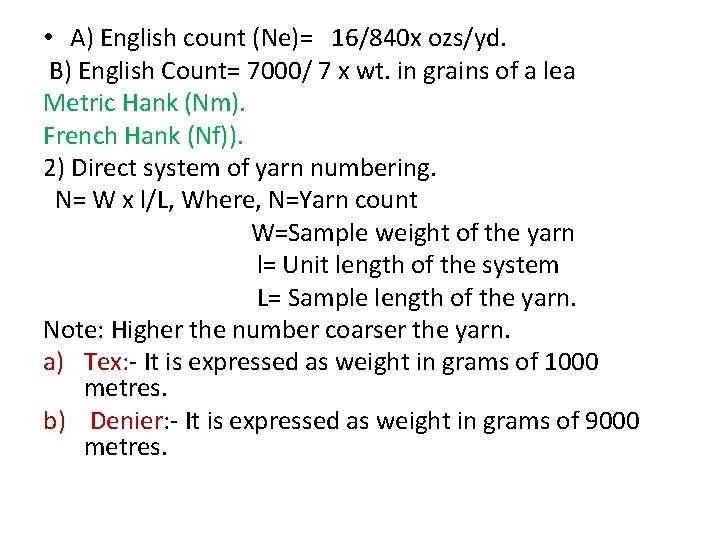
• A) English count (Ne)= 16/840 x ozs/yd. B) English Count= 7000/ 7 x wt. in grains of a lea Metric Hank (Nm). French Hank (Nf)). 2) Direct system of yarn numbering. N= W x l/L, Where, N=Yarn count W=Sample weight of the yarn l= Unit length of the system L= Sample length of the yarn. Note: Higher the number coarser the yarn. a) Tex: - It is expressed as weight in grams of 1000 metres. b) Denier: - It is expressed as weight in grams of 9000 metres.
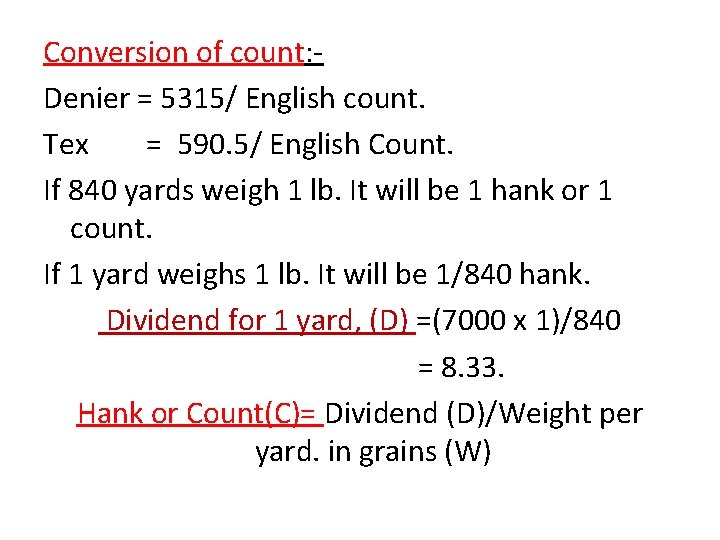
Conversion of count: Denier = 5315/ English count. Tex = 590. 5/ English Count. If 840 yards weigh 1 lb. It will be 1 hank or 1 count. If 1 yard weighs 1 lb. It will be 1/840 hank. Dividend for 1 yard, (D) =(7000 x 1)/840 = 8. 33. Hank or Count(C)= Dividend (D)/Weight per yard. in grains (W)
GINNING. • Ginning is a operation by which the fibres are separated from the seeds without injury to the fibres or seeds. • Faulty Ginning: - After proper process of ginning, if cut and broken fibres, thin husk of the seed and neps (pinhead size dots formed by rolling cotton) remain in ginned fibres, that is called faulty ginning. • Ginning is performed by hand or ordinary machines such as foot roller gin or Charakha gin initially. • After introduction of modern machinery, Ginning is found in three types. 1) Knife roller Gin.
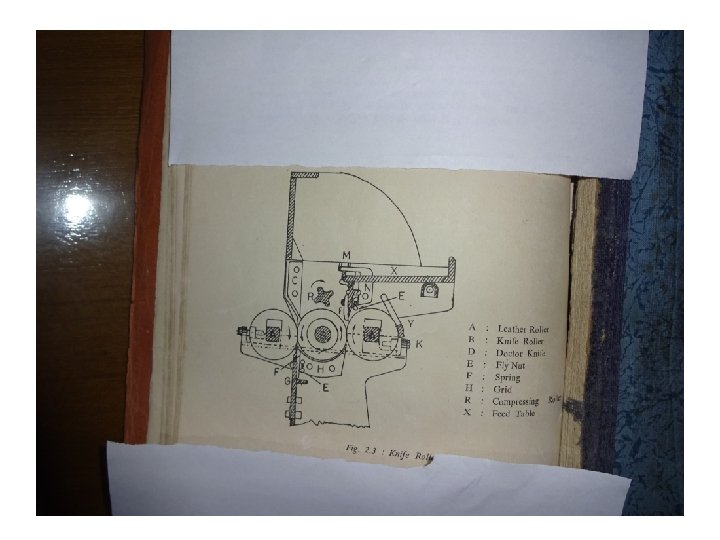
2) Macarthy Gin 3) Saw Gin. Knife Roller is of two types: - 1) Single Roller. 2) Double Roller. The seed cotton is placed on the feed table. A compressing roller breaks up the large lumps of seed cotton. Then the seed cotton comes into contact with the knife roller, which consists of a knife discs. The roller, with the help of the knives gives a gentle to and fro motion which is repeated very quickly. The cotton is carried forward by a leather roller, which has a very rough surface due to spiral cut on the leather roller. The seed are not allowed to follow along with the fibres at the point of contact of the doctor knife and leather roller. The combined actions of the knife and roller soon separate fibres from the seeds, and the seeds are allowed to fall down through the grid to the floor. Finally the freed fibres are passed forward and stripped from the roller by the stripping board.
• Saw Gin: The seed cooton is fed upon the lattice p and carried forward to the spiked roller Q which loosens it and throw it over, so that it falls into the hopper F when it comes into contact with rapidly revolving saws a. These saws varying into contact with rapidly revolving saws (A). These saws are having 70 no of discs and space about ¾” left between each saw. The teeth of revolving saws carry the fibre forward, but it is impossible for the seeds to follow, so that fibre are simply wtrenched from the seed and taken round untill the brush B strips them from the seed.
• An air current from cage N draws the fibre along the passage M and on reaching the revolving cage N are brought under the pressure roller R Ana delivered as a sheet from which point it is taken to the baling press either by labours or by lattice feeder. Production =400 lbs/hour No of saw discs = 70 Speed = 400 r. p. m Power = 7 H. P
Causes of Faulty Ginning: i) Excessive dampness and dryness of cotton. ii) Dull Saws in ginning machine. iii) Inadequate machine setting. iv) Inadequate speed of the ginning machine. v) Negligence of the operative. vi) Improper humidity condition which can differ moisture regain of cotton fibres. MIXING: Mixing is the process of intermingling of various verities of fibres ( as various cotton) to produce a uniform distribution of each throughout the entire mass.
• BLENDING: It is a intermingling of different types of fibre like cotton/ polyester, Polyester vs viscose etc to get a proper blend of fibres. There are different methods of Mixing: i) Hand Mixing. ii) Direct Mixing. iii) Stack Mixing. iv) Bin Mixing. v) Modern Mixing. vi) Machine Mixing.
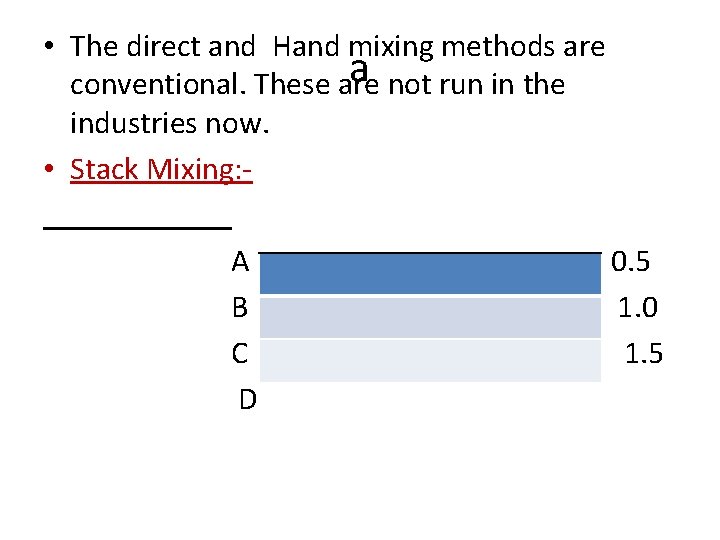
• The direct and Hand mixing methods are a not run in the conventional. These are industries now. • Stack Mixing: A B C D 0. 5 1. 0 1. 5
• Advantage of Stack Mixing: 1. More even yarn is produced for a large period. 2. As cotton is allowed to to stand for 20 to 24 hours, it absorbs the moisture according to the stage of atmosphere. 3. By allowing the cotton to stand in a room all the fibres get same temperature and humidity as that of room. Advantage of Bin Mixing: 1. Less labour is required and better mixing. 2. Less space is required.
3. It permits an aging of cotton depending upon how long it is placed in bin. Advantage of Modern Mixing: 1. One operator can manage one machine which is a saving device. 2. Saving of capital in investment and less chance of getting fire. 3. It is suitable where small quantities of yarn are required. Advantage of Machine Mixing: 1. Saving of large floor surface. 2. Saving in labour. 3. No fire hazard because cotton is closed in the machine , so insurance charges will less. 4. Cost of production is less. 5. Dirt and dust cannot enter in cotton because cotton is closed in the machine.
• Disadvantages: 1) Cotton is not exposed to atmosphere and not sufficient time to regain moisture and temperature, i. e atmospheric contion. Thus the spinning cannot work so smoothly as is possible in oters. 2) More verities of cotton wants the more number of machines. BLOW ROOM LINE: In the blow room line the cotton bales are opened, cleaned and mixed and converted into lap form, which is a long sheet of fibres. Hence the function of Blow Room Line: -
1. 2. 3. 4. Opening and cleaning Removal of waste ( Dust and dirt) Formation a long sheet of fibres as named lap. In the blow room line the various types of motions are executed: i) By opposite action of spikes. ii) By air current. iii) By a pair of feed roller and beater. iv) By pedals and beaters. Main machines which are used in blow room line are as follows: -
a) Hopper bale breaker (1) b) Super cleaner (2) c) Porcupine opener(3) d) Krighton or vertical opener(4) e) Hopper feeder with condenser cage. f) Double beater opener. (6) g) Two way distributor. h) Hopper feeder. (7) i) Scutcher (8). This sequence of machinery is single process Blow room line where production can give in higher rate.
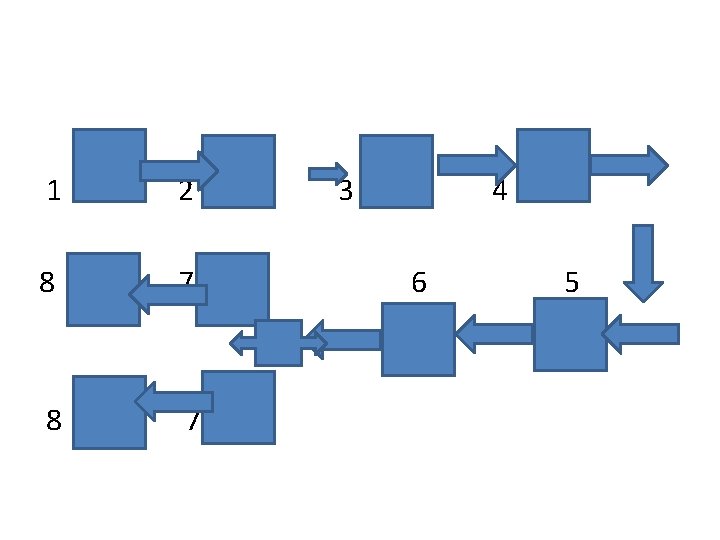
1 2 8 7 3 4 6 5
CLEANING POINT OF HOPPER BALE BREAKER: 1) Cotton which is stripped off by the evener roller, strikes the protecting bars when dust is extracted and is taken by the sucking fan. 2) There are grid bars under the beater roller so that by beating action the trash and dust is removed. 3) A magnet is usually placed near the stripper beater to remove the iron pieces if present in the cotton bales. 4) cleaning power can be increased by setting evener roller closed to the inclined spiked lattice.
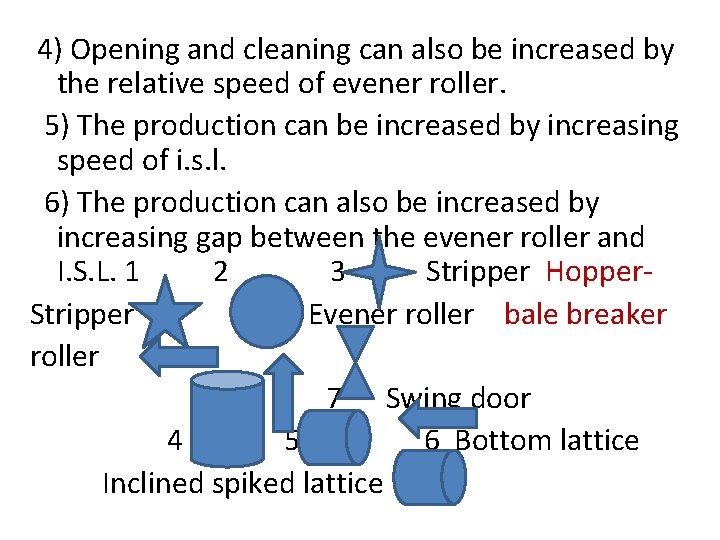
4) Opening and cleaning can also be increased by the relative speed of evener roller. 5) The production can be increased by increasing speed of i. s. l. 6) The production can also be increased by increasing gap between the evener roller and I. S. L. 1 2 3 Stripper Hopper. Stripper Evener roller bale breaker roller 7 Swing door 4 5 6 Bottom lattice Inclined spiked lattice
Hopper Feeder: The principal object of the hopper feeder is to provide a uniform feed to the subsequent machine and incidently to take advantage of extracting a trash, as the opportunity for the trash extraction. Types of hopper feeder: - 1) HF 1 ( one reserve box) 2) HF 2 (Two reserve box) 3) HF 3 ( Three reserve box) 4) HF A. (Automatic). In between hopper feeder and scutcher, there is piano feed regulating device consisting of 18 pedal levers with pedal roller and a pair of feed roller in front of pedal levers.
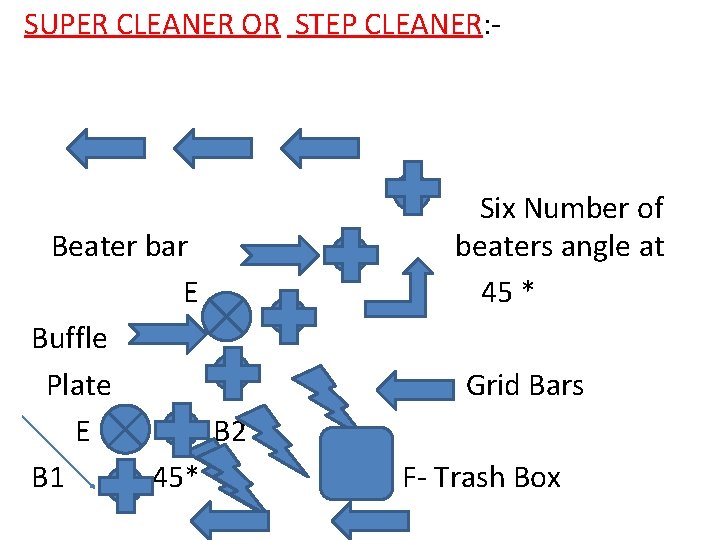
SUPER CLEANER OR STEP CLEANER: - Beater bar E Buffle Plate E B 2 B 1 45* Six Number of beaters angle at 45 * Grid Bars F- Trash Box
The Step cleaner is commonly equipped with six number of beaters arranged at an angle of 45*. Each beater consists of tubeler body on to which are welded four rows of spikes or beating arms of elliptical cross section. Under each beater a grid bar system ‘c’ is fitted which is adjustable. On entering the first beater compartment the partially opened cotton is flung by the beater arms against the grid bars before passing on upward to the second beater B 2. Buffle plate E inter passed between each turn of beater prevents them from creating a circular air current by deflecting air and cotton towards the next beater.
The beaters revolve in the same direction at 550 rpm, which has the effect of giving the cotton tufts a series of severe blows in a direction opposite to that at which the previous beater delivers the cotton. The trash extracted by the beater action falls into the trash box F. Beater rpm= 550 Power = 3. 7 H. P Production = 600 to 700 lbs/hour. Angle of beater= 45*. The material flow in the step cleaner from lower beater to upper beater.
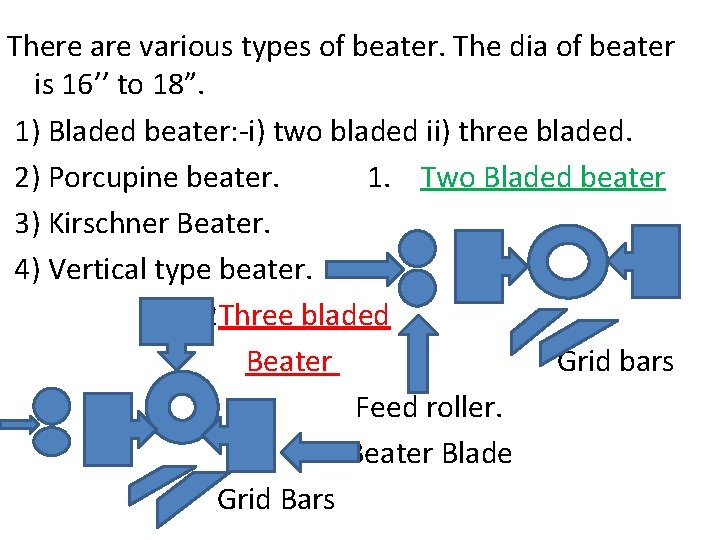
There are various types of beater. The dia of beater is 16’’ to 18”. 1) Bladed beater: -i) two bladed ii) three bladed. 2) Porcupine beater. 1. Two Bladed beater 3) Kirschner Beater. 4) Vertical type beater. 2 Three bladed Beater Grid bars. Feed roller. Beater Blade Grid Bars
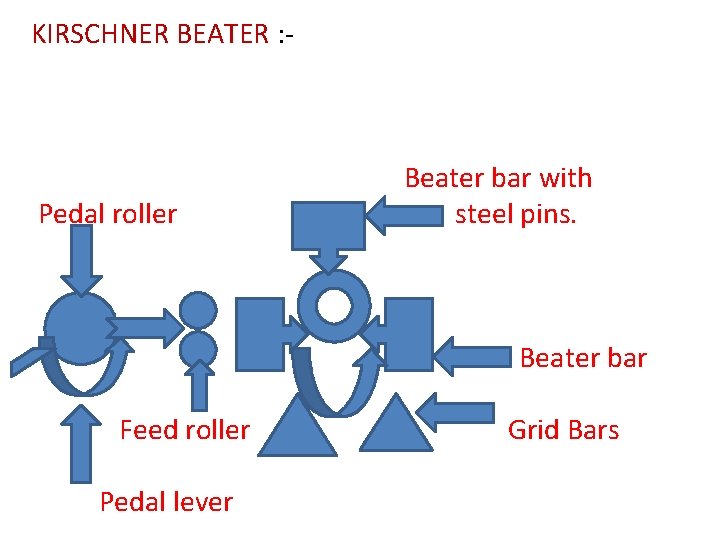
KIRSCHNER BEATER : - Pedal roller Beater bar with steel pins. Beater bar Feed roller Pedal lever Grid Bars
The Kirschner beater consists of three arm spiders mounted on a shaft, with wooden legs firmly fixed to the arms. Each leg carries a longer number of hardened, well pointed steel pins arranged in staggered formation to ensure adequate combing of cotton across the whole width of the machine. The beater has effect of a gradual penetration in the cotton fringe at each blow. It removes small trash materials as leaf, wooden pieces etc. There are three types of pins : i) Coarser having stronger pins, ii) Finer having fine and more pins fixed, iii) Medium pins are most commonly used and suitable for 1’’ to 1 3/8’’ in staple length. This beater speed is 700 to 750 rpm.
SCUTCHER ( LAP DOFFING PART): The scutcher is having five essential motions: 1) Piano feed regulating motion, 2) Knocking off motion. 3) Pressure on calendar roller. 4) Lap Compacting device. 5) Automatic lap doffing. CONE DRUM DRIVING SYSTEM: The material flow under the pedal roller and over the pedal lever passes across the pair of feed roller and underneath the kirschner beater. The motion of pedal levers is connected with cone drive system.
The rising and depressing of pedal levers due to material flow, shift the cone drums belt which are placed opposite to another. One cone drives other by this belt. Other cone is connected directly with feed rollers. A variation in speed of this driven cone causes corresponding variation of speed of the feed rollers. A depressing action of pedals for thick tuft of cotton causes shifting down the belt of cone drum and hence the speed of driven cone decreases and so speed of feed roller is also decreases which minimizes the feeding of cotton. For thinner tuft of cotton is vice-versa.
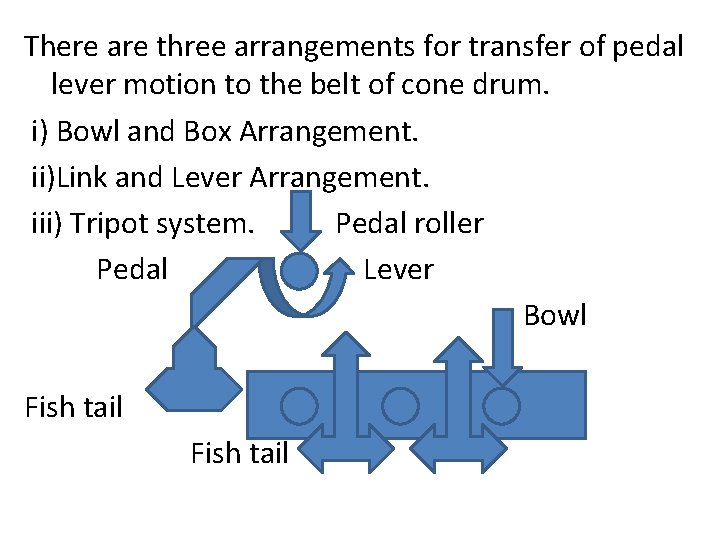
There are three arrangements for transfer of pedal lever motion to the belt of cone drum. i) Bowl and Box Arrangement. ii)Link and Lever Arrangement. iii) Tripot system. Pedal roller Pedal Lever Bowl Fish tail
Bowl and Box arrangement: We see that, one end of pedal lever is like fish tail and other end is nosed shape where the pedal roller rests. All the pedal levers are connected in a rail fixed with bowl like bearing. When one lever is moved up and down with the flow of material, immediately the other lever starts move which are connected to each other with bowl in a rail. One end of rail is kept fixed. This displacement of fish tail end of the levers along with the flow of material effects a series of levers and through which the trap of the cone drum is moved. Thus the driven cone which is connected with feed roller change the speed of feed roller as high and low. The up and down of the levers by the material control the speed of the feed roller. This is called piano feed regulating motion in the bowl and box arrangement
- Slides: 31