
Yapay Zeka 802600715151 Do Dr Mehmet Serdar GZEL
- Slides: 12
Yapay Zeka 802600715151 Doç. Dr. Mehmet Serdar GÜZEL Slides are mainly adapted from the following course page: at http: //ai. berkeley. edu created by Dan Klein and Pieter Abbeel for CS 188
Lecturer Instructor: Assoc. Prof Dr. Mehmet S Güzel Office hours: Tuesday, 1: 30 -2: 30 pm Open door policy – don’t hesitate to stop by! Watch the course website Assignments, lab tutorials, lecture notes • slide 2
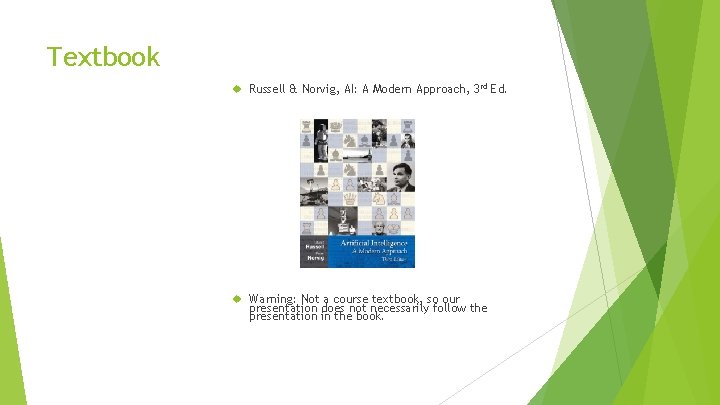
Textbook Russell & Norvig, AI: A Modern Approach, 3 rd Ed. Warning: Not a course textbook, so our presentation does not necessarily follow the presentation in the book.
Today What is artificial intelligence? What can AI do? What is this course?
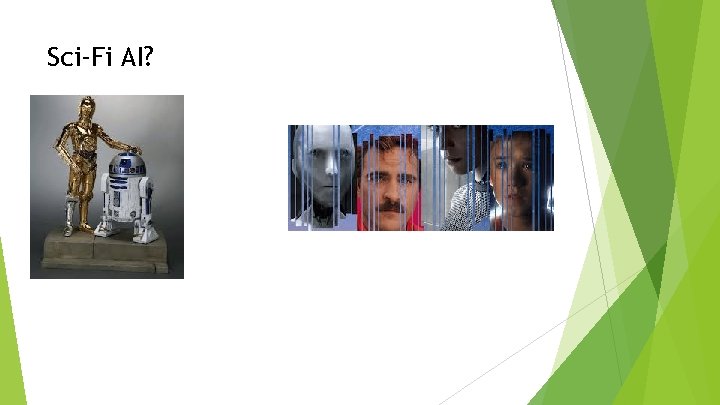
Sci-Fi AI?
What is AI? The science of making machines that: Think like people Think rationally Act like people Act rationally
Rational Decisions We’ll use the term rational in a very specific, technical way: § Rational: maximally achieving pre-defined goals § Rationality only concerns what decisions are made (not the thought process behind them) § Goals are expressed in terms of the utility of outcomes § Being rational means maximizing your expected utility A better title for this course would be: Computational Rationality
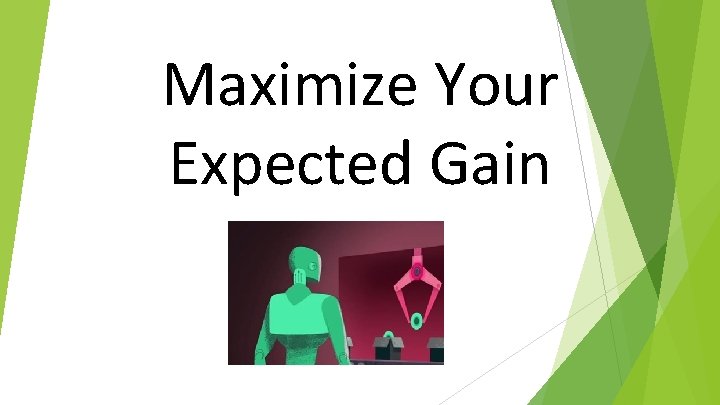
Maximize Your Expected Gain
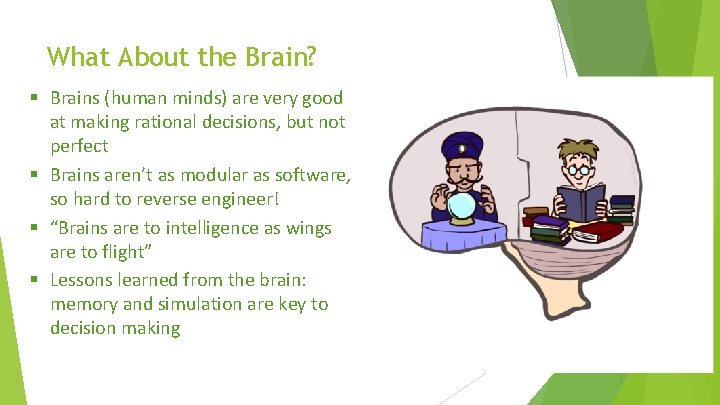
What About the Brain? § Brains (human minds) are very good at making rational decisions, but not perfect § Brains aren’t as modular as software, so hard to reverse engineer! § “Brains are to intelligence as wings are to flight” § Lessons learned from the brain: memory and simulation are key to decision making
A (Short) History of AI Demo: HISTORY – MT 1950. wmv
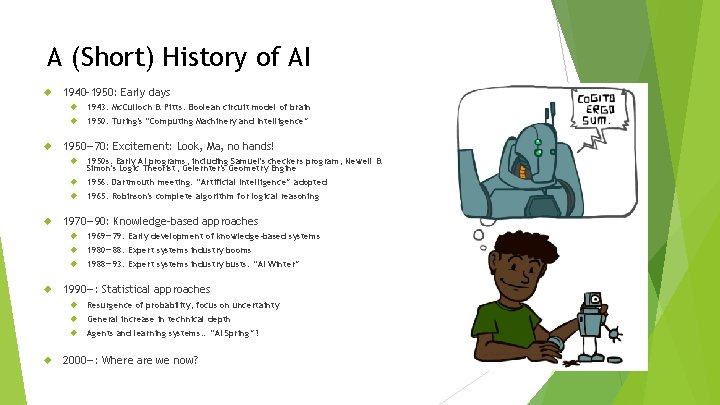
A (Short) History of AI 1940 -1950: Early days 1943: Mc. Culloch & Pitts: Boolean circuit model of brain 1950: Turing's “Computing Machinery and Intelligence” 1950— 70: Excitement: Look, Ma, no hands! 1950 s: Early AI programs, including Samuel's checkers program, Newell & Simon's Logic Theorist, Gelernter's Geometry Engine 1956: Dartmouth meeting: “Artificial Intelligence” adopted 1965: Robinson's complete algorithm for logical reasoning 1970— 90: Knowledge-based approaches 1969— 79: Early development of knowledge-based systems 1980— 88: Expert systems industry booms 1988— 93: Expert systems industry busts: “AI Winter” 1990—: Statistical approaches Resurgence of probability, focus on uncertainty General increase in technical depth Agents and learning systems… “AI Spring”? 2000—: Where are we now?
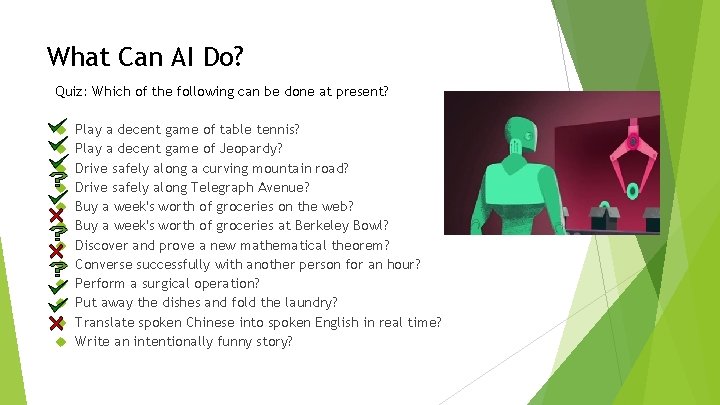
What Can AI Do? Quiz: Which of the following can be done at present? Play a decent game of table tennis? Play a decent game of Jeopardy? Drive safely along a curving mountain road? Drive safely along Telegraph Avenue? Buy a week's worth of groceries on the web? Buy a week's worth of groceries at Berkeley Bowl? Discover and prove a new mathematical theorem? Converse successfully with another person for an hour? Perform a surgical operation? Put away the dishes and fold the laundry? Translate spoken Chinese into spoken English in real time? Write an intentionally funny story?