
Yangon City Development Committee Toe Aung Deputy Head
- Slides: 25
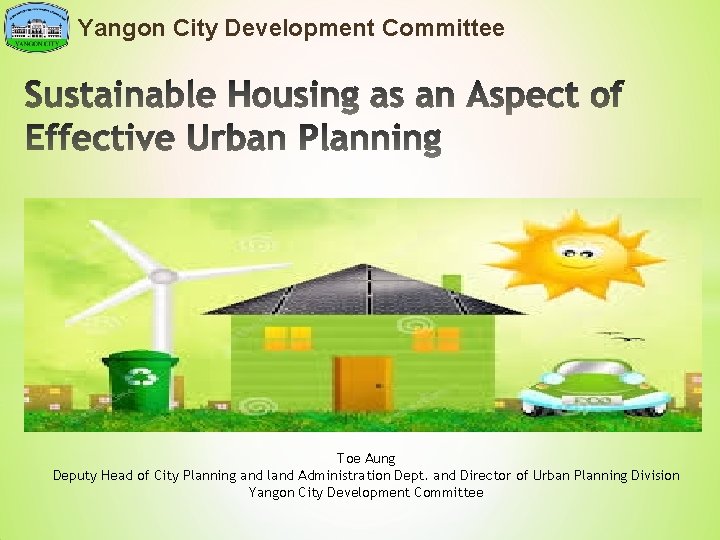
Yangon City Development Committee Toe Aung Deputy Head of City Planning and land Administration Dept. and Director of Urban Planning Division Yangon City Development Committee
Yangon City Development Committee * v Sustainable Urban Housing Strategies v Housing Policy and Strategies in Myanmar v Eco-cities v Planning for Sustainable Housing
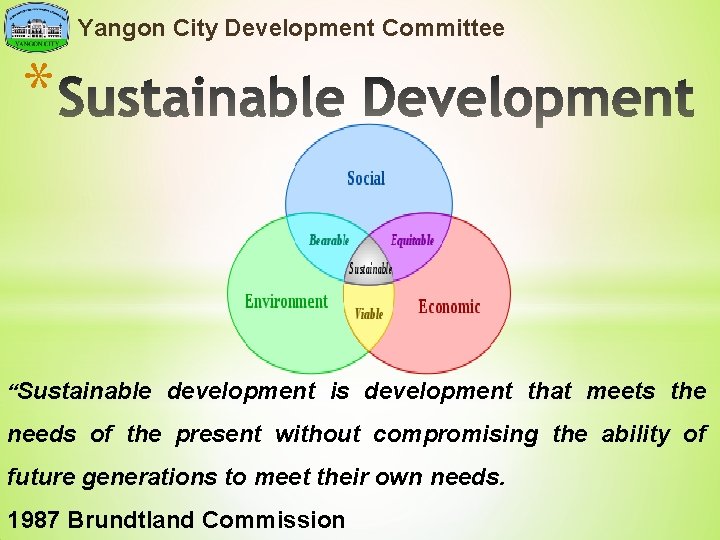
Yangon City Development Committee * “Sustainable development is development that meets the needs of the present without compromising the ability of future generations to meet their own needs. 1987 Brundtland Commission
Yangon City Development Committee * v Cities continue to grow as more and more people move into urban areas and with this shift towards urbanization, cities are experiencing an increasing strain on their current infrastructure systems. v Roadways, power grids, telecommunications lines and efficient healthcare all rely on a strong infrastructure to handle demand. v Optimizing these infrastructural networks in order to achieve sustainable development is an immense task which requires public and private cooperation.
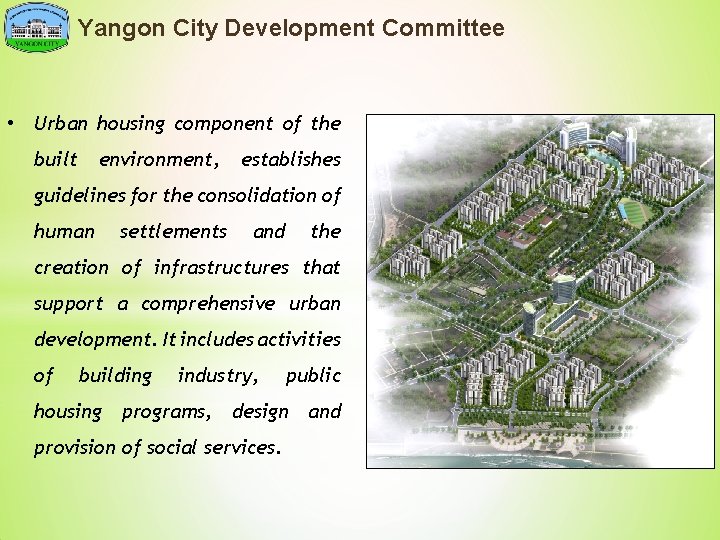
Yangon City Development Committee • Urban housing component of the built environment, establishes guidelines for the consolidation of human settlements and the creation of infrastructures that support a comprehensive urban development. It includes activities of building industry, public housing programs, design and provision of social services.
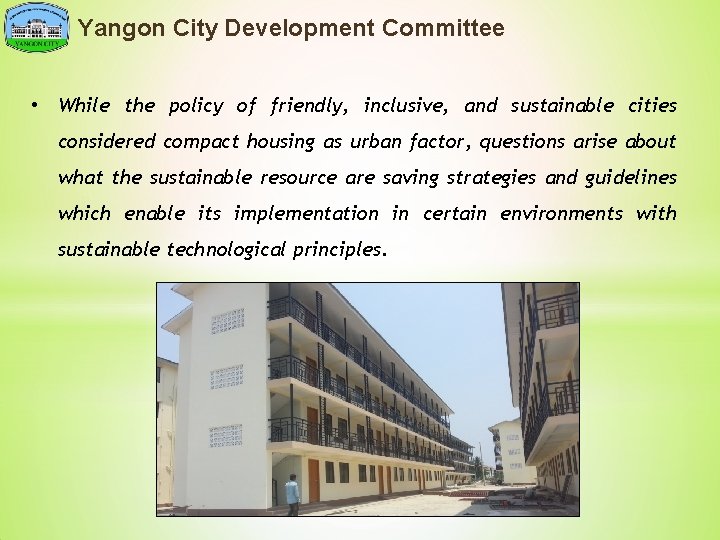
Yangon City Development Committee • While the policy of friendly, inclusive, and sustainable cities considered compact housing as urban factor, questions arise about what the sustainable resource are saving strategies and guidelines which enable its implementation in certain environments with sustainable technological principles.
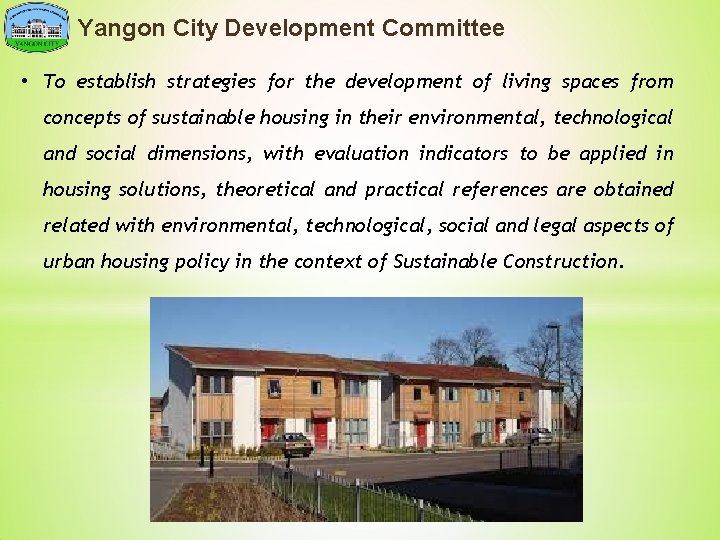
Yangon City Development Committee • To establish strategies for the development of living spaces from concepts of sustainable housing in their environmental, technological and social dimensions, with evaluation indicators to be applied in housing solutions, theoretical and practical references are obtained related with environmental, technological, social and legal aspects of urban housing policy in the context of Sustainable Construction.
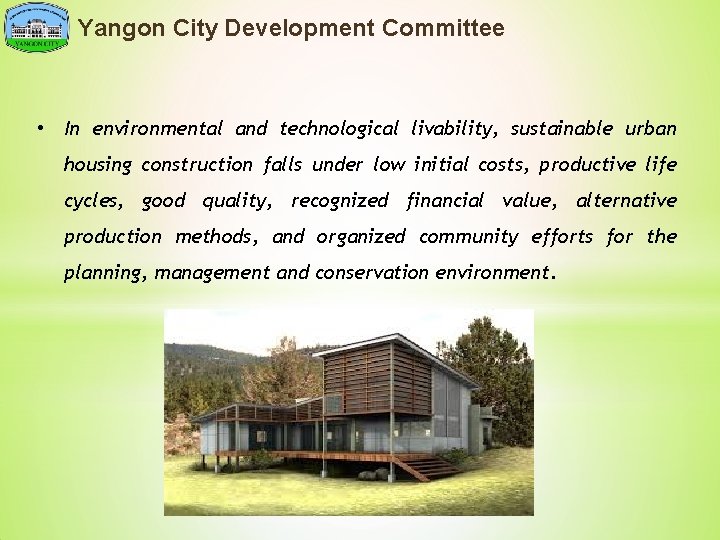
Yangon City Development Committee • In environmental and technological livability, sustainable urban housing construction falls under low initial costs, productive life cycles, good quality, recognized financial value, alternative production methods, and organized community efforts for the planning, management and conservation environment.
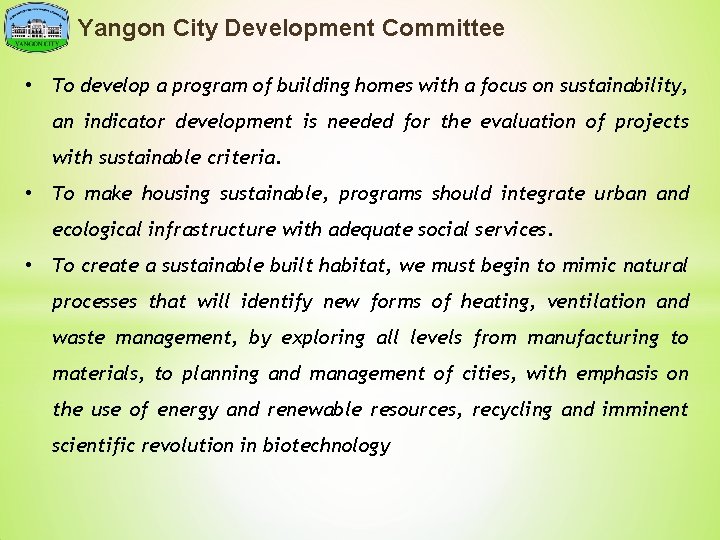
Yangon City Development Committee • To develop a program of building homes with a focus on sustainability, an indicator development is needed for the evaluation of projects with sustainable criteria. • To make housing sustainable, programs should integrate urban and ecological infrastructure with adequate social services. • To create a sustainable built habitat, we must begin to mimic natural processes that will identify new forms of heating, ventilation and waste management, by exploring all levels from manufacturing to materials, to planning and management of cities, with emphasis on the use of energy and renewable resources, recycling and imminent scientific revolution in biotechnology
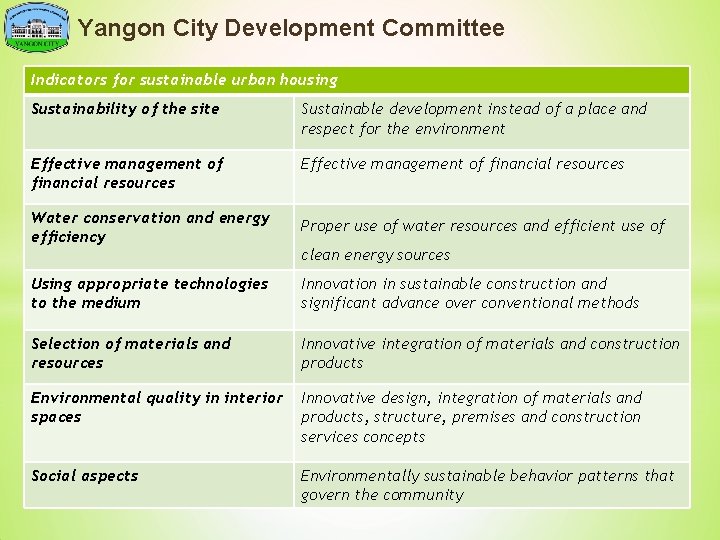
Yangon City Development Committee Indicators for sustainable urban housing Sustainability of the site Sustainable development instead of a place and respect for the environment Effective management of financial resources Water conservation and energy efficiency Proper use of water resources and efficient use of Using appropriate technologies to the medium Innovation in sustainable construction and significant advance over conventional methods Selection of materials and resources Innovative integration of materials and construction products Environmental quality in interior spaces Innovative design, integration of materials and products, structure, premises and construction services concepts Social aspects Environmentally sustainable behavior patterns that govern the community clean energy sources
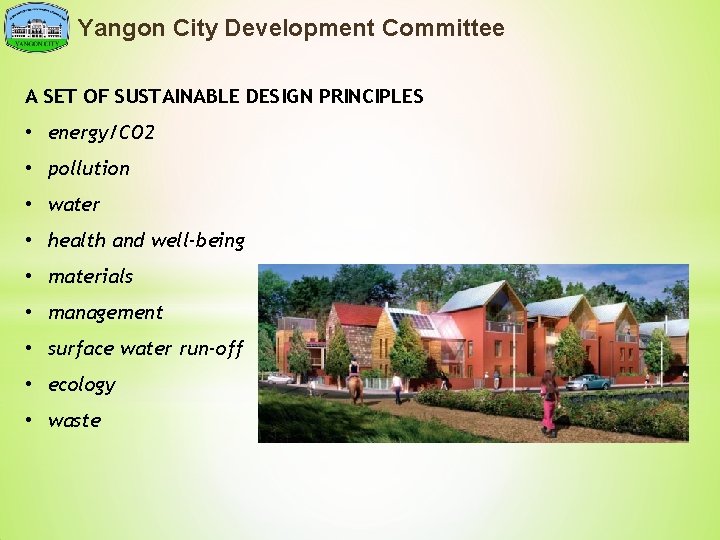
Yangon City Development Committee A SET OF SUSTAINABLE DESIGN PRINCIPLES • energy/CO 2 • pollution • water • health and well-being • materials • management • surface water run-off • ecology • waste
Yangon City Development Committee
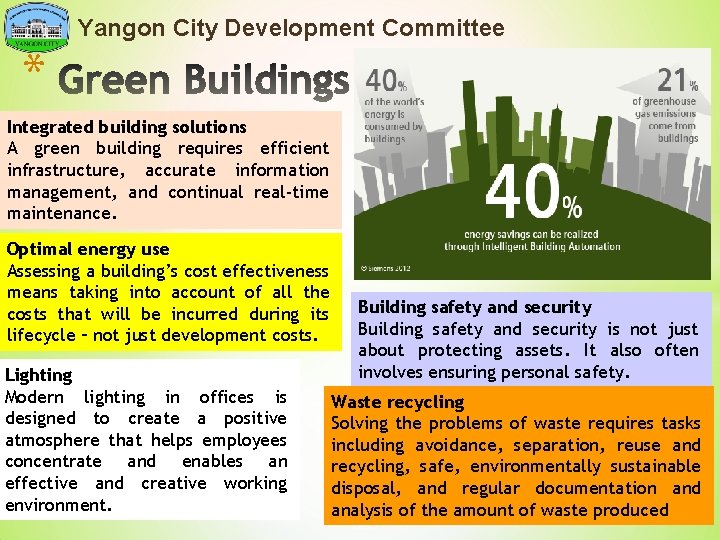
Yangon City Development Committee * Integrated building solutions A green building requires efficient infrastructure, accurate information management, and continual real-time maintenance. Optimal energy use Assessing a building’s cost effectiveness means taking into account of all the costs that will be incurred during its lifecycle – not just development costs. Lighting Modern lighting in offices is designed to create a positive atmosphere that helps employees concentrate and enables an effective and creative working environment. Building safety and security is not just about protecting assets. It also often involves ensuring personal safety. Waste recycling Solving the problems of waste requires tasks including avoidance, separation, reuse and recycling, safe, environmentally sustainable disposal, and regular documentation and analysis of the amount of waste produced
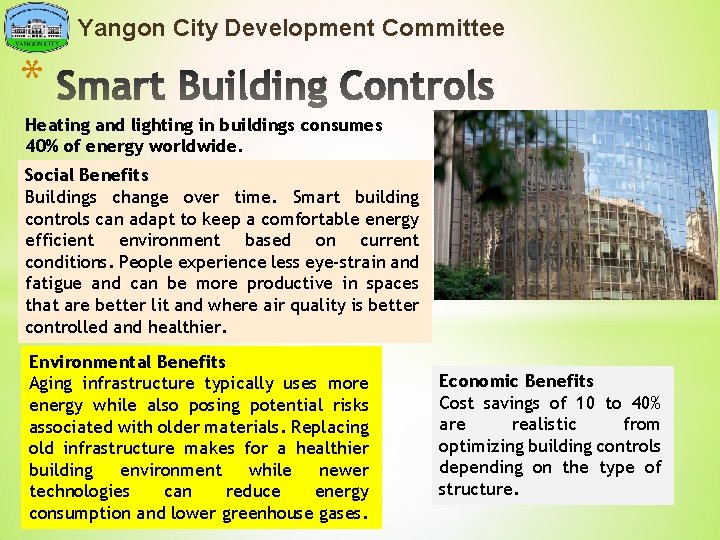
Yangon City Development Committee * Heating and lighting in buildings consumes 40% of energy worldwide. Social Benefits Buildings change over time. Smart building controls can adapt to keep a comfortable energy efficient environment based on current conditions. People experience less eye-strain and fatigue and can be more productive in spaces that are better lit and where air quality is better controlled and healthier. Environmental Benefits Aging infrastructure typically uses more energy while also posing potential risks associated with older materials. Replacing old infrastructure makes for a healthier building environment while newer technologies can reduce energy consumption and lower greenhouse gases. Economic Benefits Cost savings of 10 to 40% are realistic from optimizing building controls depending on the type of structure.
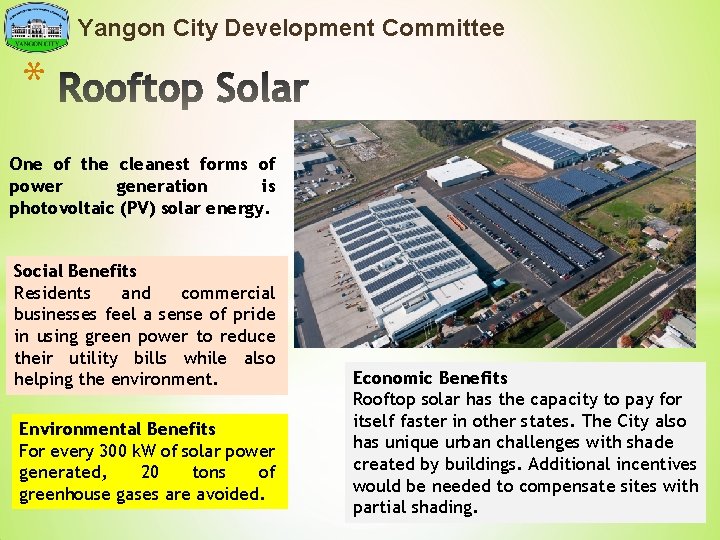
Yangon City Development Committee * One of the cleanest forms of power generation is photovoltaic (PV) solar energy. Social Benefits Residents and commercial businesses feel a sense of pride in using green power to reduce their utility bills while also helping the environment. Environmental Benefits For every 300 k. W of solar power generated, 20 tons of greenhouse gases are avoided. Economic Benefits Rooftop solar has the capacity to pay for itself faster in other states. The City also has unique urban challenges with shade created by buildings. Additional incentives would be needed to compensate sites with partial shading.
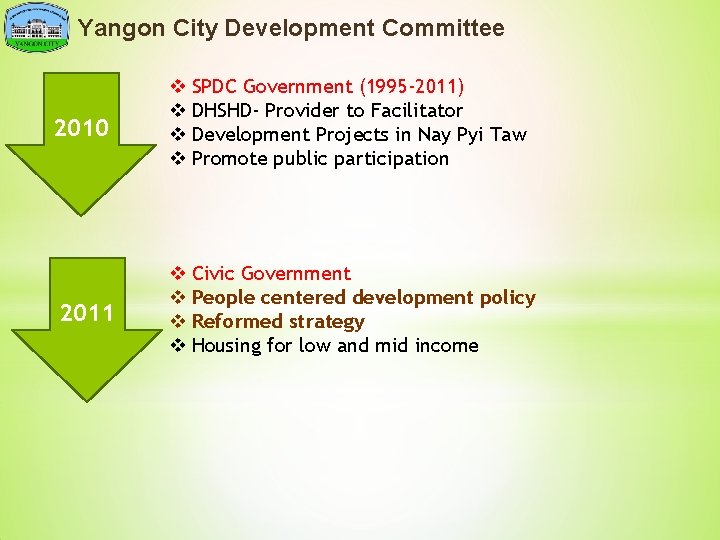
Yangon City Development Committee Housing Policies and Strategies in Myanmar 1970 1990 v Myanmar Socialist Programme Party v Housing corporation, Housing Department (1972) v Policy: non-profit, Non-lost v 1967 Thuwunna Housing estate was implemented v Public Housing 100 units/year v SLORC/SPDC, Military Government v Department of Human Settlement & Housing Development (1990) v No clear housing policy v Housing projects implemented in Yangon and other major cities v Land granted to government employees and the public v 230, 000 plots of land in Yangon and 100, 000 plots of land in other major cities were provided (1990 -2010) v Urban and Housing Development projects were implemented by PPP
Yangon City Development Committee 2010 v SPDC Government (1995 -2011) v DHSHD- Provider to Facilitator v Development Projects in Nay Pyi Taw v Promote public participation 2011 v Civic Government v People centered development policy v Reformed strategy v Housing for low and mid income
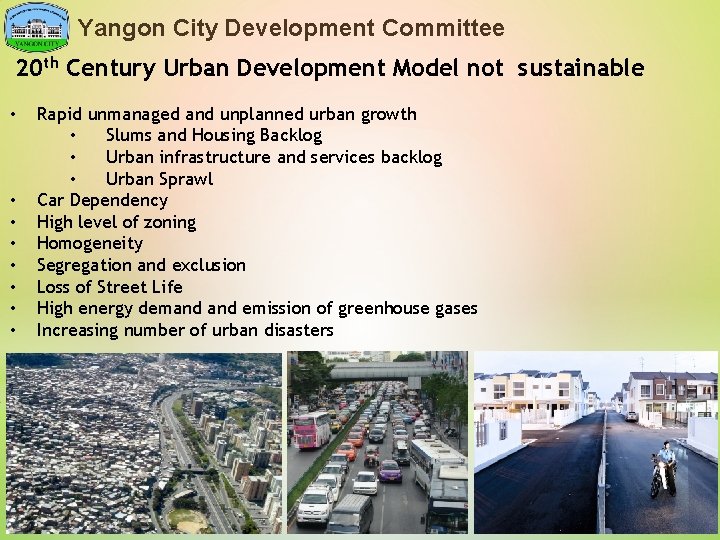
Yangon City Development Committee 20 th Century Urban Development Model not sustainable • • Rapid unmanaged and unplanned urban growth • Slums and Housing Backlog • Urban infrastructure and services backlog • Urban Sprawl Car Dependency High level of zoning Homogeneity Segregation and exclusion Loss of Street Life High energy demand emission of greenhouse gases Increasing number of urban disasters 18
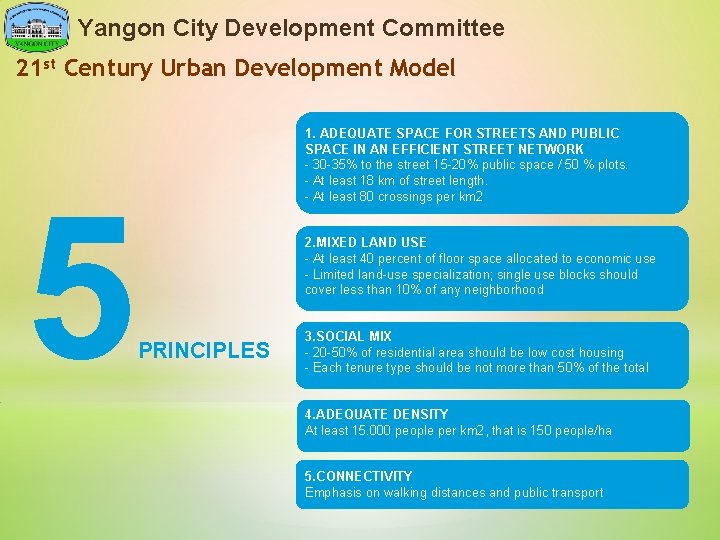
Yangon City Development Committee 21 st Century Urban Development Model 5 1. ADEQUATE SPACE FOR STREETS AND PUBLIC SPACE IN AN EFFICIENT STREET NETWORK - 30 -35% to the street 15 -20% public space / 50 % plots. - At least 18 km of street length. - At least 80 crossings per km 2 2. MIXED LAND USE - At least 40 percent of floor space allocated to economic use - Limited land-use specialization; single use blocks should cover less than 10% of any neighborhood PRINCIPLES 3. SOCIAL MIX - 20 -50% of residential area should be low cost housing - Each tenure type should be not more than 50% of the total 4. ADEQUATE DENSITY At least 15. 000 people per km 2, that is 150 people/ha 5. CONNECTIVITY Emphasis on walking distances and public transport
Yangon City Development Committee * Ecological cities enable their residents to live a good quality of life while using minimal natural resources. They do so by: Ø using local materials, and local energy, air and water flows (sunlight, wind and rain) to best advantage. Ø incorporating natural ecosystems into urban areas, to host local wildlife, and to enhance the experience of urban public spaces. Ø using vegetation to control urban microclimates – to stabilise temperature and humidity. Ø enhancing the life of the community and relationships between people, by creating convivial social environments. Ø supporting an innovative culture which enables people to flourish and develop their creative potential, and use new technologies to improve liveability.
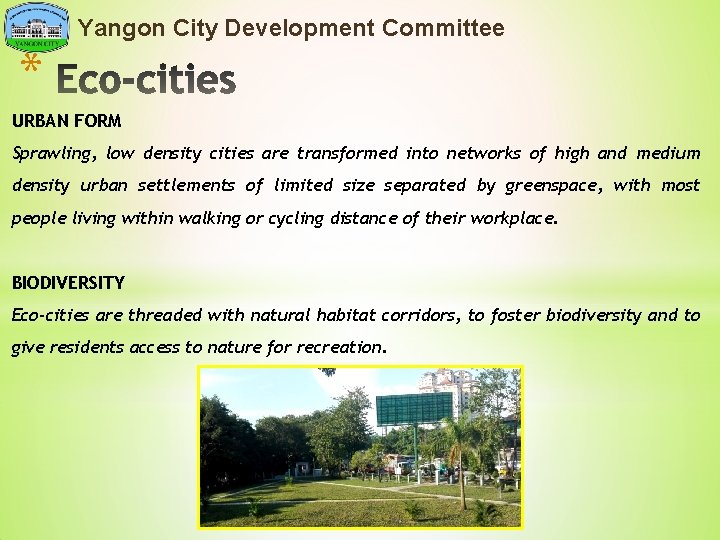
Yangon City Development Committee * URBAN FORM Sprawling, low density cities are transformed into networks of high and medium density urban settlements of limited size separated by greenspace, with most people living within walking or cycling distance of their workplace. BIODIVERSITY Eco-cities are threaded with natural habitat corridors, to foster biodiversity and to give residents access to nature for recreation.
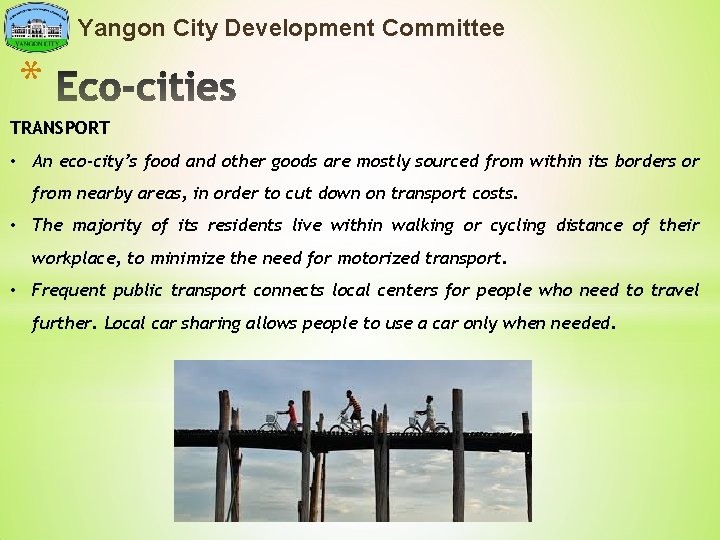
Yangon City Development Committee * TRANSPORT • An eco-city’s food and other goods are mostly sourced from within its borders or from nearby areas, in order to cut down on transport costs. • The majority of its residents live within walking or cycling distance of their workplace, to minimize the need for motorized transport. • Frequent public transport connects local centers for people who need to travel further. Local car sharing allows people to use a car only when needed.
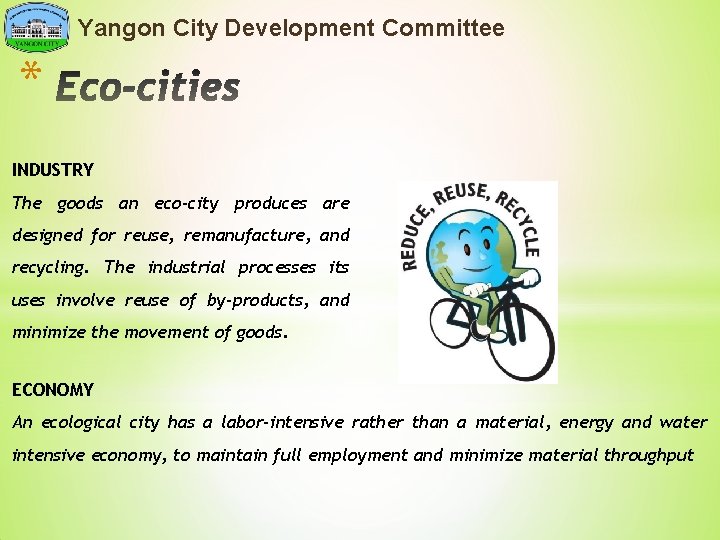
Yangon City Development Committee * INDUSTRY The goods an eco-city produces are designed for reuse, remanufacture, and recycling. The industrial processes its uses involve reuse of by-products, and minimize the movement of goods. ECONOMY An ecological city has a labor-intensive rather than a material, energy and water intensive economy, to maintain full employment and minimize material throughput
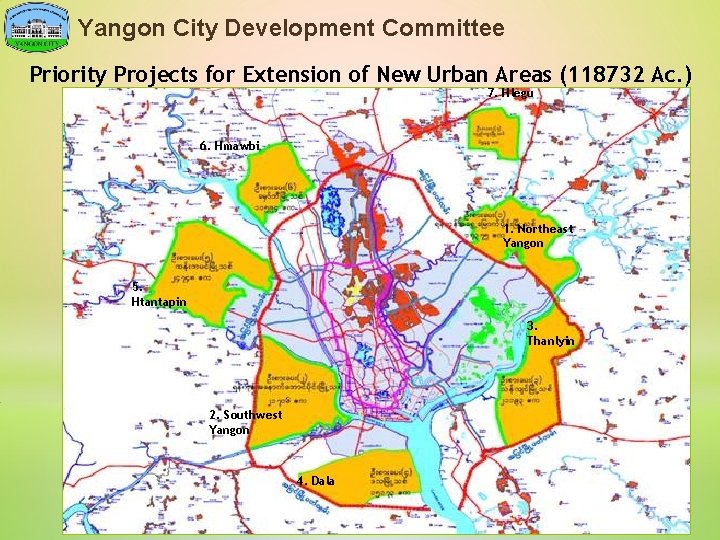
Yangon City Development Committee Priority Projects for Extension of New Urban Areas (118732 Ac. ) 7. Hlegu 6. Hmawbi 1. Northeast Yangon 5. Htantapin 3. Thanlyin 2. Southwest Yangon 4. Dala 24 24
Yangon City Development Committee toeaungteza 16@gmail. com