
Yangcheng Wellbeing Hotel Eco Sustainable Resort for Chinas
Yangcheng Wellbeing Hotel & Eco Sustainable Resort for China’s Development Growth A Green Strategy for a Sustainable future …spreading earth respect, investing in green integrated development ….
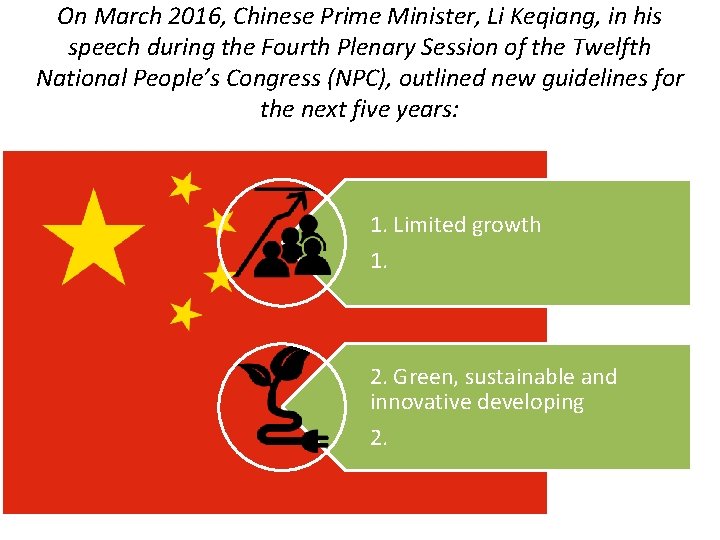
On March 2016, Chinese Prime Minister, Li Keqiang, in his speech during the Fourth Plenary Session of the Twelfth National People’s Congress (NPC), outlined new guidelines for the next five years: 1. Limited growth 1. 2. Green, sustainable and innovative developing 2.
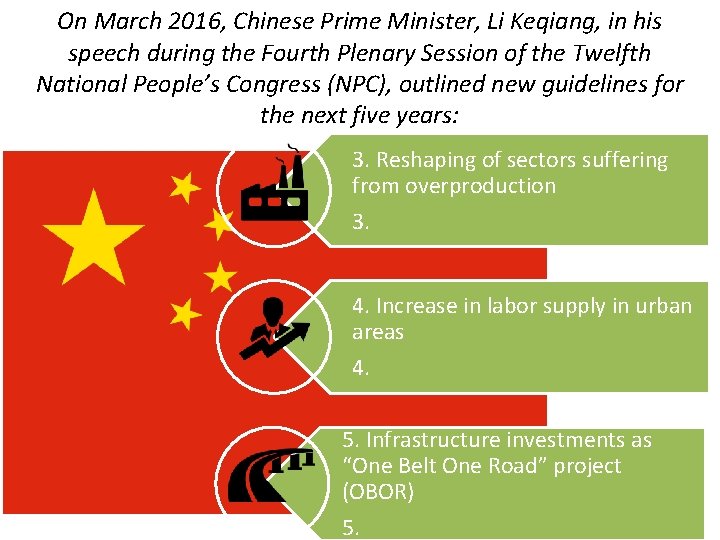
On March 2016, Chinese Prime Minister, Li Keqiang, in his speech during the Fourth Plenary Session of the Twelfth National People’s Congress (NPC), outlined new guidelines for the next five years: 3. Reshaping of sectors suffering from overproduction 3. 4. Increase in labor supply in urban areas 4. 5. Infrastructure investments as “One Belt One Road” project (OBOR) 5.
1. 2 HISTORICAL KNOWLEDGE OF CHINA’S ANCIENT PHILOSOPHY Chinese philosophy begun thousands of years ago representing one of the longest continous intellectual thoughts on men and nature. MAIN TOPICS ONTOLOGY EPISTEMOLOGY MORAL THEORY POLITICAL PHILOSOPHY
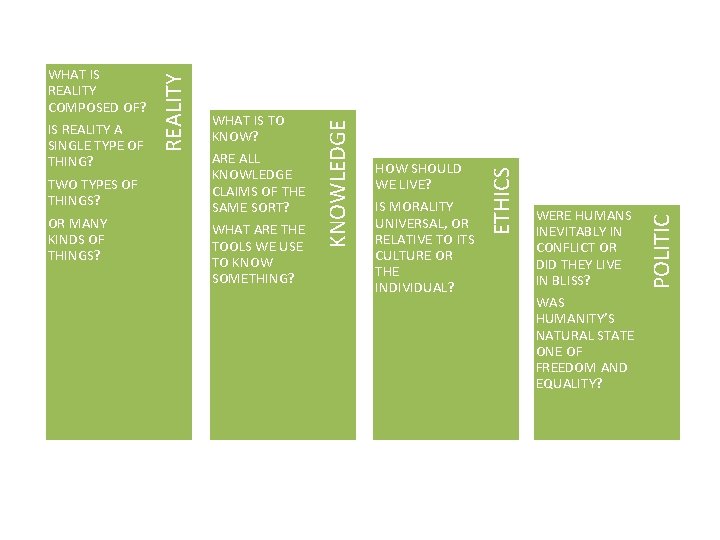
WERE HUMANS INEVITABLY IN CONFLICT OR DID THEY LIVE IN BLISS? WAS HUMANITY’S NATURAL STATE ONE OF FREEDOM AND EQUALITY? POLITIC WHAT ARE THE TOOLS WE USE TO KNOW SOMETHING? HOW SHOULD WE LIVE? IS MORALITY UNIVERSAL, OR RELATIVE TO ITS CULTURE OR THE INDIVIDUAL? ETHICS WHAT IS TO KNOW? ARE ALL KNOWLEDGE CLAIMS OF THE SAME SORT? KNOWLEDGE TWO TYPES OF THINGS? OR MANY KINDS OF THINGS? REALITY WHAT IS REALITY COMPOSED OF? IS REALITY A SINGLE TYPE OF THING?
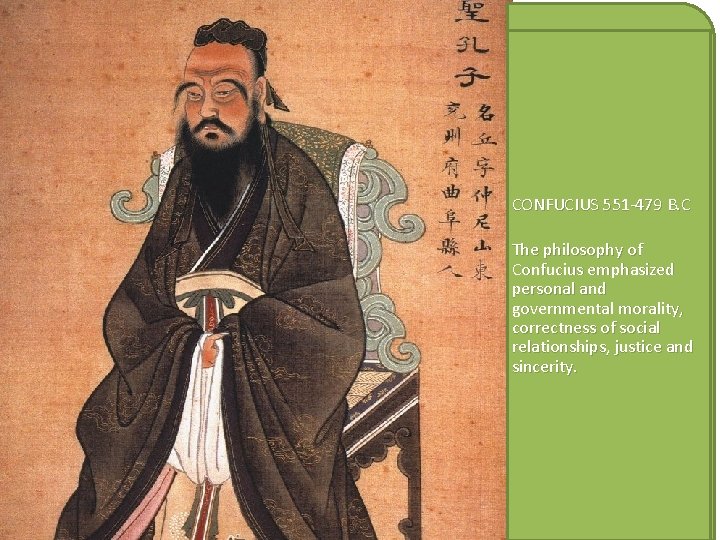
CONFUCIUS 551 -479 B. C The philosophy of Confucius emphasized personal and governmental morality, correctness of social relationships, justice and sincerity.
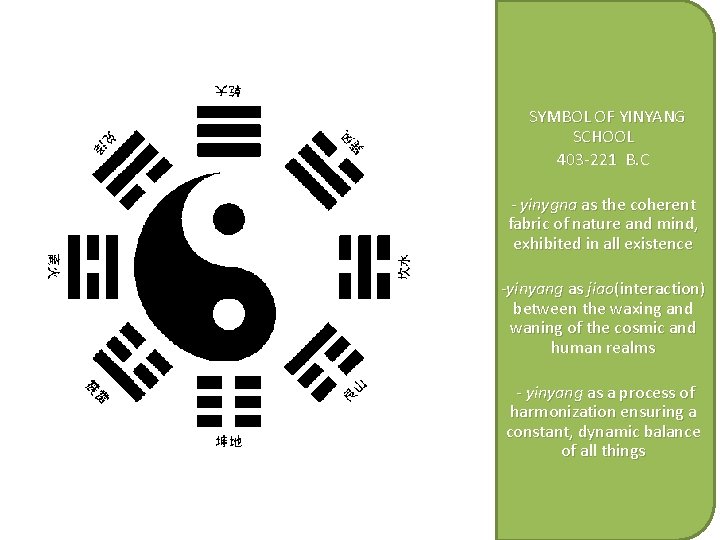
SYMBOL OF YINYANG SCHOOL 403 -221 B. C - yinygna as the coherent fabric of nature and mind, exhibited in all existence -yinyang as jiao(interaction) between the waxing and waning of the cosmic and human realms - yinyang as a process of harmonization ensuring a constant, dynamic balance of all things
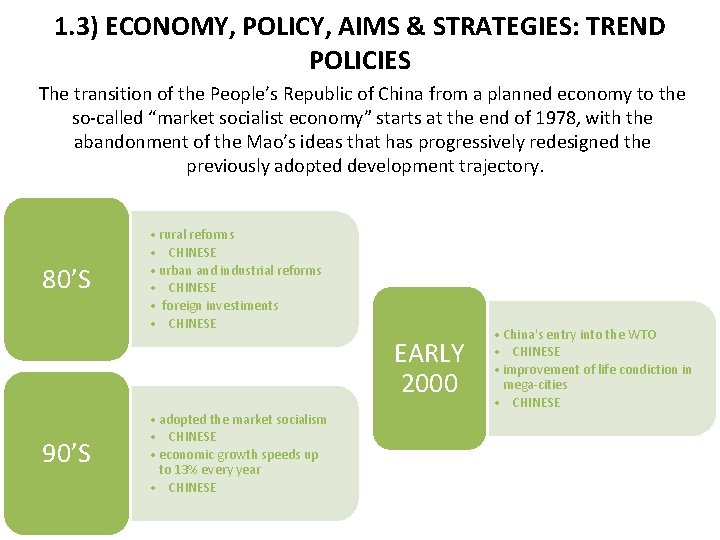
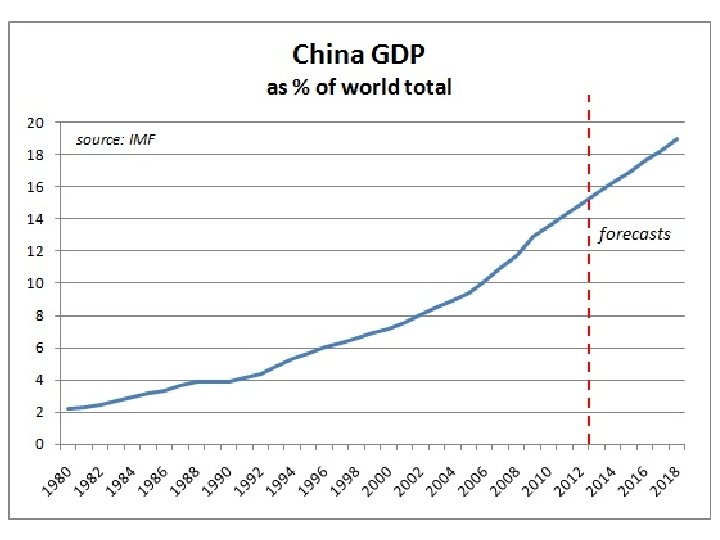
1. 3) ECONOMY, POLICY, AIMS & STRATEGIES: TREND POLICIES The transition of the People’s Republic of China from a planned economy to the so-called “market socialist economy” starts at the end of 1978, with the abandonment of the Mao’s ideas that has progressively redesigned the previously adopted development trajectory. 80’S • rural reforms • CHINESE • urban and industrial reforms • CHINESE • foreign investiments • CHINESE EARLY 2000 90’S • adopted the market socialism • CHINESE • economic growth speeds up to 13% every year • CHINESE • China's entry into the WTO • CHINESE • improvement of life condiction in mega-cities • CHINESE
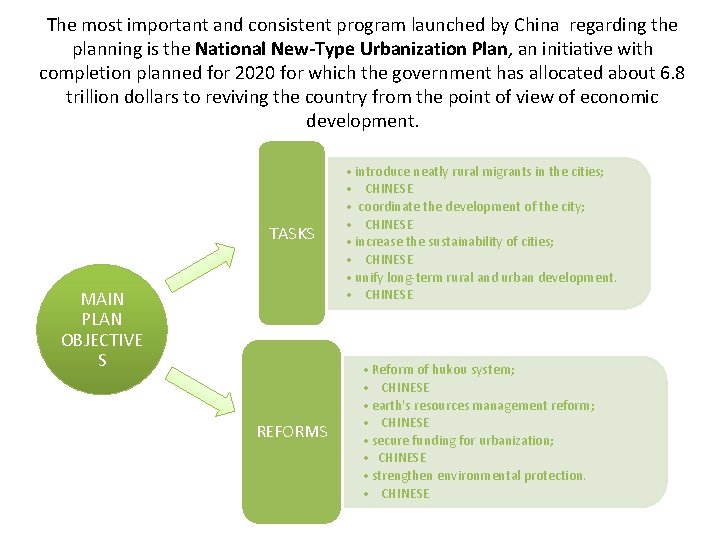
The most important and consistent program launched by China regarding the planning is the National New-Type Urbanization Plan, an initiative with completion planned for 2020 for which the government has allocated about 6. 8 trillion dollars to reviving the country from the point of view of economic development. TASKS • introduce neatly rural migrants in the cities; • CHINESE • coordinate the development of the city; • CHINESE • increase the sustainability of cities; • CHINESE • unify long-term rural and urban development. • CHINESE REFORMS • Reform of hukou system; • CHINESE • earth's resources management reform; • CHINESE • secure funding for urbanization; • CHINESE • strengthen environmental protection. • CHINESE MAIN PLAN OBJECTIVE S
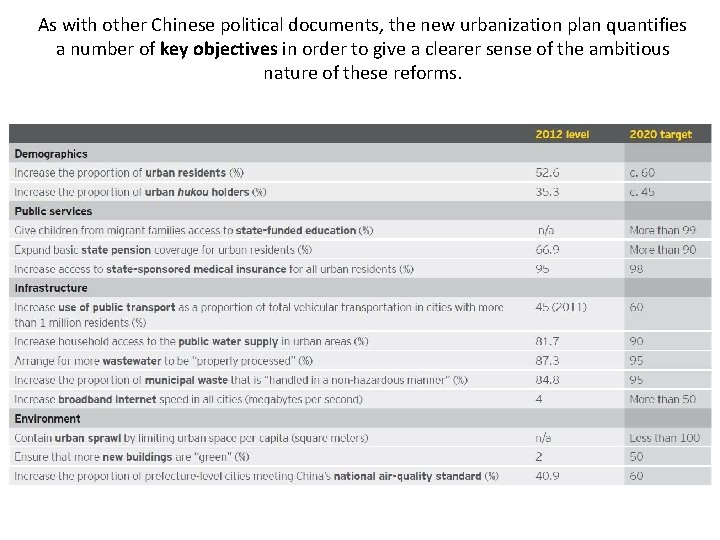
As with other Chinese political documents, the new urbanization plan quantifies a number of key objectives in order to give a clearer sense of the ambitious nature of these reforms.
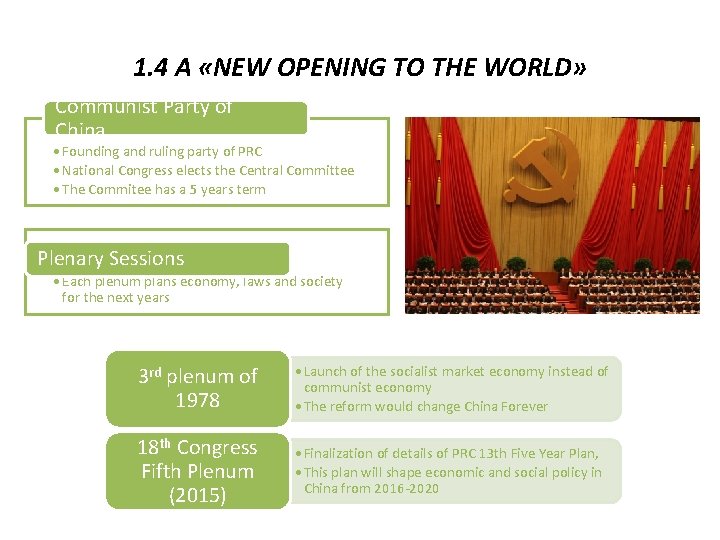
1. 4 A «NEW OPENING TO THE WORLD» Communist Party of China • Founding and ruling party of PRC • National Congress elects the Central Committee • The Commitee has a 5 years term Plenary Sessions • 7 sessions during each 5 years term • Each plenum plans economy, laws and society for the next years 3 rd plenum of 1978 • Launch of the socialist market economy instead of communist economy • The reform would change China Forever 18 th Congress Fifth Plenum (2015) • Finalization of details of PRC 13 th Five Year Plan, • This plan will shape economic and social policy in China from 2016 -2020
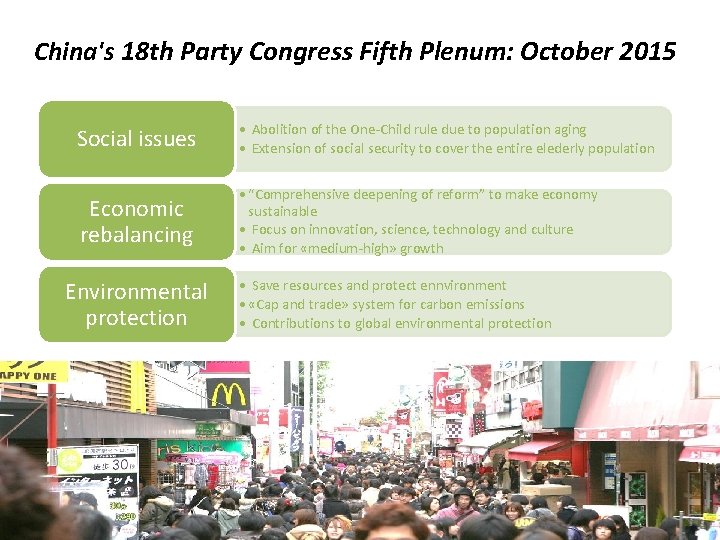
China's 18 th Party Congress Fifth Plenum: October 2015 Social issues • Abolition of the One-Child rule due to population aging • Extension of social security to cover the entire elederly population Economic rebalancing • “Comprehensive deepening of reform” to make economy sustainable • Focus on innovation, science, technology and culture • Aim for «medium-high» growth Environmental protection • Save resources and protect ennvironment • «Cap and trade» system for carbon emissions • Contributions to global environmental protection
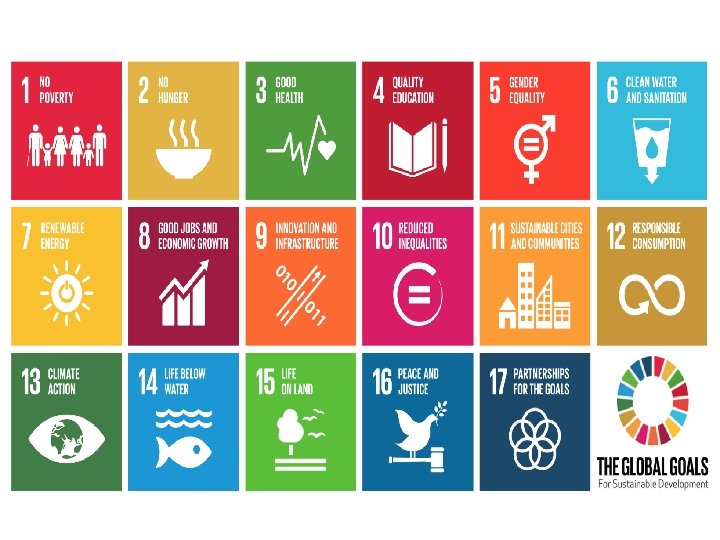
SDGs: the 2030 Agenda for Sustainable Development SUSTAINABLE DEVELOPMENT GOALS • Adopted at the UN Sustainable Development Summit in September 2015 • Set of aspiration Goals: 17 goals and 169 targets for the next 15 years • 5 «Areas of critical importance» : PEOPLE, PLANET, PROSPERITY, PEACE, PARTNERSHIP
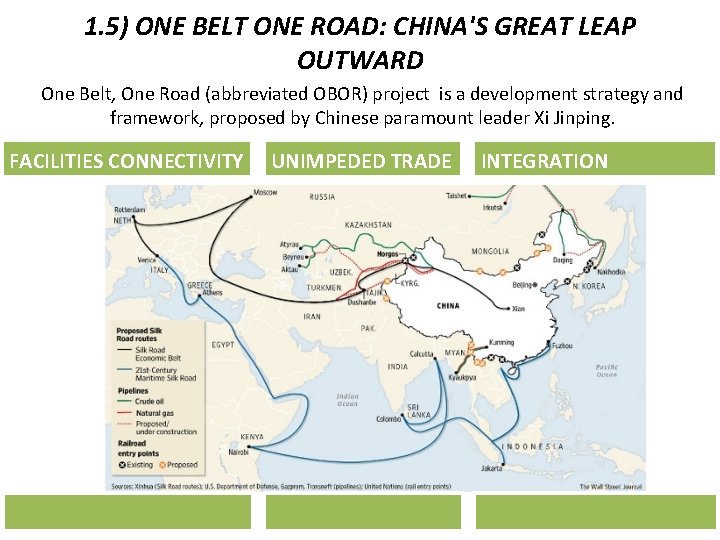
1. 5) ONE BELT ONE ROAD: CHINA'S GREAT LEAP OUTWARD One Belt, One Road (abbreviated OBOR) project is a development strategy and framework, proposed by Chinese paramount leader Xi Jinping. FACILITIES CONNECTIVITY UNIMPEDED TRADE FINANCIAL INTEGRATION
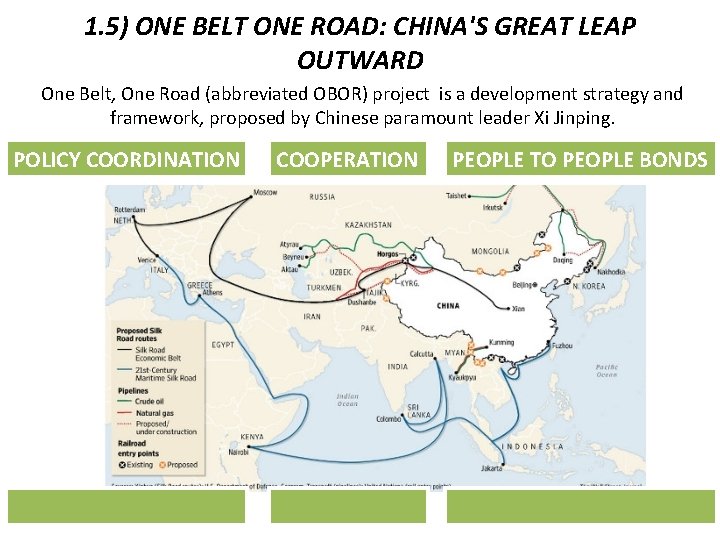
1. 5) ONE BELT ONE ROAD: CHINA'S GREAT LEAP OUTWARD One Belt, One Road (abbreviated OBOR) project is a development strategy and framework, proposed by Chinese paramount leader Xi Jinping. POLICY COORDINATION COOPERATION PEOPLE TO PEOPLE BONDS
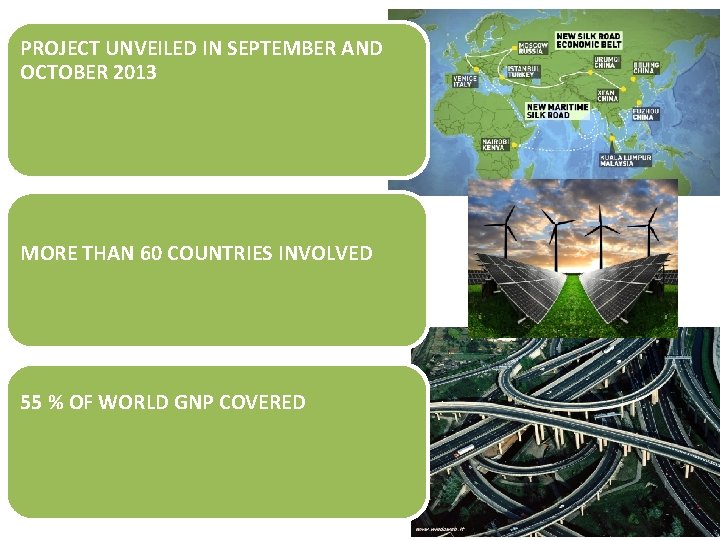
PROJECT UNVEILED IN SEPTEMBER AND OCTOBER 2013 MORE THAN 60 COUNTRIES INVOLVED 55 % OF WORLD GNP COVERED
70 % OF GLOBAL POPULATION INCLUDED 75 %OF KNOWN ENERGY INVOLVED $300 BILLION IN INFRASTRUCTURE FINANCING FROM CHINA REACHING COMPLETION IN TIME FOR 2049
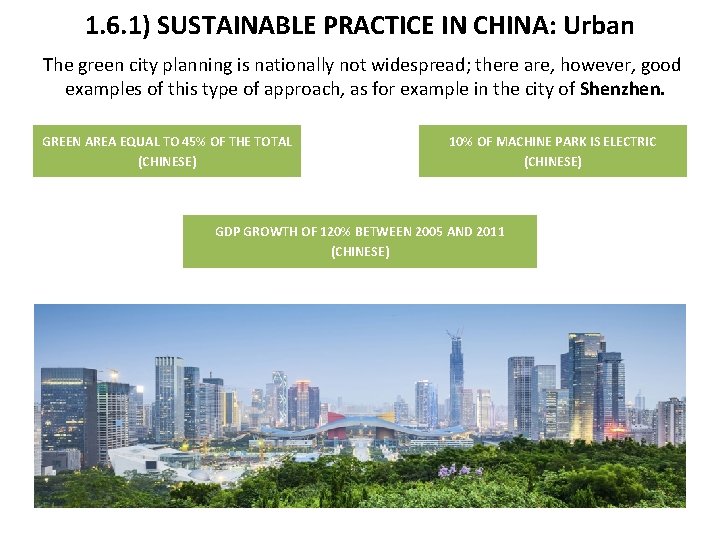
1. 6. 1) SUSTAINABLE PRACTICE IN CHINA: Urban The green city planning is nationally not widespread; there are, however, good examples of this type of approach, as for example in the city of Shenzhen. GREEN AREA EQUAL TO 45% OF THE TOTAL (CHINESE) 10% OF MACHINE PARK IS ELECTRIC (CHINESE) GDP GROWTH OF 120% BETWEEN 2005 AND 2011 (CHINESE)
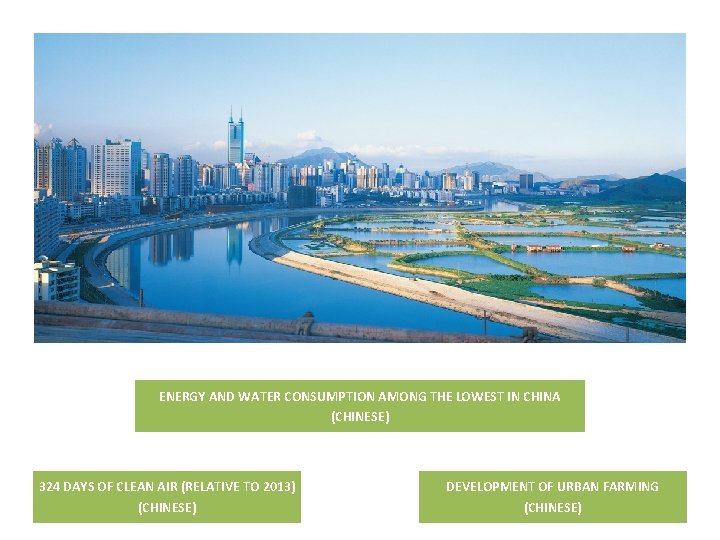
ENERGY AND WATER CONSUMPTION AMONG THE LOWEST IN CHINA (CHINESE) 324 DAYS OF CLEAN AIR (RELATIVE TO 2013) (CHINESE) DEVELOPMENT OF URBAN FARMING (CHINESE)
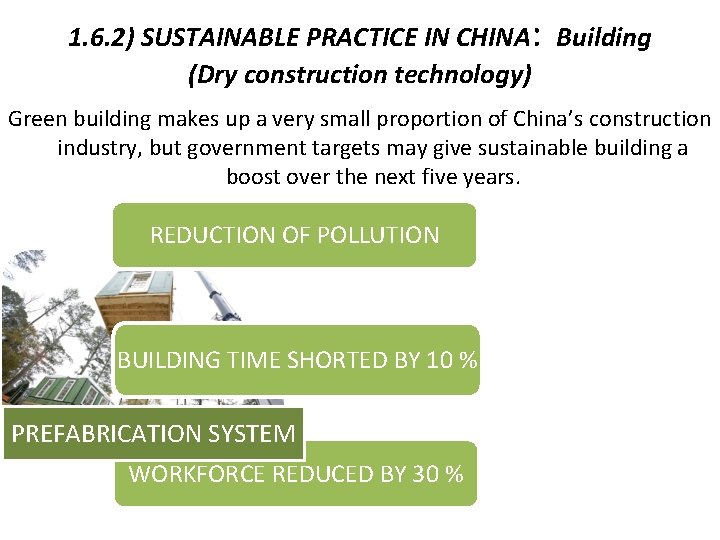
1. 6. 2) SUSTAINABLE PRACTICE IN CHINA: Building (Dry construction technology) Green building makes up a very small proportion of China’s construction industry, but government targets may give sustainable building a boost over the next five years. REDUCTION OF POLLUTION BUILDING TIME SHORTED BY 10 % PREFABRICATION SYSTEM WORKFORCE REDUCED BY 30 %
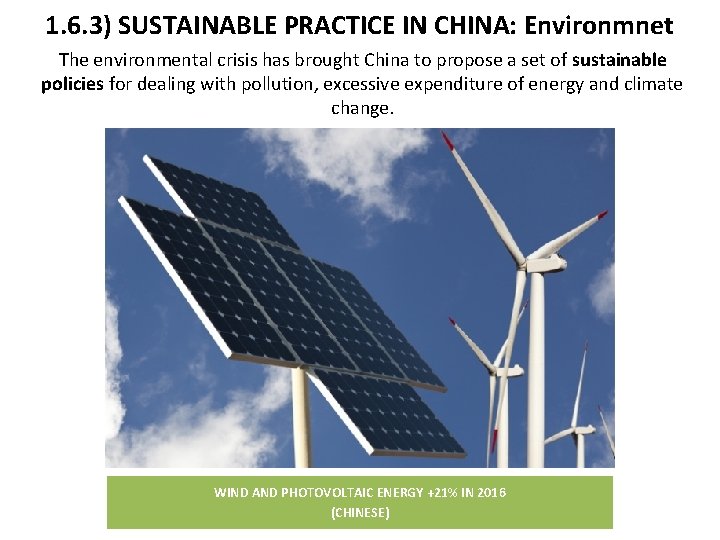
1. 6. 3) SUSTAINABLE PRACTICE IN CHINA: Environmnet The environmental crisis has brought China to propose a set of sustainable policies for dealing with pollution, excessive expenditure of energy and climate change. WIND AND PHOTOVOLTAIC ENERGY +21% IN 2016 (CHINESE)
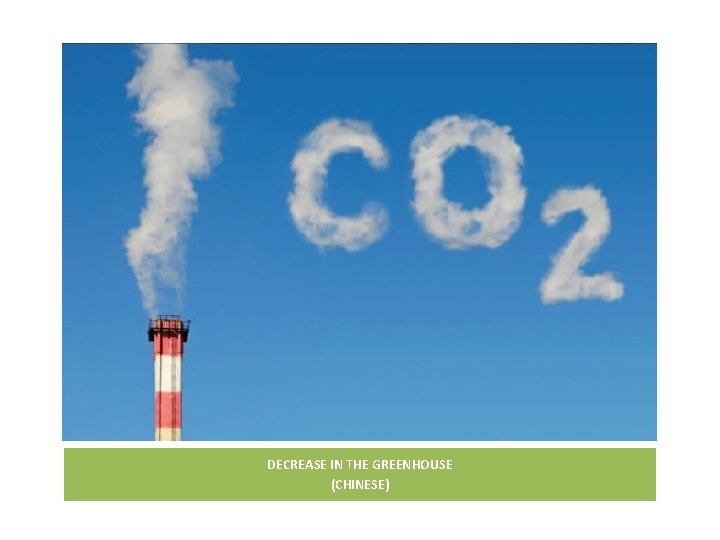
DECREASE IN THE GREENHOUSE (CHINESE)
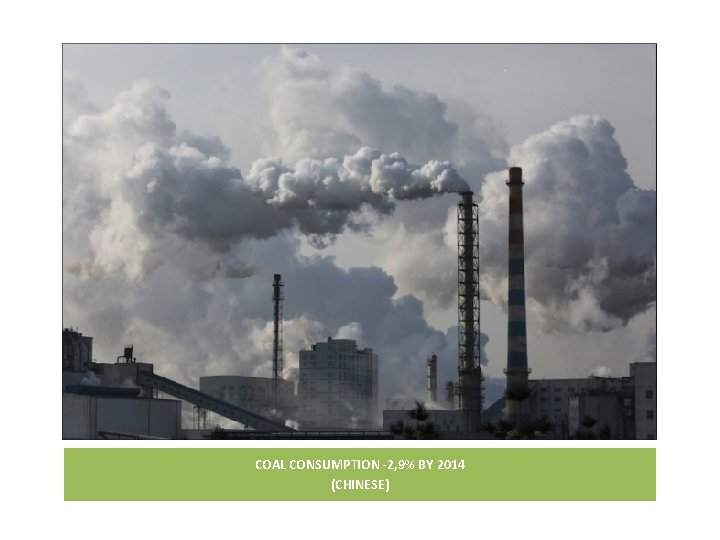
COAL CONSUMPTION -2, 9% BY 2014 (CHINESE)
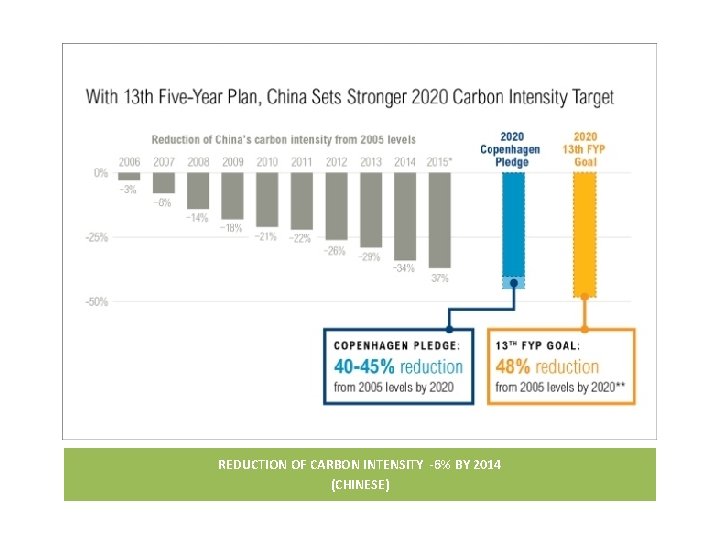
REDUCTION OF CARBON INTENSITY -6% BY 2014 (CHINESE)
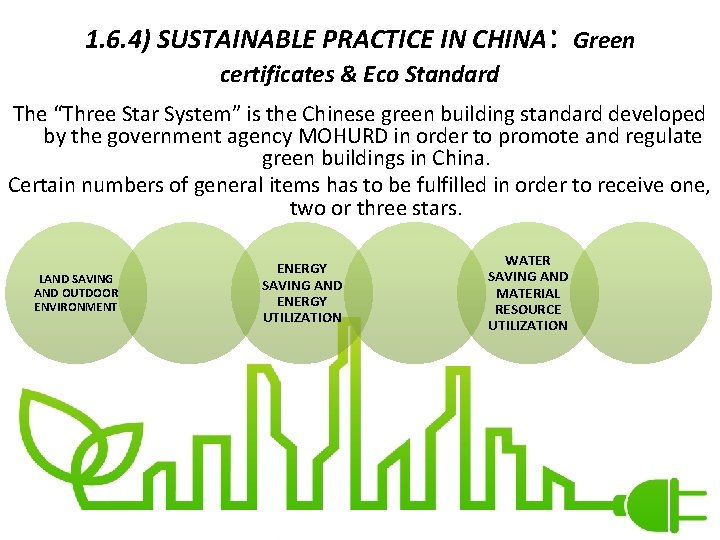
1. 6. 4) SUSTAINABLE PRACTICE IN CHINA: Green certificates & Eco Standard The “Three Star System” is the Chinese green building standard developed by the government agency MOHURD in order to promote and regulate green buildings in China. Certain numbers of general items has to be fulfilled in order to receive one, two or three stars. LAND SAVING AND OUTDOOR ENVIRONMENT ENERGY SAVING AND ENERGY UTILIZATION WATER SAVING AND MATERIAL RESOURCE UTILIZATION
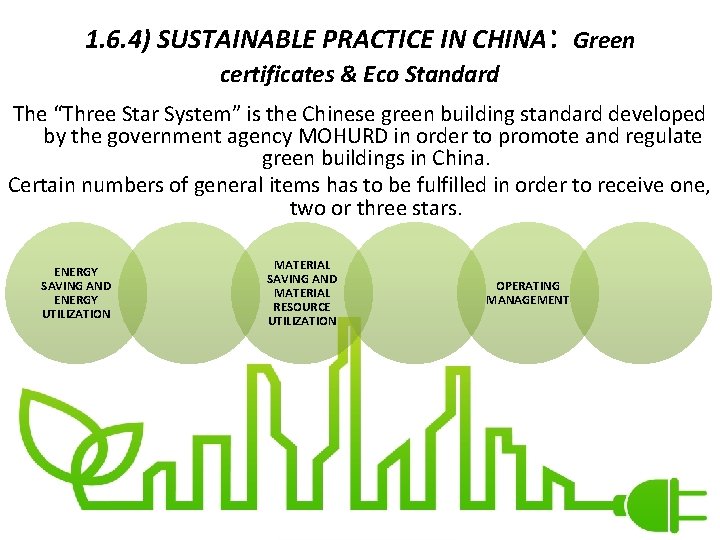
1. 6. 4) SUSTAINABLE PRACTICE IN CHINA: Green certificates & Eco Standard The “Three Star System” is the Chinese green building standard developed by the government agency MOHURD in order to promote and regulate green buildings in China. Certain numbers of general items has to be fulfilled in order to receive one, two or three stars. ENERGY SAVING AND ENERGY UTILIZATION MATERIAL SAVING AND MATERIAL RESOURCE UTILIZATION OPERATING MANAGEMENT
1. 7 TRENDS IN WELLNESS TOURISM PERSPECTIVES & WORLD DATA

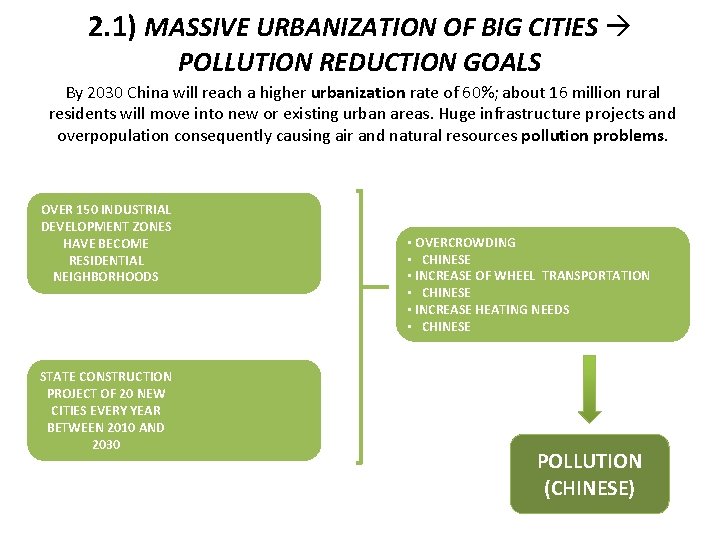
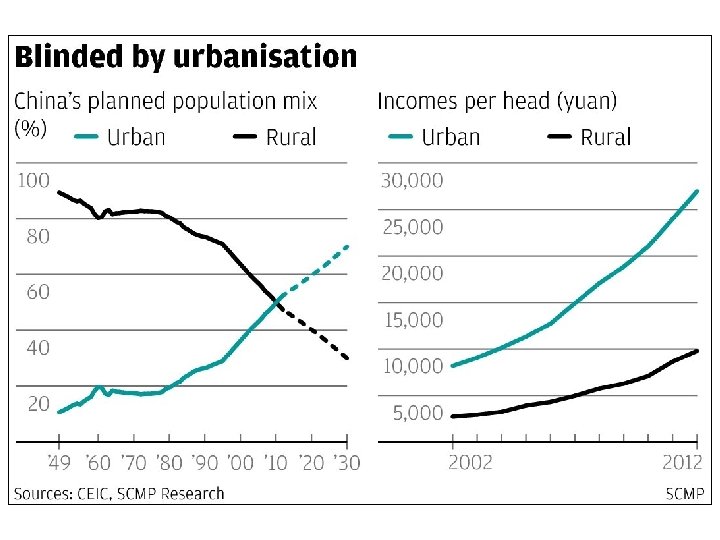
2. 1) MASSIVE URBANIZATION OF BIG CITIES POLLUTION REDUCTION GOALS By 2030 China will reach a higher urbanization rate of 60%; about 16 million rural residents will move into new or existing urban areas. Huge infrastructure projects and overpopulation consequently causing air and natural resources pollution problems. OVER 150 INDUSTRIAL DEVELOPMENT ZONES HAVE BECOME RESIDENTIAL NEIGHBORHOODS STATE CONSTRUCTION PROJECT OF 20 NEW CITIES EVERY YEAR BETWEEN 2010 AND 2030 • OVERCROWDING • CHINESE • INCREASE OF WHEEL TRANSPORTATION • CHINESE • INCREASE HEATING NEEDS • CHINESE POLLUTION (CHINESE)
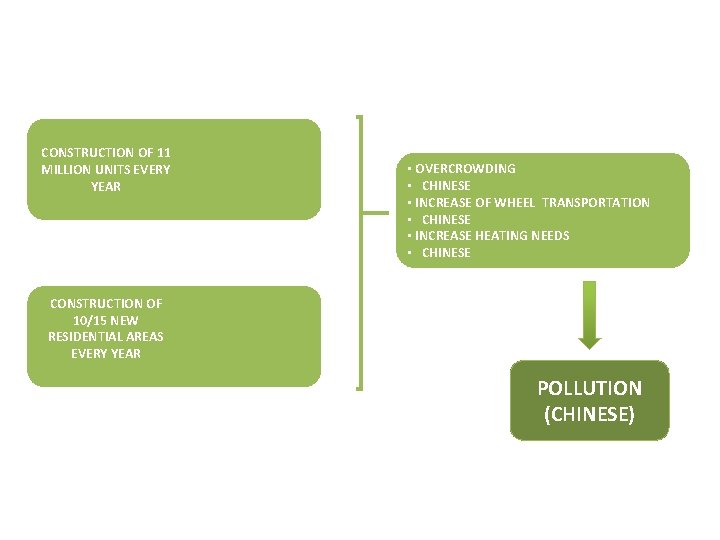
CONSTRUCTION OF 11 MILLION UNITS EVERY YEAR • OVERCROWDING • CHINESE • INCREASE OF WHEEL TRANSPORTATION • CHINESE • INCREASE HEATING NEEDS • CHINESE CONSTRUCTION OF 10/15 NEW RESIDENTIAL AREAS EVERY YEAR POLLUTION (CHINESE)
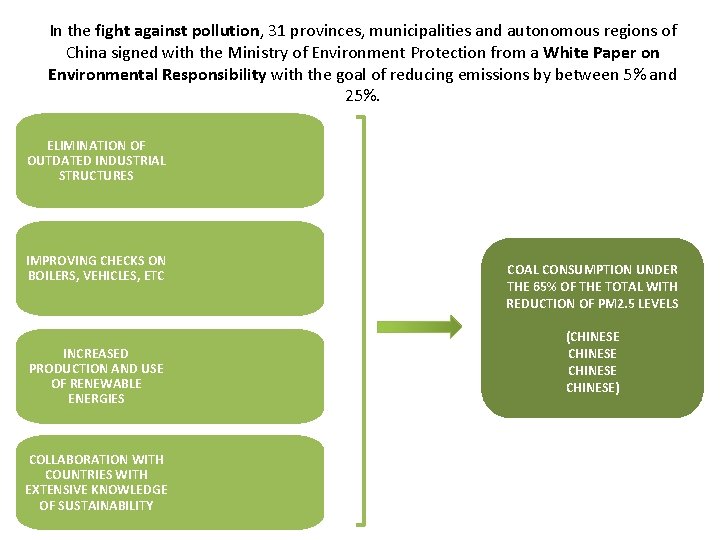
In the fight against pollution, 31 provinces, municipalities and autonomous regions of China signed with the Ministry of Environment Protection from a White Paper on Environmental Responsibility with the goal of reducing emissions by between 5% and 25%. ELIMINATION OF OUTDATED INDUSTRIAL STRUCTURES IMPROVING CHECKS ON BOILERS, VEHICLES, ETC INCREASED PRODUCTION AND USE OF RENEWABLE ENERGIES COLLABORATION WITH COUNTRIES WITH EXTENSIVE KNOWLEDGE OF SUSTAINABILITY COAL CONSUMPTION UNDER THE 65% OF THE TOTAL WITH REDUCTION OF PM 2. 5 LEVELS (CHINESE CHINESE)
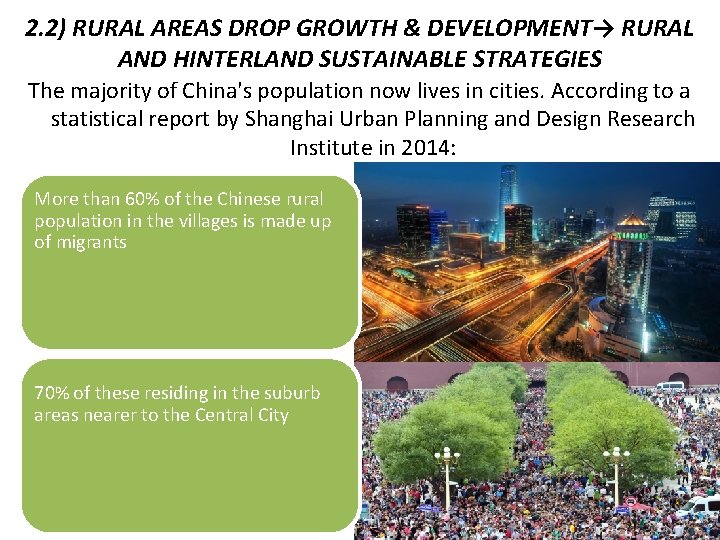
2. 2) RURAL AREAS DROP GROWTH & DEVELOPMENT→ RURAL AND HINTERLAND SUSTAINABLE STRATEGIES The majority of China's population now lives in cities. According to a statistical report by Shanghai Urban Planning and Design Research Institute in 2014: More than 60% of the Chinese rural population in the villages is made up of migrants 70% of these residing in the suburb areas nearer to the Central City
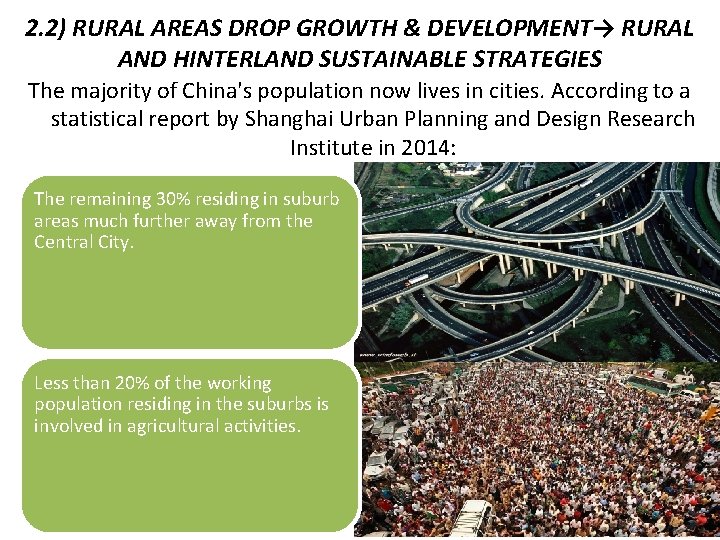
2. 2) RURAL AREAS DROP GROWTH & DEVELOPMENT→ RURAL AND HINTERLAND SUSTAINABLE STRATEGIES The majority of China's population now lives in cities. According to a statistical report by Shanghai Urban Planning and Design Research Institute in 2014: The remaining 30% residing in suburb areas much further away from the Central City. Less than 20% of the working population residing in the suburbs is involved in agricultural activities.
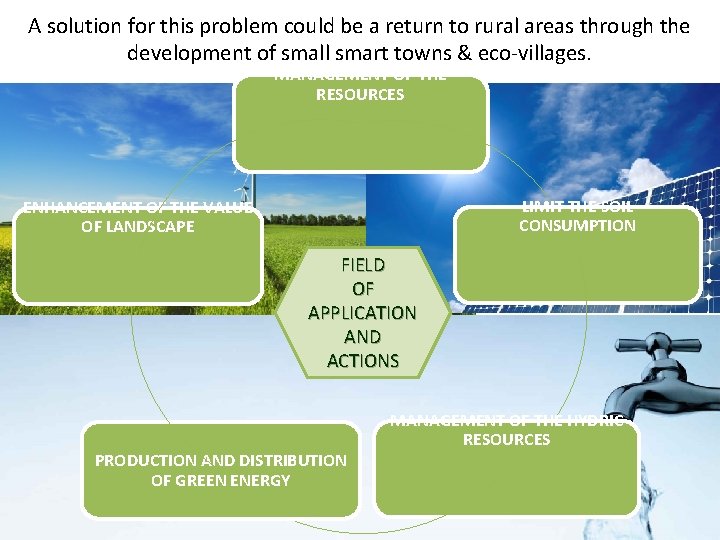
A solution for this problem could be a return to rural areas through the development of small smart towns & eco-villages. MANAGEMENT OF THE RESOURCES LIMIT THE SOIL CONSUMPTION ENHANCEMENT OF THE VALUE OF LANDSCAPE FIELD OF APPLICATION AND ACTIONS PRODUCTION AND DISTRIBUTION OF GREEN ENERGY MANAGEMENT OF THE HYDRIC RESOURCES
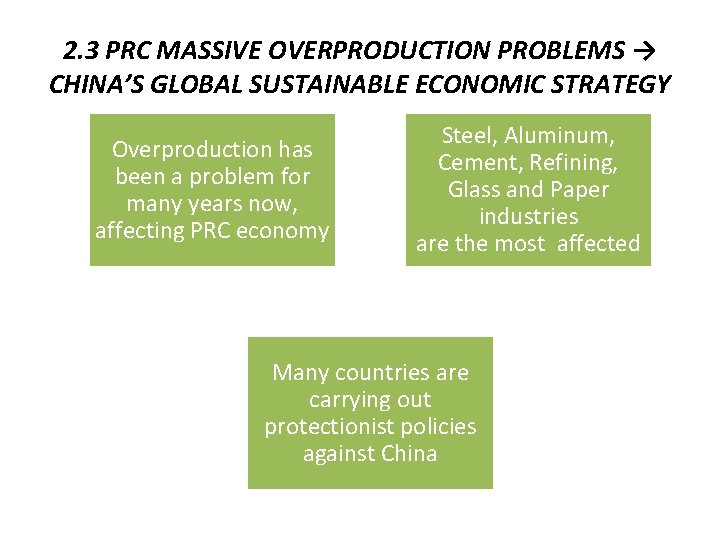
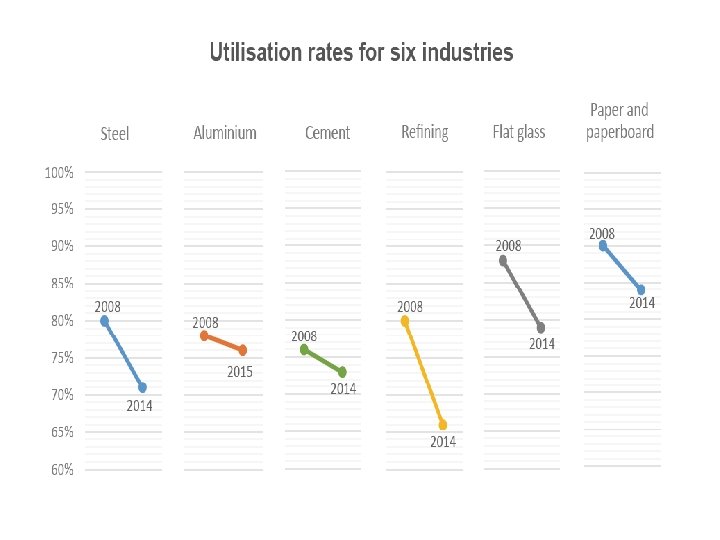
2. 3 PRC MASSIVE OVERPRODUCTION PROBLEMS → CHINA’S GLOBAL SUSTAINABLE ECONOMIC STRATEGY Overproduction has been a problem for many years now, affecting PRC economy Steel, Aluminum, Cement, Refining, Glass and Paper industries are the most affected Many countries are carrying out protectionist policies against China
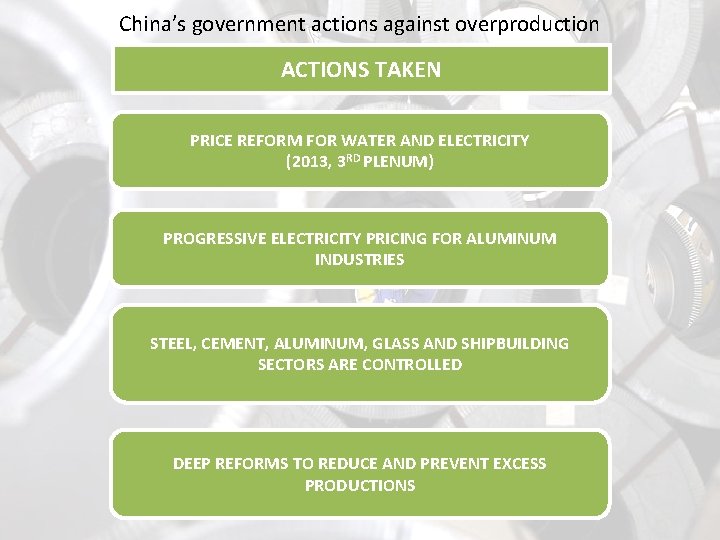
China’s government actions against overproduction ACTIONS TAKEN PRICE REFORM FOR WATER AND ELECTRICITY (2013, 3 RD PLENUM) PROGRESSIVE ELECTRICITY PRICING FOR ALUMINUM INDUSTRIES STEEL, CEMENT, ALUMINUM, GLASS AND SHIPBUILDING SECTORS ARE CONTROLLED DEEP REFORMS TO REDUCE AND PREVENT EXCESS PRODUCTIONS
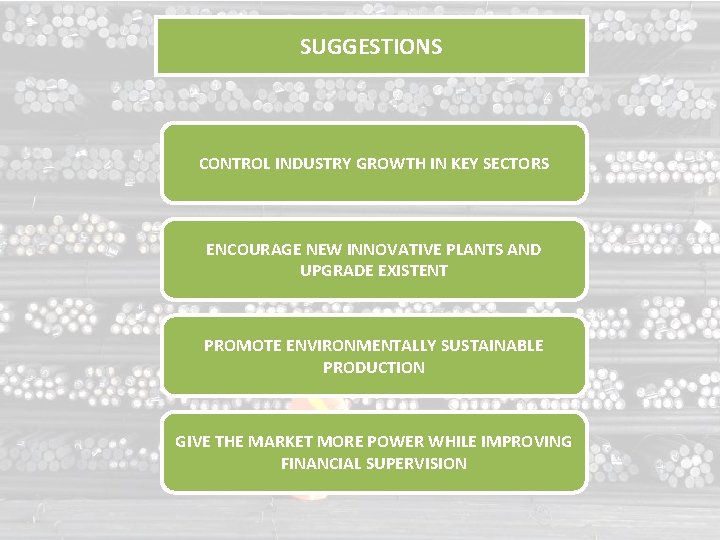
SUGGESTIONS CONTROL INDUSTRY GROWTH IN KEY SECTORS ENCOURAGE NEW INNOVATIVE PLANTS AND UPGRADE EXISTENT PROMOTE ENVIRONMENTALLY SUSTAINABLE PRODUCTION GIVE THE MARKET MORE POWER WHILE IMPROVING FINANCIAL SUPERVISION
- Slides: 42