
YANBU UNIVERSITY COLLEGE Management Science Department MGT 214
YANBU UNIVERSITY COLLEGE Management Science Department MGT 214 OPERATIONS MANAGEMENT CHAPTER 06 Layout Decisions Prepared by: Ms. Dalal Bamufleh © Yanbu University College
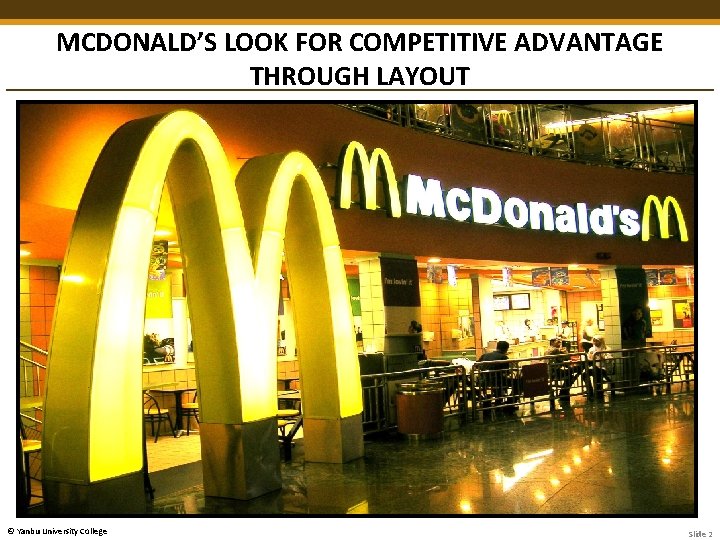
MCDONALD’S LOOK FOR COMPETITIVE ADVANTAGE THROUGH LAYOUT © Yanbu University College Slide 2
MCDONALD’S LOOK FOR COMPETITIVE ADVANTAGE THROUGH LAYOUT 1. 2. 3. 4. 5. 6. 7. Indoor seating (1950 s) Drive-through window (1970 s) Adding breakfast to the menu (1980 s) Adding play areas (late 1980 s) Redesign of the kitchens (1990 s) Self-service kiosk (2004) 21 st Century look: 3 dining sections © Yanbu University College Slide 3
MCDONALD’S LOOK FOR COMPETITIVE ADVANTAGE THROUGH LAYOUT • Three separate dining areas o Linger zone with comfortable chairs and Wi-Fi connections o Grab and go zone with tall counters and with bar stools. o Flexible zone for kids and families with colorful and movable furniture • Facility layout is a source of competitive advantage (CSF) © Yanbu University College Slide 4

Strategic Importance of Layout Decisions • The objective of layout strategy is to develop an effective and efficient layout that will meet the firm’s competitive needs and requirements. • An effective layout can help an organization achieve a strategy that support differentiation, low cost or response. © Yanbu University College Slide 5
Strategic Importance of Layout Decisions • Layout Design Considerations: o Higher utilization of space, equipment, and people o Improved flow of information, materials, or people o Improved employee morale and safer working conditions o Improved customer/client interaction o Flexibility • Layout designs needs to be viewed as dynamic © Yanbu University College Slide 6
Types of Layout 1. Office layout 2. Retail layout 3. Warehouse layout 4. Fixed-position layout 5. Process-oriented layout 6. Work-cell layout 7. Product-oriented layout © Yanbu University College Slide 7
Types of Layout • Good layouts requires determining the following: 1. Material handling equipment 2. Capacity and space requirements 3. Environment and aesthetics 4. Flows of information 5. Cost of moving between various work areas © Yanbu University College Slide 8
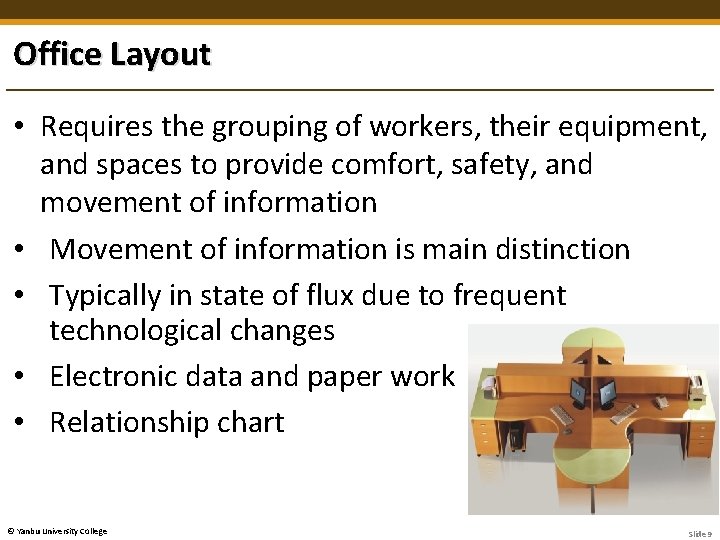
Office Layout • Requires the grouping of workers, their equipment, and spaces to provide comfort, safety, and movement of information • Movement of information is main distinction • Typically in state of flux due to frequent technological changes • Electronic data and paper work • Relationship chart © Yanbu University College Slide 9
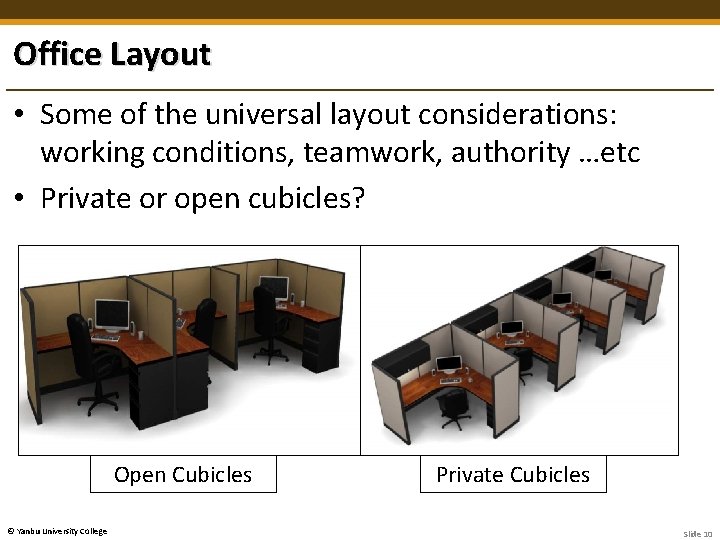
Office Layout • Some of the universal layout considerations: working conditions, teamwork, authority …etc • Private or open cubicles? Open Cubicles © Yanbu University College Private Cubicles Slide 10
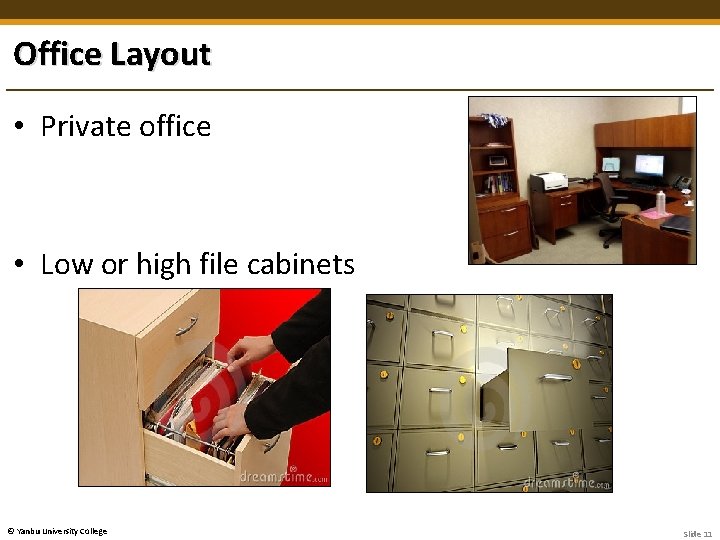
Office Layout • Private office • Low or high file cabinets © Yanbu University College Slide 11
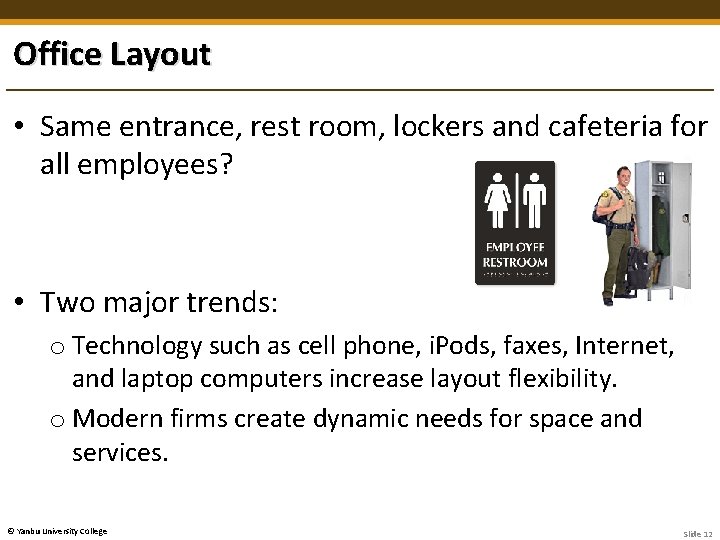
Office Layout • Same entrance, rest room, lockers and cafeteria for all employees? • Two major trends: o Technology such as cell phone, i. Pods, faxes, Internet, and laptop computers increase layout flexibility. o Modern firms create dynamic needs for space and services. © Yanbu University College Slide 12
Retail Layout • Objective is to maximize profitability per square foot of floor space • Sales and profitability vary directly with customer exposure • OM try to expose customers to as many products as possible • �rate of exposure, �sales and �return on investment • How to change exposure? © Yanbu University College Slide 13
Retail Layout Five Helpful Ideas for Supermarket Layout: 1. Locate high-draw items around the periphery of the store 2. Use prominent locations for high-impulse and highmargin items 3. Distribute power items to both sides of an aisle and disperse them to increase viewing of other items 4. Use end-aisle locations 5. Convey mission of store through careful positioning of lead-off department © Yanbu University College Slide 14
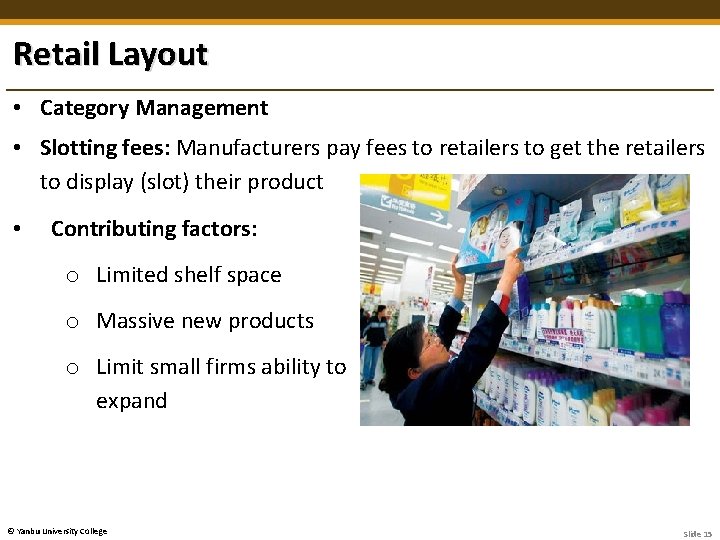
Retail Layout • Category Management • Slotting fees: Manufacturers pay fees to retailers to get the retailers to display (slot) their product • Contributing factors: o Limited shelf space o Massive new products o Limit small firms ability to expand © Yanbu University College Slide 15
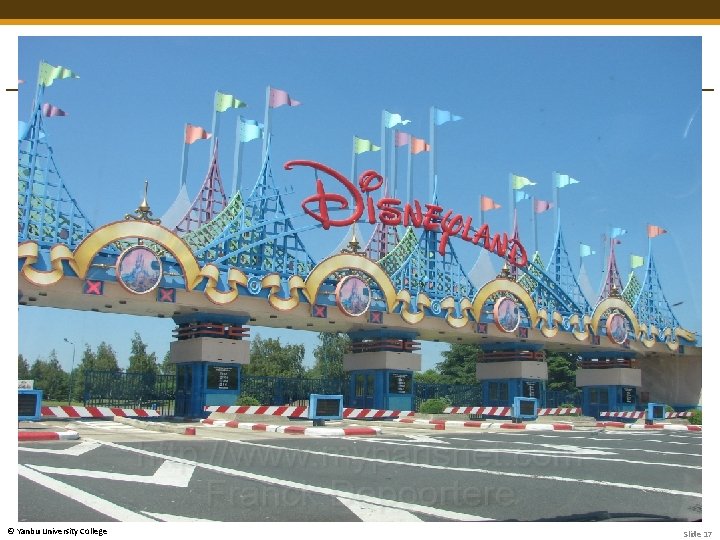
Retail Layout • Servicescapes: o Ambient conditions - background characteristics such as lighting, sound, smell, and temperature o Spatial layout and functionality - which involve, aisle characteristics (width, direction, shelf spacing. . . etc. ) , and product grouping o Signs, symbols, and artifacts - characteristics of building design that carry social significance e. g. : Wal-Mart greeter at the door, Disneyland's entrance © Yanbu University College Slide 16
© Yanbu University College Slide 17
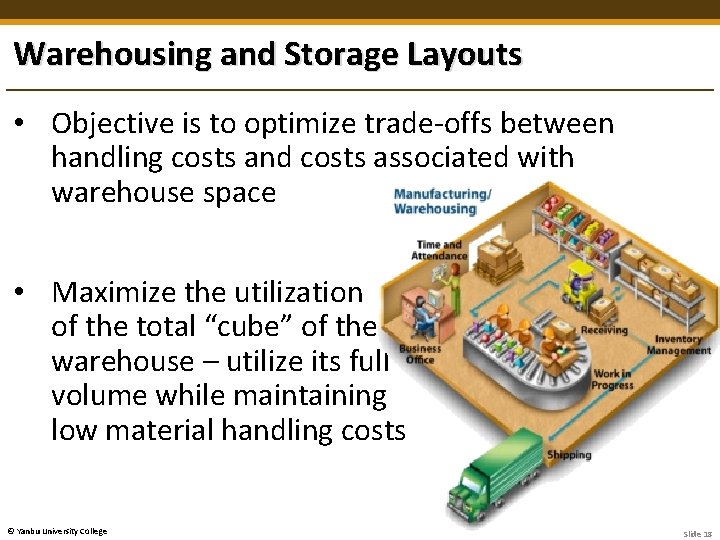
Warehousing and Storage Layouts • Objective is to optimize trade-offs between handling costs and costs associated with warehouse space • Maximize the utilization of the total “cube” of the warehouse – utilize its full volume while maintaining low material handling costs © Yanbu University College Slide 18
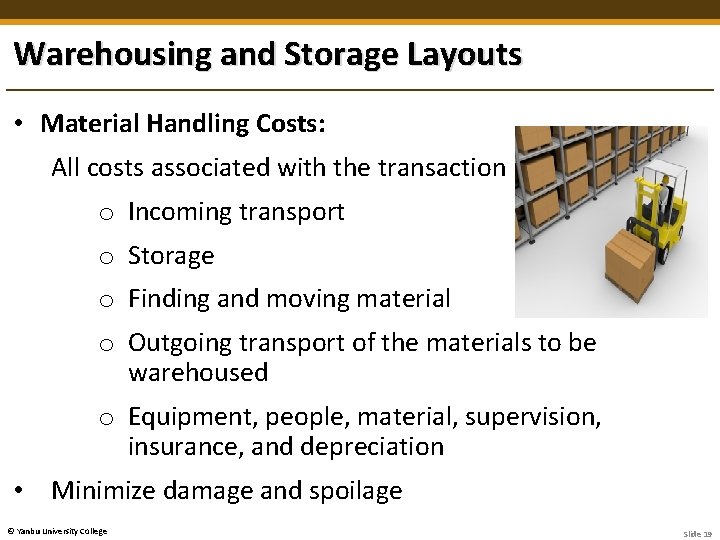
Warehousing and Storage Layouts • Material Handling Costs: All costs associated with the transaction o Incoming transport o Storage o Finding and moving material o Outgoing transport of the materials to be warehoused o Equipment, people, material, supervision, insurance, and depreciation • Minimize damage and spoilage © Yanbu University College Slide 19
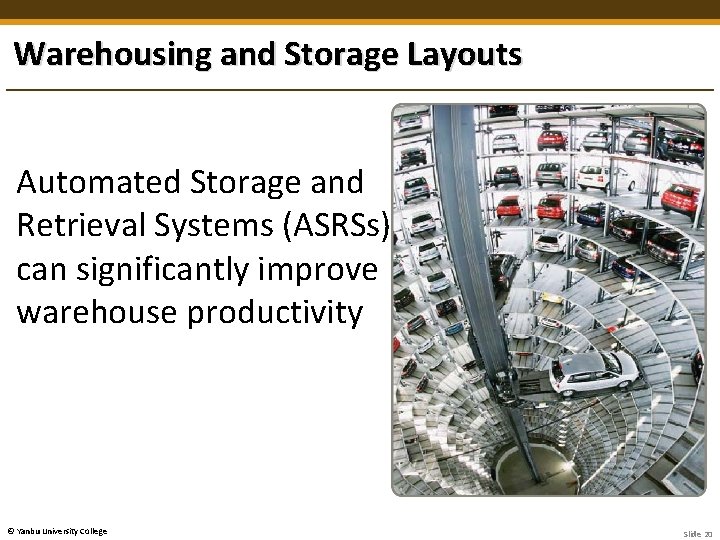
Warehousing and Storage Layouts • Automated Storage and Retrieval Systems (ASRSs) can significantly improve warehouse productivity © Yanbu University College Slide 20
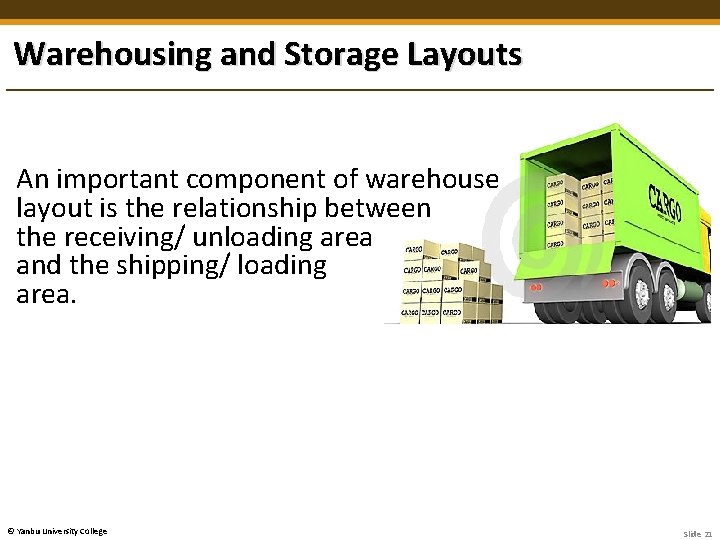
Warehousing and Storage Layouts An important component of warehouse layout is the relationship between the receiving/ unloading area and the shipping/ loading area. © Yanbu University College Slide 21
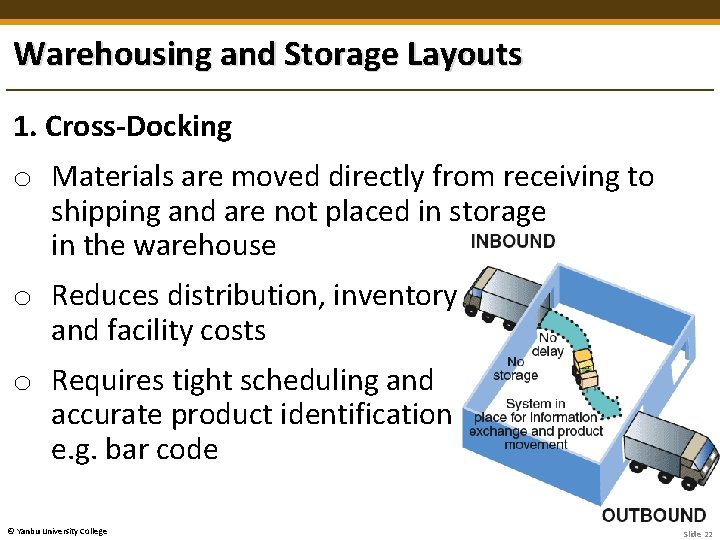
Warehousing and Storage Layouts 1. Cross-Docking o Materials are moved directly from receiving to shipping and are not placed in storage in the warehouse o Reduces distribution, inventory and facility costs o Requires tight scheduling and accurate product identification e. g. bar code © Yanbu University College Slide 22
Warehousing and Storage Layouts 2. Random Stocking • • Typically requires automatic identification systems (AISs) and effective information systems Random assignment of stocking locations allows more efficient use of space Key tasks: o Maintain list of open locations o Maintain accurate records of existing inventory and its locations o Sequence items to minimize travel, and pick time o Combine picking orders to reduce picking time o Assign classes of items to particular areas �facility utilization, �labor cost, but requires very accurate records © Yanbu University College Slide 23
Warehousing and Storage Layouts 3. Customizing • Value-added activities performed at the warehouse o Assembly of components o Loading software o Repairs o Customized labeling and packaging © Yanbu University College Slide 24
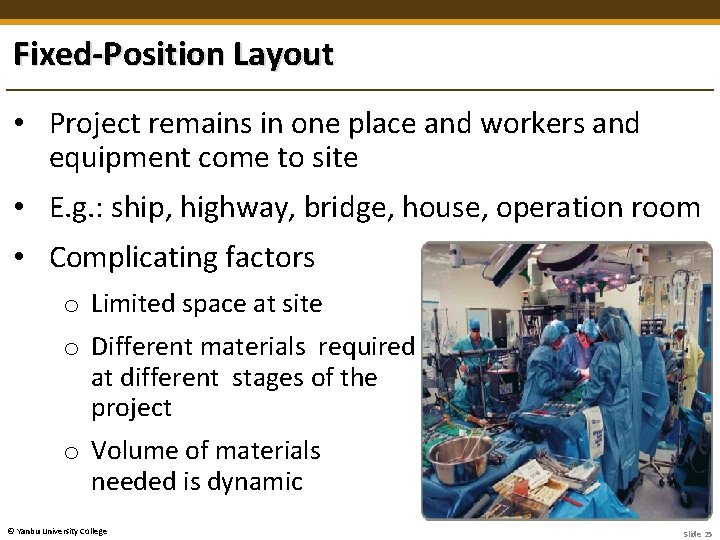
Fixed-Position Layout • Project remains in one place and workers and equipment come to site • E. g. : ship, highway, bridge, house, operation room • Complicating factors o Limited space at site o Different materials required at different stages of the project o Volume of materials needed is dynamic © Yanbu University College Slide 25
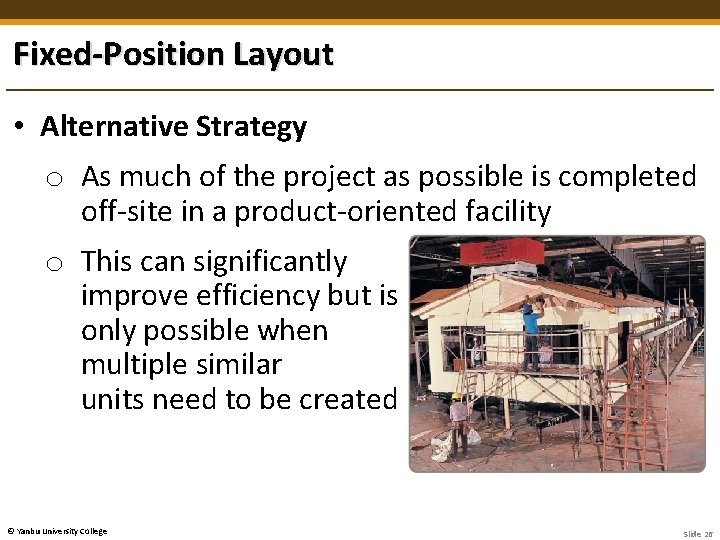
Fixed-Position Layout • Alternative Strategy o As much of the project as possible is completed off-site in a product-oriented facility o This can significantly improve efficiency but is only possible when multiple similar units need to be created © Yanbu University College Slide 26
Work Cells • Reorganizes people and machines into groups to focus on single products or product groups • Volume must justify cells • Group technology identifies products that have similar characteristics for particular cells • Cells can be reconfigured as designs or volume changes © Yanbu University College Slide 27
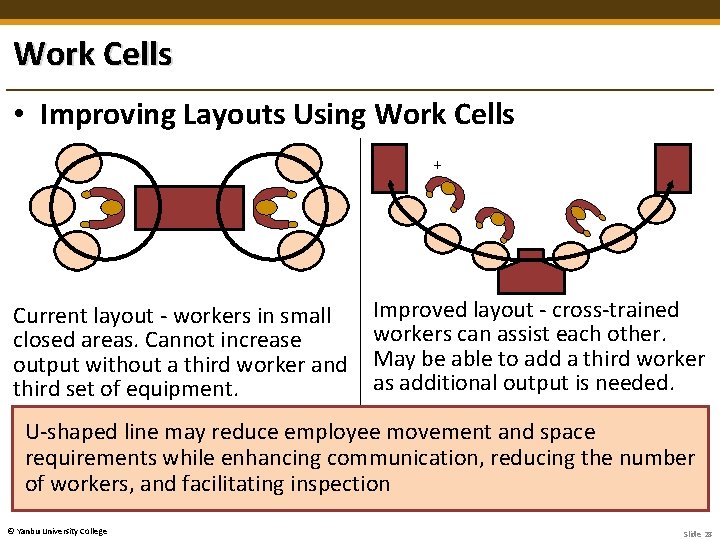
Work Cells • Improving Layouts Using Work Cells + Current layout - workers in small closed areas. Cannot increase output without a third worker and third set of equipment. Improved layout - cross-trained workers can assist each other. May be able to add a third worker as additional output is needed. U-shaped line may reduce employee movement and space requirements while enhancing communication, reducing the number of workers, and facilitating inspection © Yanbu University College Slide 28
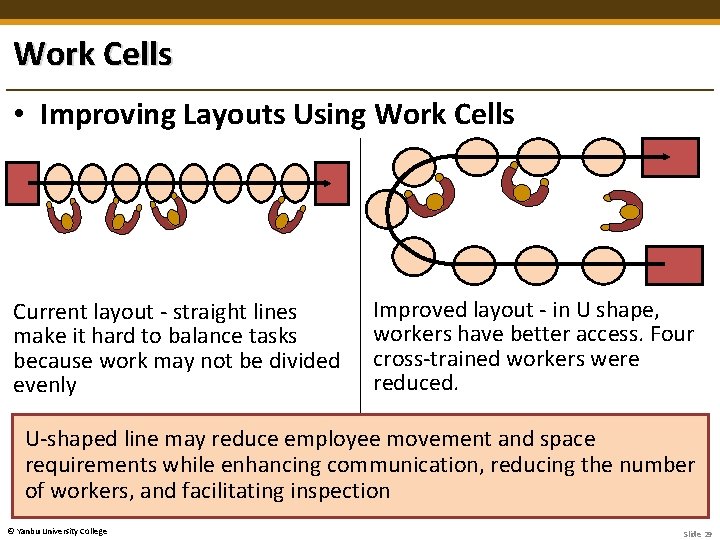
Work Cells • Improving Layouts Using Work Cells Current layout - straight lines make it hard to balance tasks because work may not be divided evenly Improved layout - in U shape, workers have better access. Four cross-trained workers were reduced. U-shaped line may reduce employee movement and space requirements while enhancing communication, reducing the number of workers, and facilitating inspection © Yanbu University College Slide 29
Process-Oriented Layout • � Low volume, �high variety • Like machines and equipment are grouped together • Efficient when making products with different requirements, or when handling different needs of customers • Each product requires different sequence of operations • E. g. : ER Process © Yanbu University College Slide 30
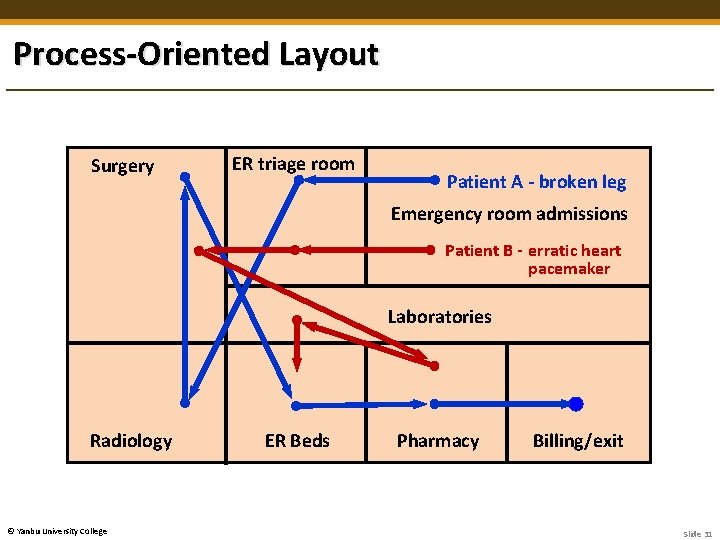
Process-Oriented Layout Surgery ER triage room Patient A - broken leg Emergency room admissions Patient B - erratic heart pacemaker Laboratories Radiology © Yanbu University College ER Beds Pharmacy Billing/exit Slide 31
Process-Oriented Layout • Advantages: o Flexibility o Capability of handling a wide variety of products or services • Disadvantages: o General-purpose use of equipment �� labor skills and cost, �required level of training and experience o Orders take more time to move through the system because of difficult scheduling, changing setup, and unique material handling © Yanbu University College Slide 32
Process-Oriented Layout • Arrange departments/ work centers so as to minimize the costs of material handling • Material handling cost in this approach depend on: 1. Number of loads (or people) moving between centers 2. Distance-related cost of moving loads (or people) between centers © Yanbu University College Slide 33
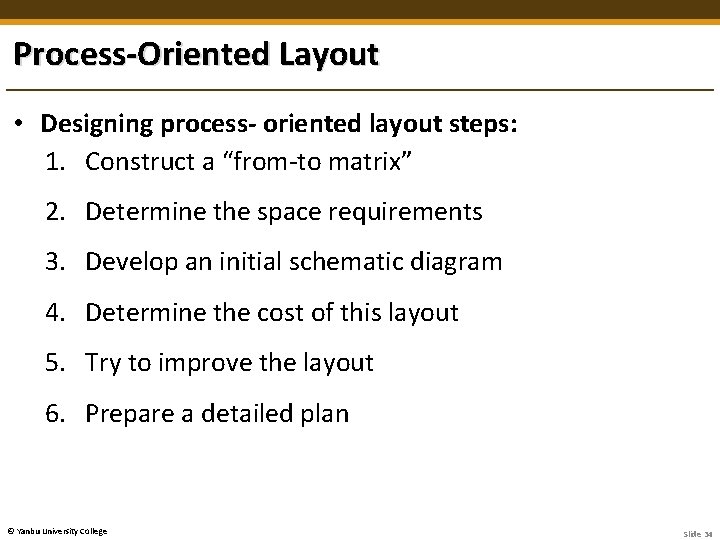
Process-Oriented Layout • Designing process- oriented layout steps: 1. Construct a “from-to matrix” 2. Determine the space requirements 3. Develop an initial schematic diagram 4. Determine the cost of this layout 5. Try to improve the layout 6. Prepare a detailed plan © Yanbu University College Slide 34
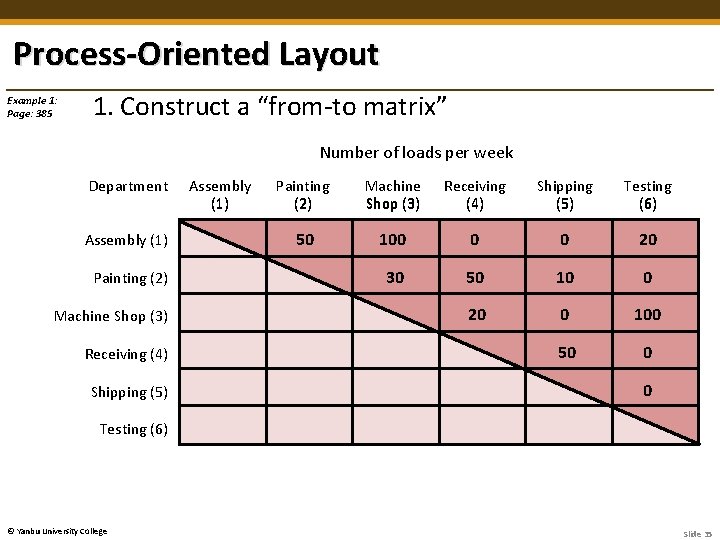
Process-Oriented Layout Example 1: Page: 385 1. Construct a “from-to matrix” Number of loads per week Department Assembly (1) Painting (2) Machine Shop (3) Receiving (4) Shipping (5) Testing (6) 50 100 0 0 20 30 50 10 0 20 0 100 50 0 0 Testing (6) © Yanbu University College Slide 35
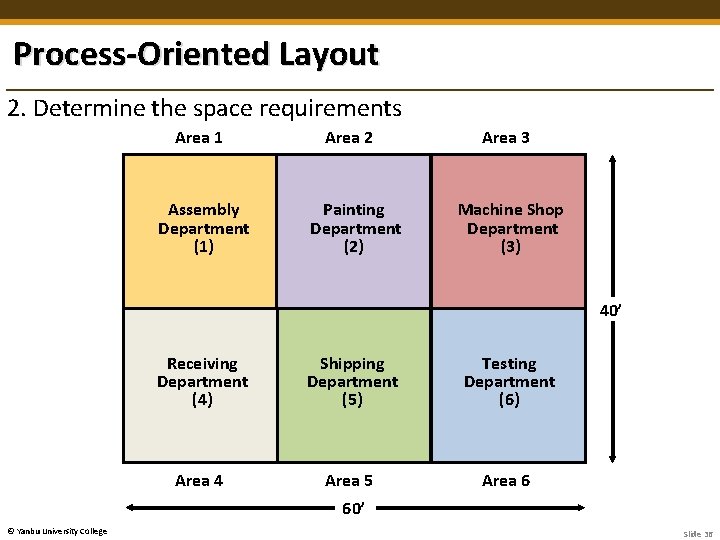
Process-Oriented Layout 2. Determine the space requirements Area 1 Assembly Department (1) Area 2 Painting Department (2) Area 3 Machine Shop Department (3) 40’ Receiving Department (4) Shipping Department (5) Testing Department (6) Area 4 Area 5 Area 6 60’ © Yanbu University College Slide 36
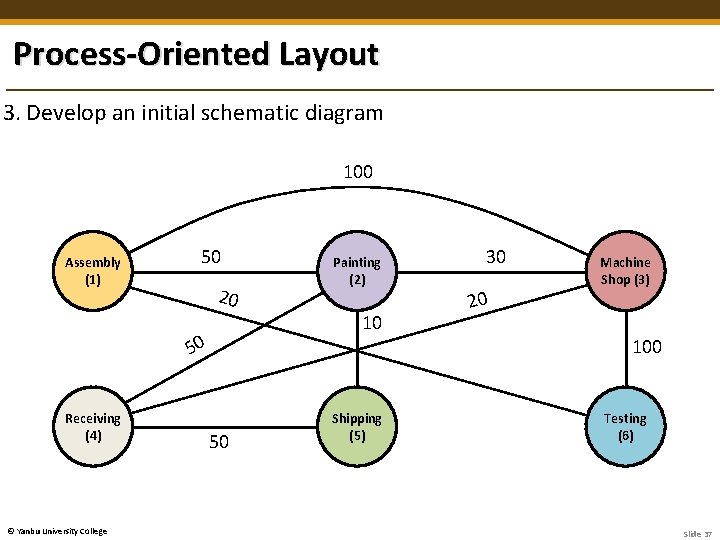
Process-Oriented Layout 3. Develop an initial schematic diagram 100 Assembly (1) 50 20 10 50 Receiving (4) © Yanbu University College Painting (2) 50 Shipping (5) 30 20 Machine Shop (3) 100 Testing (6) Slide 37
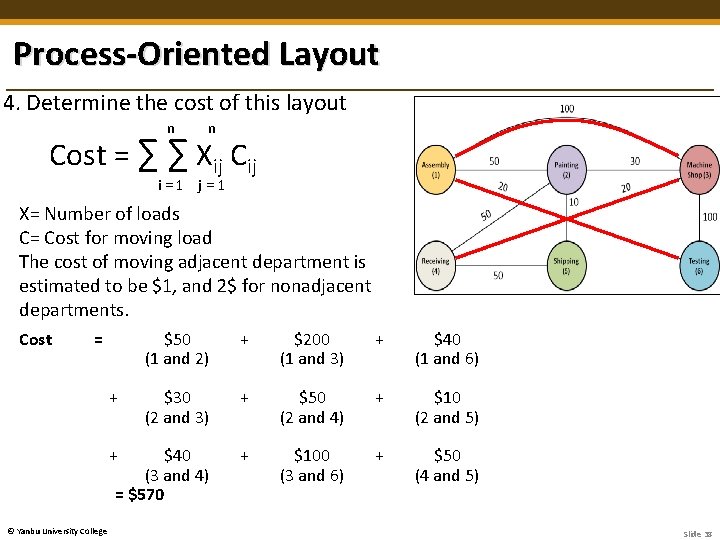
Process-Oriented Layout 4. Determine the cost of this layout n n Cost = ∑ ∑ Xij Cij i=1 j=1 X= Number of loads C= Cost for moving load The cost of moving adjacent department is estimated to be $1, and 2$ for nonadjacent departments. Cost = $50 (1 and 2) + $200 (1 and 3) + $40 (1 and 6) $30 (2 and 3) + $50 (2 and 4) + $10 (2 and 5) $40 (3 and 4) = $570 + $100 (3 and 6) + $50 (4 and 5) + + © Yanbu University College Slide 38
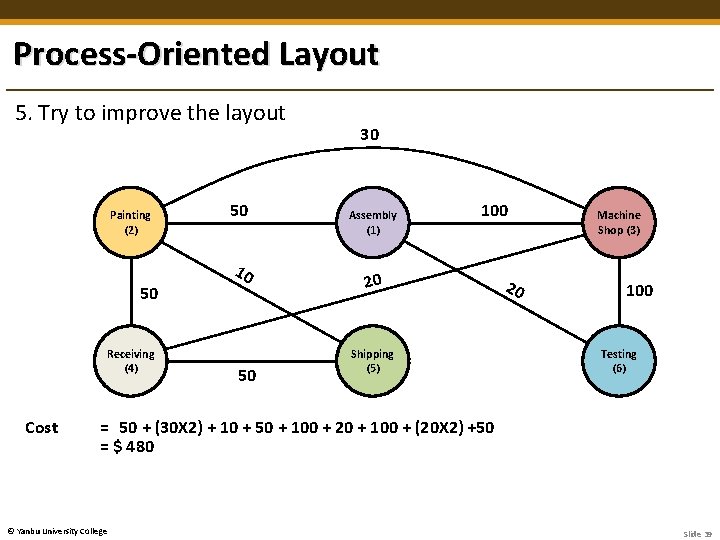
Process-Oriented Layout 5. Try to improve the layout Painting (2) 50 Receiving (4) Cost 50 10 50 30 Assembly (1) 100 20 Shipping (5) 20 Machine Shop (3) 100 Testing (6) = 50 + (30 X 2) + 10 + 50 + 100 + 20 + 100 + (20 X 2) +50 = $ 480 © Yanbu University College Slide 39
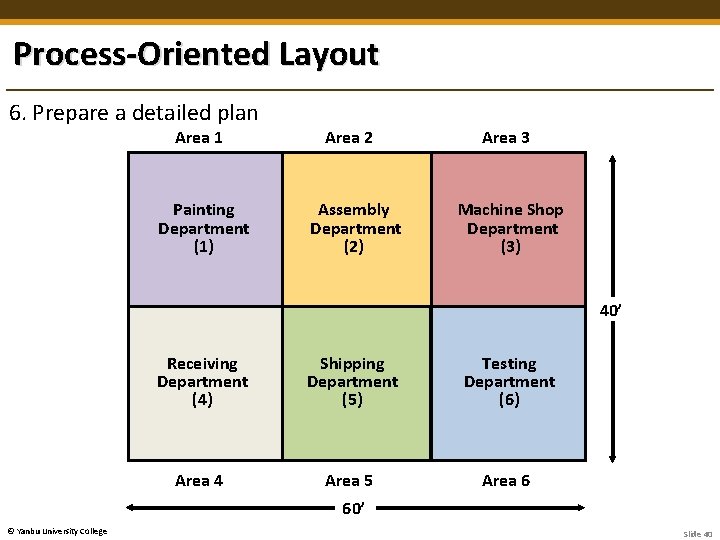
Process-Oriented Layout 6. Prepare a detailed plan Area 1 Painting Department (1) Area 2 Assembly Department (2) Area 3 Machine Shop Department (3) 40’ Receiving Department (4) Shipping Department (5) Testing Department (6) Area 4 Area 5 Area 6 60’ © Yanbu University College Slide 40
Repetitive and Product-Oriented Layout • �High volume, �low variety products • Repetitive production and continuous production use product layout. • Two types of layout: Fabrication line and Assembly line. 1. Fabrication line o Builds components on a series of machines o Machine-paced o Require mechanical or engineering changes to balance © Yanbu University College Slide 41
Repetitive and Product-Oriented Layout 2. Assembly line o Puts fabricated parts together at a series of workstations o Paced by work tasks o Balanced by moving tasks • Both types of lines must be balanced so that the time to perform the work at each station is the same © Yanbu University College Slide 42

END OF LECTURE © Yanbu University College Slide 43
- Slides: 43