
YAMM Yet Another Memory Manager Andrei Vintila Ionut

- Slides: 25
YAMM Yet Another Memory Manager Andrei Vintila, Ionut Tolea Amiq Consulting © Accellera Systems Initiative 1
Agenda • Theory – Memory Management Introduction – YAMM Overview: Features, Algorithm, Datatypes, API • Comparison with UVM_MAM – Feature-wise – Performance-wise • Examples © Accellera Systems Initiative 2
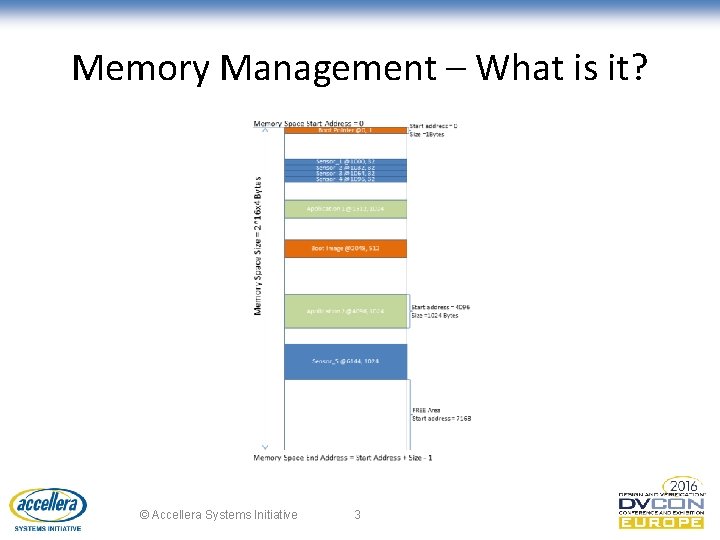
Memory Management – What is it? © Accellera Systems Initiative 3
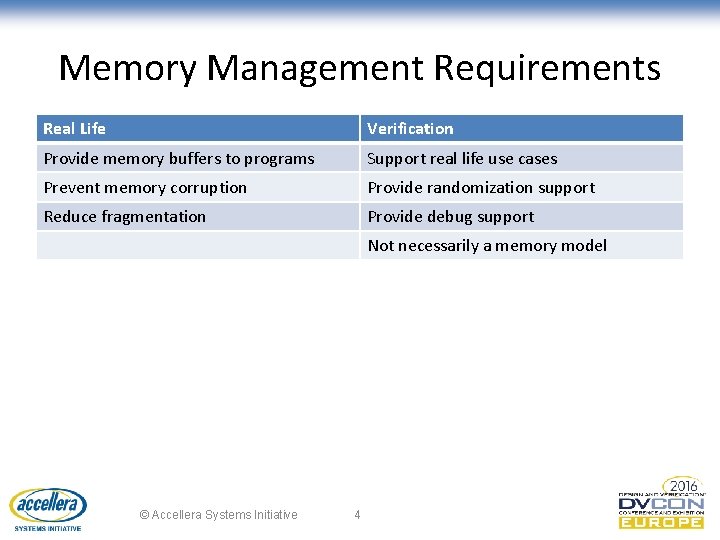
Memory Management Requirements Real Life Verification Provide memory buffers to programs Support real life use cases Prevent memory corruption Provide randomization support Reduce fragmentation Provide debug support Not necessarily a memory model © Accellera Systems Initiative 4
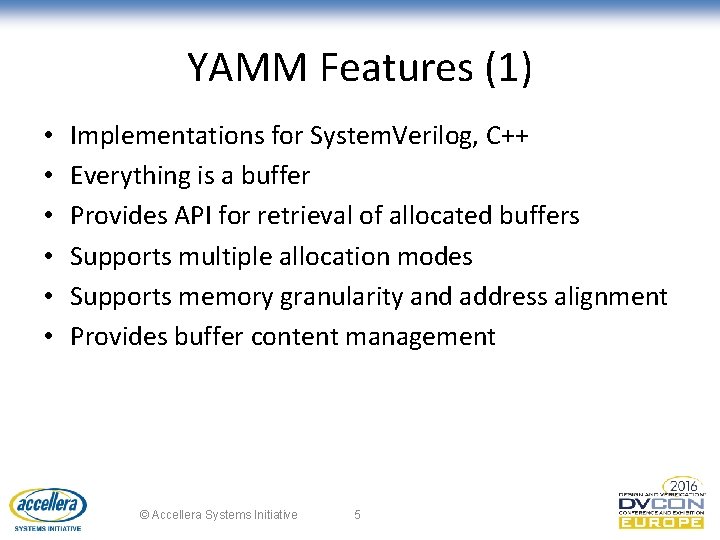
YAMM Features (1) • • • Implementations for System. Verilog, C++ Everything is a buffer Provides API for retrieval of allocated buffers Supports multiple allocation modes Supports memory granularity and address alignment Provides buffer content management © Accellera Systems Initiative 5
YAMM Features (2) • • Buffers represent address spaces themselves Memory can be written to file or pretty-printed Provides usage and fragmentation statistics Can be easily extended for specific use cases © Accellera Systems Initiative 6
YAMM Data Types • yamm_buffer – Contains all data and functions • yamm – Top level instance of the memory manager – Inherits yamm_buffer • yamm_access – Optional usage – Used to model a basic access (start address, size) © Accellera Systems Initiative 7
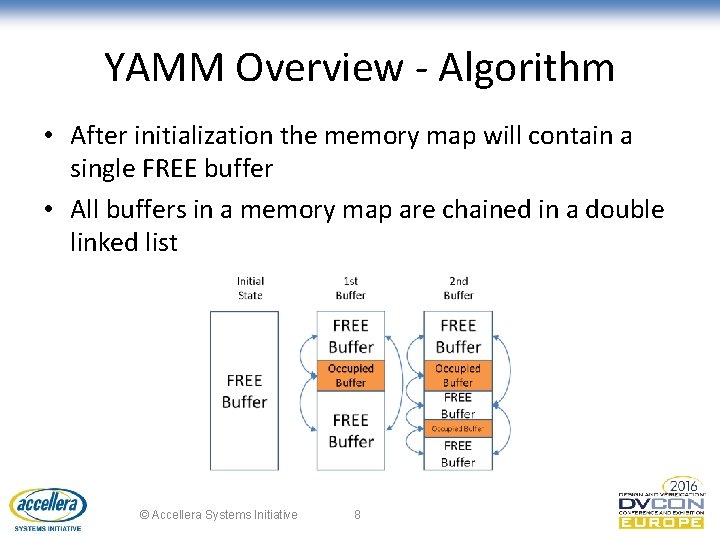
YAMM Overview - Algorithm • After initialization the memory map will contain a single FREE buffer • All buffers in a memory map are chained in a double linked list © Accellera Systems Initiative 8
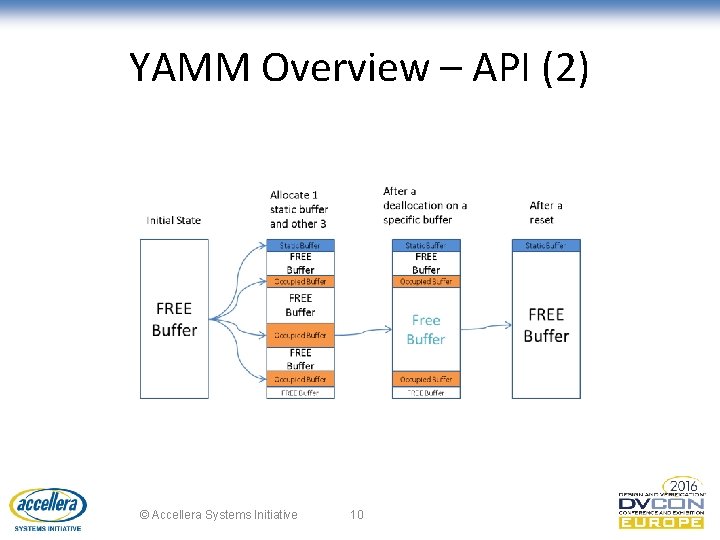
YAMM Overview – API (1) • Allocation – Manual allocation: insertion – Automatic allocation rules: • • RANDOM_FIT FIRST_FIT (and FIRST_FIT_RND) BEST_FIT (and BEST_FIT_RND) UNIFORM_FIT • Deallocation – It can be done on a specific buffer or address © Accellera Systems Initiative 9
YAMM Overview – API (2) © Accellera Systems Initiative 10
YAMM Overview – API (3) • Search functions – – Retrieve buffers by name Retrieve buffers by address Retrieve buffers in address range Retrieve buffers by access • Debug functions – Return the memory map allocation as a string – Dump memory map to file – Provide usage and fragmentation statistics © Accellera Systems Initiative 11
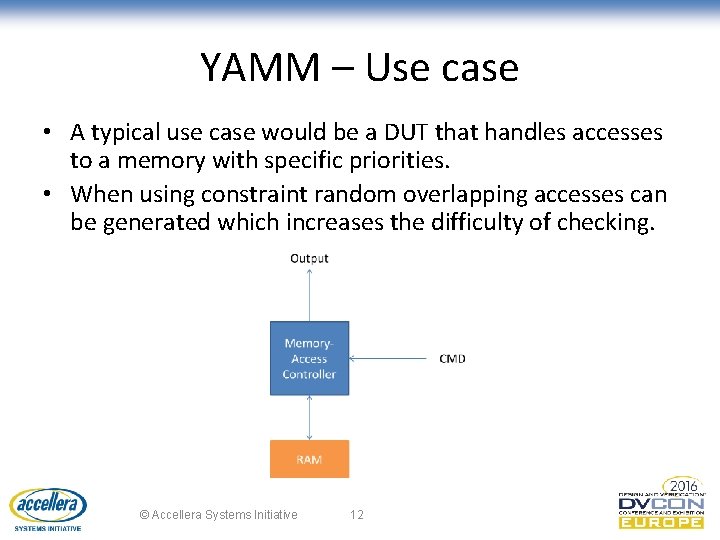
YAMM – Use case • A typical use case would be a DUT that handles accesses to a memory with specific priorities. • When using constraint random overlapping accesses can be generated which increases the difficulty of checking. © Accellera Systems Initiative 12
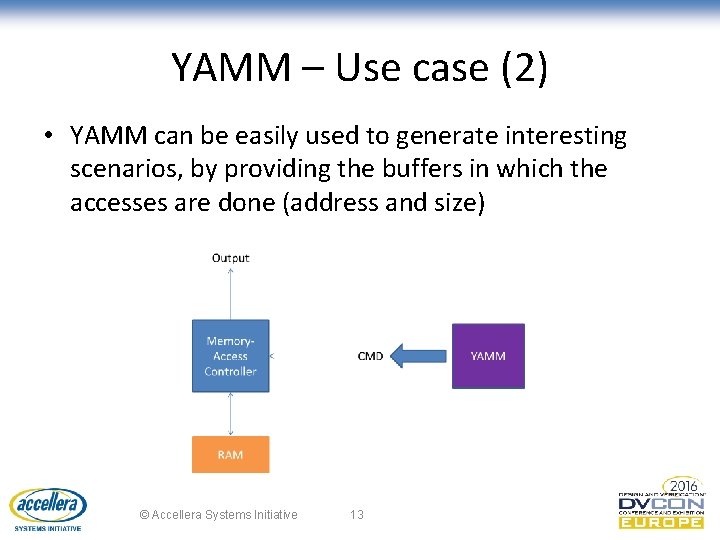
YAMM – Use case (2) • YAMM can be easily used to generate interesting scenarios, by providing the buffers in which the accesses are done (address and size) © Accellera Systems Initiative 13
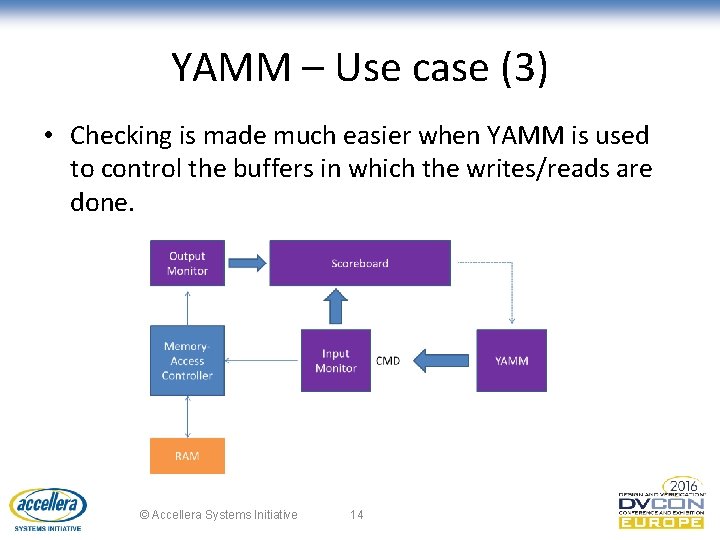
YAMM – Use case (3) • Checking is made much easier when YAMM is used to control the buffers in which the writes/reads are done. © Accellera Systems Initiative 14
MAM – UVM Solution • Oriented towards memory modeling • MAM is used with UVM_MEM to reserve specific memory regions • Supports only “greedy” allocation mode • Specific regions can be freed or entire memory can be wiped • Memory state can be returned as a string © Accellera Systems Initiative 15
MAM vs YAMM – Feature Wise (1) • Memory – UVM_MAM is linked to UVM_MEM which provides the memory locations used for storing data – YAMM top level as well as every individual buffer contains a memory map composed of multiple buffers that can store simple data • Allocation – UVM_MAM can only allocate on previously unallocated memory (2 allocation modes) – YAMM can allocate new buffers in either unallocated memory or inside an already allocated buffer (6 allocation modes) © Accellera Systems Initiative 16
MAM vs YAMM – Feature Wise (2) • Finding buffers – UVM_MAM provides only an iterator; user must implement the search functions – YAMM provides support for finding and modifying buffers by different criteria © Accellera Systems Initiative 17
MAM vs YAMM – Feature Wise (3) • Ease of use – UVM_MAM is complex and rather hard to use and for features beyond reserving and freeing regions user has to go to objects higher in hierarchy – YAMM has a more user friendly API, memory map can be accessed by calling functions on the top level and also specific regions can be accessed by calling same functions on the chosen buffers © Accellera Systems Initiative 18
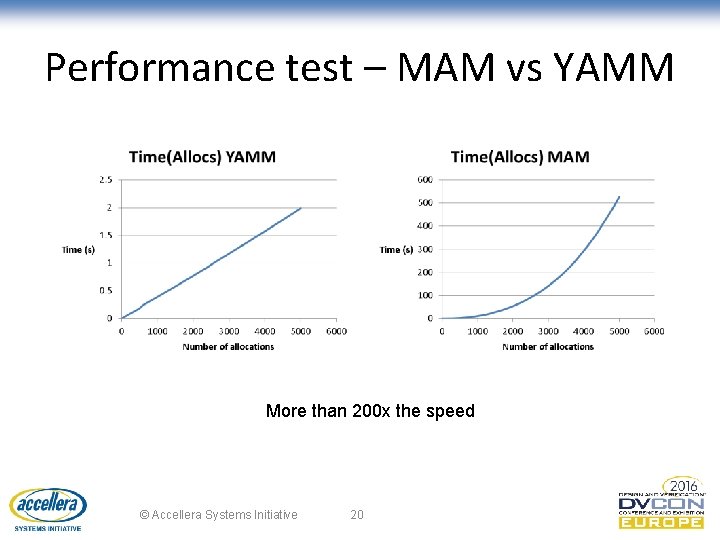
Performance test - Parameters • Memory space of 1 G • Allocation of 5000 buffers of size 100 • Measuring the time taken for allocation every 100 allocations • For MAM, request_region() with default policy • For YAMM, allocate_by_size() with RANDOM_FIT allocation mode was used © Accellera Systems Initiative 19
Performance test – MAM vs YAMM More than 200 x the speed © Accellera Systems Initiative 20
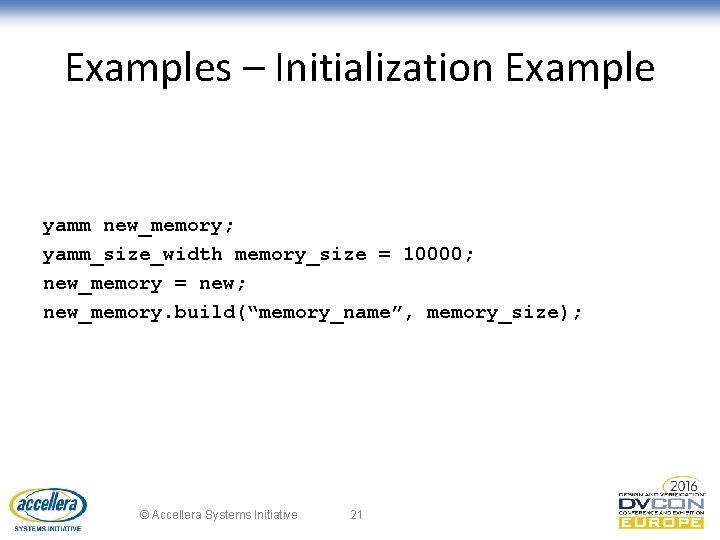
Examples – Initialization Example yamm new_memory; yamm_size_width memory_size = 10000; new_memory = new; new_memory. build(“memory_name”, memory_size); © Accellera Systems Initiative 21
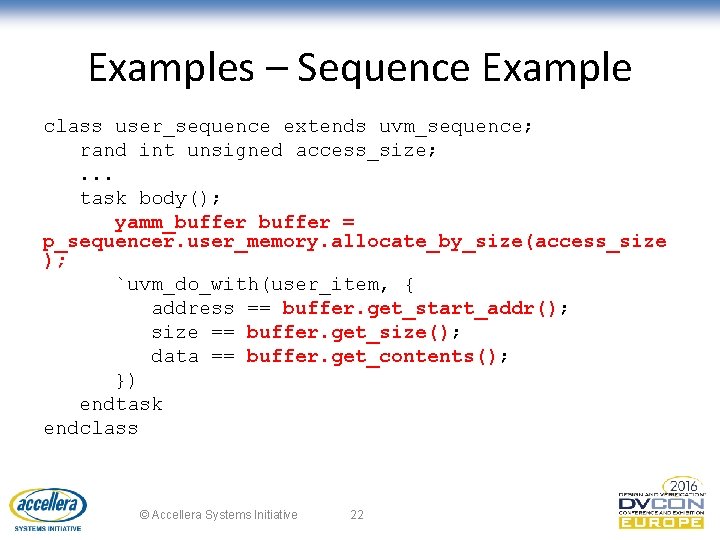
Examples – Sequence Example class user_sequence extends uvm_sequence; rand int unsigned access_size; . . . task body(); yamm_buffer = p_sequencer. user_memory. allocate_by_size(access_size ); `uvm_do_with(user_item, { address == buffer. get_start_addr(); size == buffer. get_size(); data == buffer. get_contents(); }) endtask endclass © Accellera Systems Initiative 22
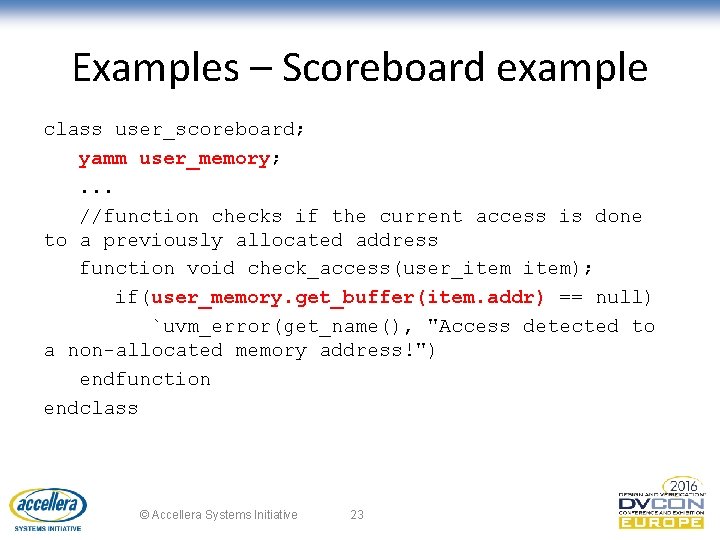
Examples – Scoreboard example class user_scoreboard; yamm user_memory; . . . //function checks if the current access is done to a previously allocated address function void check_access(user_item); if(user_memory. get_buffer(item. addr) == null) `uvm_error(get_name(), "Access detected to a non-allocated memory address!") endfunction endclass © Accellera Systems Initiative 23
YAMM Availability • • Open Source under Apache 2. 0 license Available in both System. Verilog and C++ as well Blog: www. amiq. com/consulting/blog Github: www. github. com/amiq-consulting/yamm © Accellera Systems Initiative 24
Questions © Accellera Systems Initiative 25