
Yale Center for Clinical Investigation From the lab
Yale Center for Clinical Investigation: From the lab, to the clinic to the community Brown Bag Luncheon Series: Presentation Tesheia H. Johnson, MBA, MHS Wednesday, April 22 12: 00 pm The Anlyan Center (TAC) N 107 auditorium
The Problems Facing Clinical Research at Yale in 2004 • Lack of comprehensive training for fellows and faculty • Lack of appropriate infrastructure to facilitate clinical and translational studies

Strategic Plan Recommendations from the Clinical and Population-Based Research Committee • Create a centralized structure to support clinical and population-based research • Improve information systems to support data collection, training, and processes of clinical research • Integrate institutional expertise in clinical care, clinical research, and basic research in an ongoing planning process • Develop metrics to refine and plan institutional efforts in clinical and population-based research The Solution: The Development of the Yale Center for Clinical Investigation (YCCI)
Programmatic Goals 1. To develop the next generation of clinical scientists by attracting talented pre- and post-doctoral students and junior faculty members across multiple disciplines; training them in the use of state-of-the-art research tools; giving them the skills to work within complex research teams; and supporting their professional development. 2. To foster the translation of disease-related discoveries from the laboratory into the clinic and then into the community, in a variety of ways: • By stimulating the creation of interdisciplinary teams of translational researchers • By establishing an organizational and regulatory infrastructure to support clinical studies
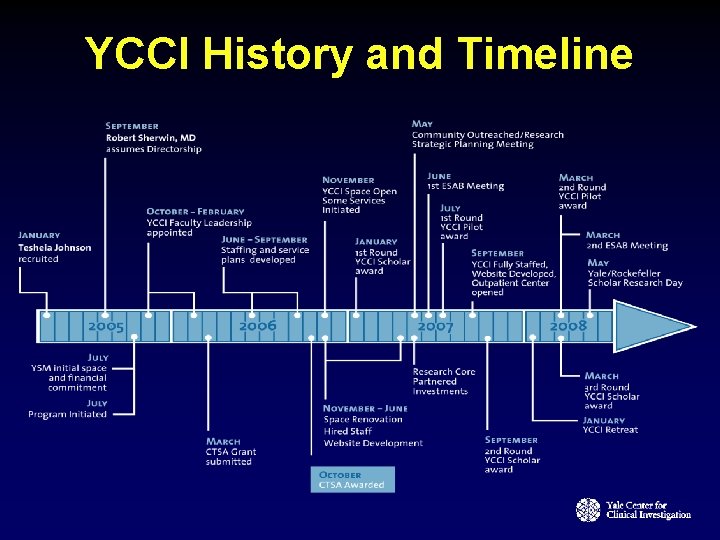
YCCI History and Timeline
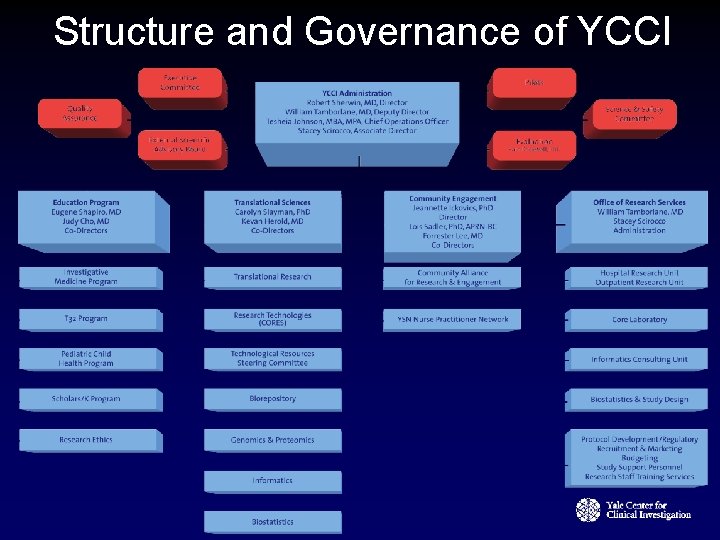
Structure and Governance of YCCI

How is YCCI Supported? • Clinical and Translational Science Award (CTSA) funded by NCRR • Institutional Support • Fee for services charges to Investigator grants
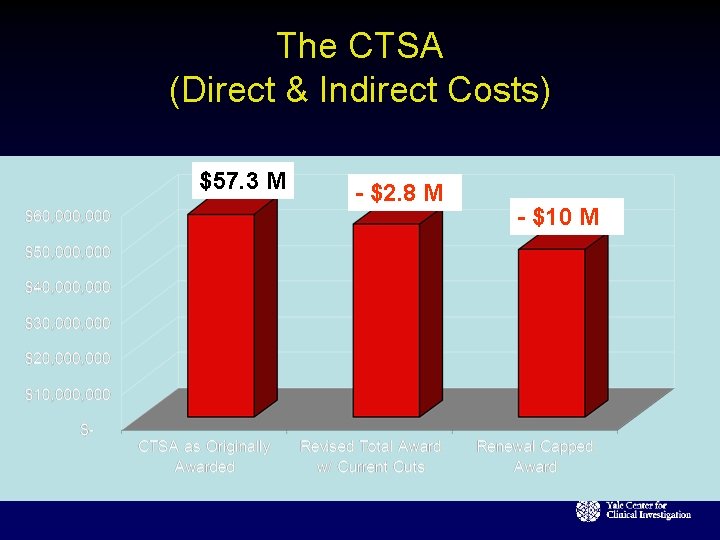
The CTSA (Direct & Indirect Costs) $57. 3 M - $2. 8 M - $10 M

Institutional Commitment to YCCI and Related Programs From CTSA award through FY 09 $15. 1 M $15. 4 M $15. 9 M
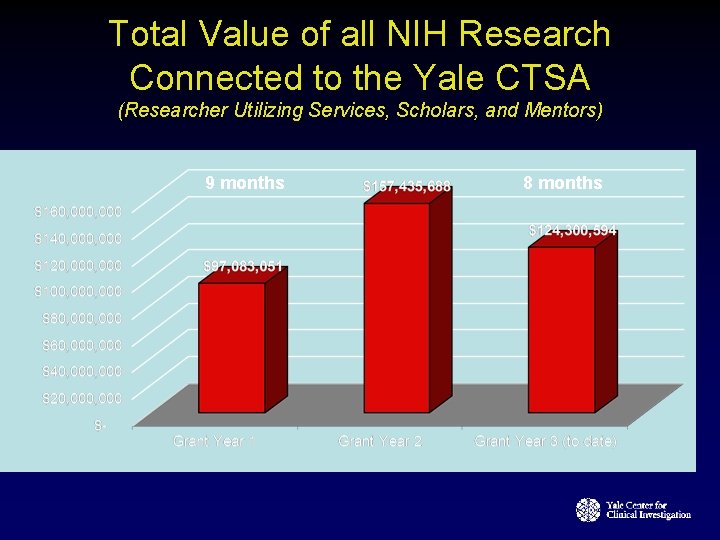
Total Value of all NIH Research Connected to the Yale CTSA (Researcher Utilizing Services, Scholars, and Mentors) 9 months 8 months
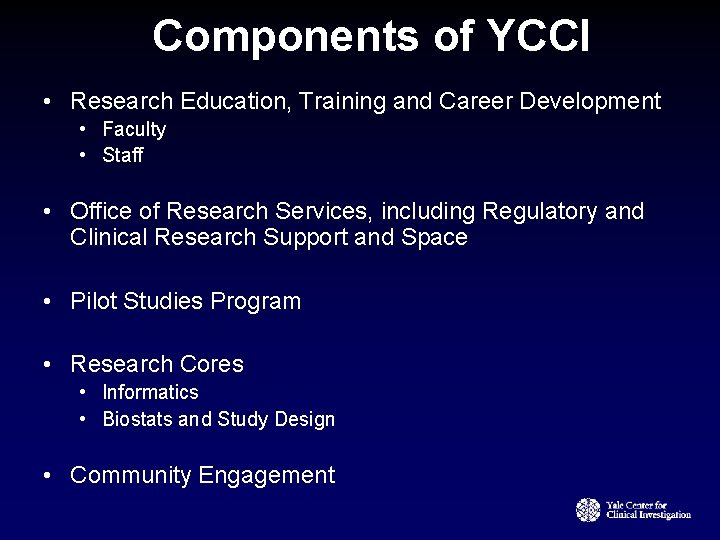
Components of YCCI • Research Education, Training and Career Development • Faculty • Staff • Office of Research Services, including Regulatory and Clinical Research Support and Space • Pilot Studies Program • Research Cores • Informatics • Biostats and Study Design • Community Engagement
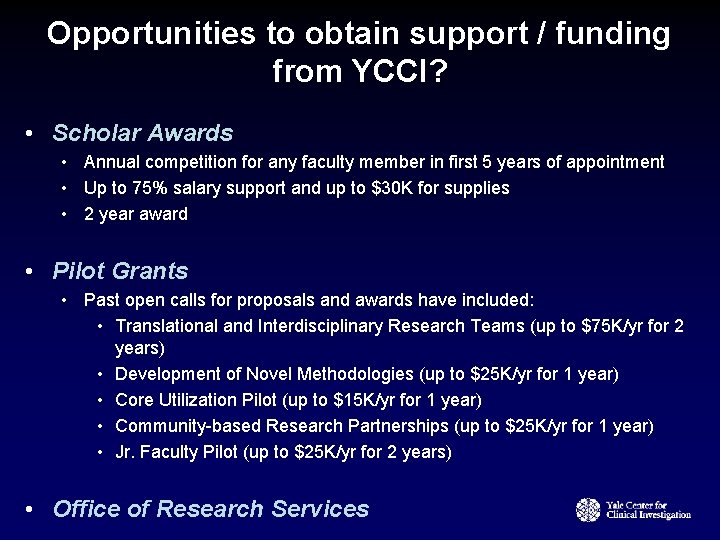
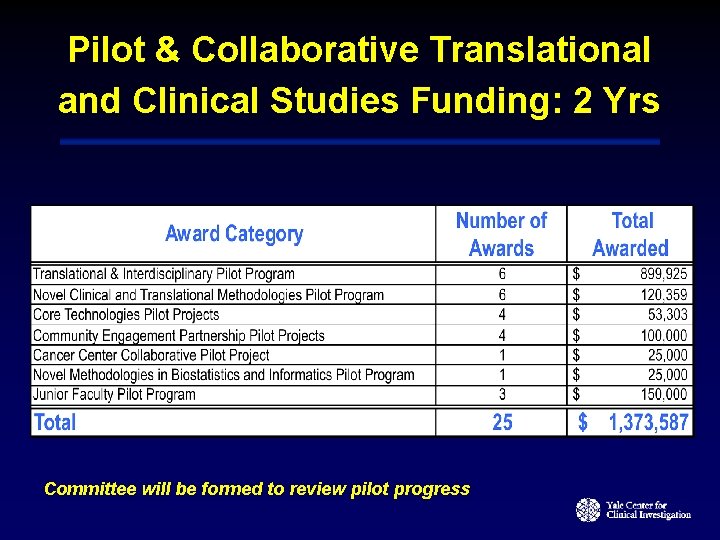
Opportunities to obtain support / funding from YCCI? • Scholar Awards • Annual competition for any faculty member in first 5 years of appointment • Up to 75% salary support and up to $30 K for supplies • 2 year award • Pilot Grants • Past open calls for proposals and awards have included: • Translational and Interdisciplinary Research Teams (up to $75 K/yr for 2 years) • Development of Novel Methodologies (up to $25 K/yr for 1 year) • Core Utilization Pilot (up to $15 K/yr for 1 year) • Community-based Research Partnerships (up to $25 K/yr for 1 year) • Jr. Faculty Pilot (up to $25 K/yr for 2 years) • Office of Research Services
YCCI: Educational Programs
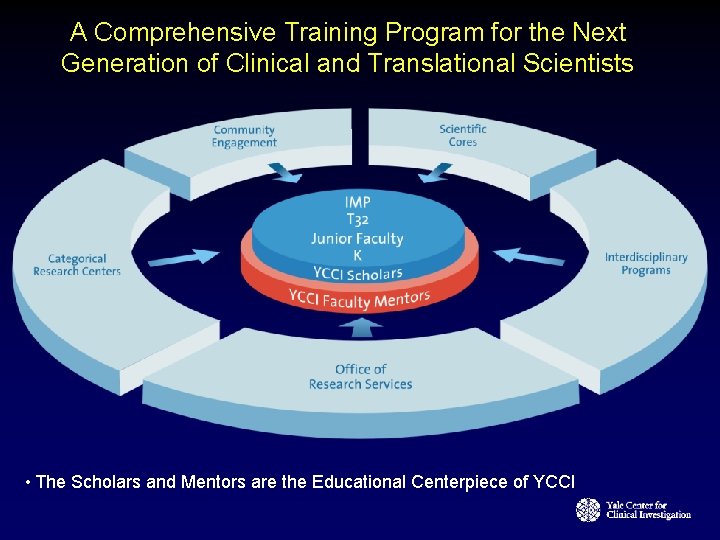
A Comprehensive Training Program for the Next Generation of Clinical and Translational Scientists • The Scholars and Mentors are the Educational Centerpiece of YCCI
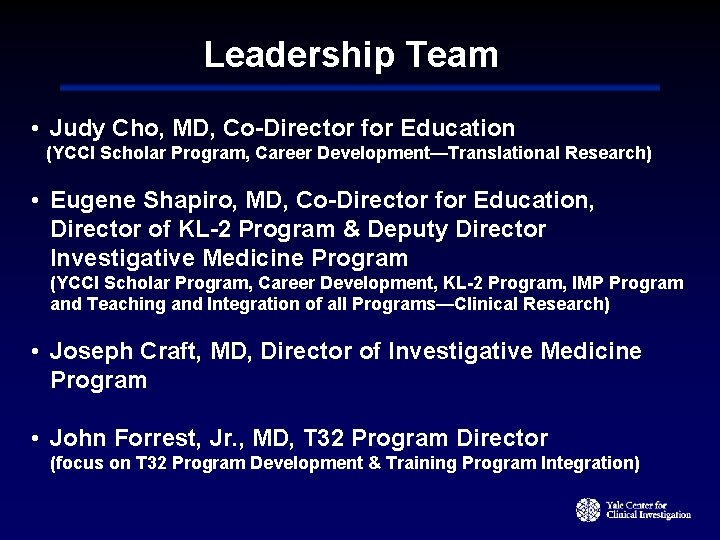
Leadership Team • Judy Cho, MD, Co-Director for Education (YCCI Scholar Program, Career Development—Translational Research) • Eugene Shapiro, MD, Co-Director for Education, Director of KL-2 Program & Deputy Director Investigative Medicine Program (YCCI Scholar Program, Career Development, KL-2 Program, IMP Program and Teaching and Integration of all Programs—Clinical Research) • Joseph Craft, MD, Director of Investigative Medicine Program • John Forrest, Jr. , MD, T 32 Program Director (focus on T 32 Program Development & Training Program Integration)
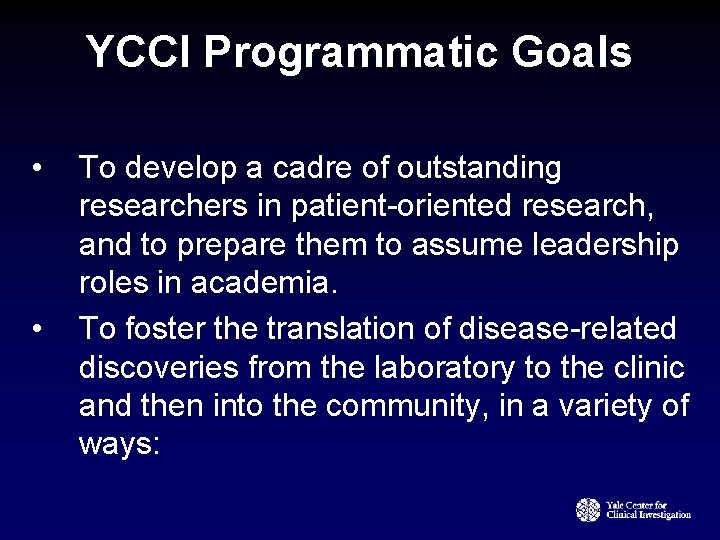
YCCI Programmatic Goals • • To develop a cadre of outstanding researchers in patient-oriented research, and to prepare them to assume leadership roles in academia. To foster the translation of disease-related discoveries from the laboratory to the clinic and then into the community, in a variety of ways:
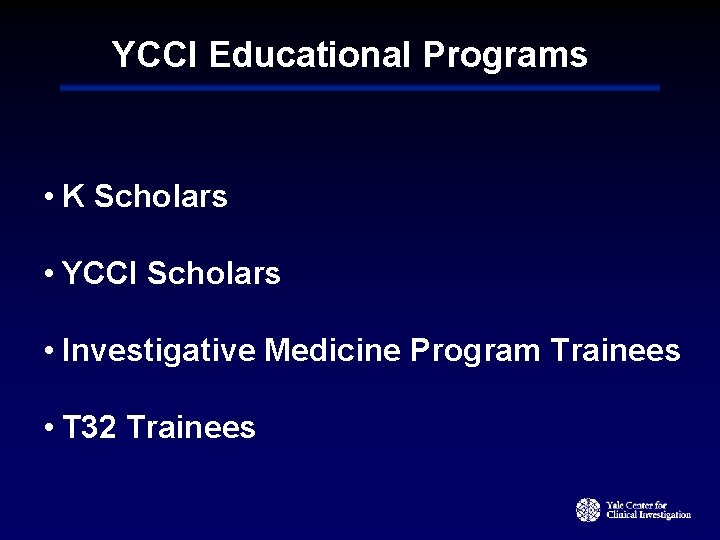
YCCI Educational Programs • K Scholars • YCCI Scholars • Investigative Medicine Program Trainees • T 32 Trainees
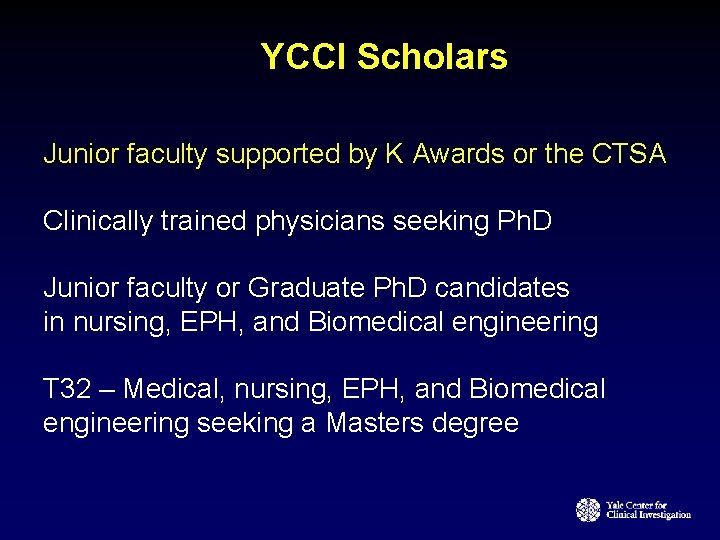
YCCI Scholars Junior faculty supported by K Awards or the CTSA Clinically trained physicians seeking Ph. D Junior faculty or Graduate Ph. D candidates in nursing, EPH, and Biomedical engineering T 32 – Medical, nursing, EPH, and Biomedical engineering seeking a Masters degree
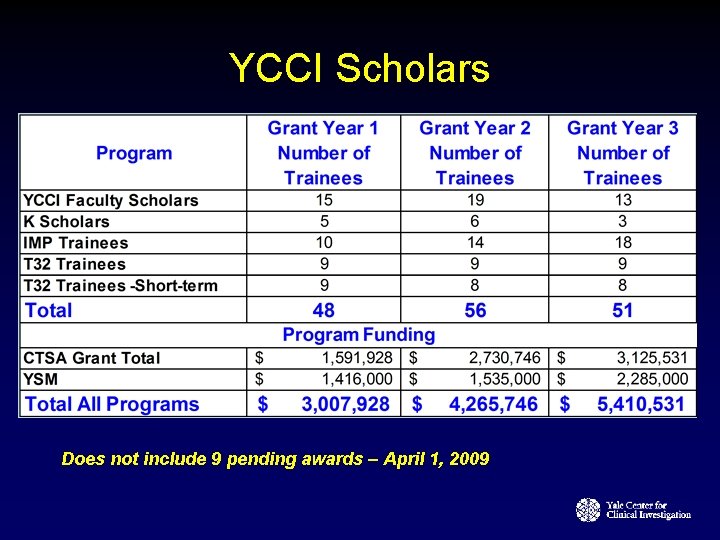
YCCI Scholars Does not include 9 pending awards – April 1, 2009
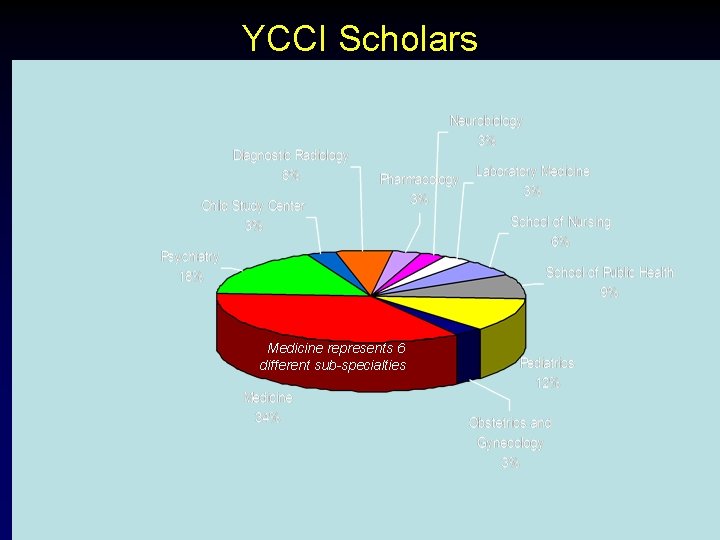
YCCI Scholars Diverse Departmental & School Representation Medicine represents 6 different sub-specialties
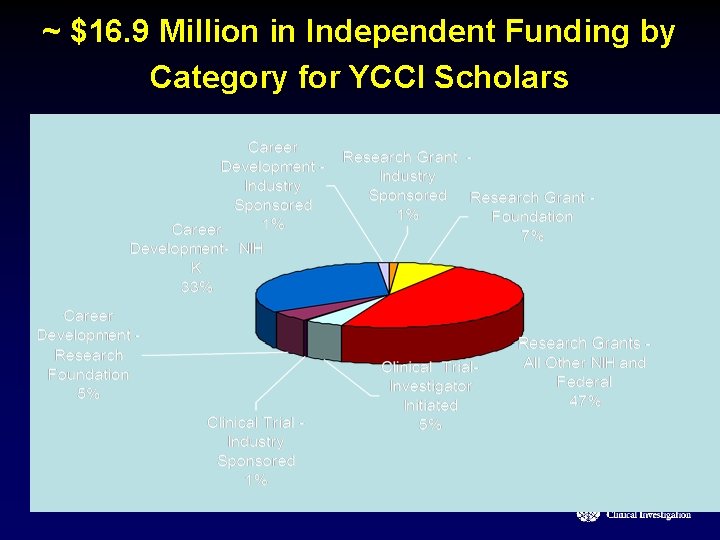
~ $16. 9 Million in Independent Funding by Category for YCCI Scholars
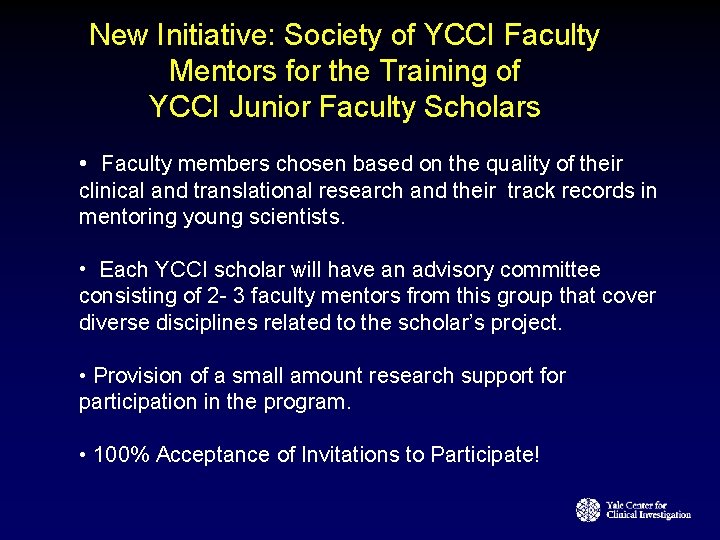
New Initiative: Society of YCCI Faculty Mentors for the Training of YCCI Junior Faculty Scholars • Faculty members chosen based on the quality of their clinical and translational research and their track records in mentoring young scientists. • Each YCCI scholar will have an advisory committee consisting of 2 - 3 faculty mentors from this group that cover diverse disciplines related to the scholar’s project. • Provision of a small amount research support for participation in the program. • 100% Acceptance of Invitations to Participate!
Investigative Medicine Program (IMP) • The Investigative Medicine Program is a unique training program that leads to a Ph. D. degree in Investigative Medicine. • Students undertake thesis work in a variety of disciplines. These include: • Evaluating risk factors and interventions for disease using modern concepts in quantitative methods and clinical study design. • Exploring the molecular basis for a disease from the laboratory standpoint. • Investigating the biochemical, physiologic and genetic basis for disease in the setting of a Clinical Research Center.
T 32 Program • Program Goal • To establish a flexible educational program to expand clinical/translational training among predoctoral medical, nursing, M. D. /Ph. D. and biomedical engineering students • In first two years of the CTSA education component, 18 students have been funded.
Master’s Program • Masters Program Overseen By YCCI Co-Directors of Research and Yale School of Medicine Office of Education
Master’s Program • Courses include Epidemiology Biostatistics Drug design (bench to bedside) Practical and Ethical Issues in Clinical/Translational Research • Electives • •
New Program • Yale Pediatric Faculty Scholar’s Program • Goal: To encourage innovative research and collaboration among faculty who do NOT necessarily have 75% protected time for research
YCCI: Office of Research Services (ORS) and the Clinical Research Units, including “former GCRC”)
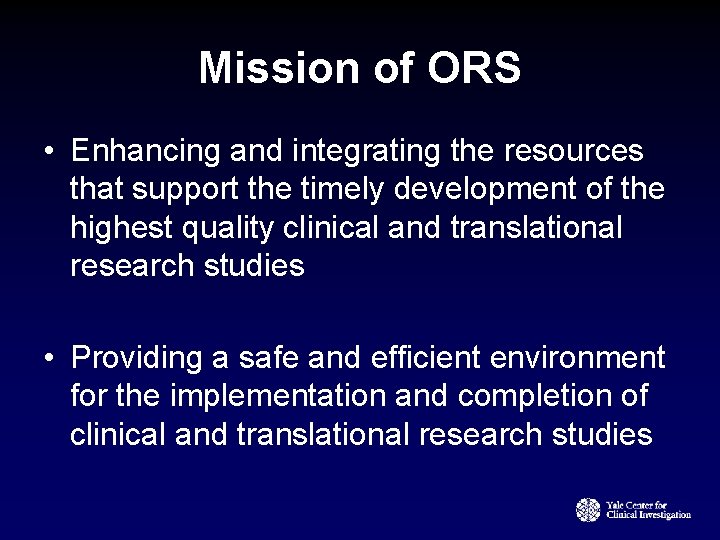
Mission of ORS • Enhancing and integrating the resources that support the timely development of the highest quality clinical and translational research studies • Providing a safe and efficient environment for the implementation and completion of clinical and translational research studies
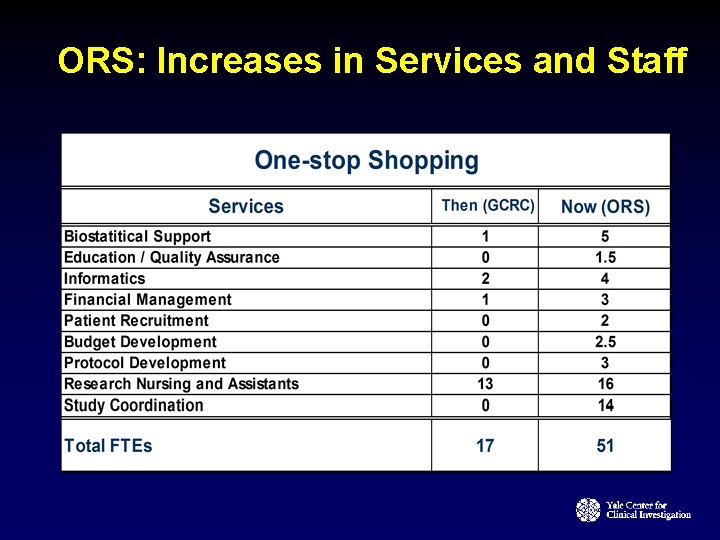
ORS: Increases in Services and Staff
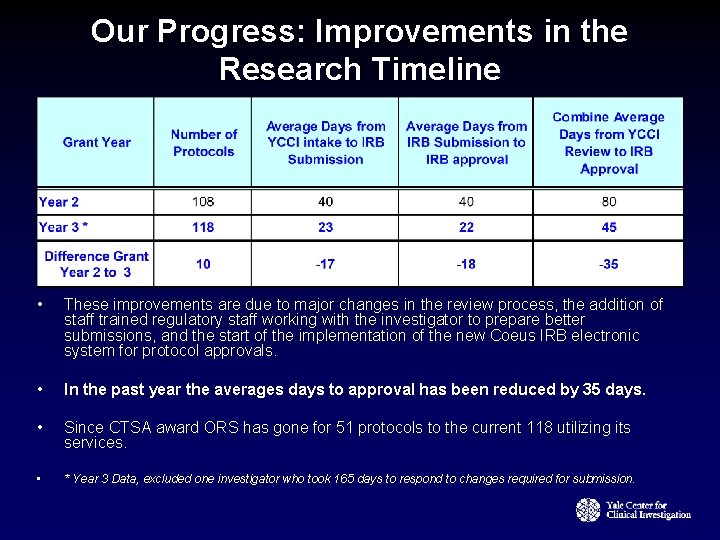
Our Progress: Improvements in the Research Timeline • These improvements are due to major changes in the review process, the addition of staff trained regulatory staff working with the investigator to prepare better submissions, and the start of the implementation of the new Coeus IRB electronic system for protocol approvals. • In the past year the averages days to approval has been reduced by 35 days. • Since CTSA award ORS has gone for 51 protocols to the current 118 utilizing its services. • * Year 3 Data, excluded one investigator who took 165 days to respond to changes required for submission.
Participant & Clinical Interaction Resource (PCIR) Components at Yale • Hospital Research Unit (HRU) former GCRC Unit • New research unit at 2 Church Street South
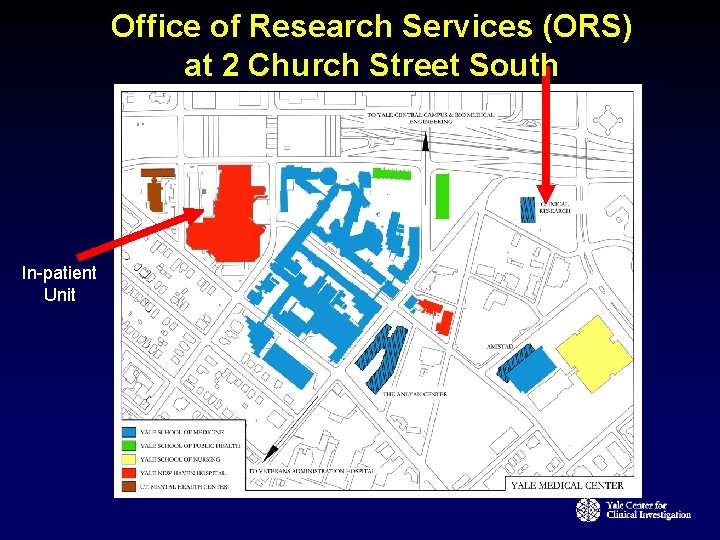
Office of Research Services (ORS) at 2 Church Street South In-patient Unit
Office of Research Services (ORS) Clinical Facilities YNHH 10 -6 and 2 Church Street So These facility includes: • Examining rooms (Inpatient and outpatient) • Office space for clinical research personnel (e. g. RN and APRN nurse coordinators, patient care associates, research assistants conducting studies on site) • Reception area & waiting room for research subjects & families • Phlebotomy and blood processing facility • Freezers and refrigerators • Storage space • Conference Rooms
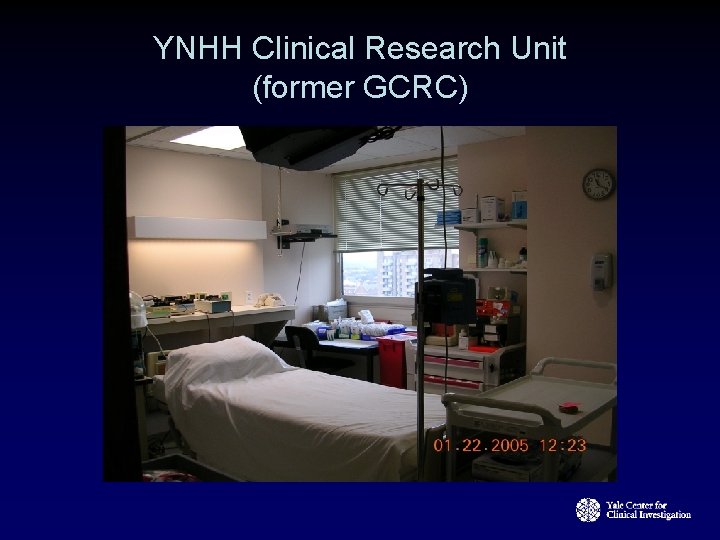
YNHH Clinical Research Unit (former GCRC)
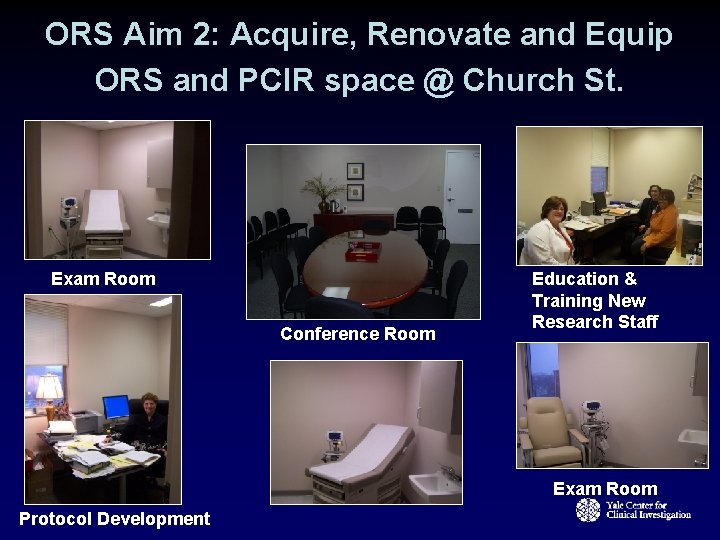
ORS Aim 2: Acquire, Renovate and Equip ORS and PCIR space @ Church St. Exam Room Conference Room Education & Training New Research Staff Exam Room Protocol Development
Church Street Clinical Research Unit (Minimal Risk Outpatient Studies) This facility includes: • 6 Examining rooms • Office space for clinical research personnel, • Waiting room for research subjects and families, • Phlebotomy and blood processing facility, • Freezers and refrigerators • Storage space
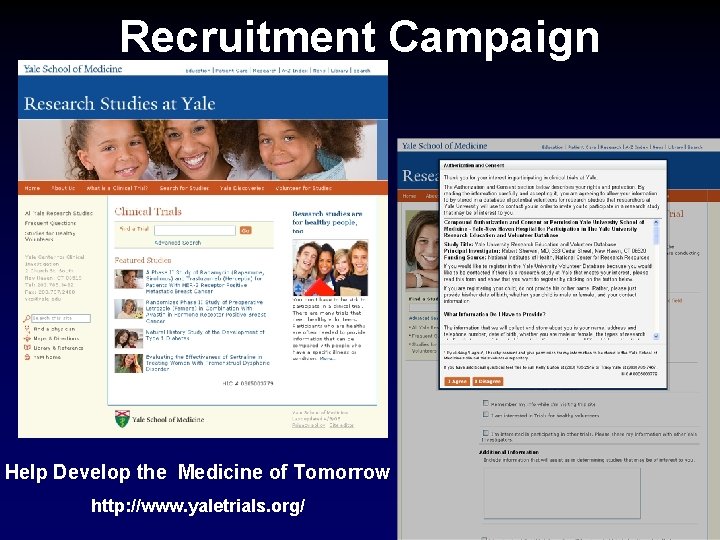
Recruitment Campaign Help Develop the Medicine of Tomorrow http: //www. yaletrials. org/
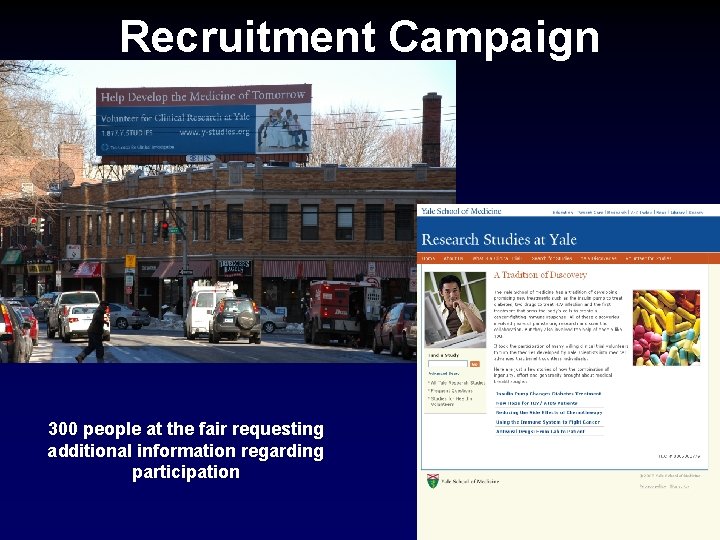
Recruitment Campaign 300 people at the fair requesting additional information regarding participation
YCCI: Pilot Grant Programs
Pilot & Collaborative Translational and Clinical Studies Funding: 2 Yrs Committee will be formed to review pilot progress
Pilot and Collaborative Translational and Clinical Studies Funding Departments Represented
YCCI: Research Cores
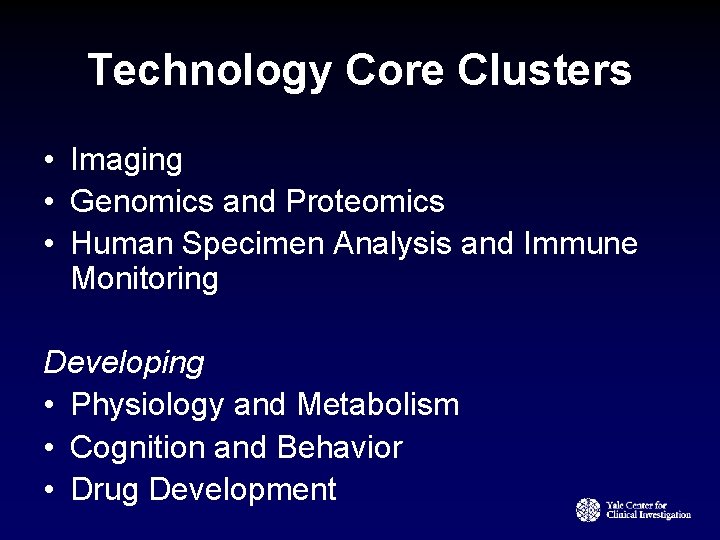
Technology Core Clusters • Imaging • Genomics and Proteomics • Human Specimen Analysis and Immune Monitoring Developing • Physiology and Metabolism • Cognition and Behavior • Drug Development
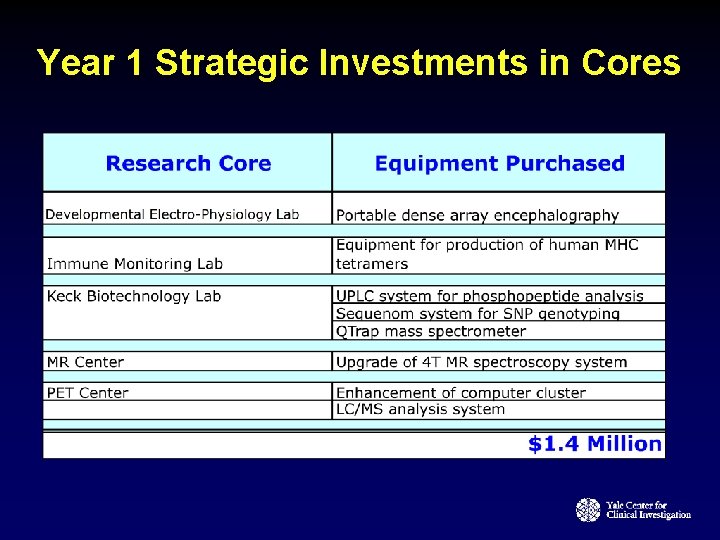
Year 1 Strategic Investments in Cores
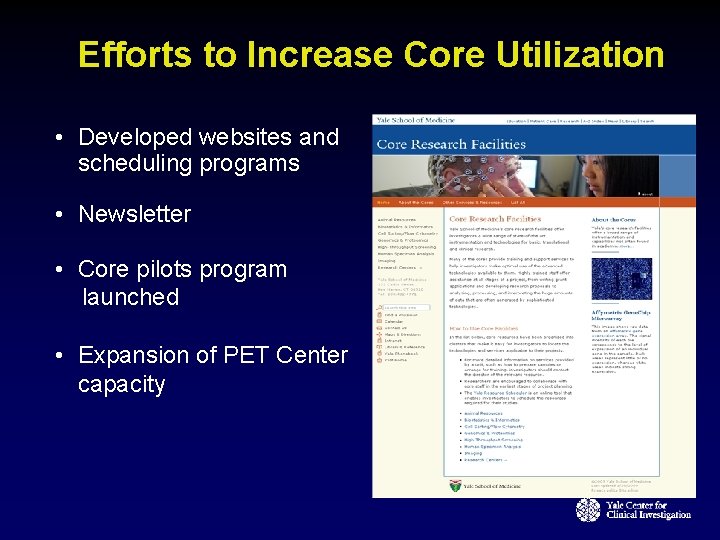
Efforts to Increase Core Utilization • Developed websites and scheduling programs • Newsletter • Core pilots program launched • Expansion of PET Center capacity
YCCI: Biostats and Study Design
The Biostatistics & Study Design Core: Programmatic Goals • Provide Biostatistical Support Services and Methodological Expertise to investigators and YCCI Scholars in the design and execution of clinical and translational research • The teaching of biostatistics and study design to students, fellows, and junior faculty members.
Vision for the Biostatistics & Study Design Core: 1. To be the link between YSPH research expertise and Yale investigators. 2. To become a hub for integration of Biostatical support on the Health Sciences Campus. 3. Develop a plan with EPH to assist in the development of an epi-genetics program focused on a specific disease. 4. The areas CTSA considers most critical for the new Director to develop: Data coordinating center for clinical trials Genomics
YCCI: Informatics
Biomedical Informatics Core Research Support and programmatic goals: • Web-accessible databases for collection of research data (Trial DB) • Specimen/study tracking system (LIMS, nearly completed) • Institutional clinical data repository (Programmatic goal)
Biorepository Progress Kevan Herold, M. D. , YCCI Biorepository Director • Biorepository Committee established. Repository will be used for storage of tissue, peripheral blood cells, DNA, and serum from patients. • IRB approved protocol for storage of samples by Yale investigators • Jr. Faculty search underway with jointly with Department of Laboratory Medicine • ca. TISSUE (centralized tissue-banking tool) - Michael Krauthammer, M. D. , Ph. D. awarded $175, 000 NCI contract to contribute to the ongoing ca. TISSUE development. Software allows flexible clinical and genomic annotations, and multi-site banking. Yale is sharing the content of ca. TISSUE on ca. GRID, making Yale part of the overall ca. BIG effort to accelerate translational research by creating an federated biorepository among ca. BIG participating institutions. • Joint grant with the Yale Cancer Center has been submitted to expand support for the repository for clinical samples
YCCI: Community Engagement
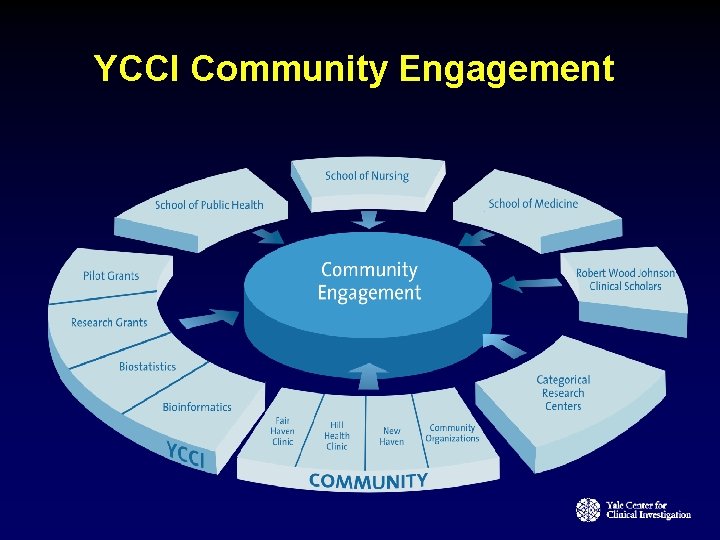
YCCI Community Engagement
YCCI Community Engagement YCCI community engagement efforts: • Community Alliance for Research and Engagement (CARE) • Research and Network collaborations with the Yale School of Nursing • Collaboration with the Yale Cancer Center to establish the Connecticut Clinical Oncology Trials Network (CCOT) • New Foundation Grant $800 K award “Changing Life-Styles for Better Health: a Model Program for Community Health Centers” A Hill Health-Yale joint research study (Tamborlane) • Bright Bodies Program
YCCI - School of Nursing Community Engagement Efforts: Yale received 1 of 6 Clinical Research Network Feasibility Awards (CRNFAs). • Yale University will collaborate with the Advanced Practice Registered Nurse Research Network (APRNet) to create a larger, interdisciplinary, practice-based research network to conduct clinical research studies within the community • YCCI will support the APRN network with Pilot funds for demonstration projects and administrative support
Thank You Questions? For more information on YCCI: Theresa C. Katz (203) 785 -6335 theresa. katz@yale. edu
- Slides: 57