
Yakima River Reconditioned Steelhead Reproductive Success Spawning Channel

- Slides: 26
Yakima River Reconditioned Steelhead Reproductive Success: Spawning Channel and Natural Setting Authors: Doug Hatch (PI)1, Dave Fast 2, Ryan Branstetter*1, Chad Stockton 3, Chris Frederiksen 2, Joe Blodgett 2, Bill Bosch 2, Gabe Temple 3, Andrew Pierce 1, 4, Jeff Stephenson 1, Tim Resseguie 2, Charlie Strom 2, Jeff Trammell 2, Anthony Fritts 3, Zack Mays 3, Bill Fiander 2, Jeremiah Newell 1, Bobby Begay 1, Mark Johnston 2. 1 Columbia River Inter-Tribal Fish Commission, 700 NE Multnomah St. , Portland, OR 97232 Yakima-Klickitat Fisheries Program, WA-22, Toppenish, WA 98948 3 Washington Department of Fish and Wildlife, 201 North Pearl Street Ellensburg, WA 98926 4 University of Idaho, 606 S Rayburn St. , Moscow, ID 2 Research Project Funding Provided by:
Research Questions: Spawning Channel 1. 2. 3. Can reconditioned kelt steelhead find mates build redds, and successfully spawn in an artificial spawning channel? (2015) Do reconditioned kelt steelhead have reproductive metrics (fry production and survival rates) similar to those of maiden steelhead in an artificial spawning channel? (2016) Are spawning behaviors of reconditioned kelt steelhead similar to those of maiden steelhead in an artificial spawning channel? (2017/18) Natural Setting 1. 2. 3. 4. Do artificially reconditioned kelt steelhead reproduce in the wild? What percentage of artificially reconditioned kelt steelhead had at least one progeny assignment? What is the relative reproductive success (RRS) of artificially reconditioned kelt steelhead? What is the lifetime reproductive success (LRS) of artificially reconditioned kelt steelhead?
Steelhead Reconditioned Kelt Study Background • • • Post spawn steelhead (O. mykiss) are termed kelts Kelts are captured at Chandler Juvenile Bypass at Prosser Dam. Kelt research Started @ Prosser in 1999 Initial experiments worked on improving survival (avg. ~40%) Kelts are Reconditioned= treated prophylactically and fed for 6 -9 months. Kelts are typically released the same year below Prosser Dam to monitor migratory movement upstream. (PIT-tags) Collected 9, 028 kelts and released 3, 701 successfully reconditioned steelhead (20002015). Individual survival correlated with fish condition. See Hatch et al. 2013 NAJFM and Trammel et al. 2016 NAJFM (in Press) for further information on the kelt reconditioning process and management strategies tested. Laura Jenkins will speak about kelt reproduction
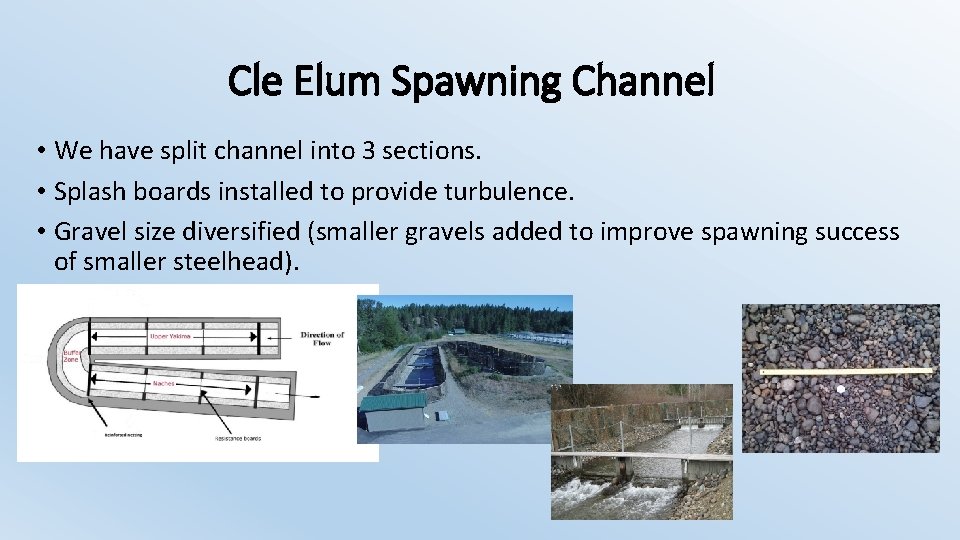
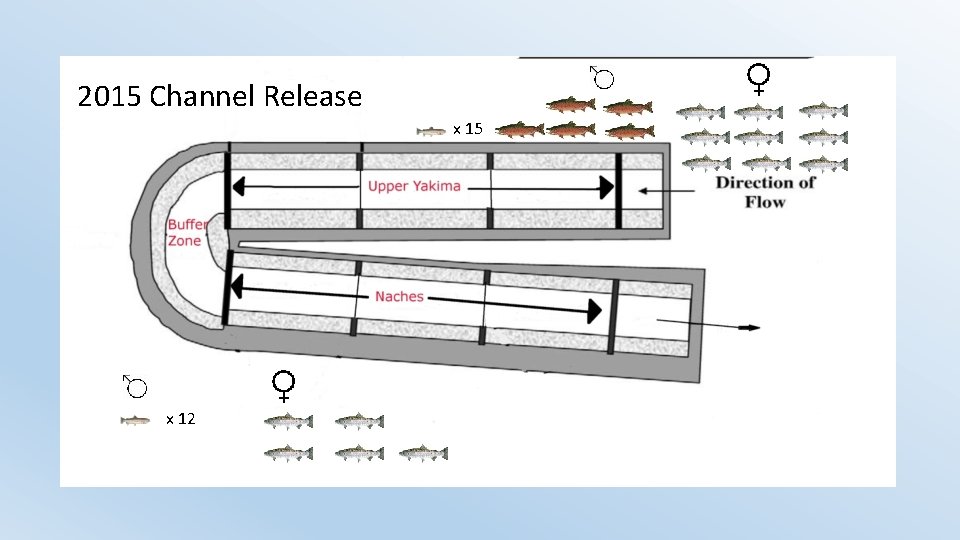
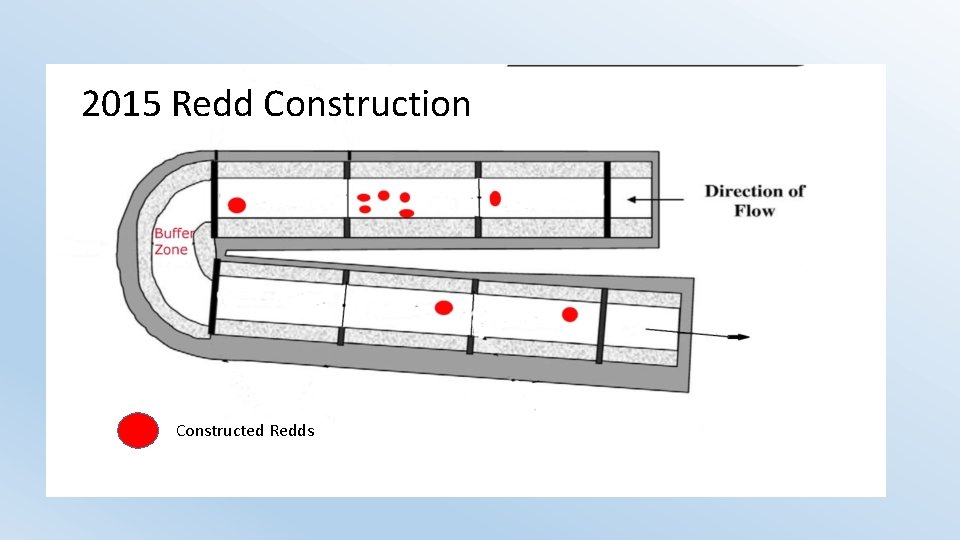
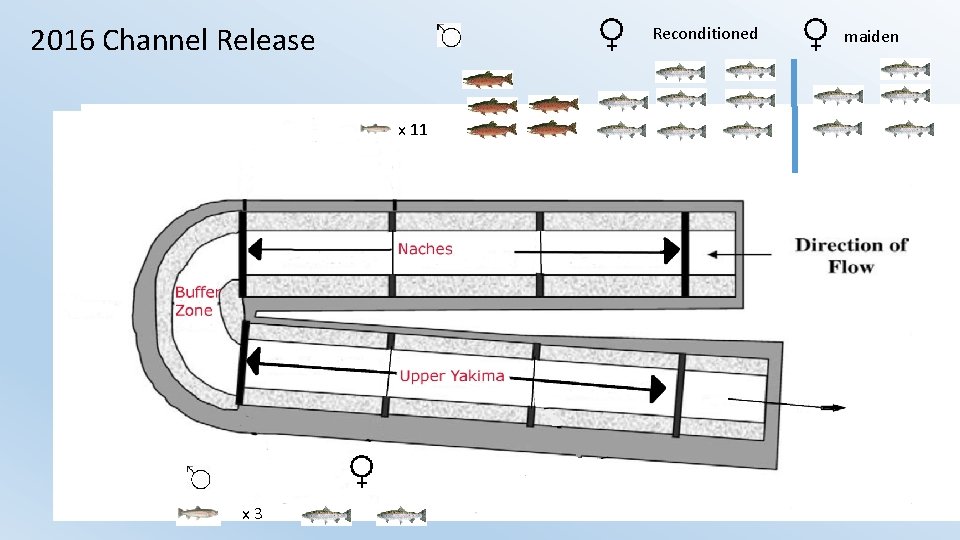
Cle Elum Spawning Channel • We have split channel into 3 sections. • Splash boards installed to provide turbulence. • Gravel size diversified (smaller gravels added to improve spawning success of smaller steelhead).
2015 Channel Release x 15 x 12
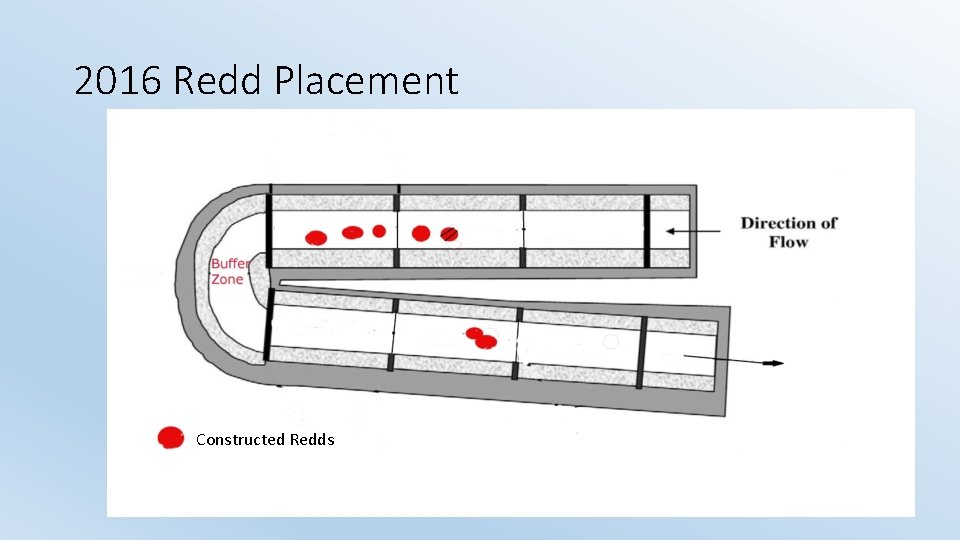
2015 Redd Construction Constructed Redds
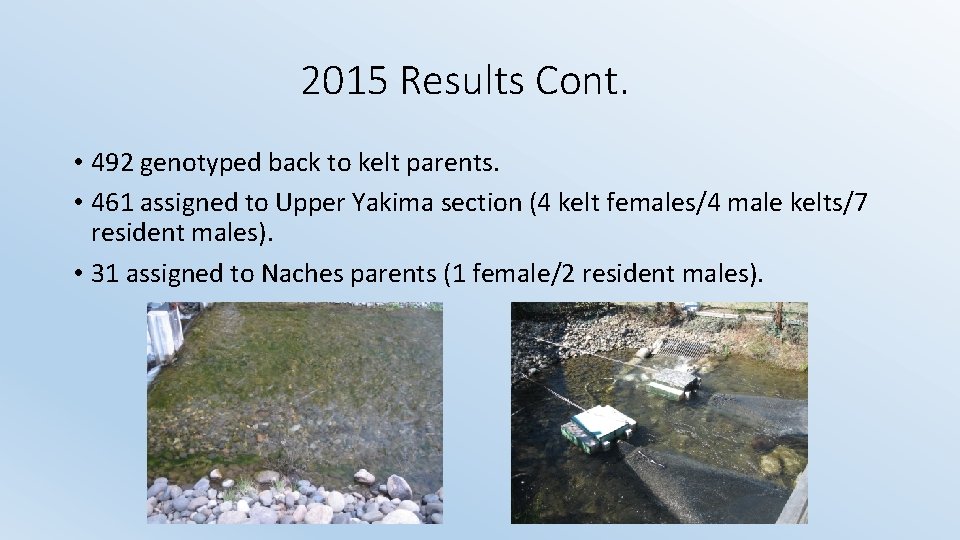
2015 Results Cont. • 492 genotyped back to kelt parents. • 461 assigned to Upper Yakima section (4 kelt females/4 male kelts/7 resident males). • 31 assigned to Naches parents (1 female/2 resident males).
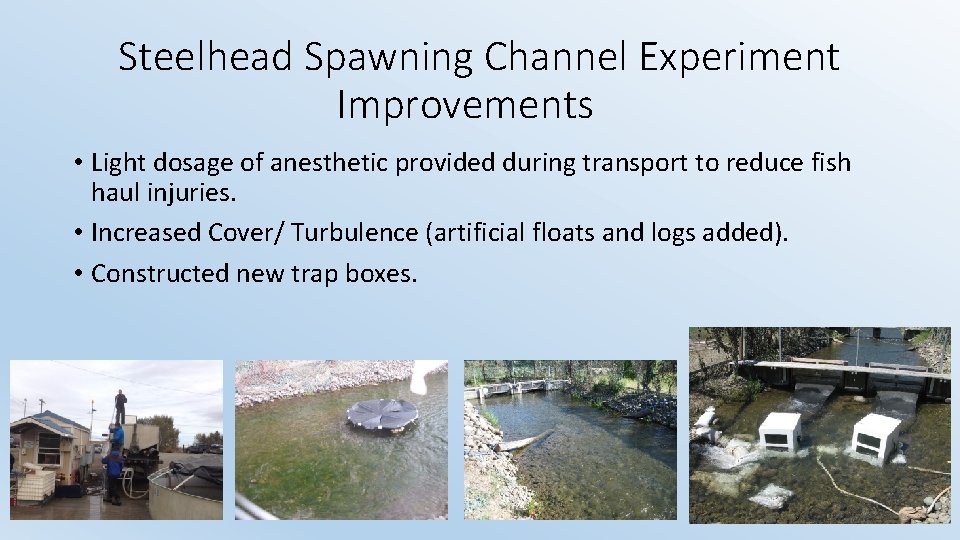
Steelhead Spawning Channel Experiment Improvements • Light dosage of anesthetic provided during transport to reduce fish haul injuries. • Increased Cover/ Turbulence (artificial floats and logs added). • Constructed new trap boxes.
2016 Channel Release Reconditioned x 11 x 3 maiden
2016 Redd Placement Constructed Redds
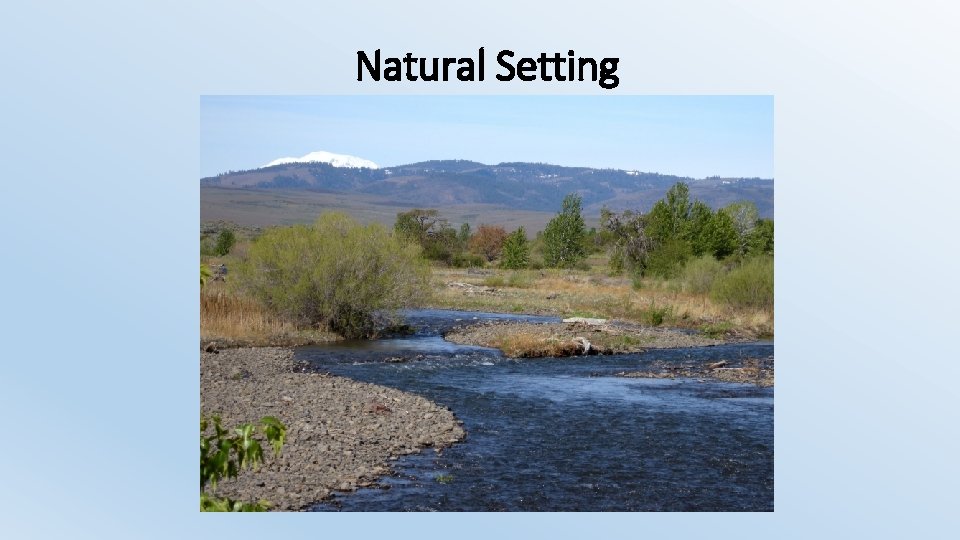
Natural Setting
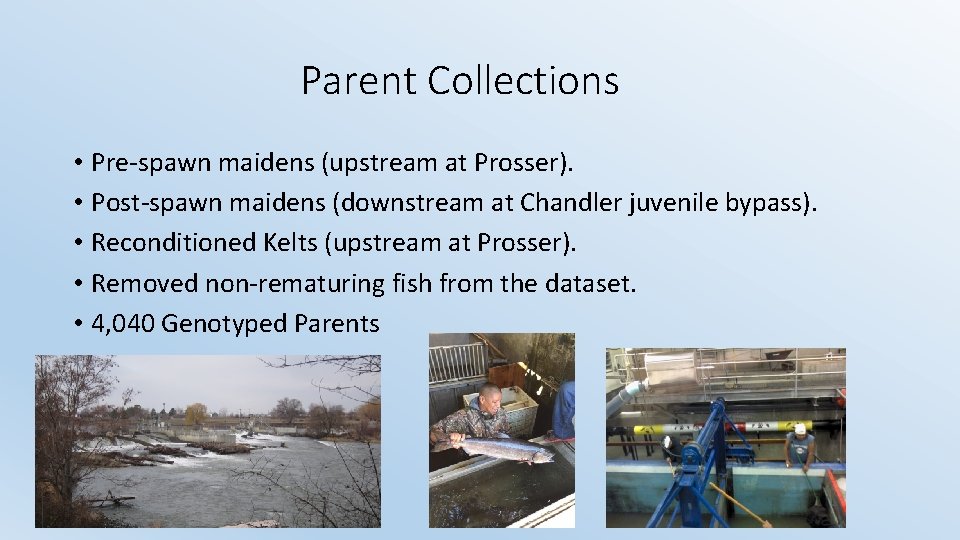
Parent Collections • Pre-spawn maidens (upstream at Prosser). • Post-spawn maidens (downstream at Chandler juvenile bypass). • Reconditioned Kelts (upstream at Prosser). • Removed non-rematuring fish from the dataset. • 4, 040 Genotyped Parents
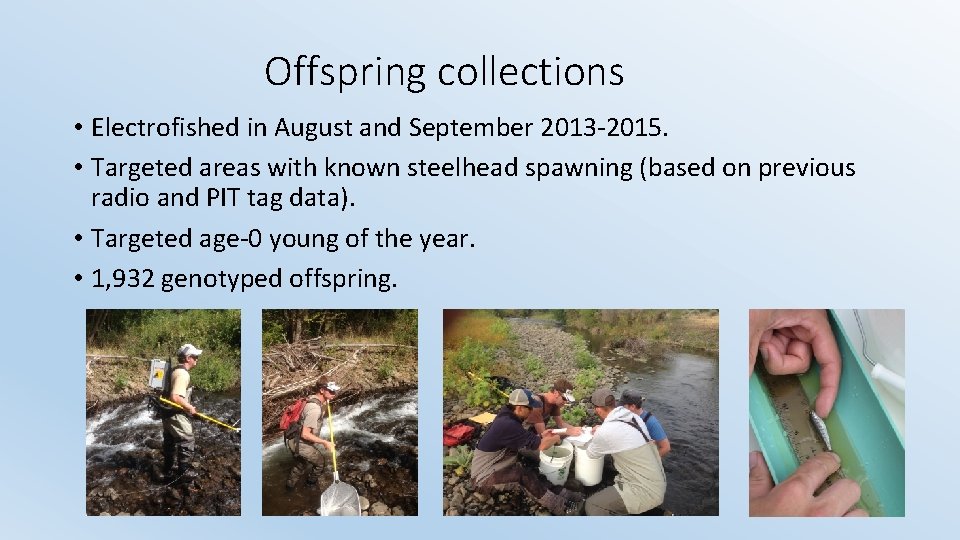
Offspring collections • Electrofished in August and September 2013 -2015. • Targeted areas with known steelhead spawning (based on previous radio and PIT tag data). • Targeted age-0 young of the year. • 1, 932 genotyped offspring.
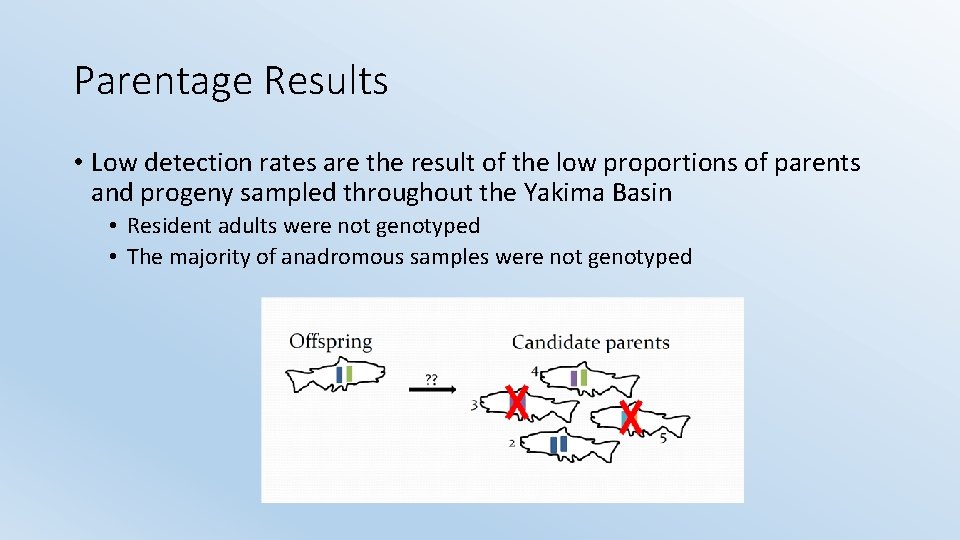
Parentage Results • Low detection rates are the result of the low proportions of parents and progeny sampled throughout the Yakima Basin • Resident adults were not genotyped • The majority of anadromous samples were not genotyped
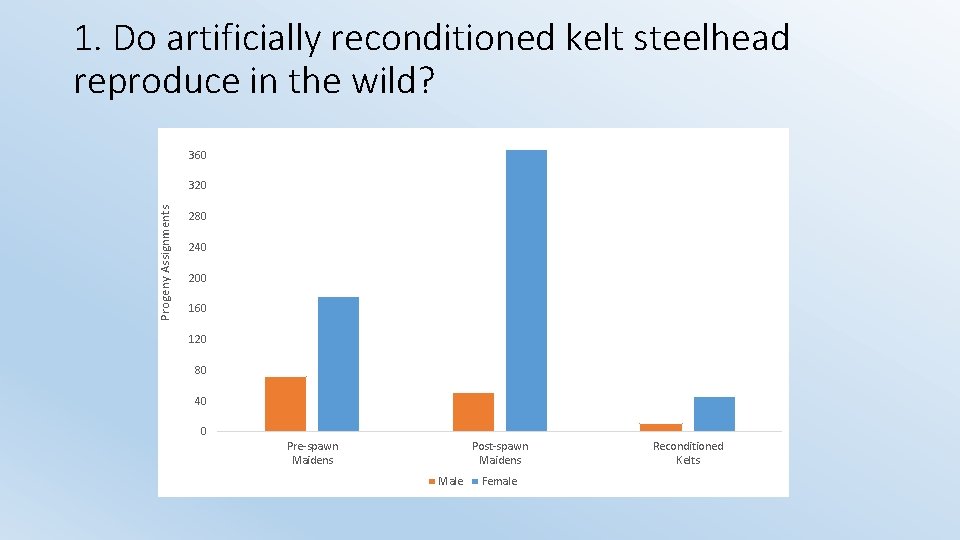
1. Do artificially reconditioned kelt steelhead reproduce in the wild? 360 Progeny Assignments 320 280 240 200 160 120 80 40 0 Pre-spawn Maidens Post-spawn Maidens Male Female Reconditioned Kelts
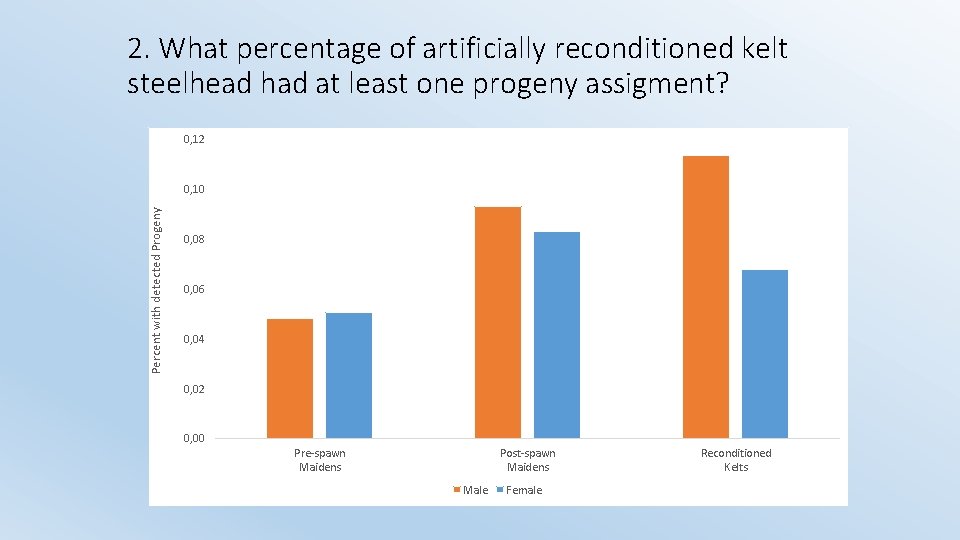
2. What percentage of artificially reconditioned kelt steelhead had at least one progeny assigment? 0, 12 Percent with detected Progeny 0, 10 0, 08 0, 06 0, 04 0, 02 0, 00 Pre-spawn Maidens Post-spawn Maidens Male Female Reconditioned Kelts
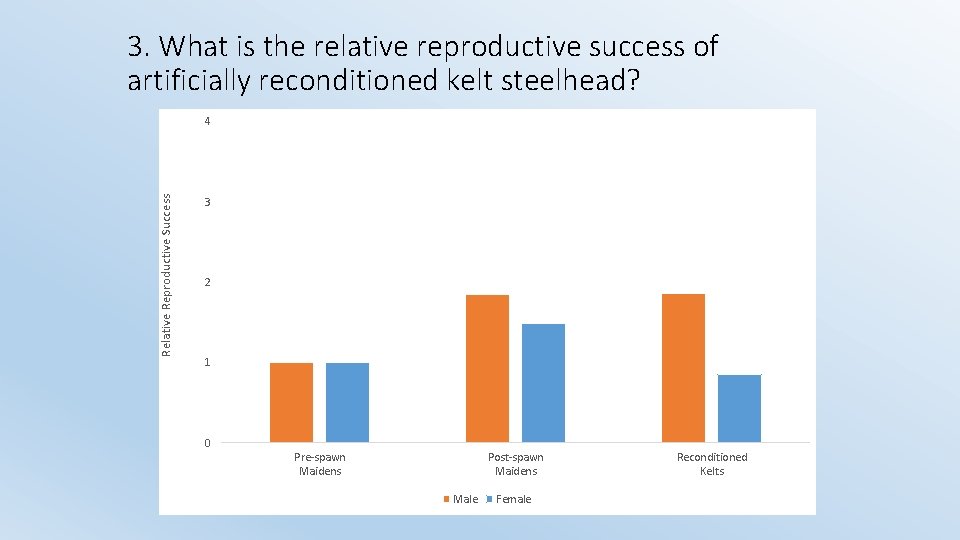
3. What is the relative reproductive success of artificially reconditioned kelt steelhead? Relative Reproductive Success 4 3 2 1 0 Pre-spawn Maidens Post-spawn Maidens Male Female Reconditioned Kelts
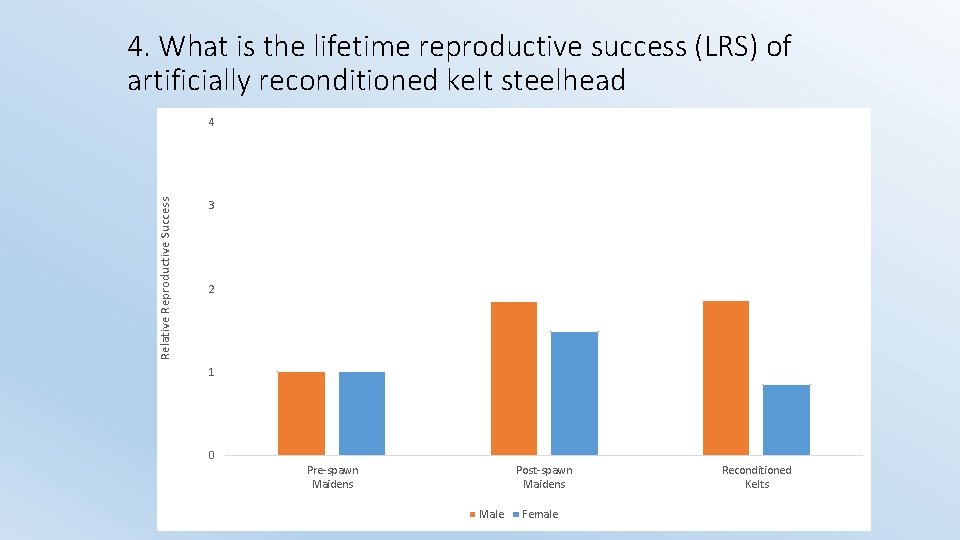
4. What is the lifetime reproductive success (LRS) of artificially reconditioned kelt steelhead Relative Reproductive Success 4 3 2 1 0 Pre-spawn Maidens Post-spawn Maidens Male Female Reconditioned Kelts
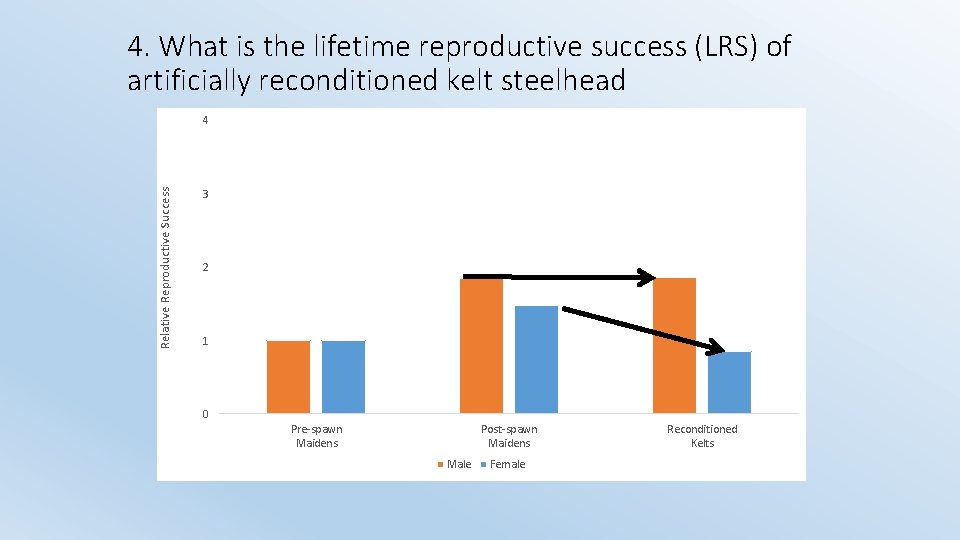
4. What is the lifetime reproductive success (LRS) of artificially reconditioned kelt steelhead Relative Reproductive Success 4 3 2 1 0 Pre-spawn Maidens Post-spawn Maidens Male Female Reconditioned Kelts
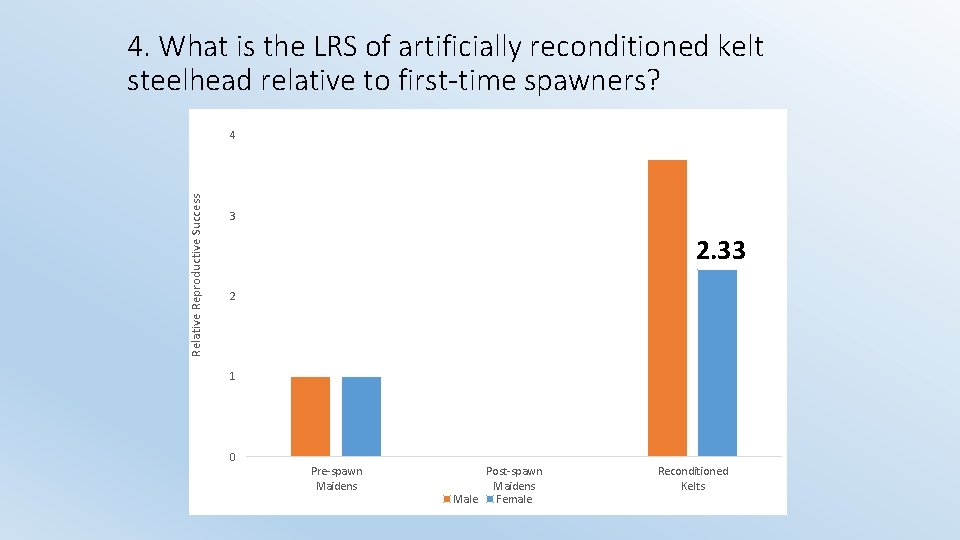
4. What is the LRS of artificially reconditioned kelt steelhead relative to first-time spawners? Relative Reproductive Success 4 3 2. 33 2 1 0 Pre-spawn Maidens Post-spawn Maidens Male Female Reconditioned Kelts
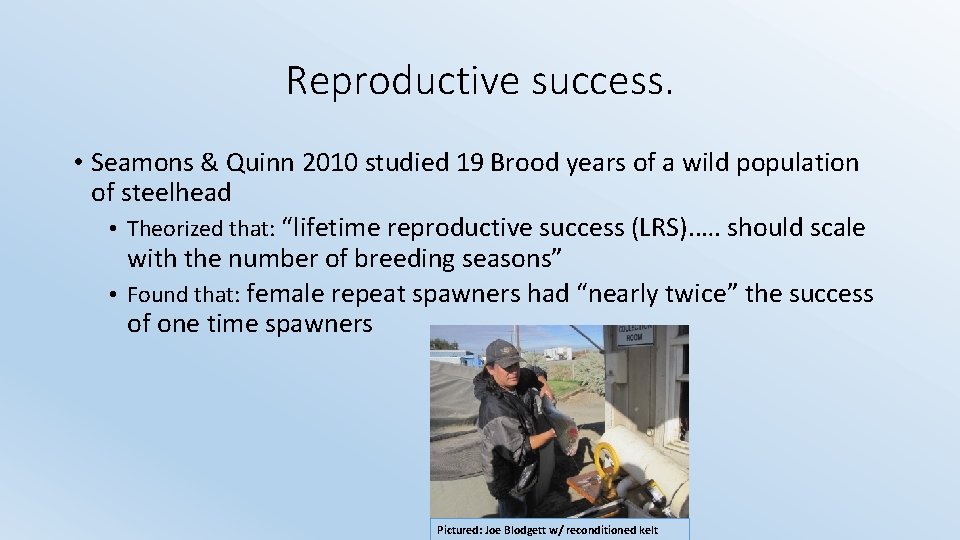
Reproductive success. • Seamons & Quinn 2010 studied 19 Brood years of a wild population of steelhead • Theorized that: “lifetime reproductive success (LRS). …. should scale with the number of breeding seasons” • Found that: female repeat spawners had “nearly twice” the success of one time spawners Pictured: Joe Blodgett w/ reconditioned kelt
Preliminary Conclusions: Cle Elum Channel • Reconditioned Steelhead can successfully reproduce in the channel. • Resident fish are capable of successfully reproducing with anadromous females. • Maiden steelhead chose to spawn in similar areas that kelts chose to spawn in the channel. • Prespawn mortality occurred in both maiden and reconditioned fish.
Preliminary Conclusions: Natural Setting • Reconditioned kelt steelhead are spawning in the wild. • Female reconditioned kelt LRS was 2. 33, which roughly scales with number of spawning events. • Reconditioned kelts have the potential to increase productivity of natural populations with virtually no negative side effects.
Future Goals • Possibly include behavioral observations of resident/maiden and reconditioned steelhead interactions. • Publish results in peerreviewed journals. • Increase juvenile sampling to increase detection power • Isolate Reproductive success to Satus and Toppenish • • Upper Yakima has fewer steelhead Upper Yakima may be under represented in the kelts We have good sampling success in Satus and Toppenish We have good adult PIT detections in Satus and Toppenish. This can be used to parse out non-migrating adults or adults destined to spawn in the Naches and Upper Yakima • Publish results in peer-reviewed journals.
Acknowledgments • • • • Sharon Lutz @ USFWS DJ Brownlee @ Cle Elum Fish Facility (YN) Bill Fiander and fish trap and haul crew (YN) Conan Northwind (YN) Michael Fiander, OJ, and the rest of the Prosser Fish Hatchery Crew (YN) Dr. Dale Mc. Cullough @ CRITFC Dr. Barry Berejikian @ NOAA Kevin Fulks and the rest of the WDFW Yakima construction shop crew WDFW genetic sampling crew John Easterbrook (WDFW) Yakama Nation and Dr. David Fast Tracy Hauser (BPA) Todd Newsome (YN) Ryan Deknikker (YN) Hagerman Genetics Laboratory (CRITFC)
Questions? • brar@critfc. org