
Y Transformation 2 7 Circuits with Dependent Sources




- Slides: 18
-Y Transformation (2. 7); Circuits with Dependent Sources (2. 8) Dr. Holbert February 13, 2006 ECE 201 Lect-8 1
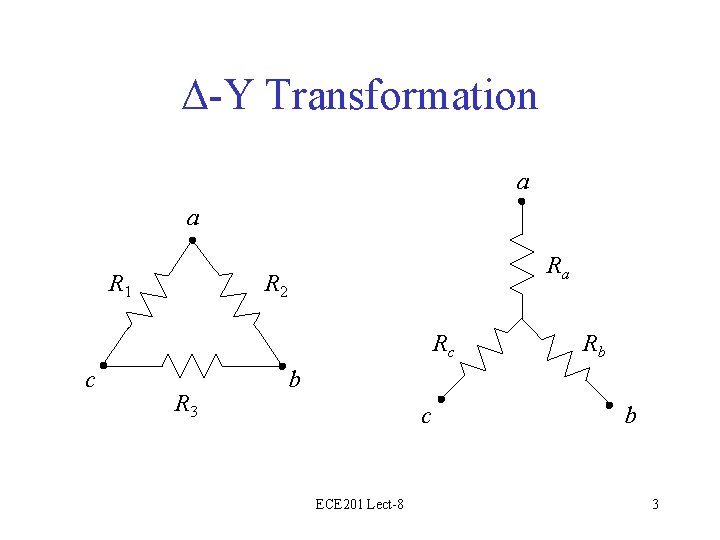
-Y Transformation • A particular configuration of resistors (or impedances) that does not lend itself to the using series and parallel combination techniques is that of a delta ( ) connection • In such cases the delta ( ) connection is converted to a wye (Y) configuration • The reverse transformation can also be performed ECE 201 Lect-8 2
-Y Transformation a a R 1 Ra R 2 Rc c R 3 Rb b c ECE 201 Lect-8 b 3
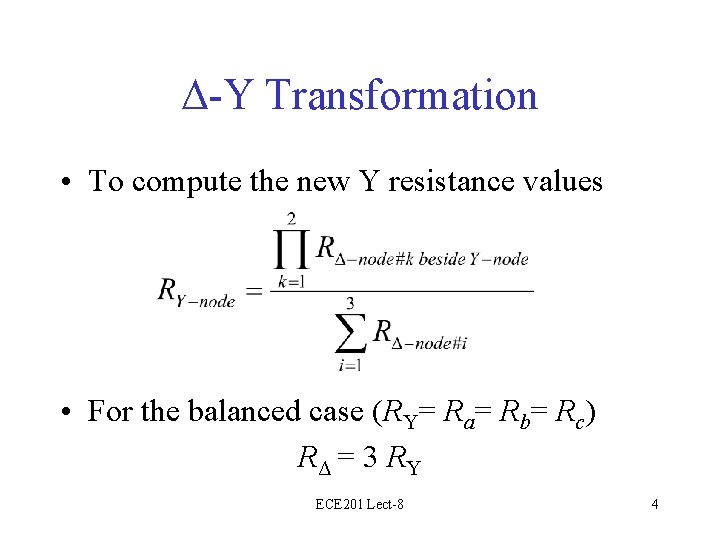
-Y Transformation • To compute the new Y resistance values • For the balanced case (RY= Ra= Rb= Rc) RΔ = 3 RY ECE 201 Lect-8 4
Class Example • Learning Extension 2. 17 • Learning Extension 2. 18 ECE 201 Lect-8 5
Circuits with Dependent Sources Strategy: • Apply KVL and KCL, treating dependent source(s) as independent sources. • Determine the relationship between dependent source values and controlling parameters. • Solve equations for unknowns. ECE 201 Lect-8 6
Example: Inverting Amplifier • The following circuit is a (simplified) model for an inverting amplifier created from an operational amplifier (op-amp). • It is an example of negative feedback. ECE 201 Lect-8 7
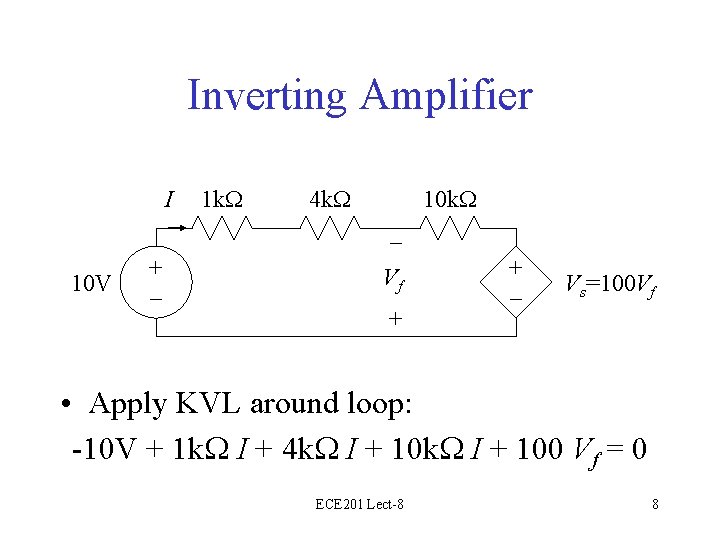
Inverting Amplifier I 10 V + – 1 k. W 4 k. W 10 k. W – Vf + + – Vs=100 Vf • Apply KVL around loop: -10 V + 1 k. W I + 4 k. W I + 100 Vf = 0 ECE 201 Lect-8 8
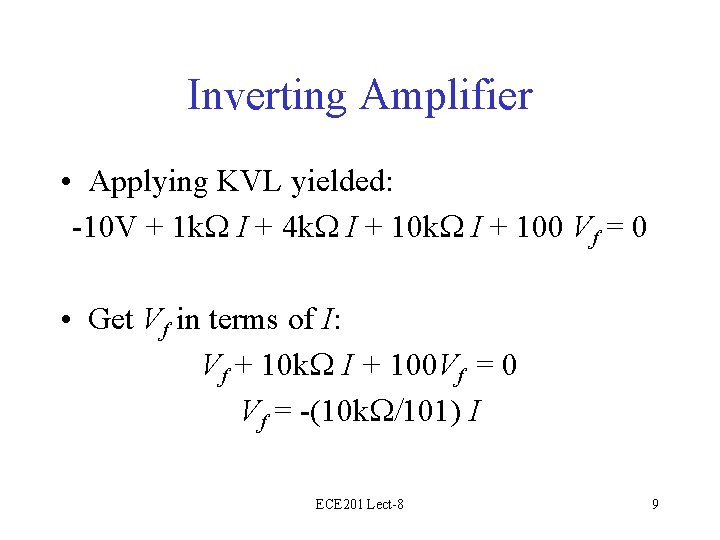
Inverting Amplifier • Applying KVL yielded: -10 V + 1 k. W I + 4 k. W I + 100 Vf = 0 • Get Vf in terms of I: Vf + 10 k. W I + 100 Vf = 0 Vf = -(10 k. W/101) I ECE 201 Lect-8 9
Inverting Amplifier • Solve for I: I = 1. 961 m. A • Solve for Vf : Vf = -0. 194 V • Solve for source voltage: Vs = -19. 4 V ECE 201 Lect-8 10
Amplifier Gain • Repeat the previous example for a gain of 1000 • Answer: Vs = -19. 94 V ECE 201 Lect-8 11
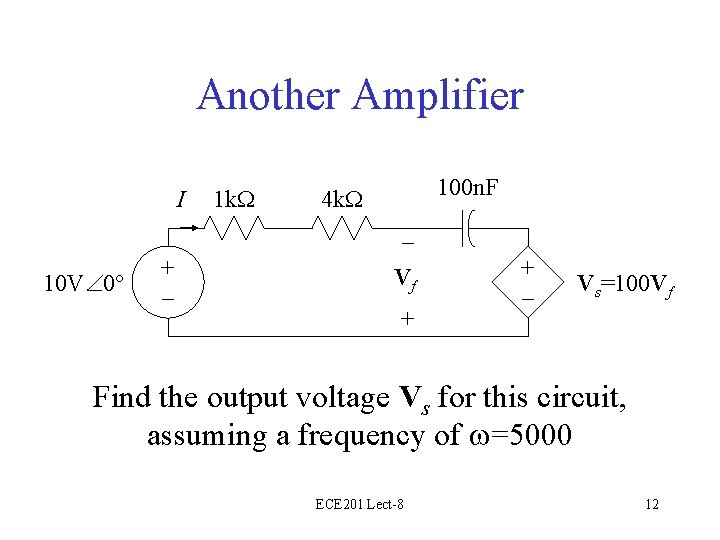
Another Amplifier I 10 V 0 + – 1 k. W 100 n. F 4 k. W – Vf + + – Vs=100 Vf Find the output voltage Vs for this circuit, assuming a frequency of w=5000 ECE 201 Lect-8 12
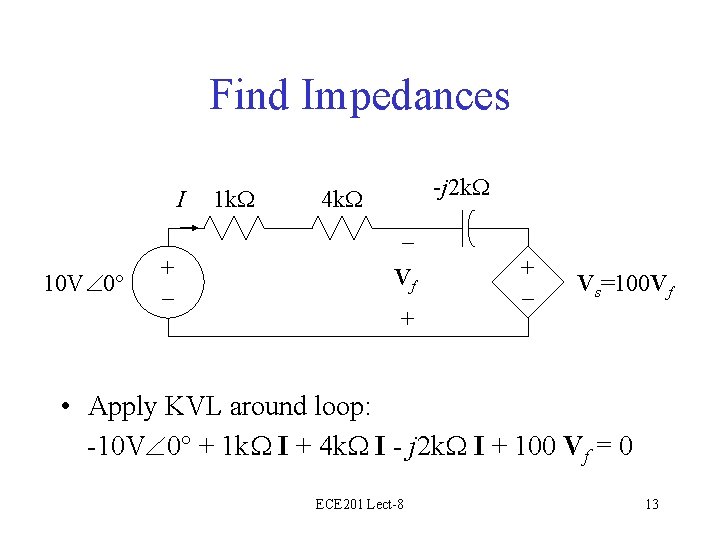
Find Impedances I 10 V 0 + – 1 k. W -j 2 k. W 4 k. W – Vf + + – Vs=100 Vf • Apply KVL around loop: -10 V 0 + 1 k. W I + 4 k. W I - j 2 k. W I + 100 Vf = 0 ECE 201 Lect-8 13
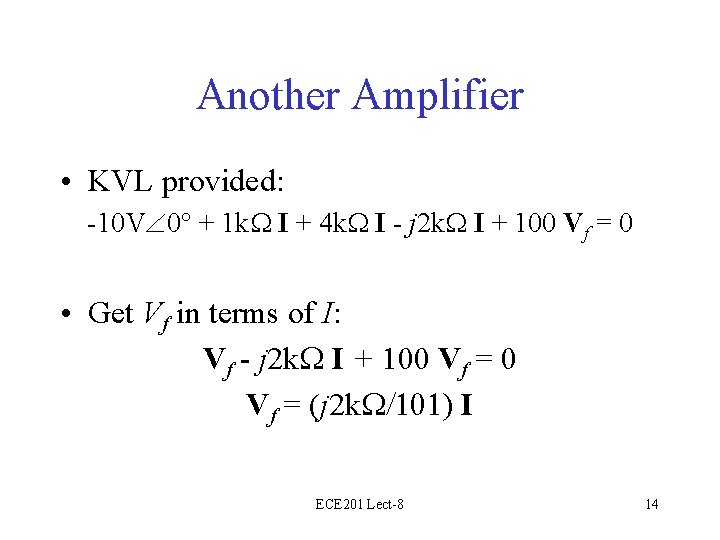
Another Amplifier • KVL provided: -10 V 0 + 1 k. W I + 4 k. W I - j 2 k. W I + 100 Vf = 0 • Get Vf in terms of I: Vf - j 2 k. W I + 100 Vf = (j 2 k. W/101) I ECE 201 Lect-8 14
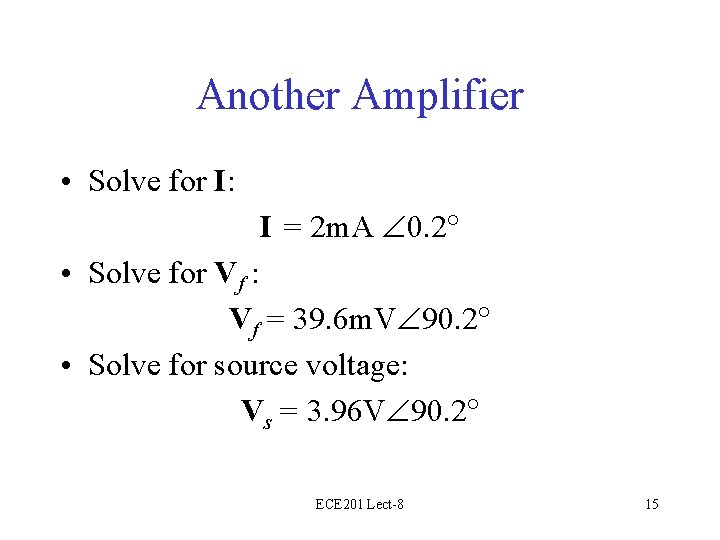
Another Amplifier • Solve for I: I = 2 m. A 0. 2 • Solve for Vf : Vf = 39. 6 m. V 90. 2 • Solve for source voltage: Vs = 3. 96 V 90. 2 ECE 201 Lect-8 15
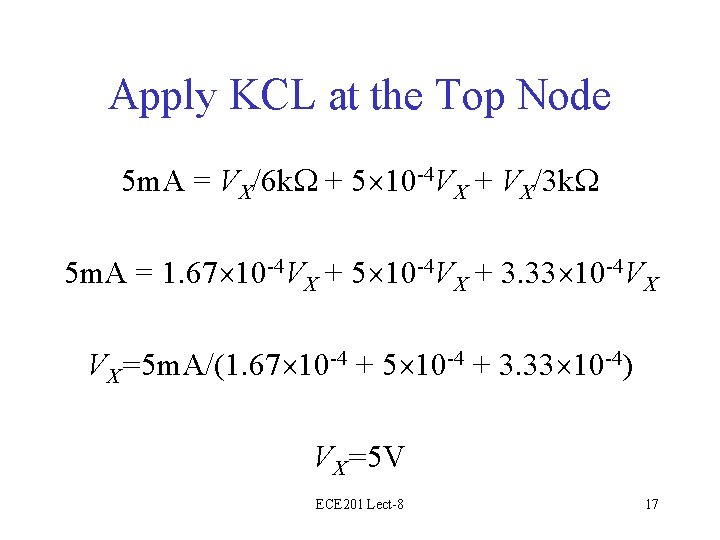
Transistor Amplifier A small-signal linear equivalent circuit for a transistor amplifier is the following: 5 m. A 6 k. W 5 10 -4 VX + 3 k. W VX – Find VX ECE 201 Lect-8 16
Apply KCL at the Top Node 5 m. A = VX/6 k. W + 5 10 -4 VX + VX/3 k. W 5 m. A = 1. 67 10 -4 VX + 5 10 -4 VX + 3. 33 10 -4 VX VX=5 m. A/(1. 67 10 -4 + 5 10 -4 + 3. 33 10 -4) VX=5 V ECE 201 Lect-8 17
Class Examples • Learning Extension E 2. 19 • Learning Extension E 2. 20 ECE 201 Lect-8 18