
Y 9 Knowledge Organiser World War Two 1939
- Slides: 2
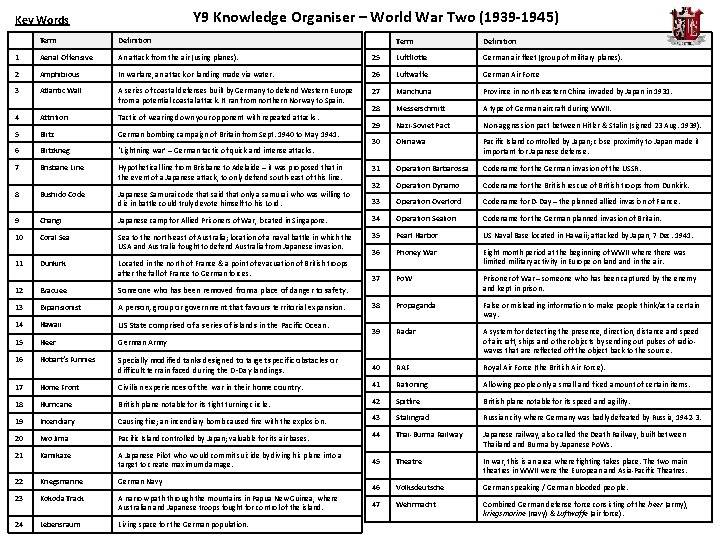
Y 9 Knowledge Organiser – World War Two (1939 -1945) Key Words Term Definition 1 Aerial Offensive An attack from the air (using planes). 2 Amphibious 3 Term Definition 25 Luftflotte German air fleet (group of military planes). In warfare, an attack or landing made via water. 26 Luftwaffe German Air Force Atlantic Wall A series of coastal defenses built by Germany to defend Western Europe from a potential coastal attack. It ran from northern Norway to Spain. 27 Manchuria Province in north-eastern China invaded by Japan in 1931. 4 Attrition Tactic of wearing down your opponent with repeated attacks. 28 Messerschmitt A type of German aircraft during WWII. 5 Blitz German bombing campaign of Britain from Sept. 1940 to May 1941. 29 Nazi-Soviet Pact Non-aggression pact between Hitler & Stalin (signed 23 Aug. 1939). 6 Blitzkrieg ‘Lightning war’ – German tactic of quick and intense attacks. 30 Okinawa Pacific Island controlled by Japan; close proximity to Japan made it important for Japanese defense. 7 Brisbane Line Hypothetical line from Brisbane to Adelaide – it was proposed that in the event of a Japanese attack, to only defend south-east of this line. 31 Operation Barbarossa Codename for the German invasion of the USSR. 8 Bushido Code Japanese Samurai code that said that only a samurai who was willing to die in battle could truly devote himself to his Lord. 32 Operation Dynamo Codename for the British rescue of British troops from Dunkirk. 33 Operation Overlord Codename for D-Day – the planned allied invasion of France. 9 Changi Japanese camp for Allied Prisoners of War, located in Singapore. 34 Operation Sealion Codename for the German planned invasion of Britain. 10 Coral Sea to the north-east of Australia; location of a naval battle in which the USA and Australia fought to defend Australia from Japanese invasion. 35 Pearl Harbor US Naval Base located in Hawaii; attacked by Japan, 7 Dec. 1941. 36 Phoney War 11 Dunkirk Located in the north of France & a point of evacuation of British troops after the fall of France to German forces. Eight month period at the beginning of WWII where there was limited military activity in Europe on land in the air. 37 Po. W 12 Evacuee Someone who has been removed from a place of danger to safety. Prisoner of War – someone who has been captured by the enemy and kept in prison. 13 Expansionist A person, group or government that favours territorial expansion. 38 Propaganda False or misleading information to make people think/act a certain way. 14 Hawaii US State comprised of a series of islands in the Pacific Ocean. 39 Radar 15 Heer German Army 16 Hobart’s Funnies Specially modified tanks designed to target specific obstacles or difficult terrain faced during the D-Day landings. A system for detecting the presence, direction, distance and speed of aircraft, ships and other objects by sending out pulses of radiowaves that are reflected off the object back to the source. 40 RAF Royal Air Force (the British Air Force). 17 Home Front Civilian experiences of the war in their home country. 41 Rationing Allowing people only a small and fixed amount of certain items. 18 Hurricane British plane notable for its tight turning circle. 42 Spitfire British plane notable for its speed and agility. 19 Incendiary Causing fire; an incendiary bomb caused fire with the explosion. 43 Stalingrad Russian city where Germany was badly defeated by Russia, 1942 -3. 20 Iwo Jima Pacific Island controlled by Japan; valuable for its air bases. 44 Thai-Burma Railway Japanese railway, also called the Death Railway, built between Thailand Burma by Japanese Po. Ws. 21 Kamikaze A Japanese Pilot who would commit suicide by diving his plane into a target to create maximum damage. 45 Theatre In war, this is an area where fighting takes place. The two main theatres in WWII were the European and Asia-Pacific Theatres. 22 Kriegsmarine German Navy 46 Volksdeutsche German speaking / German blooded people. 23 Kokoda Track A narrow path through the mountains in Papua New Guinea, where Australian and Japanese troops fought for control of the island. 47 Wehrmacht Combined German defense force consisting of the heer (army), kriegsmarine (navy) & Luftwaffe (air force). 24 Lebensraum Living space for the German population.
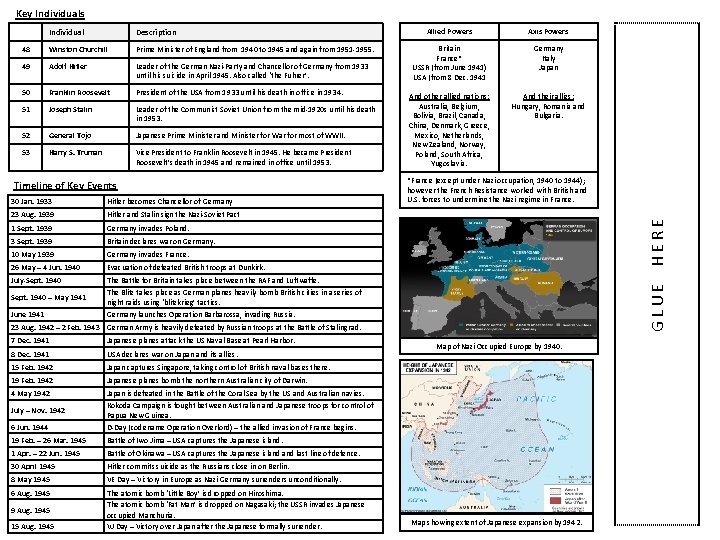
Key Individuals Description 48 Winston Churchill Prime Minister of England from 1940 to 1945 and again from 1951 -1955. 49 Adolf Hitler Leader of the German Nazi-Party and Chancellor of Germany from 1933 until his suicide in April 1945. Also called ‘the Fuhrer’. 50 Franklin Roosevelt President of the USA from 1933 until his death in office in 1934. 51 Joseph Stalin Leader of the Communist Soviet Union from the mid-1920 s until his death in 1953. 52 General Tojo Japanese Prime Minister and Minister for War for most of WWII. 53 Harry S. Truman Vice President to Franklin Roosevelt in 1945. He became President Roosevelt’s death in 1945 and remained in office until 1953. Timeline of Key Events 30 Jan. 1933 Hitler becomes Chancellor of Germany 23 Aug. 1939 Hitler and Stalin sign the Nazi-Soviet Pact 1 Sept. 1939 Germany invades Poland. 3 Sept. 1939 Britain declares war on Germany. 10 May 1939 Germany invades France. 26 May – 4 Jun. 1940 Evacuation of defeated British troops at Dunkirk. July-Sept. 1940 The Battle for Britain takes place between the RAF and Luftwaffe. The Blitz takes place as German planes heavily bomb British cities in a series of night raids using ‘blitzkrieg’ tactics. Germany launches Operation Barbarossa, invading Russia. Sept. 1940 – May 1941 June 1941 Allied Powers Axis Powers Britain France* USSR (from June 1941) USA (from 8 Dec. 1941 Germany Italy Japan And other allied nations: Australia, Belgium, Bolivia, Brazil, Canada, China, Denmark, Greece, Mexico, Netherlands, New Zealand, Norway, Poland, South Africa, Yugoslavia. And their allies: Hungary, Romania and Bulgaria. *France (except under Nazi occupation, 1940 to 1944); however the French Resistance worked with British and U. S. forces to undermine the Nazi regime in France. GLUE HERE Individual 23 Aug. 1942 – 2 Feb. 1943 German Army is heavily defeated by Russian troops at the Battle of Stalingrad. 7 Dec. 1941 Japanese planes attack the US Naval Base at Pearl Harbor. 8 Dec. 1941 USA declares war on Japan and its allies. 15 Feb. 1942 Japan captures Singapore, taking control of British naval bases there. 19 Feb. 1942 Japanese planes bomb the northern Australian city of Darwin. 4 May 1942 6 Jun. 1944 Japan is defeated in the Battle of the Coral Sea by the US and Australian navies. Kokoda Campaign is fought between Australian and Japanese troops for control of Papua New Guinea. D-Day (codename Operation Overlord) – the allied invasion of France begins. 19 Feb. – 26 Mar. 1945 Battle of Iwo Jima – USA captures the Japanese island. 1 Apr. – 22 Jun. 1945 Battle of Okinawa – USA captures the Japanese island last line of defence. 30 April 1945 Hitler commits suicide as the Russians close in on Berlin. 8 May 1945 VE Day – Victory in Europe as Nazi-Germany surrenders unconditionally. 6 Aug. 1945 The atomic bomb ‘Little Boy’ is dropped on Hiroshima. The atomic bomb ‘Fat Man’ is dropped on Nagasaki; the USSR invades Japanese occupied Manchuria. VJ Day – Victory over Japan after the Japanese formally surrender. July – Nov. 1942 9 Aug. 1945 15 Aug. 1945 Map of Nazi Occupied Europe by 1940. Map showing extent of Japanese expansion by 1942.