
Y 12 A level Art Transition Project 2021
- Slides: 4
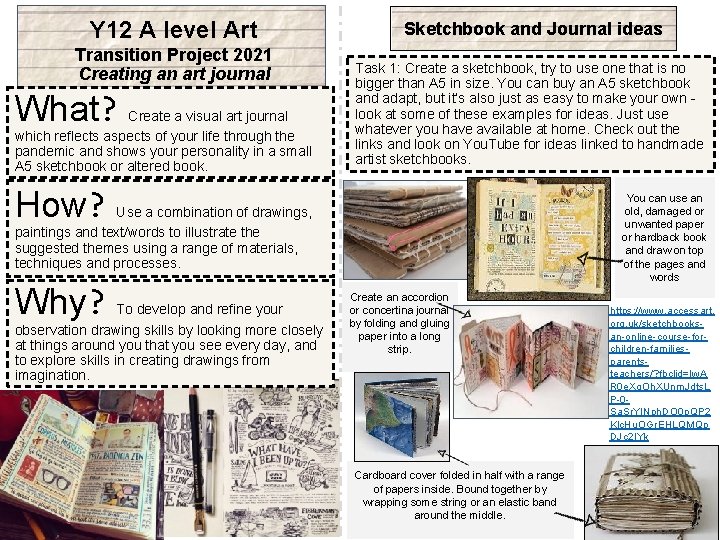
Y 12 A level Art Transition Project 2021 Creating an art journal What? Create a visual art journal which reflects aspects of your life through the pandemic and shows your personality in a small A 5 sketchbook or altered book. Sketchbook and Journal ideas Task 1: Create a sketchbook, try to use one that is no bigger than A 5 in size. You can buy an A 5 sketchbook and adapt, but it’s also just as easy to make your own look at some of these examples for ideas. Just use whatever you have available at home. Check out the links and look on You. Tube for ideas linked to handmade artist sketchbooks. How? You can use an old, damaged or unwanted paper or hardback book and draw on top of the pages and words Use a combination of drawings, paintings and text/words to illustrate the suggested themes using a range of materials, techniques and processes. Why? To develop and refine your observation drawing skills by looking more closely at things around you that you see every day, and to explore skills in creating drawings from imagination. Create an accordion or concertina journal by folding and gluing paper into a long strip. Cardboard cover folded in half with a range of papers inside. Bound together by wrapping some string or an elastic band around the middle. https: //www. accessart. org. uk/sketchbooksan-online-course-forchildren-familiesparentsteachers/? fbclid=Iw. A R 0 e. Xg. Oh. XUnm. Jdts. L P-0 Sa. Sr. YINph. DO 0 p. QP 2 Klc. Hu. OGr. EHLQMQp DJc 2 IYk
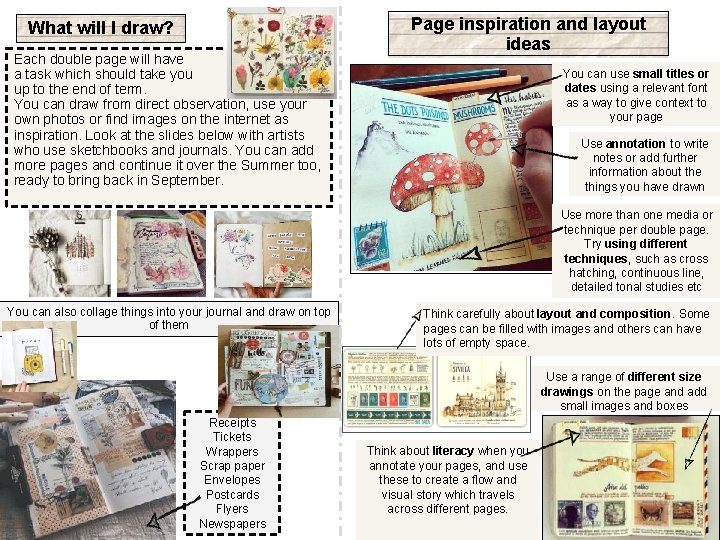
What will I draw? Each double page will have a task which should take you up to the end of term. You can draw from direct observation, use your own photos or find images on the internet as inspiration. Look at the slides below with artists who use sketchbooks and journals. You can add more pages and continue it over the Summer too, ready to bring back in September. Page inspiration and layout ideas You can use small titles or dates using a relevant font as a way to give context to your page Use annotation to write notes or add further information about the things you have drawn Use more than one media or technique per double page. Try using different techniques, such as cross hatching, continuous line, detailed tonal studies etc You can also collage things into your journal and draw on top of them Think carefully about layout and composition. Some pages can be filled with images and others can have lots of empty space. Use a range of different size drawings on the page and add small images and boxes Receipts Tickets Wrappers Scrap paper Envelopes Postcards Flyers Newspapers Think about literacy when you annotate your pages, and use these to create a flow and visual story which travels across different pages.
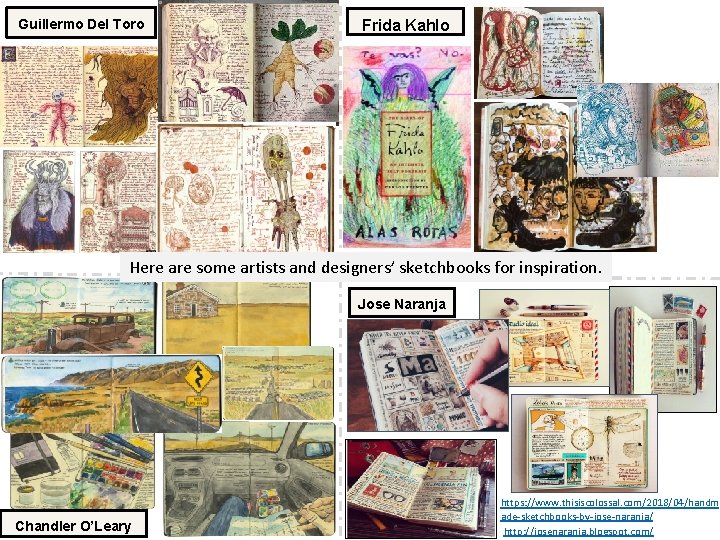
Guillermo Del Toro Frida Kahlo Here are some artists and designers’ sketchbooks for inspiration. Jose Naranja Chandler O’Leary https: //www. thisiscolossal. com/2018/04/handm ade-sketchbooks-by-jose-naranja/ http: //josenaranja. blogspot. com/
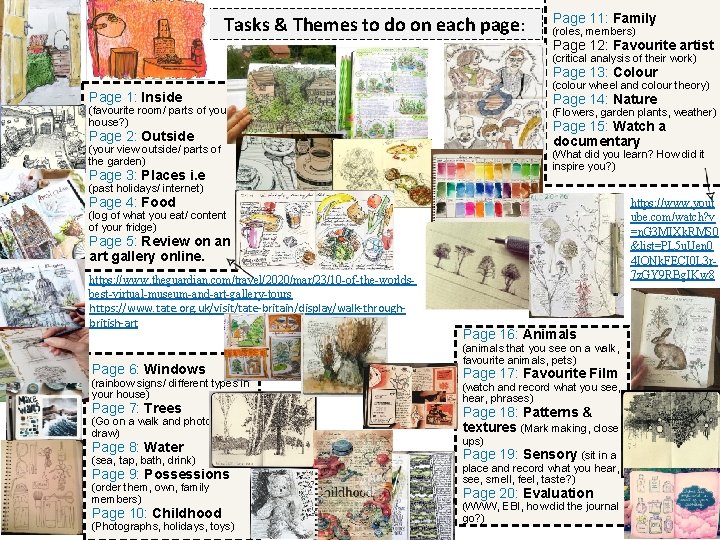
Tasks & Themes to do on each page: Page 11: Family (roles, members) Page 12: Favourite artist (critical analysis of their work) Page 13: Colour (colour wheel and colour theory) Page 1: Inside Page 14: Nature (favourite room/ parts of your house? ) (Flowers, garden plants, weather) Page 15: Watch a documentary Page 2: Outside (your view outside/ parts of the garden) (What did you learn? How did it inspire you? ) Page 3: Places i. e (past holidays/ internet) Page 4: Food https: //www. yout ube. com/watch? v =n. G 3 MIXk. RMS 0 &list=PL 5 u. Uen 0 4 IQNk. FECI 0 L 3 r 7 z. GY 9 RBg. IKw 8 (log of what you eat/ content of your fridge) Page 5: Review on an art gallery online. https: //www. theguardian. com/travel/2020/mar/23/10 -of-the-worldsbest-virtual-museum-and-art-gallery-tours https: //www. tate. org. uk/visit/tate-britain/display/walk-throughbritish-art Page 6: Windows (rainbow signs/ different types in your house) Page 7: Trees Page 16: Animals (animals that you see on a walk, favourite animals, pets) Page 17: Favourite Film (watch and record what you see, hear, phrases) (Go on a walk and photograph to draw) Page 18: Patterns & textures (Mark making, close (sea, tap, bath, drink) Page 19: Sensory (sit in a (order them, own, family members) Page 20: Evaluation Page 8: Water ups) Page 9: Possessions place and record what you hear, see, smell, feel, taste? ) Page 10: Childhood (Photographs, holidays, toys) (WWW, EBI, how did the journal go? )