
XXY XYY and More Teaching Gender in Year




- Slides: 39
XXY, XYY and More - Teaching Gender in Year 2 A-Level Psychology Hosted by Joseph & Jim
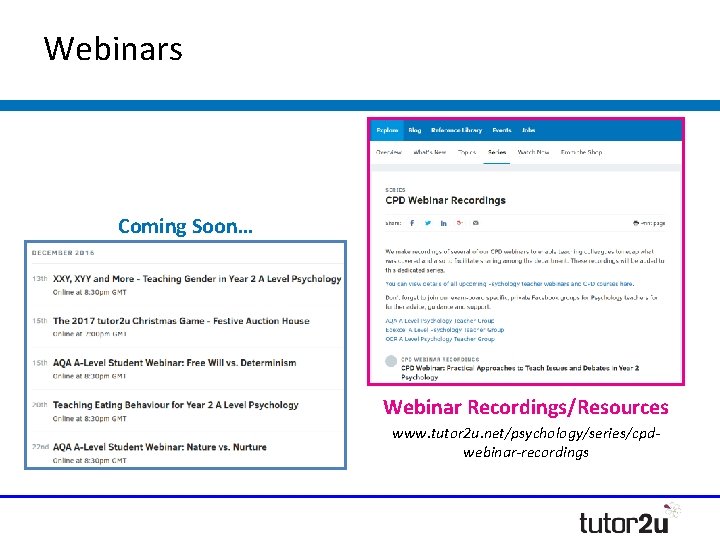
Webinars Coming Soon… Webinar Recordings/Resources www. tutor 2 u. net/psychology/series/cpdwebinar-recordings
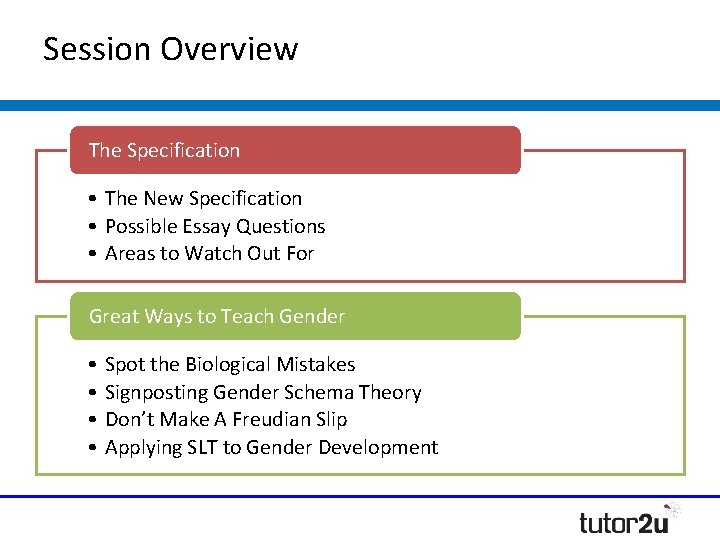
Session Overview The Specification • The New Specification • Possible Essay Questions • Areas to Watch Out For Great Ways to Teach Gender • • Spot the Biological Mistakes Signposting Gender Schema Theory Don’t Make A Freudian Slip Applying SLT to Gender Development
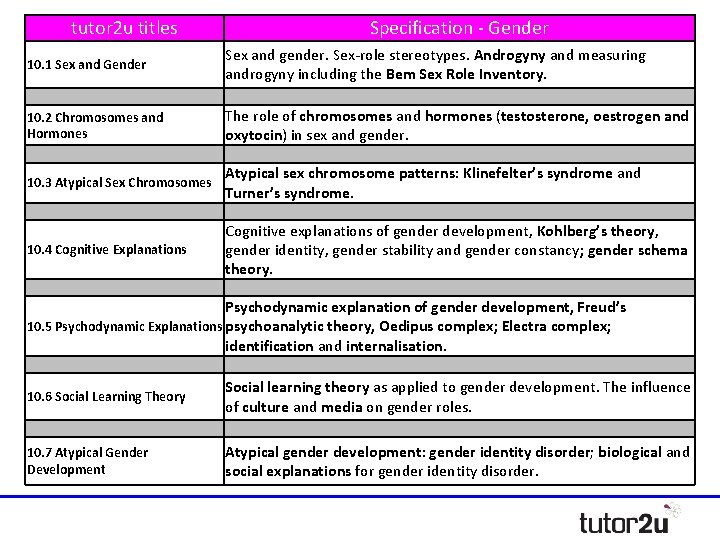
tutor 2 u titles Specification - Gender 10. 1 Sex and Gender Sex and gender. Sex-role stereotypes. Androgyny and measuring androgyny including the Bem Sex Role Inventory. 10. 2 Chromosomes and Hormones The role of chromosomes and hormones (testosterone, oestrogen and oxytocin) in sex and gender. 10. 3 Atypical Sex Chromosomes Atypical sex chromosome patterns: Klinefelter’s syndrome and Turner’s syndrome. 10. 4 Cognitive Explanations Cognitive explanations of gender development, Kohlberg’s theory, gender identity, gender stability and gender constancy; gender schema theory. Psychodynamic explanation of gender development, Freud’s 10. 5 Psychodynamic Explanations psychoanalytic theory, Oedipus complex; Electra complex; identification and internalisation. 10. 6 Social Learning Theory Social learning theory as applied to gender development. The influence of culture and media on gender roles. 10. 7 Atypical Gender Development Atypical gender development: gender identity disorder; biological and social explanations for gender identity disorder.
tutor 2 u titles Specification - Gender 10. 1 Sex and Gender Sex and gender. Sex-role stereotypes. Androgyny and measuring androgyny including the Bem Sex Role Inventory. 10. 2 Chromosomes and Hormones The role of chromosomes and hormones (testosterone, oestrogen and oxytocin) in sex and gender. 10. 3 Atypical Sex Chromosomes Atypical sex chromosome patterns: Klinefelter’s syndrome and Turner’s syndrome. 10. 4 Cognitive Explanations Cognitive explanations of gender development, Kohlberg’s theory, gender identity, gender stability and gender constancy; gender schema theory. Psychodynamic explanation of gender development, Freud’s 10. 5 Psychodynamic Explanations psychoanalytic theory, Oedipus complex; Electra complex; identification and internalisation. 10. 6 Social Learning Theory Social learning theory as applied to gender development. The influence of culture and media on gender roles. 10. 7 Atypical Gender Development Atypical gender development: gender identity disorder; biological and social explanations for gender identity disorder.
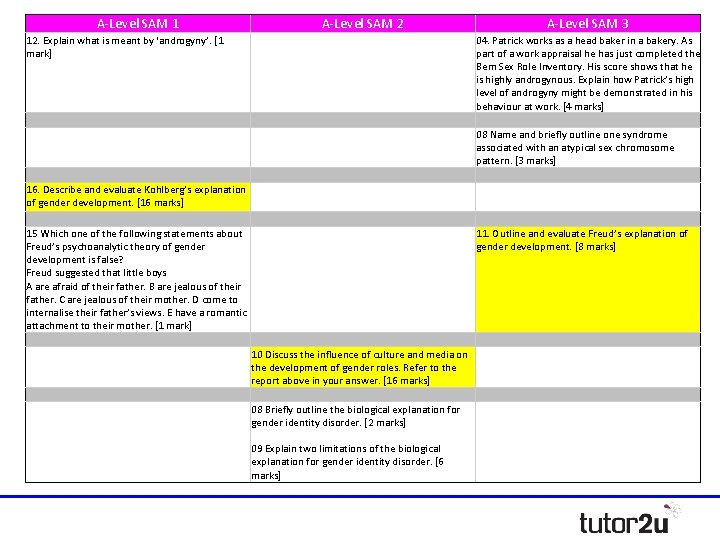
A-Level SAM 1 A-Level SAM 2 12. Explain what is meant by ‘androgyny’. [1 mark] A-Level SAM 3 04. Patrick works as a head baker in a bakery. As part of a work appraisal he has just completed the Bem Sex Role Inventory. His score shows that he is highly androgynous. Explain how Patrick’s high level of androgyny might be demonstrated in his behaviour at work. [4 marks] 08 Name and briefly outline one syndrome associated with an atypical sex chromosome pattern. [3 marks] 16. Describe and evaluate Kohlberg’s explanation of gender development. [16 marks] 15 Which one of the following statements about Freud’s psychoanalytic theory of gender development is false? Freud suggested that little boys A are afraid of their father. B are jealous of their father. C are jealous of their mother. D come to internalise their father’s views. E have a romantic attachment to their mother. [1 mark] 11. Outline and evaluate Freud’s explanation of gender development. [8 marks] 10 Discuss the influence of culture and media on the development of gender roles. Refer to the report above in your answer. [16 marks] 08 Briefly outline the biological explanation for gender identity disorder. [2 marks] 09 Explain two limitations of the biological explanation for gender identity disorder. [6 marks]
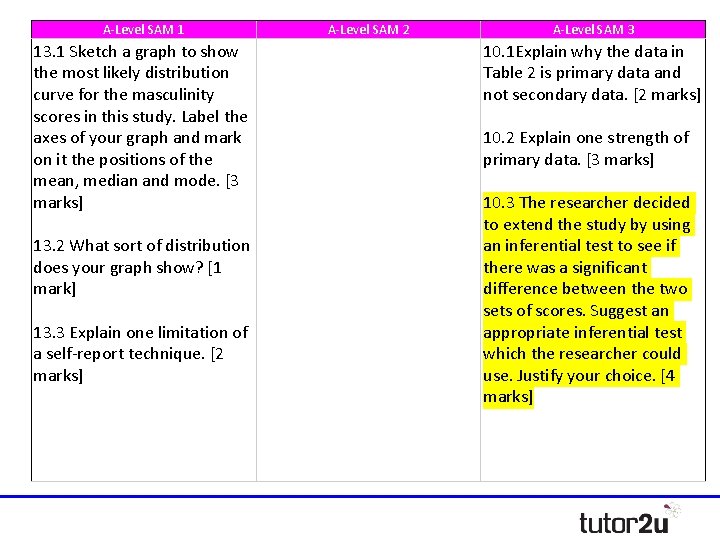
A-Level SAM 1 13. 1 Sketch a graph to show the most likely distribution curve for the masculinity scores in this study. Label the axes of your graph and mark on it the positions of the mean, median and mode. [3 marks] 13. 2 What sort of distribution does your graph show? [1 mark] 13. 3 Explain one limitation of a self-report technique. [2 marks] A-Level SAM 2 A-Level SAM 3 10. 1 Explain why the data in Table 2 is primary data and not secondary data. [2 marks] 10. 2 Explain one strength of primary data. [3 marks] 10. 3 The researcher decided to extend the study by using an inferential test to see if there was a significant difference between the two sets of scores. Suggest an appropriate inferential test which the researcher could use. Justify your choice. [4 marks]
Possible Essay Questions § 18 Potential Essay Questions from Exam Pro & Textbooks. § Watch out for the application essay in the social learning theory topic!
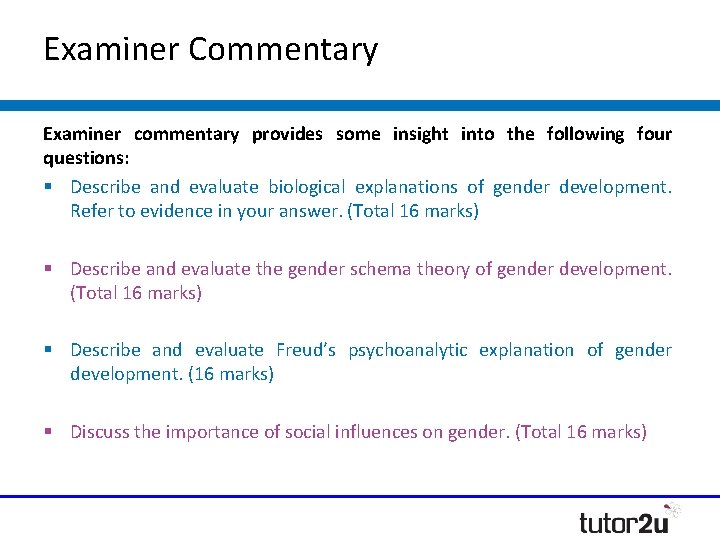
Examiner Commentary Examiner commentary provides some insight into the following four questions: § Describe and evaluate biological explanations of gender development. Refer to evidence in your answer. (Total 16 marks) § Describe and evaluate the gender schema theory of gender development. (Total 16 marks) § Describe and evaluate Freud’s psychoanalytic explanation of gender development. (16 marks) § Discuss the importance of social influences on gender. (Total 16 marks)
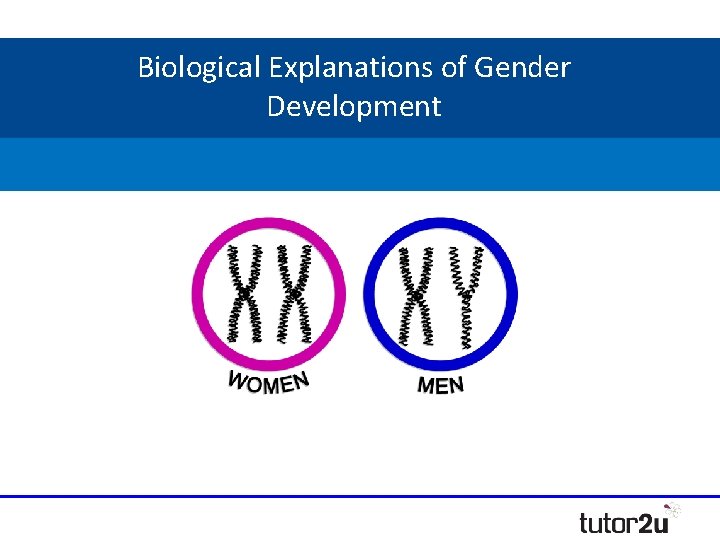
Biological Explanations of Gender Development
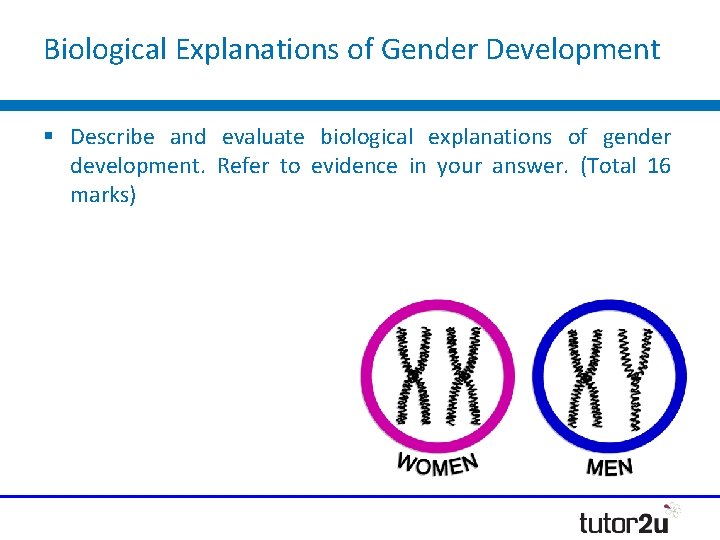
Biological Explanations of Gender Development § Describe and evaluate biological explanations of gender development. Refer to evidence in your answer. (Total 16 marks)
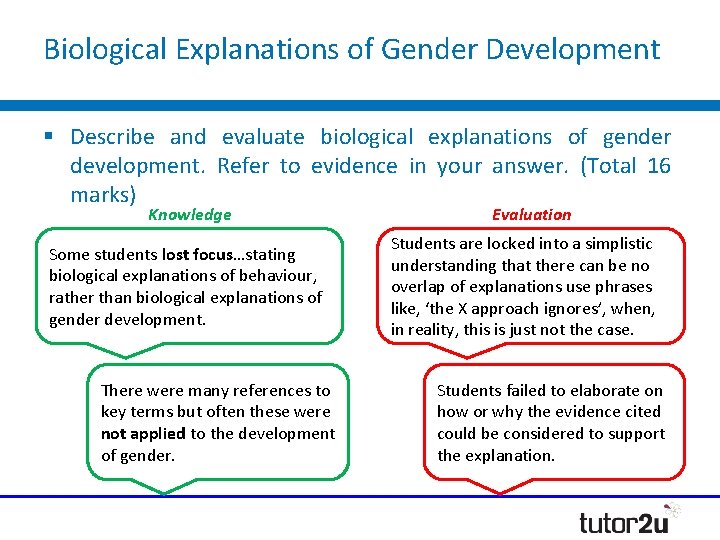
Biological Explanations of Gender Development § Describe and evaluate biological explanations of gender development. Refer to evidence in your answer. (Total 16 marks) Knowledge Some students lost focus…stating biological explanations of behaviour, rather than biological explanations of gender development. There were many references to key terms but often these were not applied to the development of gender. Evaluation Students are locked into a simplistic understanding that there can be no overlap of explanations use phrases like, ‘the X approach ignores’, when, in reality, this is just not the case. Students failed to elaborate on how or why the evidence cited could be considered to support the explanation.
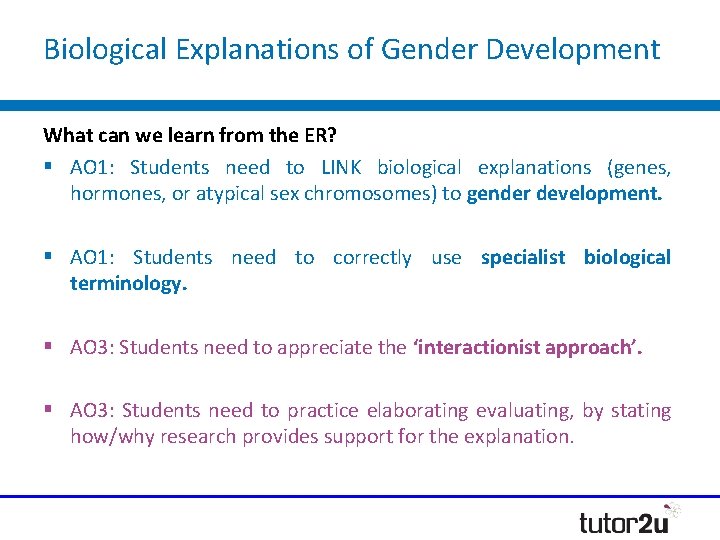
Biological Explanations of Gender Development What can we learn from the ER? § AO 1: Students need to LINK biological explanations (genes, hormones, or atypical sex chromosomes) to gender development. § AO 1: Students need to correctly use specialist biological terminology. § AO 3: Students need to appreciate the ‘interactionist approach’. § AO 3: Students need to practice elaborating evaluating, by stating how/why research provides support for the explanation.
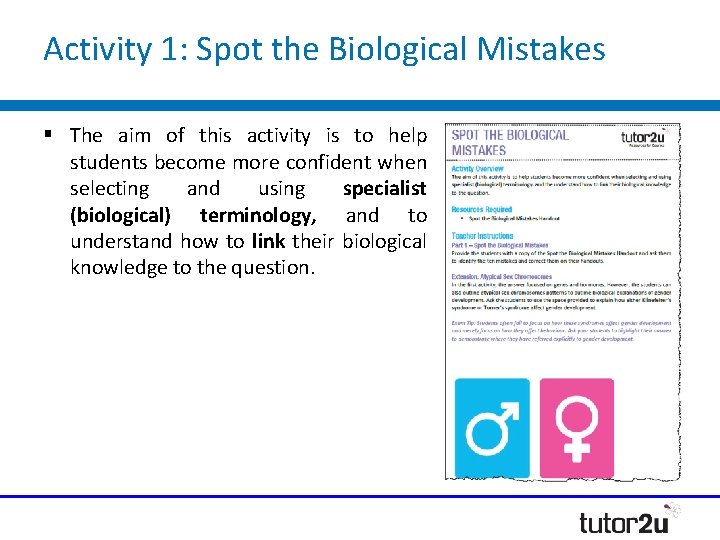
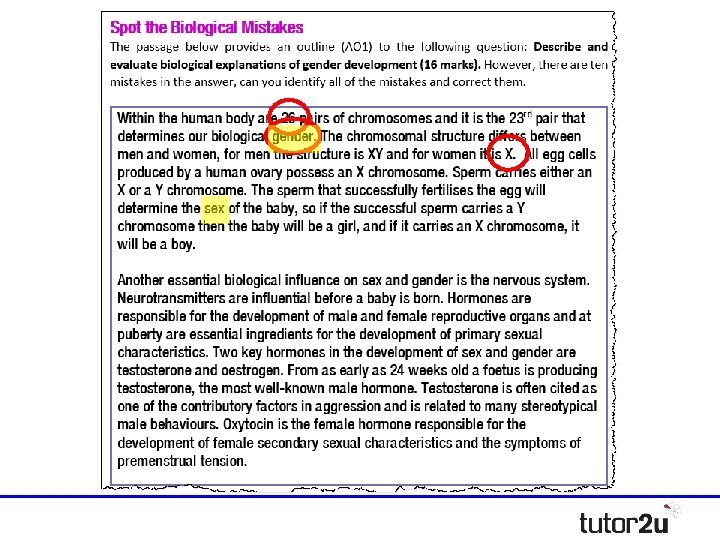
Activity 1: Spot the Biological Mistakes § The aim of this activity is to help students become more confident when selecting and using specialist (biological) terminology, and to understand how to link their biological knowledge to the question.
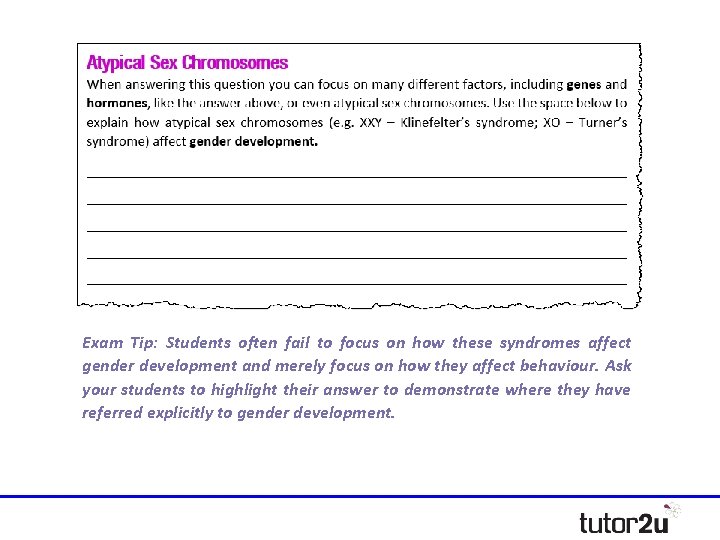
Exam Tip: Students often fail to focus on how these syndromes affect gender development and merely focus on how they affect behaviour. Ask your students to highlight their answer to demonstrate where they have referred explicitly to gender development.
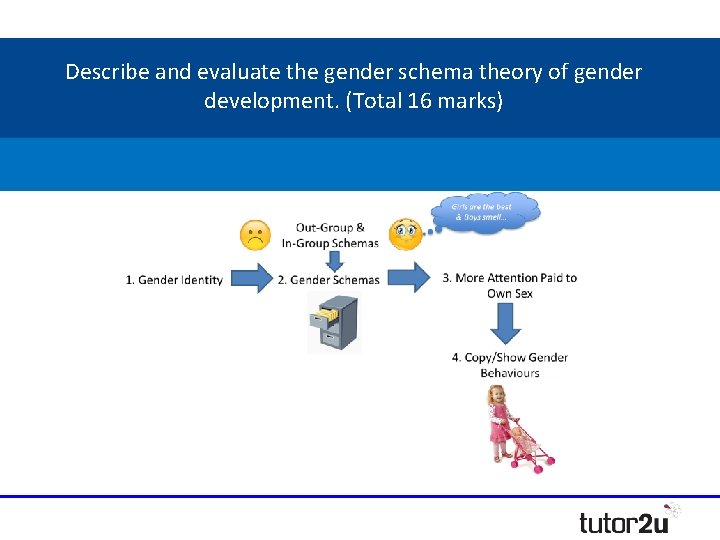
Describe and evaluate the gender schema theory of gender development. (Total 16 marks)
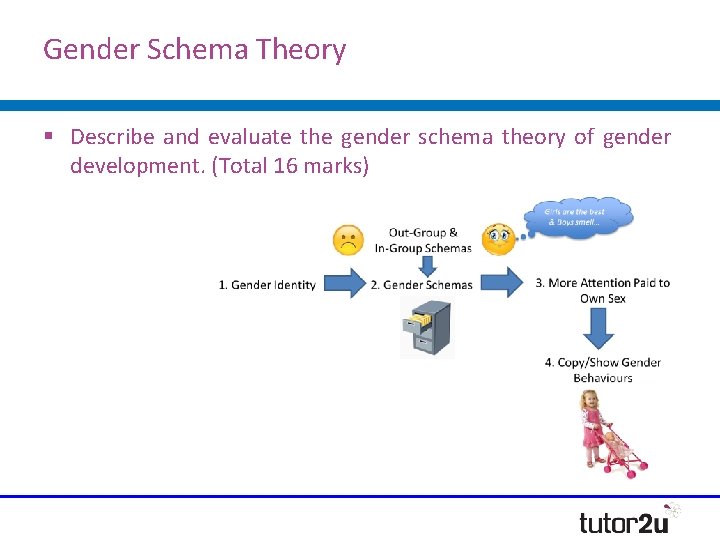
Gender Schema Theory § Describe and evaluate the gender schema theory of gender development. (Total 16 marks)
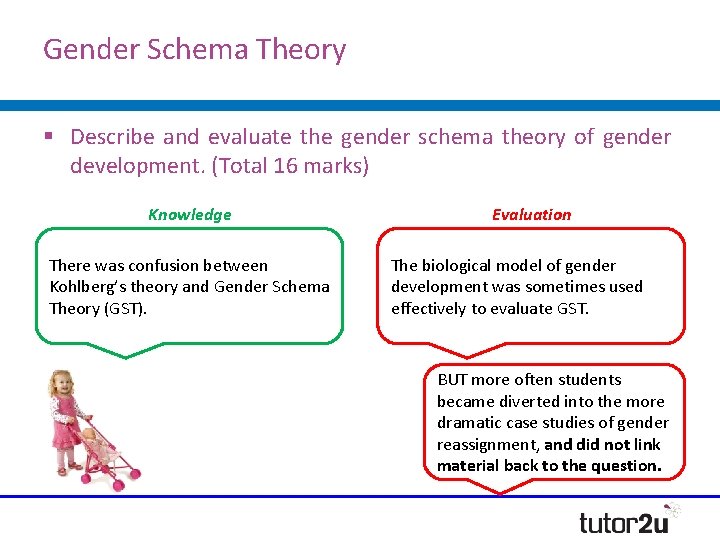
Gender Schema Theory § Describe and evaluate the gender schema theory of gender development. (Total 16 marks) Knowledge There was confusion between Kohlberg’s theory and Gender Schema Theory (GST). Evaluation The biological model of gender development was sometimes used effectively to evaluate GST. BUT more often students became diverted into the more dramatic case studies of gender reassignment, and did not link material back to the question.
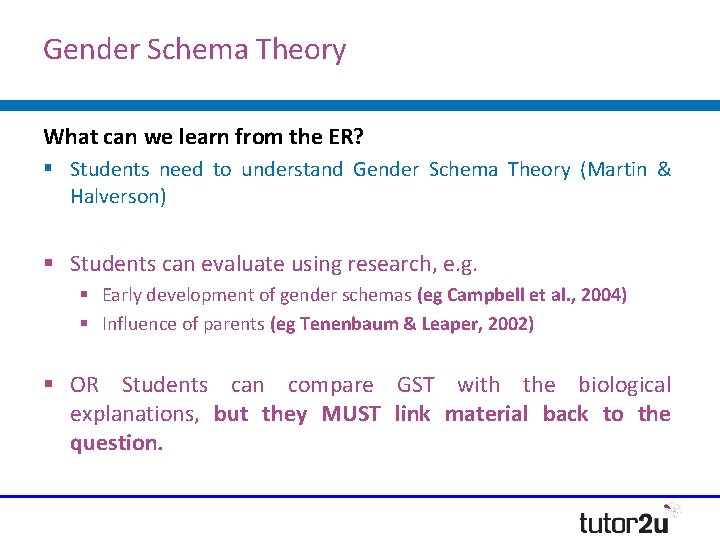
Gender Schema Theory What can we learn from the ER? § Students need to understand Gender Schema Theory (Martin & Halverson) § Students can evaluate using research, e. g. § Early development of gender schemas (eg Campbell et al. , 2004) § Influence of parents (eg Tenenbaum & Leaper, 2002) § OR Students can compare GST with the biological explanations, but they MUST link material back to the question.
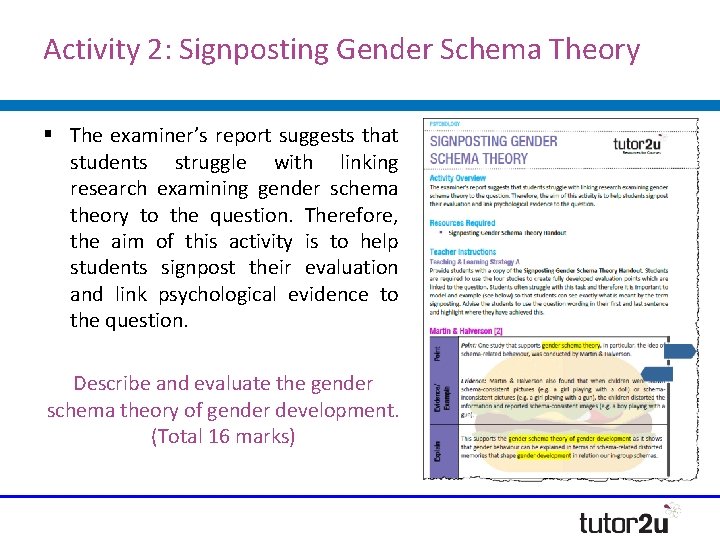
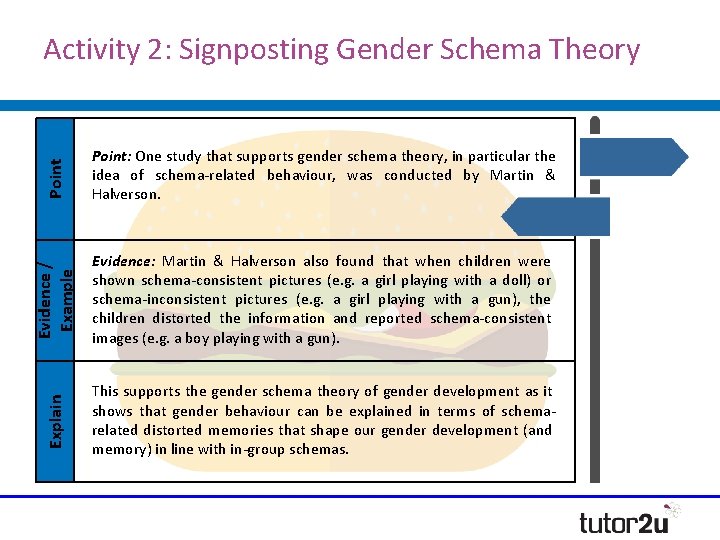
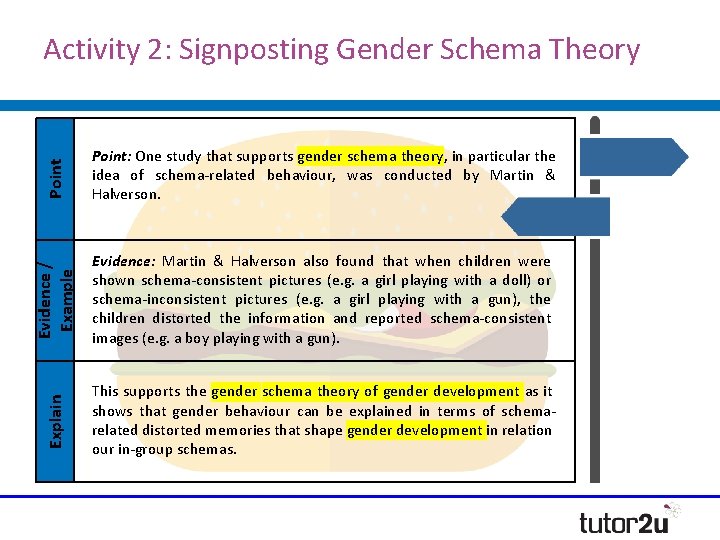
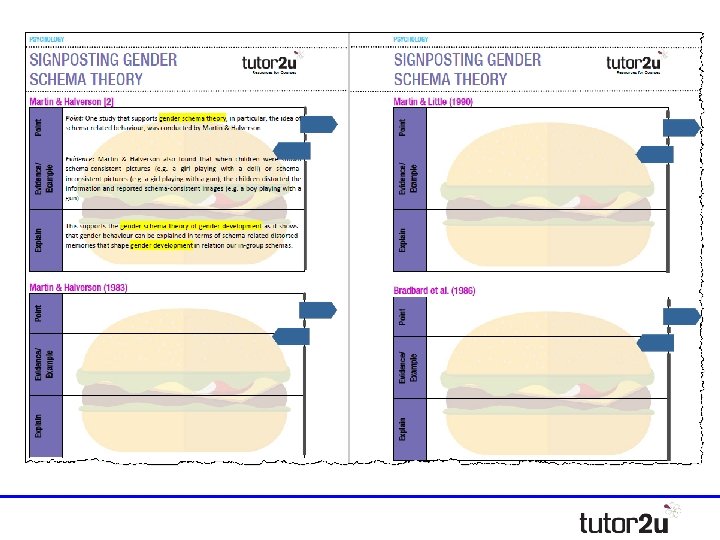
Activity 2: Signposting Gender Schema Theory § The examiner’s report suggests that students struggle with linking research examining gender schema theory to the question. Therefore, the aim of this activity is to help students signpost their evaluation and link psychological evidence to the question. Describe and evaluate the gender schema theory of gender development. (Total 16 marks)
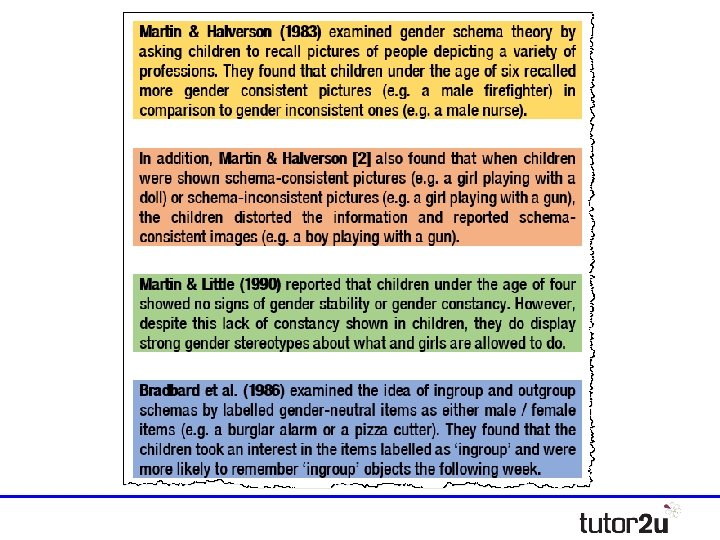
Point: One study that supports gender schema theory, in particular the idea of schema-related behaviour, was conducted by Martin & Halverson. Evidence / Example Evidence: Martin & Halverson also found that when children were shown schema-consistent pictures (e. g. a girl playing with a doll) or schema-inconsistent pictures (e. g. a girl playing with a gun), the children distorted the information and reported schema-consistent images (e. g. a boy playing with a gun). Explain Activity 2: Signposting Gender Schema Theory This supports the gender schema theory of gender development as it shows that gender behaviour can be explained in terms of schemarelated distorted memories that shape our gender development (and memory) in line with in-group schemas.
Point: One study that supports gender schema theory, in particular the idea of schema-related behaviour, was conducted by Martin & Halverson. Evidence / Example Evidence: Martin & Halverson also found that when children were shown schema-consistent pictures (e. g. a girl playing with a doll) or schema-inconsistent pictures (e. g. a girl playing with a gun), the children distorted the information and reported schema-consistent images (e. g. a boy playing with a gun). Explain Activity 2: Signposting Gender Schema Theory This supports the gender schema theory of gender development as it shows that gender behaviour can be explained in terms of schemarelated distorted memories that shape gender development in relation our in-group schemas.
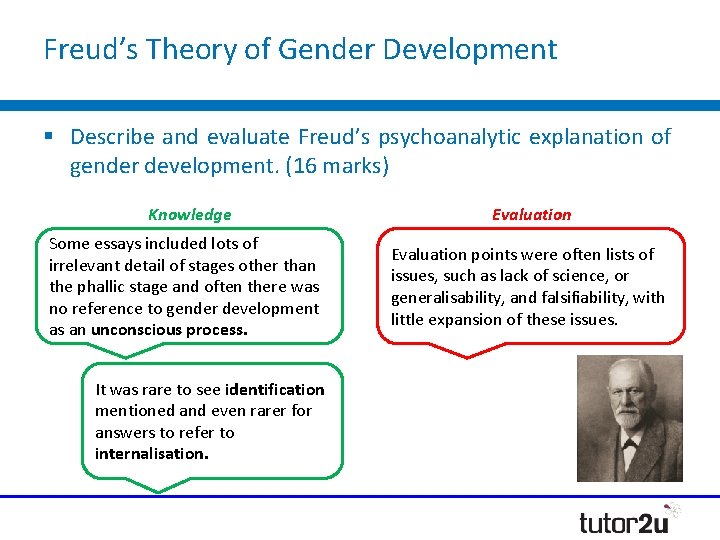
Describe and evaluate Freud’s psychoanalytic explanation of gender development. (16 marks)
Freud’s Theory of Gender Development § Describe and evaluate Freud’s psychoanalytic explanation of gender development. (16 marks) Knowledge Some essays included lots of irrelevant detail of stages other than the phallic stage and often there was no reference to gender development as an unconscious process. It was rare to see identification mentioned and even rarer for answers to refer to internalisation. Evaluation points were often lists of issues, such as lack of science, or generalisability, and falsifiability, with little expansion of these issues.
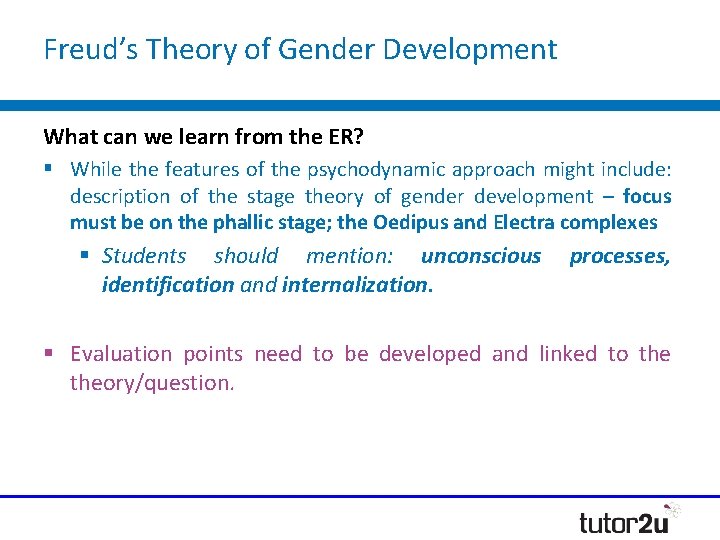
Freud’s Theory of Gender Development What can we learn from the ER? § While the features of the psychodynamic approach might include: description of the stage theory of gender development – focus must be on the phallic stage; the Oedipus and Electra complexes § Students should mention: unconscious identification and internalization. processes, § Evaluation points need to be developed and linked to theory/question.
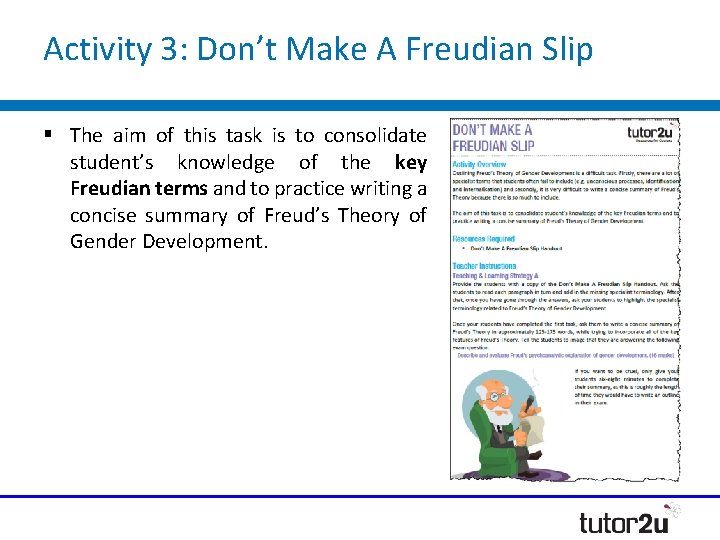
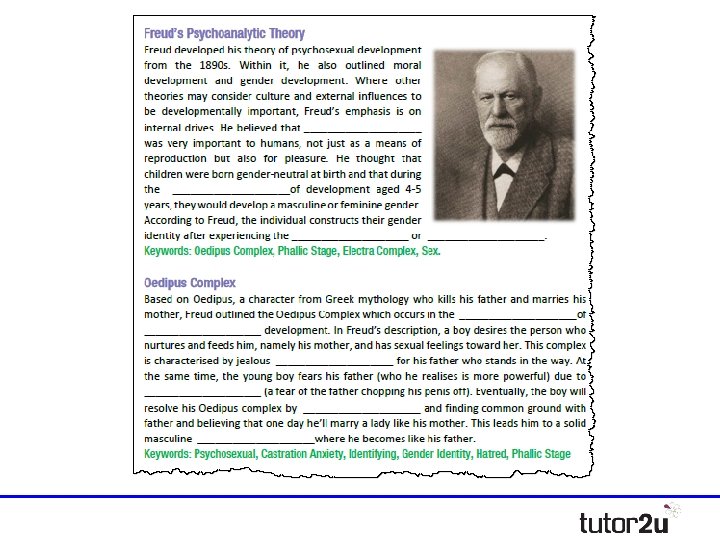
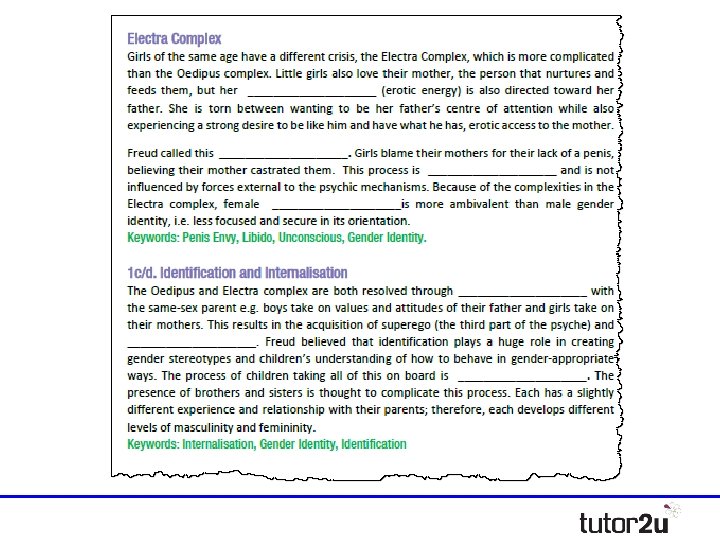
Activity 3: Don’t Make A Freudian Slip § The aim of this task is to consolidate student’s knowledge of the key Freudian terms and to practice writing a concise summary of Freud’s Theory of Gender Development.
Discuss the importance of social influences on gender. (Total 16 marks)
Social Influences § Discuss the importance of social influences on gender. (Total 16 marks) Knowledge A common error was to simply provide evidence for effects of social influences without explicitly addressing implications for how important or significant they were.
Social Influences What can we learn from the ER? § Relevant social influences would include: § Culture § Media § References to relevant theory e. g. Social Learning Theory § Students need to FOCUS their answer and link their discussion/evaluation to the ‘importance’ of different social influences.
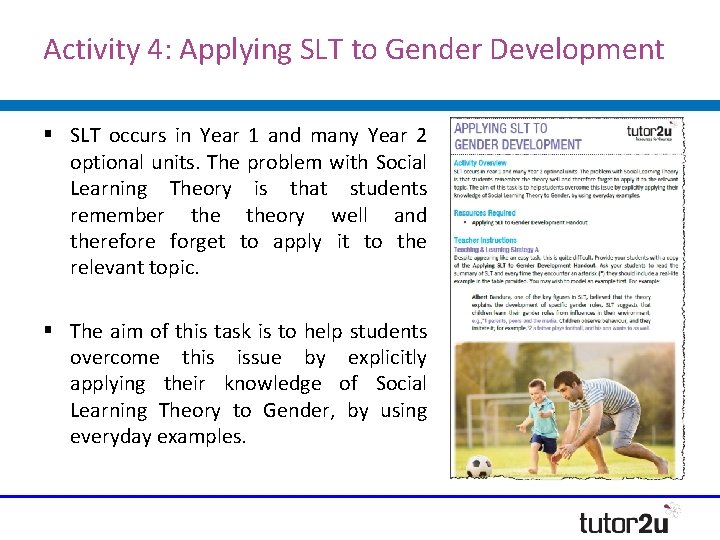
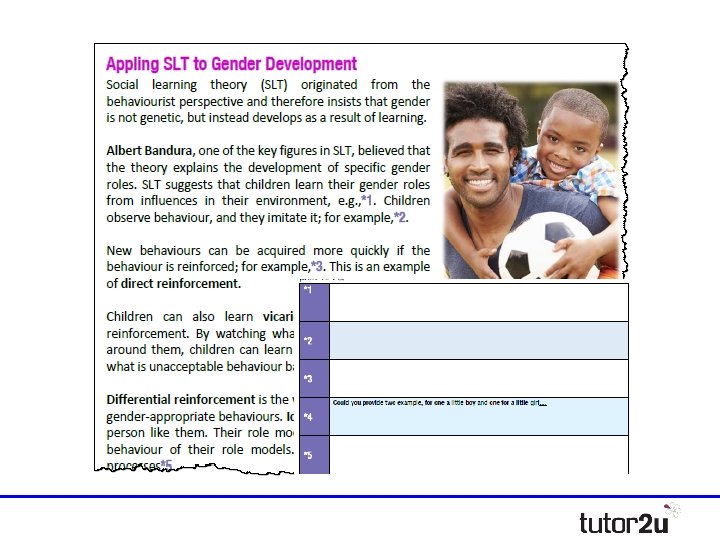
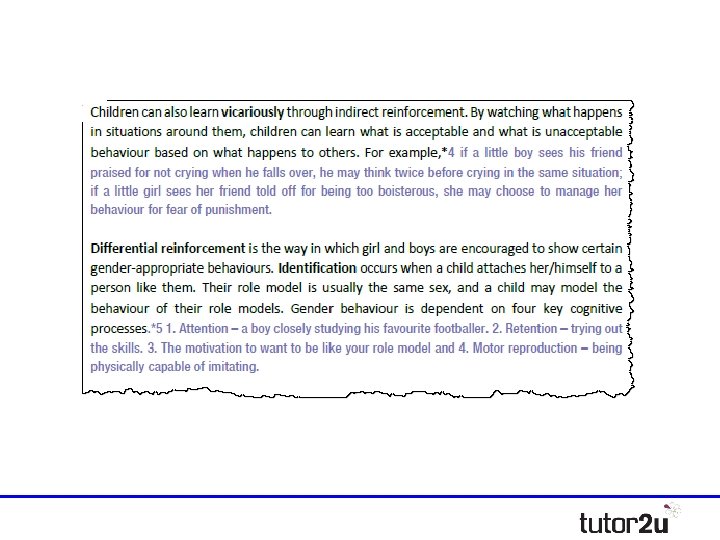
Activity 4: Applying SLT to Gender Development § SLT occurs in Year 1 and many Year 2 optional units. The problem with Social Learning Theory is that students remember theory well and therefore forget to apply it to the relevant topic. § The aim of this task is to help students overcome this issue by explicitly applying their knowledge of Social Learning Theory to Gender, by using everyday examples.
§ Don’t forget to sign up for our future webinars: www. tutor 2 u. net/psychology/events § Please follow us on Twitter @tutor 2 upsych and spread the word… § Join our Teacher FB Community, search: ‘AQA A Level Psychology Teachers’ § Encourage your students to join our Student FB Community: ‘A Level Psychology Student Group’. § If you ever need any advice, support or guidance, email: joseph@tutor 2 u. net Any Questions?