
XXXX 00 Generic Basic SI Units and Conversions
XXXX 00 - Generic Basic SI Units and Conversions
Same Symbols, Different Properties Ø It is essential that the basic SI units are understood and the relationships that they can build to create units that describe a large variety of different properties. Ø It is unfortunate that different branches of physics and engineering use the same symbol to represent different properties. Ø For example in this topic we will generally represent velocity as the symbol ‘v’, However in Thermofluids this has an alternate meaning and velocity is represented by ‘c’. Ø In a similar fashion ‘h’ in Dynamics would usually represent height, whereas in Thermofluids, this is a symbol for a property know as ‘specific enthalpy’ and ‘Z’ is therefore used for height.
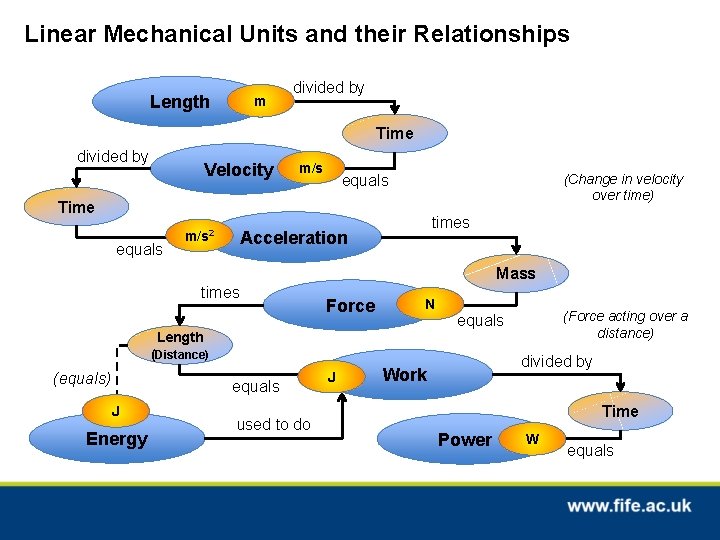
Linear Mechanical Units and their Relationships Length m divided by Time divided by Velocity m/s (Change in velocity over time) equals Time equals m/s 2 times Acceleration Mass times Force N Length (Distance) (equals) equals J Energy used to do J (Force acting over a distance) equals divided by Work Time Power W equals

Mechanical SI Units - Summary Unit Definition SI Description Symbol Length* L meter m Time T second s Mass M kilogram kg Velocity L/T meters per second m/s Acceleration L/T 2 meters per second m/s 2 Force ML/T 2 (mass times acceleration) Newtons N Work (ML/T 2) x L (Newton meters) Joules Nm (J) Energy (ML/T 2) x L (same as work) Joules J Power ((ML/T 2) x L) / T (Joules per second) Watts W * Length can be referred to as distance or displacement
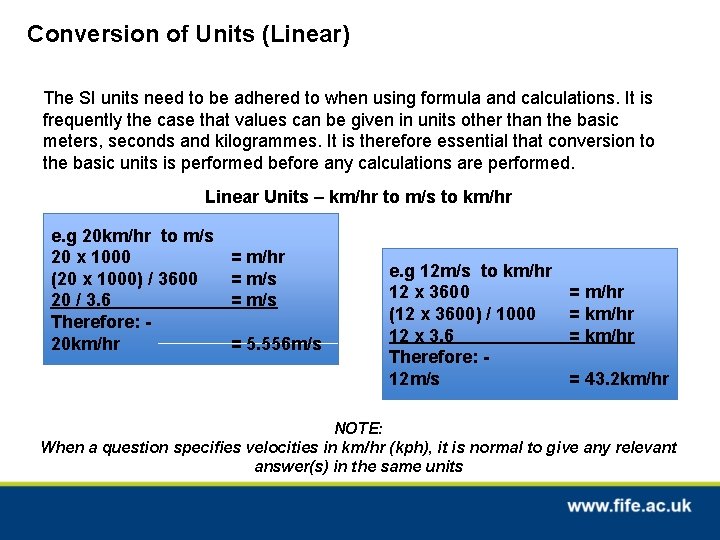
Conversion of Units (Linear) The SI units need to be adhered to when using formula and calculations. It is frequently the case that values can be given in units other than the basic meters, seconds and kilogrammes. It is therefore essential that conversion to the basic units is performed before any calculations are performed. Linear Units – km/hr to m/s to km/hr e. g 20 km/hr to m/s 20 x 1000 (20 x 1000) / 3600 20 / 3. 6 Therefore: 20 km/hr = m/s = 5. 556 m/s e. g 12 m/s to km/hr 12 x 3600 (12 x 3600) / 1000 12 x 3. 6 Therefore: 12 m/s = m/hr = km/hr = 43. 2 km/hr NOTE: When a question specifies velocities in km/hr (kph), it is normal to give any relevant answer(s) in the same units
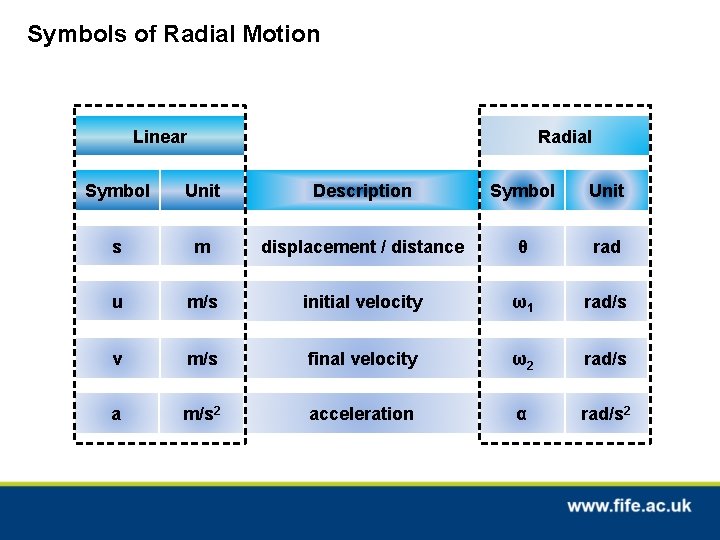
Symbols of Radial Motion Linear Radial Symbol Unit Description Symbol Unit s m displacement / distance θ rad u m/s initial velocity ω1 rad/s v m/s final velocity ω2 rad/s a m/s 2 acceleration α rad/s 2
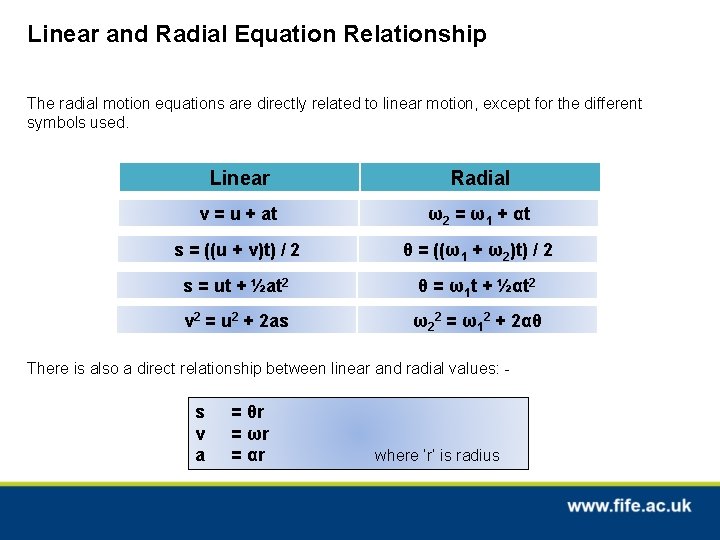
Linear and Radial Equation Relationship The radial motion equations are directly related to linear motion, except for the different symbols used. Linear Radial v = u + at ω2 = ω1 + αt s = ((u + v)t) / 2 θ = ((ω1 + ω2)t) / 2 s = ut + ½at 2 θ = ω1 t + ½αt 2 v 2 = u 2 + 2 as ω22 = ω12 + 2αθ There is also a direct relationship between linear and radial values: - s v a = θr = ωr = αr where ‘r’ is radius
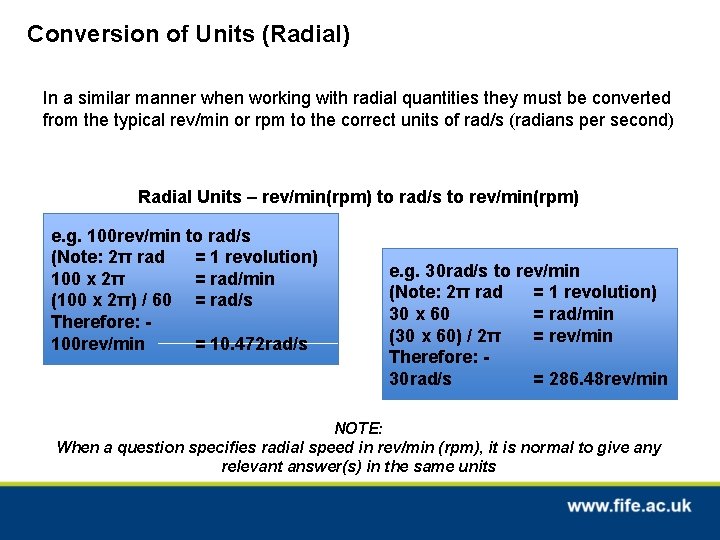
Conversion of Units (Radial) In a similar manner when working with radial quantities they must be converted from the typical rev/min or rpm to the correct units of rad/s (radians per second) Radial Units – rev/min(rpm) to rad/s to rev/min(rpm) e. g. 100 rev/min to rad/s (Note: 2π rad = 1 revolution) 100 x 2π = rad/min (100 x 2π) / 60 = rad/s Therefore: 100 rev/min = 10. 472 rad/s e. g. 30 rad/s to rev/min (Note: 2π rad = 1 revolution) 30 x 60 = rad/min (30 x 60) / 2π = rev/min Therefore: 30 rad/s = 286. 48 rev/min NOTE: When a question specifies radial speed in rev/min (rpm), it is normal to give any relevant answer(s) in the same units
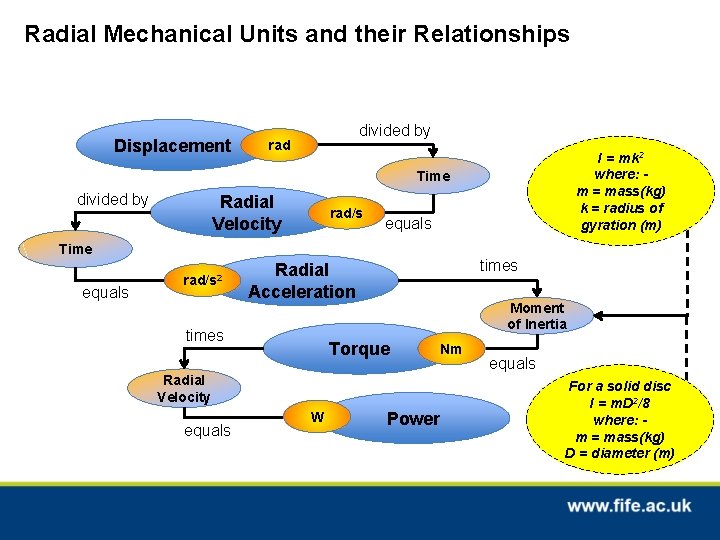
Radial Mechanical Units and their Relationships Displacement divided by rad I = mk 2 where: m = mass(kg) k = radius of gyration (m) Time divided by Radial Velocity rad/s equals Time equals rad/s 2 times Radial Acceleration times Moment of Inertia Torque Nm Radial Velocity equals W Power equals For a solid disc I = m. D 2/8 where: m = mass(kg) D = diameter (m)
- Slides: 9