
XXX Police Department Use of Deadly Force Annual
- Slides: 42
XXX Police Department Use of Deadly Force Annual Update Instructor: _____
Instruction Topics n Annual Update on Use of Force n Annual Update on Use of Deadly Force
Use of Force
Legitimate Use of Force by Law Enforcement n With the responsibility to enforce the law, police officers are given the authority to use force, when necessary, to accomplish that mission.
Legitimate Use of Force by Law Enforcement n n This authority to use force is not without limits. The Police in the United States are the protectors of civil and human rights. Use of Force by Police Officers is controlled by law and the courts to ensure they do not violate the rights they are sworn to protect.
Legitimate Use of Force by Law Enforcement n Use of Force by Police Officers is controlled Federal Law and Court Decisions, by State Law, and by Department Policy.
Federal Law n n Federal Law and the Federal Court Decisions determine if you can be held liable (financially) for violating the rights of individuals. The Fourth Amendment of the U. S. Constitution protects citizens from unreasonable searches and seizures.
Federal Law n In Graham v. Connor the Supreme Court ruled that a police officer’s use of force was a seizure. The Court found that law enforcement officers’ use of force against subjects was a type of seizure, and therefore, under the Constitution had to be “objectively reasonable. ” The Court laid out the issues to consider when deciding if a particular use of force is reasonable.
Federal Law n FACTORS TO DETERMINE REASONABLENESS The severity of the alleged crime at issue. n Whether the suspect poses an imminent threat to the safety of officers and/or others. n Whether the suspect is actively resisting or attempting to evade arrest by flight. n n This must be based on the perspective of the officer involved rather than 20/20 vision or hindsight of another!
Federal Law n n In Tennessee v. Garner (1985) Deadly Force must be Objectively Reasonable under the circumstances faced by the officer.
Federal Law n It is Objectively Reasonable when: n an officer is faced with an immediate threat of serious bodily harm or death to him/herself or some other party present at the scene; OR
Federal Law n It is Objectively Reasonable when (con’t) an officer has probable cause to believe the subject has committed a violent felony involving the infliction or threatened infliction of serious bodily harm or death AND pose a an imminent or immediate danger to others if allowed to escape, AND n the officer gives a warning prior to the use of force where feasible. n
Texas Law n n In Texas, a person’s use of force against another is a criminal violation unless justified under the law. A person’s use of force against another could be interpreted to be: n Assault, Aggravated Assault, Deadly Conduct, Manslaughter, Attempted Murder, and even Murder.
Texas Law n n Chapter 9 of the Texas Penal Code is Entitled “JUSTIFICATION EXCLUDING CRIMINAL RESPONSIBILITY” Chapter 9 outlines those circumstances where individuals may use force legitimately and not be prosecuted for their actions.
Texas Law n Sub. Chapter B, Justification Generally 9. 21 Public Duty n 9. 22 Necessity n n Sub. Chapter C, Protection of Persons 9. 31 Self-Defense n 9. 32 Deadly Force n 9. 33 Defense of Third Person n 9. 34 Protection of Life & Health n
Texas Law n Sub. Chapter D, Protection of Property 9. 42 Deadly Force to Protect Property n 9. 43 Protection of 3 rd Person’s Property n
Texas Law n For Law Enforcement Officers in the performance of their Duty, Sub. Chapter E, Law Enforcement, also applies. n 9. 51 Arrest and Search
Arrest & Search PC 9. 51 a A peace officer is justified in using force against another when and to the degree the officer reasonably believes the force is immediately necessary to make or assist in making an arrest or search, or prevent or assist in preventing escape after arrest if:
Arrest & Search PC 9. 51 a 1. 2. The officer reasonably believes the arrest or search is lawful or, if the arrest or search is made under a warrant, he reasonably believes the warrant is valid. Before using force, the officer manifests his purpose to arrest and search and identifies himself as a peace officer, unless he reasonably believes his purpose and identity are already known by or cannot reasonably be made known to the person to be arrested.
Arrest & Search PC 9. 51 c n A peace officer is justified in using deadly force against another when and to the degree the peace officer reasonably believes the deadly force is immediately necessary to make an arrest, or to prevent escape after arrest, if the use of force would have been justified under Subsection (a) and:
Arrest & Search PC 9. 51 c n n the actor reasonably believes the conduct for which arrest is authorized included the use or attempted use of deadly force; or the actor reasonably believes there is a substantial risk that the person to be arrested will cause death or serious bodily injury to the actor or another if the arrest is delayed.
Arrest & Search PC 9. 51 e n There is no duty to retreat before using deadly force.
Department Policy n n Department Policy also controls officer’s use of force. Violations of the Department Policy can lead to a loss of your job.
Department Policy n Policy: It is the policy of this department that officers use only the force that is reasonably necessary to effectively bring an incident under control, while protecting the lives of the officer and others. The use of force must be objectively reasonable. The officer must only use that force which a reasonably prudent officer could use under the same or similar circumstances. The officer’s actions will be reviewed based upon the information known to the officer at the time the force was used. Information discovered after the fact will not be considered when assessing the reasonableness of the use of force.
Department Policy n Use of Non-deadly Force Where deadly force is not authorized, officers may use only that level of force that is objectively reasonable to bring an incident under control. n Officers are authorized to use departmentapproved, non-deadly force techniques and issued equipment when one or more of the following apply: n n To protect the officer or others from physical harm. To lawfully restrain or subdue a resistant individual. To bring an unlawful situation safely and effectively under control.
Department Policy n n Department Policy on the Use of Deadly Force: Any use of force that creates a substantial risk of causing death or serious bodily harm.
Department Policy n Use of Deadly Force n Law enforcement officers are authorized to use deadly force when one or both of the following apply:
Department Policy To protect the officer or others from what is reasonably believed to be a threat of death or serious bodily harm. n To prevent the escape of a fleeing violent felon who the officer has probable cause to believe will pose a significant threat of death or serious physical injury to the officer or others. Where practicable prior to discharge of the firearm, officers shall identify themselves as law enforcement officers and state their intent to shoot. n
Department Policy To protect the officer or others from what is reasonably believed to be a threat of death or serious bodily harm. n To prevent the escape of a fleeing violent felon who the officer has probable cause to believe will pose a significant threat of death or serious physical injury to the officer or others. Where practicable prior to discharge of the firearm, officers shall identify themselves as law enforcement officers and state their intent to shoot. n
Department Policy n Deadly Force Restrictions n n Warning shots shall not be fired. Firearms shall not be discharged at a moving vehicle in an attempt to disable the vehicle.
Department Policy n Deadly Force Restrictions n Because of the low probability of penetrating a vehicle with a handgun, officers threatened by an oncoming vehicle should attempt to move out of its path, if possible, instead of discharging a firearm at it or any of its occupants. However, if an officer reasonably believes that a person is immediately threatening the officer or another person with deadly force by means of a vehicle, an officer may use deadly force against the driver of the vehicle.
Department Policy n Limitations of Use of Force n The following acts associated with the use of force are prohibited. n Application of choke hold or carotid control holds, except when the officer reasonably believes such holds are the only means of protecting himself or herself or another person from an imminent threat of serious physical injury or death and the use of deadly force would be authorized.
Department Policy n Limitations of Use of Force n Use of Streamlites or Kel-lites or other flashlights as batons. An officer may use a flashlight or other object designed for a use other than as a weapon only to defend himself or herself or another from imminent serious bodily injury or death and then only if departmentally sanctioned methods are not available or are impractical. The use of a flashlight or other alternative weapon under such circumstances, depending on the manner of use, may be deemed an application of deadly force.
Considerations before Using Force n In Deciding to Use Force Officers Must Consider n Is an arrest or detention legal and authorized? Do I have Authority? This must be present for an officer to use any force. (State Law PC 9. 51 a)
Considerations before Using Force n In deciding the level of force that can be used (Is it Objectively Reasonable – Graham v. Connor) How serious is the offense which is suspected? n Is the person posing as a threat to anyone at the scene? n Is the subject attempting to resist arrest or evade arrest? n
Use of Force Justifications 1. 2. 3. 4. Was there a need for the application of force? Was the relationship between the resistance and the level of force proportional? Was the extent of the subject’s injury proportional to the subject’s level of resistance or threat to the officer or another? Was the force applied in good faith, based upon the perceptions of a reasonably trained officer and the objectively reasonable facts the officer had at the time of the incident?
Judging The Proper Application of Force This must be based on the perspective of the officer involved rather than 20/20 vision or hindsight of another! Look through the eyes of the officer and answer these two questions; 1. Was his/her perception of the threat reasonable? 2. Was his/her reaction towards that perceived threat reasonable?
Use of Force Continuum n To assist officers in understanding and incorporating an acceptable response to resistance and aggression from suspects the Department uses a Use of Force Continuum during training.
Use of Force Continuum n If time and opportunity permit, Officers should attempt to use the lowest level of response possible in order to avoid needless injury. However, The department understands that a classroom model is rarely achieved on the street. The Department understands that the street is both Dynamic and Reactive and that a dynamic application of a trained technique is the norm rather that the exception. The concept of Intervention Options is easiest to explain by comparing it to a toolbox. Whatever intervention option you need pick it. This selection is based on a myriad of circumstances existing at the moment the force is needed.
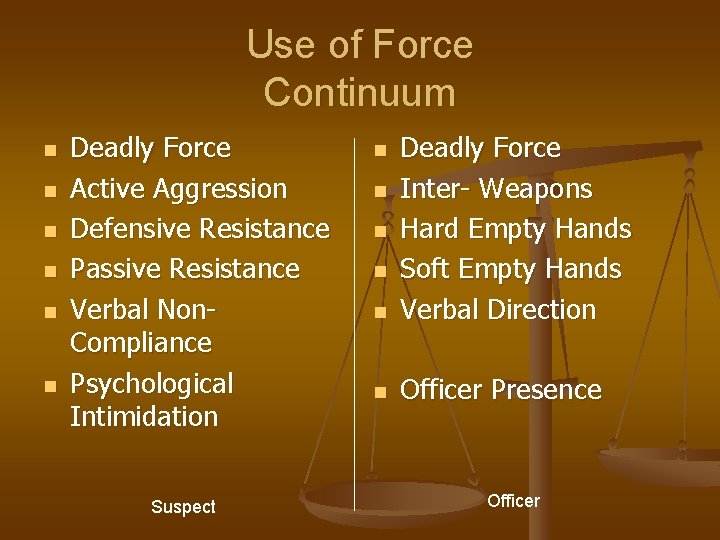
Use of Force Continuum n n n Deadly Force Active Aggression Defensive Resistance Passive Resistance Verbal Non. Compliance Psychological Intimidation Suspect n Deadly Force Inter- Weapons Hard Empty Hands Soft Empty Hands Verbal Direction n Officer Presence n n Officer
Proper Police Action n Balances Safety And Efficiency. How much risk are you willing to take? n Before you get in too deep, ask yourself "What am I doing here? " n "Are you winning? " n "Is this worth dying for? " n
After any Use of Force n n Medical aid should be provided and EMS called to the scene immediately in all cases where there is alleged or appears to be any physical manifestation of an injury following a use of force. Notify a supervisor immediately and request their presence at the scene. Preserve any evidence of the event including any video or audio recordings. Complete a detailed report of the incident and a Use of Force report if it meets the reporting requirements.