
XXX PCT Orientation Visit for the Improvement Foundation
- Slides: 36
XXX PCT Orientation Visit for the Improvement Foundation Practice Based Commissioning Development Programme
Aims of the Day • • • Set out the detail of the programme Clarify participation in programme Discuss expectations Discuss initial ideas for service redesign Discuss plans for spread of learning
Improvement Foundation incorporating NPDT • Established 1 st April 2006 • Incorporates NPDT • Creates the organisational flexibility to enable us to continue to develop our improvement work • NHS • Other public services • International improvement work • Same people, same values, same business
Brief Background to Improvement Foundation • National Team • 11 Improvement Foundation Centres
The Collaborative Process An improvement method that relies on spread and adaptation of existing knowledge to multiple settings to accomplish a common aim It is NOT: • A research project • A set of conferences • A passive exercise
Elements of a Collaborative • • Clear aims Framework of practical ideas Series of Learning Workshops Action periods in between Protected time Focus on measurement Practical support Use of tried and tested improvement method • PBC as the mechanism to underpin specific service improvements
Aim of the Programme In partnership with SHAs and PCTs, maximise the number of PCTs and practices operating PBC: • in order to develop and improve services for patients • to embed a residual local skill base in commissioning for future development
Opportunities • Share experiences and learning • Linked into other “experts” and like minded peers • Access to a range of resources that can be tailored for each site • Opportunity to get involved at the entrepreneurial stage • Drive services to represent what your population needs • Better services for your patients
Common Questions How will: • Any new commissioning decisions deliver improvements for patients? • Practices know they are delivering these improvements? • Ensure the benefits of PBC are meaningful for clinicians and aid clinical engagement?
• Acute trusts operate in this new environment? • Commissioning new patient pathways fit with patient choice? • Deliver improvements in unscheduled care?
• Engage patients and the wider community to ensure services meet local need? • Decisions be made on the services to be commissioned, balancing resources, use of efficiency gains, managing risk?
Basic Principles • • Local aims for PBC Clinical engagement Good data PCT support – people and funding Local expertise Menu of service areas Quality improvement tools and techniques
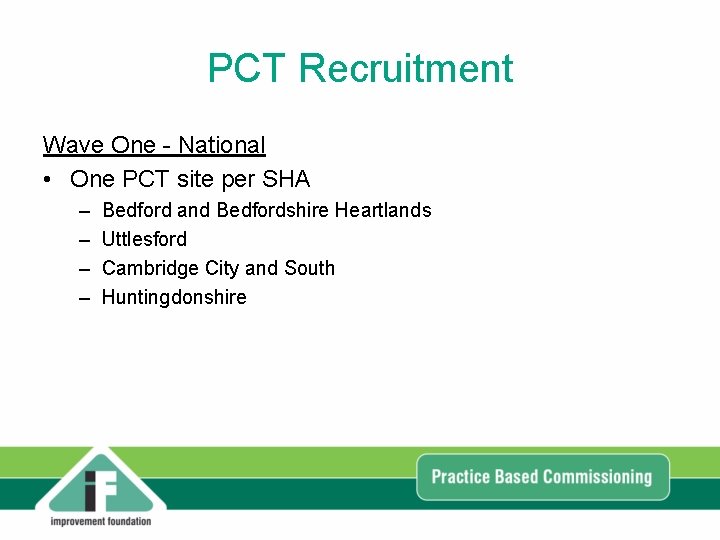
PCT Recruitment Wave One - National • One PCT site per SHA – – Bedford and Bedfordshire Heartlands Uttlesford Cambridge City and South Huntingdonshire
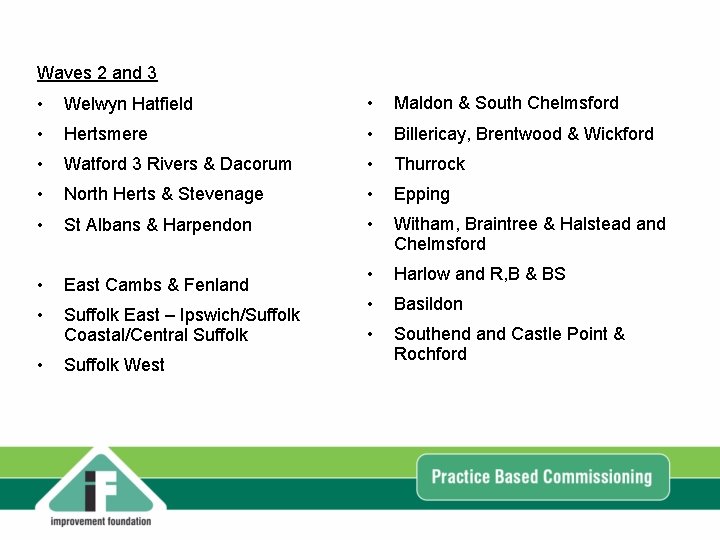
Waves 2 and 3 • Welwyn Hatfield • Maldon & South Chelmsford • Hertsmere • Billericay, Brentwood & Wickford • Watford 3 Rivers & Dacorum • Thurrock • North Herts & Stevenage • Epping • St Albans & Harpendon • Witham, Braintree & Halstead and Chelmsford • East Cambs & Fenland • Harlow and R, B & BS • Suffolk East – Ipswich/Suffolk Coastal/Central Suffolk • Basildon • • Suffolk West Southend and Castle Point & Rochford
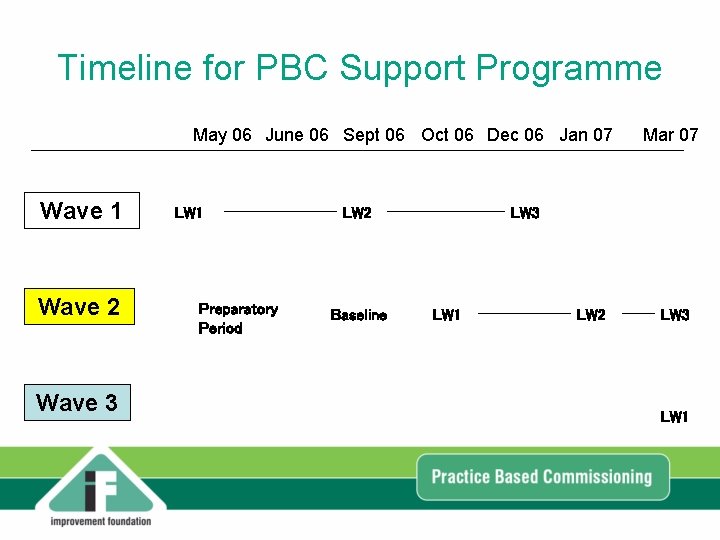
Timeline for PBC Support Programme May 06 June 06 Sept 06 Oct 06 Dec 06 Jan 07 Wave 1 Wave 2 Wave 3 LW 1 Preparatory Period LW 2 Baseline Mar 07 LW 3 LW 1 LW 2 LW 3 LW 1
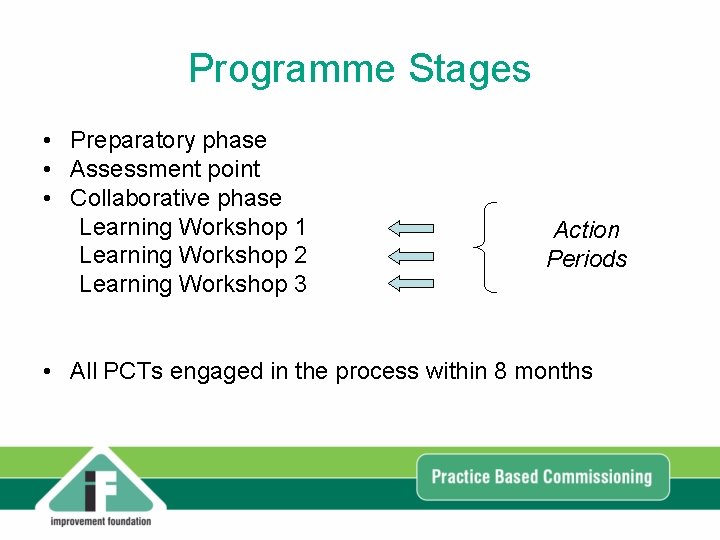
Programme Stages • Preparatory phase • Assessment point • Collaborative phase Learning Workshop 1 Learning Workshop 2 Learning Workshop 3 Action Periods • All PCTs engaged in the process within 8 months
Membership of the LIT • As varied a group of managers and clinicians as possible • Effective leadership and ownership is crucial to drive forward improvements and sustain change • LIT should have a shared understanding and agreement of the common aims and purpose of the work – agreed vision • The LIT will help strengthen relationships between managers and clinicians and ensure service developments fit with local priorities, identified in the LDP and in line with local and national targets
The LIT / Site • The Local Improvement Team (LIT) lead clinicians and managers will influence the local thinking and plans for PBC • Active participation in learning workshops • Regular meeting of the LIT • Implementation of ideas within action periods • Regular reporting - 2 years commitment to report • Sharing of learning both locally and nationally • Plans for spread
Role of the Project Manager • Support - Explain what needs to be done and how • Resource - Information/best practice/ ideas/feedback. Extensive network • Coordinator - Data collection/workshops/LIT meetings • Link - with the Centre and other practices • Facilitation –Process Redesign etc
Role of Improvement Foundation • Support • Facilitate • Training • Resource
Preparatory Phase • Learning from other programmes • Different PCTs at varying stages of development and readiness for the challenges of commissioning Aim: • PCTs and practices to have the appropriate infrastructure in place before they engage in the collaborative phase (focus on service re-design) • Maximise the improvements to be made in patient services
Preparatory Phase (i) (iii) (iv) Orientation visit to Local Improvement Team (LIT) Assessment and action plan Training events Milestones / tasks: – Action period tasks in between training events – Mapping and analysis of services – Baseline measures for service areas
Overview of the Assessment Framework • Developed to enable PCTs and practices to jointly assess themselves against criteria which forms a minimum standards framework • Increasing levels of achievement to ensure continuous review and improvement • The framework encompasses 2 main areas: • PBC Commissioning cycles 7 sub sections • Building capacity 3 sub sections • Generates an action plan for improving areas of PBC
How to use the Assessment Framework • • Initial completion by orientation Discussion at orientation visit Action plan developed by site Resource pack and preparatory period training events to support progress • Completion again by 15 September 2006 • 6 -monthly completion thereafter to continue to assess progress
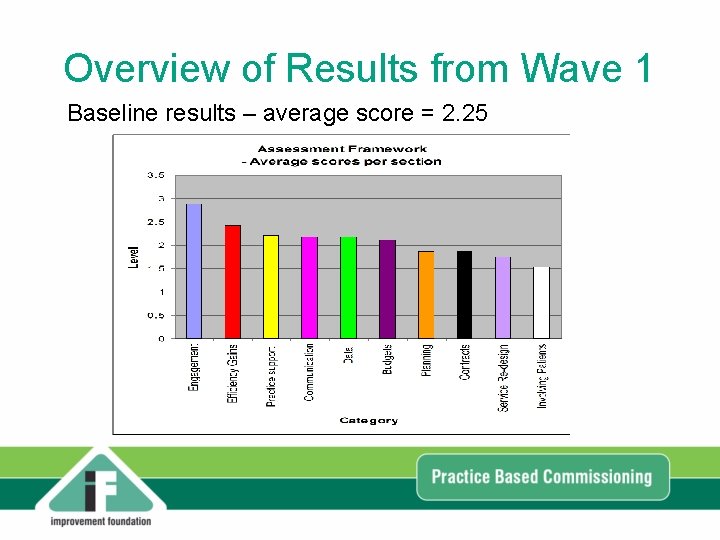
Overview of Results from Wave 1 Baseline results – average score = 2. 25
Preparatory Period - Training • Aim: – Provide sites with greater understanding and knowledge about different components of PBC – Validate what has already been done locally – Share what others have done • Attendance: – PCT Senior Management – PCT representatives from Information, Finance and Commissioning functions – Lead clinicians and practice managers – SHA PBC leads • Dates: 29 June 2006, 25/26 July 2006 • Agendas: Plenaries and practical breakout sessions
Feedback from the Wave 1 Training Events: 96% found the events good / excellent Comments included: • The event was extremely informative and useful • Useful timeout to start planning how we can deliver PBC. Also reassuring to hear we are progressing as well as others! • BRILLIANT! I learnt much more than I could have hoped • Feel more confident about our plans for future re-design. Great opportunity to work with PCT staff • A real opportunity to get a head start on PBC and in particular get to grips with the tools needed and understand some of the challenges ahead
Mapping and Analysis • As part of care pathway redesign • Process mapping of service areas for re-design • Patients should be included in the process mapping and analysis • Use the analysis of the process mapping to inform decisions on improvement – action plan
Baseline Measures • Baseline measures to be reported in September 2006 • Global measures to be reported on internet based system • Local measures should be developed by September and reported each month • The PBC Assessment Framework (PBCAF) will provide baseline measures for commissioning systems
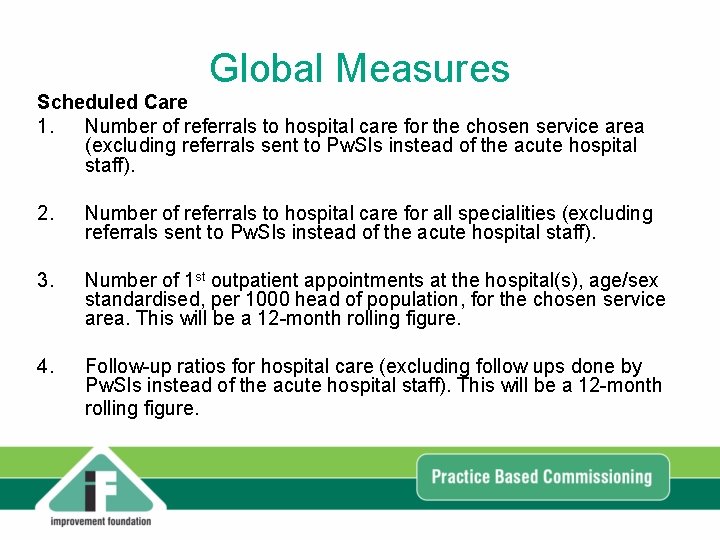
Global Measures Scheduled Care 1. Number of referrals to hospital care for the chosen service area (excluding referrals sent to Pw. SIs instead of the acute hospital staff). 2. Number of referrals to hospital care for all specialities (excluding referrals sent to Pw. SIs instead of the acute hospital staff). 3. Number of 1 st outpatient appointments at the hospital(s), age/sex standardised, per 1000 head of population, for the chosen service area. This will be a 12 -month rolling figure. 4. Follow-up ratios for hospital care (excluding follow ups done by Pw. SIs instead of the acute hospital staff). This will be a 12 -month rolling figure.
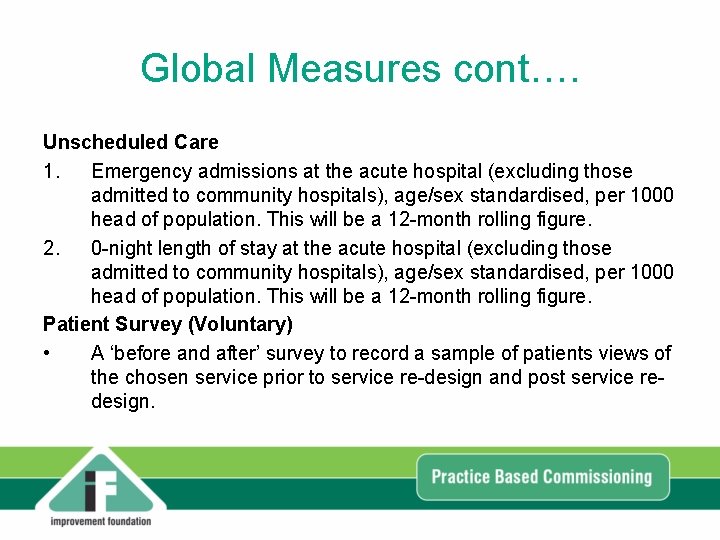
Global Measures cont…. Unscheduled Care 1. Emergency admissions at the acute hospital (excluding those admitted to community hospitals), age/sex standardised, per 1000 head of population. This will be a 12 -month rolling figure. 2. 0 -night length of stay at the acute hospital (excluding those admitted to community hospitals), age/sex standardised, per 1000 head of population. This will be a 12 -month rolling figure. Patient Survey (Voluntary) • A ‘before and after’ survey to record a sample of patients views of the chosen service prior to service re-design and post service redesign.
Parallel Learning Routes • • • Assessment Framework Internet based training – web cast presentations PBC tools Website and web forum Support for local learning exchanges Simulation event
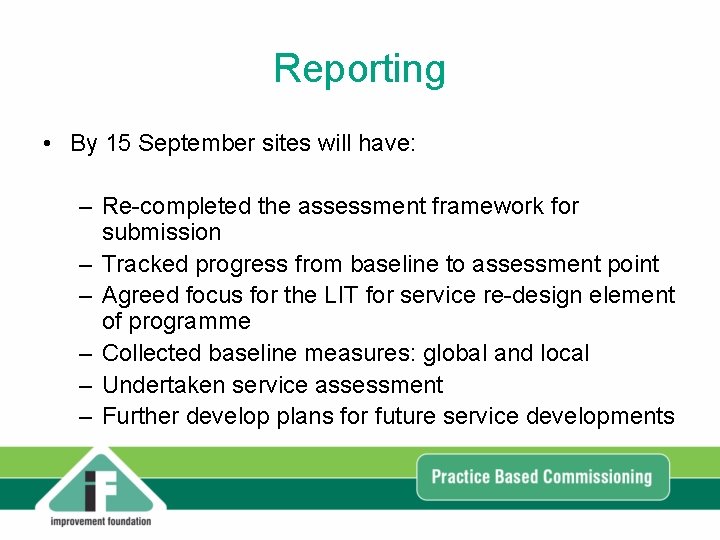
Reporting • By 15 September sites will have: – Re-completed the assessment framework for submission – Tracked progress from baseline to assessment point – Agreed focus for the LIT for service re-design element of programme – Collected baseline measures: global and local – Undertaken service assessment – Further develop plans for future service developments
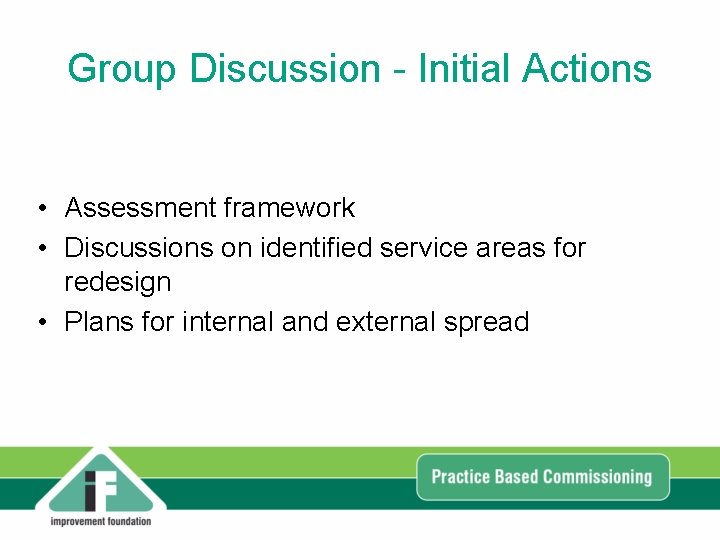
Group Discussion - Initial Actions • Assessment framework • Discussions on identified service areas for redesign • Plans for internal and external spread
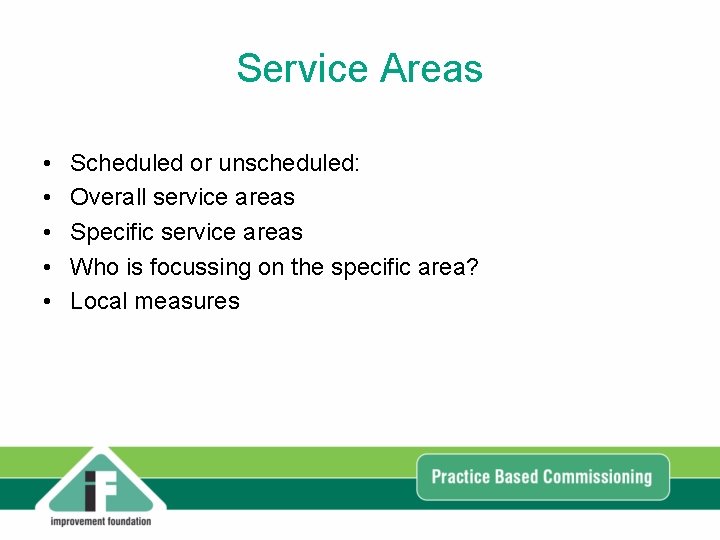
Service Areas • • • Scheduled or unscheduled: Overall service areas Specific service areas Who is focussing on the specific area? Local measures
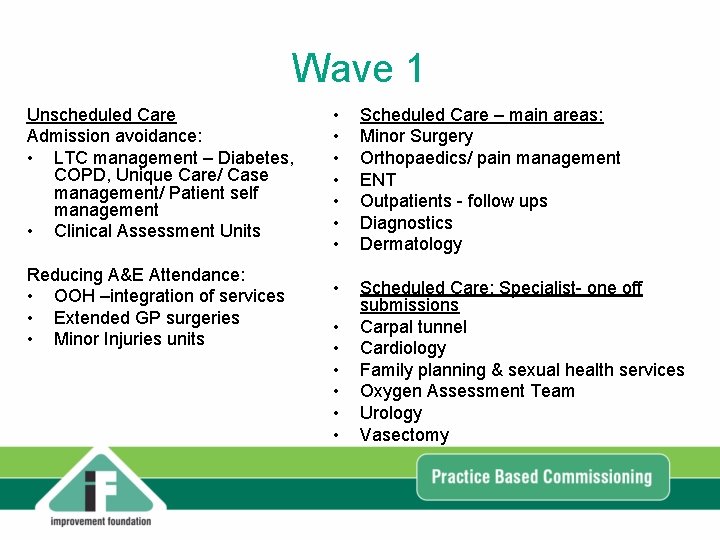
Wave 1 Unscheduled Care Admission avoidance: • LTC management – Diabetes, COPD, Unique Care/ Case management/ Patient self management • Clinical Assessment Units Reducing A&E Attendance: • OOH –integration of services • Extended GP surgeries • Minor Injuries units • • Scheduled Care – main areas: Minor Surgery Orthopaedics/ pain management ENT Outpatients - follow ups Diagnostics Dermatology • Scheduled Care: Specialist- one off submissions Carpal tunnel Cardiology Family planning & sexual health services Oxygen Assessment Team Urology Vasectomy • • •