
XVI Gas Embolism Accidents with Medical Devices TRAINING
XVI. Gas Embolism Accidents with Medical Devices TRAINING SEMINAR ON MEDICAL DEVICE ACCIDENT INVESTIGATION for Kingdom of Saudi Arabia Saudi Food & Drug Authority Riyadh 11 -14 February, 2007 Presenter: Mark E. Bruley Vice President, Accident and Forensic Investigation ECRI 5200 Butler Pike, Plymouth Meeting, PA, 19642 USA Tel: +1 610 -825 -6000, ext. 5223 E-mail: mbruley@ecri. org Web Sites: www. ecri. org www. mdsr. ecri. org ©ECRI 2007 1
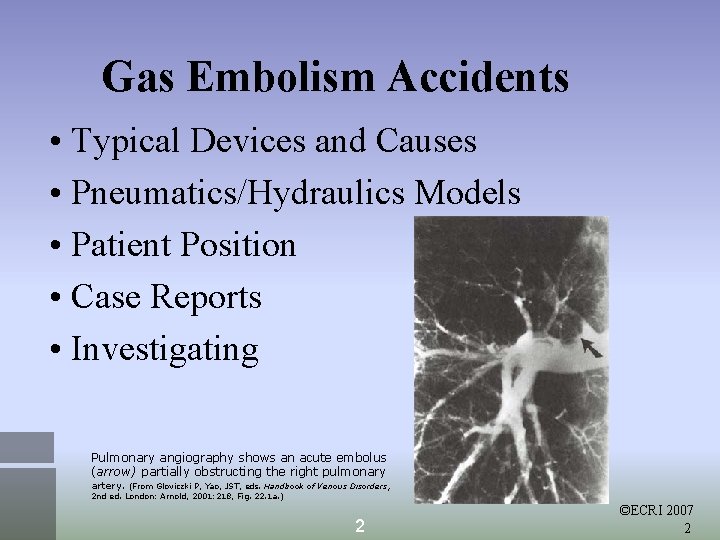
Gas Embolism Accidents • Typical Devices and Causes • Pneumatics/Hydraulics Models • Patient Position • Case Reports • Investigating Pulmonary angiography shows an acute embolus (arrow) partially obstructing the right pulmonary artery. (From Gloviczki P, Yao, JST, eds. Handbook of Venous Disorders, 2 nd ed. London: Arnold, 2001: 218, Fig. 22. 1 a. ) 2 ©ECRI 2007 2
Typical Devices: Gas Emboli • Heart-Lung Bypass • Units • • Haemodialysis Units • Blood Recovery Systems (Cell Savers) • • Gas-Cooled Laser Fibers • Insufflators • – Laparoscopic • – Hysteroscopic – Ophthalmic – Arthroscopic 3 Central Venous Cath. Ruptured Balloons: – Intra-Aortic Pumping? – PTCA Balloons Nitrogen Powered Surgical Instruments Infusion Devices Radiographic Dye Injectors ©ECRI 2007 3
Heart-Lung Bypass Accidents: Involved Devices • Reusable – Bypass Pump Consoles – Gas Blenders – O 2 Saturation Mon. – Anesth. Vaporizers – Gas Regulators – Gas Flowmeters – Bubble Detectors • Disposable – – Tubing Circuits Oxygenators Arterial Blood Filters Cardiotomy Reservoirs ©ECRI 2007 4
Air Embolism Causes • >50 possible causes • Forced through IV tubing • Forced onto open vein bed from end of surgical instrument • Forced into uterine lining laser fiber cooling gas • Forced into joint capsule from irrigating arthroscopic instrument • Barotrauma of mechanical ventilation • Luer Misconnections • Passive entry into open jugular stopcock or diploic vein (skull) See Health Devices handouts. See also: Sowell MW, Lovelady CL, et al. Infant Death Due to Air Embolism from Peripheral Venous Infusion. J Forensic Sci 2007 Jan 52(1): 183 -188. 5 ©ECRI 2007 5
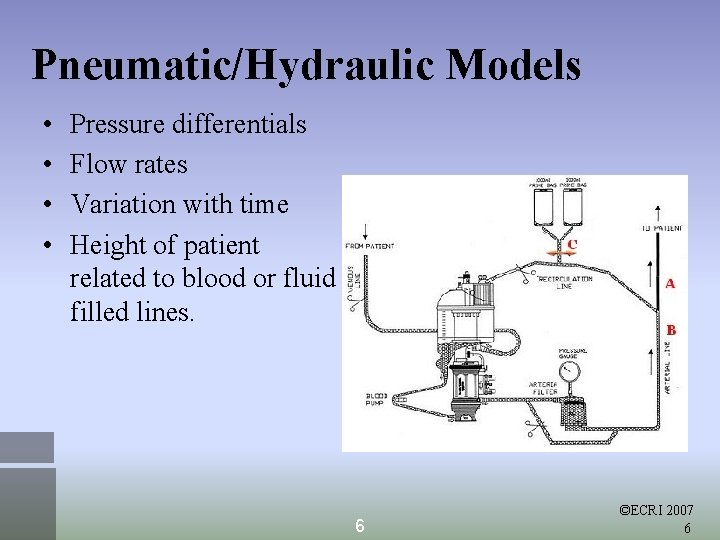
Pneumatic/Hydraulic Models • • Pressure differentials Flow rates Variation with time Height of patient related to blood or fluid filled lines. 6 ©ECRI 2007 6
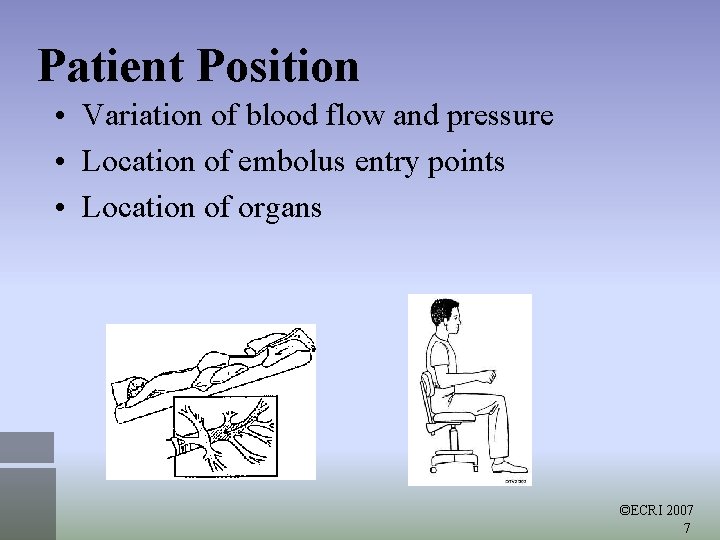
Patient Position • Variation of blood flow and pressure • Location of embolus entry points • Location of organs ©ECRI 2007 7
Case Report: Argon Beam Coagulator Air Embolism • Fatal Gas Embolism caused by intra-abdominal over-pressurization during laparoscopic cholecystectomy using argon enhanced coagulation (AEC) • Patient’s intra-abdominal pressure increased above insufflator’s alarm limit (33 mm. Hg) • Patient experienced difficulties consistent with gas embolism – confirmed at autopsy 8 ©ECRI 2007 8
Case Report: Argon Beam Coagulator Air Embolism • It is possible for argon gas to enter open blood vessels • AEC systems act as secondary source of pressurized gas causing intra-abdominal pressure to rise, exceeding venous pressure • Argon is less soluble – not readily absorbed in blood than CO 2 normally used for insufflation 9 ©ECRI 2007 9
Argon Beam Recommendations • • • Limit argon flow to lowest levels possible Keep tip several millimeters from surgical site Flush cavity with CO 2 after AEC activations Leave one instrument cannula vent open Use patient monitoring (e. g. , end-tidal CO 2) for early detection of venous or pulmonary gas embolism • Make sure that staff is properly trained to detect and manage gas embolism 1 ©ECRI 2007 10
Case Report: Aphaeresis Unit Air Embolism • Fatal air embolism during blood aphaeresis (blood filtration) • Death within 2 minutes of re-starting treatment • Autopsy: >500 cc air in heart and lung vessels • Air seen in blood tube flowing from machine to patient. • Two years of testing by vendor and authorities • Case unexplained. Unit performance OK. Air detectors OK ©ECRI 2007 11
Case Report: Aphaeresis Unit Air Embolism • ECRI analysis, testing, and incident recreation: – Air came from central line catheter in neck – Accumulated in superior vena cava – Air flowed in blood tube toward machine during troubleshooting – Blood tubing pulled out of one air detector – Air returned to patient when machine restarted – Open stopcock on neck catheter was cause – Air detector design contributory (tube dislodgement not detected) ©ECRI 2007 12
Investigating Air Embolism • Passive v. forced gas flow • Device misconnections (e. g. , Luer fittings) • Biological routes v. machine routes • Post Mortem Studies 1 ©ECRI 2007 13
XVI. Gas Embolism Accidents with Medical Devices QUESTIONS? ©ECRI 2007 14
- Slides: 14