
XRD Line Broadening With effects on Selected Area
XRD Line Broadening With effects on Selected Area Diffraction (SAD) Patterns in a TEM Part of MATERIALS SCIENCE & A Learner’s Guide ENGINEERING AN INTRODUCTORY E-BOOK Anandh Subramaniam & Kantesh Balani Materials Science and Engineering (MSE) Indian Institute of Technology, Kanpur- 208016 Email: anandh@iitk. ac. in, URL: home. iitk. ac. in/~anandh http: //home. iitk. ac. in/~anandh/E-book. htm
Ideal versus real diffraction patterns q Under an ideal diffraction scenario, the diffraction pattern will consist of -peaks in a dark background. q In a practical situation, ‘instrumental’ and ‘sample’ related issues lead to: the presence of intensity between the Bragg peaks & Bragg peaks with a certain profile (i. e. broadened). q Let us assume that the instrumental origins of the non-ideality have been accounted for. Then, information about the sample can be obtained from the diffuse intensity between the Bragg peaks and the profile of the peaks. q The diffuse intensity typically arises from defects like atomic disorder (point defects) and thermal vibrations of atoms. q The broadening of Bragg peak can arise from defects in the sample (e. g. dislocations & stacking faults) and due to small crystallite/grain size. In general truncation in real space and concomitant broadening in reciprocal space can arise from three sources as below. (i) Truncation of the wave-front (i. e. the wave-front has a finite extent like a beam with a finite diameter). (ii) Truncation of the crystal (say due to small grain size). (iii) Truncation of the sample (finite sample sizes may in addition lead to crystal truncation). Finite crystals can be ‘features’ like precipitates, twins, etc.
Crystallite size and Strain Bragg’s equation assumes: Crystal is perfect and infinite Incident beam is perfectly parallel and monochromatic. Actual experimental conditions are different from these leading various kinds of deviations from Bragg’s condition Peaks are not ‘ ’ curves Peaks are broadened (in addition to other possible deviations). There also deviations from the assumptions involved in the generating powder patterns Crystals may not be randomly oriented (textured sample) Peak intensities are altered w. r. t. to that expected. In a powder sample if the crystallite size < 0. 5 m there are insufficient number of planes to ‘build up’ a sharp diffraction pattern peaks are broadened Funda Check What is meant by the terms: (i) particle size, (ii) crystallite size, (iii) grain size. q If a particle is amorphous or consists of many crystallites, the particle size cannot be directly measured by XRD. q Crystallite is a small sized crystal and many such crystallites (i. e. now each particle is a single crystal of small size) can be used in powder diffraction to obtain crystallite size. q In a solid polycrystalline sample (like a piece of Cu or Alumina), the grain size and crystallite size refer to the same thing.
When considering constructive and destructive interference we considered the following points: q In the example considered ’ was ‘far away’ (at a larger angular separation) from ( Bragg) and it was easy to see the destructive interference q In other words for incidence angle of ’ the phase difference of is accrued just by traversing one ‘d’. q If the angle is just away from the Bragg angle ( Bragg), then one will have to go deep into the crystal (many ‘d’) to find a plane (belonging to the same parallel set) which will scatter out of phase with this ray (phase difference of ) and hence cause destructive interference q If such a plane which scatters out of phase with a off Bragg angle ray is absent (due to finiteness of the crystal) then the ray will not be cancelled and diffraction would be observed just off Bragg angles too line broadening! (i. e. the diffraction peak is not sharp like a -peak in the intensity versus angle plot) q This is one source of line broadening. Other sources include: residual strain, instrumental effects, stacking faults etc. (next slide).
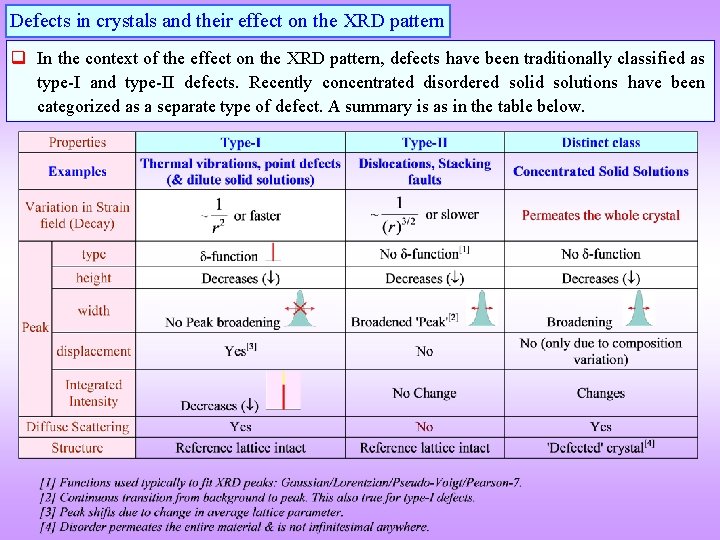
Defects in crystals and their effect on the XRD pattern q In the context of the effect on the XRD pattern, defects have been traditionally classified as type-I and type-II defects. Recently concentrated disordered solid solutions have been categorized as a separate type of defect. A summary is as in the table below.
q In XRD (focussing on powder XRD for now), line broadening can come from many sources. They are as listed below. Instrumental broadening has to be subtracted* to obtain broadening from other sources. This is done by using a ‘standard’ sample with large grain size and low strain, wherein there is no crystallite size or strain broadening (sample is chosen such that the density of other defects is small). q Macrostrain (e. g. arising from pulling a specimen) will result in peak shift, while microstrain will result in peak broadening.
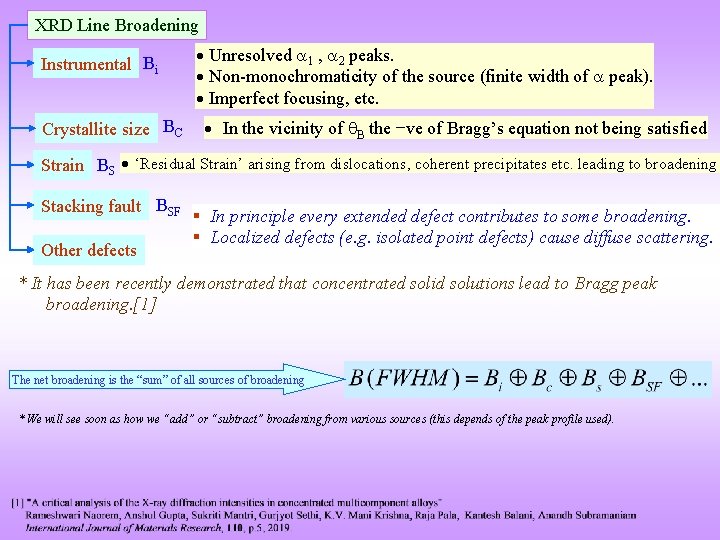
XRD Line Broadening Instrumental Bi Crystallite size BC Unresolved 1 , 2 peaks. Non-monochromaticity of the source (finite width of peak). Imperfect focusing, etc. In the vicinity of B the −ve of Bragg’s equation not being satisfied Strain BS ‘Residual Strain’ arising from dislocations, coherent precipitates etc. leading to broadening Stacking fault BSF Other defects In principle every extended defect contributes to some broadening. Localized defects (e. g. isolated point defects) cause diffuse scattering. * It has been recently demonstrated that concentrated solid solutions lead to Bragg peak broadening. [1] The net broadening is the “sum” of all sources of broadening * We will see soon as how we “add” or “subtract” broadening from various sources (this depends of the peak profile used).
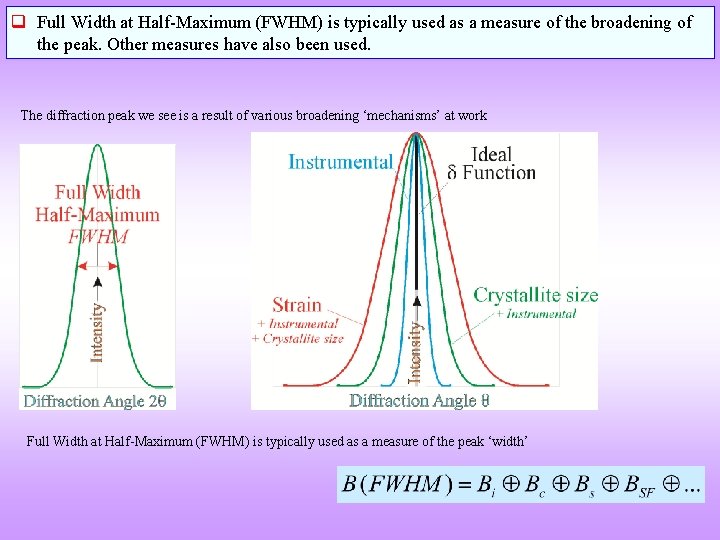
q Full Width at Half-Maximum (FWHM) is typically used as a measure of the broadening of the peak. Other measures have also been used. The diffraction peak we see is a result of various broadening ‘mechanisms’ at work Full Width at Half-Maximum (FWHM) is typically used as a measure of the peak ‘width’
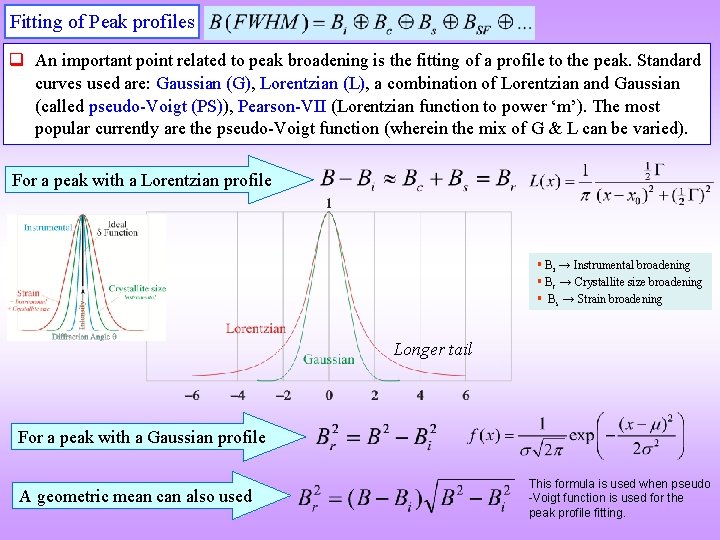
Fitting of Peak profiles q An important point related to peak broadening is the fitting of a profile to the peak. Standard curves used are: Gaussian (G), Lorentzian (L), a combination of Lorentzian and Gaussian (called pseudo-Voigt (PS)), Pearson-VII (Lorentzian function to power ‘m’). The most popular currently are the pseudo-Voigt function (wherein the mix of G & L can be varied). For a peak with a Lorentzian profile Bi → Instrumental broadening Bc → Crystallite size broadening Bs → Strain broadening Longer tail For a peak with a Gaussian profile A geometric mean can also used This formula is used when pseudo -Voigt function is used for the peak profile fitting.
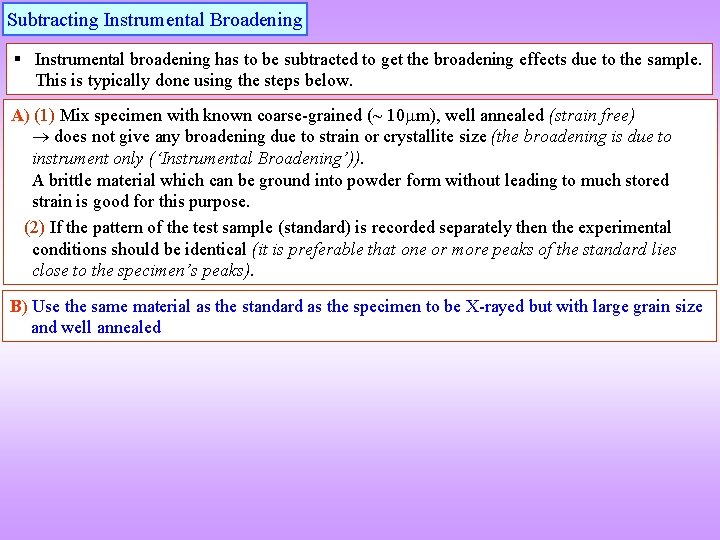
Subtracting Instrumental Broadening Instrumental broadening has to be subtracted to get the broadening effects due to the sample. This is typically done using the steps below. A) (1) Mix specimen with known coarse-grained (~ 10 m), well annealed (strain free) does not give any broadening due to strain or crystallite size (the broadening is due to instrument only (‘Instrumental Broadening’)). A brittle material which can be ground into powder form without leading to much stored strain is good for this purpose. (2) If the pattern of the test sample (standard) is recorded separately then the experimental conditions should be identical (it is preferable that one or more peaks of the standard lies close to the specimen’s peaks). B) Use the same material as the standard as the specimen to be X-rayed but with large grain size and well annealed
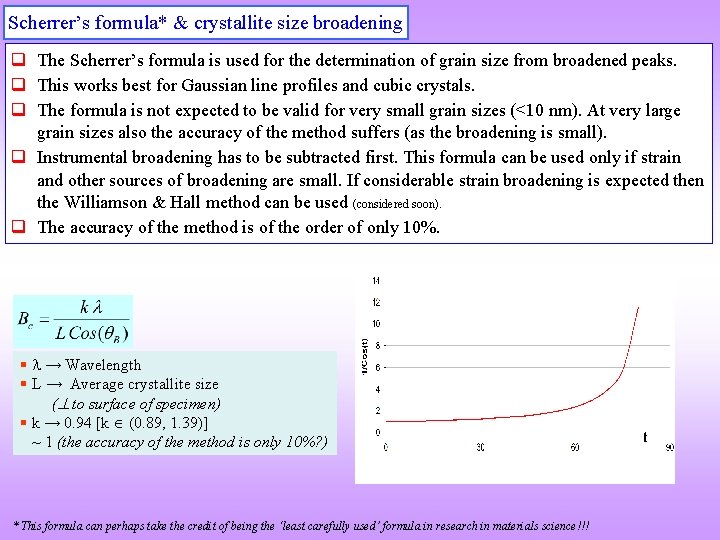
Scherrer’s formula* & crystallite size broadening q The Scherrer’s formula is used for the determination of grain size from broadened peaks. q This works best for Gaussian line profiles and cubic crystals. q The formula is not expected to be valid for very small grain sizes (<10 nm). At very large grain sizes also the accuracy of the method suffers (as the broadening is small). q Instrumental broadening has to be subtracted first. This formula can be used only if strain and other sources of broadening are small. If considerable strain broadening is expected then the Williamson & Hall method can be used (considered soon). q The accuracy of the method is of the order of only 10%. → Wavelength L → Average crystallite size ( to surface of specimen) k → 0. 94 [k (0. 89, 1. 39)] ~ 1 (the accuracy of the method is only 10%? ) * This formula can perhaps take the credit of being the ‘least carefully used’ formula in research in materials science!!!
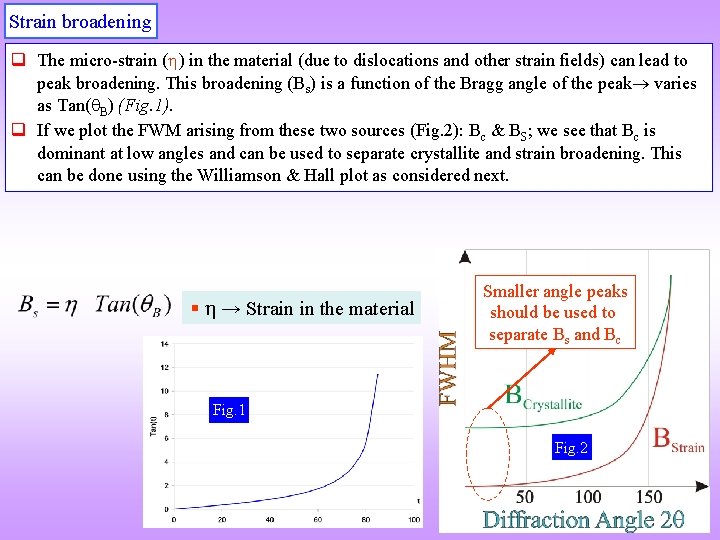
Strain broadening q The micro-strain ( ) in the material (due to dislocations and other strain fields) can lead to peak broadening. This broadening (Bs) is a function of the Bragg angle of the peak varies as Tan( B) (Fig. 1). q If we plot the FWM arising from these two sources (Fig. 2): Bc & BS; we see that Bc is dominant at low angles and can be used to separate crystallite and strain broadening. This can be done using the Williamson & Hall plot as considered next. → Strain in the material Smaller angle peaks should be used to separate Bs and Bc Fig. 1 Fig. 2
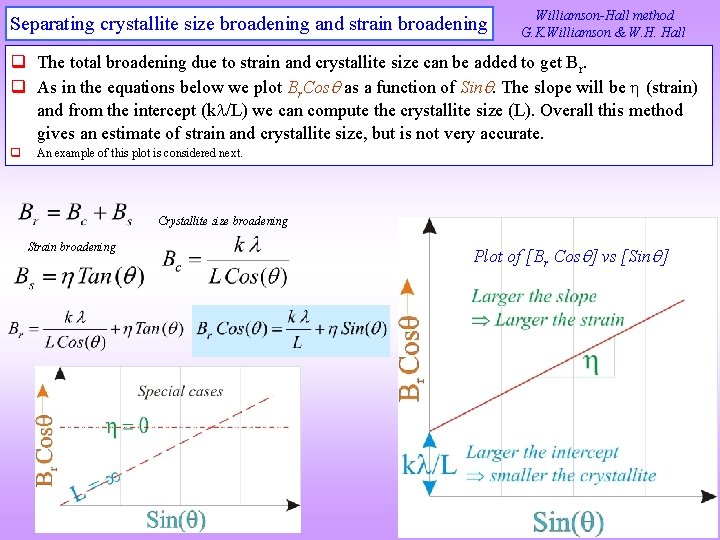
Separating crystallite size broadening and strain broadening Williamson-Hall method G. K. Williamson & W. H. Hall q The total broadening due to strain and crystallite size can be added to get Br. q As in the equations below we plot Br. Cos as a function of Sin. The slope will be (strain) and from the intercept (k /L) we can compute the crystallite size (L). Overall this method gives an estimate of strain and crystallite size, but is not very accurate. q An example of this plot is considered next. Crystallite size broadening Strain broadening Plot of [Br Cos ] vs [Sin ]
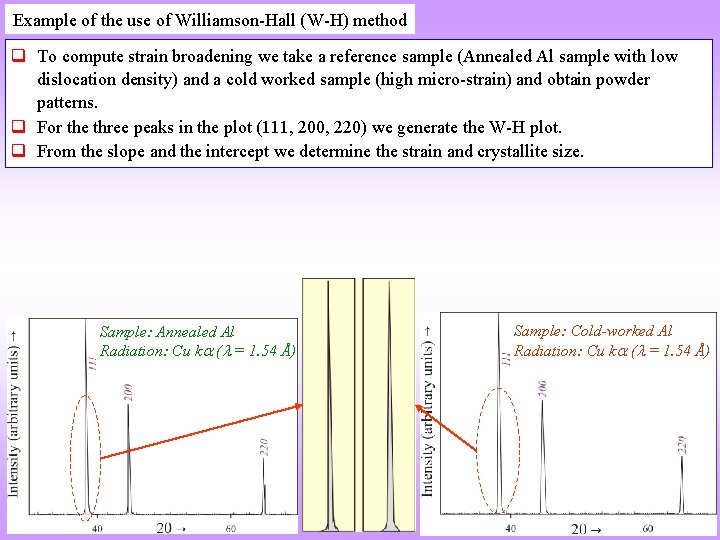
Example of the use of Williamson-Hall (W-H) method q To compute strain broadening we take a reference sample (Annealed Al sample with low dislocation density) and a cold worked sample (high micro-strain) and obtain powder patterns. q For the three peaks in the plot (111, 200, 220) we generate the W-H plot. q From the slope and the intercept we determine the strain and crystallite size. Sample: Annealed Al Radiation: Cu k ( = 1. 54 Å) Sample: Cold-worked Al Radiation: Cu k ( = 1. 54 Å)
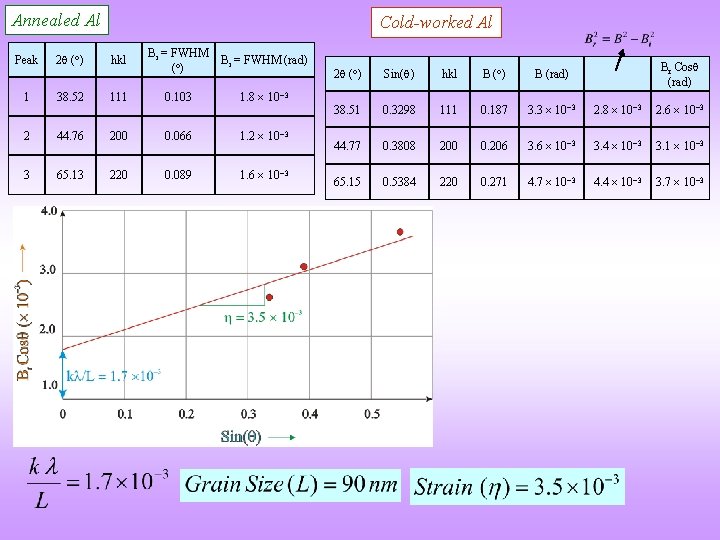
Annealed Al Peak 2 ( ) Cold-worked Al hkl Bi = FWHM ( ) Bi = FWHM (rad) 1 38. 52 111 0. 103 1. 8 10− 3 2 44. 76 200 0. 066 1. 2 10− 3 3 65. 13 220 0. 089 1. 6 10− 3 Br Cos (rad) 2 ( ) Sin( ) hkl B ( ) B (rad) 38. 51 0. 3298 111 0. 187 3. 3 10− 3 2. 8 10− 3 2. 6 10− 3 44. 77 0. 3808 200 0. 206 3. 6 10− 3 3. 4 10− 3 3. 1 10− 3 65. 15 0. 5384 220 0. 271 4. 7 10− 3 4. 4 10− 3 3. 7 10− 3
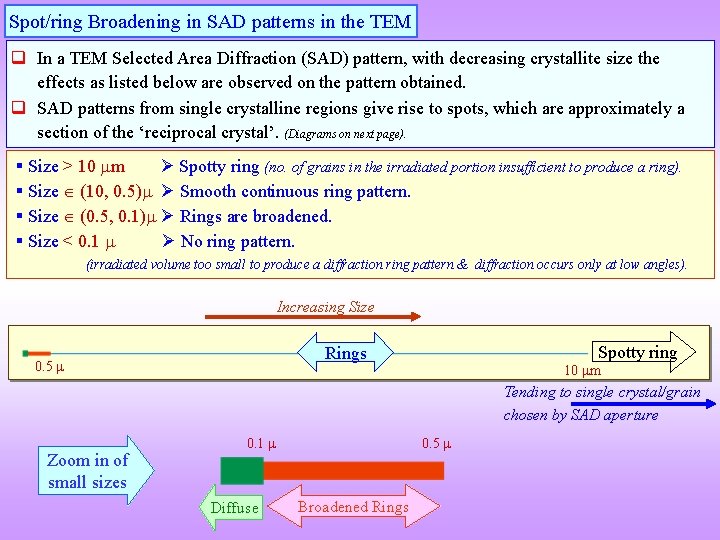
Spot/ring Broadening in SAD patterns in the TEM q In a TEM Selected Area Diffraction (SAD) pattern, with decreasing crystallite size the effects as listed below are observed on the pattern obtained. q SAD patterns from single crystalline regions give rise to spots, which are approximately a section of the ‘reciprocal crystal’. (Diagrams on next page). Size > 10 m Spotty ring (no. of grains in the irradiated portion insufficient to produce a ring). Size (10, 0. 5) Smooth continuous ring pattern. Size (0. 5, 0. 1) Rings are broadened. Size < 0. 1 No ring pattern. (irradiated volume too small to produce a diffraction ring pattern & diffraction occurs only at low angles). Increasing Size Spotty ring Rings 0. 5 10 m Tending to single crystal/grain chosen by SAD aperture Zoom in of small sizes 0. 1 Diffuse 0. 5 Broadened Rings
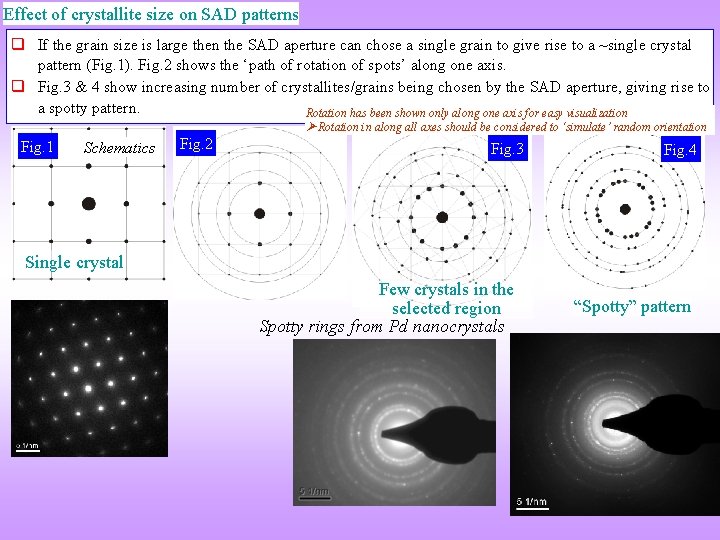
Effect of crystallite size on SAD patterns q If the grain size is large then the SAD aperture can chose a single grain to give rise to a ~single crystal pattern (Fig. 1). Fig. 2 shows the ‘path of rotation of spots’ along one axis. q Fig. 3 & 4 show increasing number of crystallites/grains being chosen by the SAD aperture, giving rise to a spotty pattern. Rotation has been shown only along one axis for easy visualization Rotation in along all axes should be considered to ‘simulate’ random orientation Fig. 1 Schematics Fig. 2 Fig. 3 Fig. 4 Single crystal Few crystals in the selected region Spotty rings from Pd nanocrystals “Spotty” pattern
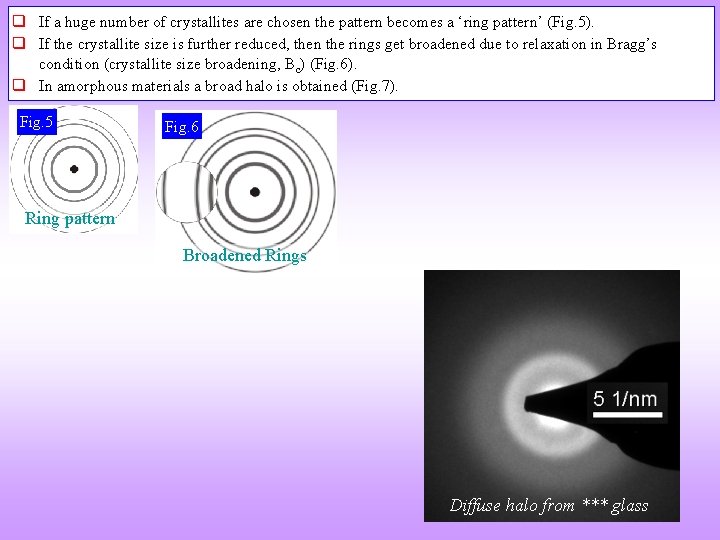
q If a huge number of crystallites are chosen the pattern becomes a ‘ring pattern’ (Fig. 5). q If the crystallite size is further reduced, then the rings get broadened due to relaxation in Bragg’s condition (crystallite size broadening, Bc) (Fig. 6). q In amorphous materials a broad halo is obtained (Fig. 7). Fig. 5 Fig. 6 Ring pattern Broadened Rings Diffuse halo from *** glass
- Slides: 18