
xRay Image Formation and Radiation Contrast 9182021 1

- Slides: 40
x-Ray Image Formation and Radiation Contrast 9/18/2021 1
9/18/2021 2
Subject Contrast l Subject Contrast Depends On: u Thickness Differences u Density Differences u Beam energy • increased energy-decreased contrast u Exposure (time or m. A): if the film is excessively light or dark, contrast is diminished. 9/18/2021 3
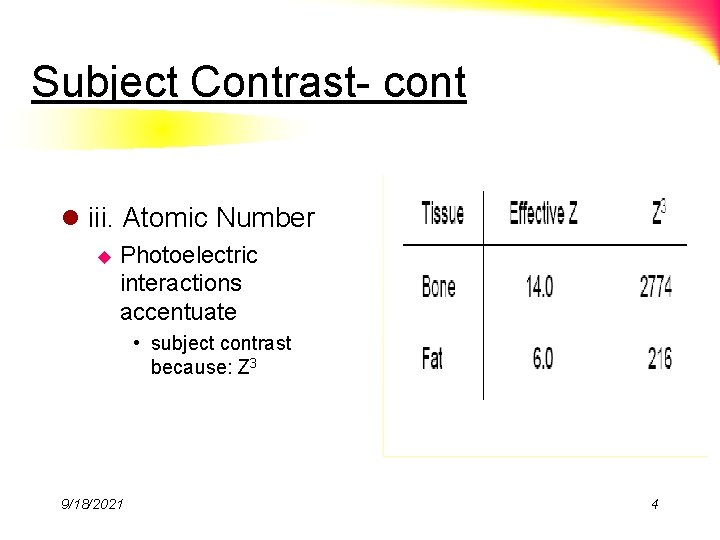
Subject Contrast- cont l iii. Atomic Number u Photoelectric interactions accentuate • subject contrast because: Z 3 9/18/2021 4
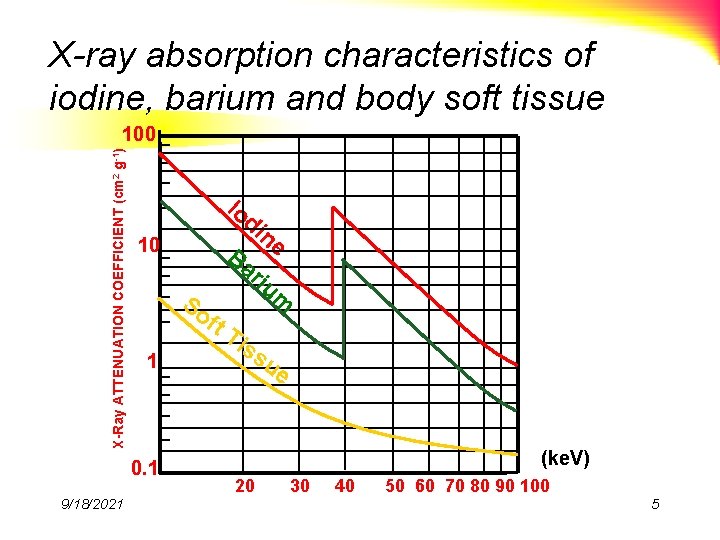
X-ray absorption characteristics of iodine, barium and body soft tissue X-Ray ATTENUATION COEFFICIENT (cm 2 g-1) 100 10 So ft Ti ss 1 ue 0. 1 9/18/2021 Io di ne Ba riu m (ke. V) 20 30 40 50 60 70 80 90 100 5
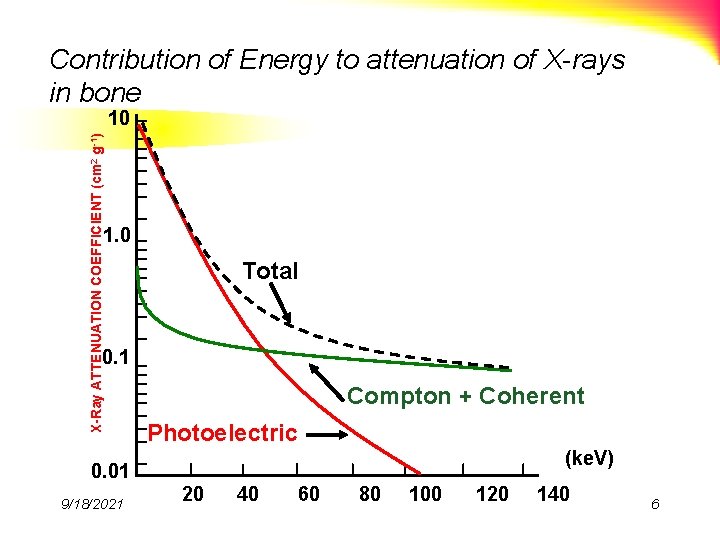
Contribution of Energy to attenuation of X-rays in bone X-Ray ATTENUATION COEFFICIENT (cm 2 g-1) 10 1. 0 Total 0. 1 Compton + Coherent Photoelectric (ke. V) 0. 01 9/18/2021 20 40 60 80 100 120 140 6
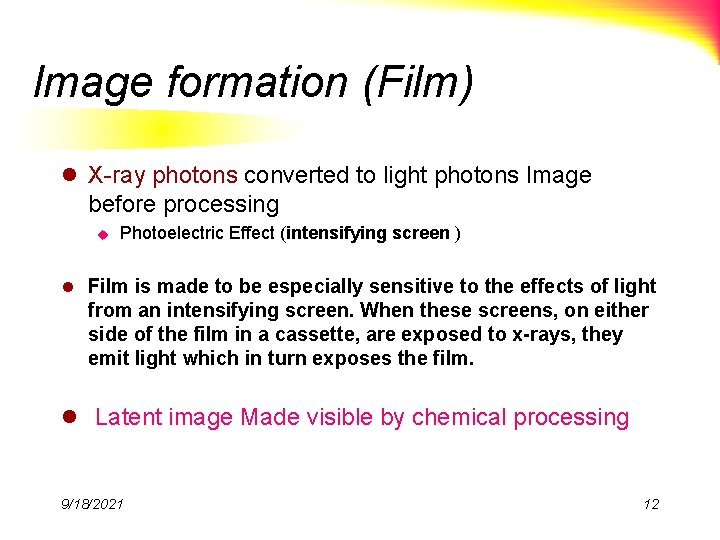
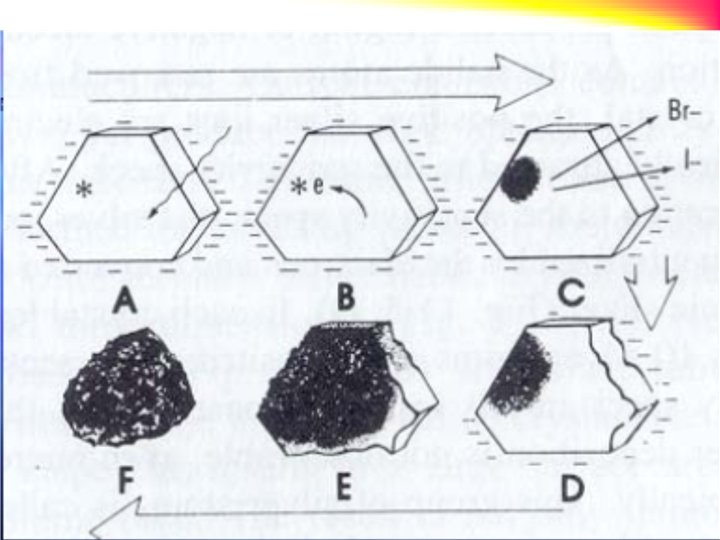
Image formation (Film) l X-ray photons converted to light photons Image before processing u Photoelectric Effect (intensifying screen ) l Film is made to be especially sensitive to the effects of light from an intensifying screen. When these screens, on either side of the film in a cassette, are exposed to x-rays, they emit light which in turn exposes the film. l Latent image Made visible by chemical processing 9/18/2021 12
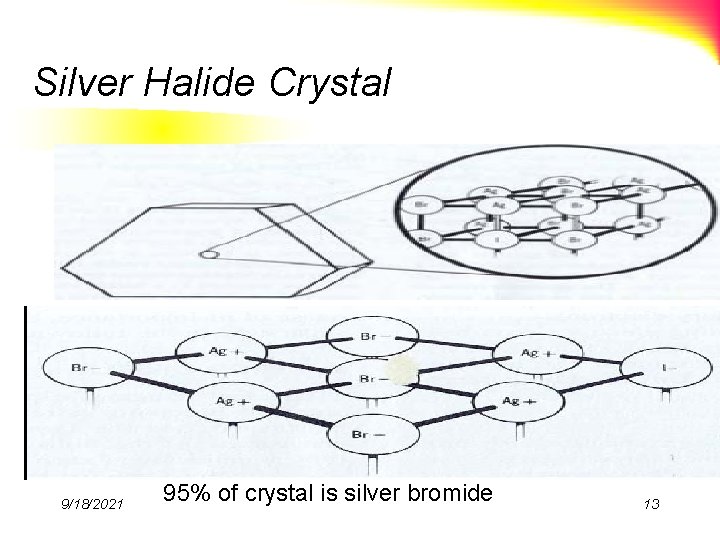
Silver Halide Crystal 9/18/2021 95% of crystal is silver bromide 13
9/18/2021 14
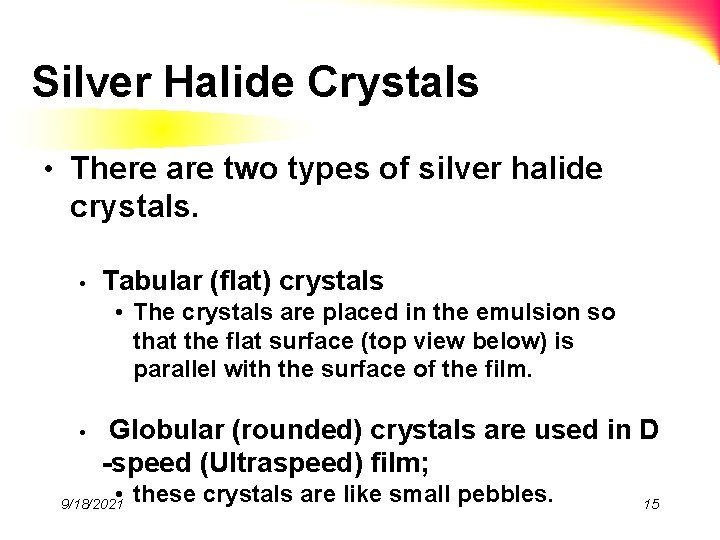
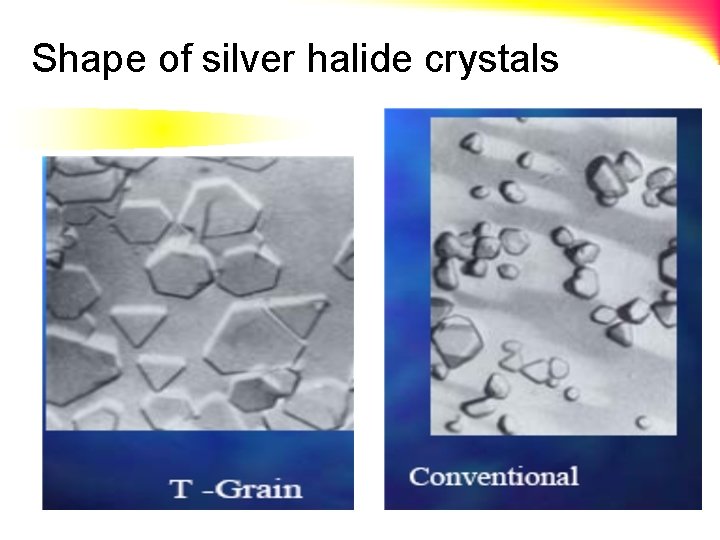
Silver Halide Crystals • There are two types of silver halide crystals. • Tabular (flat) crystals • The crystals are placed in the emulsion so that the flat surface (top view below) is parallel with the surface of the film. • Globular (rounded) crystals are used in D -speed (Ultraspeed) film; • these crystals are like small pebbles. 9/18/2021 15
Shape of silver halide crystals 9/18/2021 16
Intensifying screen structure 4 The fluorescent layer (luminophor crystals) should : 4 4 be able to absorb the maximum quantity of X-rays match its fluorescence with the film sensitivity (color of emitted light) 4 Type of material : 4 4 Calcium Tungstate (Ca. WO 4) (till 1972) Rare earth (since 1970) (La. OBr: Tm) (Gd 2 O 2 S: Tb) more sensitive and effective than (Ca. WO 4) 9/18/2021 17
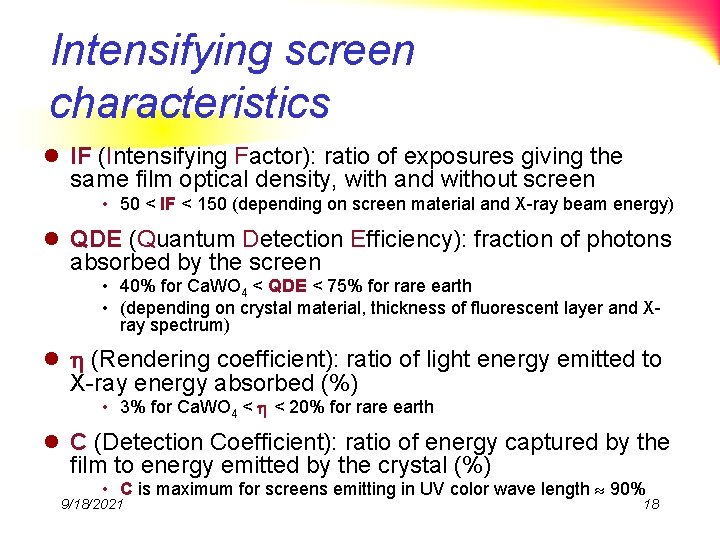
Intensifying screen characteristics l IF (Intensifying Factor): ratio of exposures giving the same film optical density, with and without screen • 50 < IF < 150 (depending on screen material and X-ray beam energy) l QDE (Quantum Detection Efficiency): fraction of photons absorbed by the screen • 40% for Ca. WO 4 < QDE < 75% for rare earth • (depending on crystal material, thickness of fluorescent layer and Xray spectrum) l (Rendering coefficient): ratio of light energy emitted to X-ray energy absorbed (%) • 3% for Ca. WO 4 < < 20% for rare earth l C (Detection Coefficient): ratio of energy captured by the film to energy emitted by the crystal (%) • C is maximum for screens emitting in UV color wave length 90% 9/18/2021 18
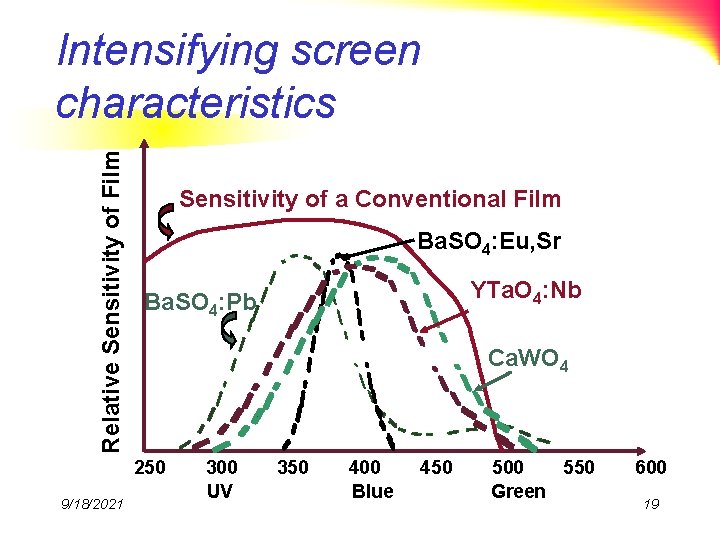
Relative Sensitivity of Film Intensifying screen characteristics Sensitivity of a Conventional Film Ba. SO 4: Eu, Sr Ca. WO 4 250 9/18/2021 YTa. O 4: Nb Ba. SO 4: Pb 300 UV 350 400 Blue 450 500 550 Green 600 19
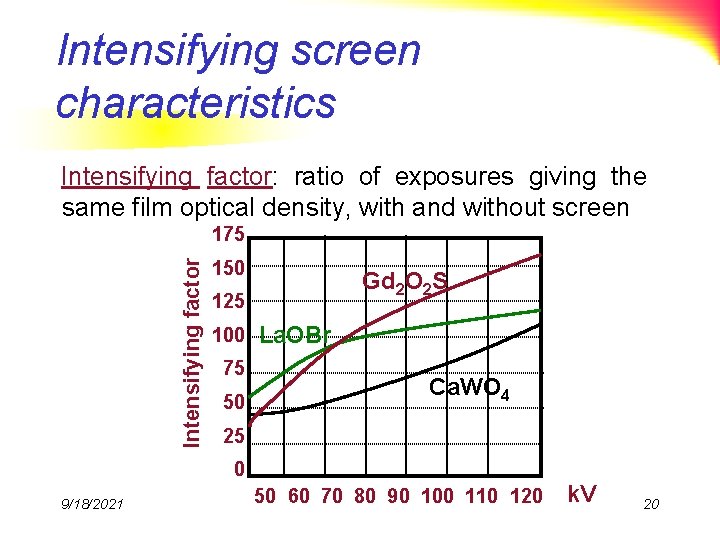
Intensifying screen characteristics Intensifying factor: ratio of exposures giving the same film optical density, with and without screen Intensifying factor 175 150 Gd 2 O 2 S 125 100 75 50 La. OBr Ca. WO 4 25 0 9/18/2021 50 60 70 80 90 100 110 120 k. V 20
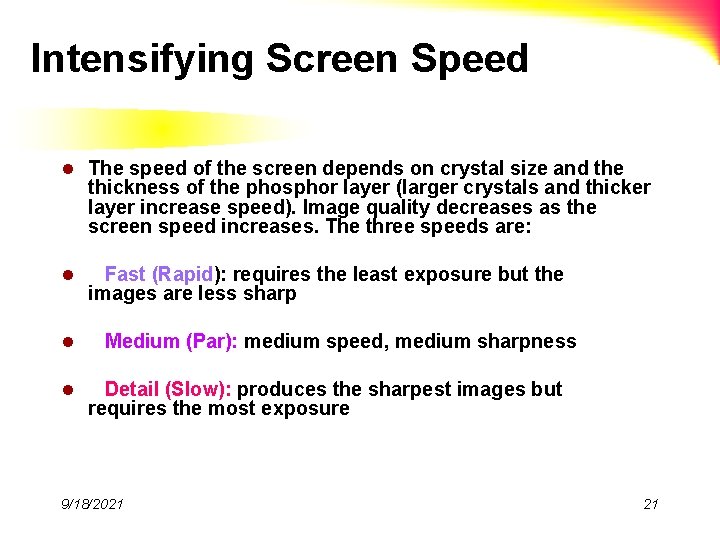
Intensifying Screen Speed l The speed of the screen depends on crystal size and the thickness of the phosphor layer (larger crystals and thicker layer increase speed). Image quality decreases as the screen speed increases. The three speeds are: l l l Fast (Rapid): requires the least exposure but the images are less sharp Medium (Par): medium speed, medium sharpness Detail (Slow): produces the sharpest images but requires the most exposure 9/18/2021 21
Screen-film characteristics * Spatial Resolution: capability of a screen film combination to display a limited number of line pairs per mm. * Modulation Transfer Function (MTF): How contrast of object is preserved by system in various frequency (sinusoidal fluctuations) * Noise spectrum: component of noise due to intensifying system (screen film) * Quantum noise, Screen noise, Granularity * Sensitivity: K 0/Ka, where K 0 = 1 m. Gy and Ka is the air kerma free-in-air for the net density D = 1. 0 9/18/2021 22
Screen film combination performance * Identification of screen by type and format * * type matching of Film and screens Screen film contact loss of spatial resolution * blurred image * Cleanliness * Inter cassette sensitivity * 9/18/2021 23
Image quality: quality the subjective judgment by the clinician of the overall appearance of a radiograph. • Density, Density • Contrast, Contrast • Latitude, Latitude • Sharpness, Sharpness • Resolution, 9/18/2021 24
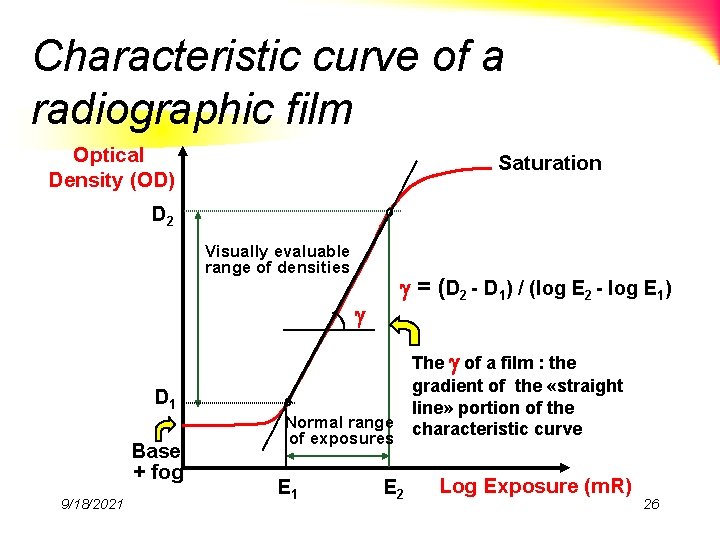
Image quality-Optical density l X-ray film is a negative recorder – increased light (or x-ray) exposure causes the developed film to become darker l Degree of darkness is quantified by the OD, measured with a densitometer 9/18/2021 25
Characteristic curve of a radiographic film Optical Density (OD) Saturation D 2 Visually evaluable range of densities D 1 Base + fog 9/18/2021 = (D 2 - D 1) / (log E 2 - log E 1) The of a film : the gradient of the «straight line» portion of the Normal range characteristic curve of exposures E 1 E 2 Log Exposure (m. R) 26
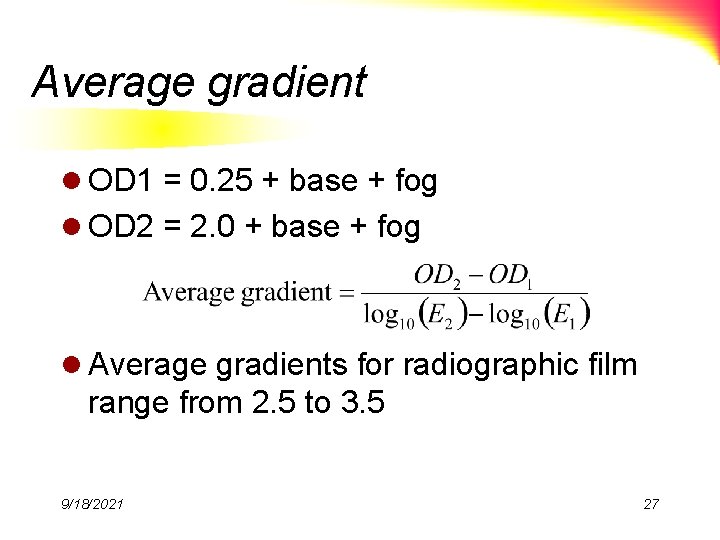
Average gradient l OD 1 = 0. 25 + base + fog l OD 2 = 2. 0 + base + fog l Average gradients for radiographic film range from 2. 5 to 3. 5 9/18/2021 27
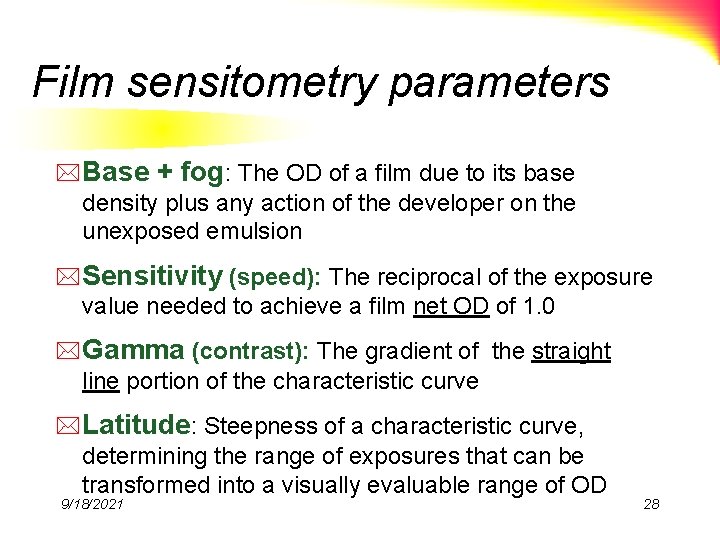
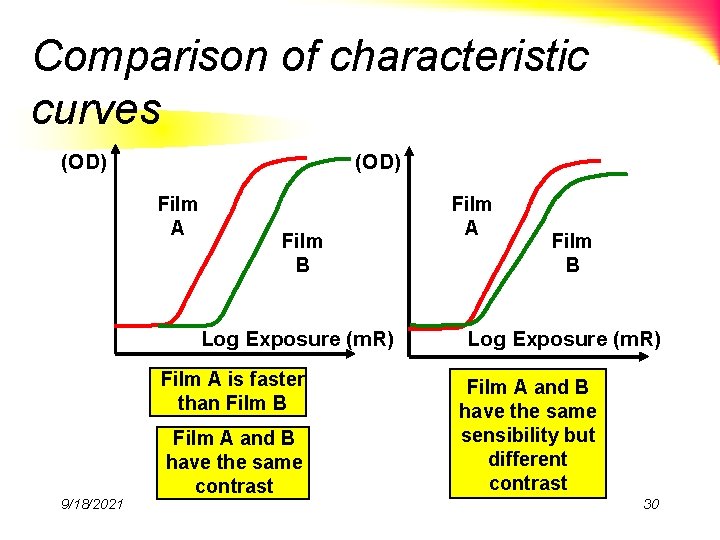
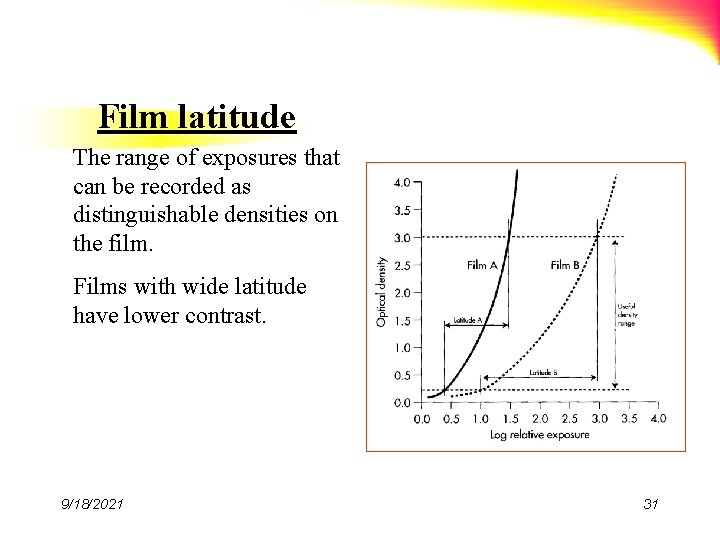
Film sensitometry parameters * Base + fog: The OD of a film due to its base density plus any action of the developer on the unexposed emulsion * Sensitivity (speed): The reciprocal of the exposure value needed to achieve a film net OD of 1. 0 * Gamma (contrast): The gradient of the straight line portion of the characteristic curve * Latitude: Steepness of a characteristic curve, determining the range of exposures that can be transformed into a visually evaluable range of OD 9/18/2021 28
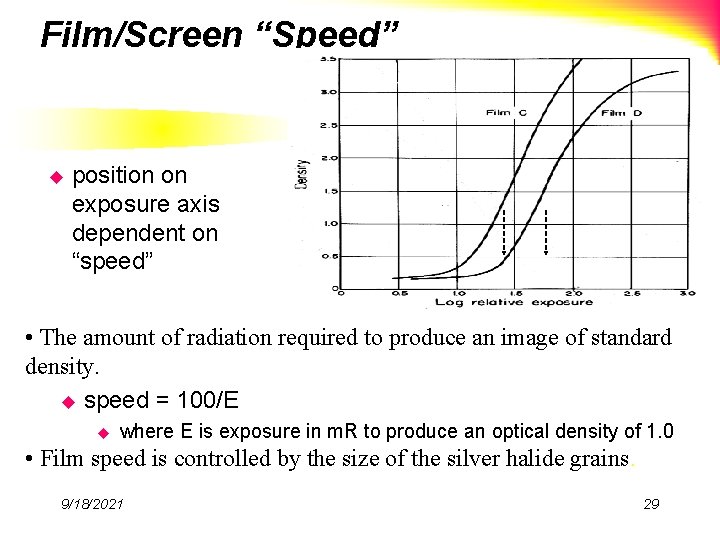
Film/Screen “Speed” u position on exposure axis dependent on “speed” • The amount of radiation required to produce an image of standard density. u speed = 100/E u where E is exposure in m. R to produce an optical density of 1. 0 • Film speed is controlled by the size of the silver halide grains. 9/18/2021 29
Comparison of characteristic curves (OD) Film A Film B Log Exposure (m. R) Film A is faster than Film B 9/18/2021 Film A and B have the same contrast Film A Film B Log Exposure (m. R) Film A and B have the same sensibility but different contrast 30
Film latitude The range of exposures that can be recorded as distinguishable densities on the film. Films with wide latitude have lower contrast. 9/18/2021 31
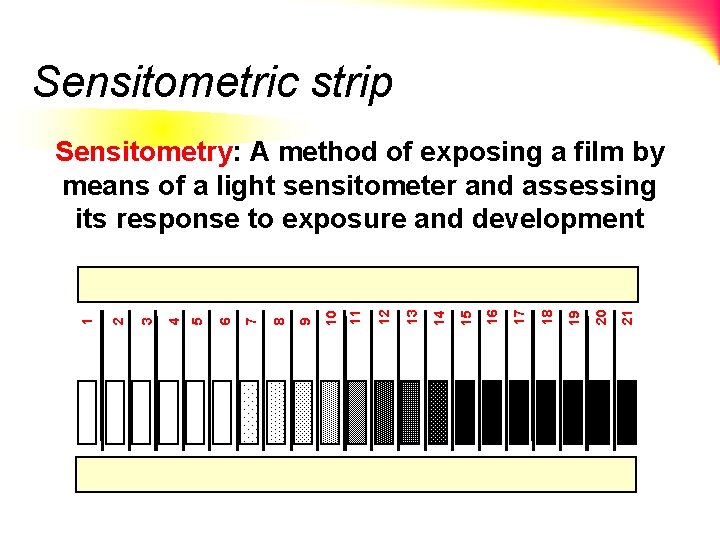
Sensitometric strip 21 20 19 18 17 16 15 14 13 12 11 10 9 8 7 6 5 4 3 2 1 Sensitometry: A method of exposing a film by means of a light sensitometer and assessing its response to exposure and development
Radiographic Contrast l Radiographic Contrast Depends On: l 1. Subject Contrast l 2. Film Contrast l 3. Scatter l 4. Fog 9/18/2021 33
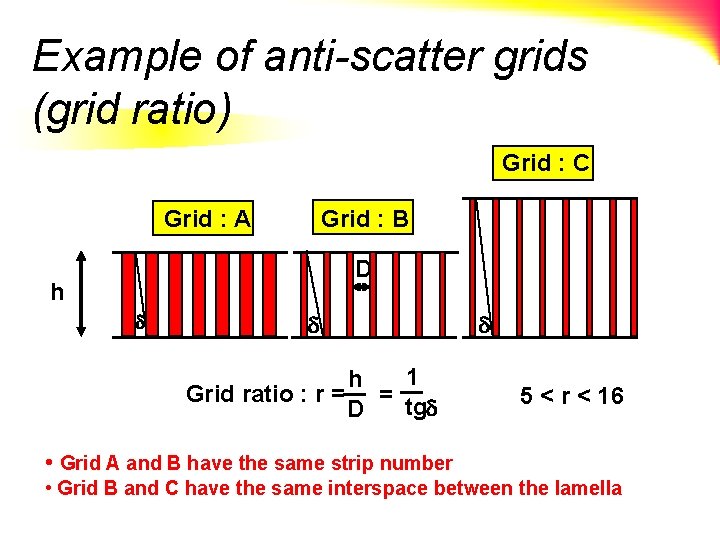
Example of anti-scatter grids (grid ratio) Grid : C Grid : A Grid : B D h 1 h Grid ratio : r = = tg D 5 < r < 16 • Grid A and B have the same strip number • Grid B and C have the same interspace between the lamella
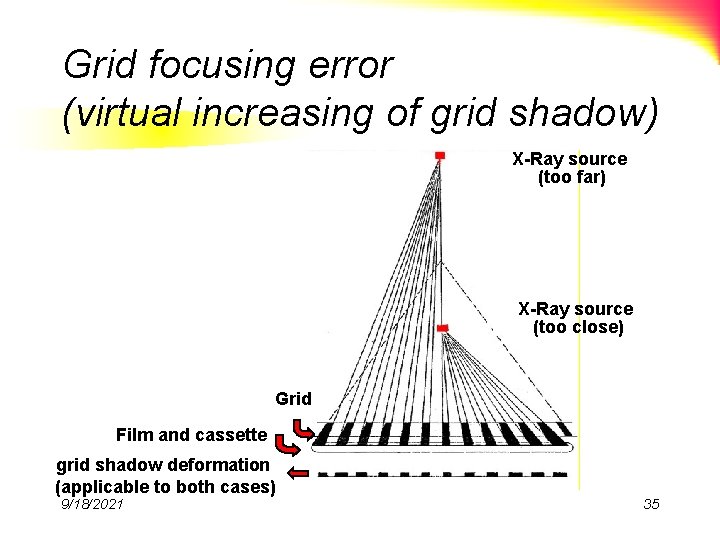
Grid focusing error (virtual increasing of grid shadow) X-Ray source (too far) X-Ray source (too close) Grid Film and cassette grid shadow deformation (applicable to both cases) 9/18/2021 35
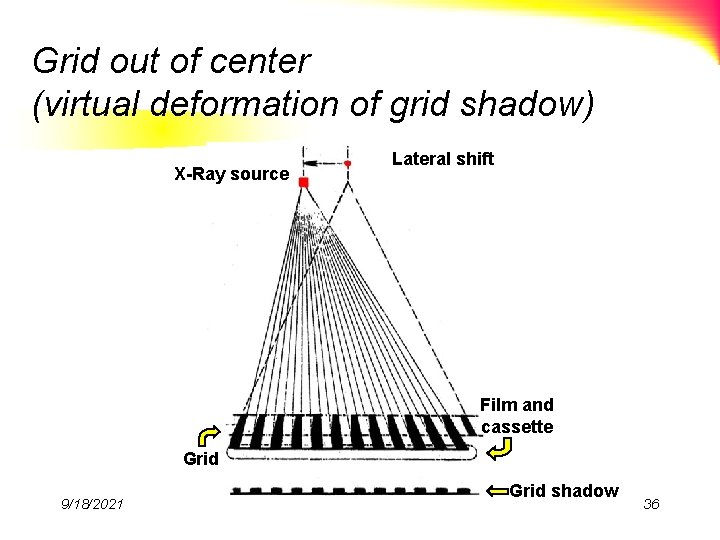
Grid out of center (virtual deformation of grid shadow) X-Ray source Lateral shift Film and cassette Grid 9/18/2021 Grid shadow 36
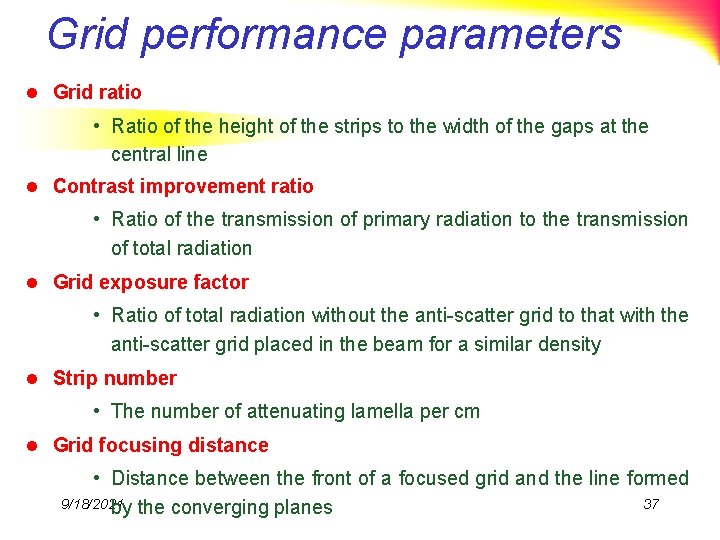
Grid performance parameters l Grid ratio • Ratio of the height of the strips to the width of the gaps at the central line l Contrast improvement ratio • Ratio of the transmission of primary radiation to the transmission of total radiation l Grid exposure factor • Ratio of total radiation without the anti-scatter grid to that with the anti-scatter grid placed in the beam for a similar density l Strip number • The number of attenuating lamella per cm l Grid focusing distance • Distance between the front of a focused grid and the line formed 9/18/2021 37 by the converging planes
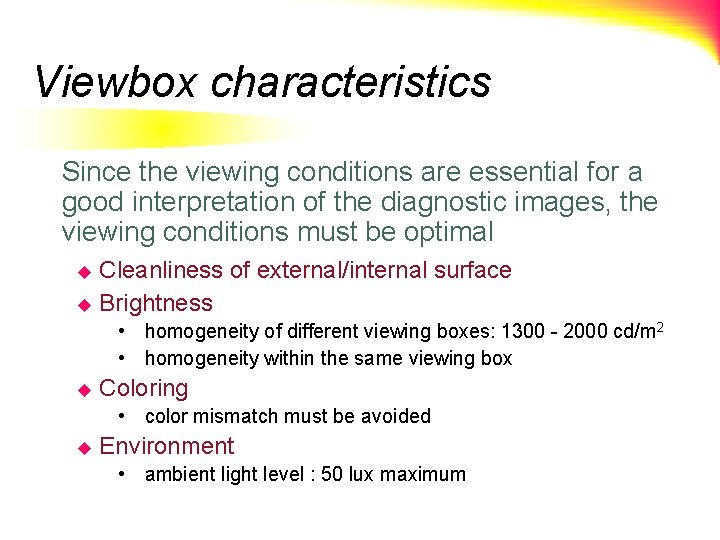
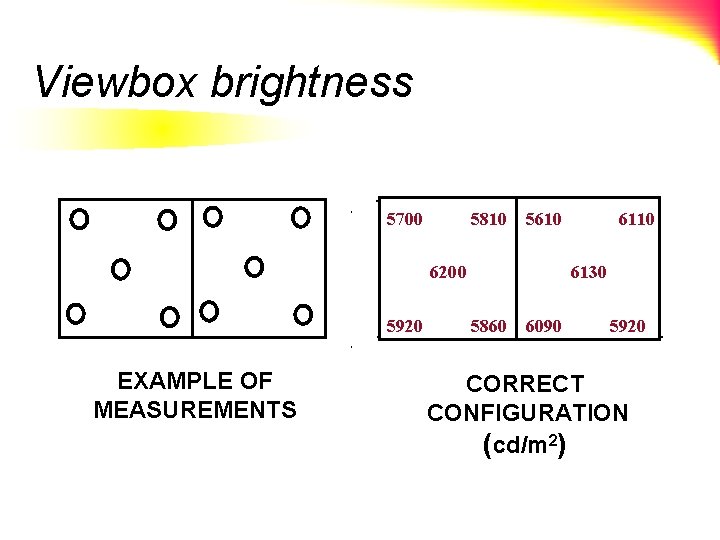
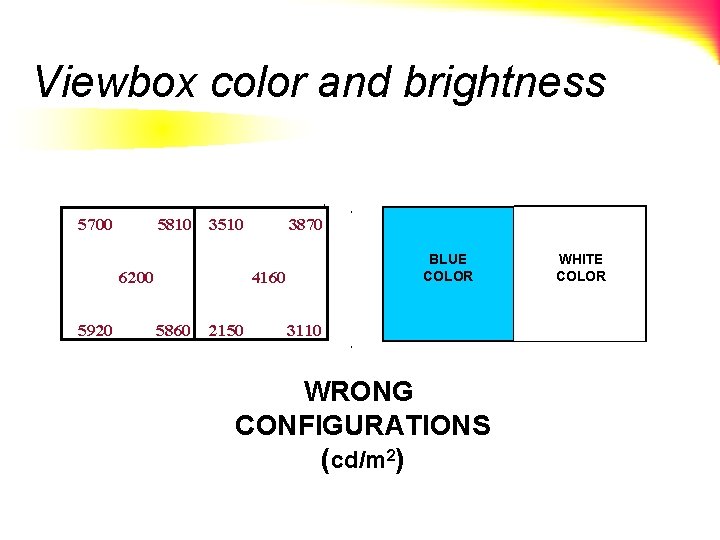
Viewbox characteristics Since the viewing conditions are essential for a good interpretation of the diagnostic images, the viewing conditions must be optimal Cleanliness of external/internal surface u Brightness u • homogeneity of different viewing boxes: 1300 - 2000 cd/m 2 • homogeneity within the same viewing box u Coloring • color mismatch must be avoided u Environment • ambient light level : 50 lux maximum
Viewbox brightness 5700 5810 5610 6200 5920 EXAMPLE OF MEASUREMENTS 6110 6130 5860 6090 5920 CORRECT CONFIGURATION (cd/m 2)
Viewbox color and brightness 5700 5810 3510 6200 5920 3870 BLUE COLOR 4160 5860 2150 3110 WRONG CONFIGURATIONS (cd/m 2) WHITE COLOR