
XRay Gamma Radiation Measurement Best Practices Max FomitchevZamilov
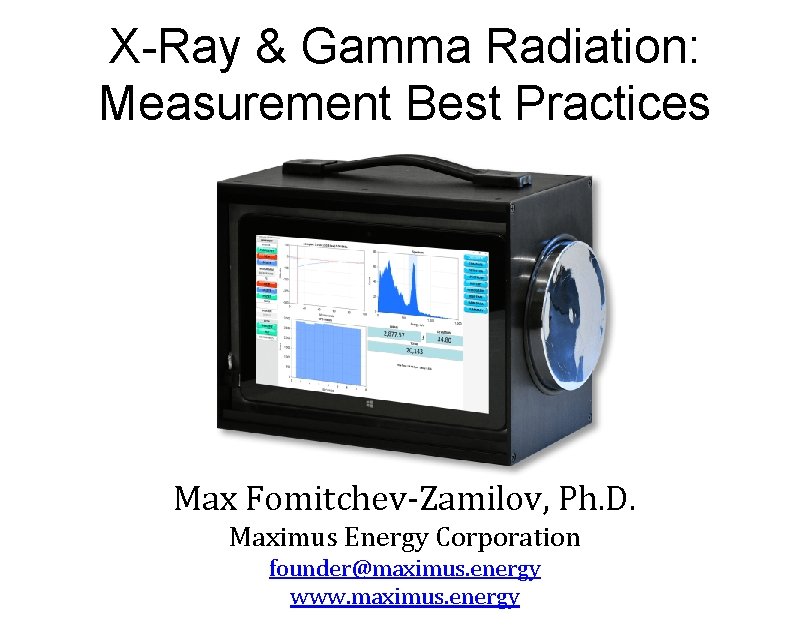
X-Ray & Gamma Radiation: Measurement Best Practices Max Fomitchev-Zamilov, Ph. D. Maximus Energy Corporation founder@maximus. energy www. maximus. energy

Philosophy of Discovery 1) Form a hypothesis, describe confirmation and falsification criteria; 2) Subdue your ego: the truth is more important; 3) Question everything including your own conclusions; 4) Look for errors and you will find them; 5) Invite critique from everybody, especially from peers.
Philosophy of Measurement 1) Understand how your measurement devices work; 2) Achieve repeatability of measurements; 3) Study and eliminate systematic errors; 4) Employ alternative measurement techniques; 5) Use bank controls: the effect must disappear; 6) Use broad controls: the effect must increase/decrease when you vary critical parameters; 7) Do not forget the statistical analysis.
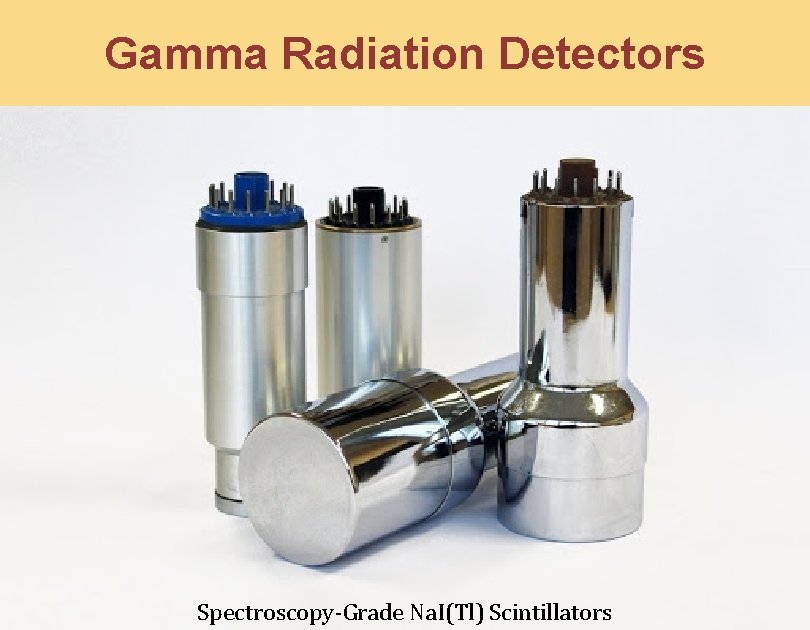
Gamma Radiation Detectors Spectroscopy-Grade Na. I(Tl) Scintillators

Gamma Spectrometer Schematics Computer MCA HV Power Supply Na. I(Tl) Crystal PMT Voltage Divider Preamp Cable Amplifier
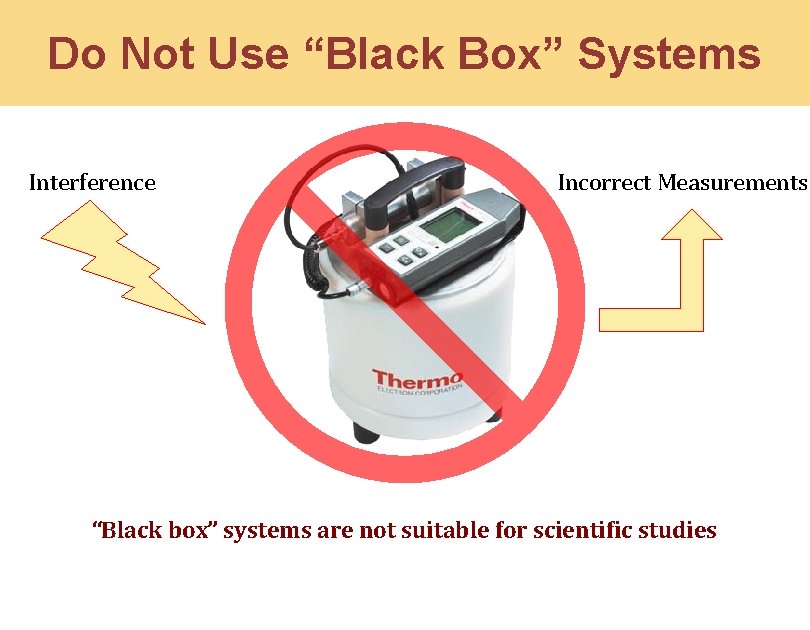
Do Not Use “Black Box” Systems Interference Incorrect Measurements “Black box” systems are not suitable for scientific studies
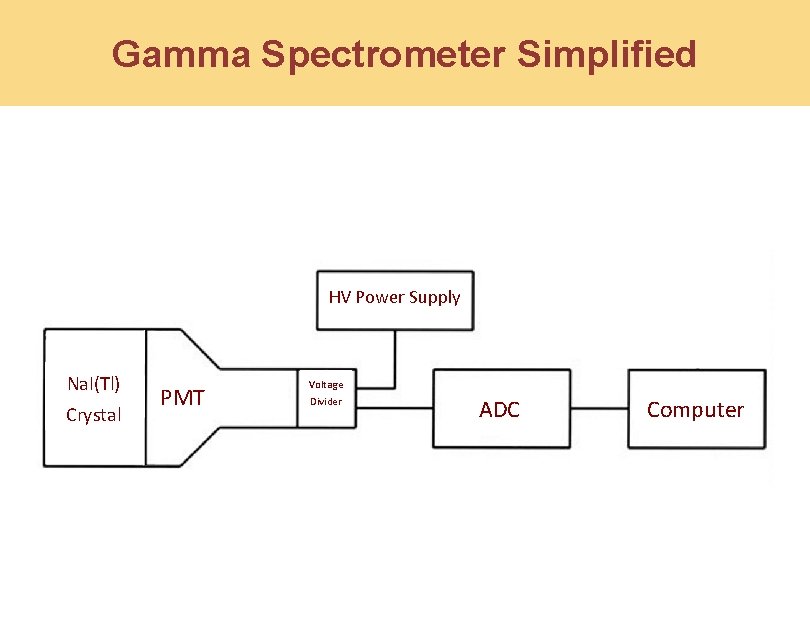
Gamma Spectrometer Simplified HV Power Supply Na. I(Tl) Crystal PMT Voltage Divider ADC Computer
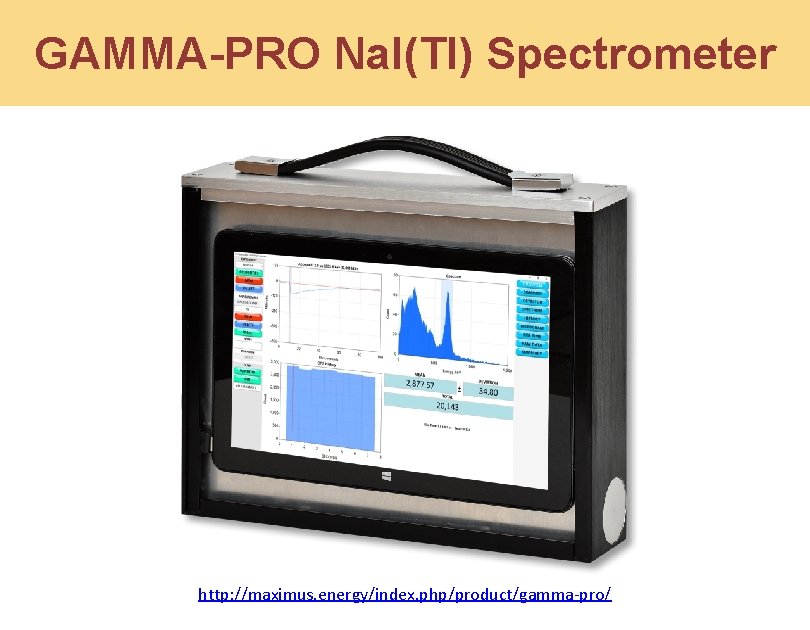
GAMMA-PRO Na. I(Tl) Spectrometer http: //maximus. energy/index. php/product/gamma-pro/
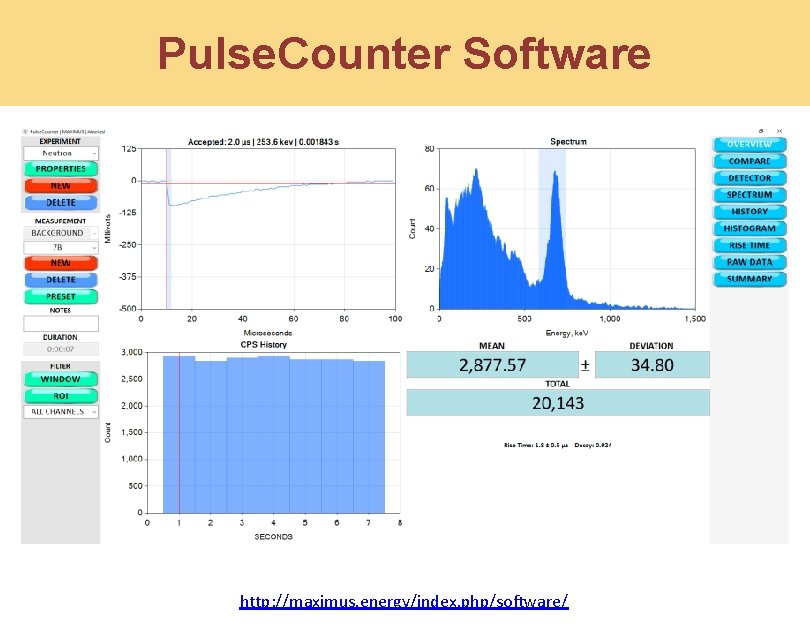
Pulse. Counter Software http: //maximus. energy/index. php/software/
Na. I Detector Properties 1) Sensitivity: depends on size (width and thickness) of scintillator crystal; 2) Energy Range: from 10 ke. V to tens of Me. V (depending on scintillator crystal thickness); 3) Resolution: energy-dependent; good crystals have ~30% @ 30 ke. V, ~7% @ 662 ke. V, 5% @ 1. 3 Me. V. 4) Central hole / well for compact sample measurement with 4π coverage.
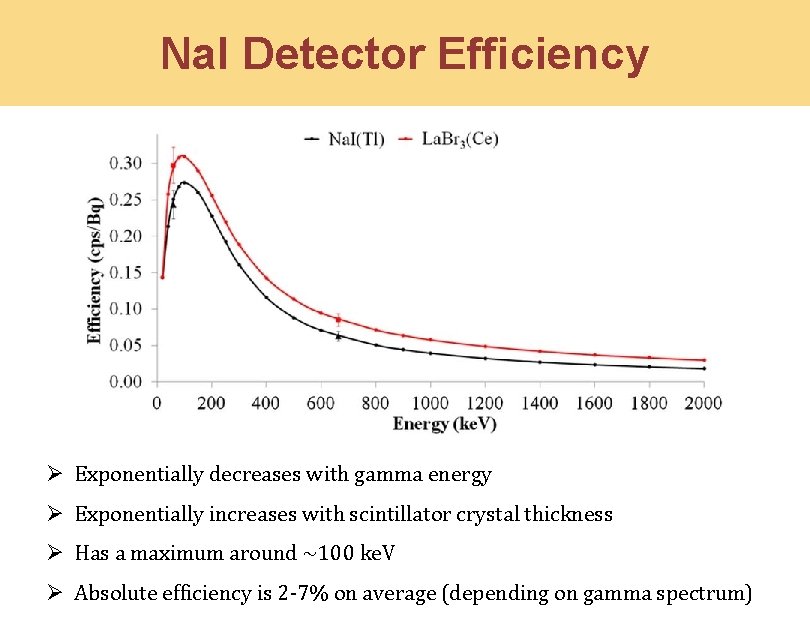
Na. I Detector Efficiency Ø Exponentially decreases with gamma energy Ø Exponentially increases with scintillator crystal thickness Ø Has a maximum around ~100 ke. V Ø Absolute efficiency is 2 -7% on average (depending on gamma spectrum)
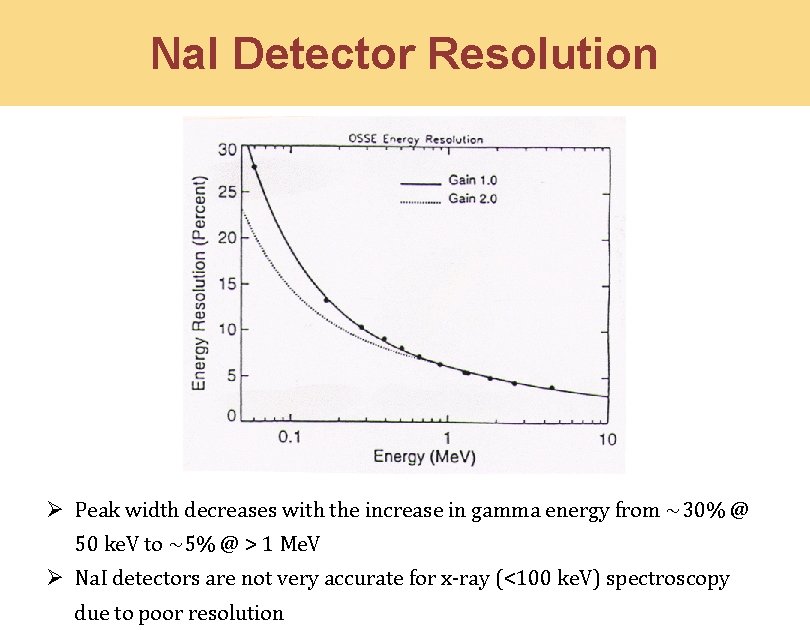
Na. I Detector Resolution Ø Peak width decreases with the increase in gamma energy from ~30% @ 50 ke. V to ~5% @ > 1 Me. V Ø Na. I detectors are not very accurate for x-ray (<100 ke. V) spectroscopy due to poor resolution
Detectors: Area of Applicability Ø SDD – high resolution (~2% @ 6 ke. V), low sensitivity, max range from 0. 2 to 100 ke. V; optimal range from 1 to 30 ke. V. Ø Cd. Te/Cd. Te. Zn/CZT – good resolution (~4% @ 662 кэ. В), low sensitivity, max range from 1 ke. V to 1. 5 Me. V; optimal range from 1. 5 to 100 ke. V. Ø Na. I(Tl) – average resolution (~7 -8% @ 662 ke. V), high sensitivity, max range from 10 ke. V 10 Me. V; optimal range from 30 ke. V to 3 Me. V. Ø HPGe – ultra-high resolution (0. 2% @ 1. 3 Me. V), low sensitivity, useful range from 3 ke. V to 10 Me. V (depending on type).
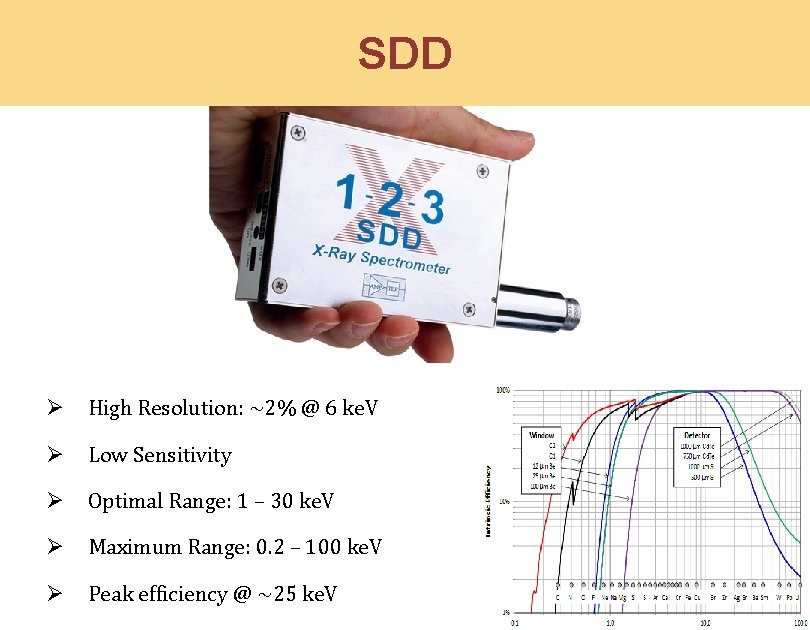
SDD Ø High Resolution: ~2% @ 6 ke. V Ø Low Sensitivity Ø Optimal Range: 1 – 30 ke. V Ø Maximum Range: 0. 2 – 100 ke. V Ø Peak efficiency @ ~25 ke. V
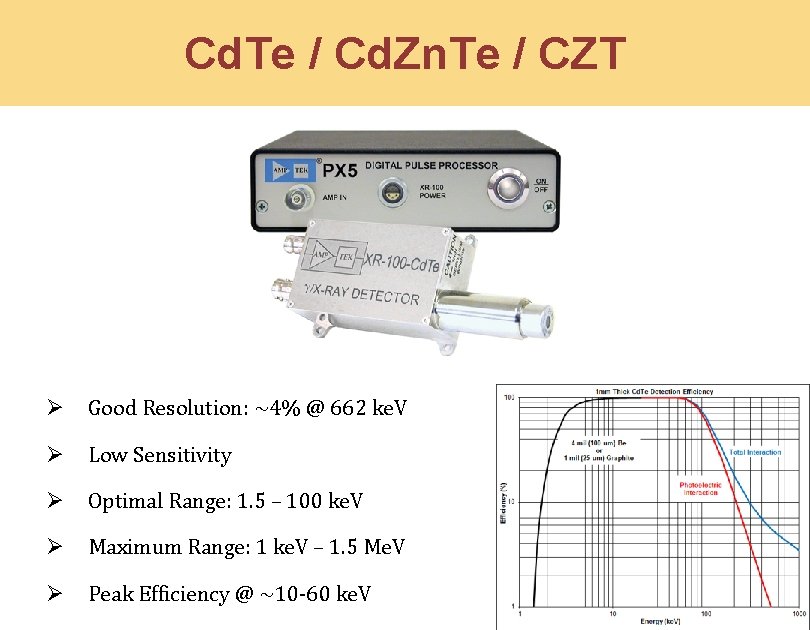
Cd. Te / Cd. Zn. Te / CZT Ø Good Resolution: ~4% @ 662 ke. V Ø Low Sensitivity Ø Optimal Range: 1. 5 – 100 ke. V Ø Maximum Range: 1 ke. V – 1. 5 Me. V Ø Peak Efficiency @ ~10 -60 ke. V
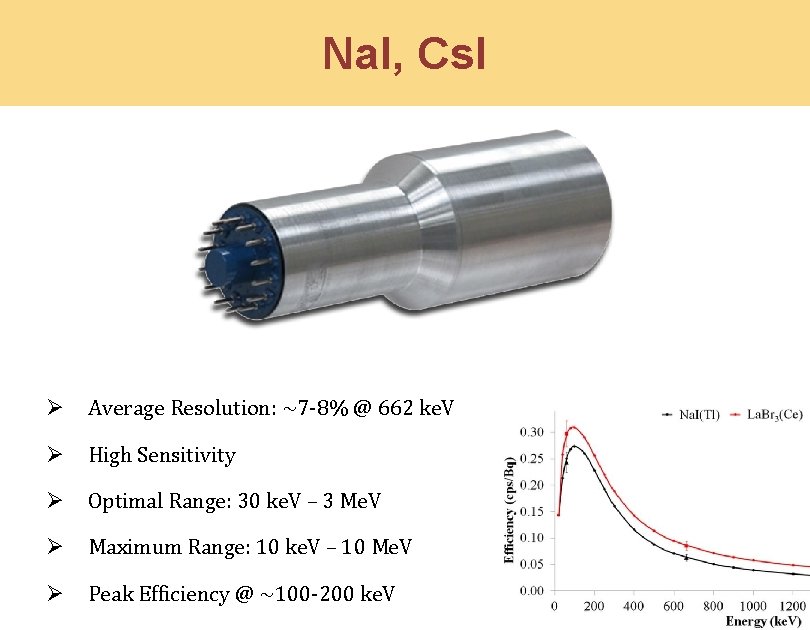
Na. I, Cs. I Ø Average Resolution: ~7 -8% @ 662 ke. V Ø High Sensitivity Ø Optimal Range: 30 ke. V – 3 Me. V Ø Maximum Range: 10 ke. V – 10 Me. V Ø Peak Efficiency @ ~100 -200 ke. V
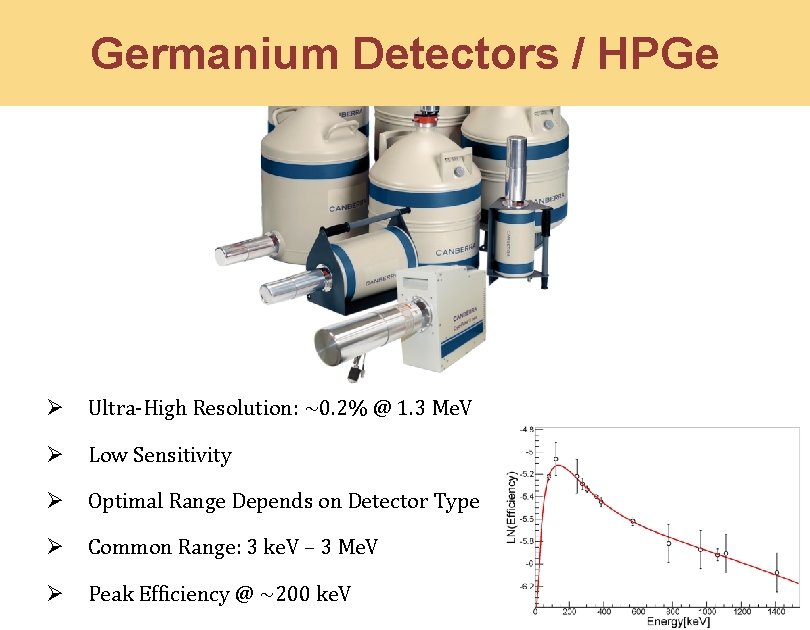
Germanium Detectors / HPGe Ø Ultra-High Resolution: ~0. 2% @ 1. 3 Me. V Ø Low Sensitivity Ø Optimal Range Depends on Detector Type Ø Common Range: 3 ke. V – 3 Me. V Ø Peak Efficiency @ ~200 ke. V
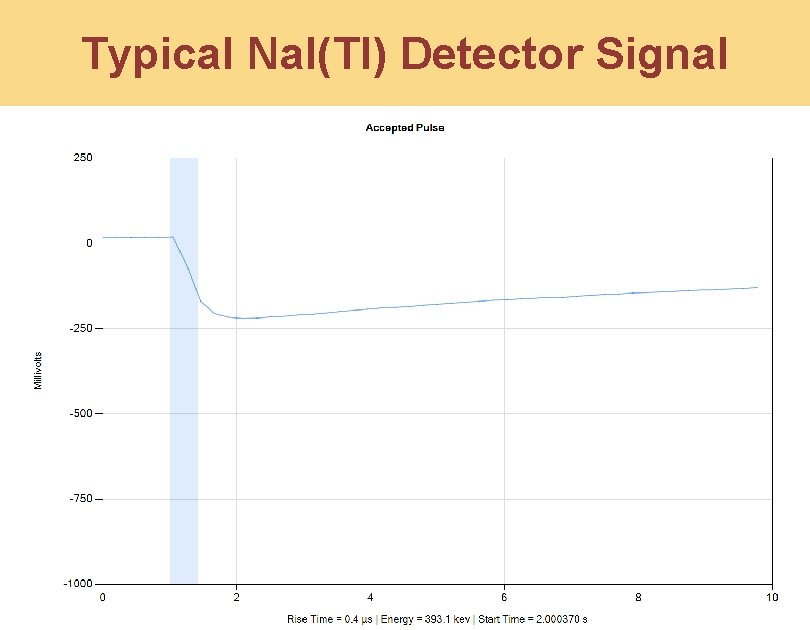
Typical Na. I(Tl) Detector Signal
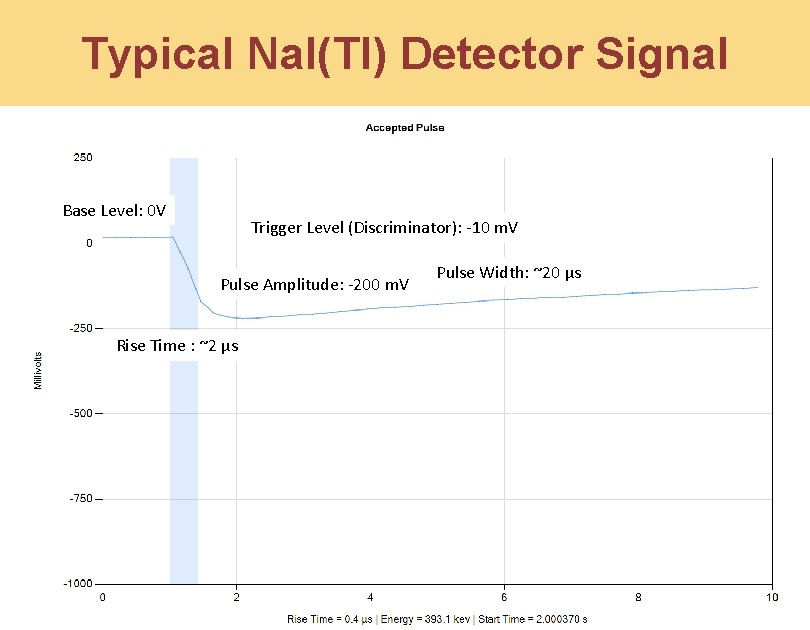
Typical Na. I(Tl) Detector Signal Base Level: 0 V Trigger Level (Discriminator): -10 m. V Pulse Amplitude: -200 m. V Rise Time : ~2 μs Pulse Width: ~20 μs
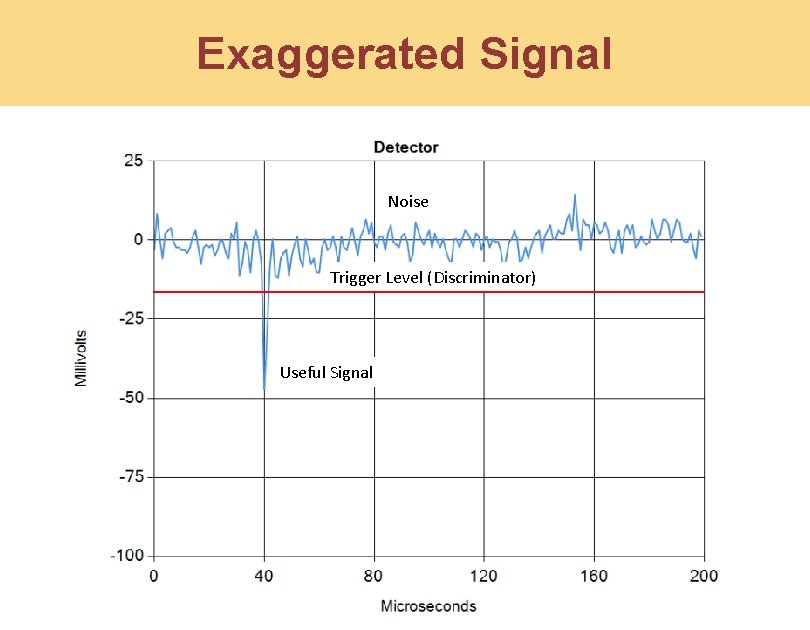
Exaggerated Signal Noise Trigger Level (Discriminator) Useful Signal
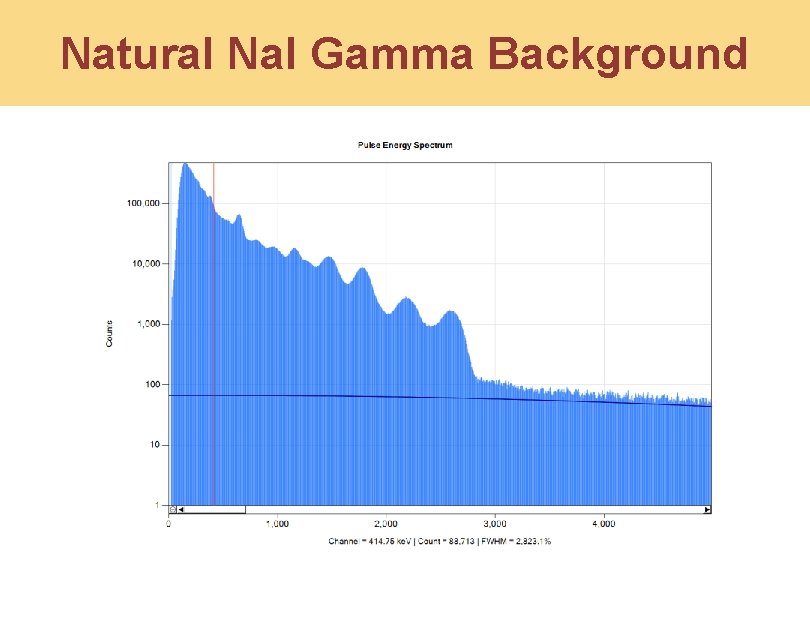
Natural Na. I Gamma Background
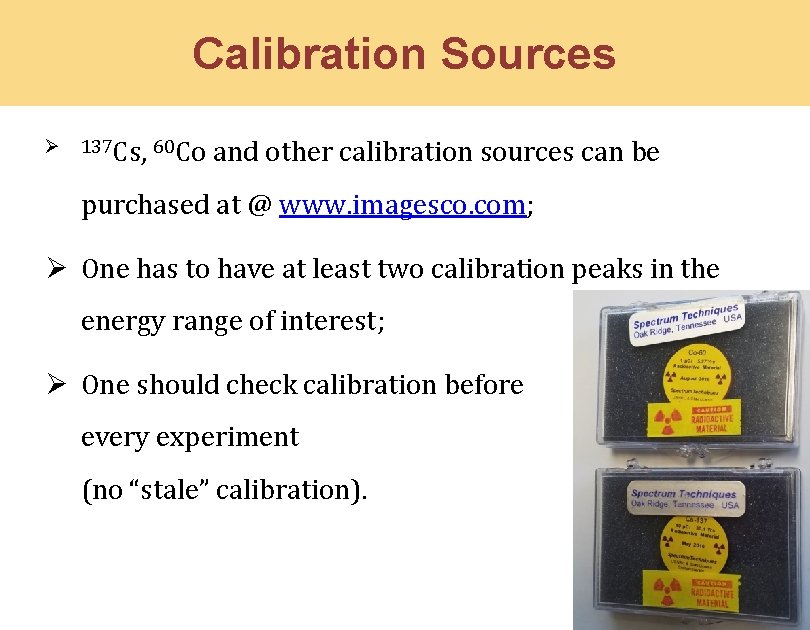
Calibration Sources Ø 137 Cs, 60 Co and other calibration sources can be purchased at @ www. imagesco. com; Ø One has to have at least two calibration peaks in the energy range of interest; Ø One should check calibration before every experiment (no “stale” calibration).
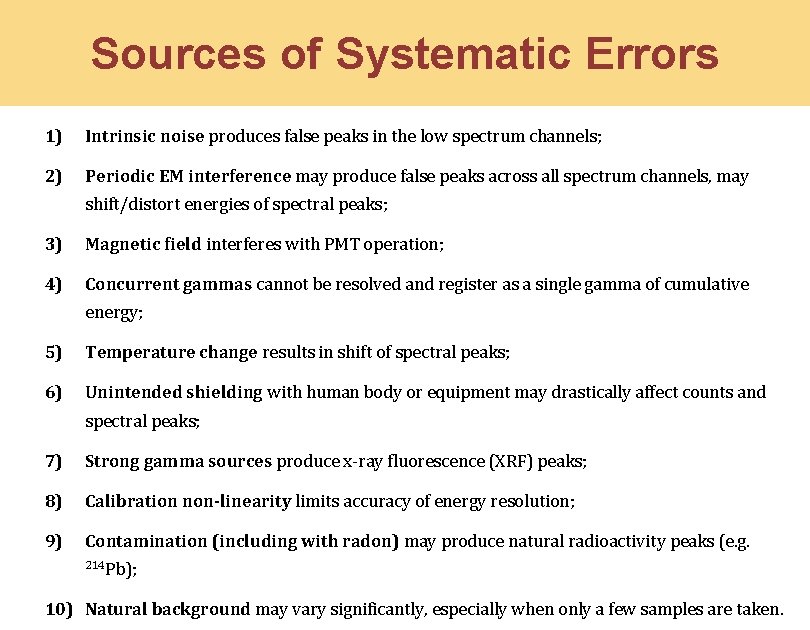
Sources of Systematic Errors 1) Intrinsic noise produces false peaks in the low spectrum channels; 2) Periodic EM interference may produce false peaks across all spectrum channels, may shift/distort energies of spectral peaks; 3) Magnetic field interferes with PMT operation; 4) Concurrent gammas cannot be resolved and register as a single gamma of cumulative energy; 5) Temperature change results in shift of spectral peaks; 6) Unintended shielding with human body or equipment may drastically affect counts and spectral peaks; 7) Strong gamma sources produce x-ray fluorescence (XRF) peaks; 8) Calibration non-linearity limits accuracy of energy resolution; 9) Contamination (including with radon) may produce natural radioactivity peaks (e. g. 214 Pb); 10) Natural background may vary significantly, especially when only a few samples are taken.
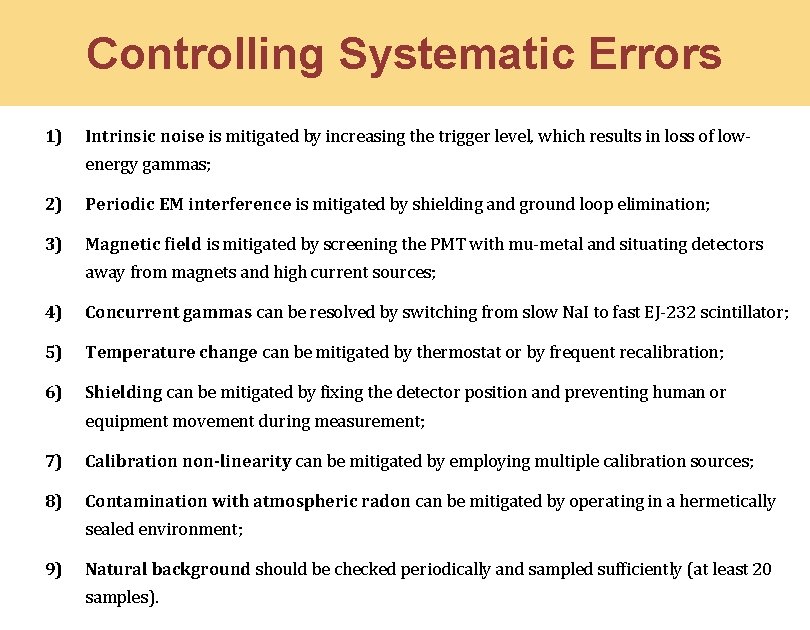
Controlling Systematic Errors 1) Intrinsic noise is mitigated by increasing the trigger level, which results in loss of lowenergy gammas; 2) Periodic EM interference is mitigated by shielding and ground loop elimination; 3) Magnetic field is mitigated by screening the PMT with mu-metal and situating detectors away from magnets and high current sources; 4) Concurrent gammas can be resolved by switching from slow Na. I to fast EJ-232 scintillator; 5) Temperature change can be mitigated by thermostat or by frequent recalibration; 6) Shielding can be mitigated by fixing the detector position and preventing human or equipment movement during measurement; 7) Calibration non-linearity can be mitigated by employing multiple calibration sources; 8) Contamination with atmospheric radon can be mitigated by operating in a hermetically sealed environment; 9) Natural background should be checked periodically and sampled sufficiently (at least 20 samples).
Random Processes Ø We are dealing with random processes. That is why we cannot draw conclusions after making only 1 -2 (or a handful) of measurements; Ø Too few measurements can yield odd patterns, including some pretty incredible ones; Ø “Non-repeatable” results are (most likely) just odd samples drawn from random distribution.
Statistical Analysis 1) Sample the background: ≥ 20 samples 2) Sample the experiment: ≥ 20 samples 3) Calculate P-value: if the value is less than 5% it is customary to consider the difference between the experiment and the background to be “statistically significant”. If the P-value changes significantly with the addition or removal of samples – you do not have enough samples in your data set.
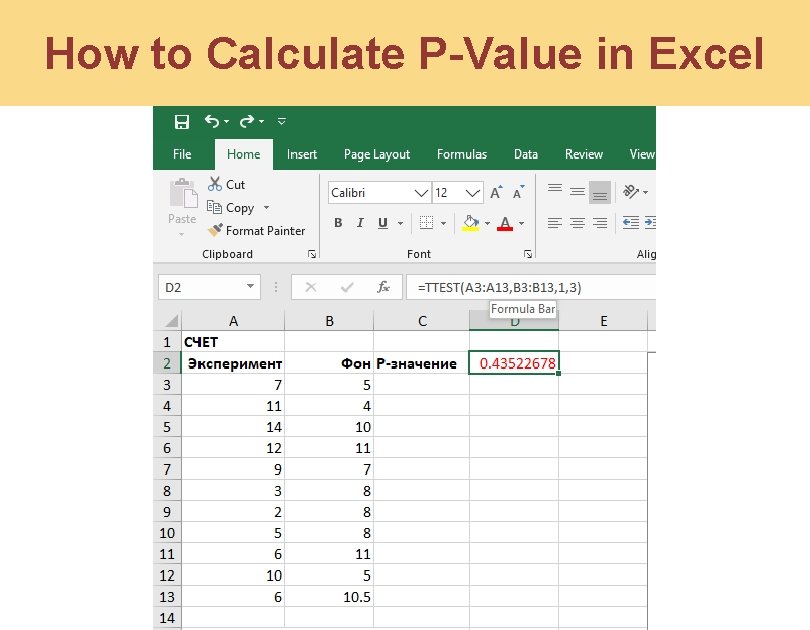
How to Calculate P-Value in Excel
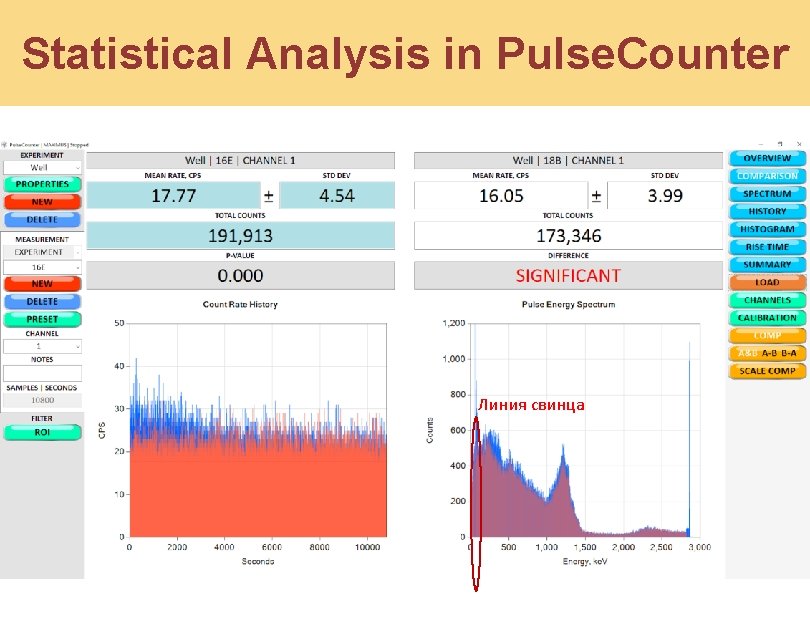
Statistical Analysis in Pulse. Counter Линия свинца
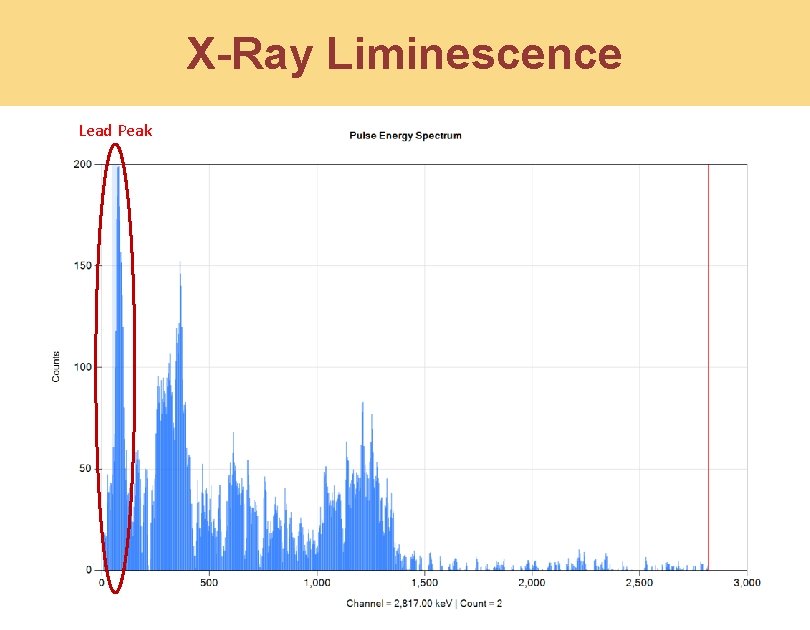
X-Ray Liminescence Lead Peak
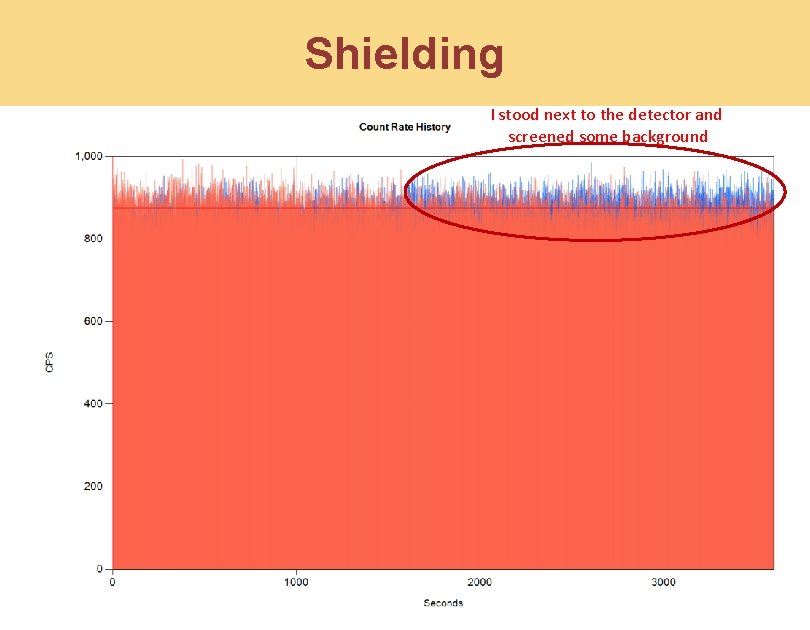
Shielding I stood next to the detector and screened some background
Amplification of the Effect 1) Increasing the number of measurements should result in P-value decrease (i. e. improved statistics); 2) Using more sensitive (in the energy range of interest) detector should result in the increased signal; 3) Using lead screen for background shielding should increase the signal; 4) Using metal filters to reduce or eliminate gamma rays of certain energies should affect the signal accordingly.
“Gold Standard” Publication Criterion A publishable paper must have: 1) Detailed description of measurement equipment and measurement methodology; 2) Description of calibration process; 3) Multiple / periodic background measurements; 4) Repeatable results (somewhat repeatable is OK, 100% repeatability is not required); 5) Multiple measurements pertaining to the effect (must have significant sample); 6) Statistical analysis and P-value calculation when comparing measurements; 7) Analysis of systematic errors: show that you have gone at reasonable length to eliminate them; 8) ‘Blank’ control experiment with null-result; 9) Control experiment that increases or decreases the effect; 10) Mandatory secondary confirmation e. g. using principally different measurement equipment and/or alternative measurement methodology; 11) Peer review, especially from experts in measurement techniques and data interpretation.
Useful Resources Ø http: //maximus. energy/index. php/productcategory/gamma/ Ø http: //maximus. energy/index. php/2020/05/09/sear ch-for-alpha-decay-acceleration/ Ø https: //www. picotech. com/products/oscilloscope Ø https: //www. amptek. com/products/sdd-x-raydetectors-for-xrf-eds/xr-100 sdd-silicon-driftdetector
- Slides: 33