
Xray Detectors for the APS Status and Future


- Slides: 46
X-ray Detectors for the APS: Status and Future Needs Mark Rivers Center for Advanced Radiation Sources University of Chicago Front End Electronics 2014 May 20, 2014
Outline • Differences in Detectors for High-Energy Physics and X-ray Sciences • Diverse detector needs for x-ray applications • Detector constraints • APS Upgrade Plans • For several detector types: • Where we’ve come from since the APS began operations in 1995 • Where we are now • Where we’d like to be in another 5 -10 years M. Rivers X-ray Detectors for the APS: Status and Future Needs 5/20/2014 2
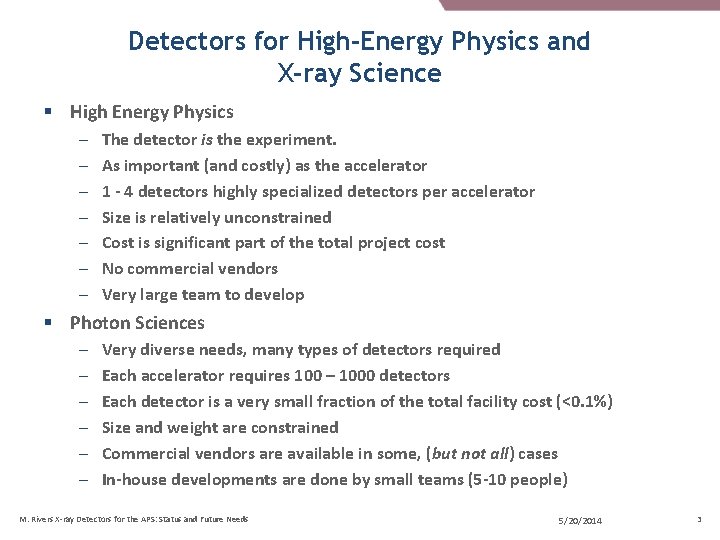
Detectors for High-Energy Physics and X-ray Science § High Energy Physics – – – – The detector is the experiment. As important (and costly) as the accelerator 1 - 4 detectors highly specialized detectors per accelerator Size is relatively unconstrained Cost is significant part of the total project cost No commercial vendors Very large team to develop § Photon Sciences – – – Very diverse needs, many types of detectors required Each accelerator requires 100 – 1000 detectors Each detector is a very small fraction of the total facility cost (<0. 1%) Size and weight are constrained Commercial vendors are available in some, (but not all) cases In-house developments are done by small teams (5 -10 people) M. Rivers X-ray Detectors for the APS: Status and Future Needs 5/20/2014 3
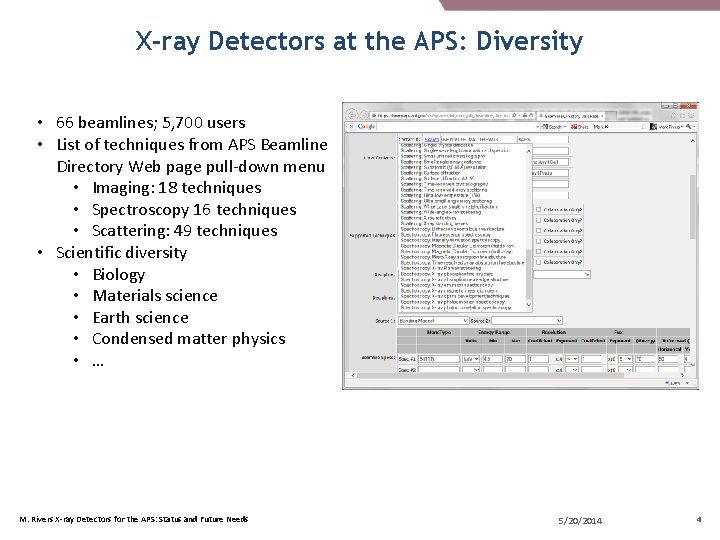
X-ray Detectors at the APS: Diversity • 66 beamlines; 5, 700 users • List of techniques from APS Beamline Directory Web page pull-down menu • Imaging: 18 techniques • Spectroscopy 16 techniques • Scattering: 49 techniques • Scientific diversity • Biology • Materials science • Earth science • Condensed matter physics • … M. Rivers X-ray Detectors for the APS: Status and Future Needs 5/20/2014 4
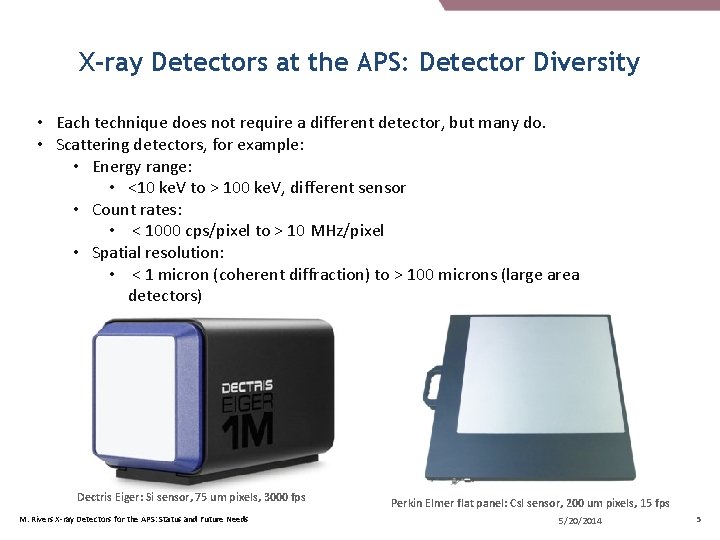
X-ray Detectors at the APS: Detector Diversity • Each technique does not require a different detector, but many do. • Scattering detectors, for example: • Energy range: • <10 ke. V to > 100 ke. V, different sensor • Count rates: • < 1000 cps/pixel to > 10 MHz/pixel • Spatial resolution: • < 1 micron (coherent diffraction) to > 100 microns (large area detectors) Dectris Eiger: Si sensor, 75 um pixels, 3000 fps M. Rivers X-ray Detectors for the APS: Status and Future Needs Perkin Elmer flat panel: Cs. I sensor, 200 um pixels, 15 fps 5/20/2014 5
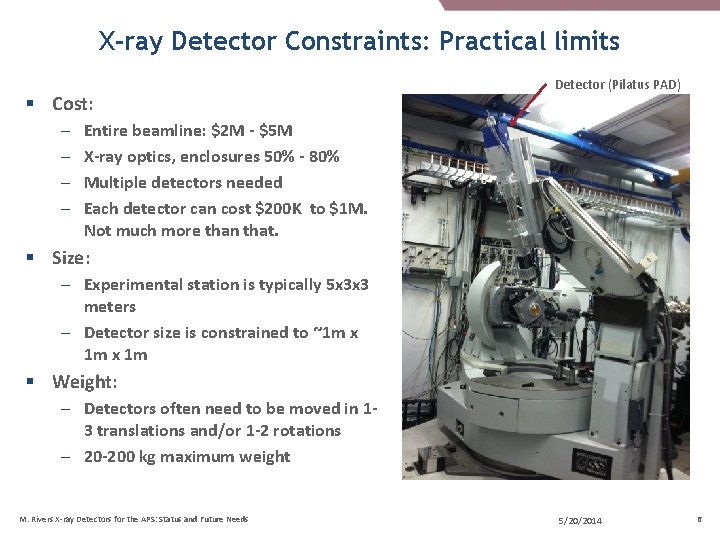
X-ray Detector Constraints: Practical limits § Cost: – – Detector (Pilatus PAD) Entire beamline: $2 M - $5 M X-ray optics, enclosures 50% - 80% Multiple detectors needed Each detector can cost $200 K to $1 M. Not much more than that. § Size: – Experimental station is typically 5 x 3 x 3 meters – Detector size is constrained to ~1 m x 1 m § Weight: – Detectors often need to be moved in 13 translations and/or 1 -2 rotations – 20 -200 kg maximum weight M. Rivers X-ray Detectors for the APS: Status and Future Needs 5/20/2014 6
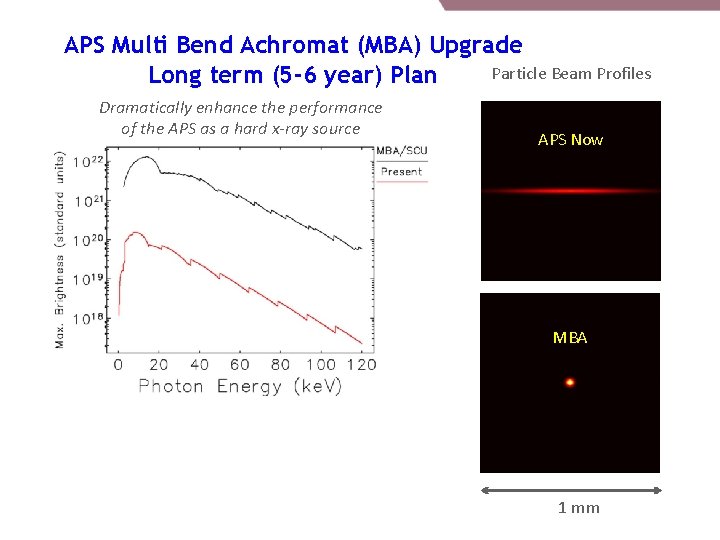
APS Multi Bend Achromat (MBA) Upgrade Particle Beam Profiles Long term (5 -6 year) Plan Dramatically enhance the performance of the APS as a hard x-ray source APS Now MBA 1 mm
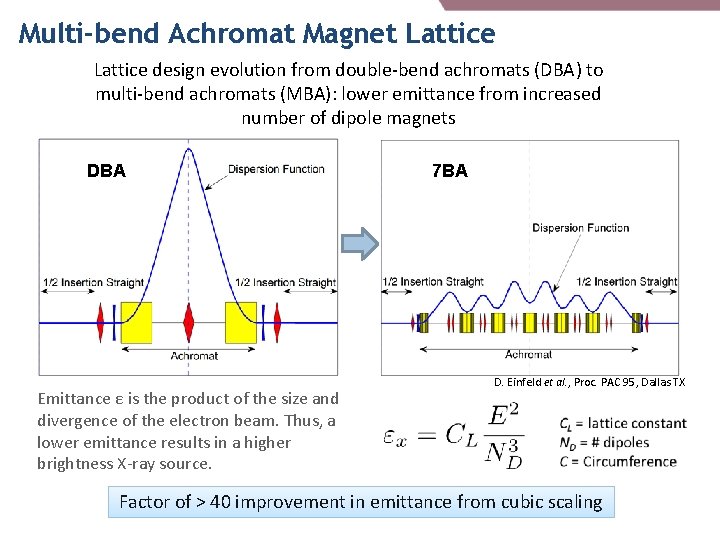
Multi-bend Achromat Magnet Lattice design evolution from double-bend achromats (DBA) to multi-bend achromats (MBA): lower emittance from increased number of dipole magnets DBA Emittance ε is the product of the size and divergence of the electron beam. Thus, a lower emittance results in a higher brightness X-ray source. 7 BA D. Einfeld et al. , Proc. PAC 95, Dallas TX Factor of > 40 improvement in emittance from cubic scaling
APS MBA Upgrade § Unique source properties: – High brightness of the upgraded ring – Traditional strengths: • High Energy • “Timing ring” § Unique scientific opportunities complemented by new storage ring: – Coherent techniques: XPCS, CDI, Ptychography… – Tighter focus: Micro/nano probe M. Rivers X-ray Detectors for the APS: Status and Future Needs 5/20/2014 9
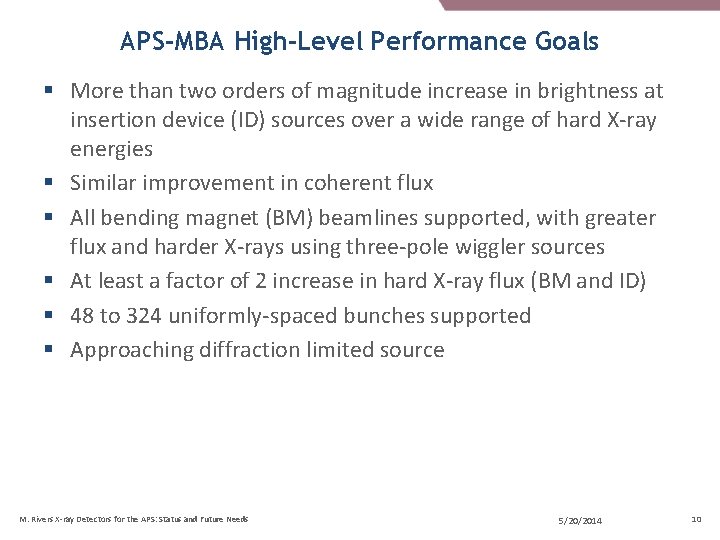
APS-MBA High-Level Performance Goals § More than two orders of magnitude increase in brightness at insertion device (ID) sources over a wide range of hard X-ray energies § Similar improvement in coherent flux § All bending magnet (BM) beamlines supported, with greater flux and harder X-rays using three-pole wiggler sources § At least a factor of 2 increase in hard X-ray flux (BM and ID) § 48 to 324 uniformly-spaced bunches supported § Approaching diffraction limited source M. Rivers X-ray Detectors for the APS: Status and Future Needs 5/20/2014 10
APS-MBA Implications for Detector Needs § Brightness increases > 100 § How to use the brightness gain: – Decrease focal spot size or divergence on sample with same # of photons/s – No need for detector changes § Increase the number of photons in the same size spot and divergence on sample – Detector must count ~100 times faster – Detector could have lower efficiency but better resolution, etc. M. Rivers X-ray Detectors for the APS: Status and Future Needs 5/20/2014 11
Needs for X-ray Free Electron Lasers § Complete data in few fs § Repetition rates increasing from 120 Hz (LCLS) to 27 k. Hz (European XFEL) § ~1012 photons in 10 fs – About the same number that APS beamline delivers in 1 s § Need for new technologies: integrating detectors with storage & fast readout § Some overlap with synchrotron detector needs for applications such as time-resolved pink-beam diffraction – Photons being delivered much faster than photon-counting detectors (e. g. Pilatus, Eiger) can handle M. Rivers X-ray Detectors for the APS: Status and Future Needs 5/20/2014 12
Spectroscopy detectors § Measure energy of each x-ray photon as it arrives § Figures of merit – Energy resolution – Count rate – Energy range § Where we were in 1995 – – – 13 -element Canberra Ge detector NIM readout electronics with 10 Mb/s Ethernet 100 ms to read 13 spectra 250 e. V resolution Problem of escape peaks (E – 9. 89 ke. V) Good high-energy performance M. Rivers X-ray Detectors for the APS: Status and Future Needs 5/20/2014 13
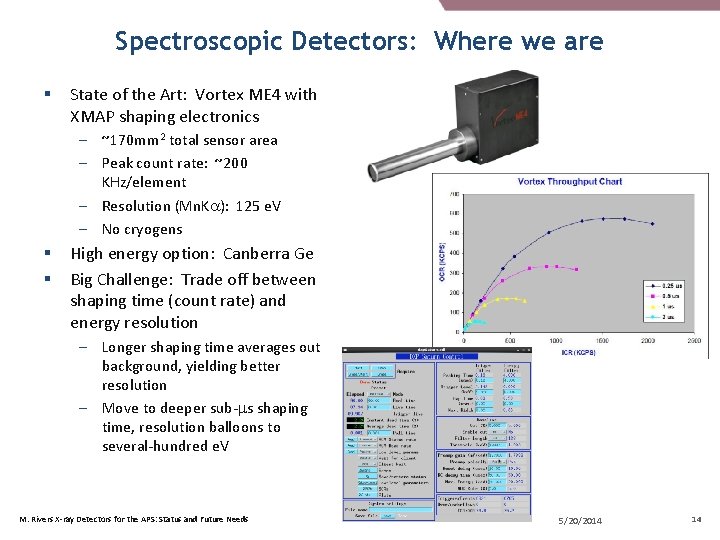
Spectroscopic Detectors: Where we are § State of the Art: Vortex ME 4 with XMAP shaping electronics – ~170 mm 2 total sensor area – Peak count rate: ~200 KHz/element – Resolution (Mn. Ka): 125 e. V – No cryogens § § High energy option: Canberra Ge Big Challenge: Trade off between shaping time (count rate) and energy resolution – Longer shaping time averages out background, yielding better resolution – Move to deeper sub-ms shaping time, resolution balloons to several-hundred e. V M. Rivers X-ray Detectors for the APS: Status and Future Needs 5/20/2014 14
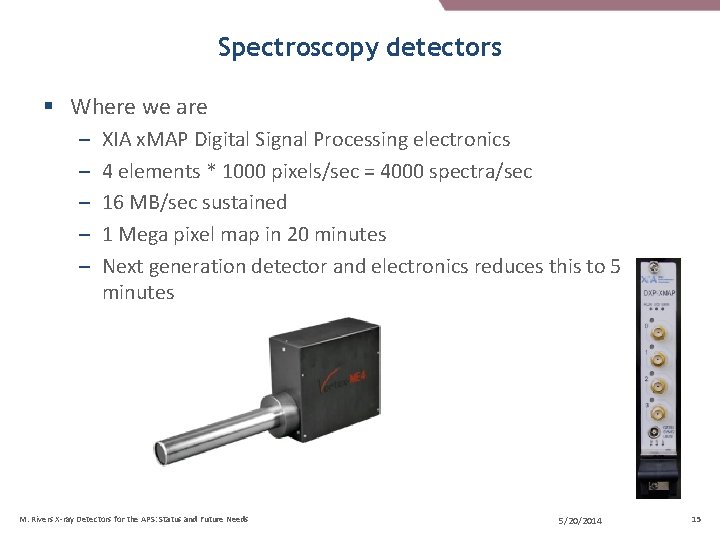
Spectroscopy detectors § Where we are – – – XIA x. MAP Digital Signal Processing electronics 4 elements * 1000 pixels/sec = 4000 spectra/sec 16 MB/sec sustained 1 Mega pixel map in 20 minutes Next generation detector and electronics reduces this to 5 minutes M. Rivers X-ray Detectors for the APS: Status and Future Needs 5/20/2014 15
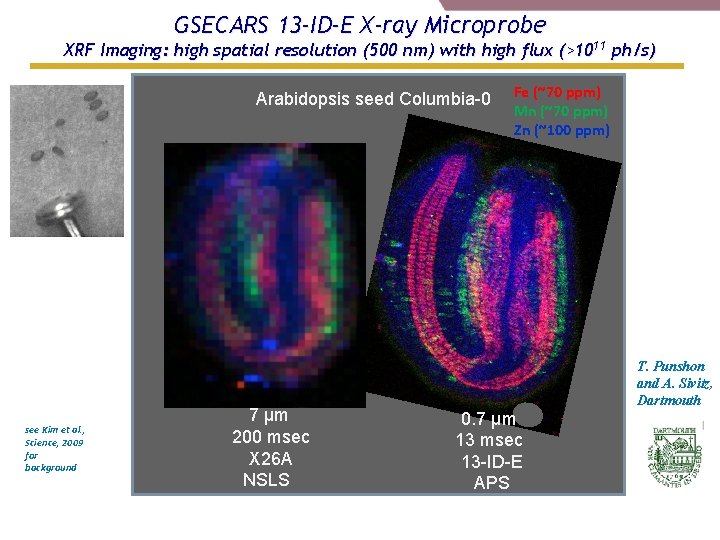
GSECARS 13 -ID-E X-ray Microprobe XRF Imaging: high spatial resolution (500 nm) with high flux (>1011 ph/s) Arabidopsis seed Columbia-0 see Kim et al. , Science, 2009 for background 7 µm 200 msec X 26 A NSLS Fe (~70 ppm) Mn (~70 ppm) Zn (~100 ppm) T. Punshon and A. Sivitz, Dartmouth 0. 7 µm 13 msec 13 -ID-E APS
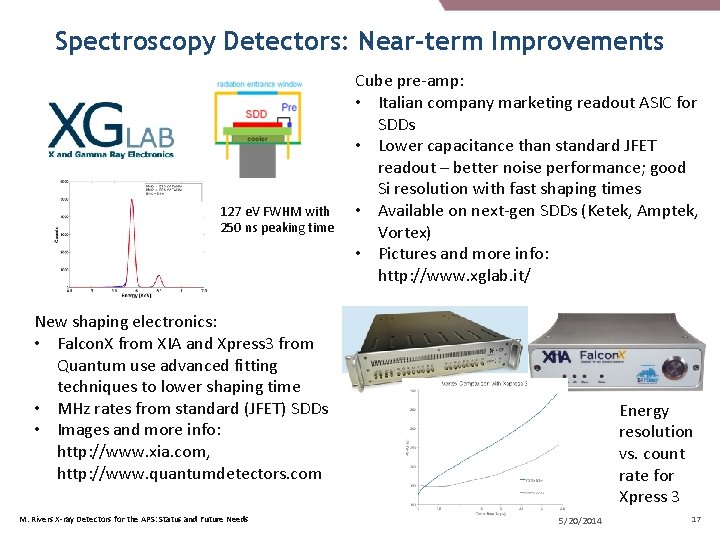
Spectroscopy Detectors: Near-term Improvements 127 e. V FWHM with 250 ns peaking time Cube pre-amp: • Italian company marketing readout ASIC for SDDs • Lower capacitance than standard JFET readout – better noise performance; good Si resolution with fast shaping times • Available on next-gen SDDs (Ketek, Amptek, Vortex) • Pictures and more info: http: //www. xglab. it/ New shaping electronics: • Falcon. X from XIA and Xpress 3 from Quantum use advanced fitting techniques to lower shaping time • MHz rates from standard (JFET) SDDs • Images and more info: http: //www. xia. com, http: //www. quantumdetectors. com M. Rivers X-ray Detectors for the APS: Status and Future Needs Energy resolution vs. count rate for Xpress 3 5/20/2014 17
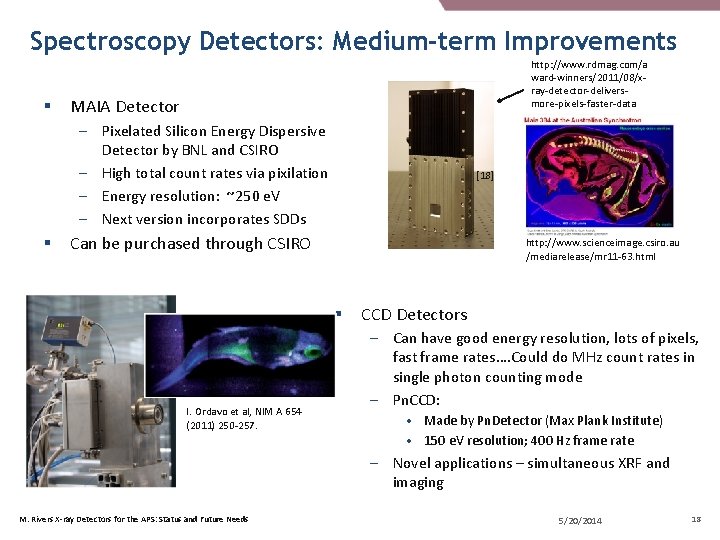
Spectroscopy Detectors: Medium-term Improvements § http: //www. rdmag. com/a ward-winners/2011/08/xray-detector-deliversmore-pixels-faster-data MAIA Detector – Pixelated Silicon Energy Dispersive Detector by BNL and CSIRO – High total count rates via pixilation – Energy resolution: ~250 e. V – Next version incorporates SDDs § [18] Can be purchased through CSIRO http: //www. scienceimage. csiro. au /mediarelease/mr 11 -63. html § I. Ordavo et al, NIM A 654 (2011) 250 -257. CCD Detectors – Can have good energy resolution, lots of pixels, fast frame rates…. Could do MHz count rates in single photon counting mode – Pn. CCD: • Made by Pn. Detector (Max Plank Institute) • 150 e. V resolution; 400 Hz frame rate – Novel applications – simultaneous XRF and imaging M. Rivers X-ray Detectors for the APS: Status and Future Needs 5/20/2014 18
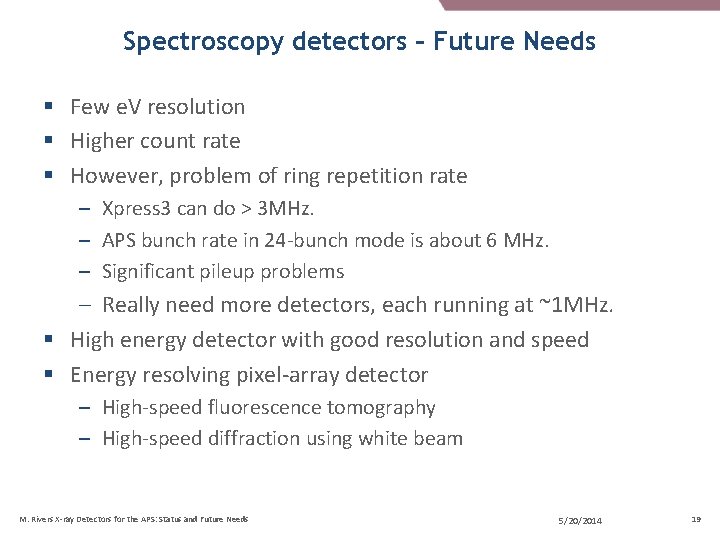
Spectroscopy detectors – Future Needs § Few e. V resolution § Higher count rate § However, problem of ring repetition rate – Xpress 3 can do > 3 MHz. – APS bunch rate in 24 -bunch mode is about 6 MHz. – Significant pileup problems – Really need more detectors, each running at ~1 MHz. § High energy detector with good resolution and speed § Energy resolving pixel-array detector – High-speed fluorescence tomography – High-speed diffraction using white beam M. Rivers X-ray Detectors for the APS: Status and Future Needs 5/20/2014 19
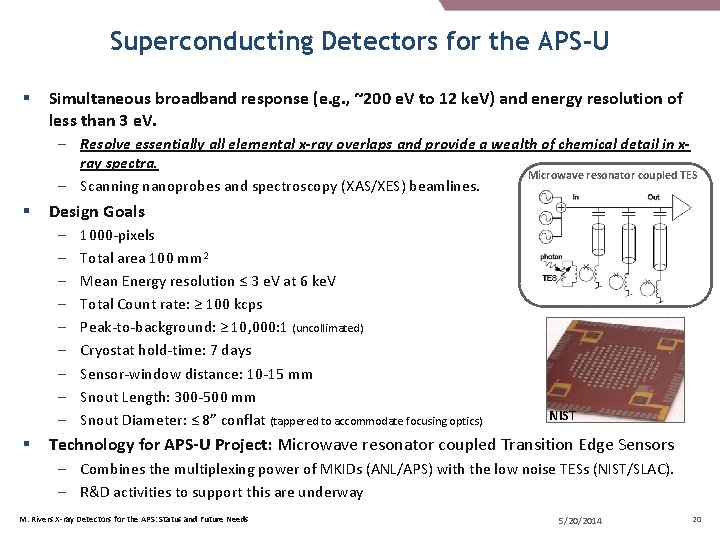
Superconducting Detectors for the APS-U § Simultaneous broadband response (e. g. , ~200 e. V to 12 ke. V) and energy resolution of less than 3 e. V. – Resolve essentially all elemental x-ray overlaps and provide a wealth of chemical detail in xray spectra. Microwave resonator coupled TES – Scanning nanoprobes and spectroscopy (XAS/XES) beamlines. § Design Goals – – – – – § 1000 -pixels Total area 100 mm 2 Mean Energy resolution ≤ 3 e. V at 6 ke. V Total Count rate: ≥ 100 kcps Peak-to-background: ≥ 10, 000: 1 (uncollimated) Cryostat hold-time: 7 days Sensor-window distance: 10 -15 mm Snout Length: 300 -500 mm Snout Diameter: ≤ 8” conflat (tappered to accommodate focusing optics) NIST Technology for APS-U Project: Microwave resonator coupled Transition Edge Sensors – Combines the multiplexing power of MKIDs (ANL/APS) with the low noise TESs (NIST/SLAC). – R&D activities to support this are underway M. Rivers X-ray Detectors for the APS: Status and Future Needs 5/20/2014 20
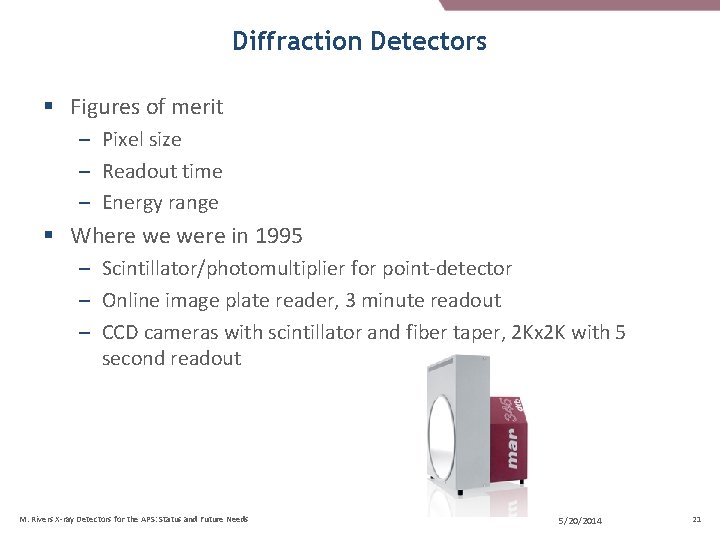
Diffraction Detectors § Figures of merit – Pixel size – Readout time – Energy range § Where we were in 1995 – Scintillator/photomultiplier for point-detector – Online image plate reader, 3 minute readout – CCD cameras with scintillator and fiber taper, 2 Kx 2 K with 5 second readout M. Rivers X-ray Detectors for the APS: Status and Future Needs 5/20/2014 21
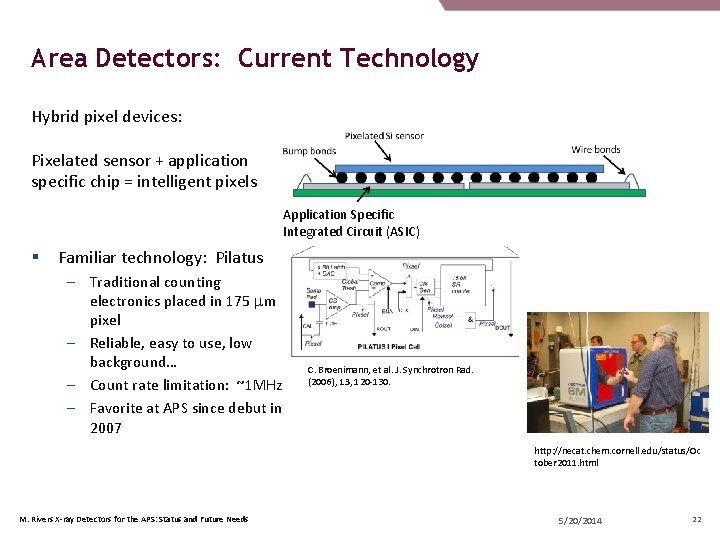
Area Detectors: Current Technology Hybrid pixel devices: Pixelated sensor + application specific chip = intelligent pixels Application Specific Integrated Circuit (ASIC) § Familiar technology: Pilatus – Traditional counting electronics placed in 175 mm pixel – Reliable, easy to use, low background… – Count rate limitation: ~1 MHz – Favorite at APS since debut in 2007 C. Broenimann, et al. J. Synchrotron Rad. (2006), 13, 120 -130. http: //necat. chem. cornell. edu/status/Oc tober 2011. html M. Rivers X-ray Detectors for the APS: Status and Future Needs 5/20/2014 22
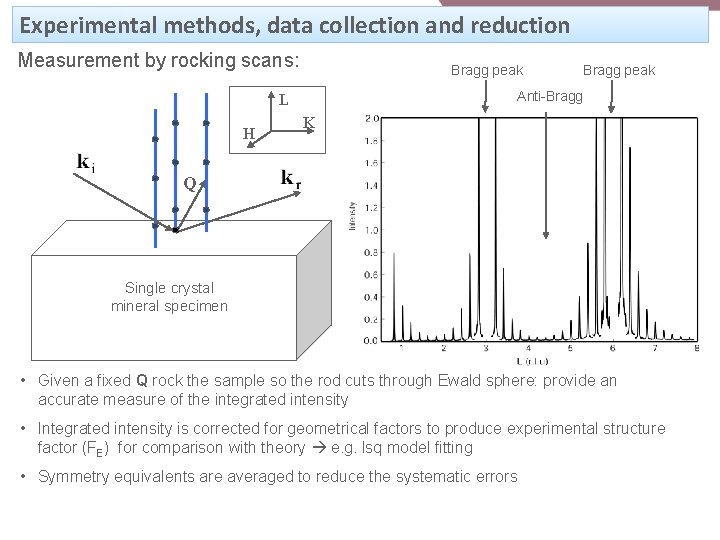
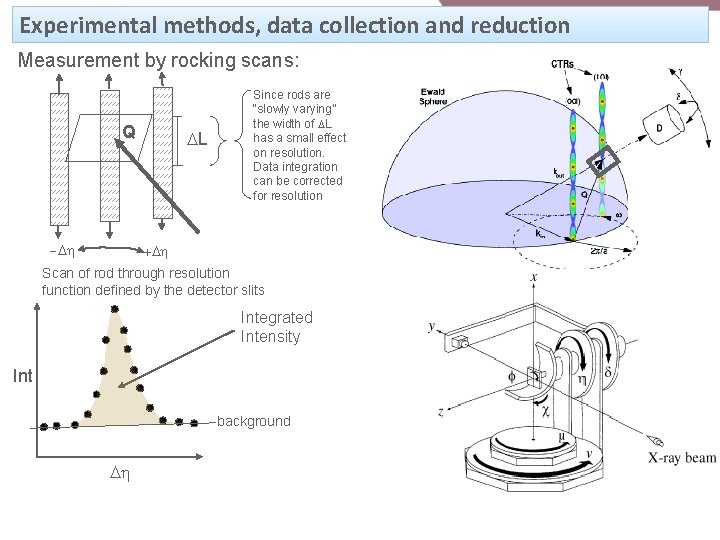
Experimental methods, data collection and reduction Measurement by rocking scans: Bragg peak Anti-Bragg L H Bragg peak K Q Single crystal mineral specimen • Given a fixed Q rock the sample so the rod cuts through Ewald sphere: provide an accurate measure of the integrated intensity • Integrated intensity is corrected for geometrical factors to produce experimental structure factor (FE) for comparison with theory e. g. lsq model fitting • Symmetry equivalents are averaged to reduce the systematic errors
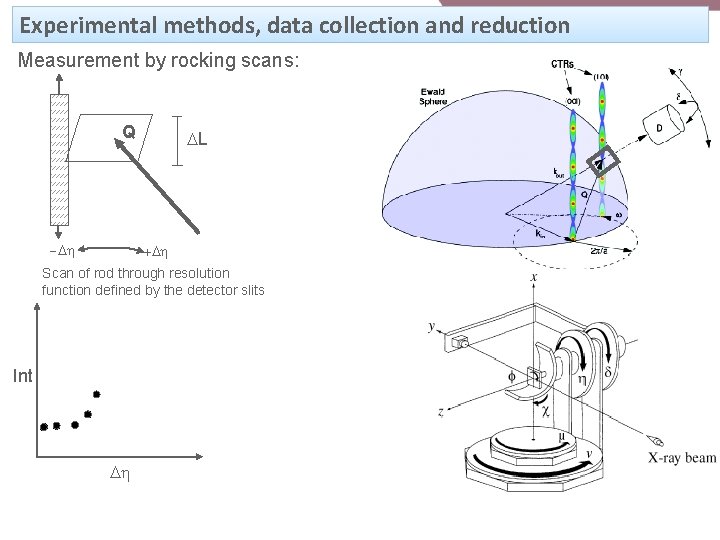
Experimental methods, data collection and reduction Measurement by rocking scans: Q -Dh DL +Dh Scan of rod through resolution function defined by the detector slits Int Dh
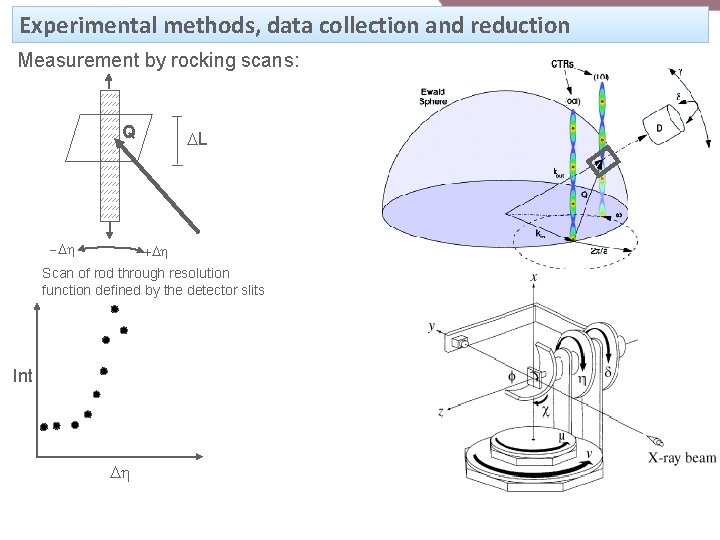
Experimental methods, data collection and reduction Measurement by rocking scans: Q -Dh DL +Dh Scan of rod through resolution function defined by the detector slits Int Dh
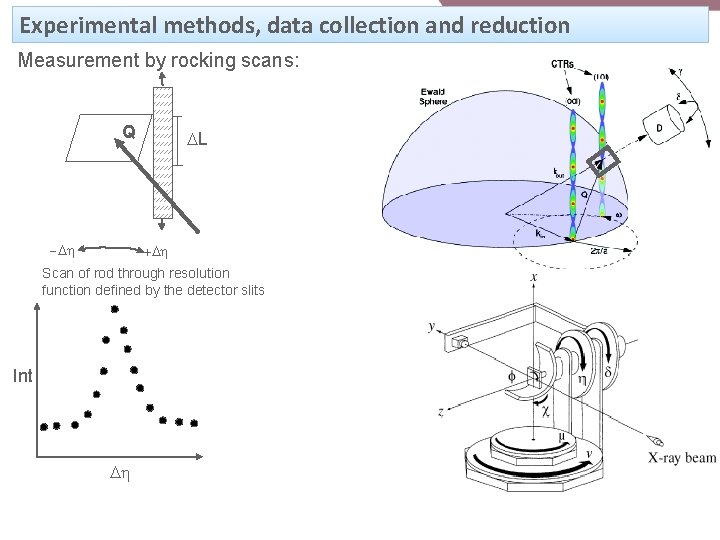
Experimental methods, data collection and reduction Measurement by rocking scans: Q -Dh DL +Dh Scan of rod through resolution function defined by the detector slits Int Dh
Experimental methods, data collection and reduction Measurement by rocking scans: Q -Dh DL Since rods are “slowly varying” the width of DL has a small effect on resolution. Data integration can be corrected for resolution +Dh Scan of rod through resolution function defined by the detector slits Integrated Intensity Int background Dh
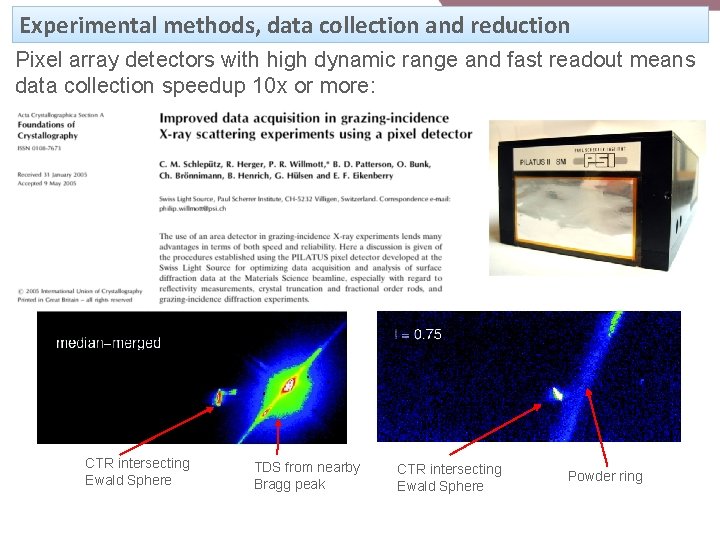
Experimental methods, data collection and reduction Pixel array detectors with high dynamic range and fast readout means data collection speedup 10 x or more: CTR intersecting Ewald Sphere TDS from nearby Bragg peak CTR intersecting Ewald Sphere Powder ring
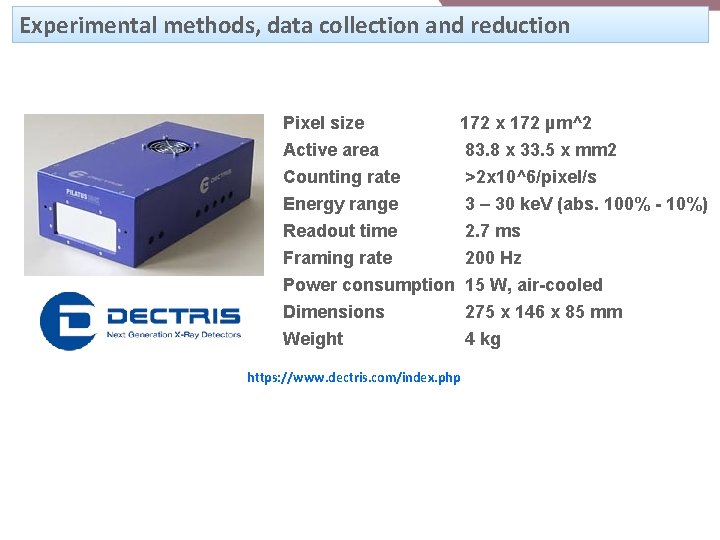
Experimental methods, data collection and reduction Pixel size 172 x 172 µm^2 Active area Counting rate 83. 8 x 33. 5 x mm 2 >2 x 10^6/pixel/s Energy range 3 – 30 ke. V (abs. 100% - 10%) Readout time Framing rate Power consumption Dimensions Weight 2. 7 ms 200 Hz 15 W, air-cooled 275 x 146 x 85 mm 4 kg https: //www. dectris. com/index. php
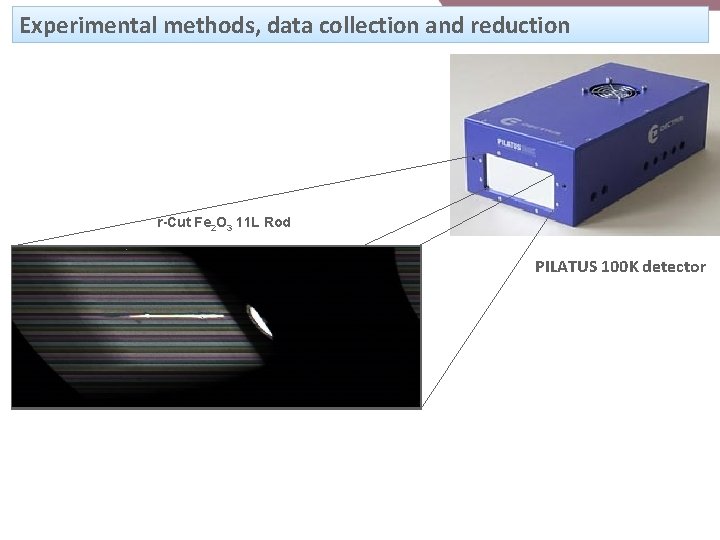
Experimental methods, data collection and reduction r-Cut Fe 2 O 3 11 L Rod PILATUS 100 K detector
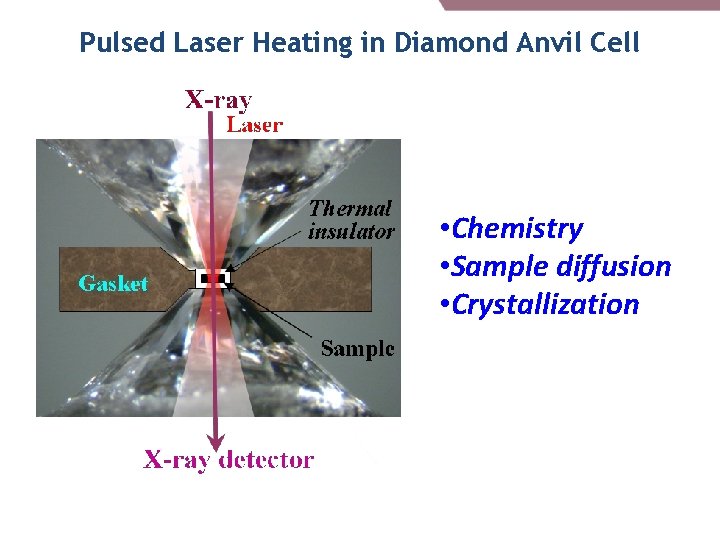
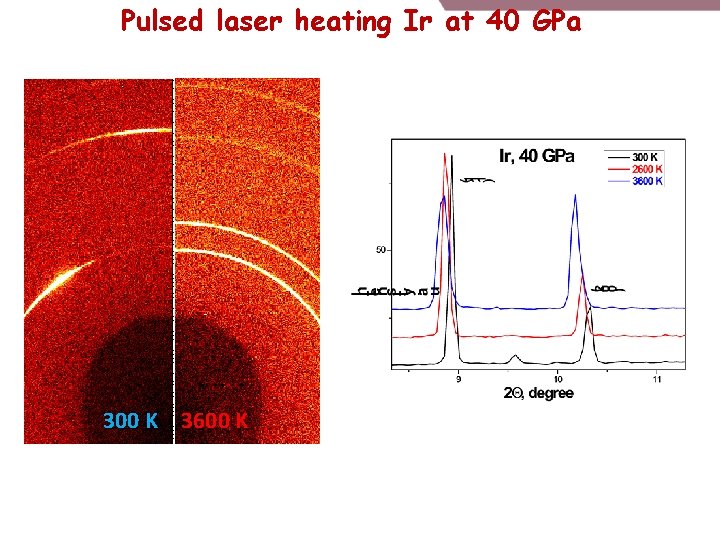
Pulsed Laser Heating in Diamond Anvil Cell • Chemistry • Sample diffusion • Crystallization
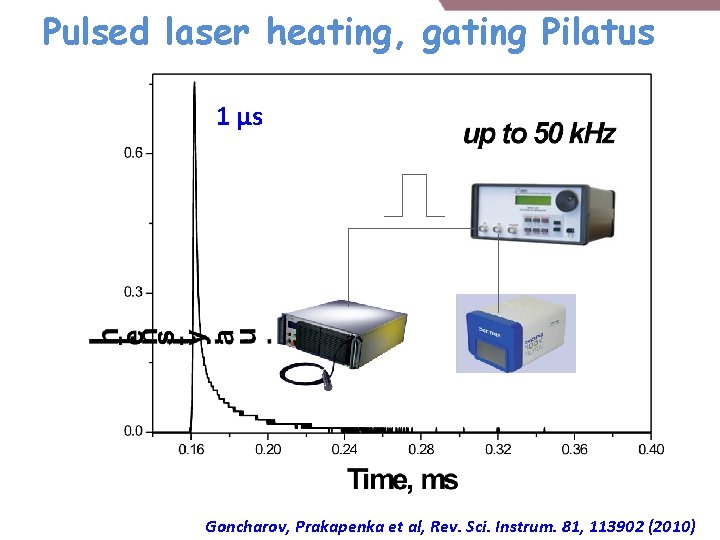
Pulsed laser heating, gating Pilatus 1 μs Goncharov, Prakapenka et al, Rev. Sci. Instrum. 81, 113902 (2010)
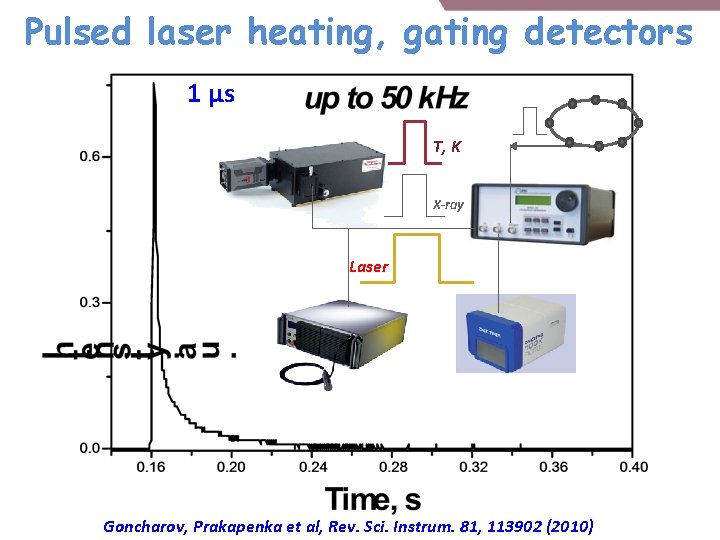
Pulsed laser heating, gating detectors 1 μs T, K X-ray Laser Goncharov, Prakapenka et al, Rev. Sci. Instrum. 81, 113902 (2010)
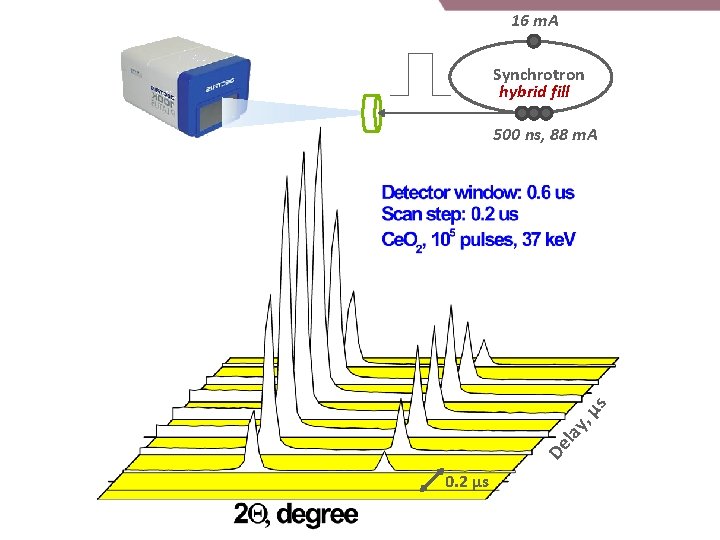
16 m. A Synchrotron hybrid fill De lay , µ s 500 ns, 88 m. A 0. 2 µs
Pulsed laser heating Ir at 40 GPa 300 K 3600 K 2600 K
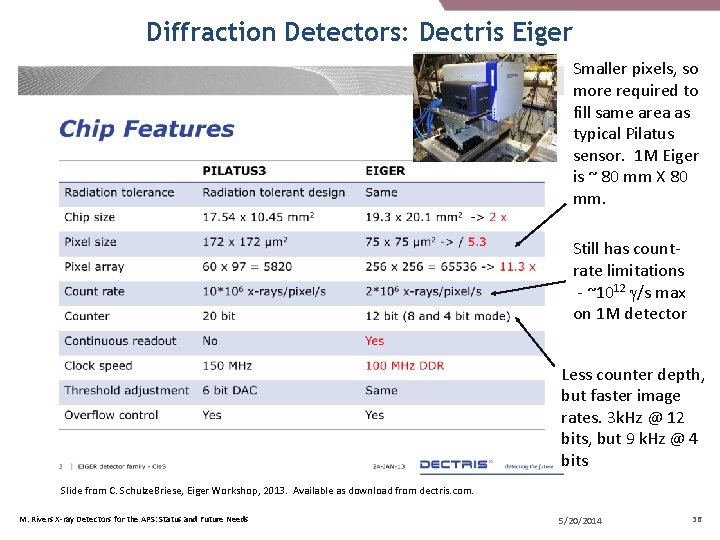
Diffraction Detectors: Dectris Eiger Smaller pixels, so more required to fill same area as typical Pilatus sensor. 1 M Eiger is ~ 80 mm X 80 mm. Still has countrate limitations - ~1012 g/s max on 1 M detector Less counter depth, but faster image rates. 3 k. Hz @ 12 bits, but 9 k. Hz @ 4 bits Slide from C. Schulze. Briese, Eiger Workshop, 2013. Available as download from dectris. com. M. Rivers X-ray Detectors for the APS: Status and Future Needs 5/20/2014 36
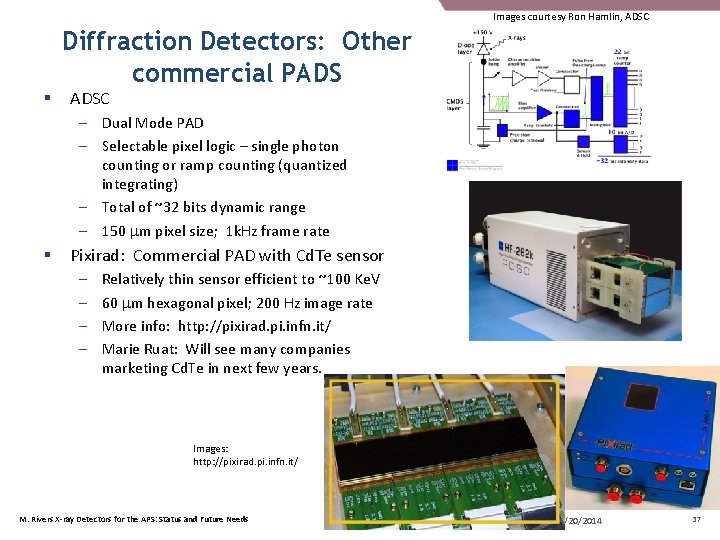
Images courtesy Ron Hamlin, ADSC Diffraction Detectors: Other commercial PADS § ADSC – Dual Mode PAD – Selectable pixel logic – single photon counting or ramp counting (quantized integrating) – Total of ~32 bits dynamic range – 150 mm pixel size; 1 k. Hz frame rate § Pixirad: Commercial PAD with Cd. Te sensor – – Relatively thin sensor efficient to ~100 Ke. V 60 mm hexagonal pixel; 200 Hz image rate More info: http: //pixirad. pi. infn. it/ Marie Ruat: Will see many companies marketing Cd. Te in next few years. Images: http: //pixirad. pi. infn. it/ M. Rivers X-ray Detectors for the APS: Status and Future Needs 5/20/2014 37
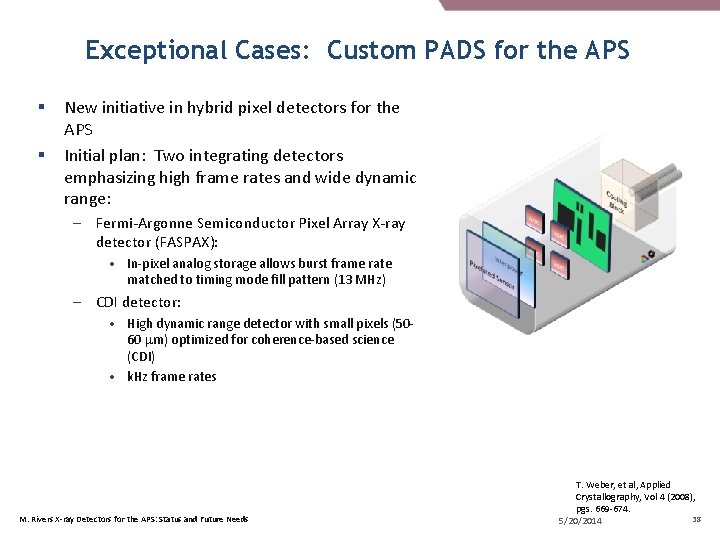
Exceptional Cases: Custom PADS for the APS § § New initiative in hybrid pixel detectors for the APS Initial plan: Two integrating detectors emphasizing high frame rates and wide dynamic range: – Fermi-Argonne Semiconductor Pixel Array X-ray detector (FASPAX): • In-pixel analog storage allows burst frame rate matched to timing mode fill pattern (13 MHz) – CDI detector: • High dynamic range detector with small pixels (5060 mm) optimized for coherence-based science (CDI) • k. Hz frame rates M. Rivers X-ray Detectors for the APS: Status and Future Needs T. Weber, et al, Applied Crystallography, Vol 4 (2008), pgs. 669 -674. 38 5/20/2014
Imaging Detectors § Figures of Merit – Pixel size – Speed – Sensitivity § Where we were in 1995 – Analog video cameras with frame grabbers – Cooled CCD cameras, mechanical shutter, 3 frames/s M. Rivers X-ray Detectors for the APS: Status and Future Needs 5/20/2014 39
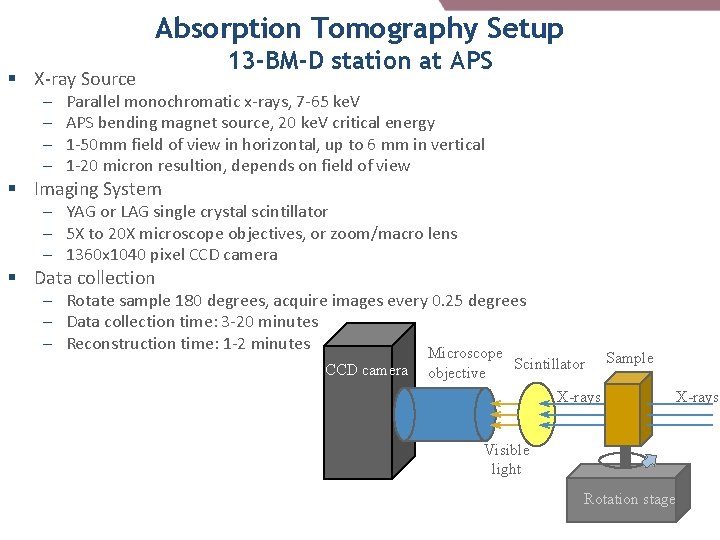
Absorption Tomography Setup § X-ray Source – – 13 -BM-D station at APS Parallel monochromatic x-rays, 7 -65 ke. V APS bending magnet source, 20 ke. V critical energy 1 -50 mm field of view in horizontal, up to 6 mm in vertical 1 -20 micron resultion, depends on field of view § Imaging System – YAG or LAG single crystal scintillator – 5 X to 20 X microscope objectives, or zoom/macro lens – 1360 x 1040 pixel CCD camera § Data collection – Rotate sample 180 degrees, acquire images every 0. 25 degrees – Data collection time: 3 -20 minutes – Reconstruction time: 1 -2 minutes CCD camera Microscope Scintillator Sample objective X-rays Visible light Rotation stage
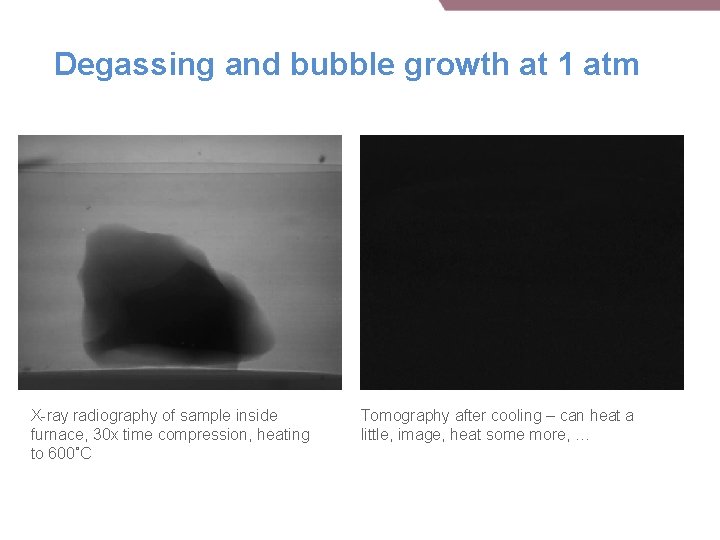
Degassing and bubble growth at 1 atm X-ray radiography of sample inside furnace, 30 x time compression, heating to 600˚C Tomography after cooling – can heat a little, image, heat some more, …
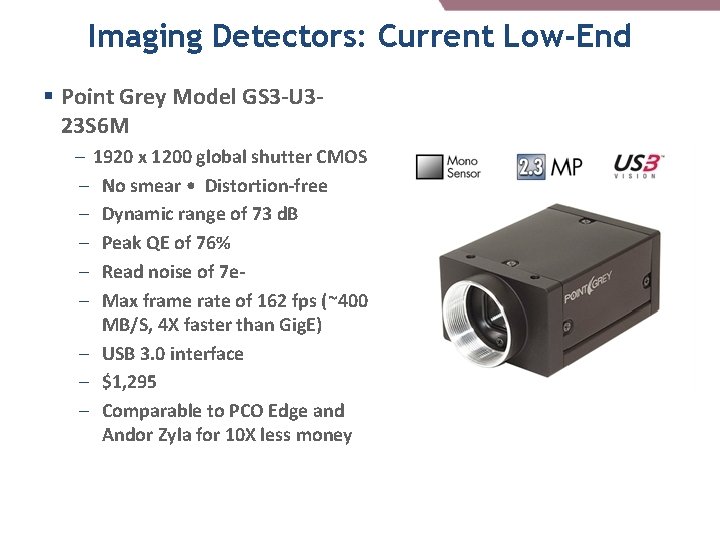
Imaging Detectors: Current Low-End § Point Grey Model GS 3 -U 323 S 6 M – 1920 x 1200 global shutter CMOS – No smear • Distortion-free – Dynamic range of 73 d. B – Peak QE of 76% – Read noise of 7 e– Max frame rate of 162 fps (~400 MB/S, 4 X faster than Gig. E) – USB 3. 0 interface – $1, 295 – Comparable to PCO Edge and Andor Zyla for 10 X less money
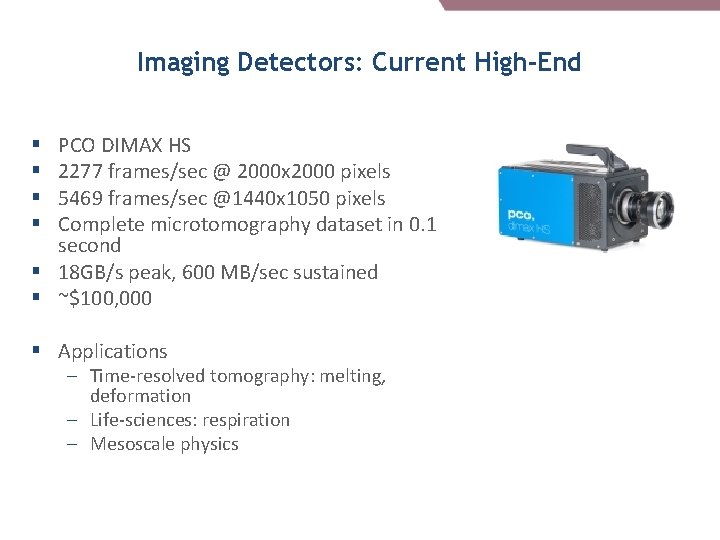
Imaging Detectors: Current High-End PCO DIMAX HS 2277 frames/sec @ 2000 x 2000 pixels 5469 frames/sec @1440 x 1050 pixels Complete microtomography dataset in 0. 1 second § 18 GB/s peak, 600 MB/sec sustained § ~$100, 000 § § § Applications – Time-resolved tomography: melting, deformation – Life-sciences: respiration – Mesoscale physics
Conclusions § Improvements in x-ray sources and detectors have the potential for transformative improvements in x-ray science in 5 -10 years § Improvements needed in – Spatial resolution – Temporal resolution – Energy resolution, energy range § The detector data rates are pushing x-ray science into the realm of “big data”, where high-energy physics has been for a long time § Clear need for major computing infrastructure improvements § However, in many cases we need “domain-specific” solutions because of the diversity of science, where needs are often unique M. Rivers X-ray Detectors for the APS: Status and Future Needs 5/20/2014 44
Conclusions § Commercial detectors have provided many exciting new capabilities in fields where there is a substantial market – Many of these are a spin-off of fields like medical and other non -synchrotron applications § There is a role for national labs in developing novel detectors. Hard to know where to put limited resources. But some efforts have had major impacts: – Energy-dispersive Si detectors from LBL – CCD array detectors for protein crystallography from ANL – PSI pixel-array detectors, spun off to Dectris M. Rivers X-ray Detectors for the APS: Status and Future Needs 5/20/2014 45
Acknowledgments § Robert Bradford, APS Detector Group for many of the slides § Peter Eng, GSECARS for surface diffraction § Vitali Prakapenka, GSECARS, laser heating in diamond anvil cell M. Rivers X-ray Detectors for the APS: Status and Future Needs 5/20/2014 46