
Xray Correlation Spectroscopy Instrument Aymeric Robert XCS Instrument
X-ray Correlation Spectroscopy Instrument Aymeric Robert – XCS Instrument Scientist LCLS Facilities Advisory Committee Meeting June 17, 2008 Team Leaders : Brian Stephenson Gerhard Grübel Karl Ludwig Lead Engineer: Eric Bong 06/17/2008 XCS Instrument 1 Aymeric ROBERT aymeric@slac. stanford. edu
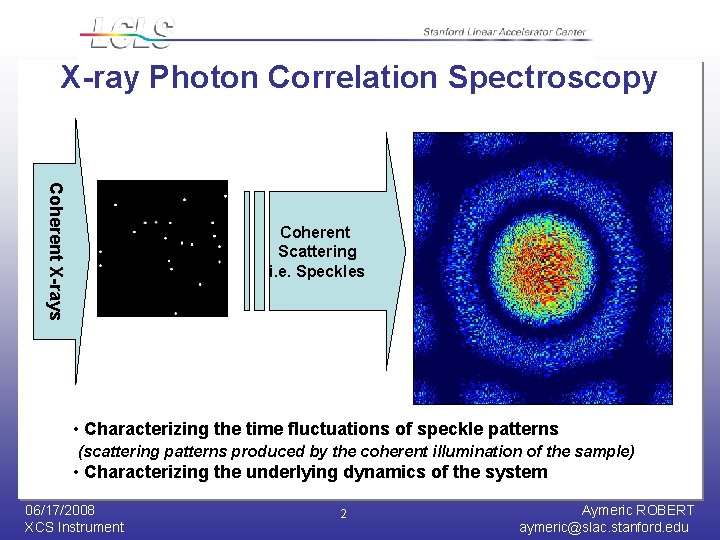
X-ray Photon Correlation Spectroscopy Coherent X-rays Coherent Scattering i. e. Speckles • Characterizing the time fluctuations of speckle patterns (scattering patterns produced by the coherent illumination of the sample) • Characterizing the underlying dynamics of the system 06/17/2008 XCS Instrument 2 Aymeric ROBERT aymeric@slac. stanford. edu
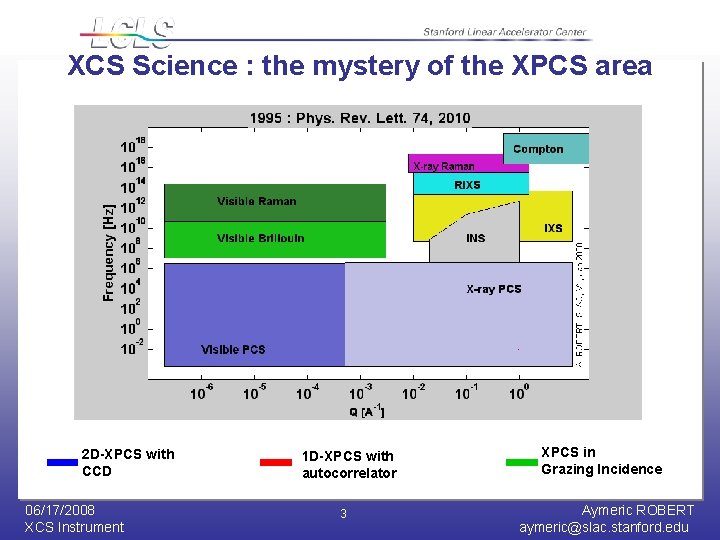
XCS Science : the mystery of the XPCS area 2 D-XPCS with CCD 06/17/2008 XCS Instrument 1 D-XPCS with autocorrelator 3 XPCS in Grazing Incidence Aymeric ROBERT aymeric@slac. stanford. edu
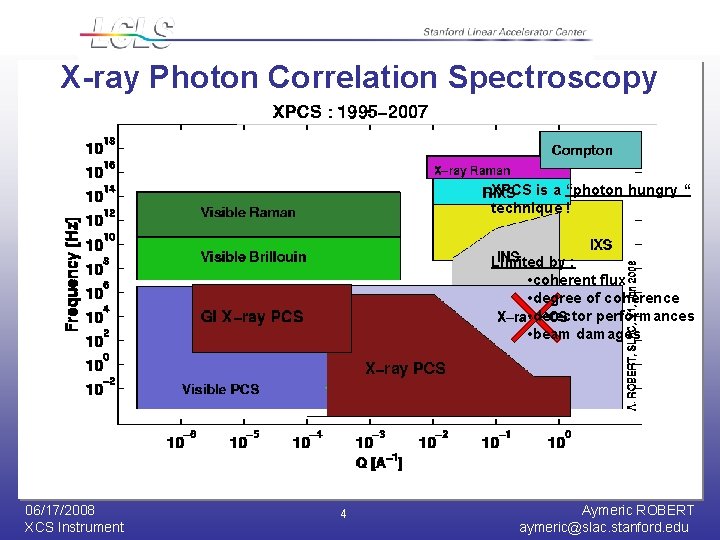
X-ray Photon Correlation Spectroscopy XPCS is a “photon hungry “ technique ! Limited by : • coherent flux • degree of coherence • detector performances • beam damages 06/17/2008 XCS Instrument 4 Aymeric ROBERT aymeric@slac. stanford. edu
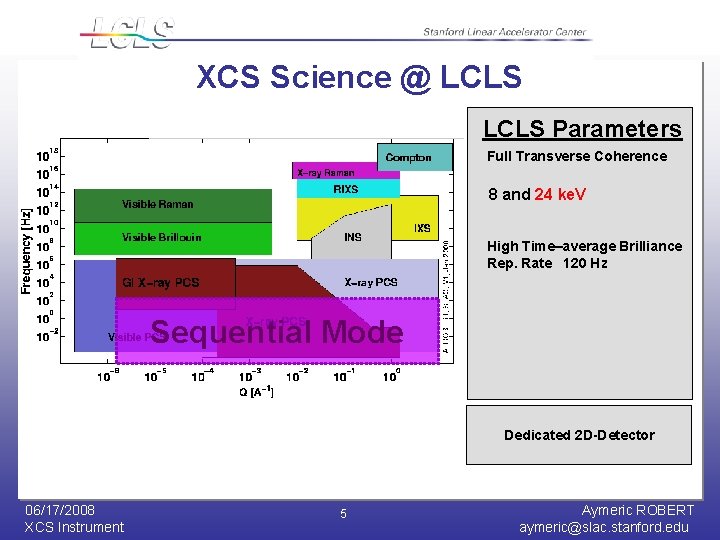
XCS Science @ LCLS Parameters Full Transverse Coherence 8 and 24 ke. V High Time–average Brilliance Rep. Rate 120 Hz Sequential Mode Dedicated 2 D-Detector 06/17/2008 XCS Instrument 5 Aymeric ROBERT aymeric@slac. stanford. edu
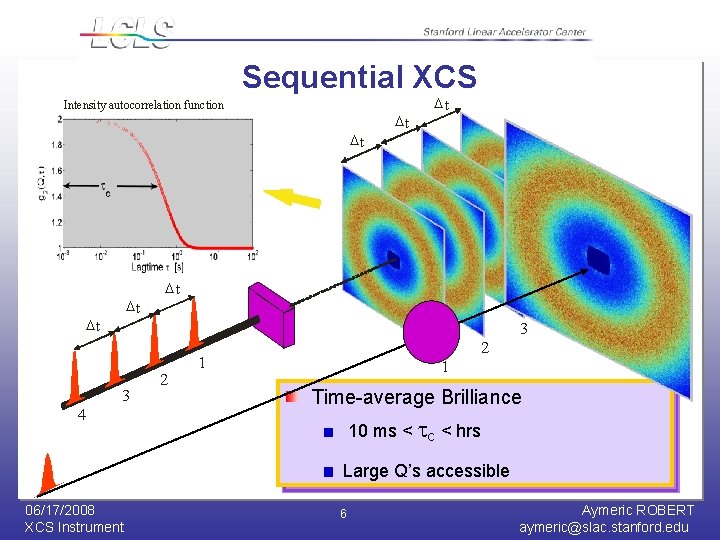
Sequential XCS Intensity autocorrelation function Dt Dt Dt 3 3 4 2 1 1 Time-average Brilliance 10 ms < t. C < hrs Large Q’s accessible 06/17/2008 XCS Instrument 6 Aymeric ROBERT aymeric@slac. stanford. edu

XCS Science @ LCLS Parameters Full Transverse Coherence Ultra Fast Mode 8 and 24 ke. V High Time–average Brilliance Rep. Rate 120 Hz Sequential Mode High Peak Brilliance Short pulse duration 230 fs Dedicated 2 D-Detector 06/17/2008 XCS Instrument 7 Aymeric ROBERT aymeric@slac. stanford. edu
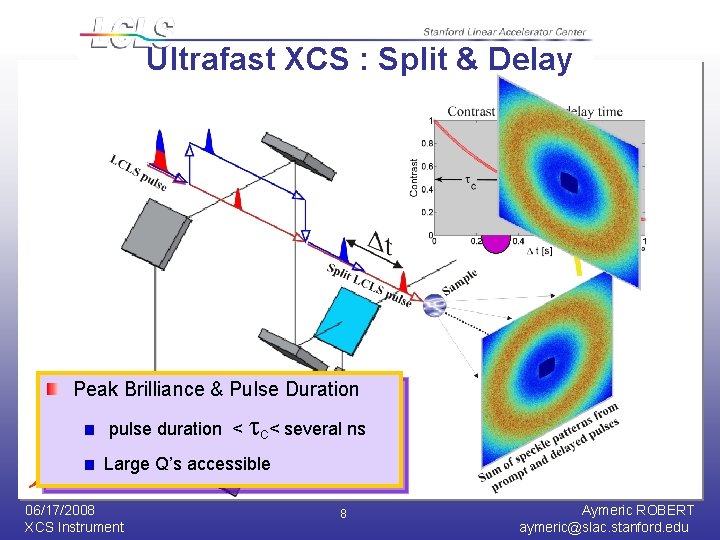
Ultrafast XCS : Split & Delay Peak Brilliance & Pulse Duration pulse duration < t. C< several ns Large Q’s accessible 06/17/2008 XCS Instrument 8 Aymeric ROBERT aymeric@slac. stanford. edu
FAC report Oct 07 4. 2. 5. XCS Instrument Aymeric Robert described the progress on designing the x-ray correlation spectroscopy (XCS) instrument. The design of this instrument is relatively mature since it builds on existing successful programs at third-generation synchrotron facilities and is scheduled to be the last commissioned. The greatest uncertainties revolve around the split and delay, x-ray monochromator and the x-ray detector. An Mo. U as been entered into with DESY to develop this system and a first instrument has been tested on the Troika beamline at ESRF. This instrument will need to be extended to operate at a variety of photon energies. The detector is anticipated to be a pixel array detector being developed at Brookhaven National Laboratory. The development of this detector appears to have appropriate progress. The committee recommends that the XCS staff retain flexibility in their designs to facilitate change as opportunities and problems are discovered. 06/17/2008 XCS Instrument 9 Aymeric ROBERT aymeric@slac. stanford. edu

XCS Instrument Schedule Instrument will operate in the 6 -25 ke. V photon energy range X-ray Wavelength and Bandwidth Monochromatic Fundamental Monochromatic 3 rd Harmonic Δλ/λ ≈10 -4 -10 -5 LUSI Project CD-0 Mission Need Approved: Aug. 2005 X-Ray Correlation Spectroscopy Wide Angle Scattering Small Angle Scattering Grazing Incidence CD-1 CD-2 CD-3 CD-4 Cost Range Approval Performance Baseline Approval Construction Start Approval Start of Operations July 2007 (b) Oct. 2008 2009 JULY (b) Mar. 2010 (b) March 2012 Project Completion 06/17/2008 XCS Instrument Scattering Techniques 10 (b) March. 2012 Aymeric ROBERT aymeric@slac. stanford. edu

XCS Instrument Concept Photon Shutter Primary Slits Item Purpose Large Offset Monochromator Deflecting beam to XCS endstations and provide monochromatic beam Non-monolithic channel-cut crystals, 600 mm offset, 0. 04 arcsec in q, energy tunability (6 25 ke. V) Be Focusing Lenses Provide focusing at sample while preserving coherence Down to typically 10 mm Split and Delay Slits/Apertures Beam definition, halo cleaning 0. 25 mm accuracy, 1 mm repeatability Focusing Lenses Attenuators variable attenuation for alignment Variable, up to 106 reduction X-ray Diffractometer Orient the sample Wide Angle Detector Stage Move the detector in reciprocal space Min 7 m sample detector distance up to 2θ = 55° in diffraction geometry Small Angle Detector Stage Move the detector in reciprocal space Up to 20 m detector distance for high resolution speckle observation in forward direction 2 D Detector from BNL by Mo. U 2 D pixelated detection capability 1024 x 1024 pixels, 120 Hz, dynamic range 100, single-photon sensitivity, pixel size 35 x 35 mm 2 Diagnostics Monochromator Secondary Slits Diagnostics Transport Tunnel Attenuators Photon Shutter Diagnostics CXI Station FEH Hutch 4 Local Optics Slits Diagnostics Diffractometer Wide Angle Detector Stage Small Angle Detector Stage 06/17/2008 XCS Instrument Specification 11 Aymeric ROBERT aymeric@slac. stanford. edu
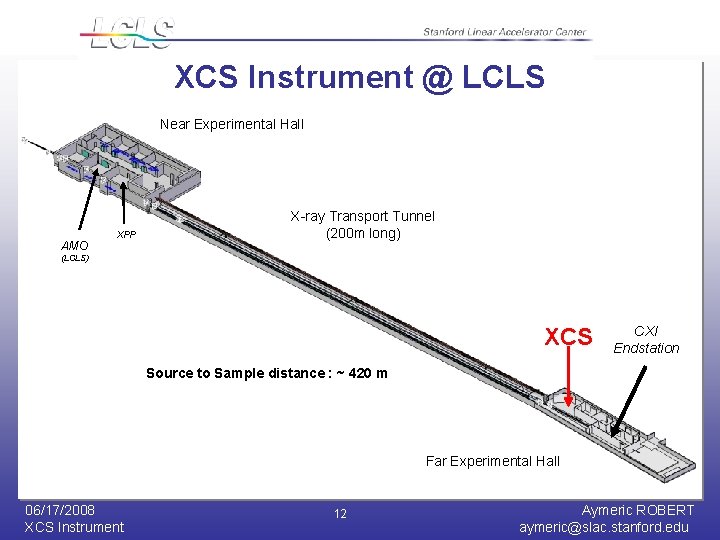
XCS Instrument @ LCLS Near Experimental Hall AMO XPP X-ray Transport Tunnel (200 m long) (LCLS) XCS CXI Endstation Source to Sample distance : ~ 420 m Far Experimental Hall 06/17/2008 XCS Instrument 12 Aymeric ROBERT aymeric@slac. stanford. edu
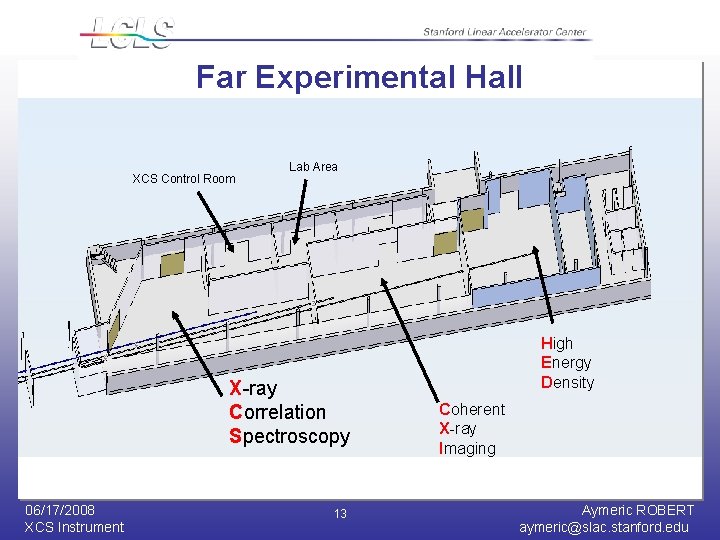
Far Experimental Hall XCS Control Room Lab Area X-ray Correlation Spectroscopy 06/17/2008 XCS Instrument 13 High Energy Density Coherent X-ray Imaging Aymeric ROBERT aymeric@slac. stanford. edu
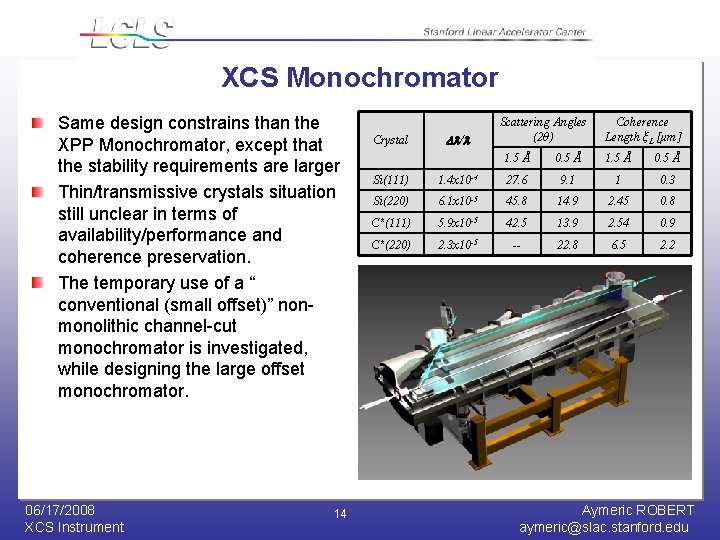
XCS Monochromator Same design constrains than the XPP Monochromator, except that the stability requirements are larger Thin/transmissive crystals situation still unclear in terms of availability/performance and coherence preservation. The temporary use of a “ conventional (small offset)” nonmonolithic channel-cut monochromator is investigated, while designing the large offset monochromator. 06/17/2008 XCS Instrument 14 Crystal Dl/l Scattering Angles (2θ) Coherence Length ξL [μm] 1. 5 Å 0. 5 Å Si(111) 1. 4 x 10 -4 27. 6 9. 1 1 0. 3 Si(220) 6. 1 x 10 -5 45. 8 14. 9 2. 45 0. 8 C*(111) 5. 9 x 10 -5 42. 5 13. 9 2. 54 0. 9 C*(220) 2. 3 x 10 -5 -- 22. 8 6. 5 2. 2 Aymeric ROBERT aymeric@slac. stanford. edu
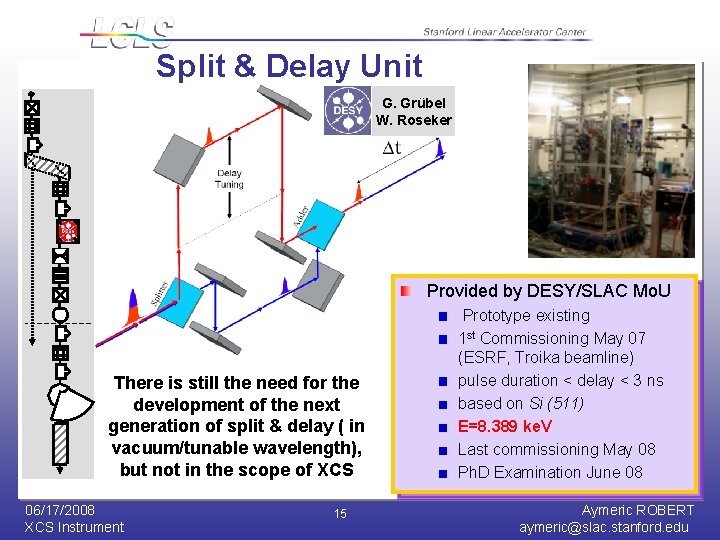
Split & Delay Unit G. Grübel W. Roseker Provided by DESY/SLAC Mo. U There is still the need for the development of the next generation of split & delay ( in vacuum/tunable wavelength), but not in the scope of XCS 06/17/2008 XCS Instrument 15 Prototype existing 1 st Commissioning May 07 (ESRF, Troika beamline) pulse duration < delay < 3 ns based on Si (511) E=8. 389 ke. V Last commissioning May 08 Ph. D Examination June 08 Aymeric ROBERT aymeric@slac. stanford. edu
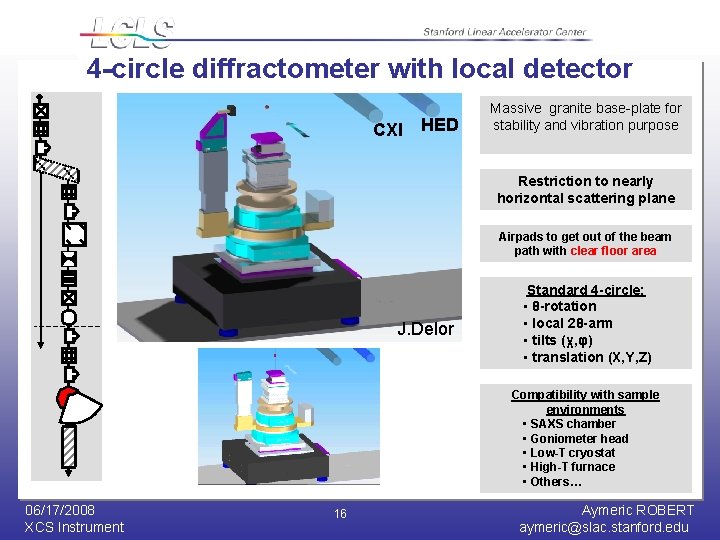
4 -circle diffractometer with local detector CXI HED Massive granite base-plate for stability and vibration purpose Restriction to nearly horizontal scattering plane Airpads to get out of the beam path with clear floor area J. Delor Standard 4 -circle: • θ-rotation • local 2θ-arm • tilts (χ, φ) • translation (X, Y, Z) Compatibility with sample environments • SAXS chamber • Goniometer head • Low-T cryostat • High-T furnace • Others… 06/17/2008 XCS Instrument 16 Aymeric ROBERT aymeric@slac. stanford. edu
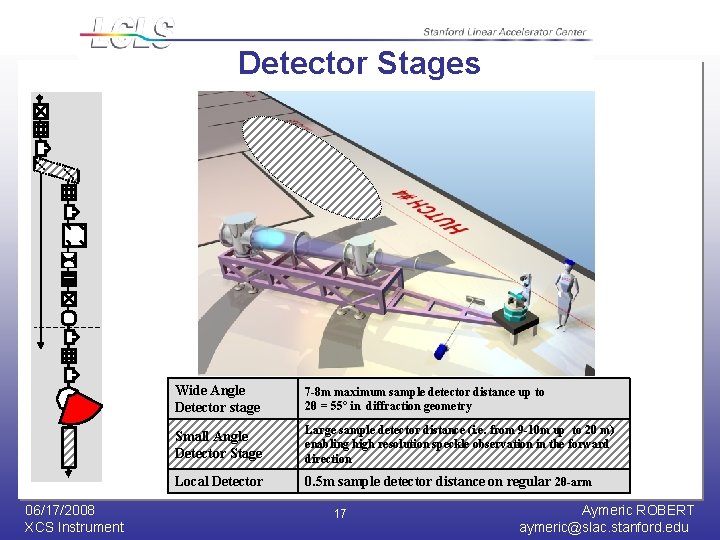
Detector Stages 06/17/2008 XCS Instrument Wide Angle Detector stage 7 -8 m maximum sample detector distance up to 2θ = 55° in diffraction geometry Small Angle Detector Stage Large sample detector distance (i. e. from 9 -10 m up to 20 m) enabling high resolution speckle observation in the forward direction Local Detector 0. 5 m sample detector distance on regular 2θ-arm 17 Aymeric ROBERT aymeric@slac. stanford. edu
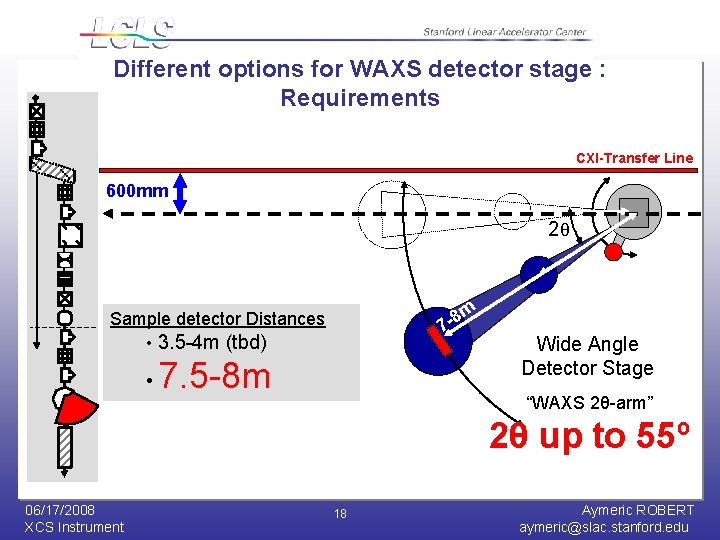
Different options for WAXS detector stage : Requirements CXI-Transfer Line 600 mm 2θ m 8 7 - Sample detector Distances • 3. 5 -4 m (tbd) • 7. 5 -8 m Wide Angle Detector Stage “WAXS 2θ-arm” 2θ up to 55º 06/17/2008 XCS Instrument 18 Aymeric ROBERT aymeric@slac. stanford. edu

Spring-8/ESRF/APS Existing Designs ID 28, IXS HERIX, sector 30 06/17/2008 XCS Instrument 19 Aymeric ROBERT aymeric@slac. stanford. edu
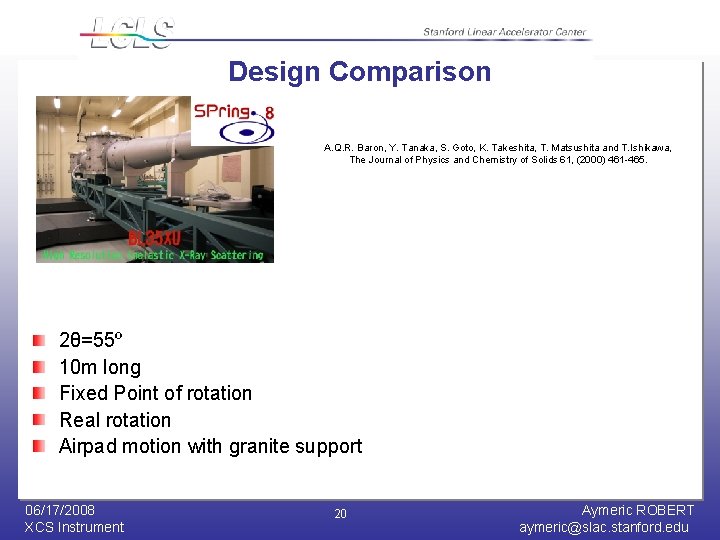
Design Comparison A. Q. R. Baron, Y. Tanaka, S. Goto, K. Takeshita, T. Matsushita and T. Ishikawa, The Journal of Physics and Chemistry of Solids 61, (2000) 461 -465. 2θ=55º 10 m long Fixed Point of rotation Real rotation Airpad motion with granite support 06/17/2008 XCS Instrument 20 Aymeric ROBERT aymeric@slac. stanford. edu

Design Comparison ID 28, IXS 2θ≈50º 7 -12 m long Point of rotation Lateral motion of the point of rotation with diffractometer Real rotation Translation stages 06/17/2008 XCS Instrument 21 Aymeric ROBERT aymeric@slac. stanford. edu
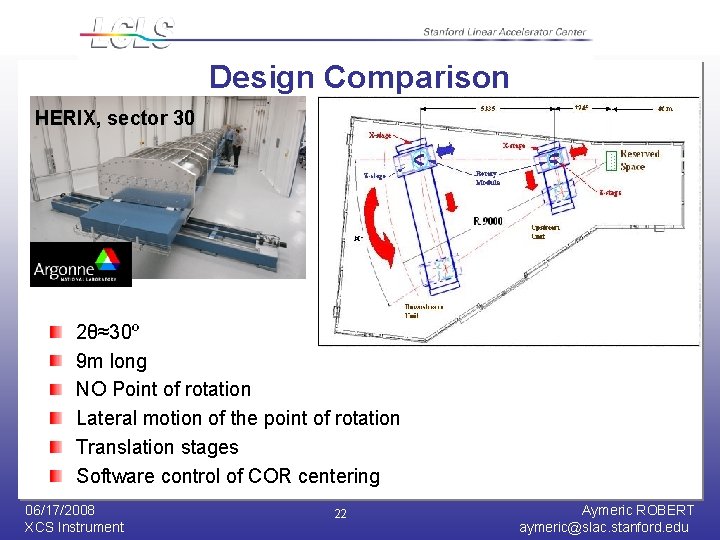
Design Comparison HERIX, sector 30 2θ≈30º 9 m long NO Point of rotation Lateral motion of the point of rotation Translation stages Software control of COR centering 06/17/2008 XCS Instrument 22 Aymeric ROBERT aymeric@slac. stanford. edu
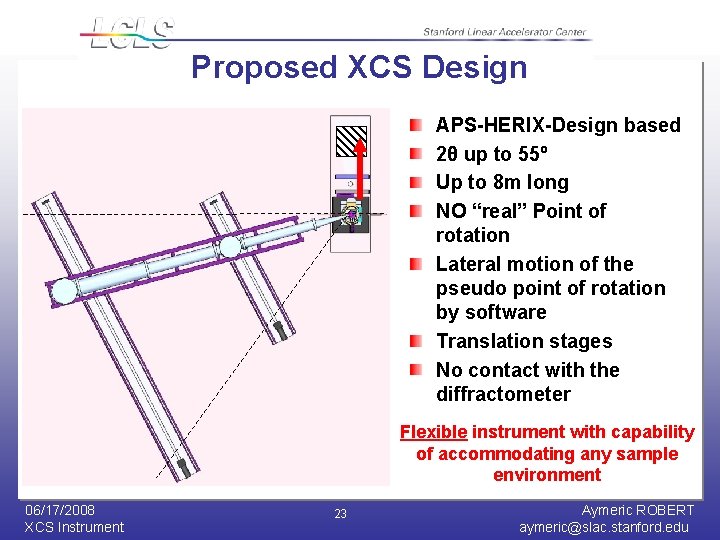
Proposed XCS Design APS-HERIX-Design based 2θ up to 55º Up to 8 m long NO “real” Point of rotation Lateral motion of the pseudo point of rotation by software Translation stages No contact with the diffractometer Flexible instrument with capability of accommodating any sample environment 06/17/2008 XCS Instrument 23 Aymeric ROBERT aymeric@slac. stanford. edu
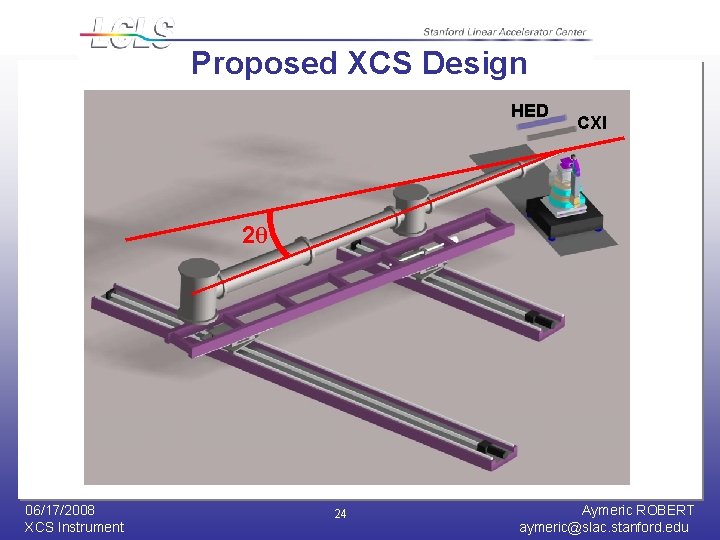
Proposed XCS Design HED CXI 2θ 06/17/2008 XCS Instrument 24 Aymeric ROBERT aymeric@slac. stanford. edu
Summary Monochromator : potential use of a temporary nonmonolithic channel cut while designing and building the large offset one (tbd). Diffractometer design allowing flexibility for accommodating very large sample environments/devices WAXS detector stage flexible design : APS/HERIX based design pseudo rotation control by software Multiple COR positions possible separated from the diffractometer ( no point of rotation), based on 2 -long translations 06/17/2008 XCS Instrument 25 Aymeric ROBERT aymeric@slac. stanford. edu
- Slides: 25