
Xray Absorption Spectroscopy Introduction to XAS XAS detection
X-ray Absorption Spectroscopy • Introduction to XAS • XAS detection techniques • XAS spectral shape • multiplet calculations
X-ray Absorption Spectroscopy • Element specific • Sensitive to low concentrations • Applicable under extreme conditions • SPACE: Combination with x-ray microscopy • TIME: femtosecond XAS • RESONANCE: RIXS, RPES, R diffraction

Interaction of x-rays with matter X-ray Absorption Spectroscopy • Photo-electric (X-ray annihilation) • Elastic X-ray scattering • Inelastic X-ray scattering Mn
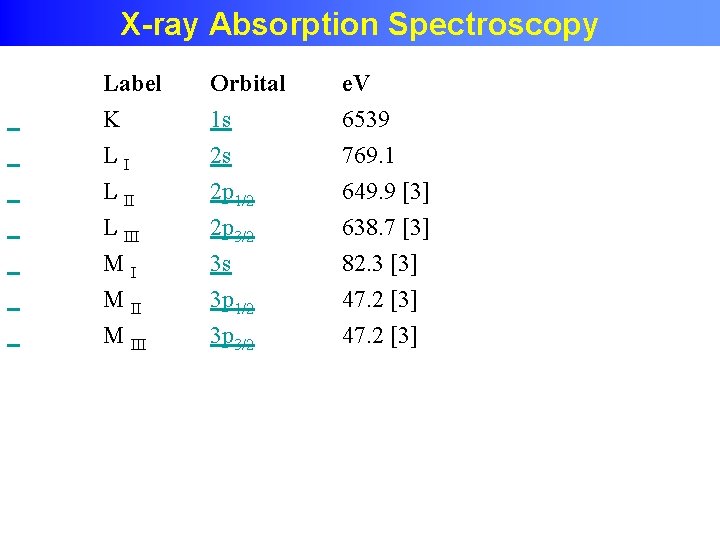
X-ray absorption edges X-ray Absorption Spectroscopy Label K Orbital 1 s e. V 6539 L I L III M III 2 s 2 p 1/2 2 p 3/2 3 s 3 p 1/2 3 p 3/2 769. 1 649. 9 [3] 638. 7 [3] 82. 3 [3] 47. 2 [3]
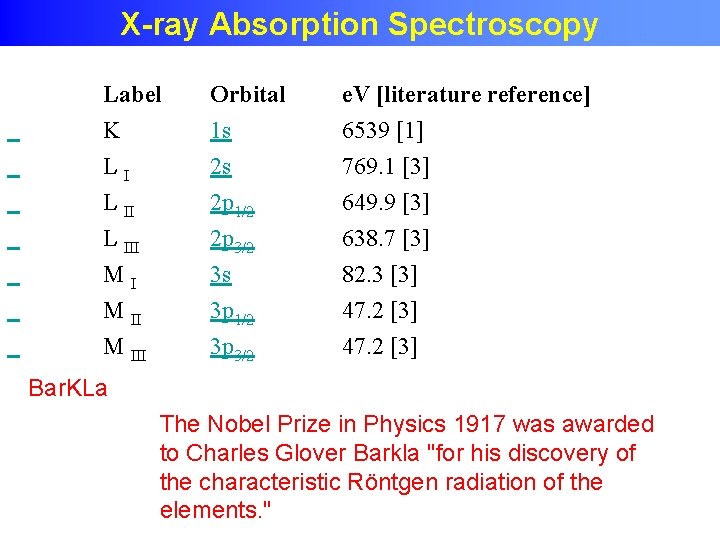
X-ray absorption edges X-ray Absorption Spectroscopy Label K Orbital 1 s e. V [literature reference] 6539 [1] L I 2 s 769. 1 [3] L III 2 p 1/2 2 p 3/2 649. 9 [3] 638. 7 [3] M III 3 s 3 p 1/2 3 p 3/2 82. 3 [3] 47. 2 [3] Bar. KLa The Nobel Prize in Physics 1917 was awarded to Charles Glover Barkla "for his discovery of the characteristic Röntgen radiation of the elements. "
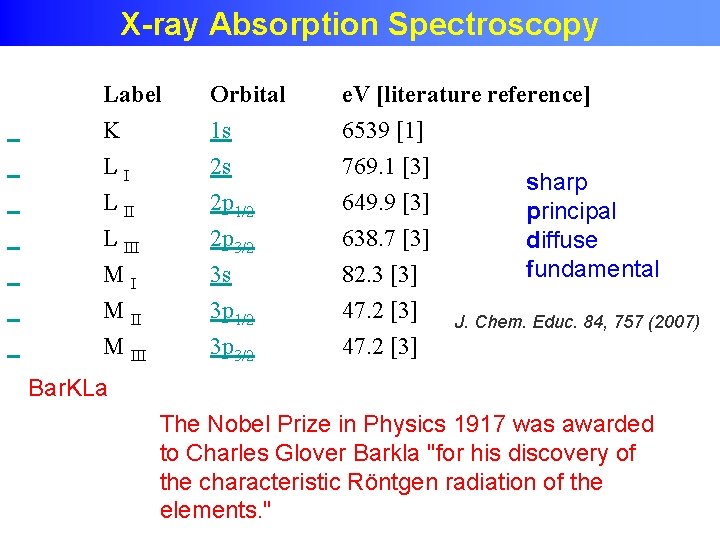
X-ray absorption edges X-ray Absorption Spectroscopy Label K Orbital 1 s e. V [literature reference] 6539 [1] L I 2 s 769. 1 [3] L III 2 p 1/2 2 p 3/2 649. 9 [3] 638. 7 [3] M III 3 s 3 p 1/2 3 p 3/2 82. 3 [3] 47. 2 [3] sharp principal diffuse fundamental J. Chem. Educ. 84, 757 (2007) Bar. KLa The Nobel Prize in Physics 1917 was awarded to Charles Glover Barkla "for his discovery of the characteristic Röntgen radiation of the elements. "
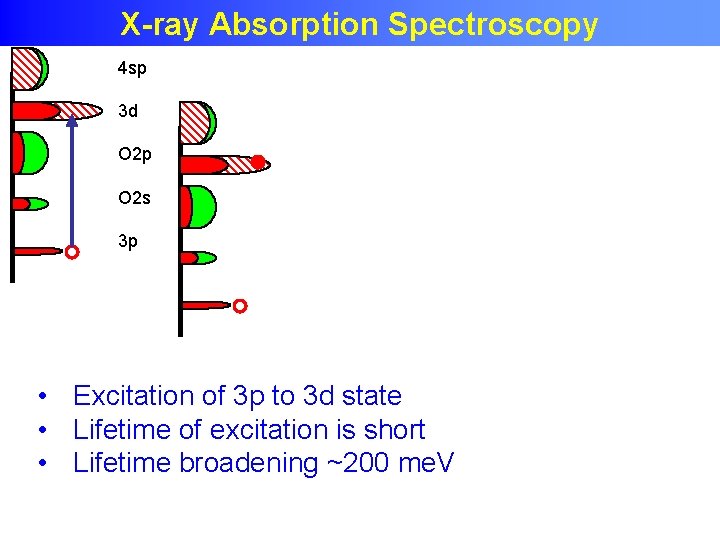
X-ray absorption X-ray Absorption Spectroscopy 4 sp 3 d O 2 p O 2 s 3 p • Excitation of 3 p to 3 d state • Lifetime of excitation is short • Lifetime broadening ~200 me. V
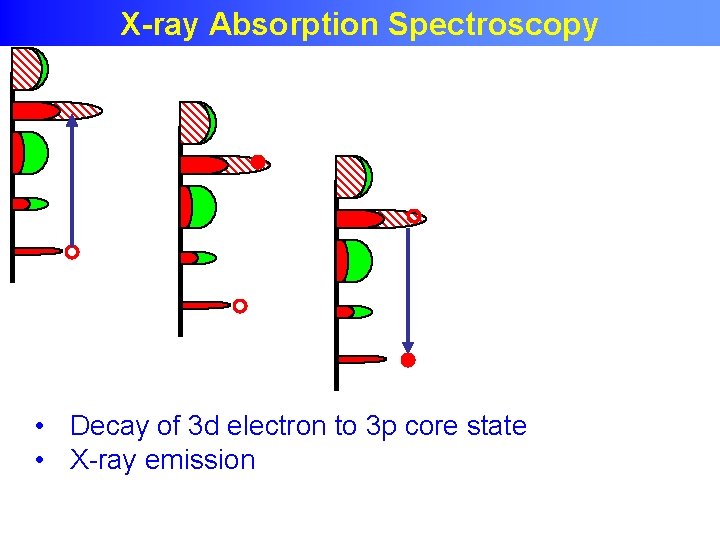
X-ray absorption & x-ray emission X-ray Absorption Spectroscopy • Decay of 3 d electron to 3 p core state • X-ray emission
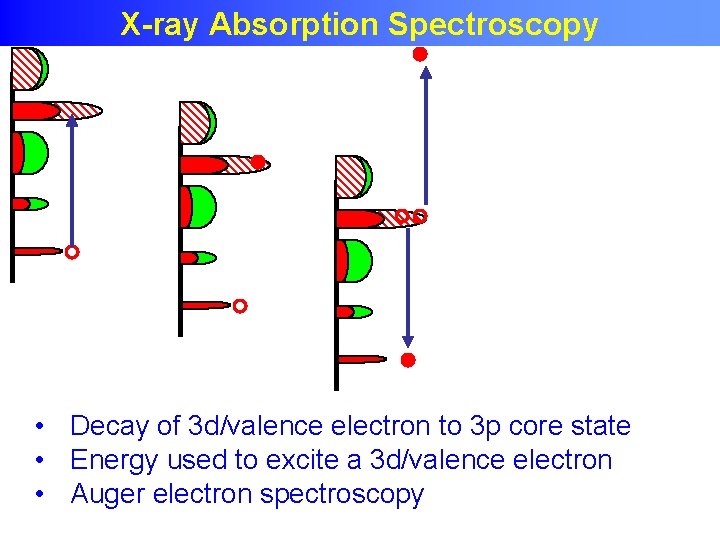
X-ray absorption & Auger X-ray Absorption Spectroscopy • Decay of 3 d/valence electron to 3 p core state • Energy used to excite a 3 d/valence electron • Auger electron spectroscopy
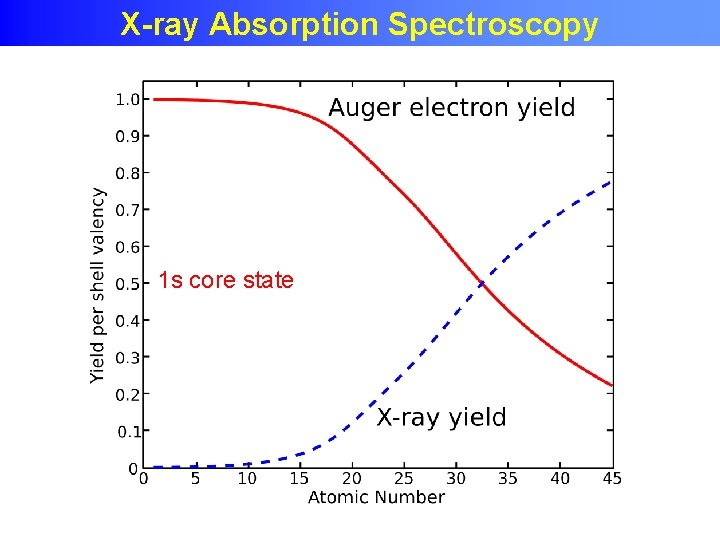
X-ray Absorption Spectroscopy 1 s core state
XAS: detection techniques
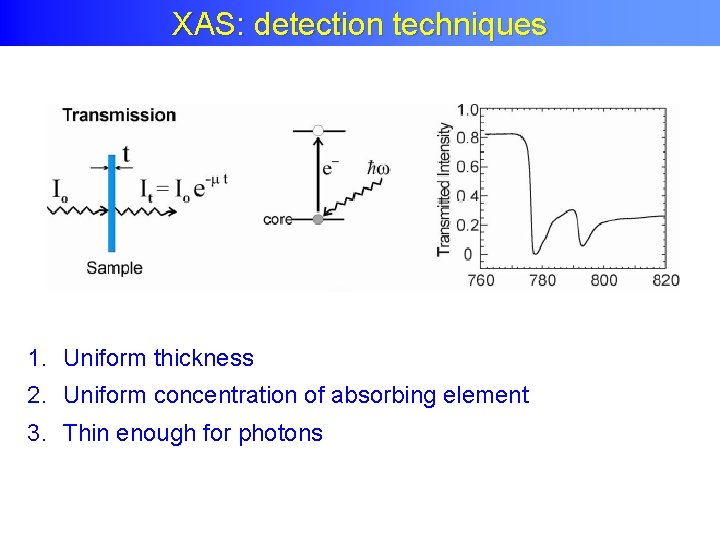
Use decay. XAS: detection techniques channels as detector 1. Uniform thickness 2. Uniform concentration of absorbing element 3. Thin enough for photons
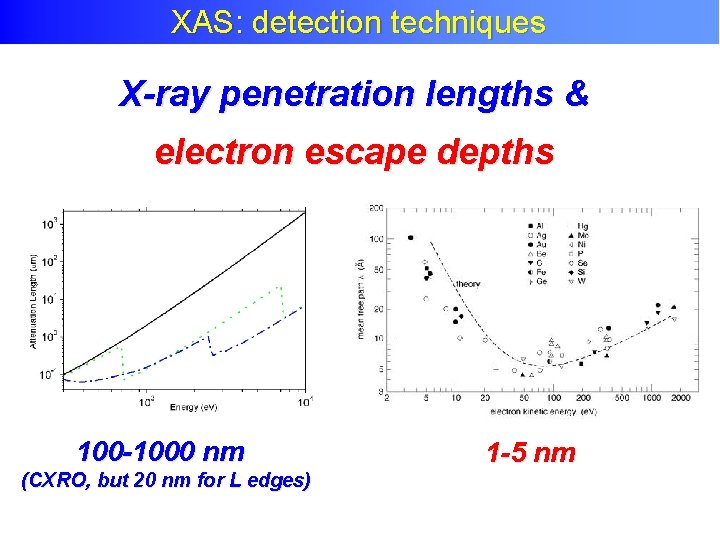
XAS: detection techniques X-ray penetration lengths & electron escape depths 100 -1000 nm (CXRO, but 20 nm for L edges) 1 -5 nm
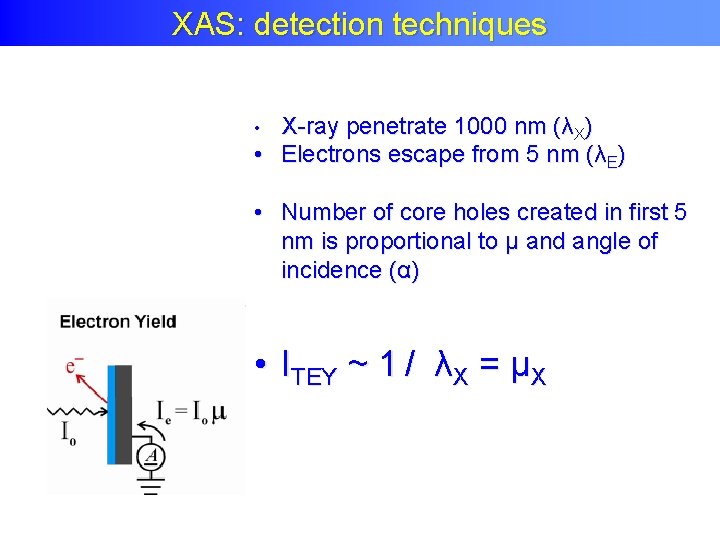
Use decay. XAS: detection techniques channels as detector X-ray penetrate 1000 nm (λX) • Electrons escape from 5 nm (λE) • • Number of core holes created in first 5 nm is proportional to μ and angle of incidence (α) • ITEY ~ 1 / λX = μX
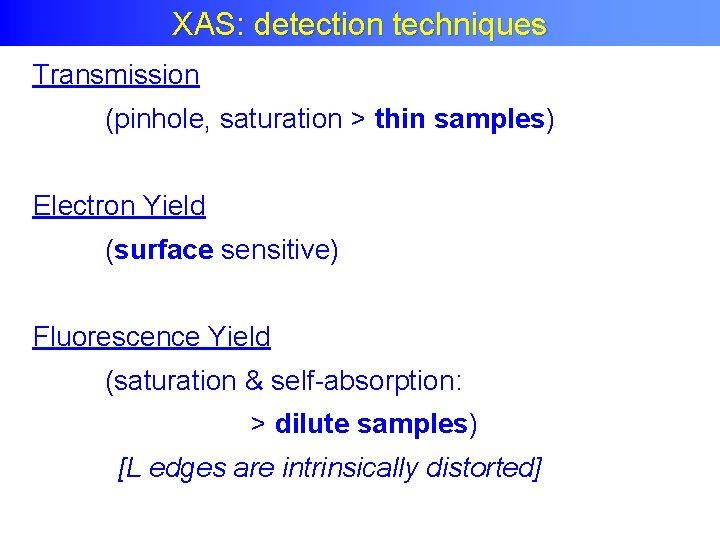
XAS: detection techniques Transmission (pinhole, saturation > thin samples) Electron Yield (surface sensitive) Fluorescence Yield (saturation & self-absorption: > dilute samples) [L edges are intrinsically distorted]
XAS: spectral shape Ø Interpretation of spectral shapes
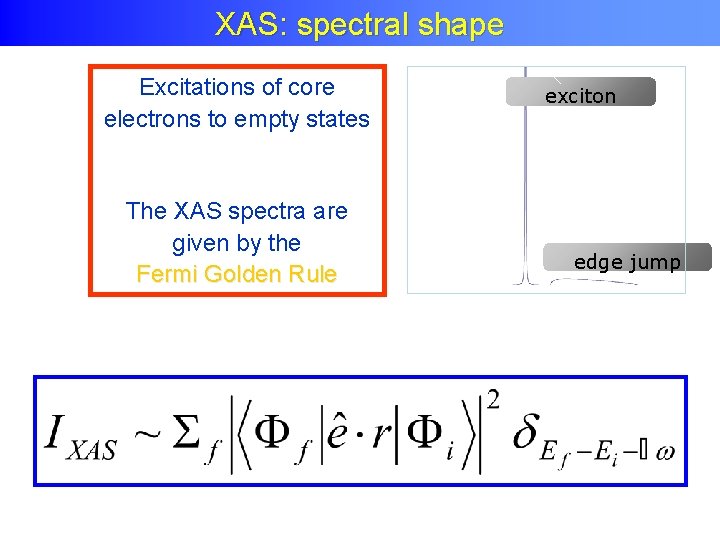
XAS: spectral shape Excitations of core electrons to empty states The XAS spectra are given by the Fermi Golden Rule exciton edge jump
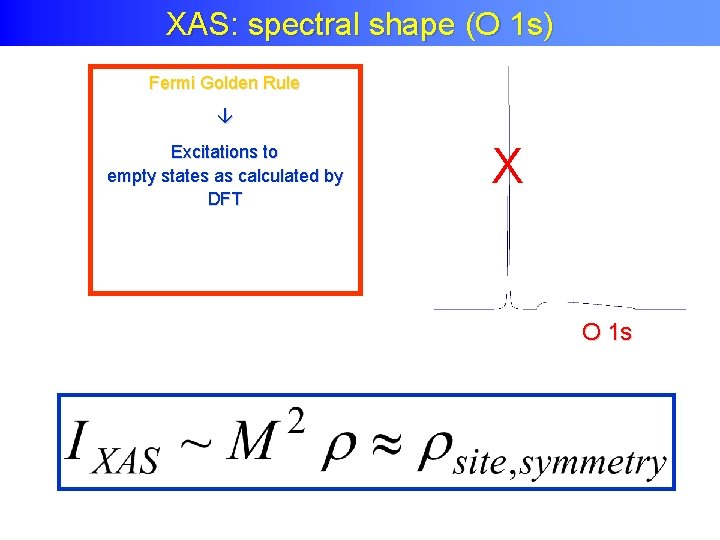
XAS: spectral shape (O 1 s) Fermi Golden Rule Excitations to empty states as calculated by DFT X O 1 s
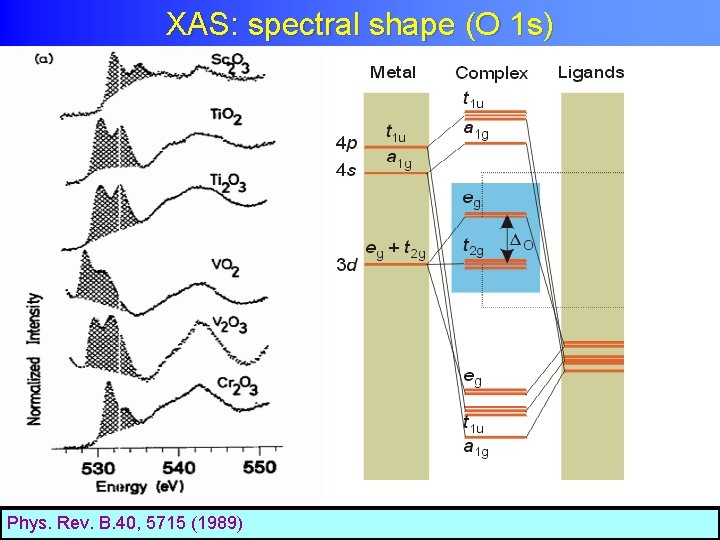
XAS: spectral shape (O 1 s) 2 p 2 s Phys. Rev. B. 40, 5715 (1989)
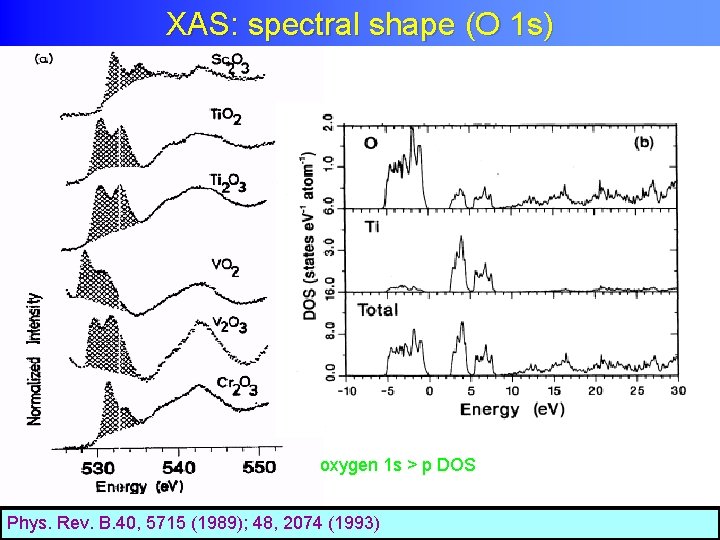
XAS: spectral shape (O 1 s) oxygen 1 s > p DOS Phys. Rev. B. 40, 5715 (1989); 48, 2074 (1993)
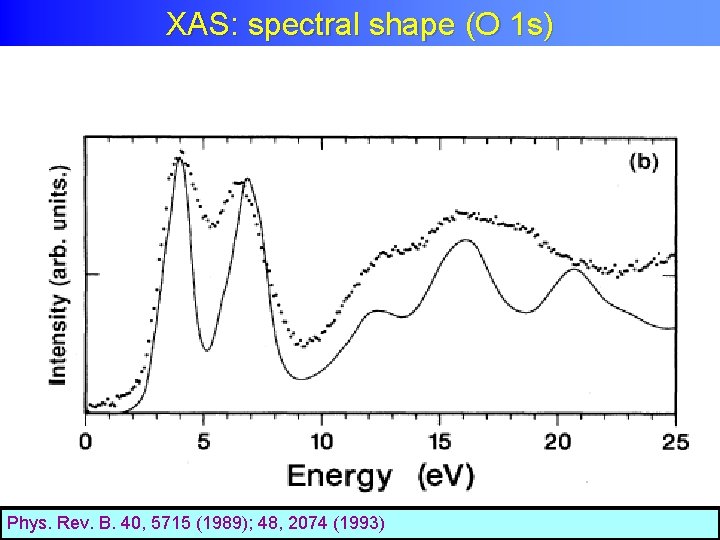
XAS: spectral shape (O 1 s) Phys. Rev. B. 40, 5715 (1989); 48, 2074 (1993)
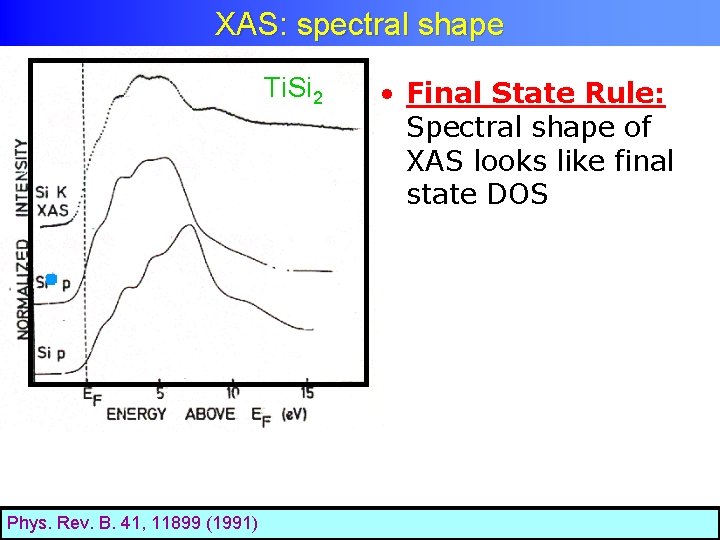
XAS: spectral shape Ti. Si 2 Phys. Rev. B. 41, 11899 (1991) • Final State Rule: Spectral shape of XAS looks like final state DOS
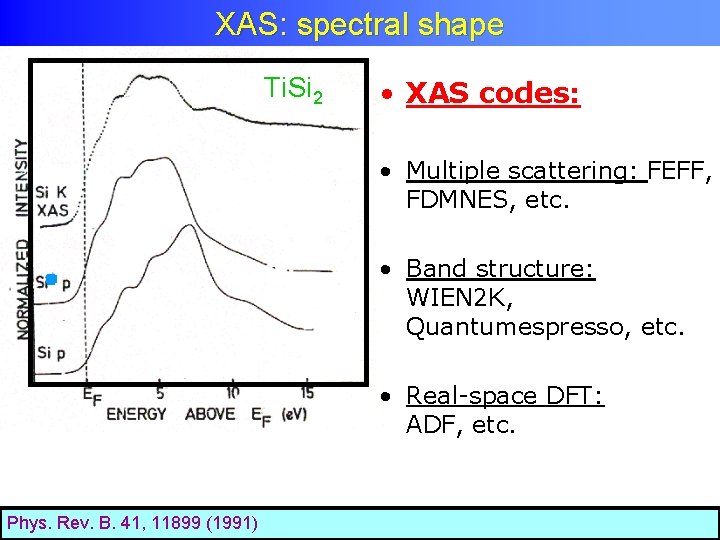
XAS: spectral shape Ti. Si 2 • XAS codes: • Multiple scattering: FEFF, FDMNES, etc. • Band structure: WIEN 2 K, Quantumespresso, etc. • Real-space DFT: ADF, etc. Phys. Rev. B. 41, 11899 (1991)
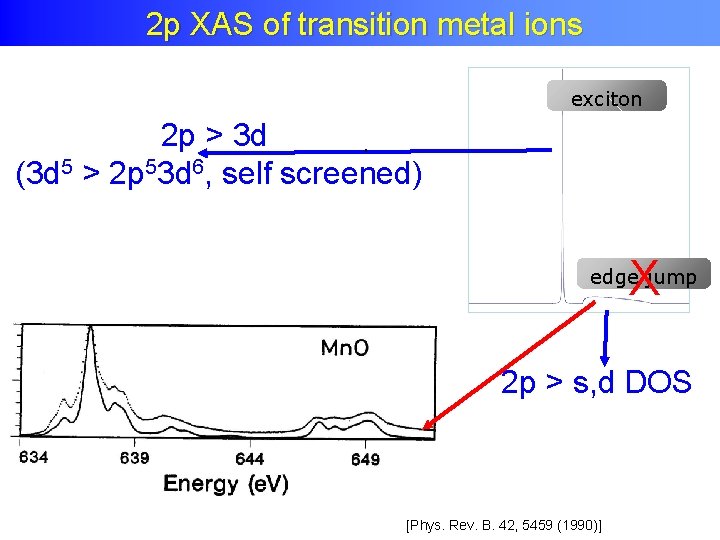
Iron 1 s XAS 2 p XAS of transition metal ions exciton 2 p > 3 d (3 d 5 > 2 p 53 d 6, self screened) X edge jump 2 p > s, d DOS [Phys. Rev. B. 42, 5459 (1990)]
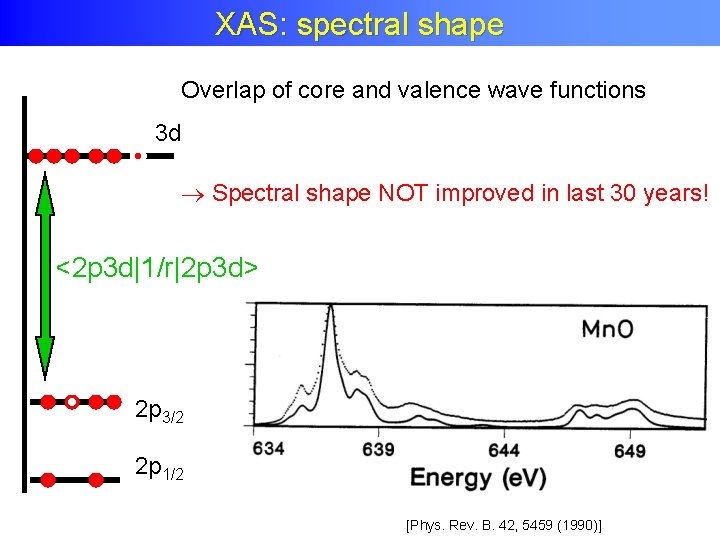
XAS: multiplet effects XAS: spectral shape Overlap of core and valence wave functions 3 d Spectral shape NOT improved in last 30 years! <2 p 3 d|1/r|2 p 3 d> 2 p 3/2 2 p 1/2 [Phys. Rev. B. 42, 5459 (1990)]
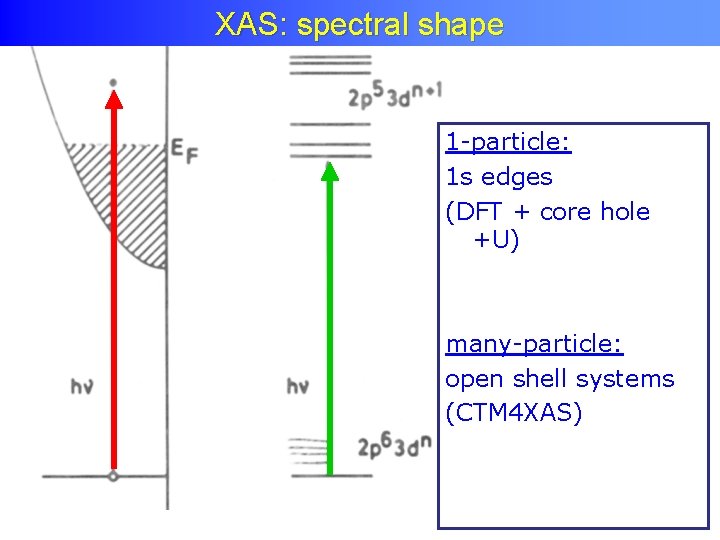
Interpretation of XAS: spectral shape 1 -particle: 1 s edges (DFT + core hole +U) many-particle: open shell systems (CTM 4 XAS)
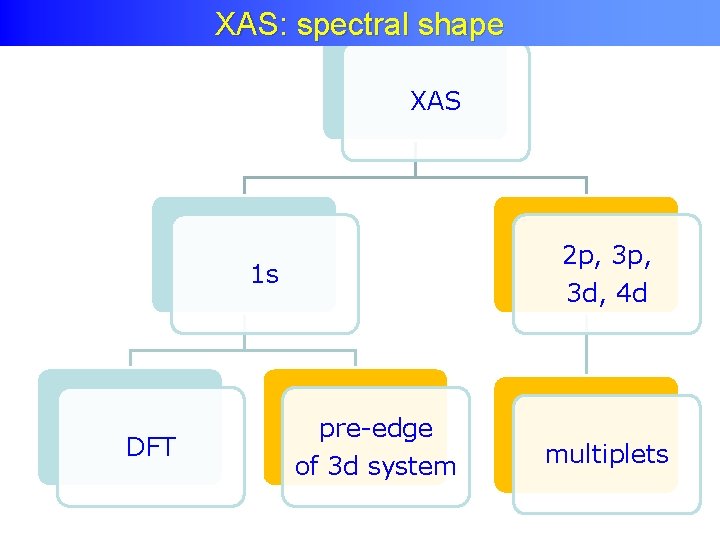
XAS: spectral shape XAS 2 p, 3 d, 4 d 1 s DFT pre-edge of 3 d system multiplets
CHARGE TRANSFER MULTIPLETS Charge Transfer Multiplet program Used for the analysis of XAS, EELS, Photoemission, Auger, XES involving d and f-shells ATOMIC PHYSICS GROUP THEORY MODEL HAMILTONIANS
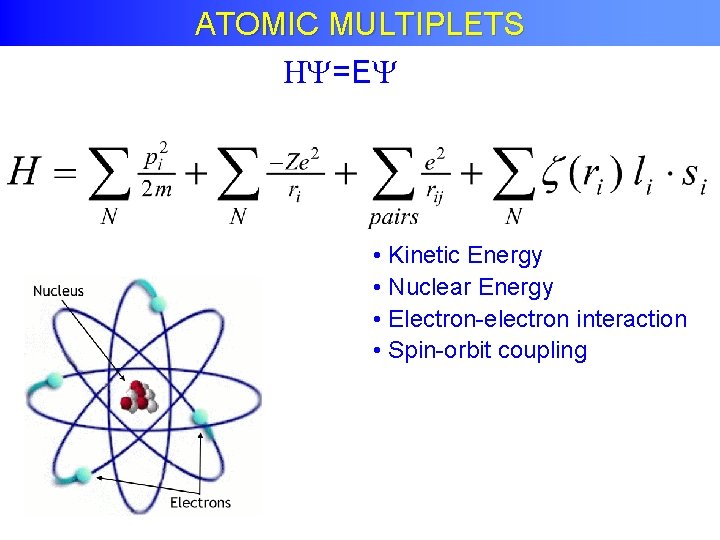
Atomic Multiplet Theory ATOMIC MULTIPLETS =E • Kinetic Energy • Nuclear Energy • Electron-electron interaction • Spin-orbit coupling
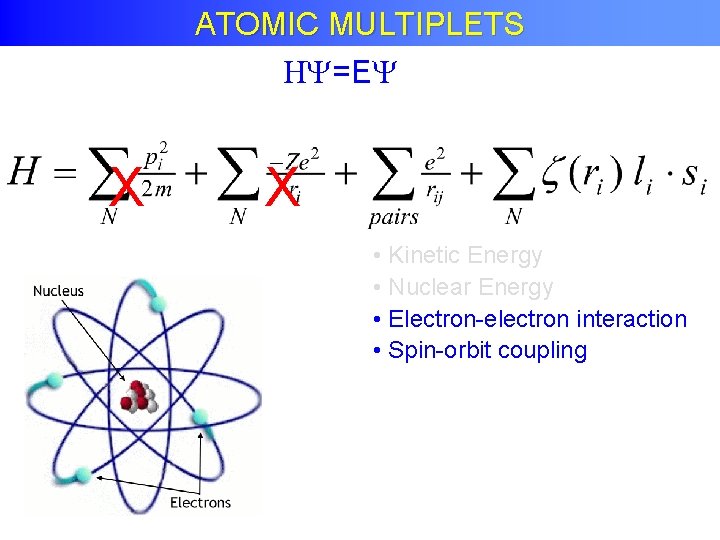
Atomic Multiplet Theory ATOMIC MULTIPLETS =E X X • Kinetic Energy • Nuclear Energy • Electron-electron interaction • Spin-orbit coupling
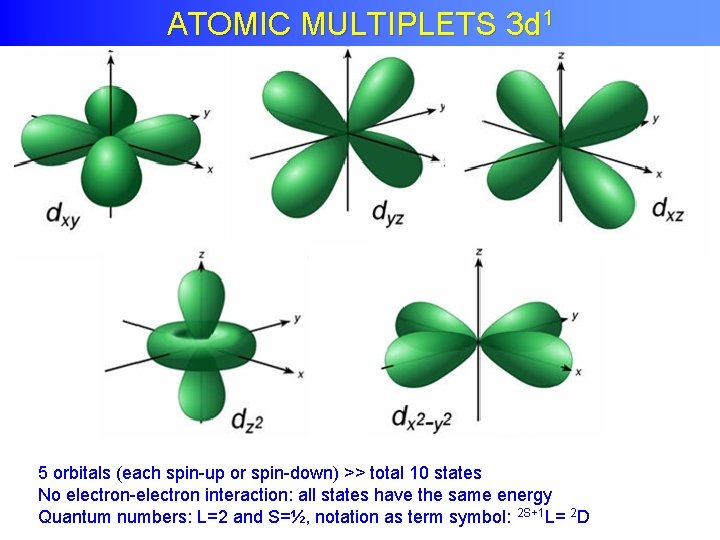
ATOMIC MULTIPLETS 3 d 1 5 orbitals (each spin-up or spin-down) >> total 10 states No electron-electron interaction: all states have the same energy Quantum numbers: L=2 and S=½, notation as term symbol: 2 S+1 L= 2 D
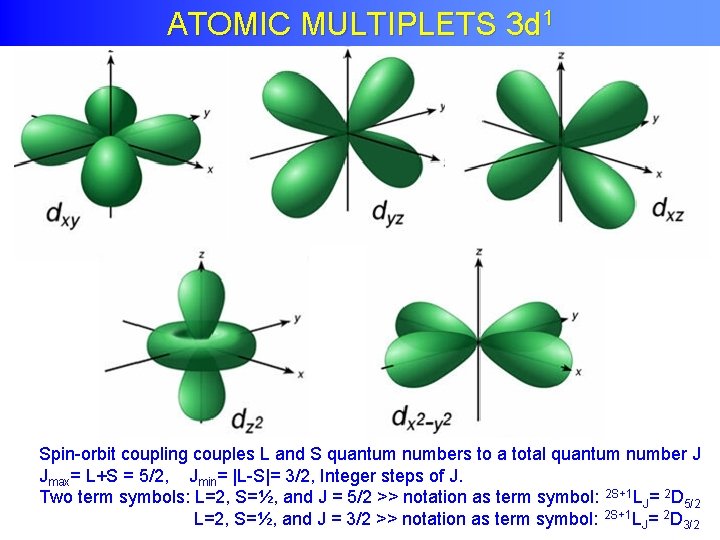
ATOMIC MULTIPLETS 3 d 1 Spin-orbit coupling couples L and S quantum numbers to a total quantum number J Jmax= L+S = 5/2, Jmin= |L-S|= 3/2, Integer steps of J. Two term symbols: L=2, S=½, and J = 5/2 >> notation as term symbol: 2 S+1 LJ= 2 D 5/2 L=2, S=½, and J = 3/2 >> notation as term symbol: 2 S+1 LJ= 2 D 3/2
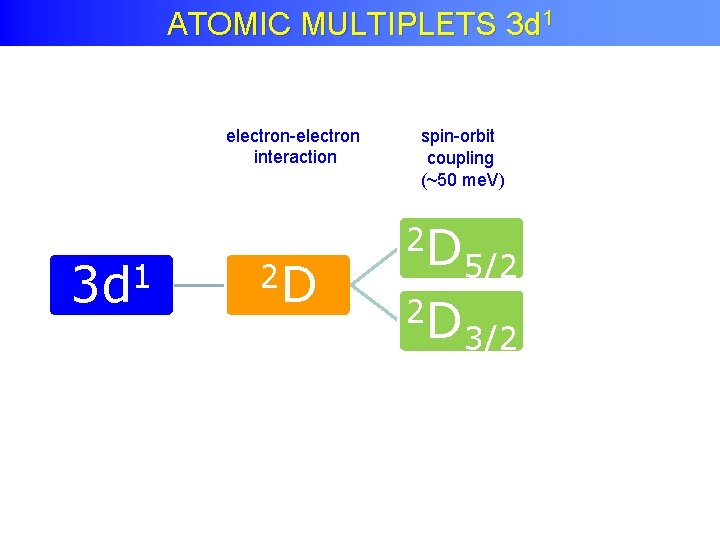
1 Atomic Multiplet Theory ATOMIC MULTIPLETS 3 d electron-electron interaction 1 3 d 2 D spin-orbit coupling (~50 me. V) 2 D 5/2 2 D 3/2
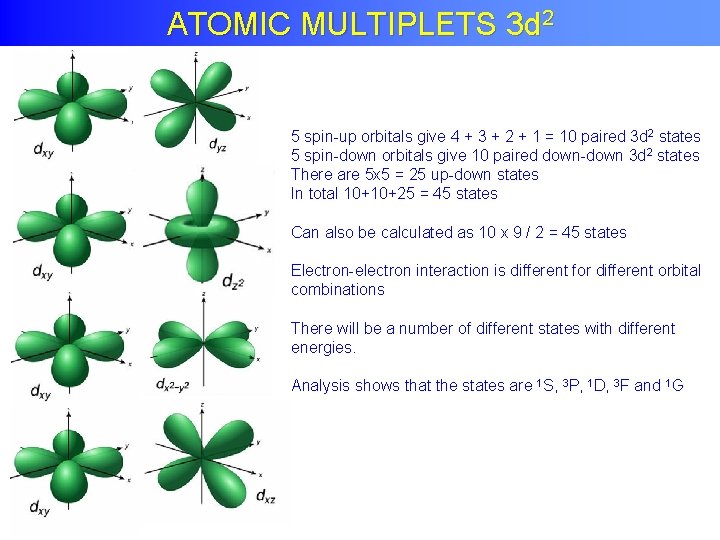
ATOMIC MULTIPLETS 3 d 2 5 spin-up orbitals give 4 + 3 + 2 + 1 = 10 paired 3 d 2 states 5 spin-down orbitals give 10 paired down-down 3 d 2 states There are 5 x 5 = 25 up-down states In total 10+10+25 = 45 states Can also be calculated as 10 x 9 / 2 = 45 states Electron-electron interaction is different for different orbital combinations There will be a number of different states with different energies. Analysis shows that the states are 1 S, 3 P, 1 D, 3 F and 1 G
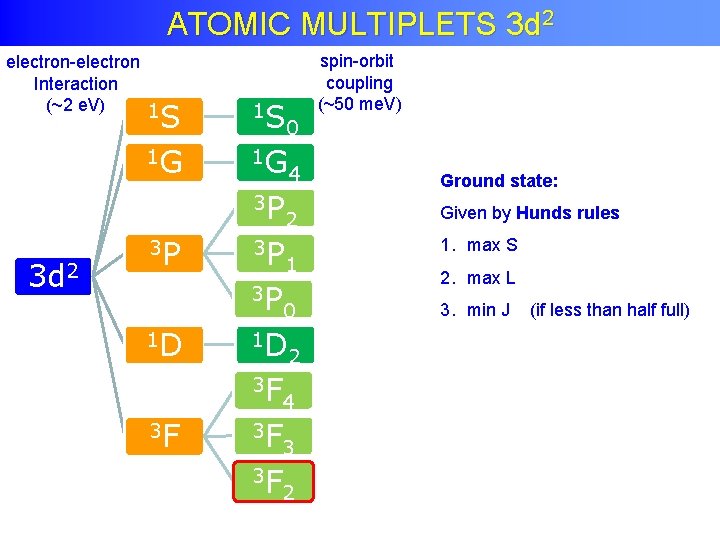
2 Atomic Multiplet Theory ATOMIC MULTIPLETS 3 d electron-electron Interaction (~2 e. V) 1 S 1 G 1 S 3 d 2 3 P 3 P 1 D 3 F 0 1 G 3 P 3 P spin-orbit coupling (~50 me. V) 4 Ground state: 2 Given by Hunds rules 1 0 1 D 2 3 F 4 3 F 3 3 F 2 1. max S 2. max L 3. min J (if less than half full)
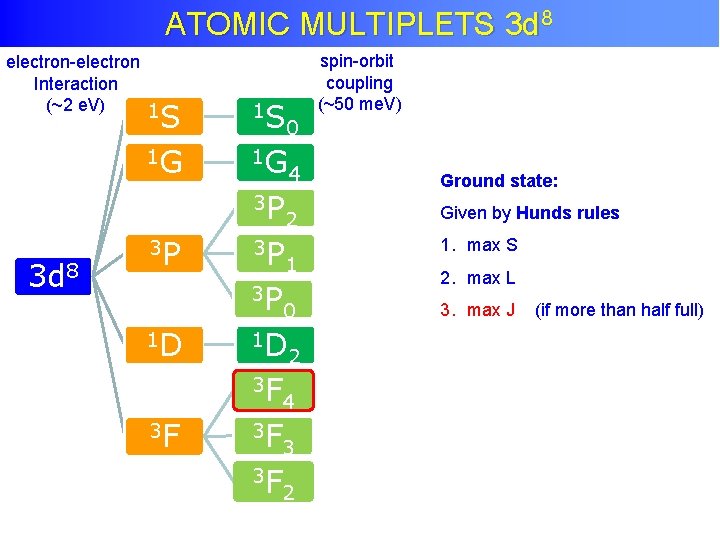
8 Atomic Multiplet Theory ATOMIC MULTIPLETS 3 d electron-electron Interaction (~2 e. V) 1 S 1 G 1 S 3 d 8 3 P 3 P 1 D 3 F 0 1 G 3 P 3 P spin-orbit coupling (~50 me. V) 4 Ground state: 2 Given by Hunds rules 1 0 1 D 2 3 F 4 3 F 3 3 F 2 1. max S 2. max L 3. max J (if more than half full)
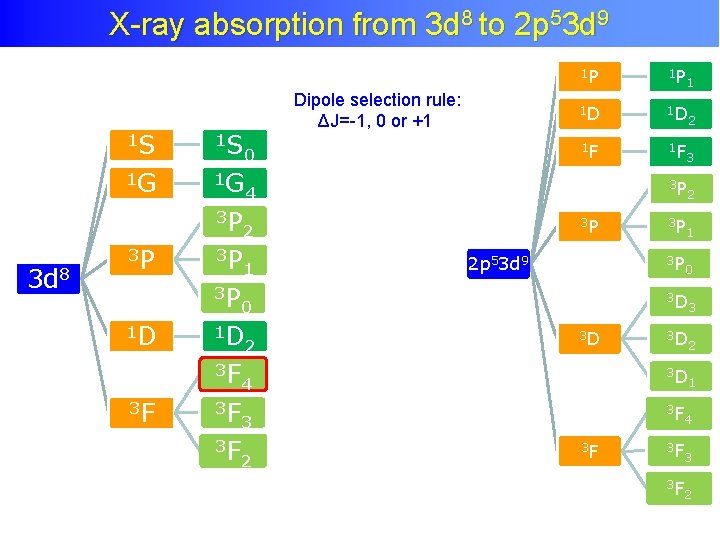
8 to 2 p 53 d 9 Atomic Multiplet Theory X-ray absorption from 3 d 3 d 8 Dipole selection rule: ΔJ=-1, 0 or +1 1 S 1 S 1 G 1 G 3 P 2 3 P 1 3 F 3 F 3 F 1 D 1 D 1 F 1 F 2 3 P 3 D 3 3 F 2 3 3 P 3 P 2 p 53 d 9 4 2 1 3 P 0 1 D 3 F 1 P 4 3 P 3 P 1 D 0 1 P 2 1 0 3 D 3 3 D 2 3 D 1 3 F 4 3 F 3 3 F 2
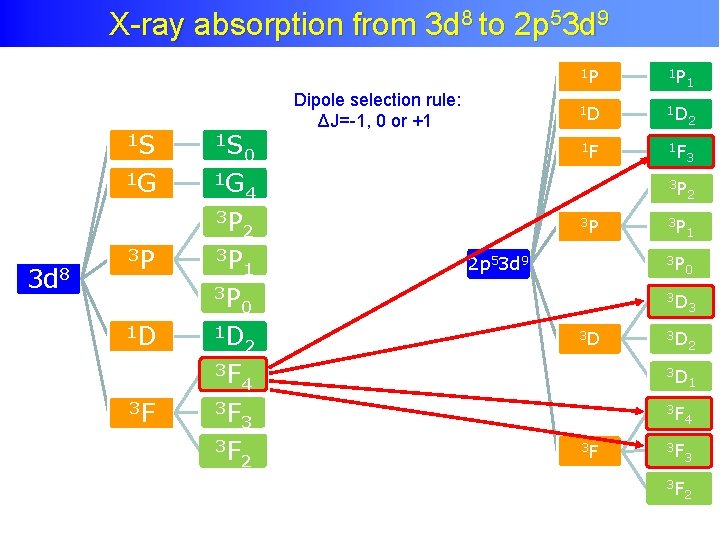
8 to 2 p 53 d 9 Atomic Multiplet Theory X-ray absorption from 3 d 3 d 8 Dipole selection rule: ΔJ=-1, 0 or +1 1 S 1 S 1 G 1 G 3 P 2 3 P 1 3 F 3 F 3 F 1 D 1 D 1 F 1 F 2 3 P 3 D 3 3 F 2 3 3 P 3 P 2 p 53 d 9 4 2 1 3 P 0 1 D 3 F 1 P 4 3 P 3 P 1 D 0 1 P 2 1 0 3 D 3 3 D 2 3 D 1 3 F 4 3 F 3 3 F 2
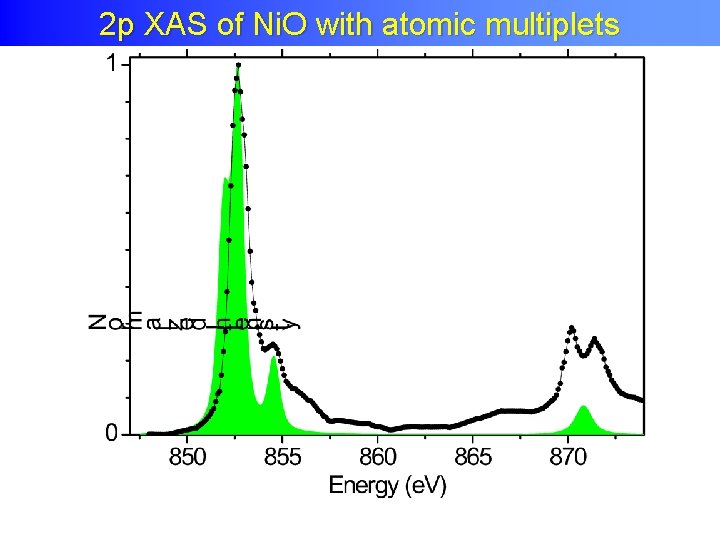
Atomic multiplets 2 p XAS of Ni. O with atomic multiplets
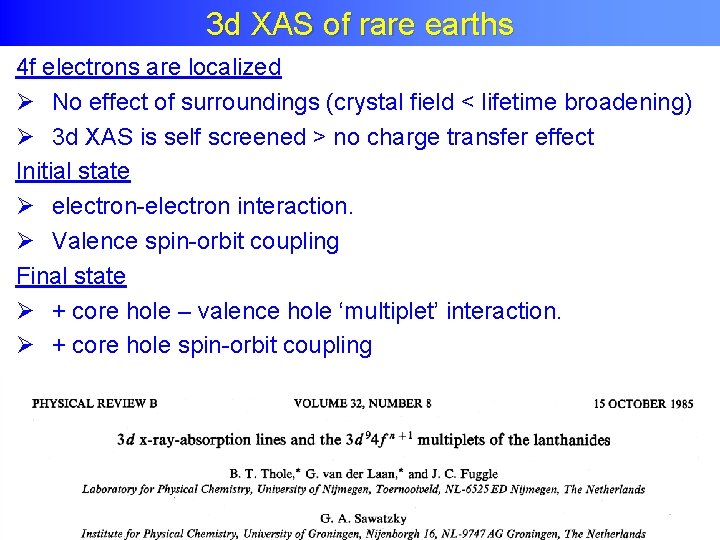
3 d XAS of rare earths 4 f electrons are localized Ø No effect of surroundings (crystal field < lifetime broadening) Ø 3 d XAS is self screened > no charge transfer effect Initial state Ø electron-electron interaction. Ø Valence spin-orbit coupling Final state Ø + core hole – valence hole ‘multiplet’ interaction. Ø + core hole spin-orbit coupling
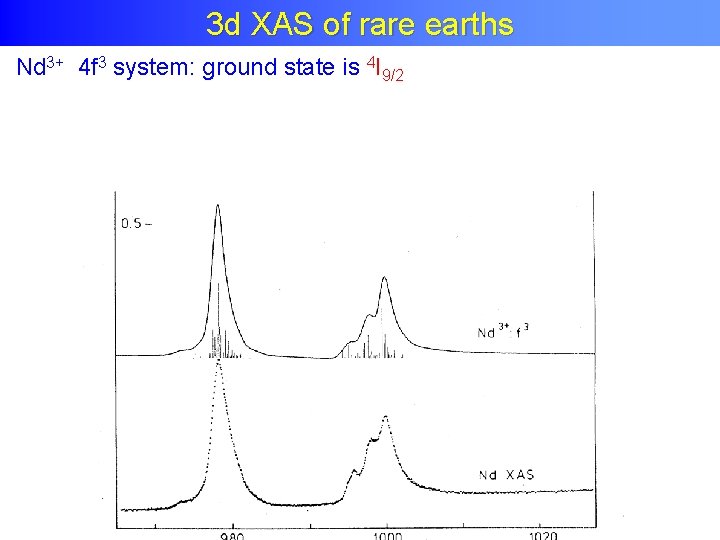
3 d XAS of rare earths Nd 3+ 4 f 3 system: ground state is 4 I 9/2
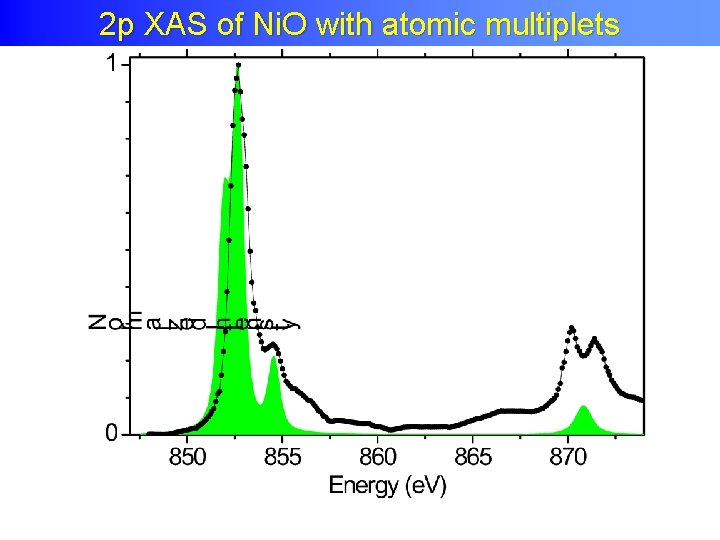
Atomic multiplets 2 p XAS of Ni. O with atomic multiplets
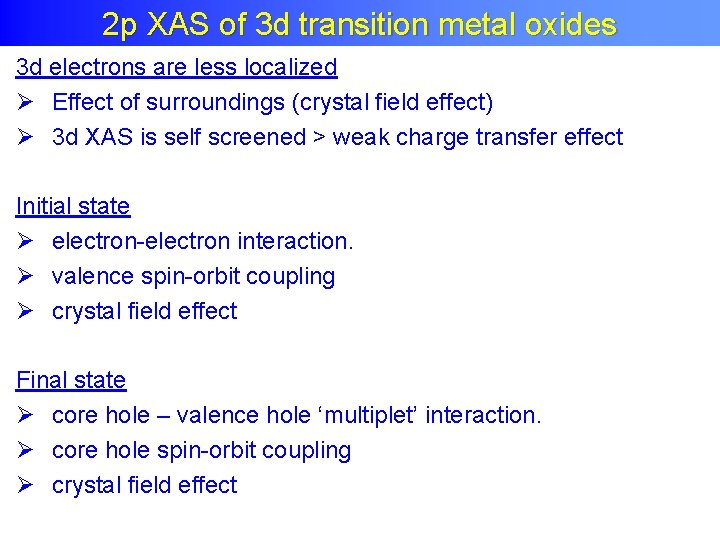
2 p XAS of 3 d transition metal oxides 3 d electrons are less localized Ø Effect of surroundings (crystal field effect) Ø 3 d XAS is self screened > weak charge transfer effect Initial state Ø electron-electron interaction. Ø valence spin-orbit coupling Ø crystal field effect Final state Ø core hole – valence hole ‘multiplet’ interaction. Ø core hole spin-orbit coupling Ø crystal field effect
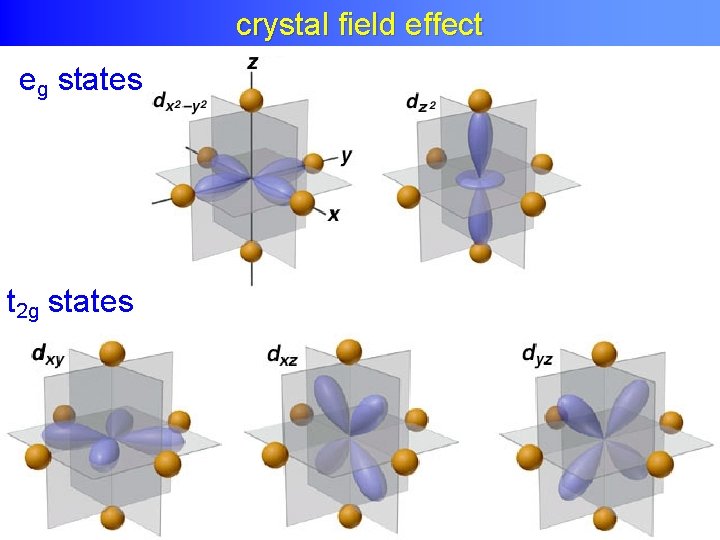
Crystal Field Effects crystal field effect eg states t 2 g states
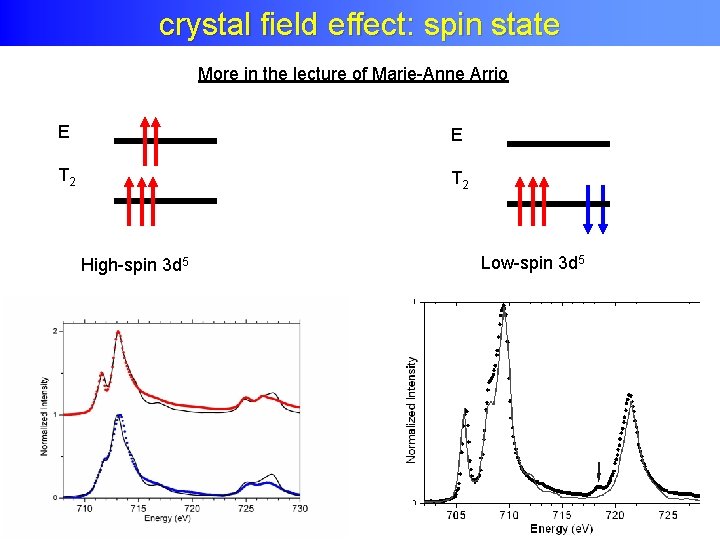
High-spin or Low-spin crystal field effect: spin state More in the lecture of Marie-Anne Arrio E E T 2 High-spin 3 d 5 Low-spin 3 d 5
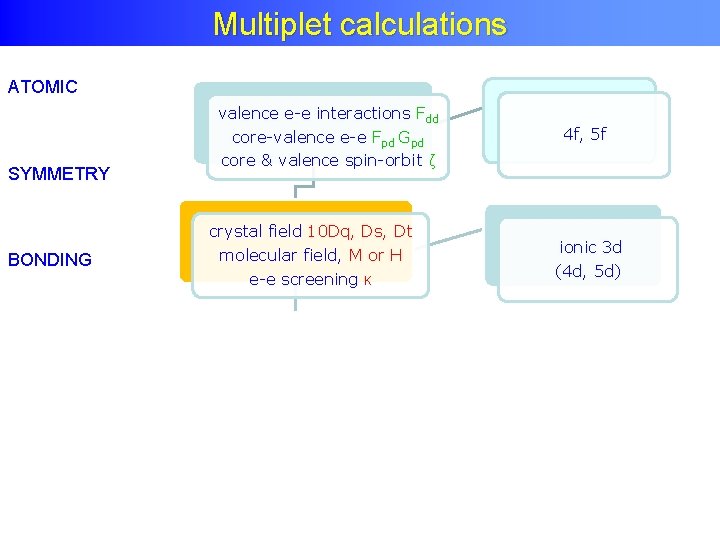
Multiplet calculations ATOMIC valence e-e interactions Fdd SYMMETRY core-valence e-e Fpd Gpd core & valence spin-orbit ζ crystal field 10 Dq, Ds, Dt BONDING molecular field, M or H e-e screening κ charge transfer Δ, U, Q hopping TΓ 4 f, 5 f ionic 3 d (4 d, 5 d) covalent 3 d mixed valence f
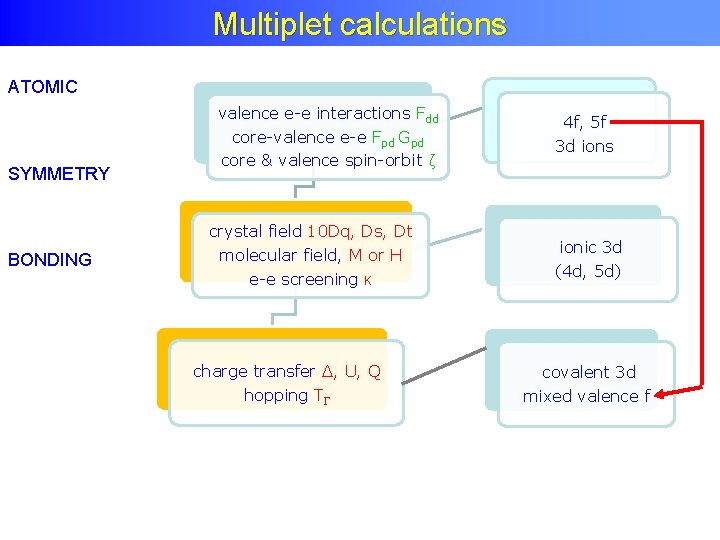
Multiplet calculations ATOMIC valence e-e interactions Fdd SYMMETRY core-valence e-e Fpd Gpd core & valence spin-orbit ζ crystal field 10 Dq, Ds, Dt BONDING molecular field, M or H e-e screening κ charge transfer Δ, U, Q hopping TΓ 4 f, 5 f 3 d ions ionic 3 d (4 d, 5 d) covalent 3 d mixed valence f
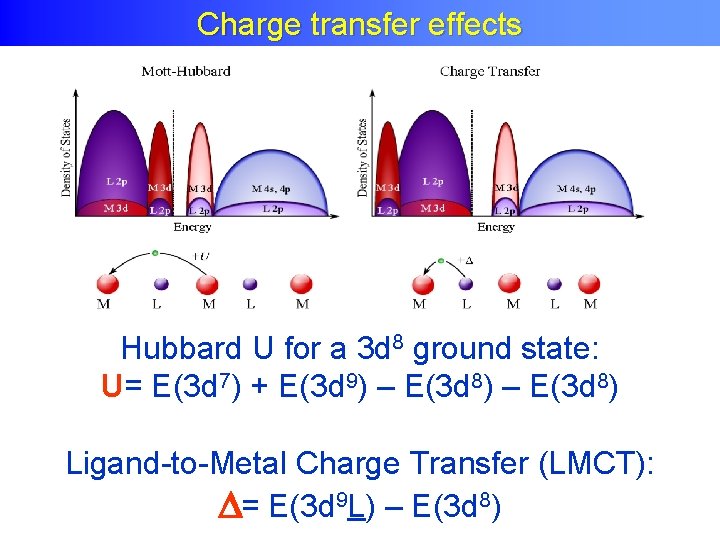
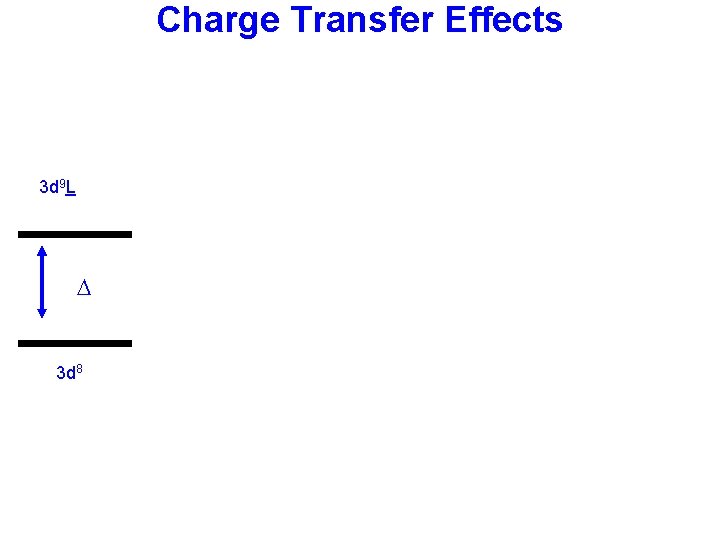
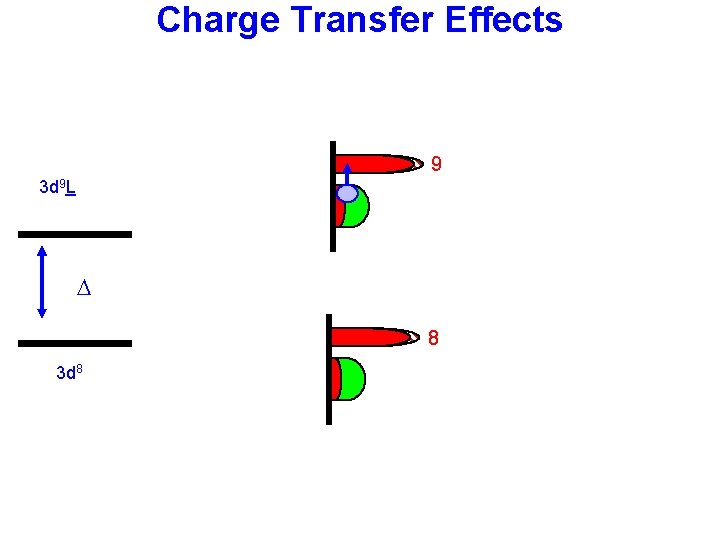
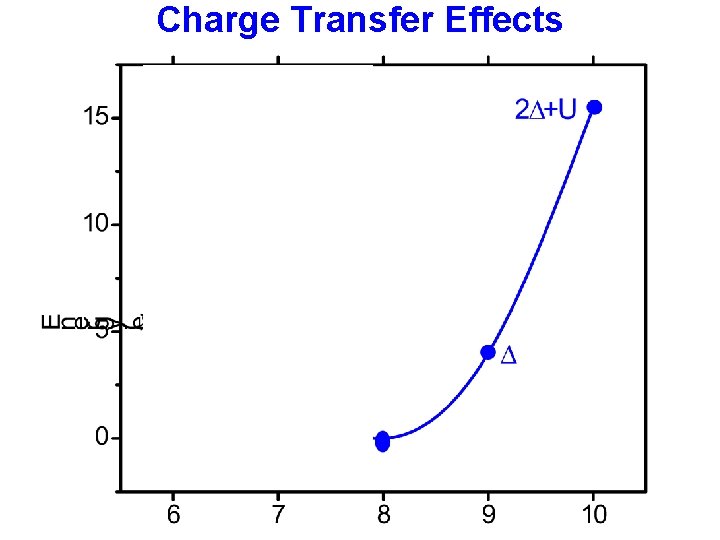
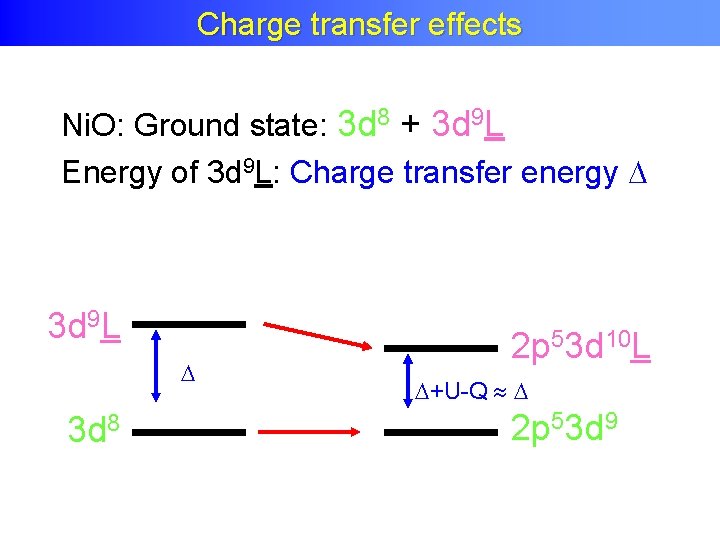
Charge Transfer Effects Charge transfer effects Hubbard U for a 3 d 8 ground state: U= E(3 d 7) + E(3 d 9) – E(3 d 8) Ligand-to-Metal Charge Transfer (LMCT): = E(3 d 9 L) – E(3 d 8)
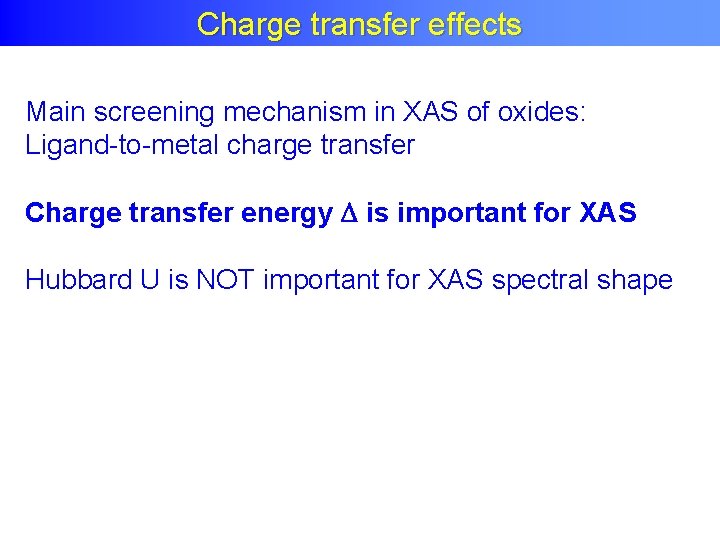
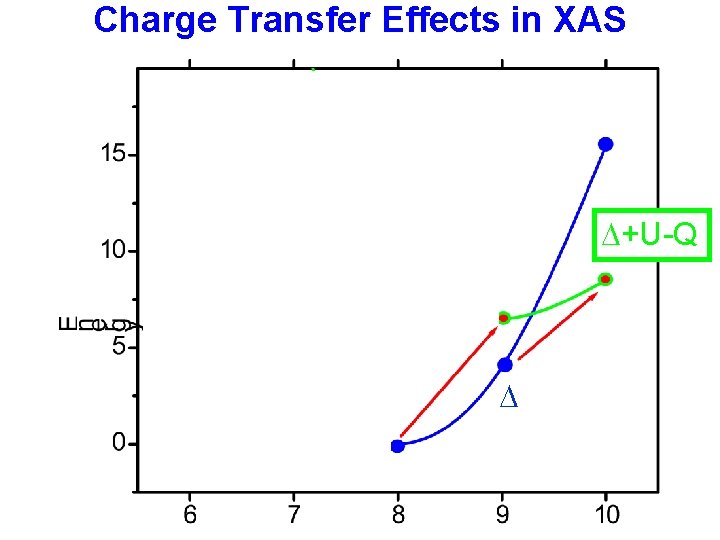
Charge Transfer Effects Charge transfer effects Main screening mechanism in XAS of oxides: Ligand-to-metal charge transfer Charge transfer energy is important for XAS Hubbard U is NOT important for XAS spectral shape
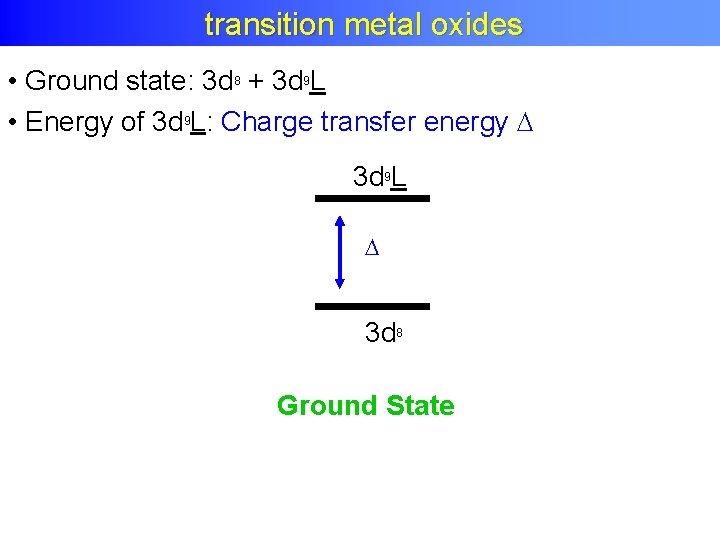
Charge transfer effects in XAS and XPS transition metal oxides • Ground state: 3 d 8 + 3 d 9 L • Energy of 3 d 9 L: Charge transfer energy 3 d 9 L 3 d 8 Ground State
Charge Transfer Effects 3 d 9 L 3 d 8
Charge Transfer Effects 9 3 d 9 L 8 3 d 8
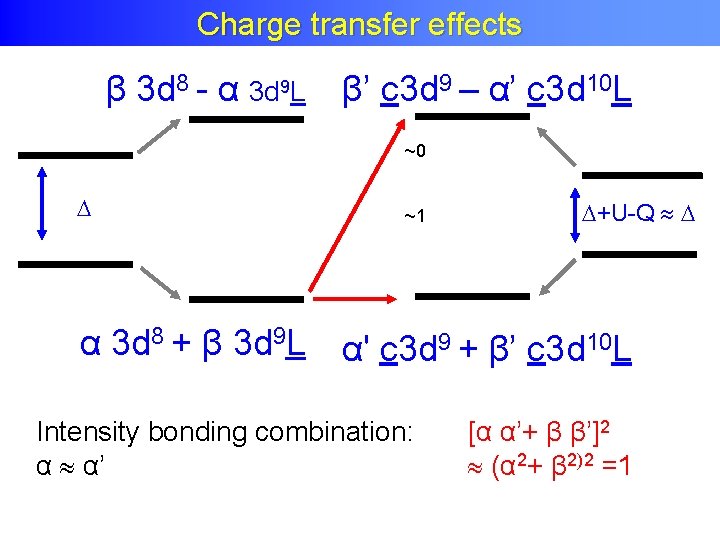
Charge Transfer Effects β 3 d 8 - α 3 d 9 L 3 d 8 α 3 d 8 + β 3 d 9 L
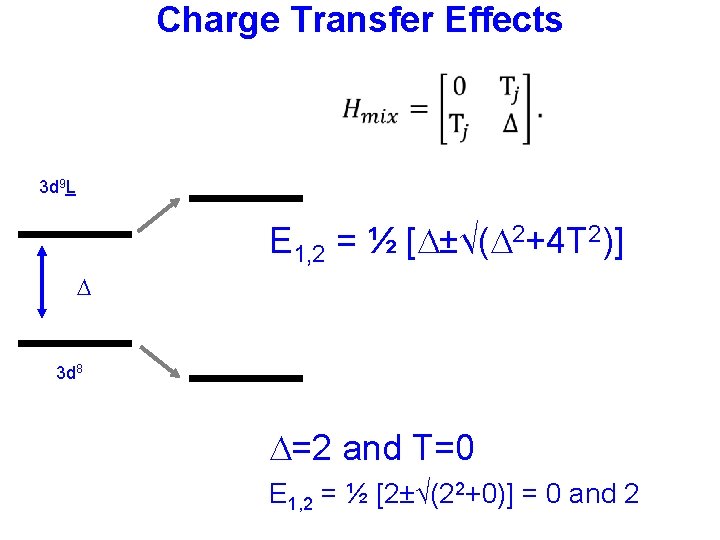
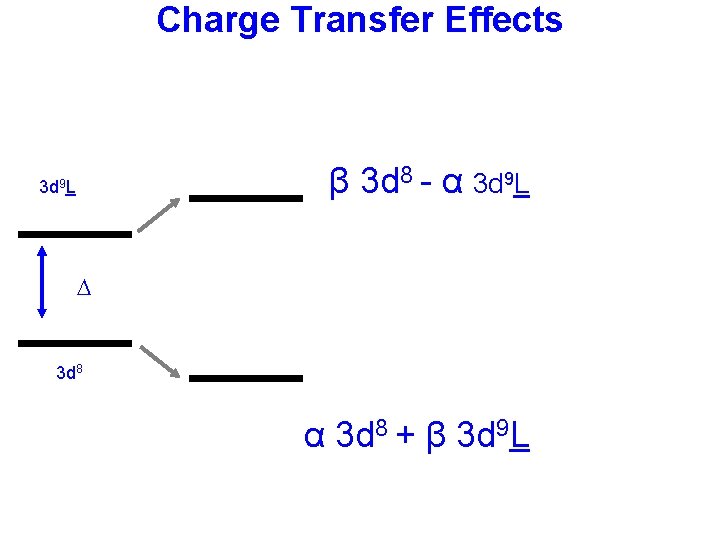
Charge Transfer Effects 3 d 9 L E 1, 2 = ½ [ ±√( 2+4 T 2)] 3 d 8 =2 and T=0 E 1, 2 = ½ [2±√(22+0)] = 0 and 2
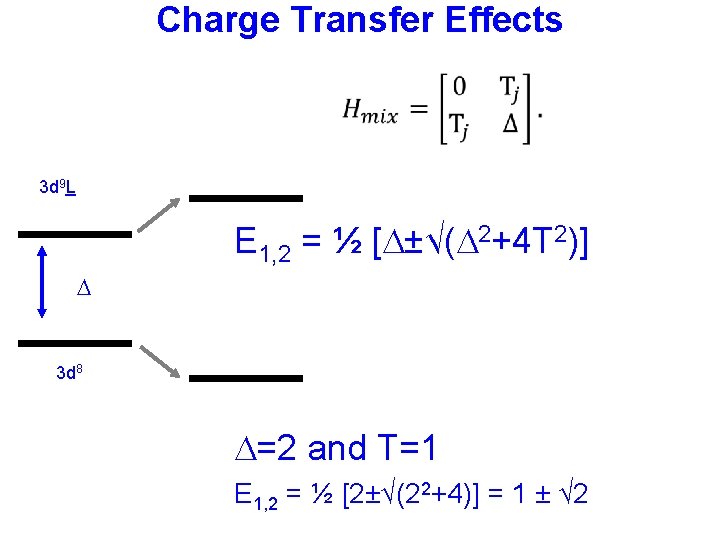
Charge Transfer Effects 3 d 9 L E 1, 2 = ½ [ ±√( 2+4 T 2)] 3 d 8 =2 and T=1 E 1, 2 = ½ [2±√(22+4)] = 1 ± √ 2
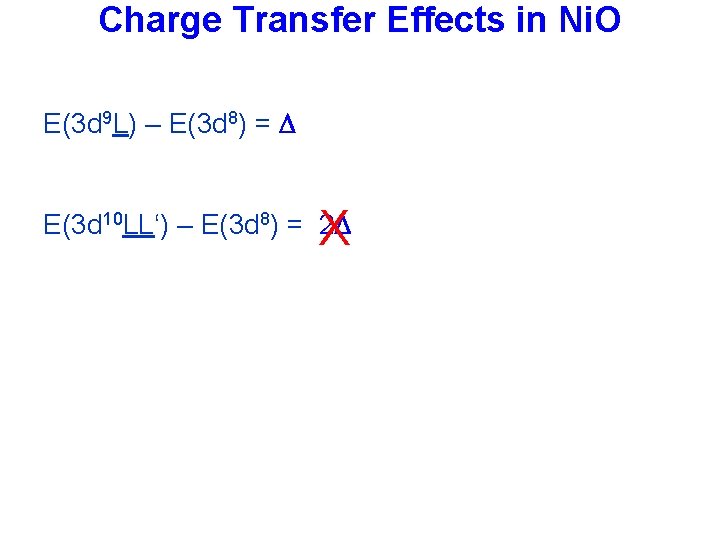
Charge Transfer Effects in Ni. O E(3 d 9 L) – E(3 d 8) = X E(3 d 10 LL‘) – E(3 d 8) = 2
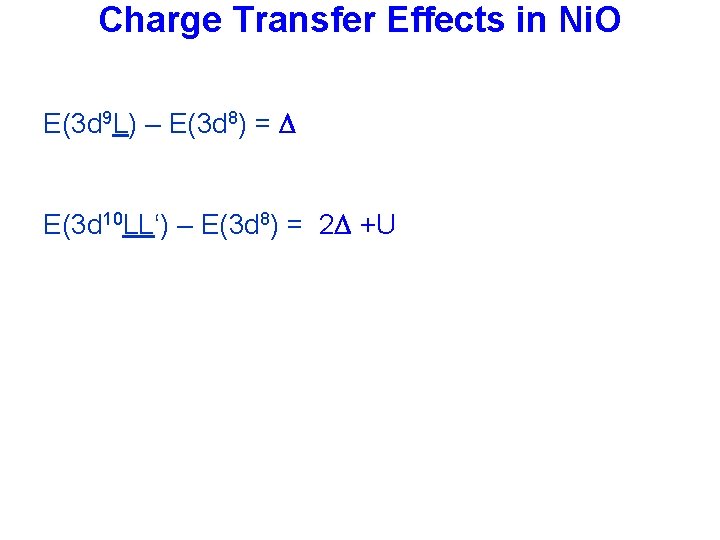
Charge Transfer Effects in Ni. O E(3 d 9 L) – E(3 d 8) = E(3 d 10 LL‘) – E(3 d 8) = 2 +U
Charge Transfer Effects
Charge Transfer Effects in XAS +U-Q
Charge Transfer Effects Charge transfer effects Ni. O: Ground state: 3 d 8 + 3 d 9 L Energy of 3 d 9 L: Charge transfer energy 3 d 9 L 3 d 8 2 p 53 d 10 L +U-Q 2 p 53 d 9
Charge transfer effects β 3 d 8 - α 3 d 9 L β’ c 3 d 9 – α’ c 3 d 10 L ~0 α 3 d 8 + β 3 d 9 L ~1 α' c 3 d 9 + β’ c 3 d 10 L Intensity bonding combination: α α’ +U-Q [α α’+ β β’]2 (α 2+ β 2)2 =1
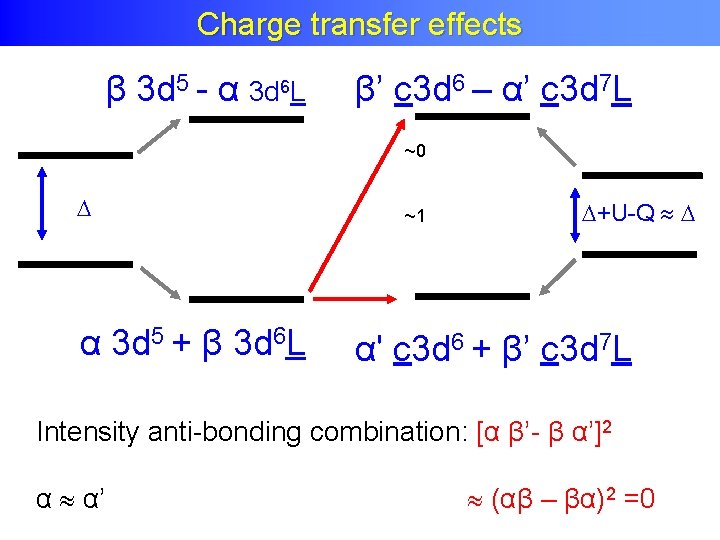
Charge transfer effects β 3 d 5 - α 3 d 6 L β’ c 3 d 6 – α’ c 3 d 7 L ~0 ~1 α 3 d 5 + β 3 d 6 L +U-Q α' c 3 d 6 + β’ c 3 d 7 L Intensity anti-bonding combination: [α β’- β α’]2 α α’ (αβ – βα)2 =0
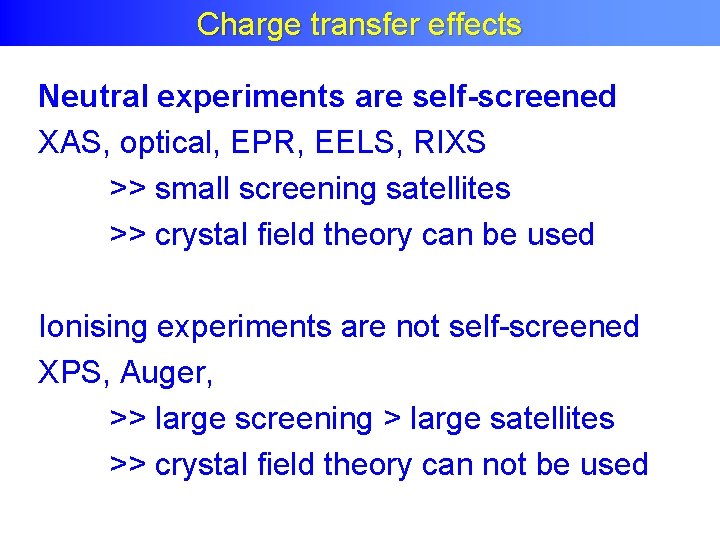
Charge Transfer Effects Charge transfer effects Neutral experiments are self-screened XAS, optical, EPR, EELS, RIXS >> small screening satellites >> crystal field theory can be used Ionising experiments are not self-screened XPS, Auger, >> large screening > large satellites >> crystal field theory can not be used
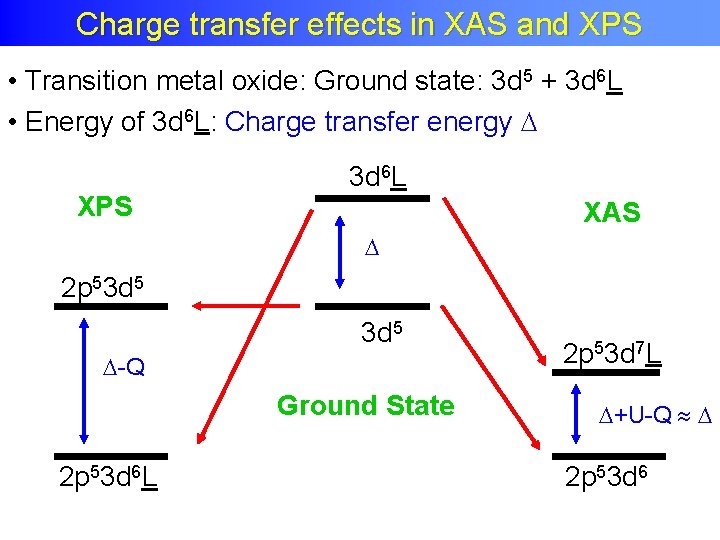
Charge transfer effects in XAS and XPS • Transition metal oxide: Ground state: 3 d 5 + 3 d 6 L • Energy of 3 d 6 L: Charge transfer energy XPS 3 d 6 L XAS 2 p 53 d 5 -Q Ground State 2 p 53 d 6 L 2 p 53 d 7 L +U-Q 2 p 53 d 6
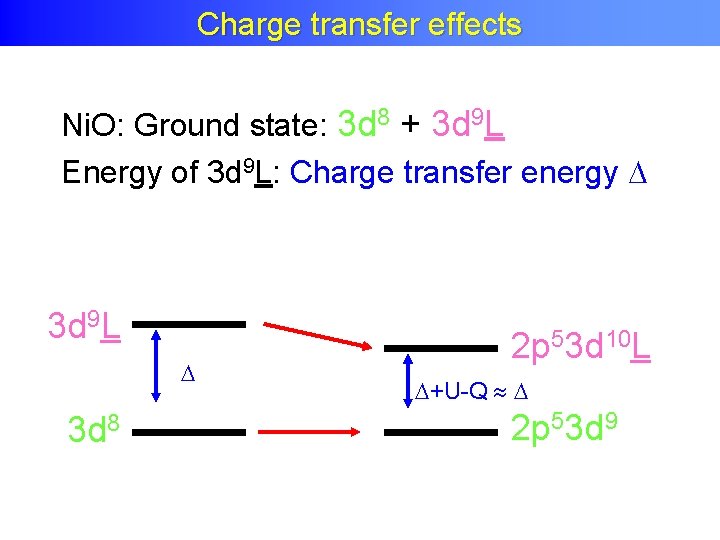
Charge Transfer Effects Charge transfer effects Ni. O: Ground state: 3 d 8 + 3 d 9 L Energy of 3 d 9 L: Charge transfer energy 3 d 9 L 3 d 8 2 p 53 d 10 L +U-Q 2 p 53 d 9
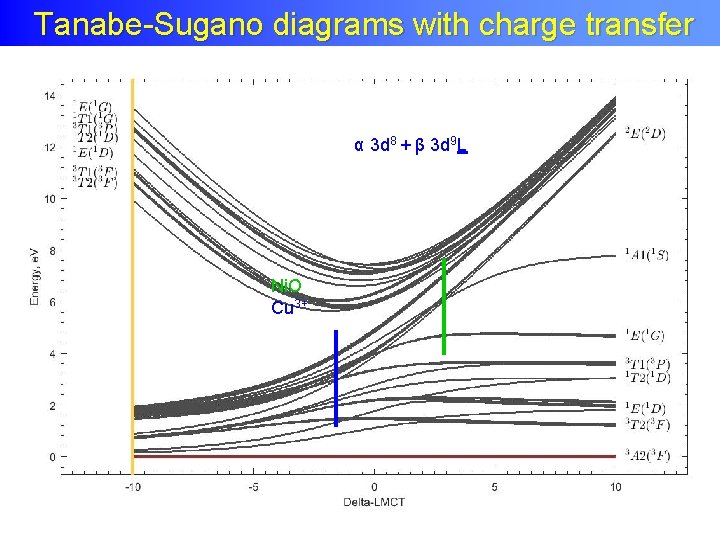
Tanabe-Sugano with Charge transfer Tanabe-Sugano diagrams with charge transfer α 3 d 8 + β 3 d 9 L Ni. O Cu 3+
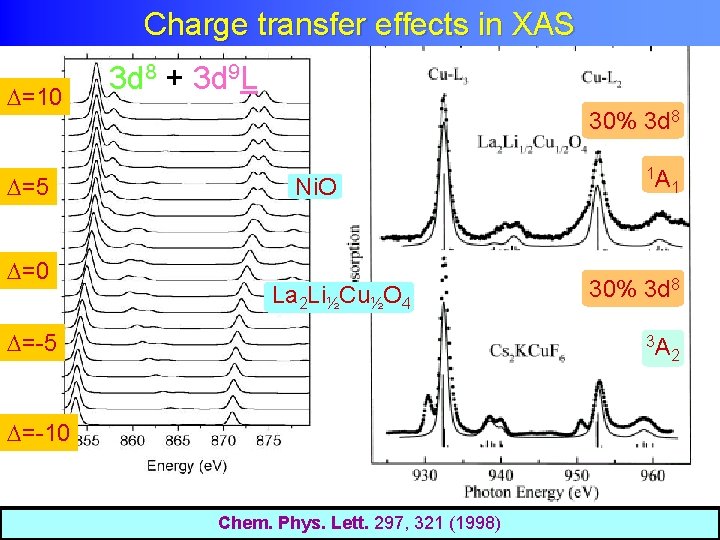
Charge transfer effects in XAS Charge Transfer effects =10 =5 =0 3 d 8 + 3 d 9 L 30% 3 d 8 Ni. O La 2 Li½Cu½O 4 =-5 1 A 30% 3 d 8 3 A =-10 Chem. Phys. Lett. 297, 321 (1998) 1 2
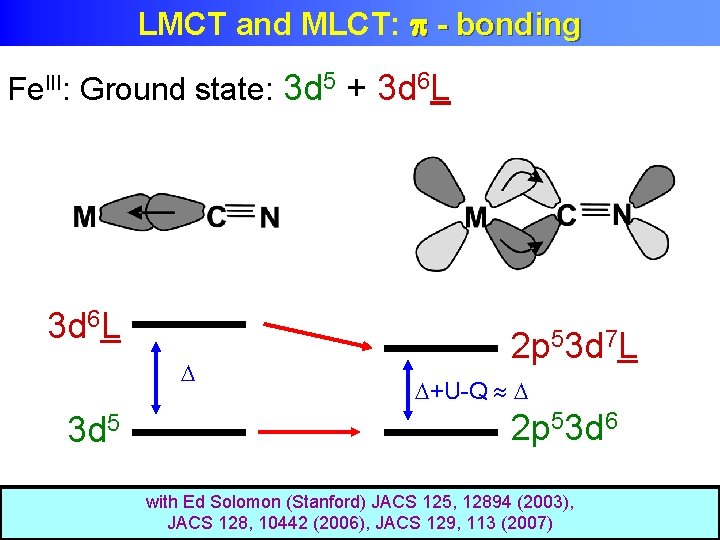
LMCT and MLCT: - bonding Fe. III: Ground state: 3 d 5 + 3 d 6 L 3 d 5 2 p 53 d 7 L +U-Q 2 p 53 d 6 with Ed Solomon (Stanford) JACS 125, 12894 (2003), JACS 128, 10442 (2006), JACS 129, 113 (2007)
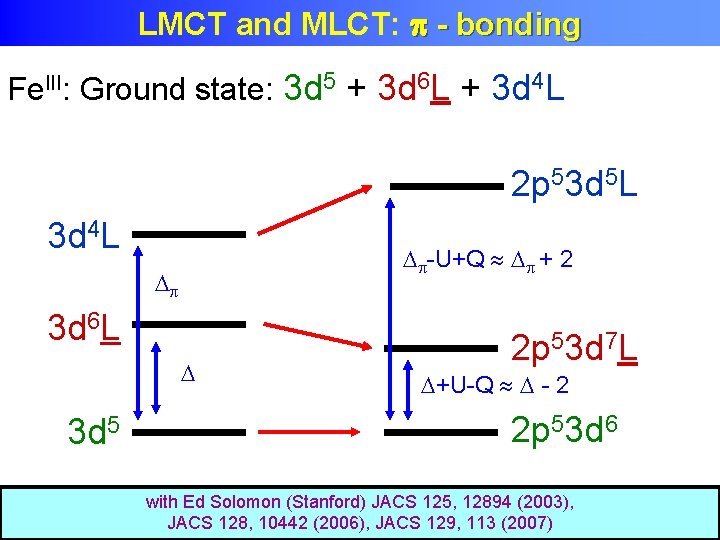
LMCT and MLCT: - bonding Fe. III: Ground state: 3 d 5 + 3 d 6 L + 3 d 4 L 2 p 53 d 5 L 3 d 4 L -U+Q + 2 3 d 6 L 3 d 5 2 p 53 d 7 L +U-Q - 2 2 p 53 d 6 with Ed Solomon (Stanford) JACS 125, 12894 (2003), JACS 128, 10442 (2006), JACS 129, 113 (2007)
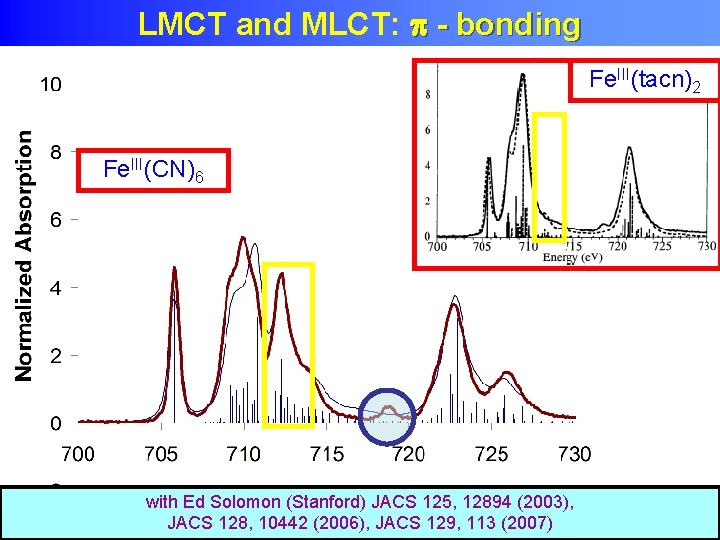
LMCT and MLCT: - bonding Fe. III(tacn)2 Fe. III(CN)6 with Ed Solomon (Stanford) JACS 125, 12894 (2003), JACS 128, 10442 (2006), JACS 129, 113 (2007)
Multiplet calculations Calculated for an atom/ion Ø Valence and core spin-orbit coupling Ø Core and valence electron-electron interaction. Comparison with experiment Ø Core hole potential and lifetime Ø Local symmetry (crystal field) Ø Spin-spin interactions (molecular field) Ø Core hole screening effects (charge transfer)
First Principle Multiplet calculations Calculated for an atom/ion Ø Valence and core spin-orbit coupling Ø Core and valence electron-electron interaction. Comparison with experiment Ø Core hole potential and lifetime Ø Local symmetry (crystal field) Ø Spin-spin interactions (molecular field) Ø Core hole screening effects (charge transfer)
2 p XAS first-principle codes SOLIDS Ø Band structure multiplet (Haverkort, Green, Hariki) Ø Cluster DFT multiplet (Ikeno, Ramanantoanina, Delley) MOLECULES Ø Restricted Active Space CI (Odelius, Kuhn) Ø Restricted Open-shell CI (Neese) TDDFT/BSE Ø Time-Dependent DFT (Joly) Ø Bethe-Salpeter (Rehr, Shirley) Ø Multi-channel Multiple-scattering (Kruger)
XPS
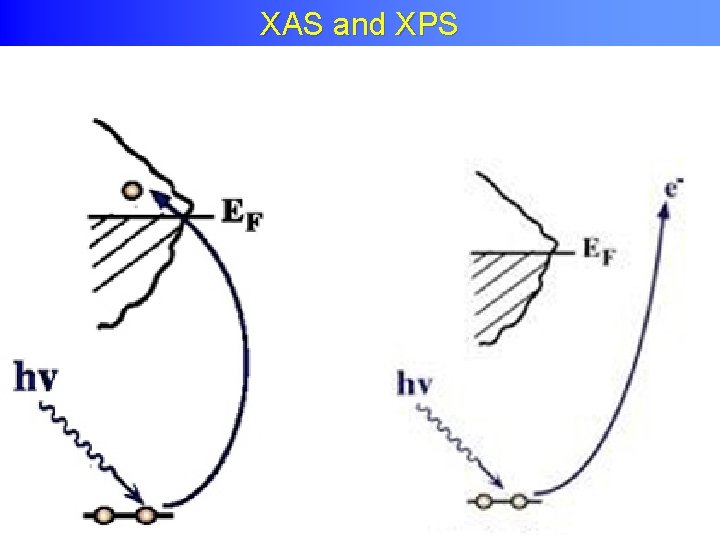
X-ray absorption and X-ray photoemission XAS and XPS I( FIXED)
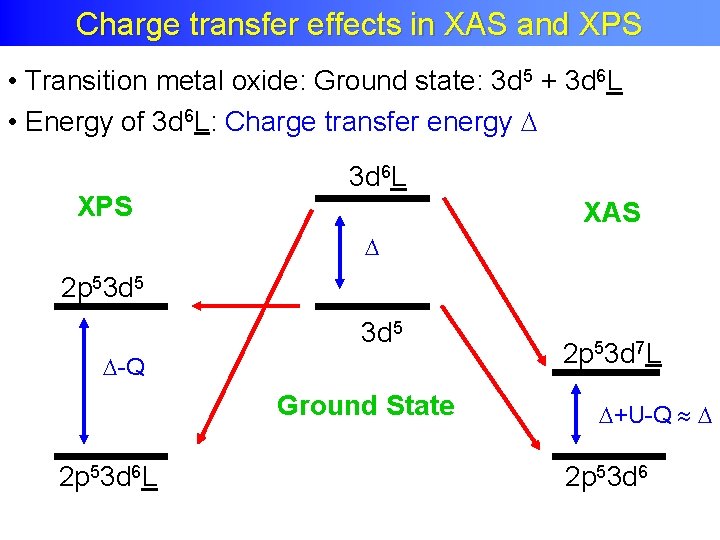
Charge transfer effects in XAS and XPS • Transition metal oxide: Ground state: 3 d 5 + 3 d 6 L • Energy of 3 d 6 L: Charge transfer energy XPS 3 d 6 L XAS 2 p 53 d 5 -Q Ground State 2 p 53 d 6 L 2 p 53 d 7 L +U-Q 2 p 53 d 6
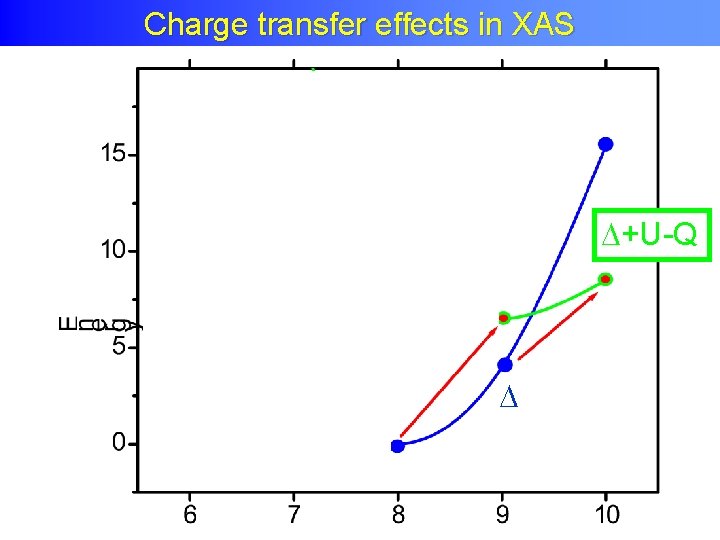
Charge Transfer Effects in XAS Charge transfer effects in XAS +U-Q
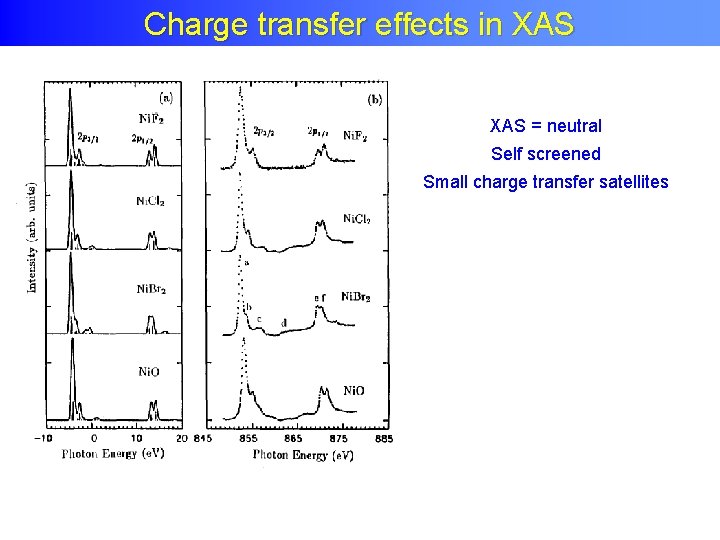
Charge transfer effects in XAS = neutral Self screened Small charge transfer satellites
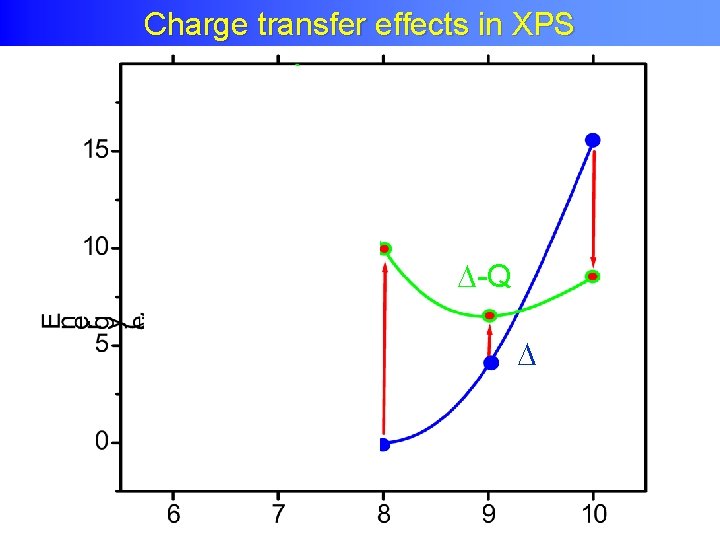
Charge Transfer Effects in XPS Charge transfer effects in XPS -Q
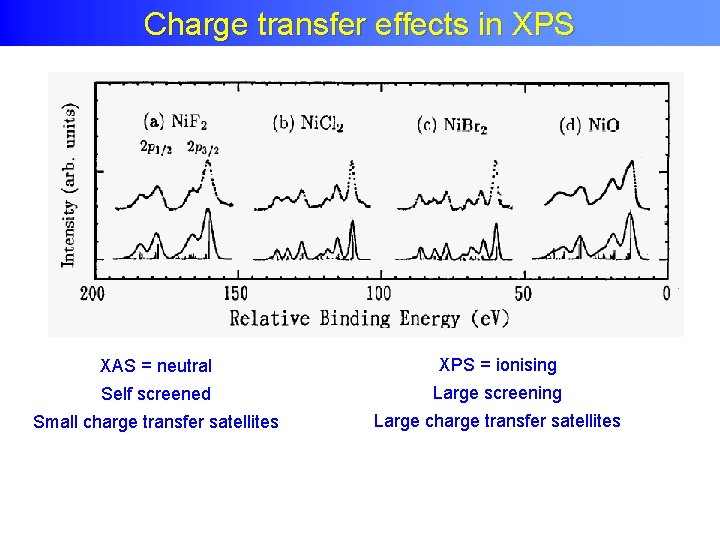
Charge transfer effects in XPS XAS = neutral XPS = ionising Self screened Large screening Small charge transfer satellites Large charge transfer satellites
Charge transfer effects in XPS 1 s and 2 p XPS of Fe 2 O 3
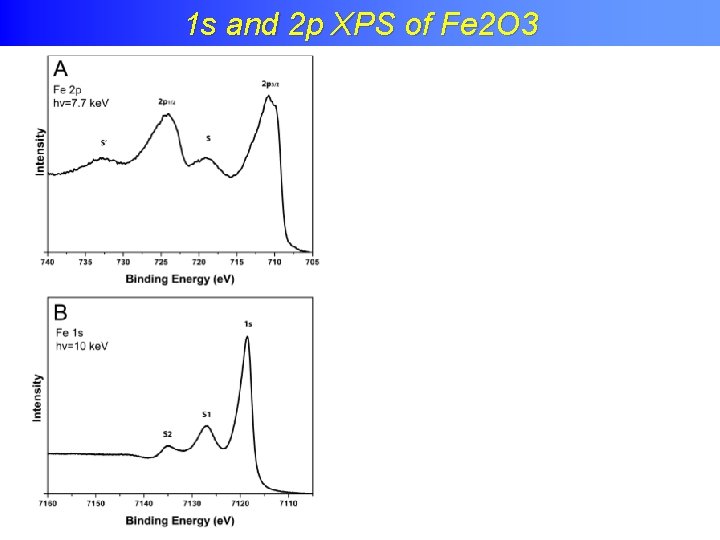
Charge transfer effects in XPS 1 s and 2 p XPS of Fe 2 O 3
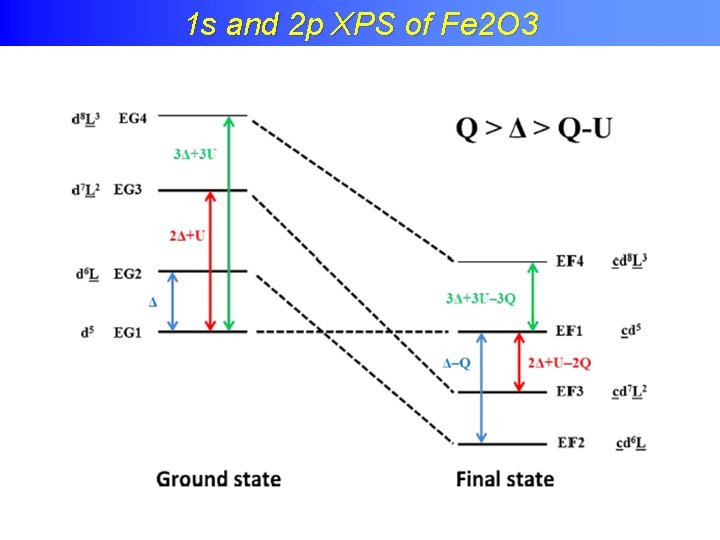
Charge transfer effects in XPS 1 s and 2 p XPS of Fe 2 O 3
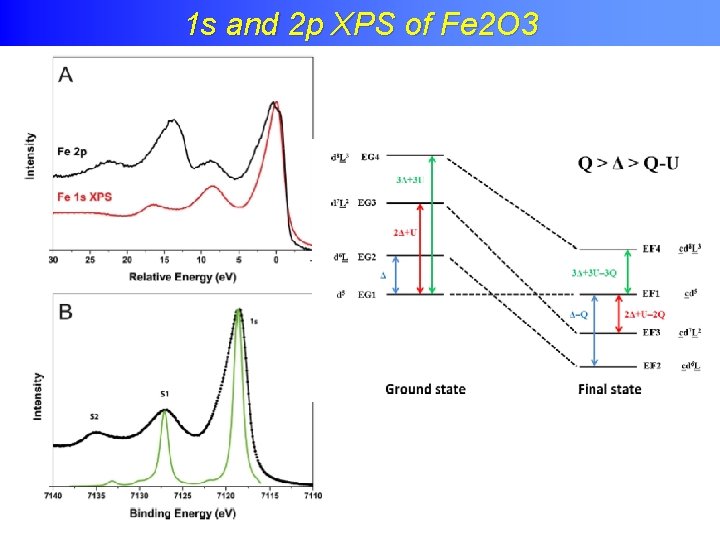
Charge transfer effects in XPS 1 s and 2 p XPS of Fe 2 O 3
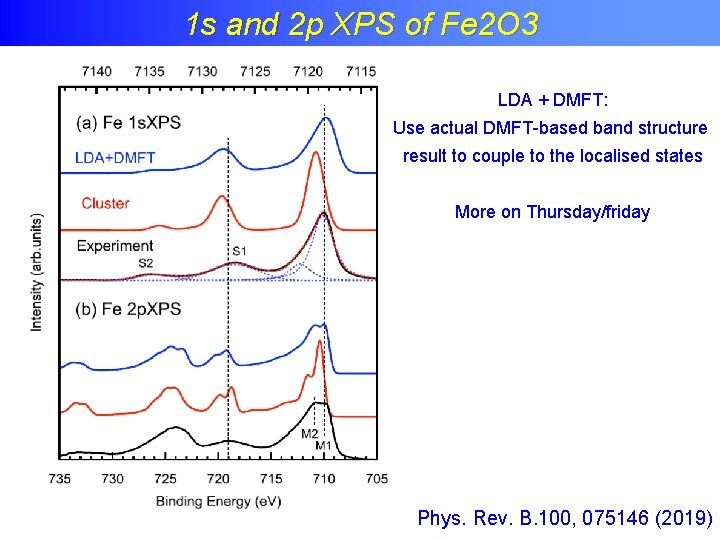
Charge transfer effects in XPS 1 s and 2 p XPS of Fe 2 O 3 LDA + DMFT: Use actual DMFT-based band structure result to couple to the localised states More on Thursday/friday Phys. Rev. B. 100, 075146 (2019)

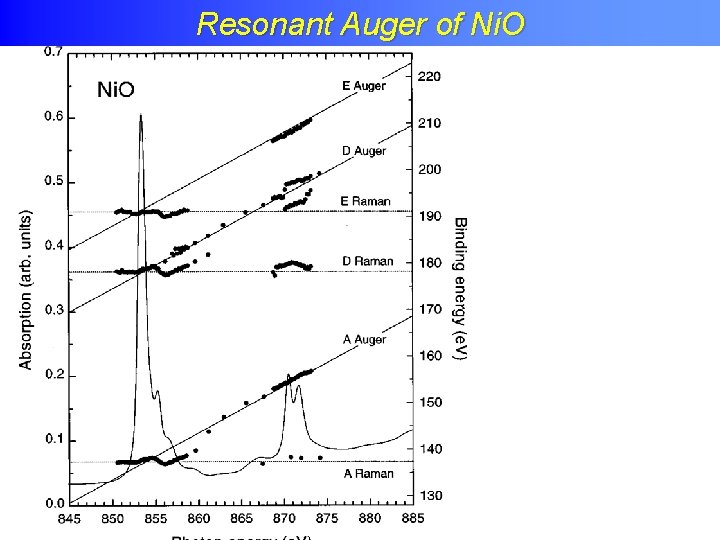
Resonant Auger of Ni. O
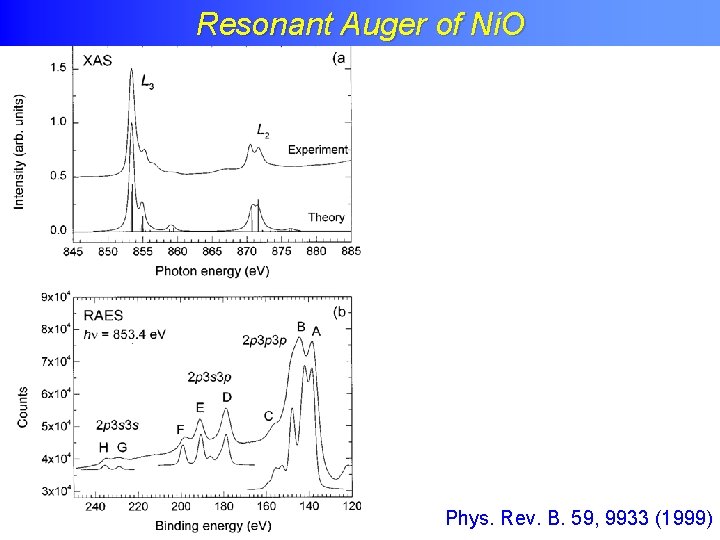
Resonant Auger of Ni. O Phys. Rev. B. 59, 9933 (1999)
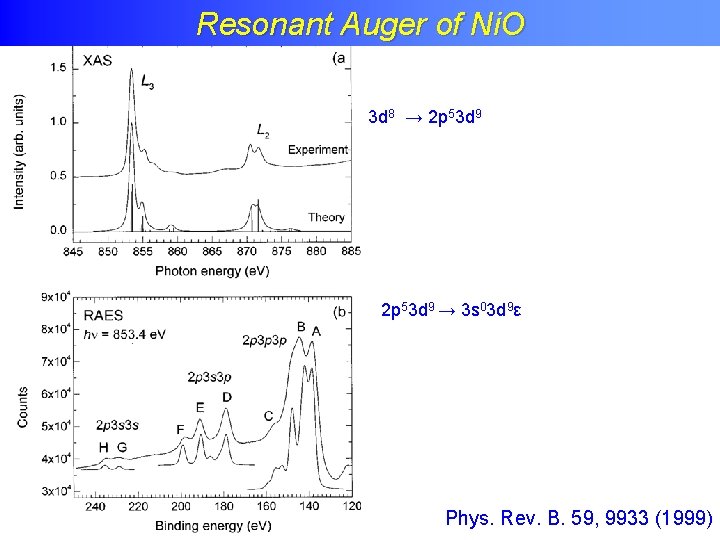
Resonant Auger of Ni. O 3 d 8 → 2 p 53 d 9 → 3 s 03 d 9ε Phys. Rev. B. 59, 9933 (1999)
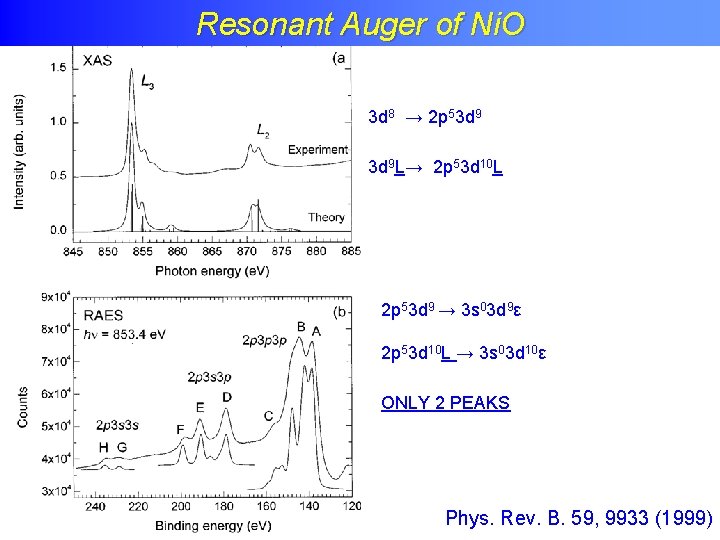
Resonant Auger of Ni. O 3 d 8 → 2 p 53 d 9 L→ 2 p 53 d 10 L 2 p 53 d 9 → 3 s 03 d 9ε 2 p 53 d 10 L → 3 s 03 d 10ε ONLY 2 PEAKS Phys. Rev. B. 59, 9933 (1999)
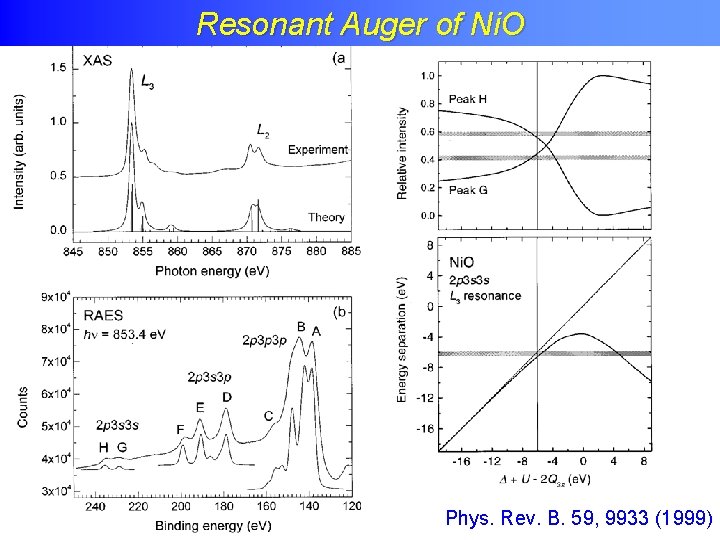
Resonant Auger of Ni. O Phys. Rev. B. 59, 9933 (1999)
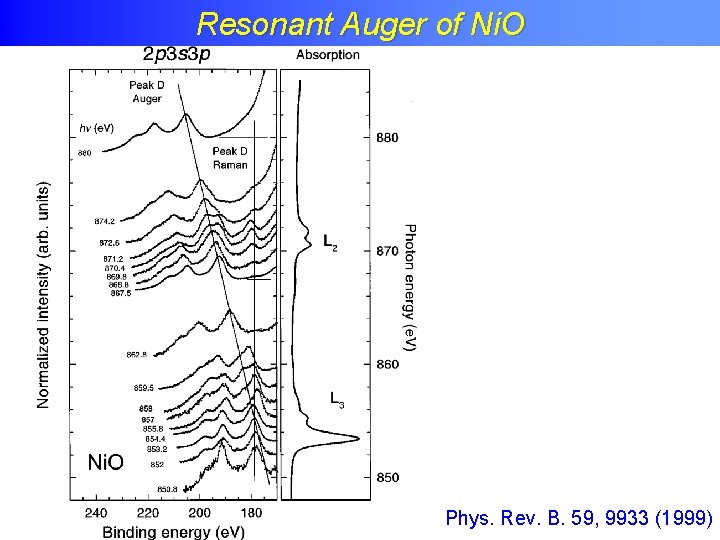
Resonant Auger of Ni. O Phys. Rev. B. 59, 9933 (1999)
Resonant Auger of Ni. O
- Slides: 92